Non-Stimulant Pump Pre-Workouts: What Works Without Caffeine
Non stim pre workout ingredients explained: citrulline, glycerol, Nitrosigine and beetroot nitrate, with what the research shows for late-night lifters.
TL;DR. The short answer
- L-citrulline (6-8 g of citrulline malate, 40-60 minutes before training) has the most lifting data of the stim-free pump ingredients, and the effect is small: about 3 extra reps across a workout in one meta-analysis.
- Nitrosigine widened blood vessels more than placebo in one 24-person trial (about 31% vs -2% change in flow-mediated dilation), but that is not the same as bigger muscles, more reps or a better pump.
- Glycerol powder holds extra water in the body. Its evidence is in endurance and heat, and I could not find lifting trials, so treat 'glycerol pumps' as a theory.
- Beetroot nitrate has mixed results in lifting: some studies show benefits, a 2026 trial in trained women found none. It can also lower blood pressure.
- Evening caffeine can reduce sleep efficiency, so a stimulant-free formula is a reasonable choice at 8pm. Just keep expectations modest.
Part of our complete guide: Creatine, Protein Powders, Pre-Workouts and Caffeine: The Science and Safety Guide
Table of contents
If you train at 8pm, you have probably stared at a tub of pre-workout wondering whether it will keep you awake till 2am. The good news is that non stim pre workout ingredients exist (see our guide to creatine, protein powders and caffeine for the wider picture), and one of them, L-citrulline, has real lifting research behind it. The honest part: the benefits are small, and some of the headline ingredients (Nitrosigine, glycerol) have very little direct evidence in lifters.
This guide focuses on the evening, stimulant-free corner of it: what each ingredient does, what the studies actually found, and a sensible way to test them.
What are non stim pre workout ingredients?
A “non-stim” or “pump” formula skips caffeine and other stimulants. Instead it leans on four main ideas:
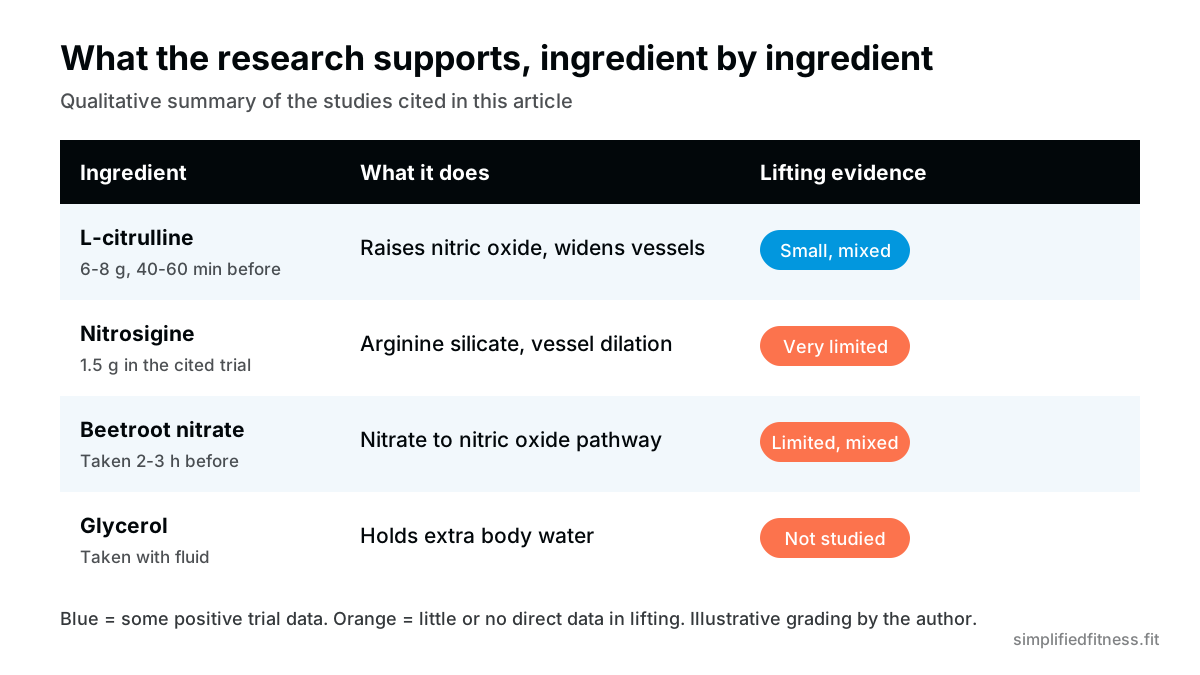
- L-citrulline (or citrulline malate): an amino acid that raises nitric oxide, a molecule that widens blood vessels.
- Nitrosigine: a branded form of arginine bonded to silicate and stabilized with inositol, also aimed at vessel dilation.
- Dietary nitrate (beetroot): nitrate that the body can convert into nitric oxide.
- Glycerol powder: a compound that helps the body hold more fluid.
Most of these are about blood flow or fluid, not energy. That is why they feel different from a caffeine-heavy product. You will not get the wired, focused kick. You might get a fuller feel in the muscle, and a lot of that depends on how you train.
Does L-citrulline work for pumps and reps?
It is the best-supported option, with a modest payoff.
A 2019 meta-analysis pooled 12 studies (198 participants) on citrulline and high-intensity strength and power performance. It found a small benefit over placebo, with a pooled standardized mean difference of 0.20 (95% CI 0.01-0.39). The authors noted that each individual study’s confidence interval crossed zero, so no single trial was convincing on its own (Trexler et al., 2019).
A 2021 meta-analysis looked specifically at repetitions to failure. Across eight double-blind studies (137 participants, mostly strength-trained), 6-8 g of citrulline malate taken 40-60 minutes before training added about 3 repetitions (roughly 6.4%) compared with placebo. The lower body showed a trend (8.1%, p = 0.051) while the upper body did not reach significance (Vårvik et al., 2021).
There is also a conflicting trial worth knowing about. In a 2023 study, 35 resistance-trained men and women took isolated citrulline malate (12 g), caffeine (5 mg/kg), both together, or placebo. Caffeine improved bench press 1RM and muscular endurance in squat and bench; citrulline malate alone had no ergogenic effect on any outcome, and adding it to caffeine gave no extra benefit (Haugen et al., 2023). Possible reasons for the mismatch include different test protocols, doses and participants. The practical takeaway: citrulline is a reasonable stim-free choice, but do not expect it to match caffeine.
If you want to dig into dose forms, see citrulline malate vs pure L-citrulline dosing.
Nitrosigine vs citrulline: which gives better blood flow?
Nitrosigine is the ingredient with the flashiest marketing and the thinnest lifting evidence.
In the main trial I could verify, 24 healthy, active young adults (16 men, 8 women) took Nitrosigine (1.5 g), citrulline malate (8 g) or a dextrose placebo on separate days. One hour later, flow-mediated dilation (a test of how well an artery widens) rose 31% with Nitrosigine and 34% with citrulline malate, versus a 2% decrease with placebo (Rogers et al., 2020).
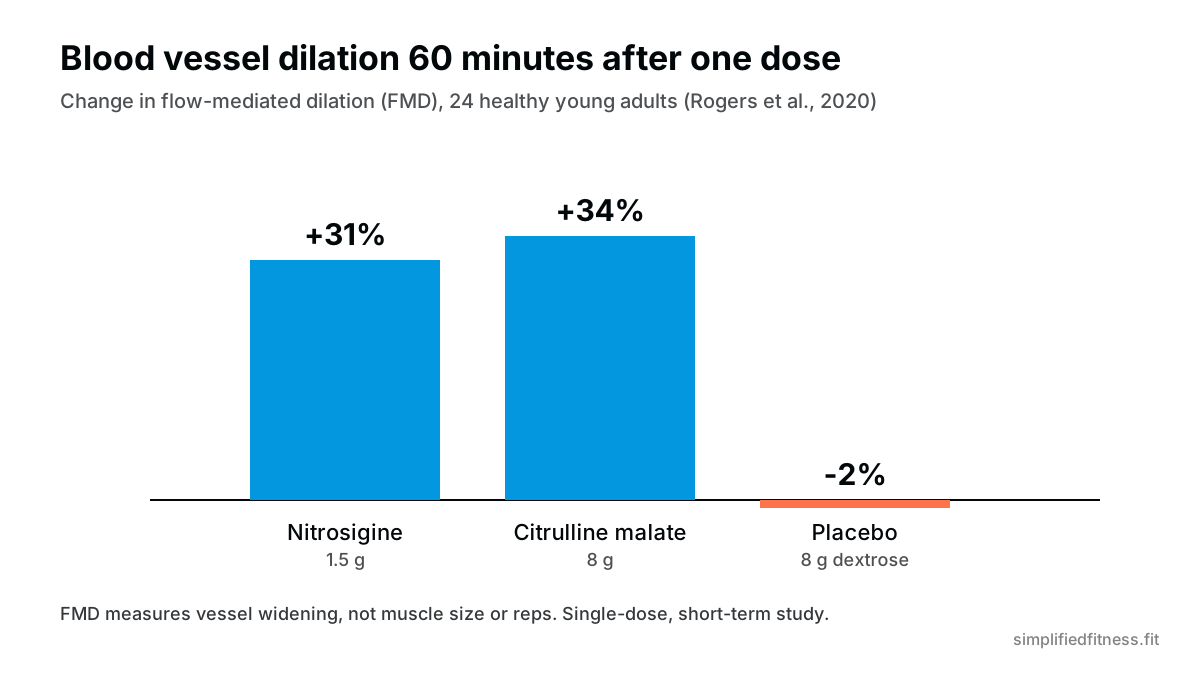
Read that carefully. It shows both ingredients can widen a blood vessel after a single dose. It does not show more reps, more strength, or bigger muscles. And it does not show Nitrosigine beats citrulline: the two numbers are close, and citrulline additionally has performance data. Much of the other Nitrosigine research I found looked at cognition, not training.
Can glycerol powder give you muscle pumps?
The theory sounds neat: glycerol makes the body hold more water, so muscles look fuller. But the research does not (yet) test that.
A review on glycerol hyperhydration found that glycerol-containing drinks can maintain hydration and may improve endurance performance, with gains such as up to 24% longer time to exhaustion in some studies. Other studies found no performance benefit. In a very small number of people, glycerol was linked to nausea, stomach discomfort, dizziness and headaches. The reviewers concluded the performance benefits are inconsistent (van Rosendal et al., 2009).
That evidence is about endurance exercise, hydration and heat. I did not find trials of glycerol in lifting, and I did not find any showing larger pumps. So glycerol is a “maybe”, mainly useful if you train in a hot gym and sweat heavily.
Glycerol protocols also involve drinking a large volume of water with it, and a lot of fluid close to bedtime can mean night-time bathroom trips. If sleep is the goal, glycerol is probably the last ingredient to add.
What about beetroot nitrate for lifting?
Beetroot is a food-based option that fits Indian kitchens easily (chukandar juice works, though the nitrate content varies by beet and batch, and trial doses came from standardized products).
A systematic review of dietary nitrate and weightlifting found only four studies. Two suggested benefits to bench press performance (mean power, velocity or reps to failure), and one saw more reps to failure in the back squat. The authors called the observations “encouraging” but said more research is needed (San Juan et al., 2020).
The picture is not all positive. A small number of newer studies have found little benefit, including a 2026 randomized crossover trial in 18 resistance-trained women. They took nitrate-rich beetroot juice (about 6.7 mmol nitrate) 2.5 hours before squats and bench press, and showed no benefit; one bench press power measure was actually lower than placebo (Brennan et al., 2026). Differences in sex, training status, dose and test choice may explain the mixed picture.
One more safety angle: beetroot nitrate is widely studied for lowering blood pressure. That can be fine for many people, but if you take blood pressure tablets or get dizzy on standing, talk to your doctor first.
Why go stim-free at night? What the sleep research says
You do not need a study to know caffeine can wreck your sleep, but the picture in athletes is more nuanced than “it always does.”
A 2025 systematic review with meta-analysis covered 10 studies (128 athletes) where caffeine was taken before late afternoon or evening training. It found a small reduction in sleep efficiency (mean difference -4.87%, 95% CI -7.45 to -2.29), but the result was not consistent in sensitivity analyses. Total sleep time showed a non-significant trend toward less sleep (about 32 minutes, p = 0.08). Athletes also reported feeling that their sleep was clearly worse, even when measurements did not always show it (Kocak et al., 2025). The authors urge caution because of the small number of studies and mostly male participants.
So the case for stim-free at 8pm is reasonable but not absolute. Caffeine can help performance, as the Haugen trial above shows, but if your sleep suffers, a stim-free routine is a fair trade. For sleep-friendly habits beyond supplements, see our sleep hygiene checklist for lifters. Not sure how much caffeine you are already getting from tea, coffee and cola? Try the caffeine dosage calculator.
A simple evening stim-free routine to test
If you want to try this, here is a conservative way to do it. It is an illustrative schedule, not a prescription.
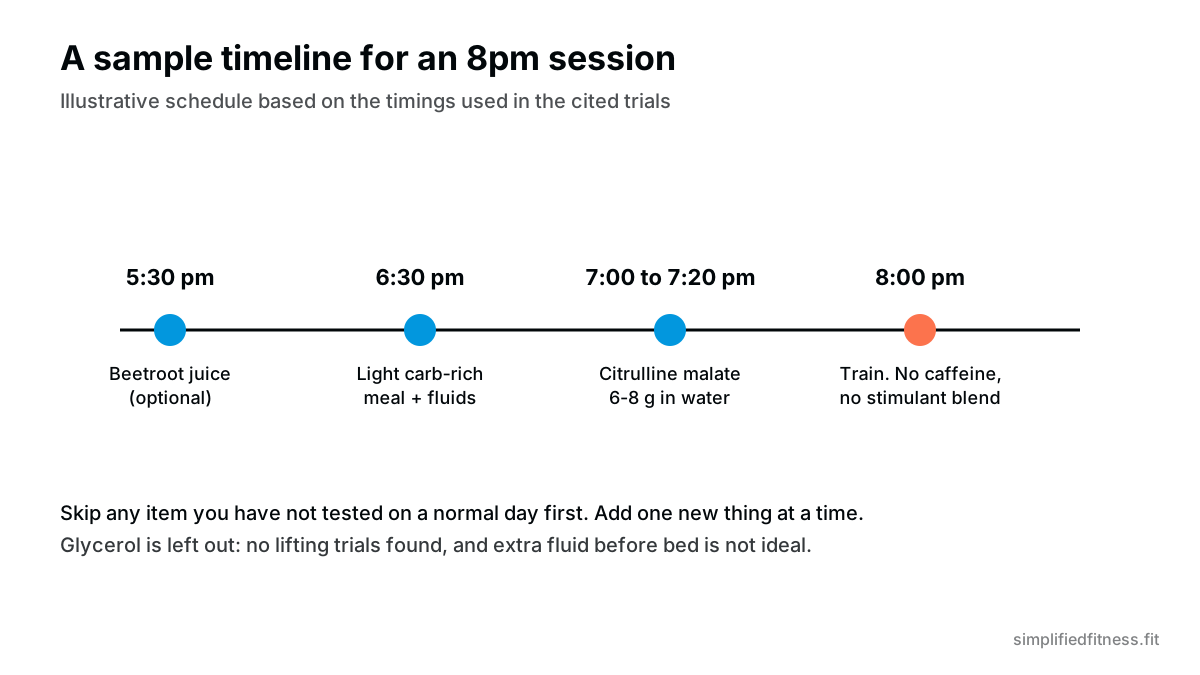
- Eat first. A light, carb-rich meal 1-3 hours before (roti or rice with dal, curd, or poha with peanuts) will do more for your lifts than any powder. Our pre-workout formulation guide covers dosing in more detail.
- Add citrulline malate. 6-8 g in water, 40-60 minutes before training.
- Judge it over 3-4 sessions. Note reps, how your muscles feel, stomach comfort and how you sleep.
- Only then consider a second ingredient (beetroot is the easier one to try).
- Check the label of any ready-made product. Many “pump” blends hide doses inside proprietary blends, so you cannot tell whether you are getting an effective amount.
On a budget, plain citrulline malate powder is usually cheaper per effective dose than a branded multi-ingredient tub. You can run the same session on a push day plan and compare how it feels with and without the powder.
Is training at night worse than training in the morning?
Not necessarily. Consistency matters more than clock time, which we cover in morning vs evening training adaptations. If 8pm is the time you reliably show up, a stim-free setup is a perfectly reasonable way to keep it.
When to see a doctor
Speak to a doctor before using any pre-workout ingredient if you:
- have heart disease, high or low blood pressure, kidney disease or diabetes,
- take blood pressure medication or other prescription drugs,
- are pregnant or breastfeeding,
- feel chest pain, palpitations or marked dizziness after any supplement.
Stop the product if you get ongoing stomach upset, severe headaches or dizziness.
Frequently Asked Questions
What is the best non stim pre workout?
There is no single best product, but citrulline malate at 6-8 g is the ingredient with the most supporting evidence for lifting. Meta-analyses show a small benefit for repetitions, not a dramatic one. Check the label for the actual dose, because many blends under-dose it.
Do stimulant-free pre-workouts actually work?
Partly. Citrulline has small positive effects in some trials and none in others, so results vary from person to person. The 'pump' you feel is also strongly shaped by sets, reps and rest times. Judge a product over a few weeks of normal training, not one session.
Nitrosigine vs citrulline: which is better for pumps?
Neither has been shown to be clearly better. In one randomized crossover trial, Nitrosigine (1.5 g) and citrulline malate (8 g) improved flow-mediated dilation by 31% and 34% versus a 2% drop on placebo. Because citrulline also has lifting-performance data and Nitrosigine mostly does not, citrulline is the safer first pick.
Does glycerol powder give you bigger muscle pumps?
It is not proven. Glycerol helps the body hold on to extra fluid, and studies on it mostly involve endurance exercise and heat, not lifting. If you try it, follow the label and test it on a non-training day first because nausea and headaches can occur.
Does beetroot juice help with muscle pumps or strength?
Evidence is mixed. A systematic review of four weightlifting studies found some improvements in power or reps to failure, while a 2026 trial in resistance-trained women found no benefit and slightly lower power in one test. Beetroot nitrate may also lower blood pressure, so people on blood pressure medication should ask a doctor first.
Can I take citrulline at night without ruining sleep?
Citrulline is not a stimulant, so it does not act on the same alertness pathways as caffeine. I did not find sleep trials of citrulline in the studies reviewed here, so test your own response. Take it 40-60 minutes before training and note how you sleep.
Does evening caffeine really hurt sleep?
It can. A 2025 meta-analysis of 10 studies in athletes found a small drop in sleep efficiency (about 4.9 percentage points) after evening caffeine, though the result was not consistent, and athletes reported feeling worse sleep than the devices measured. If you notice trouble falling asleep, move to stim-free for sessions after about 5pm.
Can I stack citrulline, Nitrosigine and glycerol together?
There is no research testing that exact stack, so the benefit is unknown. Stacking also multiplies the chance of stomach upset. Add one ingredient at a time so you can tell what is helping.
What dose of citrulline malate should I use?
Trials in the 2021 meta-analysis used 6-8 g of citrulline malate taken 40-60 minutes before exercise. Mix it in water and sip it, since large doses can sit heavily in the stomach. You can compare it with pure citrulline in our guide to [citrulline malate vs pure L-citrulline dosing](/blog/citrulline-malate-vs-pure-l-citrulline-dosing-pumps).
Is a pump a sign of muscle growth?
Not by itself. A pump is temporary swelling from blood and fluid in the muscle, and it fades within hours. Growth depends on training volume, effort and recovery over months.
Are non-stim pre-workouts safe?
For most healthy adults, standard doses of these ingredients appear well tolerated in short trials, but long-term data in lifters are limited. Side effects mentioned in the research include stomach upset, nausea and headaches with glycerol, and lower blood pressure with beetroot. See a doctor first if you have heart, kidney or blood pressure conditions, or if you are pregnant.
Do I need a pre-workout at all?
No. A carb-rich meal 1-3 hours before training, enough water and decent sleep matter more than any pump powder. Supplements are a small extra on top of that base.
Sources & References
Every claim above is checked against peer-reviewed research (PubMed, U.S. National Library of Medicine) or guidance from established health bodies. How we fact-check.
- Rogers JM, et al. Acute effects of Nitrosigine and citrulline malate on vasodilation in young adults. J Int Soc Sports Nutr. 2020. PMID: 32093766
- Trexler ET, et al. Acute effects of citrulline supplementation on high-intensity strength and power performance: a systematic review and meta-analysis. Sports Med. 2019. PMID: 30895562
- Varvik FT, et al. Acute effect of citrulline malate on repetition performance during strength training: a systematic review and meta-analysis. Int J Sport Nutr Exerc Metab. 2021. PMID: 34010809
- Haugen ME, et al. Effect of isolated and combined ingestion of caffeine and citrulline malate on resistance exercise and jumping performance: a randomized double-blind placebo-controlled crossover study. Eur J Nutr. 2023. PMID: 37450275
- van Rosendal SP, et al. Physiological and performance effects of glycerol hyperhydration and rehydration. Nutr Rev. 2009. PMID: 19941615
- San Juan AF, et al. Effects of dietary nitrate supplementation on weightlifting exercise performance in healthy adults: a systematic review. Nutrients. 2020. PMID: 32722588
- Brennan SN, et al. Dietary nitrate supplementation does not improve resistance exercise performance in resistance-trained women. Eur J Appl Physiol. 2026. PMID: 41931137
- Kocak A, et al. The effect of consuming caffeine before late afternoon/evening training or competition on sleep: a systematic review with meta-analysis. Sports (Basel). 2025. PMID: 41003623

Umair Hazrami · Founder & Head Coach, Simplified Fitness
Umair Hazrami founded Simplified Fitness and the Simplified Lifter channel to cut through fitness noise. With 4+ years of consistent training and 10+ coaching clients, he writes every guide from the peer-reviewed research and links the sources so you can check them. Our editorial standards.
Educational content only, not medical advice. If you have a medical condition, are pregnant, or take medication, talk to a qualified doctor before changing your diet, supplements or training. Full disclaimer.
Keep reading
Supplements
Alpha-GPC and Huperzine A Pre-Workout: Do Cholinergic Nootropics Help Lifting?
Does an alpha GPC pre workout add power or focus? See what small trials found, why Huperzine A is a poor lifting bet, and the safety flags to know first.
10 min read
Supplements
The Antioxidant Paradox: Can Vitamin C and E Pills Blunt Muscle Growth and Endurance?
Does vitamin C blunt muscle growth? See what trials of 1000 mg vitamin C plus E found for strength, hypertrophy and endurance, and when pills are worth taking.
8 min read
Supplements
Caffeine Powder vs Coffee Before Lifting: Does the Source Really Matter?
Caffeine anhydrous vs coffee for lifting: what research says on absorption speed, peak levels and stomach upset, and whether pills beat your daily cup.
7 min read

Supplements
Caffeine Dosing for Strength and Power: 3-6 mg/kg and When to Take It
Caffeine dosage for strength is 3-6 mg/kg, about 210-420 mg for a 70 kg lifter, taken around 60 minutes before training. Doses, timing and when to stop.
8 min read