Pre-Workout Side Effects Fixes: Jitters, Stomach Cramps, Palpitations and the Crash
Pre workout side effects fixes for jitters, stomach cramps, a racing heart and the crash. Find your trigger and the exact change to make, with the evidence.

TL;DR. The short answer
- Most pre-workout jitters and a racing heart come from too much caffeine in one hit. A systematic review of athletes found tachycardia and heart palpitations were among the most common side effects, and a dose near 3 mg/kg had the lowest side-effect burden.
- Stomach cramps and diarrhea usually point to a concentrated dose on an empty stomach. Eat a small carb snack first, mix the scoop in more water, and check the label for sugar alcohols or magnesium.
- Tingling or itchy skin is beta-alanine paresthesia. It is harmless in healthy people and eases with smaller divided doses of about 1.6 g or a sustained-release version.
- The crash is mostly caffeine fading plus poor sleep. Use a lower dose, take it earlier, and stop caffeine at least 6 hours before bed.
- Chest pain, fainting, or a heartbeat that stays irregular after the product wears off needs a doctor, not a new product.
Part of our complete guide: Creatine, Protein Powders, Pre-Workouts and Caffeine: The Science and Safety Guide
Table of contents
If your pre-workout makes your heart pound, your stomach cramp or your skin tingle, the product is rarely “bad”. Most pre workout side effects fixes come down to four levers: a smaller dose, food in your stomach, more water in the shaker, and an ingredient swap. This article helps you work out which lever applies to you. For the wider picture on caffeine, creatine and protein, see our complete guide to creatine, protein powders and caffeine.
Quick warning first. Some symptoms are not a “fix it yourself” job. We cover those near the end.
The four pre-workout side effects and what causes each
Almost every complaint falls into one of four buckets, and each has a different cause. Treating them all the same way is the most common mistake here.
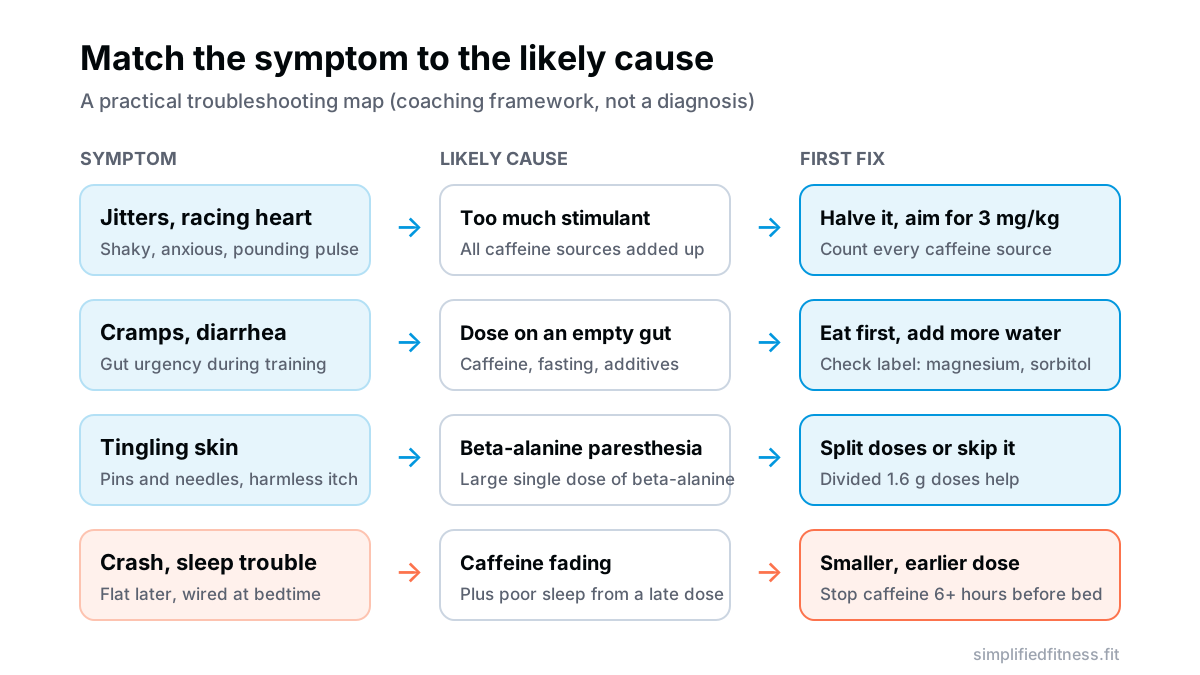
Keep one rule in mind. Change one variable per session. Halve the dose, or eat first, or switch brands. Not all three.
Why does pre-workout give me jitters and a racing heart?
Caffeine is the main driver. It is also the main reason pre-workouts work, so this is a dose problem rather than a “stop everything” problem.
A 2022 systematic review pooled 25 studies and 421 athletes and found that caffeine produced more of every side effect studied than placebo. Reported prevalence was 6-34% at low doses (3.0 mg/kg or less), 0-34% at moderate doses (3.1-6.0 mg/kg) and 8-83% at high doses (6.1 mg/kg or more). Tachycardia and heart palpitations, along with worse sleep onset, had the highest prevalence and magnitude (de Souza et al., 2022). The authors concluded that about 3.0 mg/kg may be the best trade-off between benefit and side effects.
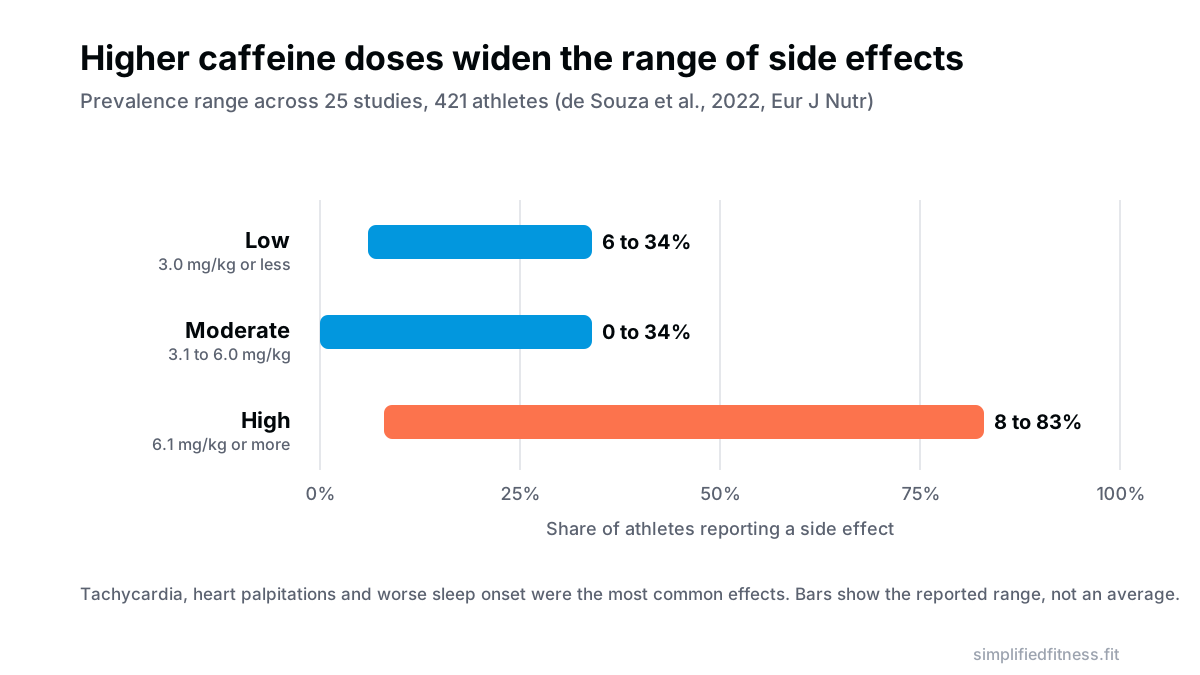
Those numbers come from a mixed pool of small studies, so treat the ranges as direction, not precision.
The ISSN position stand agrees on the dose side. Caffeine reliably helps at 3-6 mg/kg, a minimum effective dose may be as low as 2 mg/kg, and very high doses (such as 9 mg/kg) bring a high incidence of side effects without being needed. It also says individual differences in anxiety and sleep effects may relate to genetics of caffeine metabolism and to how much caffeine you normally have (Guest et al., 2021).
So why do two lifters react so differently to the same scoop? Probably body weight, habitual intake and genetics. A person who never drinks tea or coffee and takes a 300 mg scoop is a very different case from a daily chai drinker.
Check your real caffeine total
This is where lifters get caught. The scoop is one source. Your morning coffee, a cola, green tea extract and an “energy” ingredient like guarana all count. The ISSN energy drink statement warns that indiscriminate use, especially several servings a day or with other caffeinated drinks and foods, may lead to adverse effects (Jagim et al., 2023).
What about stacked stimulants?
Some products add other stimulants on top of caffeine. Labels often hide exact amounts behind a “proprietary blend”. A 2013 pharmacy review noted that pre-workouts are unregulated, labels usually do not disclose all ingredients or their precise amounts, and reported adverse effects include gastrointestinal symptoms, cardiac arrhythmia and blood pressure increases, with the safety of these products possibly compromised when people take more than recommended or use more than one product (Eudy et al., 2013).
If you feel anxious or jittery on a blend but fine on coffee, a stacked stimulant is a reasonable suspect. I cannot tell you which one from here, because that review does not break it down by ingredient. Switching to a product that lists every dose, or to plain caffeine, is the clean test.
Pre-workout stomach ache and diarrhea: how to fix it
Gut trouble is another frequent complaint, and it has more than one possible cause.
A 2022 review of supplements and the athlete’s gut lists caffeine as an evidence-based supplement that can trigger gastrointestinal symptoms. It suggests keeping to low-to-moderate doses (under 500 mg) and avoiding things that worsen it, including stress, anxiety, other stimulants and fasting (Wilson, 2022).
That fits the common gym pattern: a big scoop, a dry shaker, an empty stomach at 6 am, and a dash to the toilet halfway through your warm-up.
Other causes are plausible but less well studied. Concentrated powders, magnesium salts, sugar alcohols and some salt-heavy formulas may draw water into the gut. I could not find direct trials on this for pre-workouts, so treat it as a coaching pattern, not proven mechanism.
Here is the order I would try things in:
- Eat something small first. A banana, a slice of toast, a few dates, or half a roti with curd about 30-60 minutes before.
- Use more water. Mix the dose in 400-500 ml instead of 150 ml. A harsh, concentrated drink is more likely to upset you.
- Drop the dose. Half a scoop for a week.
- Read the label. Look for sorbitol, xylitol, magnesium or a long list of “blends”.
- Test plain caffeine. A cup of coffee or a caffeine capsule at your target dose isolates caffeine from everything else in the tub.
In a hot Indian summer, also check how much you drink across the day. Training dehydrated can make nausea worse, though I would not blame pre-workout for what a poor hydration day started.
Why does my face tingle? Beta-alanine explained
If your face, neck or hands tingle a few minutes after drinking it and then fade, that is very likely beta-alanine.
The ISSN position stand says beta-alanine appears safe in healthy populations at recommended doses, that the only reported side effect is paraesthesia (tingling), and that studies indicate it can be reduced with divided lower doses (1.6 g) or a sustained-release formula (Trexler et al., 2015).
Here is the thing: the tingle is a nuisance, not a danger. And beta-alanine works through a build-up over weeks, so a single big scoop before training is not how it delivers benefit. The same position stand says 4-6 g daily for at least 2-4 weeks improves performance, mainly in efforts lasting 1-4 minutes. For heavy sets of 5-10 reps, evidence is much thinner, and the ISSN calls for more research on strength.
If it bothers you, you have two options. Choose a product without beta-alanine, or take it as a separate small dose through the day. Most people do not need it for lifting.
How to prevent the pre-workout crash
The crash is the most misunderstood problem. It usually has two parts: the caffeine wearing off, and the sleep you lost because of it.
I could not find a trial that studied “pre-workout crash” itself, so treat the following as a reasoned explanation, not a measured finding. Caffeine masks tiredness. When it fades, the tiredness you were holding off can arrive in a lump. Add a short night and the next session feels worse, so you take more, and the loop tightens.
The sleep part is better supported. A randomized trial gave people 400 mg of caffeine at bedtime, 3 hours before, or 6 hours before bed. All three significantly disrupted sleep compared with placebo, and the authors supported advice to avoid substantial caffeine for at least 6 hours before bedtime (Drake et al., 2013). That was 400 mg, a bigger dose than many lifters take, so a smaller serving may be gentler. But 400 mg is not far from some “double scoop” habits.
To soften the crash:
- Lower the dose. The lowest effective dose gives less to fall from.
- Move it earlier. Evening session at 8 pm? Stimulant-free is the safer call.
- Eat after training. Low blood sugar and low energy intake feel like a crash too. A proper meal with protein and carbs, such as dal, rice and paneer, helps.
- Skip the sugar-heavy mixers. Some people find a big sugar hit followed by a dip feels like a crash of its own.
- Do not stack a second dose to rescue the afternoon.
If you still want a lift without the stimulant side, see our guide to non-stimulant pump pre-workouts.
Do pre-workouts even work well enough to bother?
Fair question. Caffeine has the best evidence by far. A 2018 meta-analysis found caffeine improved maximal strength (SMD 0.20) and muscle power (SMD 0.17), with upper-body strength improving (SMD 0.21) and lower-body strength not reaching significance. The effects were small (Grgic et al., 2018).
So the realistic benefit is a small edge, not a transformation. If side effects are making you miserable, a lower dose or a plain coffee is an easy trade. We compare the ingredients properly in our pre-workout formulation science guide, and our article on caffeine for strength and power covers dosing in detail. If your caffeine source is the question, see anhydrous vs natural caffeine.
A simple troubleshooting plan
Run this for two weeks:
| Week | What to change | What to watch |
|---|---|---|
| 1 | Half the scoop, with a small carb snack and 400-500 ml water | Heart rate, shakiness, gut |
| 2 | If still unwell, switch to plain coffee or caffeine at about 3 mg/kg | Whether symptoms vanish |
| Any time | Stop caffeine at least 6 hours before bed | Sleep and next-day energy |
If symptoms go away on plain caffeine, your old formula had something else in it that you did not tolerate. If symptoms persist on plain caffeine at a modest dose, you may simply be caffeine sensitive. The ISSN energy drink position stand says caffeinated energy products are not recommended for people who are sensitive to caffeine (Jagim et al., 2023).
When to see a doctor
Side effects that fade as the product wears off are one thing. Stop using it and get medical advice if you have:
- chest pain or tightness
- fainting or near-fainting
- palpitations that continue after the product has worn off, or an irregular heartbeat
- shortness of breath that is out of proportion to the workout
- known heart, blood pressure, thyroid, liver or kidney conditions, or you are pregnant or breastfeeding, before using any stimulant product
This article is general education, not a diagnosis. If something feels wrong, trust that feeling over any tub label.
The bottom line
Most pre-workout side effects have boring, fixable causes: too much caffeine, an empty stomach, a hidden ingredient, or a bedtime that got too close. Lower the dose, eat first, drink more water with it and stop caffeine at least 6 hours before bed. Change one thing at a time.
And remember what the evidence says about the payoff. The benefit is small. If a product makes you feel awful, you lose very little by switching to coffee and putting your energy into the programme itself. Our free push, pull and legs plans are a good place to start, and our protein calculator will sort the food side.
Frequently Asked Questions
Why does pre-workout make my heart race?
The most common cause is caffeine, often at a dose bigger than your body is used to. A 2022 systematic review of athletes found tachycardia and heart palpitations were among the most prevalent caffeine side effects, especially at higher doses. Halve the scoop next time and keep total daily caffeine in mind.
Is it normal to get jitters from pre-workout?
Yes, mild jitters are common, particularly with high doses or if you rarely have caffeine. Response varies between people, and the ISSN notes that genetics and habitual intake help explain why. Try a dose closer to 3 mg/kg of body weight and see if the shakiness fades.
Why does pre-workout give me stomach pain or diarrhea?
A concentrated powder on an empty stomach is the usual culprit. Caffeine is an evidence-based trigger of gut symptoms, and a 2022 review lists fasting, stress and other stimulants as things that make it worse. Eat a small carb snack beforehand and dissolve the powder in more water.
Can pre-workout cause diarrhea even at a normal dose?
It can if the formula contains ingredients that loosen the gut, such as sugar alcohols or magnesium salts. There is little direct research on this for pre-workouts, so treat it as a practical pattern rather than a proven mechanism. Read the label, then try a plain caffeine option to see if the problem disappears.
Why does my face tingle after pre-workout?
That tingling is usually beta-alanine paresthesia, a harmless pins-and-needles feeling. The ISSN position stand says it is the only reported side effect of beta-alanine and can be reduced with divided doses of about 1.6 g or a sustained-release formula. If it bothers you, choose a product without beta-alanine.
Why do I crash after pre-workout?
The energy lift comes from caffeine blocking tiredness signals, so when the effect fades you can feel flatter than before. Poor sleep from a late or large dose makes the next day worse. Lower the dose, take it earlier, and eat a proper meal after training.
How long before bed should I stop taking caffeine?
At least 6 hours is a sensible minimum. In a randomized trial, 400 mg of caffeine taken even 6 hours before bedtime significantly disrupted sleep compared with placebo. If you train in the evening, use a stimulant-free pre-workout.
How much caffeine is too much in a pre-workout?
Performance benefits are well supported at 3-6 mg/kg, and the ISSN says very high doses such as 9 mg/kg bring a high rate of side effects without being needed. For a 70 kg lifter, 3 mg/kg is about 210 mg. Use our caffeine dosage calculator to get your own number.
Can pre-workout cause heart palpitations or arrhythmia?
Palpitations are a documented side effect of caffeine in athletes, and a pharmacy review of pre-workout ingredients also lists cardiac arrhythmia and blood pressure increases among reported adverse effects. Healthy people often get short-lived palpitations at high doses, but the evidence on serious events is limited. If you have chest pain, fainting or palpitations that persist, stop and see a doctor.
Is it safe to take pre-workout on an empty stomach?
It is not dangerous for most healthy people, but it raises the odds of nausea, cramps and urgency. Fasting is named as an exacerbating factor for caffeine-related gut symptoms. A banana, a roti with curd or a few dates 30-60 minutes earlier usually helps.
Should I stop using pre-workout if I get side effects?
You do not have to quit, but you should change something. Lower the dose, check the ingredient list for stacked stimulants, and adjust timing before deciding the product is the problem. If symptoms are severe or do not settle, stop and speak to a doctor.
Is pre-workout worth it, or is coffee enough?
For most lifters, caffeine does the heavy lifting. A 2018 meta-analysis found small improvements in strength (SMD 0.20) and power (SMD 0.17) from caffeine, and other ingredients have weaker evidence. Coffee or a plain caffeine tablet, dosed by body weight, is cheaper, and a tablet is the easiest to dose precisely.
Who should avoid pre-workout supplements?
The ISSN position stand on energy drinks, the closest official guidance, says these caffeinated products are not recommended for children, people who are pregnant, trying to become pregnant or breastfeeding, or people sensitive to caffeine. It advises people with heart, metabolic, liver, kidney or neurologic disease who take medication to check with their doctor first, and teenagers to be cautious, especially with high doses. If any of these apply, ask your doctor before using a pre-workout.
Sources & References
Every claim above is checked against peer-reviewed research (PubMed, U.S. National Library of Medicine) or guidance from established health bodies. How we fact-check.
- de Souza JG, et al. Risk or benefit? Side effects of caffeine supplementation in sport: a systematic review. Eur J Nutr. 2022. PMID: 35380245
- Guest NS, et al. International society of sports nutrition position stand: caffeine and exercise performance. J Int Soc Sports Nutr. 2021. PMID: 33388079
- Trexler ET, et al. International society of sports nutrition position stand: Beta-Alanine. J Int Soc Sports Nutr. 2015. PMID: 26175657
- Eudy AE, et al. Efficacy and safety of ingredients found in preworkout supplements. Am J Health Syst Pharm. 2013. PMID: 23515510
- Wilson P. Sport Supplements and the Athlete's Gut: A Review. Int J Sports Med. 2022. PMID: 34814219
- Drake C, et al. Caffeine effects on sleep taken 0, 3, or 6 hours before going to bed. J Clin Sleep Med. 2013. PMID: 24235903
- Grgic J, et al. Effects of caffeine intake on muscle strength and power: a systematic review and meta-analysis. J Int Soc Sports Nutr. 2018. PMID: 29527137
- Jagim AR, et al. International society of sports nutrition position stand: energy drinks and energy shots. J Int Soc Sports Nutr. 2023. PMID: 36862943

Umair Hazrami · Founder & Head Coach, Simplified Fitness
Umair Hazrami founded Simplified Fitness and the Simplified Lifter channel to cut through fitness noise. With 4+ years of consistent training and 10+ coaching clients, he writes every guide from the peer-reviewed research and links the sources so you can check them. Our editorial standards.
Educational content only, not medical advice. If you have a medical condition, are pregnant, or take medication, talk to a qualified doctor before changing your diet, supplements or training. Full disclaimer.
Keep reading
Supplements
Alpha-GPC and Huperzine A Pre-Workout: Do Cholinergic Nootropics Help Lifting?
Does an alpha GPC pre workout add power or focus? See what small trials found, why Huperzine A is a poor lifting bet, and the safety flags to know first.
10 min read

Supplements
The Antioxidant Paradox: Can Vitamin C and E Pills Blunt Muscle Growth and Endurance?
Does vitamin C blunt muscle growth? See what trials of 1000 mg vitamin C plus E found for strength, hypertrophy and endurance, and when pills are worth taking.
8 min read

Supplements
Caffeine Powder vs Coffee Before Lifting: Does the Source Really Matter?
Caffeine anhydrous vs coffee for lifting: what research says on absorption speed, peak levels and stomach upset, and whether pills beat your daily cup.
7 min read

Supplements
Caffeine Dosing for Strength and Power: 3-6 mg/kg and When to Take It
Caffeine dosage for strength is 3-6 mg/kg, about 210-420 mg for a 70 kg lifter, taken around 60 minutes before training. Doses, timing and when to stop.
8 min read