CoQ10 (Ubiquinol) for Athletes: Statin Muscle Pain, Performance and Where It Falls Short
CoQ10 for athletes: does ubiquinol boost endurance or recovery, and can it ease statin muscle aches? What the trials show, who it suits and how to dose it.
TL;DR. The short answer
- CoQ10 reliably raises blood CoQ10 levels, but in healthy adults its effect on exercise performance is small and inconsistent, and the 2025 meta-analysis rated certainty as very low to low.
- For statin muscle aches the trials disagree: a 2025 meta-analysis found a small pain reduction, while a 2020 meta-analysis found no benefit over placebo. Treat it as a possible, unproven option and talk to your doctor before changing statins.
- Ubiquinol is the reduced form of CoQ10 and appears to be absorbed better than ubiquinone in lab work, but there is no good evidence yet that it improves gym results.
- Studies have used 100-600 mg a day. Taking it with a meal that contains fat is a sensible habit, since CoQ10 is fat soluble.
- If you are young and healthy, skip it and spend the money on food. A trial makes more sense for older lifters (the one HIIT trial was in 65 to 75 year olds) or statin users, after speaking to their doctor.
Part of our complete guide: Creatine, Protein Powders, Pre-Workouts and Caffeine: The Science and Safety Guide
Table of contents
CoQ10 for athletes is a case of a molecule that matters a lot inside your cells and a supplement that matters much less in your training. In healthy adults, taking more of it raises blood levels but gives small, inconsistent performance effects. For statin muscle aches, the trials disagree. That is the honest summary.
It sits in the “secondary supplements” tier of our complete guide to creatine, protein powders and caffeine, well behind the basics. Here is where it earns a place, where it does not, and how to test it sensibly if you are curious.
What does CoQ10 actually do in your muscles?
Coenzyme Q10 (also called ubiquinone in its oxidized form) lives in the inner membrane of your mitochondria. Its job is to shuttle electrons between the complexes of the electron transport chain, from complexes I and II toward complex III, so the cell can make ATP. It also acts as an antioxidant in membranes.
Your body makes it. You also get a little from meat, fish and oils.
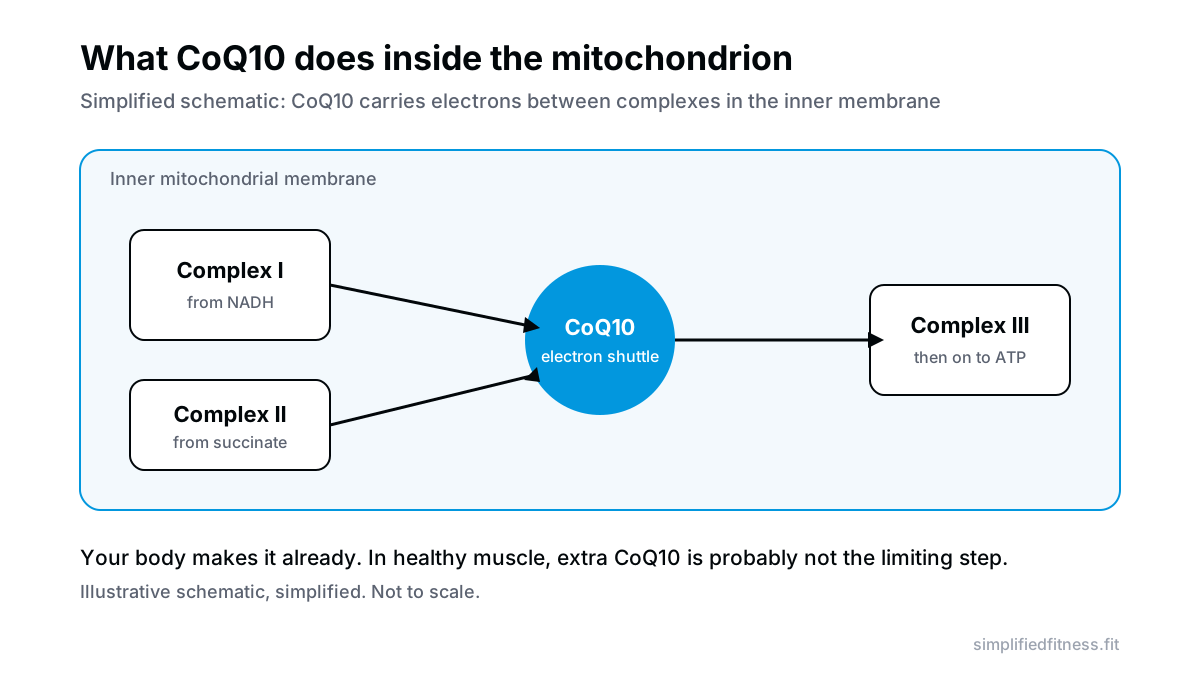
Here is the logic error behind most CoQ10 marketing. “Essential for energy production” sounds like “more equals more energy.” But a car needs oil, and pouring extra oil into a full engine does not add horsepower. If your muscle already has enough CoQ10 to run the chain, a capsule has little left to fix.
Does CoQ10 improve athletic performance or endurance?
Mostly no, with a few asterisks.
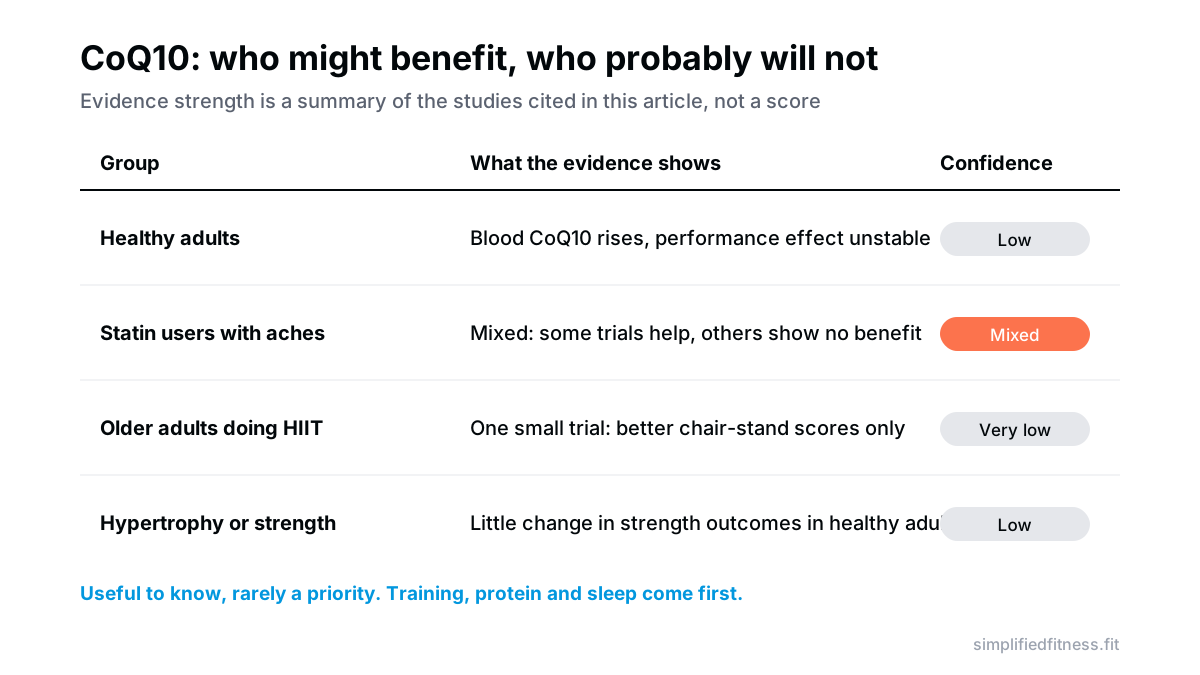
A 2025 systematic review and meta-analysis pooled 24 studies in healthy adults. Supplementation consistently raised blood CoQ10, so your body does respond to the capsule. Performance effects were another matter: small and inconsistent. Chronic use showed a small benefit in the primary analysis, but after excluding outliers it was no longer stable. Acute (single dose) use showed no benefit. Aerobic endurance became borderline after outlier exclusion, while anaerobic and strength outcomes barely moved. The authors rated certainty as very low to low, and found no stable dose-response pattern (Deng et al., 2025).
An older randomized trial gives a feel for why the picture is blurry. In 41 trained and untrained adults, 14 days of CoQ10 raised plasma levels significantly and showed only a trend (p = 0.06) toward longer time to exhaustion (Cooke et al., 2008). A trend is not a result.
If endurance is your goal, the proven levers are boring and free: consistent aerobic base work (see zone 2 cardio for lifters) and enough total training.
Can CoQ10 help with statin muscle pain?
This is the one place CoQ10 gets real attention, and it is also where the evidence is most contested.
Statins are widely prescribed to lower cholesterol, and statin-associated muscle symptoms (SAMS) are a common reason people stop taking them. The theory is neat: statins block the pathway that also makes CoQ10, so supplementing should fix the aches.
What the “it helps” side found. A 2025 meta-analysis of 7 randomized trials (389 patients, 100-600 mg a day for 30-90 days) found a significant reduction in muscle pain, with a weighted mean difference of -0.96 (95% CI -1.88 to -0.03). Four trials showed a significant reduction and three showed none. The authors concluded that more research is needed before firm recommendations (Kovacic et al., 2025).
What the “it does not” side found. A 2020 meta-analysis of 7 trials (321 patients) found no benefit over placebo for myalgia (WMD -0.42, 95% CI -1.47 to 0.62), and no improvement in the proportion of people staying on their statin. Only two of the included studies showed a positive effect (Kennedy et al., 2020).
A well-designed single trial points the same way. Taylor and colleagues first confirmed statin myalgia with a blinded statin-versus-placebo crossover, then gave 41 affected people 600 mg a day of ubiquinol or placebo for 8 weeks. Pain scores rose on the statin regardless of CoQ10, and there were no changes in muscle strength or VO2max (Taylor et al., 2015).
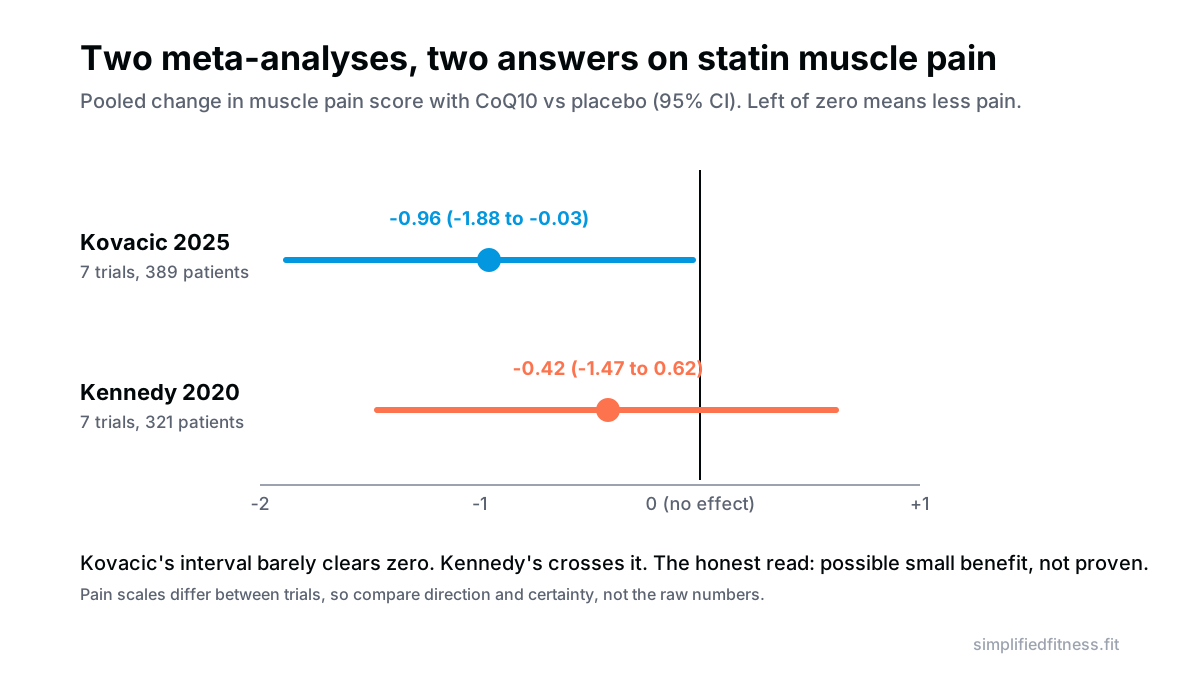
Why might these disagree? The trials are small (35 to 76 people each), short, use different pain scales and different doses, and enroll people with different definitions of statin myalgia. Taylor’s trial hints at another issue: only 36% of people who complained of statin myalgia actually developed symptoms in a blinded statin-versus-placebo test, so some of the “statin pain” in unblinded studies may not be caused by the statin at all.
There is also a mechanism wrinkle. In the LIFESTAT study of people on simvastatin, muscle CoQ10 concentration was comparable between those with myalgia, those without, and untreated controls. Statin therapy did appear to impair complex II-linked respiration, but myalgia was not tied to lower muscle CoQ10 (Dohlmann et al., 2019). So “statins deplete CoQ10, therefore supplement it” is not as tidy as it sounds.
Ubiquinol vs ubiquinone: does the form matter?
Ubiquinone is the oxidized form most older studies used. Ubiquinol is the reduced form, and it is what sells at a premium. Your body interconverts the two.
The absorption story favors ubiquinol, with caveats. In a lab digestion and cell model, ubiquinol was incorporated into micelles more efficiently and absorbed more readily than ubiquinone (Failla et al., 2014). That is a cell model, not a human trial. Absorption is not the same as results, and I am leaning on a cell model here, so hold that loosely.
What is missing is the link to results. I could find no trial showing that ubiquinol builds more muscle or improves performance than ubiquinone in healthy lifters. Taylor’s statin trial did use ubiquinol and still found no pain benefit. If you want to try CoQ10, ubiquinol is a reasonable choice if the price gap is small. It is not a bodybuilding unlock.
Is CoQ10 worth it for lifters over 45?
This is where the question gets interesting for masters lifters, and also where the evidence is thinnest.
A 2025 randomized trial in 38 adults aged 65-75 gave CoQ10 or placebo during an 8-week supervised HIIT program. The CoQ10 group improved more on the 5-repetition chair stand and 30-second chair stand tests. Grip strength, balance, the timed up and go and 6-minute walk improved in both groups with no difference between them (Bagheri et al., 2025).
That is promising, but it is one small trial, in an older population, with a narrow result. I would not build a plan around it. For the bigger picture on training in your 40s, 50s and 60s, read our guide to resistance training for masters lifters and the evidence on strength training in older adults.
How to take CoQ10: dose, timing and cost
If you decide to test it, keep the experiment clean.
- Dose: studies in statin users ranged from 100 to 600 mg a day. Starting around 100-200 mg keeps you at the lower end of that range. More is not clearly better.
- With food: CoQ10 is fat soluble, and the digestion work above supports taking it with a meal. Dal with ghee, paneer, curd or nuts all do the job.
- Duration: give it 8 weeks, since the trials above ran about 4 to 12 weeks.
- Track one thing: a pain rating, a repeatable chair-stand count, or a fixed 5 km time. If nothing moves, stop and keep the money.
- Cost: CoQ10 and especially ubiquinol cost more than creatine for far weaker evidence. If your budget is tight, creatine has the stronger case for lifters.
Who should skip CoQ10 or talk to a doctor first
CoQ10 appeared well tolerated in the small studies above, but those studies were short. Check with a doctor or pharmacist first if you:
- take a statin, blood thinner (such as warfarin) or blood pressure medicine
- have a heart, liver or kidney condition
- are pregnant or breastfeeding
- have unexplained muscle pain, weakness or dark urine, which needs a medical check rather than a supplement
The bottom line
CoQ10 is essential biology and an unremarkable gym supplement. In healthy adults it raises blood levels without a reliable performance payoff. For statin muscle aches, the trials split and the honest answer is “maybe.” For lifters over 45, it is a low-priority experiment at best.
Spend first on the things that work: a progressive plan from our free training plans, enough protein (use the protein calculator), sleep, and perhaps vitamin D if you are deficient. If you are on a statin and struggling with muscle symptoms, make that a conversation with your doctor, not a purchase.
Frequently Asked Questions
Does CoQ10 improve athletic performance?
Probably not by much. A 2025 systematic review of 24 studies found that CoQ10 raised blood levels reliably but gave small, inconsistent performance effects, with very low to low certainty. If you want to test it anyway, do it for 8 weeks at a fixed dose and track one measure, such as a repeatable run or rep test.
Does CoQ10 improve endurance or VO2max?
The evidence is weak. In the 2025 meta-analysis, the endurance benefit became borderline once outlier studies were removed. Aerobic base work such as zone 2 cardio does far more for your engine, so put your effort there first.
Is ubiquinol better than ubiquinone?
Ubiquinol appears to absorb better. Lab digestion and cell work found the reduced form is taken up more efficiently, though that is not a human performance trial. Better absorption does not automatically mean better results, so the extra cost is hard to justify for most people.
Can CoQ10 help with statin muscle pain?
It might, but the trials conflict. A 2025 meta-analysis of 7 trials found a small reduction in muscle pain, while a 2020 meta-analysis of 7 trials found no significant benefit. Never stop a prescribed statin on your own, and ask your doctor whether a trial of CoQ10 or a different statin plan makes sense.
Do statins really lower CoQ10 in muscle?
Not clearly. In the LIFESTAT study of people on simvastatin, muscle CoQ10 levels were similar in people with and without myalgia and in untreated controls. The statin did appear to reduce one part of mitochondrial respiration (complex II), so the picture is more complicated than simple depletion.
How much CoQ10 should I take?
Trials in statin users used 100-600 mg a day, usually for 30-90 days. Starting at the lower end, around 100-200 mg a day, keeps you inside the studied range. Split larger doses across meals and stop if your stomach objects.
Should I take CoQ10 with food?
Yes, with a meal that contains some fat. CoQ10 is fat soluble, and lab digestion work shows it needs to be incorporated into micelles to be absorbed. A sabzi cooked in oil, paneer, curd or a handful of nuts with the dose is a simple way to do it.
Does CoQ10 help muscle recovery or soreness?
The data are too mixed to promise it. The 2025 meta-analysis found suggestive evidence for lower subjective fatigue that held up better after outlier removal, but overall certainty was very low to low and recovery itself was not the main outcome. Sleep, protein and total training load will move recovery far more.
Is CoQ10 worth it after age 45?
It is a reasonable experiment, not a proven upgrade. One small 2025 trial in 38 adults aged 65-75 found bigger gains in chair-stand tests with CoQ10 during HIIT, but nothing else differed. Lift consistently, eat enough protein and treat CoQ10 as optional.
Can CoQ10 build muscle?
There is no good evidence that it does. The 2025 meta-analysis found little change in anaerobic and strength outcomes. Progressive overload and protein intake are the drivers of hypertrophy.
Are there side effects of CoQ10?
It is generally well tolerated in trials. The older-adult trial reported no adverse events, though it was short and small. If you take blood thinners or blood pressure medicines, check with your doctor or pharmacist first.
Is CoQ10 the same as creatine?
No. Creatine tops up a fast energy store for short, hard efforts, while CoQ10 is a carrier inside the mitochondria. Creatine has strong evidence for strength and lean mass, while CoQ10 does not.
Sources & References
Every claim above is checked against peer-reviewed research (PubMed, U.S. National Library of Medicine) or guidance from established health bodies. How we fact-check.
- Kovacic S, et al. Effects of coenzyme Q10 supplementation on myopathy in statin-treated patients: a systematic review and meta-analysis. J Nutr Sci. 2025. PMID: 41158831
- Kennedy C, et al. Effect of Coenzyme Q10 on statin-associated myalgia and adherence to statin therapy: A systematic review and meta-analysis. Atherosclerosis. 2020. PMID: 32179207
- Taylor BA, et al. A randomized trial of coenzyme Q10 in patients with confirmed statin myopathy. Atherosclerosis. 2015. PMID: 25545331
- Dohlmann TL, et al. Statin Treatment Decreases Mitochondrial Respiration But Muscle Coenzyme Q10 Levels Are Unaltered: The LIFESTAT Study. J Clin Endocrinol Metab. 2019. PMID: 30299473
- Deng H, et al. Coenzyme Q10 supplementation increases blood concentrations but shows limited and inconsistent effects on exercise performance: a systematic review and meta-analysis. Br J Nutr. 2025. PMID: 41457257
- Cooke M, et al. Effects of acute and 14-day coenzyme Q10 supplementation on exercise performance in both trained and untrained individuals. J Int Soc Sports Nutr. 2008. PMID: 18318910
- Failla ML, et al. Increased bioavailability of ubiquinol compared to that of ubiquinone is due to more efficient micellarization during digestion and greater GSH-dependent uptake and basolateral secretion by Caco-2 cells. J Agric Food Chem. 2014. PMID: 24979483
- Bagheri N, et al. Effects of Coenzyme Q10 Supplementation on Physical Function Adaptations to High-Intensity Interval Training in Older Adults. Nutrients. 2025. PMID: 41470903

Umair Hazrami · Founder & Head Coach, Simplified Fitness
Umair Hazrami founded Simplified Fitness and the Simplified Lifter channel to cut through fitness noise. With 4+ years of consistent training and 10+ coaching clients, he writes every guide from the peer-reviewed research and links the sources so you can check them. Our editorial standards.
Educational content only, not medical advice. If you have a medical condition, are pregnant, or take medication, talk to a qualified doctor before changing your diet, supplements or training. Full disclaimer.
Keep reading
Supplements
Alpha-GPC and Huperzine A Pre-Workout: Do Cholinergic Nootropics Help Lifting?
Does an alpha GPC pre workout add power or focus? See what small trials found, why Huperzine A is a poor lifting bet, and the safety flags to know first.
10 min read

Supplements
The Antioxidant Paradox: Can Vitamin C and E Pills Blunt Muscle Growth and Endurance?
Does vitamin C blunt muscle growth? See what trials of 1000 mg vitamin C plus E found for strength, hypertrophy and endurance, and when pills are worth taking.
8 min read
Supplements
Caffeine Powder vs Coffee Before Lifting: Does the Source Really Matter?
Caffeine anhydrous vs coffee for lifting: what research says on absorption speed, peak levels and stomach upset, and whether pills beat your daily cup.
7 min read

Supplements
Caffeine Dosing for Strength and Power: 3-6 mg/kg and When to Take It
Caffeine dosage for strength is 3-6 mg/kg, about 210-420 mg for a 70 kg lifter, taken around 60 minutes before training. Doses, timing and when to stop.
8 min read