Caffeine Dosing for Strength and Power: 3-6 mg/kg and When to Take It
Caffeine dosage for strength is 3-6 mg/kg, about 210-420 mg for a 70 kg lifter, taken around 60 minutes before training. Doses, timing and when to stop.

TL;DR. The short answer
- The best-supported caffeine dose for lifting is 3-6 mg per kg of body weight, which is about 210-420 mg for a 70 kg lifter, according to the ISSN position stand.
- Most people take it about 60 minutes before training. Caffeine gum works faster, roughly 5-25 minutes before, based on a 2026 meta-analysis.
- Going above 6 mg/kg does not reliably help more but raises side effects. In one trial, side effect frequency at 9 mg/kg ranged from 15% to 62% depending on the symptom.
- The effect on strength is small (a standardized difference of about 0.2), so caffeine is a tweak, not a substitute for sleep, food and progressive overload.
- Training late? A 100 mg dose did not significantly affect sleep in one crossover trial, while 400 mg within 12 hours of bed did. Heart conditions, pregnancy or anxiety disorders call for a doctor first.
Part of our complete guide: Creatine, Protein Powders, Pre-Workouts and Caffeine: The Science and Safety Guide
Table of contents
The caffeine dosage for strength that research supports is 3-6 mg per kg of body weight, taken about 60 minutes before you train. For a 70 kg lifter that works out to roughly 210-420 mg. Going higher does not reliably help and tends to bring jitters, a racing heart and wrecked sleep.
That is the short answer. This article is the practical version: how to turn mg/kg into a number you can actually swallow, when to take it, why more is not better, and how to handle evening sessions. (For how caffeine fits next to creatine and protein, see our complete guide to creatine, protein powders and caffeine.)
How much caffeine should you take before a workout?
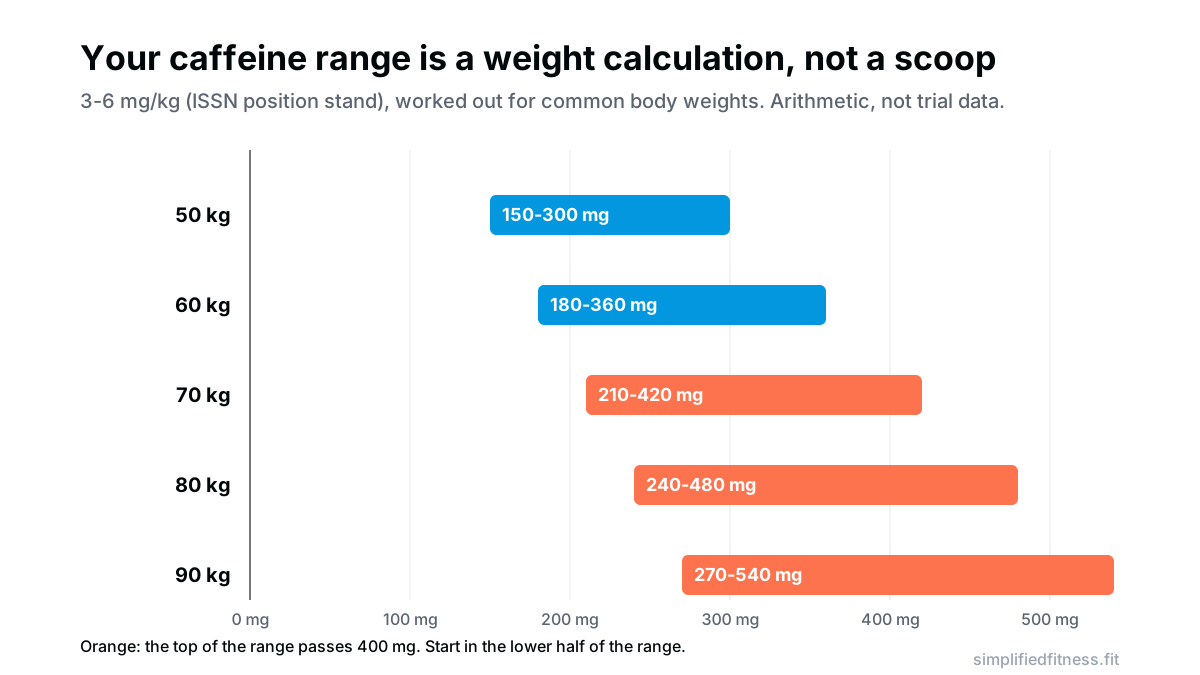
Start with your body weight in kilograms and multiply by 3 and by 6. That is your studied range.
The International Society of Sports Nutrition (ISSN) position stand states that caffeine has consistently improved exercise performance at 3-6 mg/kg, that the minimal effective dose may be as low as 2 mg/kg, and that very high doses (such as 9 mg/kg) are linked to a high rate of side effects without seeming necessary (Guest et al., 2021). Note that the position stand’s authors disclose several ties to supplement companies, which is standard for this field but worth knowing.
Here is what that looks like on the scale.
| Body weight | 3 mg/kg | 6 mg/kg |
|---|---|---|
| 50 kg | 150 mg | 300 mg |
| 60 kg | 180 mg | 360 mg |
| 70 kg | 210 mg | 420 mg |
| 80 kg | 240 mg | 480 mg |
| 90 kg | 270 mg | 540 mg |
Want your own number? Use the caffeine dosage calculator, which also caps the top of the range at 400 mg.
What does caffeine actually do for strength and power?
Less than the marketing suggests, but it is real.
A 2018 systematic review and meta-analysis of 10 strength studies and 10 power studies found caffeine improved both maximal strength (standardized mean difference, SMD, 0.20) and power measured by vertical jump (SMD 0.17) (Grgic et al., 2018). Subgroup analysis suggested the strength effect was clearer for upper body (SMD 0.21) than lower body (SMD 0.15, which was not statistically significant). The authors also asked for more data in women and for better control of blinding, because people often guess correctly whether they got caffeine.
An SMD of 0.2 is small. Think “a slightly better day,” not “a different lifter.”
More recent data point the same way for bar speed. A 2025 meta-analysis of 12 studies (230 participants) found caffeine improved mean bar velocity (SMD 0.42) and mean power output (SMD 0.21) during resistance exercise, with no significant difference across loads (Xiao et al., 2025). Heterogeneity for velocity was high, so the exact size is uncertain. Benefits were larger in males and in people who normally consumed less than 3 mg/kg of caffeine a day.
Why not take more than 6 mg/kg?
Because the extra benefit is unreliable and the cost is not.
In a randomized, double-blind crossover trial, 13 resistance-trained men did squat and bench press tests after placebo, 3, 6 or 9 mg/kg of caffeine. At light loads (25-50% of 1RM), all three doses increased bar velocity by roughly 5-8%. At 75% of 1RM, 3 mg/kg did not improve squat or bench power. Only 9 mg/kg improved bench velocity and squat power at 90% of 1RM, and 9 mg/kg also sharply increased side effects (15-62%) (Pallares et al., 2013).
So a case can be made for a higher dose when the load is very heavy. But that is one small trial of 13 men.
Then there is the opposite finding. A 2024 crossover trial in 16 female team-sport athletes (average age about 17) who were mild caffeine consumers compared the same three doses. Sprint, agility and repeated-sprint results were better at 6 and 9 mg/kg than at 3 mg/kg, with no significant difference between 6 and 9 mg/kg, and side effects were most frequent at 9 mg/kg. The authors recommended 6 mg/kg over 3 or 9 (Bougrine et al., 2024).
Why might the two trials differ? Different sexes and ages, different tests (heavy 1RM-percentage lifts versus sprints and jumps), different sample sizes, and different habitual caffeine intakes. Neither trial settles it.
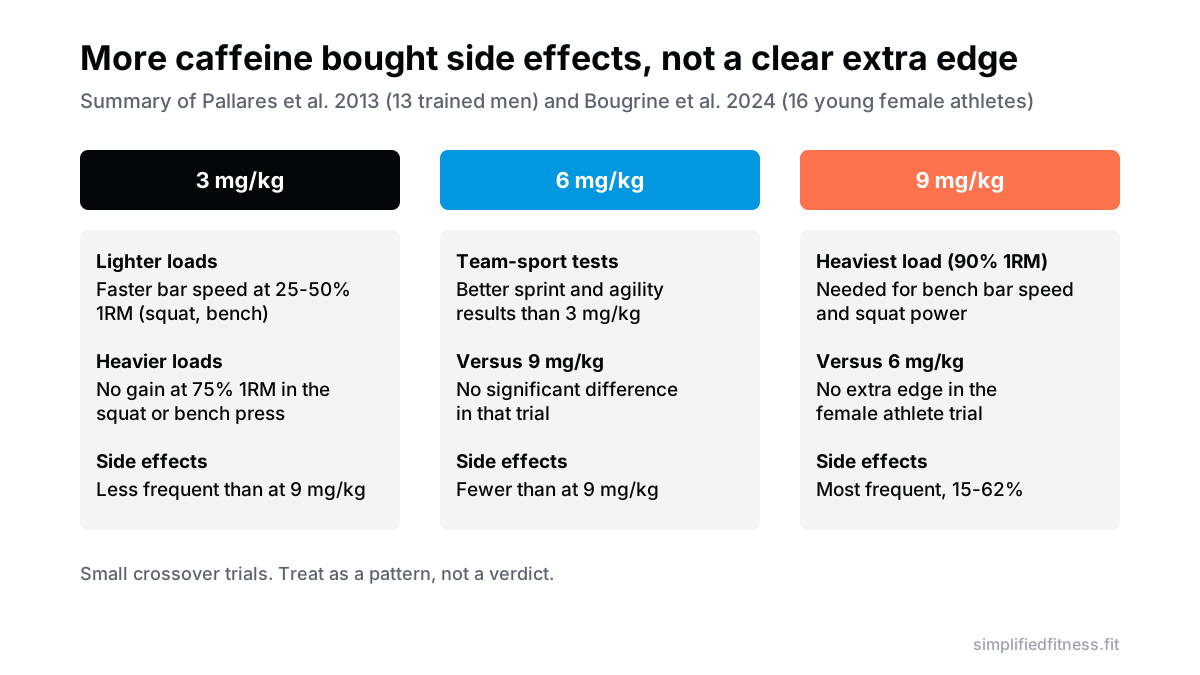
A cautious takeaway: most lifters get the bulk of the benefit between 3 and 6 mg/kg. If your top set is a near-max single and you tolerate caffeine well, you could test the upper end of that range. There is little reason to go beyond it.
When should you take caffeine before lifting?
About 60 minutes before your first heavy set is a good default.
The ISSN position stand notes that 60 minutes pre-exercise is the most commonly used timing, and that the best timing likely depends on the source of caffeine. Gum, for example, may need a shorter wait (Guest et al., 2021).
A timing trial gives some support. In 29 resistance-trained people (18 men, 11 women), 6 mg/kg of caffeine was given 2 hours, 1 hour or 30 minutes before testing. Taking it 1 hour before gave the most consistent benefit, particularly compared with 2 hours, and the effects were more consistent in males than females (Harty et al., 2020). The study was small, so treat the exact windows as a guide.
Chewing gum is the exception. A 2026 meta-analysis of 21 studies found a small ergogenic effect of caffeinated gum on strength (SMD 0.21) and jump height (SMD 0.16) when it was chewed about 5-25 minutes before exercise, with no clear effect on muscular endurance (Varovic and Grgic, 2026).
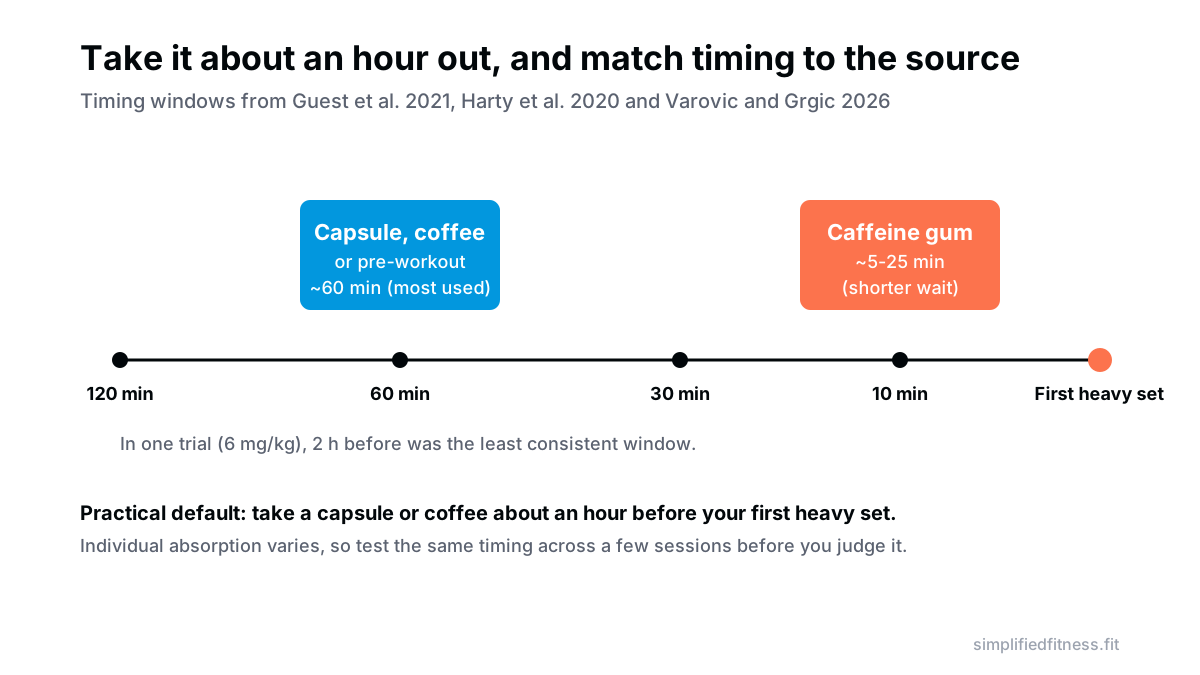
In practice: if you train at 6 am in a rush, a capsule taken on waking will not hit its stride until you are well into your warm-up. Gum fills that gap. If you train after work, take your usual dose on the way to the gym.
Can you take caffeine before an evening workout?
Sometimes, but you pay for it in sleep if you overdo the dose.
A 2025 randomized crossover trial gave 23 young men placebo, 100 mg or 400 mg of caffeine 12, 8 or 4 hours before bedtime. The 100 mg dose had no significant effect on objective or subjective sleep, even 4 hours before bed. The 400 mg dose delayed sleep onset and changed sleep architecture within 12 hours of bedtime, caused more fragmentation within 8 hours, and reduced perceived sleep quality at 4 hours (Gardiner et al., 2025). The participants were all men with moderate habitual intake, so it may not apply to everyone, and the trial used flat doses rather than mg/kg.
Put plainly, you probably do not need 6 mg/kg for a 7 pm session. For late training:
- Aim for the low end of the range, or 2-3 mg/kg.
- Skip caffeine on lighter or technique-focused days.
- Notice how you sleep. People can misjudge how caffeine affects them, and the same trial showed that the objective and subjective picture did not always match.
Who should be careful with caffeine for lifting?
Anyone with a heart rhythm problem, uncontrolled high blood pressure, an anxiety disorder, or who is pregnant should speak to a doctor before using performance doses. Caffeine raises alertness and blood pressure and can trigger palpitations in sensitive people. Teenagers should not use performance doses without guidance from a doctor or qualified coach.
For context, the European Food Safety Authority considers habitual intakes up to 400 mg a day safe for healthy non-pregnant adults, and up to 200 mg a day in pregnancy. Heavier lifters whose 6 mg/kg figure passes 400 mg should treat 400 mg as a practical ceiling for the whole day, coffee and tea included.
Also stop and get medical advice if you get chest pain, palpitations that do not settle, fainting, or severe headaches after caffeine. This article is general information, not a diagnosis.
A simple protocol for your next heavy session
Keep it boring.
- Work out 3 mg/kg for your weight and use that for 2-3 sessions.
- Take it about 60 minutes before lifting (or gum about 5-25 minutes before).
- Track your top-set weight and how fast the bar moves.
- If it helps and you feel fine, move up toward 4-5 mg/kg. Do not exceed 6 mg/kg.
- For evening sessions, drop to 2-3 mg/kg or skip it.
If tolerance is creeping in, our guide on caffeine tolerance and cycling covers how to reset. If caffeine makes you jittery, read pre-workout side effects and fixes. And if you want to know why one person feels wired on 100 mg and another feels nothing, see caffeine sensitivity and CYP1A2 genetics.
Dose depends on the form too: anhydrous versus natural caffeine affects how fast it peaks. For the broader picture of what is actually in a tub, see what clinical pre-workout doses look like and, for sleep, the afternoon caffeine cutoff.
Frequently Asked Questions
How much caffeine should I take before a workout?
Most lifters should aim for 3-6 mg of caffeine per kg of body weight, so about 210-420 mg at 70 kg. The ISSN position stand says doses in this range consistently improve exercise performance. Start near 3 mg/kg and only move up if you tolerate it well.
How long before lifting should I take caffeine?
About 60 minutes before your first heavy set is the most common and best-supported timing. In a trial of resistance-trained men and women, caffeine taken 1 hour before testing gave the most consistent benefit, while 2 hours before was the weakest. Take your capsule or coffee on the way to the gym and keep the timing the same for a few weeks.
Is 200 mg of caffeine enough for strength training?
It can be, especially for lighter lifters or people who are sensitive to caffeine. 200 mg is roughly 3 mg/kg for a 67 kg person, the bottom of the studied range. Try it for a couple of weeks and look at bar speed and how your last reps feel.
Is 400 mg of caffeine too much before a workout?
For many people it is more than they need, and it is a lot to take in one go. In a crossover trial in young men, 400 mg taken within 12 hours of bedtime delayed sleep onset and changed sleep architecture. Stay under 400 mg per day, spread it out, and cut back if you feel jittery.
Does more caffeine mean more strength?
No, not reliably. Studies comparing 3, 6 and 9 mg/kg found 9 mg/kg gave a few extra benefits at very heavy loads in one trial of trained men, but in a trial of adolescent female athletes it did no better than 6 mg/kg while causing the most side effects. The practical move is to stay at or below 6 mg/kg.
Does caffeine help with one rep max strength?
Slightly. A meta-analysis found a small improvement in maximal strength, with the benefit clearer for upper body than lower body. Expect a small edge on the day, not a new personal record by default.
Should I take caffeine before every workout?
Not necessarily. Habitual users may respond less, and in one meta-analysis on bar velocity the effect was larger in people who normally consumed less than 3 mg/kg per day. Save it for key sessions like heavy squats or deadlifts, and keep your other days lower.
Is caffeine gum better than capsules before lifting?
Gum works faster, but it is not clearly stronger. A 2026 meta-analysis found a small ergogenic effect for strength and jump height when gum was chewed about 5-25 minutes before exercise. If you train after work and need a quick effect, gum is a practical option; otherwise capsules or coffee 60 minutes out are fine.
Does caffeine work as well for women?
The evidence is thinner for women, and some studies suggest the effect may be less consistent. One timing trial found muscular performance was more consistently improved in males than females, though it included only 11 women. If you are female, treat the 3-6 mg/kg range as a starting point and judge it by how your own sessions feel.
Can I have caffeine before an evening workout?
You can, but dose and timing matter for sleep. In a randomized crossover trial, 100 mg did not significantly affect sleep when taken as close as 4 hours before bed, while 400 mg did. If you train after 5 pm, use the lowest dose that works or skip it on lighter days.
Do coffee and chai count toward my dose?
Yes, caffeine is caffeine, but the amount in a cup of coffee or chai varies a lot with the brew and cup size. That makes it hard to hit a precise mg/kg number from drinks alone. Check labels on capsules or pre-workouts, or use a measured source if you want to be exact.
Who should avoid caffeine before training?
People with heart rhythm problems, uncontrolled high blood pressure, anxiety disorders or pregnancy should talk to a doctor before using performance doses. Caffeine raises alertness and blood pressure and can trigger palpitations in some people. Stop and get medical advice if you notice chest pain, palpitations that do not settle or fainting.
Sources & References
Every claim above is checked against peer-reviewed research (PubMed, U.S. National Library of Medicine) or guidance from established health bodies. How we fact-check.
- Grgic J, et al. Effects of caffeine intake on muscle strength and power: a systematic review and meta-analysis. J Int Soc Sports Nutr. 2018. PMID: 29527137
- Guest NS, et al. International society of sports nutrition position stand: caffeine and exercise performance. J Int Soc Sports Nutr. 2021. PMID: 33388079
- Harty PS, et al. Caffeine timing improves lower-body muscular performance: a randomized trial. Front Nutr. 2020. PMID: 33330586
- Pallares JG, et al. Neuromuscular responses to incremental caffeine doses: performance and side effects. Med Sci Sports Exerc. 2013. PMID: 23669879
- Bougrine H, et al. Optimizing short-term maximal exercise performance: the superior efficacy of a 6 mg/kg caffeine dose over 3 or 9 mg/kg in young female team-sports athletes. Nutrients. 2024. PMID: 38474768
- Gardiner CL, et al. Dose and timing effects of caffeine on subsequent sleep: a randomized clinical crossover trial. Sleep. 2025. PMID: 39377163
- Varovic D, et al. Fast-acting caffeine: does caffeinated chewing gum enhance muscular strength, endurance, and jumping performance? A systematic review and meta-analysis. J Strength Cond Res. 2026. PMID: 42228847
- Xiao Y, et al. Effects of acute caffeine intake on muscular power during resistance exercise: a systematic review and meta-analysis. Front Nutr. 2025. PMID: 41127092

Umair Hazrami · Founder & Head Coach, Simplified Fitness
Umair Hazrami founded Simplified Fitness and the Simplified Lifter channel to cut through fitness noise. With 4+ years of consistent training and 10+ coaching clients, he writes every guide from the peer-reviewed research and links the sources so you can check them. Our editorial standards.
Educational content only, not medical advice. If you have a medical condition, are pregnant, or take medication, talk to a qualified doctor before changing your diet, supplements or training. Full disclaimer.
Keep reading
Supplements
Alpha-GPC and Huperzine A Pre-Workout: Do Cholinergic Nootropics Help Lifting?
Does an alpha GPC pre workout add power or focus? See what small trials found, why Huperzine A is a poor lifting bet, and the safety flags to know first.
10 min read

Supplements
The Antioxidant Paradox: Can Vitamin C and E Pills Blunt Muscle Growth and Endurance?
Does vitamin C blunt muscle growth? See what trials of 1000 mg vitamin C plus E found for strength, hypertrophy and endurance, and when pills are worth taking.
8 min read

Supplements
Caffeine Powder vs Coffee Before Lifting: Does the Source Really Matter?
Caffeine anhydrous vs coffee for lifting: what research says on absorption speed, peak levels and stomach upset, and whether pills beat your daily cup.
7 min read

Supplements
Caffeine Tolerance and Cycling: Adenosine, Withdrawal and a Reset Without the Crash
Caffeine tolerance reset made practical: why 400 mg of pre-workout stops working, what withdrawal really looks like, and a 10-day taper to dodge headaches.
8 min read