Caffeine Sensitivity, CYP1A2 Genetics and Caffeine Cycling: Why Pre-Workout Works for Him, Not You
Caffeine sensitivity genetics explain why pre-workout gives your friend PRs and you anxiety. See what CYP1A2 and ADORA2A do, and how to find your dose.
TL;DR. The short answer
- Genes probably explain part of why caffeine feels different between lifters: CYP1A2 affects how fast your liver clears it, and ADORA2A affects how your brain's adenosine receptors react, including anxiety.
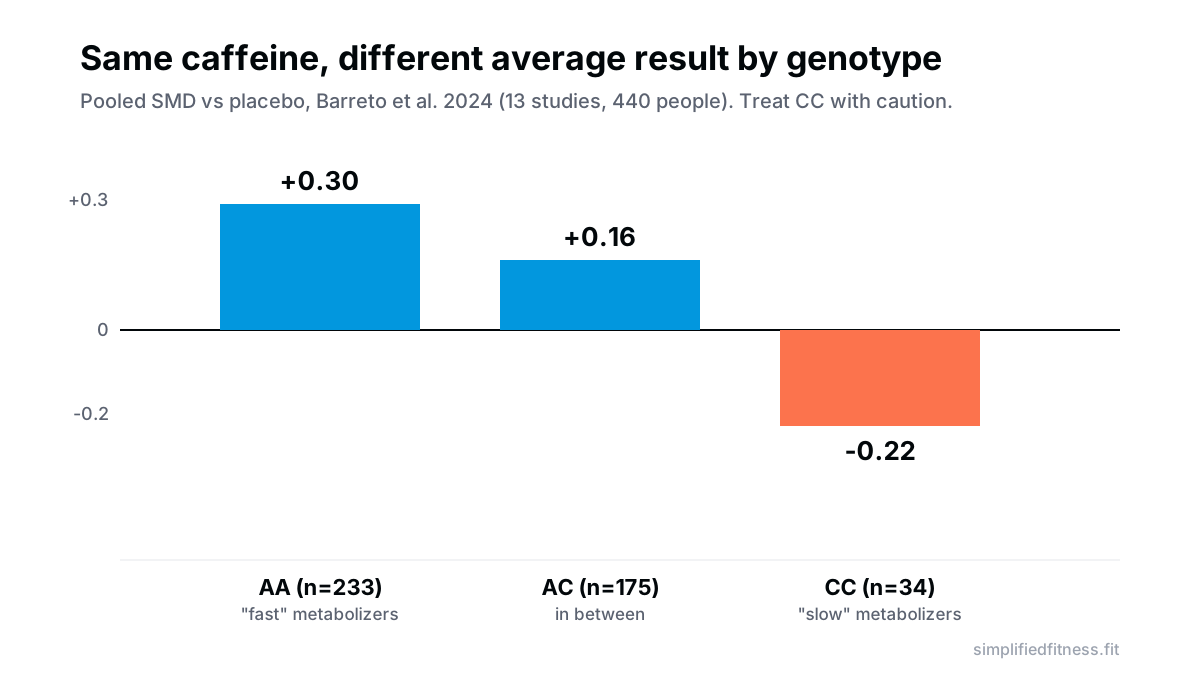
- A 2024 meta-analysis of 13 studies (440 people) found caffeine helped AA genotypes (effect size 0.30) and AC genotypes (0.16) but slightly hurt CC genotypes (-0.22), yet the authors warned the CC result may be biased.
- When studies with reported conflicts of interest were removed, no genotype effect remained, and a 2026 trial in 94 trained lifters found 3 mg/kg helped all genotypes (least in CC). A DNA test is not required. A 2 mg/kg trial dose and an honest session log tell you most of what you need.
- Daily caffeine builds tolerance, and a short break may restore some of the effect. The exact length of a reset is not firmly established, so treat a gradual taper of about 10 days as a practical template, not a proven protocol.
- Persistent palpitations, chest discomfort or panic after caffeine are a reason to see a doctor, not a reason to push through.
Part of our complete guide: Carbohydrates, Fats, Fibre, Micronutrients and Hydration: The Lifter's Fueling Guide
Table of contents
Same scoop of pre-workout. One guy adds 5 kg to his bench, the other sits in the car park with a pounding heart. Caffeine sensitivity genetics may be part of that gap, though not the whole story. Two genes get the most attention: CYP1A2, which sets how fast your liver clears caffeine, and ADORA2A, which shapes how your brain responds to it, including anxiety. Habitual intake adds a third layer on top.
This is a cluster article under our complete guide to carbohydrates, fats and hydration for performance, so we will keep the focus on the personal side: why you respond the way you do, how to find a dose that suits you, and how to reset tolerance. For standard dosing, see caffeine dosing for strength and power.
Why does caffeine affect lifters so differently?
Caffeine works mainly by blocking adenosine, a chemical that builds up while you are awake and makes you feel tired. Block the receptor and you feel alert, perceived effort drops a little, and some people produce more force or velocity.
Three things decide how strongly that plays out for you:
- How fast you clear it. Your liver enzyme CYP1A2 does most of the work.
- How sensitive your receptors are. ADORA2A codes for one of the adenosine receptors.
- How much you already drink. Daily coffee or chai changes the baseline.
The ISSN position stand on caffeine says exactly this: individual differences in performance, sleep effects and anxiety may be attributed to genetic variation in caffeine metabolism and in physical and psychological response, and habitual intake probably contributes too. It also says caffeine helps in many but not all studies, with small to moderate benefits for muscular endurance, velocity and strength.
CYP1A2 gene: fast vs slow caffeine metabolizer
The variant most studied sits at a position called rs762551. You can carry AA, AC or CC. AA is usually called the “fast” type and C-allele carriers the “slower” type, because the C version is associated with less enzyme activity.
Here is the sports data, and it is more mixed than most supplement sites admit.
What the pooled data show. A 2024 meta-analysis by Barreto and colleagues pooled 13 studies (440 people: 233 AA, 175 AC, 34 CC). Caffeine improved performance in AA (SMD 0.30) and AC (0.16) but worsened it in CC (-0.22). Dose and timing mattered only for CC, with higher doses and a longer wait after dosing linked to better results.
The catch. The same authors flagged that studies with reported conflicts of interest drove the CC result. After excluding them, no genotype influence was seen. They advised caution, and only 34 CC people were in the pool.
What the strength studies found
Resistance work is where studies disagree.
- Bench press and squat, resistance-trained men and women. A 2026 trial of 94 people gave 3 mg/kg. Bar speed rose 4-12% in AA and 3-9% in AC, with minor changes (4% or less) in CC. The genotype by caffeine interaction showed up only at 90% 1RM, the overall effect of caffeine held across genotypes, and no sex differences or ergolytic effects appeared.
A 2021 systematic review of 17 studies concluded that genotype may modulate caffeine’s effects, but the differences were small, inconsistent or limited to specific scenarios. Where a genotype effect existed, it favoured AA over AC/CC. For high-intensity exercise, the differences it found were small (about 1 extra rep in a high-load set taken to failure) or inconsistent (seen in only one of eight tests).
Why do results clash? Different doses, different tests (grip versus bench versus cycling) and different habitual intake. Small samples are a real problem too: the 2026 trial had only 11 CC carriers, and the whole 2024 meta-analysis had 34.
A cautious takeaway: genes may nudge your response, but in the 2026 trial of trained lifters, 3 mg/kg helped across genotypes, though least in CC carriers. If you are a C-allele carrier who feels awful on 4-6 mg/kg, believe your body and go lower. For a fuller look at the performance genetics, including the 2018 cyclist trial, see our CYP1A2 genetics deep dive.
Why does pre-workout give me anxiety?
Jitters and anxiety are a separate question from performance, and ADORA2A is the better-studied gene for it.
In a double-blind study giving 102 healthy adults who normally consumed little caffeine 0, 50, 150 and 450 mg, anxiety at 150 mg was linked to several ADORA2A and DRD2 variants. The lowest dose did not raise anxiety, and the highest raised it in most people. So dose matters for everyone.
A later study of 379 non-, low-, medium- and high-caffeine consumers found the rs5751876 TT genotype was more susceptible to caffeine-induced anxiety. It also found substantial tolerance to the anxious effect develops with frequent use, even in genetically susceptible people.
Other things that make pre-workout feel worse: training fasted, poor sleep, big doses taken on an empty stomach, and proprietary blends where you cannot see the caffeine number. Our guide to pre-workout side effects like jitters and palpitations covers fixes in more detail.
How to find your own dose
Skip the sales pitch for a gene test. Run a tiny experiment instead.
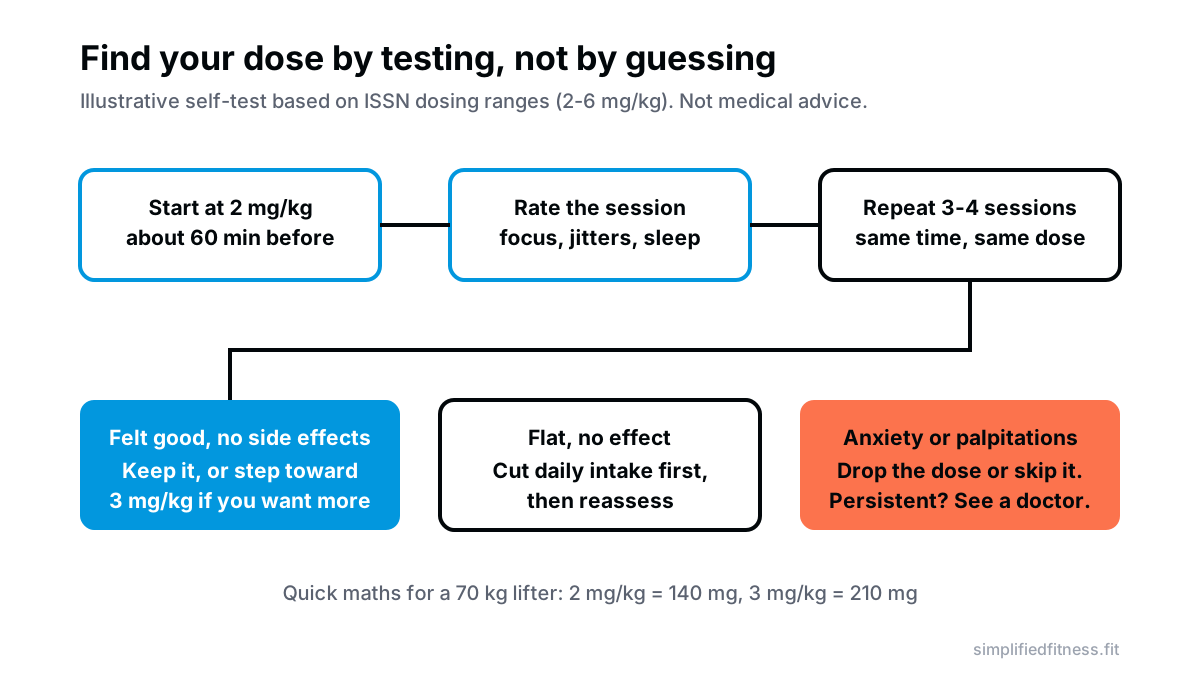
- Pick a low starting dose. The ISSN says the minimum effective dose may be as low as 2 mg/kg, with 3-6 mg/kg consistently shown to help. For a 70 kg lifter that is 140 mg to start. Use our caffeine dosage calculator for your body weight.
- Take it about 60 minutes before training. The ISSN notes that is the most commonly used timing in research, though gum may need less time.
- Log four things. Focus, rep quality, jitters, and how you slept that night.
- Repeat for 3-4 sessions before changing anything. One session is noise.
- Move up in small steps only if you felt good and want more.
If your pre-workout hides its caffeine amount, you cannot run this test properly. A plain caffeine source (a coffee or tablet with a stated dose) makes it much easier. Our DIY pre-workout guide explains how to spot blends.
Does caffeine tolerance really exist?
Yes, to some degree. An 8-week trial in 80 physically inactive men found a 3 mg/kg dose improved 3 km run time and Wingate mean power, but habitual caffeine use reduced that effect. The authors suggested that a higher pre-exercise dose in trained people, or a short caffeine break, could help compensate.
That is one trial in young inactive men, so it is a hint rather than a rule for trained lifters. Still, it fits a common complaint: a pre-workout that felt strong at first seems to fade with daily use.
Tolerance is also not even across effects. In the Rogers study above, anxiety faded with regular intake, but there was no net alertness gain, because abstaining lowered alertness and drinking merely returned it to baseline. In other words, daily use may partly just keep you at normal.
Caffeine cycling for sensitive lifters
No trial has tested one exact reset length, so be honest about that. The practical version is a gradual step down over about 10 days, a few low or caffeine-free days, then a re-test. Our caffeine tolerance reset guide lays out a full taper schedule and what withdrawal feels like.
For a sensitive lifter, two tweaks matter more than the exact schedule:
- Count every source. Chai, filter coffee, tea, colas and the scoop all add up. If you drink four cups a day, your “baseline” is already high before the pre-workout.
- Re-test low. After the break, go back to 2 mg/kg before a hard session rather than your old dose, and see how it feels. Expect possible headache and low alertness in the first few days off.
After the reset, a sensible habit is to keep daily caffeine modest and use higher doses only on key sessions.
Caffeine and sleep for sensitive lifters
Slower clearance probably means caffeine lingers longer, and the ISSN links genetic variation to individual differences in sleep effects. Direct data in lifters is thin, so use your own sleep as the test. If an afternoon dose costs you sleep, move your cutoff earlier. Our afternoon caffeine cutoff guide lays out how to set one.
Non-stimulant alternatives
If caffeine just does not agree with you, you lose less than the marketing suggests. The meta-analysis of strength and power studies found small gains (SMD 0.20 for strength, 0.17 for power), with a clear upper-body benefit but not a clear lower-body one.
Options that do not rely on a stimulant:
- A real meal 1-3 hours before training. Roti with dal and curd, or rice with paneer, works. See our pre-workout meal ideas for budget-friendly options.
- Sleep and a proper warm-up. Boring, but they often matter more than the scoop.
- Pump or endurance formulas such as citrulline, glycerol or similar non-stimulant products. Evidence varies by ingredient, so keep expectations modest.
When to see a doctor
Caffeine is a drug, even if it comes in a tub with a flame on it. See a doctor if you get:
- palpitations that keep happening or occur at small doses
- chest pain, fainting or shortness of breath
- panic attacks, or anxiety that spills into the rest of your day
- caffeine use alongside a heart condition, high blood pressure, pregnancy or medicines that interact
Do not use a genetic result to override symptoms. If your body says no, the answer is no.
Frequently Asked Questions
Why does pre-workout make me anxious but not my friend?
Your brain and liver may simply handle caffeine differently. Variation in ADORA2A, a gene for an adenosine receptor, has been linked to higher caffeine-induced anxiety at moderate doses, and slower CYP1A2 clearance may keep levels higher for longer. Try a lower dose, check the total caffeine in the scoop, and stop if palpitations appear.
What is the CYP1A2 gene and what does it do?
CYP1A2 makes a liver enzyme that breaks down most of the caffeine you consume. Common variants, usually read from a spot called rs762551, are labelled AA, AC and CC. People with AA are often called fast metabolizers and C-allele carriers slower ones, though real-world differences are smaller than the labels suggest.
Am I a fast or slow caffeine metabolizer?
Only a genetic test can tell you your CYP1A2 genotype, and even that does not predict everything, because smoking, medicines and habitual intake also change clearance. A practical stand-in is how long a coffee keeps you wired and whether an afternoon dose wrecks your sleep. If both are true, treat yourself as sensitive and dose lower.
Is the CYP1A2 gene test worth buying for lifters?
For most lifters, probably not. A 2021 systematic review found genotype differences that were small, inconsistent or limited to specific scenarios, so a result will not reliably change what you do. A free two-week dose experiment gives you more useful information.
How much caffeine should a sensitive person take before the gym?
Start around 2 mg/kg of body weight, roughly 140 mg for a 70 kg person, because the ISSN suggests the minimum effective dose may be as low as that. The usual range with good evidence is 3-6 mg/kg, but sensitive people often do fine at the bottom or below it. Test across several sessions before moving up.
Does caffeine tolerance really exist for gym performance?
Yes, to some degree. An 8-week trial in 80 inactive men found that habitual caffeine use reduced the performance boost from a pre-exercise dose, and the authors suggested a short caffeine break could help compensate. Keep daily caffeine moderate and save the pre-workout for your hardest sessions.
How long does it take to reset caffeine tolerance?
There is no single proven number. Tolerance to the anxious feeling develops with frequent intake, and a break may let sensitivity return, but trials have not nailed down the ideal length. A taper of about 10 days followed by a few low or caffeine-free days is a sensible, low-risk template, then re-test at a low dose.
Should I taper caffeine or quit cold turkey?
Tapering is gentler. Stopping suddenly after heavy daily use can cause headache and low alertness, which in one study of regular users meant lower alertness and more headache when they were given placebo instead. Step down gradually over about 10 days, for example by roughly a quarter every few days, instead of dropping to zero overnight.
Can too much caffeine cause heart palpitations?
It can in some people, particularly at high doses or when combined with stimulant-heavy pre-workouts and little sleep. Mechanistically caffeine blocks adenosine, which raises alertness and can raise heart rate and jitteriness. If palpitations recur, happen at small doses or come with chest pain or fainting, stop caffeine and see a doctor.
What can I use instead of caffeine pre-workout?
Non-stimulant options include a carbohydrate-containing meal 1-3 hours before training, enough sleep, and a decent warm-up. Some people use citrulline, glycerol or beta-alanine style formulas, which affect pumps or endurance through other routes and have a mixed evidence base. None is a direct swap for caffeine, so keep expectations modest.
Does caffeine help strength training at all?
Modestly. A meta-analysis of 10 strength and 10 power studies found small improvements (effect sizes 0.20 and 0.17), with a clearer benefit for upper body than lower body. Expect a nudge, not a transformation, and know that sleep, food and programming each matter more.
Does caffeine affect sleep more in slow metabolizers?
It plausibly does, since slower clearance means caffeine hangs around longer, and the ISSN position stand links genetic variation to individual differences in sleep effects. Direct evidence in lifters is limited. Set a personal cutoff, such as no caffeine within 8 hours of bed, and adjust by how you actually sleep.
Is caffeine chewing gum a better option for sensitive people?
Not clearly. Gum is absorbed faster, so effects arrive sooner, but a faster hit can feel worse if you are prone to jitters. If you try it, use a small dose and take it closer to the session so you only carry the effect for the time you need it.
Sources & References
Every claim above is checked against peer-reviewed research (PubMed, U.S. National Library of Medicine) or guidance from established health bodies. How we fact-check.
- Barreto G, et al. Caffeine, CYP1A2 Genotype, and Exercise Performance: A Systematic Review and Meta-analysis. Med Sci Sports Exerc. 2024. PMID: 37844569
- Grgic J, et al. CYP1A2 genotype and acute ergogenic effects of caffeine intake on exercise performance: a systematic review. Eur J Nutr. 2021. PMID: 33137206
- Montalvo-Alonso JJ, et al. CYP1A2 Genotype and the Ergogenic Effect of Acute Caffeine Intake on Muscular Strength and Endurance Performance in Trained Individuals. Scand J Med Sci Sports. 2026. PMID: 41627185
- Childs E, et al. Association between ADORA2A and DRD2 polymorphisms and caffeine-induced anxiety. Neuropsychopharmacology. 2008. PMID: 18305461
- Rogers PJ, et al. Association of the anxiogenic and alerting effects of caffeine with ADORA2A and ADORA1 polymorphisms and habitual level of caffeine consumption. Neuropsychopharmacology. 2010. PMID: 20520601
- Khodadadi D, et al. Habitual Caffeine Consumption and Training Status Affect the Ergogenicity of Acute Caffeine Intake on Exercise Performance. Sports Health. 2025. PMID: 39905628
- Guest NS, et al. International society of sports nutrition position stand: caffeine and exercise performance. J Int Soc Sports Nutr. 2021. PMID: 33388079
- Grgic J, et al. Effects of caffeine intake on muscle strength and power: a systematic review and meta-analysis. J Int Soc Sports Nutr. 2018. PMID: 29527137

Umair Hazrami · Founder & Head Coach, Simplified Fitness
Umair Hazrami founded Simplified Fitness and the Simplified Lifter channel to cut through fitness noise. With 4+ years of consistent training and 10+ coaching clients, he writes every guide from the peer-reviewed research and links the sources so you can check them. Our editorial standards.
Educational content only, not medical advice. If you have a medical condition, are pregnant, or take medication, talk to a qualified doctor before changing your diet, supplements or training. Full disclaimer.
Keep reading
Nutrition
Alcohol and Muscle Growth: What a Heavy Night Does to MPS, Sleep and Recovery
Alcohol and muscle growth: does a heavy Saturday night wipe out your week? See what research says on MPS, REM sleep and recovery, and how to limit the damage.
7 min read
Nutrition
Ashwagandha and Cortisol: Does It Lower Stress and Boost Strength in the Gym?
Ashwagandha for lifting: what the trials show on cortisol, stress and strength gains, realistic dose (300-600 mg), who should skip it and how to buy it safely.
7 min read
Nutrition
Creatine Non-Responders: Why It May Not Be Working and What to Try
Creatine non responder? Learn why roughly 1 in 4 people see little change, how baseline diet matters, and when carbs with creatine help. Studies linked.
7 min read

Nutrition
Dietary Carbohydrates and Hypertrophy: Glycogen, Performance and Training Volume
Do you need carbohydrates for muscle hypertrophy? See what meta-analyses say about glycogen, training volume and daily carb targets per kg, plus Indian foods.
8 min read