Creatine Monohydrate Mechanisms: Cellular Phosphocreatine Resynthesis and ATP Recycling
How creatine works inside your muscle cells: the phosphocreatine and ATP cycle behind extra reps, plus what trials do and do not show about growth signals.

TL;DR. The short answer
- Creatine works by raising the phosphocreatine stored in your muscle cells. Phosphocreatine hands a phosphate to ADP and rebuilds ATP, the fuel for a hard set, within seconds.
- Trials in young men show creatine loading raises muscle phosphocreatine and improves repeated high-intensity output. Whether it also speeds phosphocreatine recovery between bouts is mixed across studies.
- Growth-related mechanisms (cell swelling, protein synthesis signals, satellite cells, glycogen storage) are plausible and partly supported, but the evidence is smaller and less settled than the energy mechanism.
- People who start with low muscle creatine, such as vegetarians, tend to gain more total muscle creatine from supplementing.
- The practical dose stays simple: about 3-5 g of creatine monohydrate a day, taken consistently.
Part of our complete guide: Creatine, Protein Powders, Pre-Workouts and Caffeine: The Science and Safety Guide
Table of contents
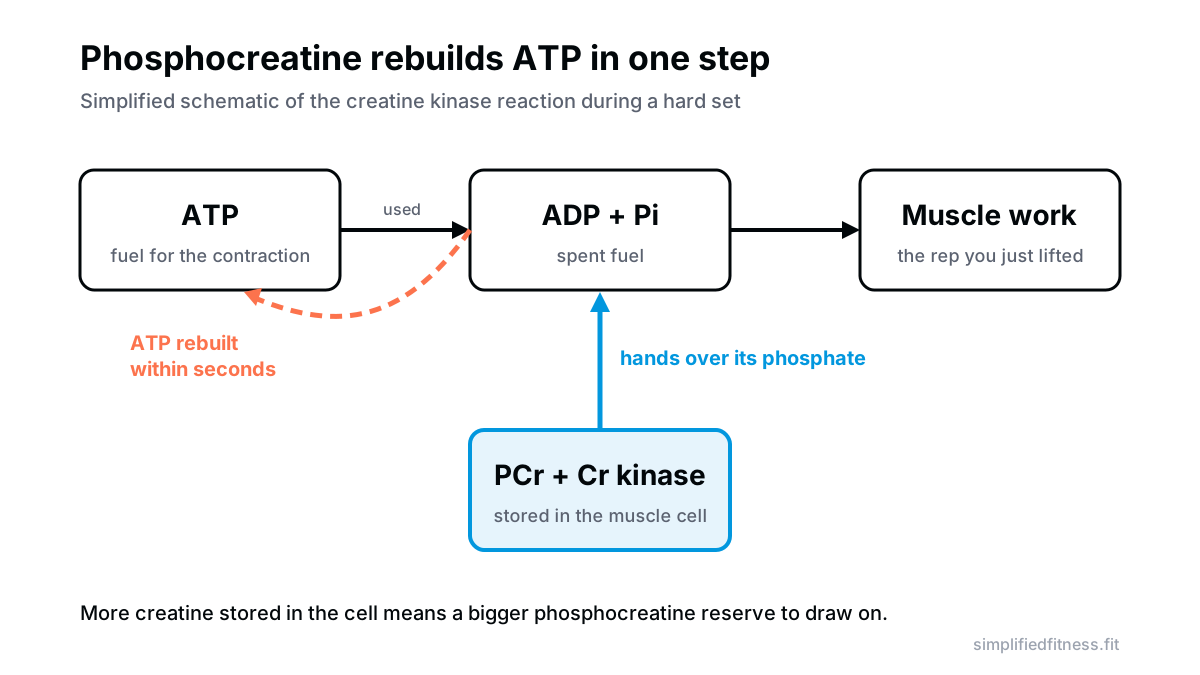
How creatine works comes down to one fast reaction. Your muscle cells store creatine as phosphocreatine, and when ATP (the fuel for a contraction) runs low during a hard set, phosphocreatine donates its phosphate to ADP and rebuilds ATP within seconds. Supplementing raises that stored reserve, which is why creatine can help you squeeze out extra quality reps. This article is the cell-level foundation for our complete guide to creatine, protein powders and caffeine.
If you want the safety side (hair, kidneys, bloating), that lives in the creatine myths article. Here we stay inside the muscle cell.
How does creatine work in muscle cells?
Think of ATP as cash in your pocket and phosphocreatine as a stack of notes in the drawer next to you. A heavy set spends ATP quickly. Your muscle only holds a small amount at a time, so it needs a way to refill it right now, not in a minute.
Phosphocreatine is that refill. The enzyme creatine kinase takes the phosphate from phosphocreatine and hands it to ADP, turning it back into ATP. One enzyme, one step. That speed is why this system matters most for short, maximal efforts: a heavy triple, a sprint, a hard set of squats.
The International Society of Sports Nutrition (ISSN) notes that studies consistently show creatine supplementation raises intramuscular creatine concentrations, which may help explain improvements in high-intensity exercise performance and training adaptations (Kreider et al., 2017). “May help explain” is accurate wording. The raised stores are well documented; the exact route from stores to performance has some open questions, and we will get to them.
What the muscle studies actually measured
Mechanism claims are easy to repeat and harder to check. Here is what the original trials did.
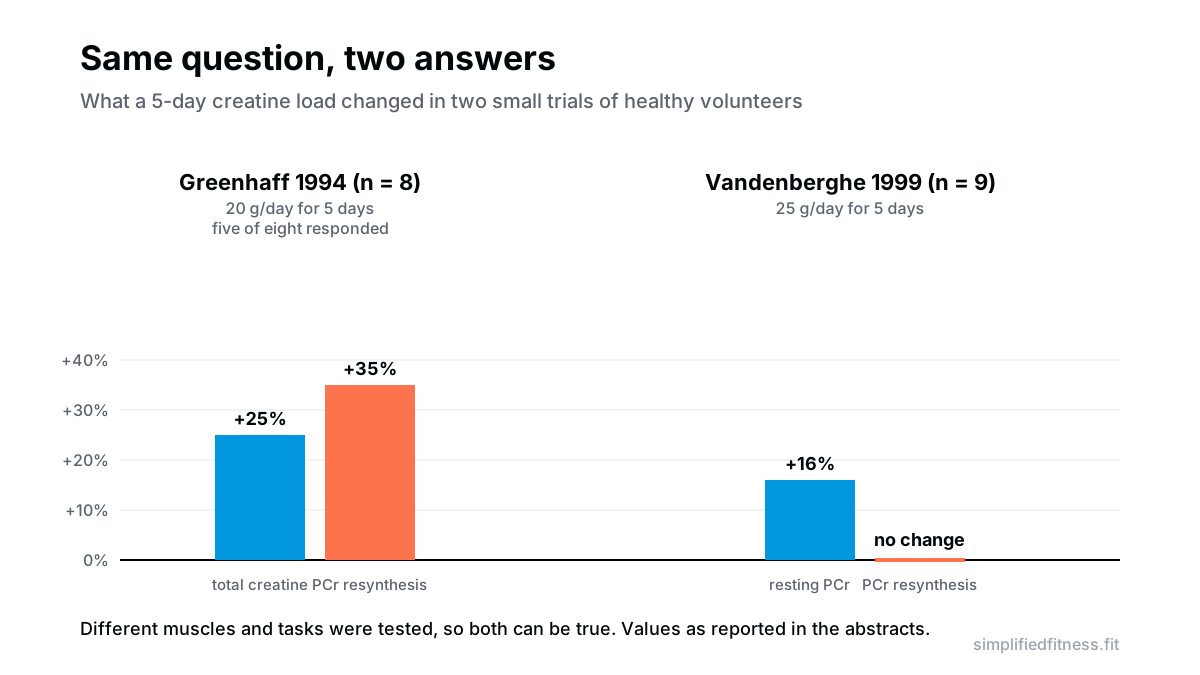
In a 1994 study, eight people had muscle biopsies after hard electrically evoked contractions, once normally and once after 20 g of creatine a day for 5 days. In five of the eight, muscle total creatine rose by about 25% on average and phosphocreatine resynthesis during recovery rose by about 35%. In the other three, total creatine barely moved (5-7%) and resynthesis did not improve (Greenhaff et al., 1994).
A 2002 study used magnetic resonance spectroscopy on nine healthy men doing repeated 8-second maximal calf efforts. After 20 g a day for 6 days, power output was about 5% higher from bout 3 to bout 7, phosphocreatine resynthesis was faster, and less inorganic phosphate built up (Yquel et al., 2002). The authors tied the better power maintenance to faster phosphocreatine resynthesis and a smaller drop in pH.
So far this is the tidy story. Now the awkward part.
Do the studies agree on faster phosphocreatine recovery?
Not entirely. A 1999 randomized crossover trial in nine young men gave 25 g a day for 5 days. Resting phosphocreatine rose by 11% after 2 days and 16% after 5 days, and torque in maximal intermittent knee extensions rose by 5-13%. But the rate of phosphocreatine breakdown and resynthesis during intermittent calf contractions was not significantly changed (Vandenberghe et al., 1999).
Why might they differ? A few plausible reasons, none proven:
- Different muscles and tasks. Knee extensors under torque, electrically evoked contractions and calf plantar flexion are not the same stress.
- Different recovery windows. One study highlighted the second minute of recovery; the others tracked short repeated bouts.
- Responders versus non-responders. In the 1994 data, a few people barely raised muscle creatine, so group averages can hide a split.
- Tiny samples. Each trial had fewer than ten participants, all healthy volunteers.
The cautious takeaway: the evidence that creatine raises resting phosphocreatine is solid, and performance in repeated high-intensity efforts tends to improve. Whether the benefit comes mainly from a bigger starting reserve or from faster refilling between efforts is less settled. For you in the gym, the practical result is the same. Take it daily and rest properly between heavy sets.
Does creatine also trigger muscle growth signals?
Possibly, and this is where the evidence thins out. A 2017 review of the proposed mechanisms lays out several: cell swelling acting as an anabolic stimulus, direct effects on the mTOR protein synthesis pathway, and changes in myokines and satellite cell activity. Its own conclusion is that there is still no clear understanding of how creatine affects muscle growth, and that it may work through several routes at once (Farshidfar et al., 2017).
Three of these ideas are worth knowing, with their limits.
Cell swelling
Creatine pulls water into the muscle cell. The idea is that a more hydrated, swollen cell signals the muscle to build protein. That is a hypothesis from review-level work, not a confirmed switch. The water itself is real, and we explain how it differs from bloating in creatine water weight vs bloating.
Satellite cells
Satellite cells are the muscle’s repair and growth crew; they donate nuclei to muscle fibres. In a 16-week trial of 32 healthy young men, 25 did heavy resistance training while taking creatine (6-24 g a day), protein or placebo, and 7 did not train and served as controls. Creatine users showed greater increases in satellite cell number at weeks 4 and 8, more myonuclei per fibre, and 14-17% gains in mean fibre area at weeks 4, 8 and 16. By week 16, satellite cell number was no longer elevated in the creatine group (Olsen et al., 2006).
That is interesting, but it is one trial with 8-9 people per supplement group, and only young men. It suggests creatine may amplify the training response rather than replace it.
Glycogen storage
Glycogen is stored carbohydrate, the fuel for longer or repeated hard training. In a small study of 12 men, a 5-day creatine load of 20 g a day was inserted between two glycogen loading protocols. Total muscle glycogen after the creatine load and second protocol (694 mmol/kg dry matter) was significantly higher than the pre-creatine value (597). The authors suggested creatine’s effect on cell volume might raise glycogen loading capacity (Nelson et al., 2001). Note the design: the same men did both protocols in order, so this is suggestive, not conclusive.
Who responds most, and why?
Your starting muscle creatine matters. Meat and fish supply dietary creatine, so a mostly vegetarian diet can mean lower stores to begin with.
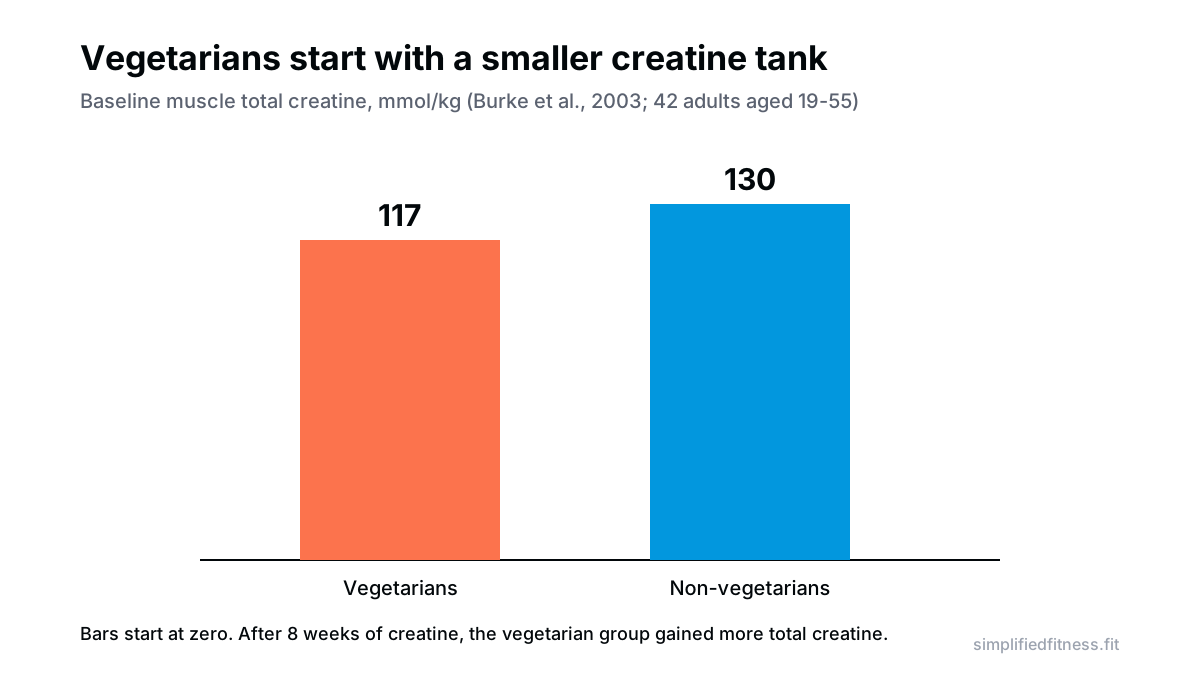
In an 8-week trial of 18 vegetarians and 24 non-vegetarians aged 19-55, baseline muscle total creatine was lower in vegetarians (117 versus 130 mmol/kg). With creatine and resistance training, vegetarians gained more total creatine, more lean tissue and more total work performance than non-vegetarians who took creatine. The change in muscle creatine was also correlated with the starting level (Burke et al., 2003).
This is relevant in India, where many lifters eat little or no meat. A diet built on dal, paneer, curd and roti is not wrong, but it supplies close to no creatine, so supplementing may close a bigger gap than it does for a daily chicken eater. One trial is not a guarantee, and individual variation is wide. If you think you are not responding, our creatine non-responders guide covers the possible reasons.
What does this mean for how you take it?
The mechanism points to a few simple rules.
- The goal is a full store, not a spike. Because creatine works by raising muscle stores, the daily habit matters more than the clock. We compare the two common routes in creatine loading vs daily maintenance, and timing in pre vs post-workout creatine.
- A typical dose. The ISSN reports that supplementation up to 30 g a day for 5 years has been safe in healthy people, but everyday use sits much lower, around 3-5 g of monohydrate. Our creatine dosage calculator gives a number for your body weight.
- Match the form to the evidence. Plain monohydrate is what most of this research used.
- Rest between heavy sets. The refill is fast but not instant. Taking 2-3 minutes between hard sets is sensible, with or without creatine.
Why the phosphocreatine system has limits
The creatine kinase reaction is fast, but the reserve is finite. It is a short-burst system, so it matters most in heavy, low to moderate rep sets and sprints, and much less in a steady 45-minute jog. That is also why creatine is not a fat burner or an endurance supplement.
It also does not remove the need for the basics. The ISSN describes creatine as one of the most popular nutritional ergogenic aids, but it still sits on top of training, enough protein and sleep. If you are not yet hitting those, start with the protein intake calculator before buying anything.
When to see a doctor
Creatine is well studied in healthy adults. If you have kidney disease, are pregnant or breastfeeding, or take medicines that affect your kidneys, speak to a doctor before starting. Persistent stomach pain, swelling or other symptoms after starting are also worth a medical check, not self-diagnosis.
The bottom line
Creatine works because phosphocreatine is the fastest ATP refill your muscle has, and supplementing makes that reserve bigger. That part is well supported. Growth signals such as cell swelling, satellite cells and glycogen are plausible add-ons backed by smaller studies, and the question of faster phosphocreatine recovery between sets is still mixed. Plain monohydrate, taken daily, with hard training behind it, is the sensible way to use all of this.
Frequently Asked Questions
How does creatine work in the body?
Creatine raises the phosphocreatine stored inside your muscle cells. During hard efforts, phosphocreatine donates its phosphate group to ADP and regenerates ATP, the molecule your muscles burn for contraction. In practice that can mean slightly more output across repeated hard sets, which is why you take it daily rather than just before training.
What is phosphocreatine and why does it matter for lifting?
Phosphocreatine is creatine with a high-energy phosphate attached, and it sits in muscle as a quick-access energy reserve. When you grind out a heavy set, ATP drops fast and phosphocreatine is the first backup that refills it. Supplementing creatine tends to enlarge this reserve, so build your training around being able to repeat hard efforts.
What does creatine kinase do?
Creatine kinase is the enzyme that moves a phosphate between phosphocreatine and ADP, in the direction needed to rebuild ATP while you work. It reverses the process during rest so the reserve refills. You do not supplement the enzyme; you supply more creatine for it to work with.
How quickly does creatine regenerate ATP?
The creatine kinase reaction is a single enzyme step, so it responds within seconds of ATP being used, which is why it matters most in short, maximal efforts. Longer efforts lean more on other energy systems. For lifting, this means the benefit shows up in hard sets and repeated sets, not in easy cardio.
Does creatine speed up phosphocreatine recovery between sets?
Results are mixed. One 1994 study found faster phosphocreatine resynthesis after creatine loading in most participants, while a 1999 study found higher resting phosphocreatine and better torque but no change in resynthesis rate. Rest enough between heavy sets, and treat faster recovery as possible rather than guaranteed.
Does creatine make muscle cells swell and trigger growth?
Creatine draws water into muscle cells, and reviews propose this cell swelling may act as a signal that supports protein synthesis. The mechanism is still debated and mostly rests on smaller or indirect evidence. Do not count on the swelling itself as a growth trick; lift hard and treat any extra growth as a bonus.
Does creatine increase satellite cells?
In one 16-week trial in young men, creatine plus heavy training raised satellite cell numbers more than training with placebo (at week 4) or with protein (at week 8), and increased myonuclei per fibre. Only 9 men took creatine, and the satellite cell advantage was gone by week 16. Take it as an interesting lead and keep your focus on progressive overload.
Does creatine store more glycogen in muscle?
One small study of 12 men found muscle glycogen loading reached higher levels after a 5-day creatine load than before it. The proposed link is the larger cell volume created by creatine. It was a single small trial in young men, so it is not a reason to change how you eat; just keep carbohydrates adequate around hard training.
Why do vegetarians respond more to creatine?
Vegetarians eat little or no dietary creatine, and in one trial they started with lower muscle total creatine (117 versus 130 mmol/kg) than non-vegetarians. They also gained more total creatine after 8 weeks of supplementing. If you eat mostly dal, paneer and curd with little meat, you may be more likely to notice a difference.
Is creatine monohydrate better than other creatine forms?
Creatine monohydrate is the form behind most of the research, including the ISSN position stand. The energy mechanism described here is about creatine itself, so a newer form would only help if it raised muscle creatine more, and that has not been shown. Stick with plain monohydrate and check our forms comparison before paying extra.
How much creatine do I need to fill muscle stores?
About 3-5 g a day of monohydrate is the standard maintenance range, and loading around 20 g a day for 5-7 days fills stores faster. Both routes aim at the same higher muscle creatine level. Use the creatine dosage calculator for your body weight and take it every day, including rest days.
Do all people respond to creatine the same way?
No. In the 1994 study, three of eight participants had little rise in muscle creatine, and baseline levels differ between people. Diet, especially meat intake, is one reason. If you notice nothing after a month of daily use, read our non-responder guide before assuming it is a waste.
Sources & References
Every claim above is checked against peer-reviewed research (PubMed, U.S. National Library of Medicine) or guidance from established health bodies. How we fact-check.
- Kreider RB, et al. International Society of Sports Nutrition position stand: safety and efficacy of creatine supplementation in exercise, sport, and medicine. J Int Soc Sports Nutr. 2017. PMID: 28615996
- Greenhaff PL, et al. Effect of oral creatine supplementation on skeletal muscle phosphocreatine resynthesis. Am J Physiol. 1994. PMID: 8203511
- Vandenberghe K, et al. Phosphocreatine resynthesis is not affected by creatine loading. Med Sci Sports Exerc. 1999. PMID: 10063812
- Yquel RJ, et al. Effect of creatine supplementation on phosphocreatine resynthesis, inorganic phosphate accumulation and pH during intermittent maximal exercise. J Sports Sci. 2002. PMID: 12043832
- Olsen S, et al. Creatine supplementation augments the increase in satellite cell and myonuclei number in human skeletal muscle induced by strength training. J Physiol. 2006. PMID: 16581862
- Farshidfar F, et al. Creatine supplementation and skeletal muscle metabolism for building muscle mass: review of the potential mechanisms of action. Curr Protein Pept Sci. 2017. PMID: 28595527
- Nelson AG, et al. Muscle glycogen supercompensation is enhanced by prior creatine supplementation. Med Sci Sports Exerc. 2001. PMID: 11445755
- Burke DG, et al. Effect of creatine and weight training on muscle creatine and performance in vegetarians. Med Sci Sports Exerc. 2003. PMID: 14600563

Umair Hazrami · Founder & Head Coach, Simplified Fitness
Umair Hazrami founded Simplified Fitness and the Simplified Lifter channel to cut through fitness noise. With 4+ years of consistent training and 10+ coaching clients, he writes every guide from the peer-reviewed research and links the sources so you can check them. Our editorial standards.
Educational content only, not medical advice. If you have a medical condition, are pregnant, or take medication, talk to a qualified doctor before changing your diet, supplements or training. Full disclaimer.
Keep reading

Supplements
Alpha-GPC and Huperzine A Pre-Workout: Do Cholinergic Nootropics Help Lifting?
Does an alpha GPC pre workout add power or focus? See what small trials found, why Huperzine A is a poor lifting bet, and the safety flags to know first.
10 min read

Supplements
The Antioxidant Paradox: Can Vitamin C and E Pills Blunt Muscle Growth and Endurance?
Does vitamin C blunt muscle growth? See what trials of 1000 mg vitamin C plus E found for strength, hypertrophy and endurance, and when pills are worth taking.
8 min read

Supplements
Caffeine Powder vs Coffee Before Lifting: Does the Source Really Matter?
Caffeine anhydrous vs coffee for lifting: what research says on absorption speed, peak levels and stomach upset, and whether pills beat your daily cup.
7 min read

Supplements
Caffeine Dosing for Strength and Power: 3-6 mg/kg and When to Take It
Caffeine dosage for strength is 3-6 mg/kg, about 210-420 mg for a 70 kg lifter, taken around 60 minutes before training. Doses, timing and when to stop.
8 min read