Rhodiola Rosea for the Gym: Does This Adaptogen Really Cut Workout Fatigue?
Rhodiola rosea gym benefits are modest and mixed. See what five trials and three reviews found on fatigue, RPE and endurance, plus dose and label tips.
TL;DR. The short answer
- Rhodiola rosea gym benefits are real but small and inconsistent. A 2023 systematic review of 13 trials found acute doses may lower perceived exertion and help endurance, with more mixed results for chronic use.
- It is not a strength or muscle builder. Direct lifting evidence is thin: the one recent bench press trial we found had 18 young, healthy people and trivial-to-small effects.
- The trials covered here used about 200 mg to 576 mg of extract a day, and the classic standardisation is roughly 3% rosavins and 1% salidroside.
- Product quality is a genuine concern. A DNA survey of Rhodiola herbal pieces sold in China found widespread species mix-ups, so pick a labelled, third-party tested extract.
- Constant exhaustion is not a supplement problem. See a doctor if tiredness lasts weeks, because sleep, iron, thyroid and mood can all be behind it.
Part of our complete guide: Creatine, Protein Powders, Pre-Workouts and Caffeine: The Science and Safety Guide
Table of contents
Rhodiola rosea gym benefits exist on paper, but they are small, short-lived and far from consistent. The best evidence suggests a single dose may take the edge off perceived effort during endurance work, while the case for strength and muscle is thin. (For the basics first, see our guide to creatine, protein powders and caffeine.)
That puts rhodiola firmly in the “optional extra” tier, well below the basics. Still, it is popular with people who want a non-stimulant option for evening sessions, so it deserves a fair read. Here is what the trials actually show.
What is rhodiola rosea, and why do lifters care?
Rhodiola rosea is a plant whose root is used in supplements. It grows in cold, high-altitude regions and is often called Arctic root or golden root. It belongs to the group of herbs labelled “adaptogens”, a marketing-friendly term for plants said to help you cope with stress.
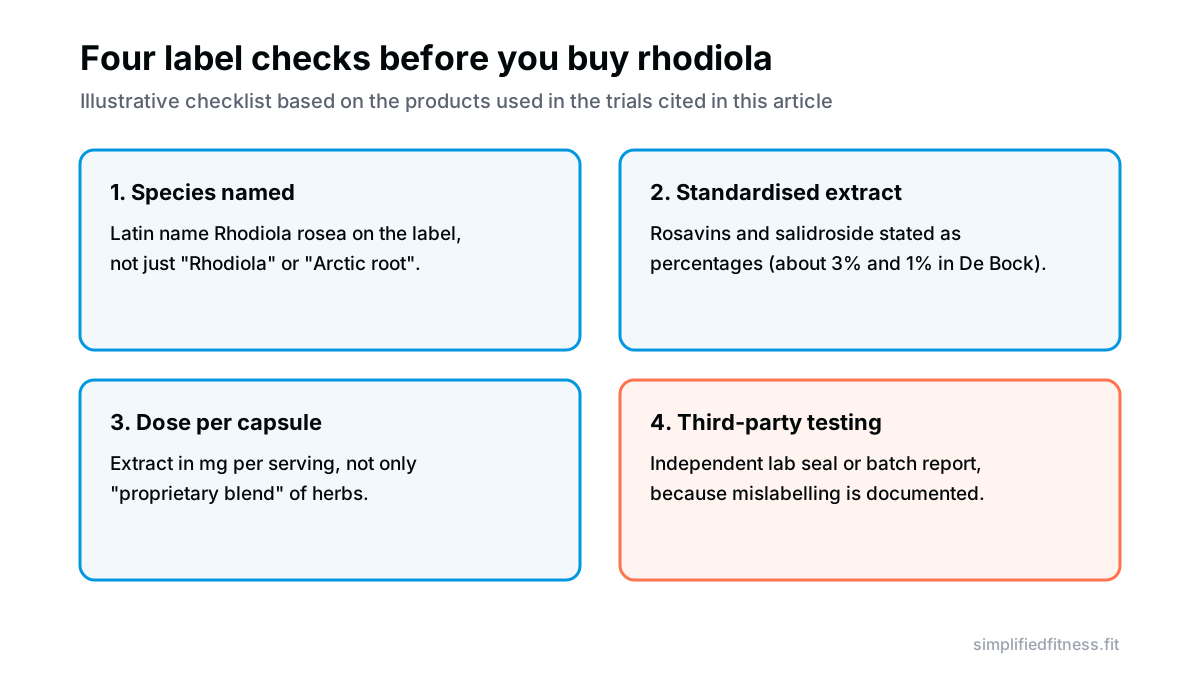
Two compound groups get most of the attention: rosavins and salidroside. Supplements are usually standardised to them. The classic ratio you will see on labels is about 3% rosavins to 1% salidroside, the same standardisation used in the De Bock 2004 trial (De Bock et al., 2004).
The pitch to lifters goes like this: rhodiola nudges brain chemistry involved in stress and motivation, so hard work feels less hard. That is a tidy story. The honest status is that the proposed mechanisms come largely from lab and animal work, and I have not seen them confirmed in human lifters. Treat the mechanism as a hypothesis, not a fact.
Rhodiola rosea gym benefits: what the trials actually show
Start with the two systematic reviews, then the individual studies that matter for lifters.
A 2023 review of 13 randomized trials (263 healthy participants) found 11 studies with some positive effect and 2 with none, across outcomes like RPE, heart rate, lactate and creatine kinase. The authors concluded that acute supplementation had a positive effect on endurance performance and RPE, chronic supplementation had a positive effect on anaerobic performance but not endurance, and that most studies were at unclear or high risk of bias (Sanz-Barrio et al., 2023).
A 2025 meta-analysis of 26 trials (668 healthy people, mean age about 22) reported small improvements in VO2max, time to exhaustion and time-trial performance, plus lower creatine kinase and lactate. The authors flagged heterogeneity across studies and urged cautious interpretation (Wang et al., 2025).
An earlier 2012 review was blunter. Of 11 trials on physical and mental fatigue, every one had either high risk of bias or reporting flaws, and the authors called the research contradictory (Ishaque et al., 2012).
So the newer reviews lean positive on endurance, but they pool small, varied studies in mostly young, healthy people. That is a long way from “proven”.
Does it lower RPE or workout fatigue?
This is the claim the whole pitch rests on, so let’s be precise about it.
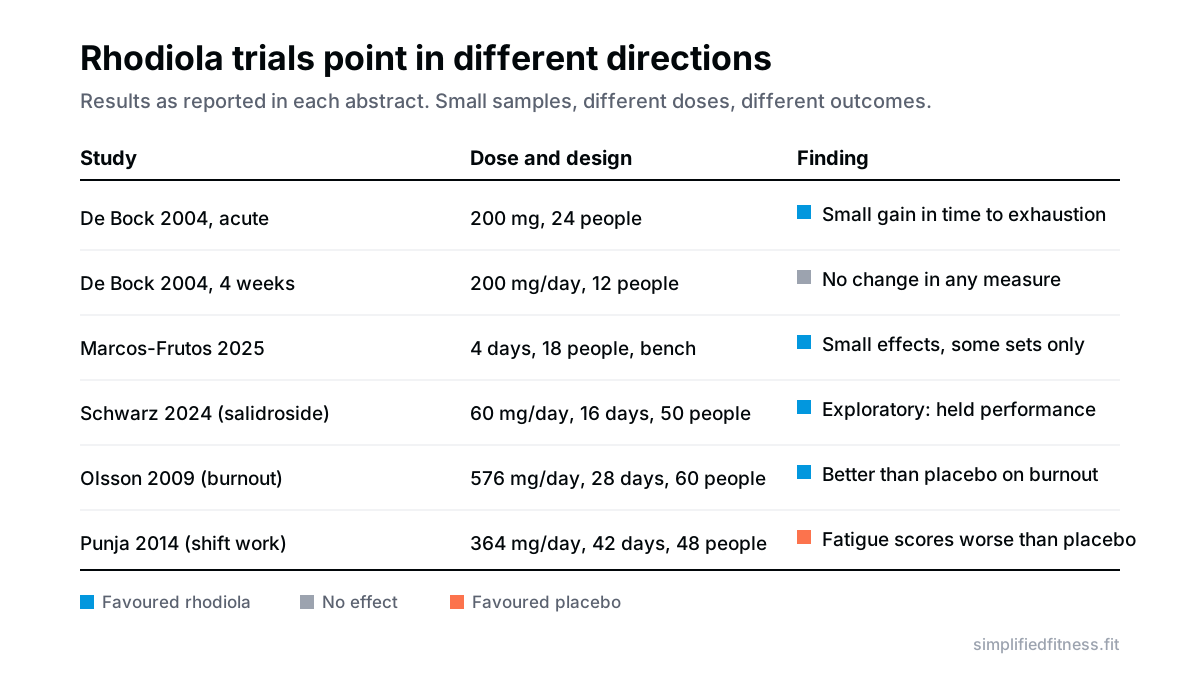
In De Bock’s study, 24 people took 200 mg of extract (3% rosavin, 1% salidroside) one hour before testing. Time to exhaustion rose from 16.8 to 17.2 minutes, and VO2peak rose from 50.9 to 52.9 ml/kg/min. That is under half a minute of extra effort. Then 12 people took 200 mg daily for four weeks, and the measures did not change (De Bock et al., 2004).
Read that twice. One dose helped a little. Four weeks of the same dose did not.
On the lifting side, a 2025 triple-blinded crossover trial gave 18 young adults rhodiola or placebo for four days. Across 52 comparisons, 17 small effects appeared, 14 favouring rhodiola and 3 favouring placebo, and the rest were trivial. Effects on perceived exertion and mental fatigue were trivial to small. Rhodiola did beat placebo on bench press reps and bench pull velocity in some sets, but only in the control video condition (Marcos-Frutos et al., 2025). The authors note some of them advise supplement companies, which is worth knowing.
A 2024 exploratory trial tested 60 mg a day of pure salidroside for 16 days in 50 active adults. The placebo group’s performance on a time-to-exhaustion test and mood state got worse, while the salidroside group held steady, and muscle damage marker myoglobin rose only in placebo. The authors call it exploratory, and several authors are employed by companies in the field (Schwarz et al., 2024).
What about mental fatigue and burnout?
Rhodiola’s reputation actually comes from stress and mental tiredness studies, and those are also split.
A 2009 trial in 60 people diagnosed with stress-related fatigue found 576 mg a day of the SHR-5 extract beat placebo on a burnout scale and some attention measures over 28 days. Both groups improved on several measures, which the authors attributed to a placebo effect (Olsson et al., 2009).
In contrast, a 2014 trial in 48 nursing students on shift work gave 364 mg daily (plus up to one extra capsule) for 42 days and found fatigue scores were worse than placebo. The authors said the result should be interpreted cautiously (Punja et al., 2014).
Why might they disagree? Different populations (burnout patients versus healthy students), different extracts, different doses, different outcome scales, and small samples. The sensible takeaway is that rhodiola is not a reliable fix for being tired. If your tiredness is the problem rather than your training, look at sleep first.
Rhodiola rosea dose: how much and which extract?
There is no validated dose. Here is what trials used, side by side.
| Study | Extract dose | Duration |
|---|---|---|
| De Bock 2004 | 200 mg (3% rosavin, 1% salidroside) | one dose, then 4 weeks |
| Olsson 2009 | 576 mg SHR-5 | 28 days |
| Punja 2014 | 364 mg, up to one more capsule | 42 days |
| Schwarz 2024 | 60 mg pure salidroside | 16 days |
The 2025 meta-analysis found larger VO2max gains in studies using more than 600 mg a day, but that is a subgroup comparison across different products, so it does not make 600 mg a safe or proven target (Wang et al., 2025).
A cautious approach: choose an extract standardised to about 3% rosavins and 1% salidroside, start near the low end of the label’s suggested serving (trials used from about 200 mg), never exceed the label, and stop after two weeks if you notice nothing. Taking it about an hour before training mirrors the acute De Bock trial. Skip it in the evening if it makes your sleep worse, which would defeat the point.
Why the label matters more than the dose
Herbal products are a mess in many markets, and Rhodiola is a known example. A DNA barcoding survey of 100 Chinese market decoction pieces sold as Rhodiola crenulata found only 36 matched that species. Of the rest, 9 were Rhodiola rosea and others were different species (Xin et al., 2015). That survey covered traditional medicine pieces, not gym capsules, so it does not prove your tub is fake. It does show that mislabelling is a real risk with this genus.
For Indian buyers shopping online, that is a reason to be a little stricter. Prefer a brand that names the species, states rosavin and salidroside percentages, and shares a batch certificate from an independent lab.
Rhodiola versus other options for evening lifters
People often ask for a non-stimulant alternative to caffeine. Be realistic about what that means.
- Caffeine has far stronger evidence for strength and power. If it wrecks your sleep, move it earlier in the day. See caffeine dosing for strength and power.
- Ashwagandha is studied more for stress and strength over weeks. Compare notes in our ashwagandha KSM-66 vs Sensoril guide.
- Sleep is the real non-stimulant. A rested lifter needs less of everything else. Our sleep supplements audit covers what is worth trying.
- L-tyrosine has its own narrow use case, covered in L-tyrosine for acute stress.
For hot-climate training, remember that fatigue in a humid gym is often hydration, food and heat. Fix those first.
Who should skip rhodiola
Talk to your doctor before trying rhodiola if you:
- are pregnant or breastfeeding, because data are limited
- have a mood disorder or take antidepressants or other prescription medication
- have heart rhythm problems or are very sensitive to stimulants
- are under 18
Also stop and speak to a doctor if you get palpitations, severe anxiety, or sleeplessness after starting it. This article does not diagnose anything, and it cannot tell you why you are tired.
The bottom line
Rhodiola is a long-tail extra. Reviews hint at a small endurance and RPE benefit from acute doses, individual trials disagree, and lifting data are limited to small studies in young, healthy people. Quality control is a legitimate concern.
If you want to try it, run a clean two-week test with a labelled, third-party tested extract, one change at a time, and keep it only if you can see it in your logs. Meanwhile, build the base that actually moves results: a decent push pull legs plan, enough protein from dal, paneer, curd and eggs, and sleep.
Frequently Asked Questions
Does rhodiola help with workout fatigue?
It might help a little, but the evidence is mixed. A 2023 systematic review of 13 randomized trials found 11 reported some positive effect and 2 found none, with most studies at unclear or high risk of bias. If you try it, treat it as a short experiment and judge it by how your sessions feel against your usual baseline.
Does rhodiola lower RPE?
Possibly after a single dose, though not reliably. The 2023 review concluded that acute supplementation had a positive effect on endurance performance and rating of perceived exertion, but a 2025 bench press trial found only trivial-to-small effects on perceived exertion. Use our RIR and RPE calculator to track your effort honestly rather than relying on how you hope it feels.
What is the best rhodiola rosea dose for gym use?
There is no proven best dose. Trials have used about 200 mg of extract acutely, 364 mg and 576 mg a day over weeks, and a 2025 meta-analysis saw larger VO2max gains above 600 mg a day. Start at the low end of the label and stay inside the manufacturer's maximum.
What does 3% rosavins and 1% salidroside mean?
It describes how standardised the extract is, so each capsule delivers a predictable amount of the plant's marker compounds. The De Bock 2004 trial used 200 mg of extract containing 3% rosavin and 1% salidroside. A label that states both percentages is a better sign than one that lists only 'Rhodiola root powder'.
When should I take rhodiola, morning or evening?
There is no good evidence for an ideal time. The acute trial we covered dosed it one hour before testing, so before training is a reasonable starting point. Avoid late evening doses if your sleep gets worse, since that would defeat the purpose.
Is rhodiola a stimulant like caffeine?
It is marketed as a non-stimulant adaptogen, but its mechanism is largely unproven in humans, so I would not assume it is gentle. The trials I read did not focus on jitters, so evidence on that is limited. If you are sensitive to stimulants, start with a low dose and watch your sleep and heart rate.
Does rhodiola build muscle or strength?
There is no good evidence that it builds muscle. The one recent lifting trial in 18 young adults found small gains in bench press reps in some sets, from a four-day course. Progressive overload, protein and sleep drive muscle growth far more than any adaptogen.
Is rhodiola better than ashwagandha?
Neither has clearly better evidence for lifters, and they are used for different reasons. Ashwagandha is mostly studied for stress and strength over weeks, while rhodiola trials focus on acute fatigue and endurance. Read our ashwagandha guide and pick one at a time so you can tell what is working.
How long does rhodiola take to work?
The acute trial saw a small effect one hour after a single dose, while the same group of measures did not change after four weeks of daily use. A 42-day nursing student trial found fatigue got worse than placebo. Give it one to two weeks at most, then stop if your logs show no difference.
Is rhodiola safe, and who should avoid it?
The burnout trial reported no serious side effects attributed to the extract, and the nursing student trial found adverse events did not differ from placebo. Long-term safety data are limited, and the studies I read did not cover drug interactions. Check with your doctor first if you are pregnant, breastfeeding, have a mood disorder or take prescription medication.
How can I tell if a rhodiola supplement is genuine?
Look for the Latin name Rhodiola rosea, stated rosavin and salidroside percentages, and independent lab testing. A DNA barcoding survey of 100 Chinese market Rhodiola decoction pieces found only 36 matched the species they were sold as. Third-party testing is the only practical check you can make at home.
Can rhodiola replace caffeine for evening workouts?
It is an untested swap, not a proven one. Rhodiola trials have mostly measured performance in the lab, not late-evening sessions, and the effects are smaller than the well-documented ergogenic effect of caffeine. For evening training, start with sleep and a proper meal, and see our guide to caffeine dosing for strength and power for timing.
Why am I tired all the time even though I train well?
Persistent tiredness is more often about sleep, calories, iron, thyroid, stress or mood than a missing supplement. An adaptogen cannot fix a sleep debt or an underlying medical issue. If it lasts more than a couple of weeks, book a blood test and a conversation with your doctor.
Sources & References
Every claim above is checked against peer-reviewed research (PubMed, U.S. National Library of Medicine) or guidance from established health bodies. How we fact-check.
- Sanz-Barrio PM, et al. Rhodiola rosea supplementation on sports performance: A systematic review of randomized controlled trials. Phytother Res. 2023. PMID: 37495266
- Wang X, et al. The effect of Rhodiola rosea supplementation on endurance performance and related biomarkers: a systematic review and meta-analysis. Front Nutr. 2025. PMID: 41080184
- De Bock K, et al. Acute Rhodiola rosea intake can improve endurance exercise performance. Int J Sport Nutr Exerc Metab. 2004. PMID: 15256690
- Marcos-Frutos D, et al. The Impact of Rhodiola Rosea Extract on Strength Performance in Alternative Bench-Press and Bench-Pull Exercises Under Resting and Mental Fatigue Conditions: A Randomized, Triple-Blinded, Placebo-Controlled, Crossover Trial. Nutrients. 2025. PMID: 40289957
- Schwarz NA, et al. Salidroside and exercise performance in healthy active young adults: an exploratory, randomized, double-blind, placebo-controlled study. J Int Soc Sports Nutr. 2024. PMID: 39601362
- Olsson EM, et al. A randomised, double-blind, placebo-controlled, parallel-group study of the standardised extract shr-5 of the roots of Rhodiola rosea in the treatment of subjects with stress-related fatigue. Planta Med. 2009. PMID: 19016404
- Punja S, et al. Rhodiola rosea for mental and physical fatigue in nursing students: a randomized controlled trial. PLoS One. 2014. PMID: 25268730
- Ishaque S, et al. Rhodiola rosea for physical and mental fatigue: a systematic review. BMC Complement Altern Med. 2012. PMID: 22643043
- Xin T, et al. Survey of commercial Rhodiola products revealed species diversity and potential safety issues. Sci Rep. 2015. PMID: 25661009

Umair Hazrami · Founder & Head Coach, Simplified Fitness
Umair Hazrami founded Simplified Fitness and the Simplified Lifter channel to cut through fitness noise. With 4+ years of consistent training and 10+ coaching clients, he writes every guide from the peer-reviewed research and links the sources so you can check them. Our editorial standards.
Educational content only, not medical advice. If you have a medical condition, are pregnant, or take medication, talk to a qualified doctor before changing your diet, supplements or training. Full disclaimer.
Keep reading
Supplements
Alpha-GPC and Huperzine A Pre-Workout: Do Cholinergic Nootropics Help Lifting?
Does an alpha GPC pre workout add power or focus? See what small trials found, why Huperzine A is a poor lifting bet, and the safety flags to know first.
10 min read
Supplements
The Antioxidant Paradox: Can Vitamin C and E Pills Blunt Muscle Growth and Endurance?
Does vitamin C blunt muscle growth? See what trials of 1000 mg vitamin C plus E found for strength, hypertrophy and endurance, and when pills are worth taking.
8 min read
Supplements
Caffeine Powder vs Coffee Before Lifting: Does the Source Really Matter?
Caffeine anhydrous vs coffee for lifting: what research says on absorption speed, peak levels and stomach upset, and whether pills beat your daily cup.
7 min read
Supplements
Caffeine Dosing for Strength and Power: 3-6 mg/kg and When to Take It
Caffeine dosage for strength is 3-6 mg/kg, about 210-420 mg for a 70 kg lifter, taken around 60 minutes before training. Doses, timing and when to stop.
8 min read