Heavy Metal Contamination in Protein Powders: Lead, Cadmium, and Arsenic Testing Reality
Heavy metals in protein powders: what lead, cadmium and arsenic tests show, why plant proteins run higher, and how to pick a safer tub, with studies linked.
TL;DR. The short answer
- Trace lead, cadmium and arsenic show up in many protein powders, but a 2020 risk assessment found typical use did not push exposure into a range of concern (hazard index below 1).
- Plant-derived powders averaged more lead and cadmium than dairy ones in a 2026 test of 30 products. Whey scored lowest in the 2020 assessment, and mass gainers scored highest.
- Dose matters. In one 2026 model, 30 g a day gave a hazard index of 0.45, 90 g a day gave 0.90, and a simulated high-use worst case crossed 1.0.
- Cadmium is the metal to respect because it accumulates in the body over years. One 2024 study of 25 products estimated weekly cadmium intake above the EFSA tolerable limit.
- The practical fix is boring: food first, one or two scoops, a brand with third-party testing and published metal numbers, and some variety in protein sources.
Part of our complete guide: Creatine, Protein Powders, Pre-Workouts and Caffeine: The Science and Safety Guide
Table of contents
Are there heavy metals in your protein powder? Probably, yes, in trace amounts. Do they make a normal daily scoop dangerous? In the studies we reviewed, mostly no, though some products and some high-dose scenarios look worse than others.
That is the honest middle between the scary headline and the “it’s all fine” reply. This guide goes through what the testing really shows, why plant proteins tend to run higher, and how to buy a tub without paying for hype. (For where protein powder fits next to creatine and caffeine, see our complete guide to creatine, protein powders and caffeine.)
Are there heavy metals in protein powders?
Yes. Arsenic, cadmium, lead and mercury are present at low levels almost everywhere in the environment, and plant foods are a major route into the human diet, especially for arsenic and cadmium (Clemens & Ma, 2016). A powder is just concentrated food. If the soil or the feed had traces, the powder carries a version of them.
The news cycle took off after a Consumer Reports analysis of 15 protein powders. It found that three servings a day exceeded the maximum limits that the U.S. Pharmacopeia had proposed for dietary supplements. A follow-up study then reported that 40% of 133 protein products had elevated levels (Bandara et al., 2020).
“Exceeds a proposed limit” and “makes you sick” are not the same sentence. That gap is what the rest of this article is about.
Why do plant proteins carry more lead, cadmium and arsenic?
Roots pull minerals out of soil, and they cannot always tell a useful one from a toxic lookalike. Rice is the standard example. A 2016 plant biology review notes that most of what we understand about arsenic and cadmium uptake comes from rice, where specific transporter proteins move these elements from soil into the grain (Clemens & Ma, 2016). Dairy sits one step removed from the soil, which may be part of why it tends to run cleaner, although that explanation is a reasonable inference and not something these test studies proved.
The numbers back up the pattern. A 2026 test of 30 sports protein products in China found plant-derived powders had higher mean lead (0.18 mg/kg) and cadmium (0.05 mg/kg) than dairy-derived ones (0.06 and 0.01 mg/kg), with a statistically significant difference (Chen et al., 2026). One brown rice and cocoa product was an outlier at 0.60 mg/kg lead, 0.15 mg/kg cadmium and 0.30 mg/kg arsenic.
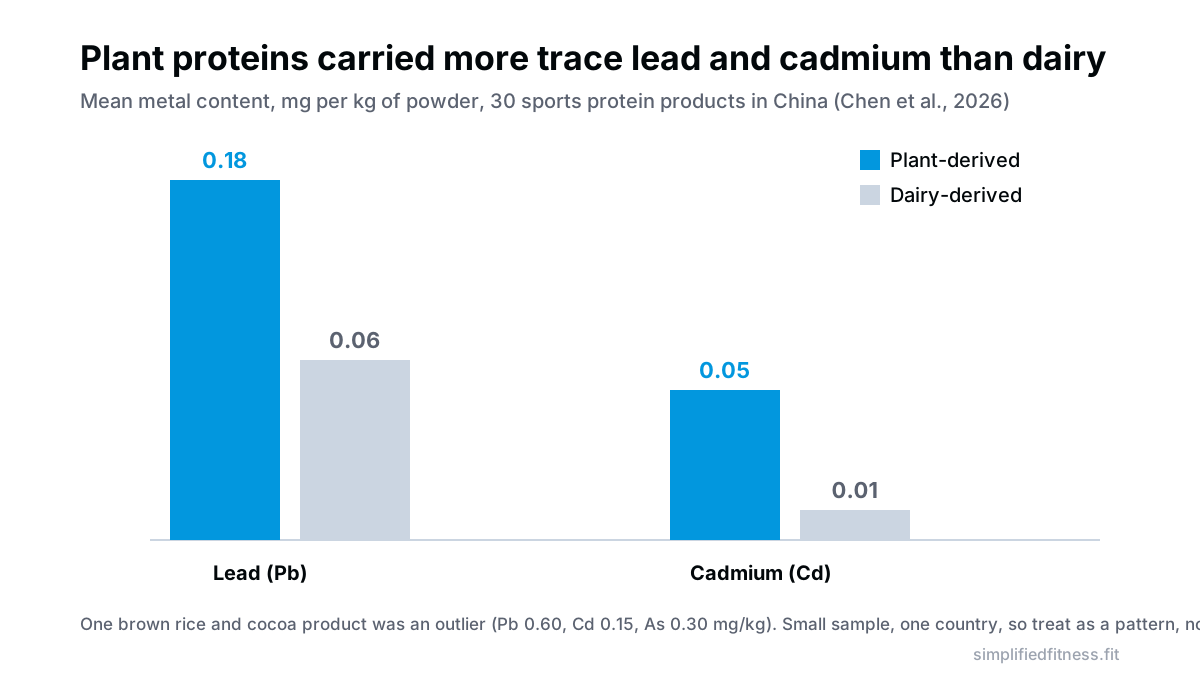
Two cautions. Thirty products from one country is a small sample, and averages hide a lot of brand-to-brand spread. If you rely on pea, rice or soy protein (very common for vegetarians in India), this is a reason to be a bit pickier, not a reason to go back to eating only dal and wondering about your protein. Our plant-based protein powder review covers amino acid quality and blending in more detail.
What do the risk assessments actually say?
Here the studies disagree a little, and the disagreement is informative.
The reassuring result. The 2020 assessment modelled arsenic, cadmium, mercury and lead from the earlier reports, assuming one or three servings a day. The cumulative hazard index stayed below 1. Mass gainer powders had the highest values, approaching 1, and whey the lowest. Background lead exposure from the rest of life drove adult blood lead estimates, and all modelled levels stayed under the CDC guidance value of 5 μg/dL. The authors concluded that typical supplement intake would not be expected to cause adverse health effects from heavy metals (Bandara et al., 2020).
The more cautious result. A 2024 study by researchers in Lahore, Pakistan, tested 25 protein supplements bought from pharmacies and found cadmium of 0.01-0.78 mg/kg and lead of 0.06-0.57 mg/kg. The weekly cadmium intake exceeded the tolerable weekly intake set by the European Food Safety Authority, although the hazard index, target hazard quotient and cancer risk estimates still showed no appreciable risk (Irshad et al., 2024). A 2026 study of 23 sports supplements sold in Oman (a broader category than protein powder alone) found cadmium was not detected, but arsenic and lead showed up in 13.0% of samples, several samples had a hazard index of 1 or more, and labels sometimes did not match contents (Ibrahim et al., 2026).
Why they may differ. Different products, different countries, different protein sources, different serving assumptions and different reference limits. Regulators also use different yardsticks, so the same powder can pass one and exceed another. The shared message is that most products are fine at normal use, a minority are not, and you cannot tell which from the front of the tub.
How much protein powder is too much?
Dose is the lever you control. The 2026 model estimated a hazard index of 0.45 at 30 g of powder a day and 0.90 at 90 g a day, driven mostly by arsenic and cadmium. A Monte Carlo simulation put the 95th-percentile hazard index at 1.28 under high-use conditions, while predicted blood lead increments stayed below 3 μg/dL (Chen et al., 2026).
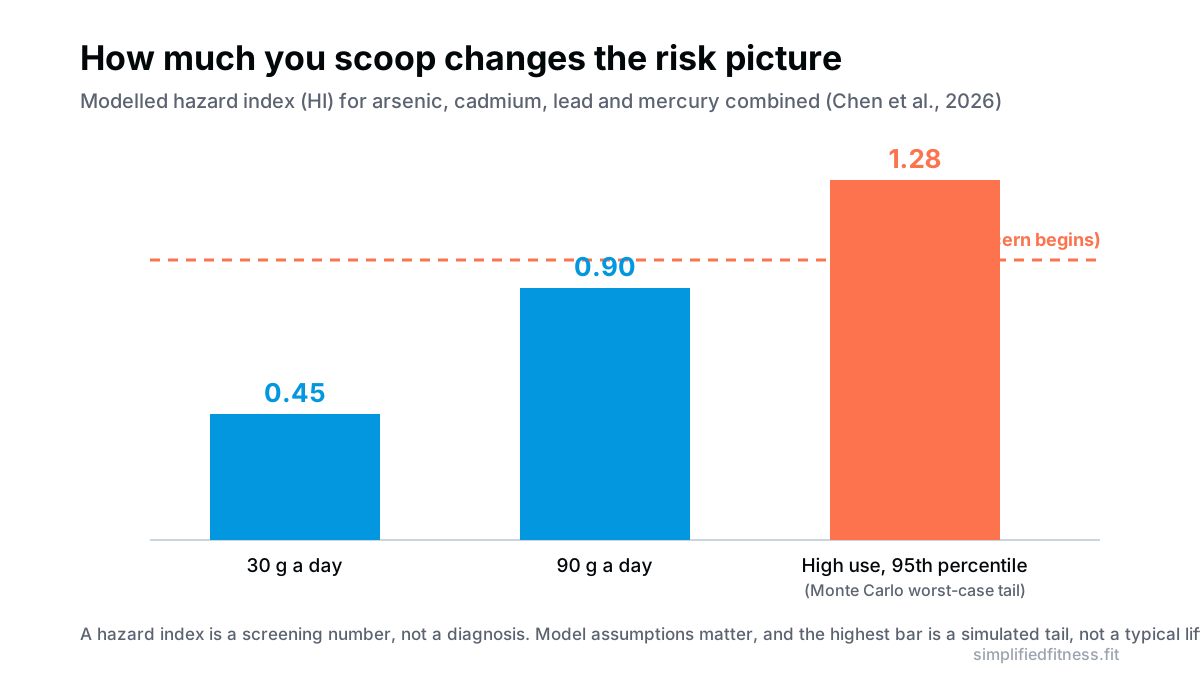
Read that carefully. The highest bar is a simulated tail, not a typical lifter, and the model rests on assumptions. But the direction is clear: more scoops from a higher-metal product means a higher number.
For lifters, a large meta-analysis found that extra protein stopped adding lean mass once total intake passed about 1.6 g per kg of body weight a day (Morton et al., 2018), and a lot of that can come from food. You can see your own target in the protein intake calculator. A 70 kg lifter aiming for about 115 g might get 80 g from roti, dal, curd, paneer, eggs and soya chunks, and use one scoop to close the gap. That is a very different exposure from three scoops by habit.
What about thallium, mercury and other extras?
Lead, cadmium and arsenic get the headlines, but they are not the only contaminants researchers have found. A 2024 Brazilian study of 32 slimming and fitness supplements bought online found about 24% had thallium above 1 mg/kg, with the highest estimated daily intake in a protein-based supplement (Tessele et al., 2024). Mercury was mostly below 0.01 mg/kg in the 2026 Chinese test, with a single collagen sample at 0.02 mg/kg (Chen et al., 2026).
The lesson is not that every tub is a risk. It is that supplements are lightly regulated in many places, and one study of online products is not the same as one of reputable brands. Buying from an unknown seller is a bigger risk factor than choosing plant over dairy. If fakes are your worry in India, our guide to FSSAI rules and spotting fake protein is the better starting point, and so is checking for amino spiking.
Third-party testing, Prop 65 and “clean” labels
This is where people lose money, so a few plain points.
Third-party certification helps, but read what it covers. Programs such as NSF Certified for Sport and Informed Choice test batches for banned substances and some contaminants. Their limits and methods differ from one another, and I have not verified specific metal limits for each program here, so check the program’s own documents. Our guide to third-party supplement certifications walks through how to read them.
A certificate of analysis (CoA) beats a logo. A good brand publishes a batch-specific report from an accredited lab that lists lead, cadmium, arsenic and mercury as numbers. “Not detected” with a reporting limit is more useful than “passes.”
Prop 65 warnings are a legal disclosure, not a diagnosis. As I understand it, California’s Proposition 65 requires a warning above fairly low trigger levels. A warning tells you a listed chemical is present above that line, and it does not tell you your exposure is harmful. Compare the numbers and your serving size.
“Clean” and “lab tested” on their own mean little. There is no universal standard behind those words. Ask which lab, which metals, which batch.
I cannot vouch for specific brand rankings from third-party sites, because their methods and results change and I have not audited them. Use them as one input, not a verdict.
How to buy a safer protein powder
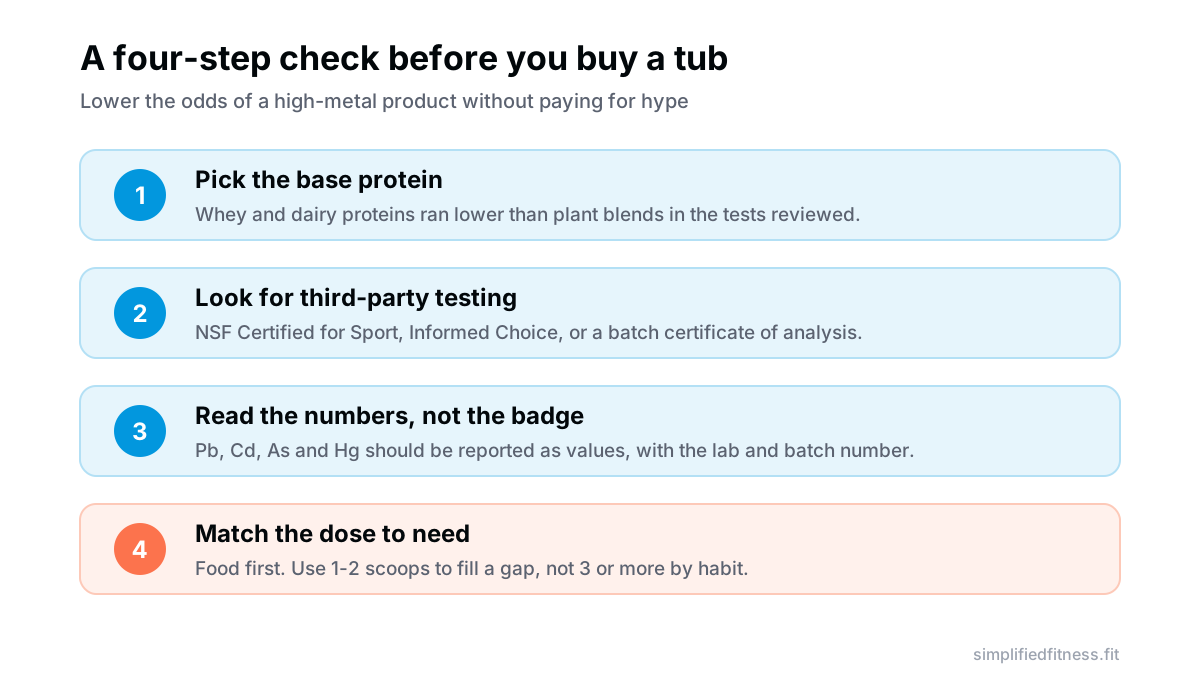
- Start with food. Dal, curd, paneer, eggs, chicken, fish, soya and milk can cover most of your protein. A powder is a convenience, not a requirement.
- Dairy protein such as whey first, if you tolerate it. Whey and dairy-derived powders ran lowest in the studies we reviewed. If lactose bothers you, see whey isolate vs concentrate.
- If you are vegetarian or vegan, rotate sources. Pea, soy and rice blends from different crops and farms spread out any one source’s metal load.
- Prefer brands that publish batch CoAs with metal values. If you cannot find one, email the company and ask.
- Stick to one or two scoops. The dose-response in the 2026 model is the most practical lever you have.
- Avoid mass gainers as a default and skip products with a flashy “proprietary” label (see proprietary blends and underdosing).
- Buy from the brand or an authorised seller. Unknown online sellers are a bigger risk than the plant vs dairy choice.
Who should be more careful
Talk to a doctor or dietitian before relying on protein powders if you have kidney disease, are pregnant or breastfeeding, or are buying for a child or teenager. Lead and cadmium are generally of greater concern in those groups, and most of the studies above modelled adults. Also mention long-term, high-dose supplement use if you ever get unexplained fatigue, abdominal pain or kidney-related blood test changes. Do not diagnose yourself from a news article.
The bottom line
The heavy metal story is not a hoax and it is not a poisoning epidemic. Trace metals turn up in many protein powders, plant-based ones run higher on average, and cadmium is the one worth respecting. At one or two scoops a day from a tested brand, the risk assessments we reviewed do not point to a level of concern.
So the move is simple. Get most of your protein from food, use powder to fill the gap, check for real test numbers, and do not stack several scoops a day out of habit. If you want a target to aim for, start with the protein intake calculator.
Frequently Asked Questions
Are there heavy metals in protein powder?
Yes, trace amounts of lead, cadmium and arsenic are found in many protein powders, though the levels are usually low. These metals occur naturally in soil and water, so crops and animals pick them up in small quantities. A 2020 risk assessment concluded that typical protein powder intake would not be expected to cause adverse effects from heavy metals, so the practical step is to choose tested brands rather than quit protein.
Is the heavy metal scare about protein powder true?
It is partly true. Contamination is real and some products are noticeably higher than others, but test results do not show that a normal scoop is poisoning people. Risk assessments mostly land below levels of concern at typical doses, with a few exceptions at high intakes or in high-metal products. Treat it as a reason to check labels and not as a reason to panic.
Which protein powder has the least heavy metals?
Whey protein tended to have the lowest estimated hazard in a 2020 risk assessment, and dairy-derived products had lower lead and cadmium than plant-derived ones in a 2026 test of 30 products. That is a pattern across small samples, not a guarantee for any single brand. Check the batch test results of the specific tub you plan to buy.
Is plant protein worse than whey for heavy metals?
On average in the data we have, yes. Plants absorb metals such as cadmium and arsenic from soil, and the 2026 test found higher mean lead and cadmium in plant-derived powders than dairy ones. Many plant products are still within modelled safe ranges, so choose a tested one and rotate sources if you rely on plant protein.
Is arsenic in rice protein dangerous?
Rice takes up arsenic more readily than most crops, so rice protein is a product worth checking. Dangerous depends on dose and the form of arsenic, and the studies we reviewed model risk at typical servings, not certainty of harm. If you use rice protein daily, look for a tested brand or blend it with other sources such as pea or soy.
Is pea protein safe regarding heavy metals?
Pea protein is not singled out in the studies we reviewed, since they grouped products as plant-derived rather than by pea or rice. Plant powders as a group ran higher in lead and cadmium than dairy, so quality varies by brand and batch. Pick one with published test results and avoid very high daily amounts.
Which heavy metal in protein powder is the most worrying?
Cadmium is usually the one to watch, because it builds up in the kidneys over years and is cleared very slowly. A 2004 review described it as a cumulative kidney toxicant, and a 2024 test of 25 products found weekly cadmium intake above the EFSA limit. Keep total intake sensible and favour tested products.
What is a hazard index in these studies?
A hazard index adds up the modelled exposure of each metal as a fraction of a reference dose. Below 1 means exposure sits under the level where regulators expect no appreciable effect, and above 1 means the model flags a possible concern worth a closer look. It is a screening tool built on assumptions, so use it as a guide and not as a diagnosis.
How many scoops of protein powder a day is safe?
There is no single official scoop limit for heavy metals, but the 2026 model suggests risk rises with dose. At 30 g a day the hazard index was 0.45, at 90 g it was 0.90, and a simulated worst-case high-use tail crossed 1.0. For most lifters, one or two scoops to close a protein gap is plenty, and the rest should come from food such as dal, paneer, curd, eggs and soya.
Does a third-party tested label guarantee no heavy metals?
No. Programs such as NSF Certified for Sport or Informed Choice screen for banned substances and contamination, but the exact metal limits and testing depth differ by program. Look for a batch certificate of analysis that reports lead, cadmium, arsenic and mercury as actual numbers, since a logo alone does not tell you how low they are.
Do Prop 65 warning labels mean a protein powder is unsafe?
Not necessarily. A Proposition 65 warning is a California disclosure rule, and as I understand it the trigger levels are set to be cautious, so a warning is not a toxicity verdict. Compare the actual metal numbers and your serving size instead of reacting to the label alone.
Should I stop using protein powder because of heavy metals?
For most healthy adults, the evidence does not support quitting. The assessments we reviewed found typical intake did not reach levels of concern, while protein itself helps you hit your daily target. Cut back to the amount you need, choose a tested brand, and speak to a doctor if you have kidney disease, are pregnant, or are buying for a child.
Are heavy metals in food and supplements worse for kids or pregnant women?
Children and pregnant women are generally treated as more vulnerable to metals such as lead, so the margin for error is smaller. Most of the protein powder studies we reviewed modelled adults. If this applies to you, talk to a doctor or dietitian and lean on regular food protein instead of heavy supplement use.
Sources & References
Every claim above is checked against peer-reviewed research (PubMed, U.S. National Library of Medicine) or guidance from established health bodies. How we fact-check.
- Bandara SB, et al. A human health risk assessment of heavy metal ingestion among consumers of protein powder supplements. Toxicol Rep. 2020. PMID: 33005567
- Irshad M, et al. Appraisal of potentially toxic metals contamination in protein supplements for muscle growth: A chemometric approach and associated human health risks. J Trace Elem Med Biol. 2024. PMID: 38878468
- Chen M, et al. Heavy metal and Microplastic exposure from sports protein Supplements: Integrated health risk modeling and scenario analysis. Environ Res. 2026. PMID: 41655677
- Ibrahim AE, et al. Divulging the hidden risks of trace and heavy elements in sports nutritional supplements; a comprehensive study targeted with health risk evaluation. J Trace Elem Med Biol. 2026. PMID: 41775224
- Clemens S, Ma JF. Toxic Heavy Metal and Metalloid Accumulation in Crop Plants and Foods. Annu Rev Plant Biol. 2016. PMID: 27128467
- Satarug S, Moore MR. Adverse health effects of chronic exposure to low-level cadmium in foodstuffs and cigarette smoke. Environ Health Perspect. 2004. PMID: 15238284
- Tessele I, et al. Investigation of thallium as a contaminant in dietary supplements marketed for weight loss and physical fitness. Food Addit Contam Part A. 2024. PMID: 38781478
- Morton RW, et al. A systematic review, meta-analysis and meta-regression of the effect of protein supplementation on resistance training-induced gains in muscle mass and strength in healthy adults. Br J Sports Med. 2018. PMID: 28698222

Umair Hazrami · Founder & Head Coach, Simplified Fitness
Umair Hazrami founded Simplified Fitness and the Simplified Lifter channel to cut through fitness noise. With 4+ years of consistent training and 10+ coaching clients, he writes every guide from the peer-reviewed research and links the sources so you can check them. Our editorial standards.
Educational content only, not medical advice. If you have a medical condition, are pregnant, or take medication, talk to a qualified doctor before changing your diet, supplements or training. Full disclaimer.
Keep reading
Supplements
Alpha-GPC and Huperzine A Pre-Workout: Do Cholinergic Nootropics Help Lifting?
Does an alpha GPC pre workout add power or focus? See what small trials found, why Huperzine A is a poor lifting bet, and the safety flags to know first.
10 min read
Supplements
The Antioxidant Paradox: Can Vitamin C and E Pills Blunt Muscle Growth and Endurance?
Does vitamin C blunt muscle growth? See what trials of 1000 mg vitamin C plus E found for strength, hypertrophy and endurance, and when pills are worth taking.
8 min read
Supplements
Caffeine Powder vs Coffee Before Lifting: Does the Source Really Matter?
Caffeine anhydrous vs coffee for lifting: what research says on absorption speed, peak levels and stomach upset, and whether pills beat your daily cup.
7 min read

Supplements
Caffeine Dosing for Strength and Power: 3-6 mg/kg and When to Take It
Caffeine dosage for strength is 3-6 mg/kg, about 210-420 mg for a 70 kg lifter, taken around 60 minutes before training. Doses, timing and when to stop.
8 min read