Creatine Timing: Pre-Workout vs Post-Workout vs Anytime, Does It Matter?
Creatine timing barely matters. See what the pre vs post-workout trials found, why daily consistency wins, and the easiest time to take your 3-5 g.
TL;DR. The short answer
- Creatine timing is a minor factor. Most controlled trials that compared before versus after training found no meaningful difference in muscle gain or strength.
- The study behind the post-workout claim (Antonio & Ciccone, 2013) had 19 men, trained for 4 weeks, and found no statistically significant difference between groups. The authors leaned on a softer statistical method.
- Muscle creatine fills up through repeated daily doses over weeks (about 28 days at 3 g/day in one study), so what you do every day matters more than what you do around one workout.
- A practical default is 3-5 g of creatine monohydrate daily, taken at a time you will never skip. If that happens to be your post-workout meal, great.
- Skipping rest days is the bigger risk. Take it on non-training days too.
Part of our complete guide: Creatine, Protein Powders, Pre-Workouts and Caffeine: The Science and Safety Guide
Table of contents
Creatine timing does not matter much. Trials that compared taking creatine before versus after training mostly find no meaningful difference, and creatine works by slowly filling your muscle stores over weeks, so a dose you take every day beats a “perfect” dose you sometimes miss. This is one of the quieter questions inside our complete guide to creatine, protein powders and caffeine.
The confusion is understandable. Supplement labels shout “take 30 minutes before your workout” while forum posts swear by “right after.” Let’s look at what the studies actually found, including the 2013 Antonio study everyone quotes, and then settle on a simple routine.
Does creatine timing matter for muscle growth?
Probably only a little, and the evidence is not strong enough to say either way with confidence. A 2021 review of the timing literature noted that emerging evidence suggests greater benefits when creatine is taken after exercise than before, but that methodological limitations stop anyone drawing solid conclusions. It also pointed out that mechanistic data supporting a timing effect are lacking (Ribeiro et al., 2021).
In plain gym language: a few small studies lean slightly toward after-training, a few find nothing, and one tiny recent pilot leaned toward before. Nobody has shown that timing beats simply taking it daily.
What did the Antonio and Ciccone creatine study actually find?
This is the trial behind most “post-workout is better” claims, so it deserves a careful look.
Nineteen healthy recreational male bodybuilders took 5 g of creatine either immediately before or immediately after training. They trained about five days a week for four weeks and took the creatine at their convenience on the two rest days. The researchers measured body composition and bench press 1-RM (Antonio & Ciccone, 2013).
Both groups gained fat-free mass and strength. Here is the important part: the authors reported that no significant interactions were found, meaning the difference between pre and post groups did not reach statistical significance. They then used magnitude-based inference, which suggested post-workout was “possibly more beneficial.” The mean changes were:
- Fat-free mass: +0.9 kg (pre) versus +2.0 kg (post)
- Fat mass: -0.1 kg versus -1.2 kg
- Bench press 1-RM: +6.6 kg versus +7.6 kg
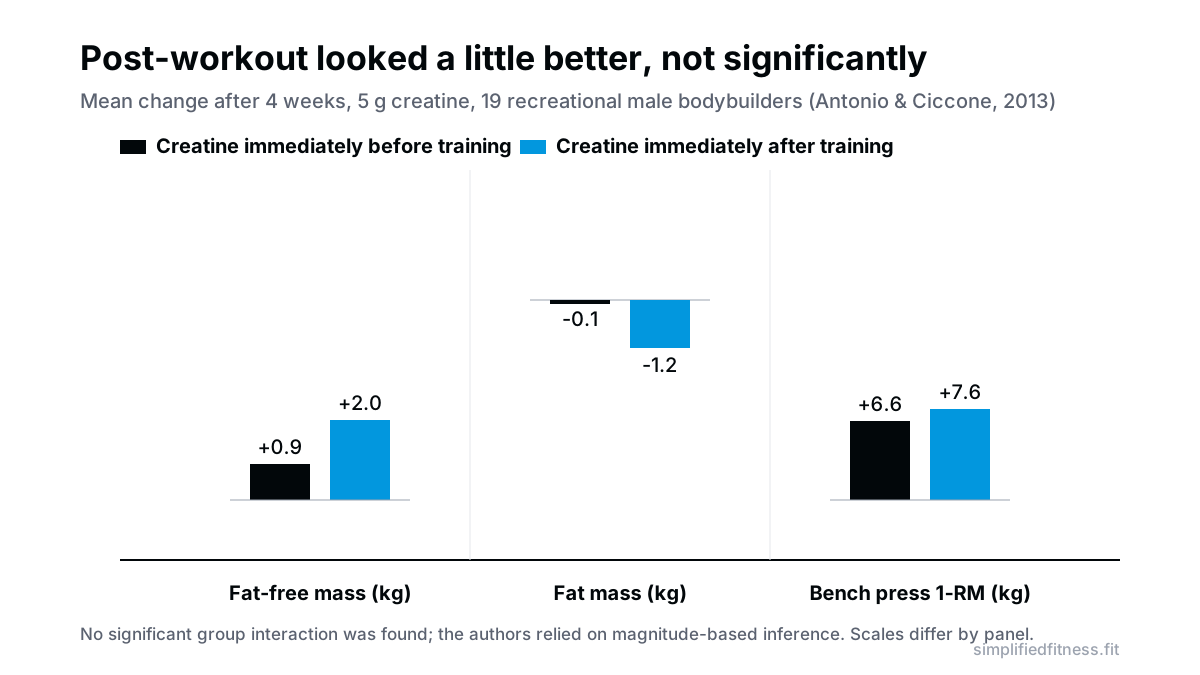
Look at those standard deviations in the abstract too: fat-free mass changed by 0.9 ± 1.8 kg in the pre group and 2.0 ± 1.2 kg in the post group. The spread is wide relative to the gap. With 19 people in total, a few individuals can swing the averages, and body composition from a single 4-week window is noisy.
What did other studies find on pre vs post-workout creatine?
Mixed, and that is the honest summary. Here is what each study did and why the results may differ.
| Study | People | Design | Main finding |
|---|---|---|---|
| Antonio & Ciccone, 2013 | 19 recreational male bodybuilders | 5 g before vs after, 4 weeks | Trend favouring after; no significant interaction |
| Candow et al., 2015 | Older adults, 50-71 years | 0.1 g/kg before vs after vs placebo, 32 weeks | Strength gains independent of timing; lean mass gain larger than placebo only in the after group |
| Forbes et al., 2021 | 10 recreationally active adults | Within-person, one side before, other side after, 8 weeks | No difference in muscle thickness or strength |
| Dinan et al., 2022 | 34 resistance-trained athletes | 5 g within 1 h before or after, vs placebo, 8 weeks | Timing gave no additional benefit |
| Ben Maaoui et al., 2026 | 11 active men | Single dose before, during or after, crossover pilot | More load lifted than placebo or no supplement when taken before; authors call it exploratory |
A few things stand out.
The longer, better-controlled designs mostly found no timing effect. Forbes used the same person as their own control, which removes a lot of person-to-person noise: both sides gained muscle and strength equally (Forbes et al., 2021). Dinan’s 8-week trial included men and women who were already resistance-trained, and all groups improved similarly (Dinan et al., 2022). One caveat: everyone in that study also took 25 g of whey isolate plus 25 g of maltodextrin with each dose, so we do not know whether timing would differ without those co-ingested nutrients.
The older-adult trial gave a nuanced result. Over 32 weeks, creatine increased strength regardless of timing, while the after-training group gained more lean tissue than placebo (3.0 ± 1.9 kg versus 0.5 ± 2.1 kg) (Candow et al., 2015). The before group was not reported as significantly different from placebo on lean mass. Whether that reflects true timing effects or just sample size is unclear. It was a small trial in older adults, so it may not apply to a 25-year-old lifter.
The 2026 pilot points the other way. In 11 active men, creatine taken before a session led to more total load lifted than placebo or no supplement, and the authors concluded it beat the other timings. But that was a single-dose, acute design with a small sample, and the authors say the results are exploratory and need confirmation (Ben Maaoui et al., 2026). Muscle gains happen over months, so one session is a weak basis for choosing a long-term schedule.
Why might the studies disagree? Small samples, different doses (a fixed 5 g versus a body-weight-based 0.1 g/kg), different training experience, different durations, and different statistical methods. That mix of reasons is typical when the true effect is small or zero.
Why does daily consistency beat timing?
Because creatine is a stored nutrient, not a stimulant. Your muscle total creatine concentration rises gradually as you keep taking it. In a classic study, 3 g a day raised muscle total creatine by about 20% over a period of 28 days, and 20 g a day for 6 days got there faster; the authors concluded that 3 g/day is, over the long term, likely to be as effective at raising tissue levels as the higher dose (Hultman et al., 1996). The same study showed muscle levels drifted back to baseline roughly 30 days after supplementation stopped.
So think in weeks, not minutes. If your muscle stores are topped up, whether the last scoop went in at 7 am or 9 pm barely changes the picture. If you skip half your days, the timing of the other half will not rescue it.
If you want to understand the loading side of this, our article on creatine loading vs daily maintenance covers the saturation timeline, and the mechanism of creatine and ATP recycling explains why stores matter.
What is the best time to take creatine monohydrate in practice?
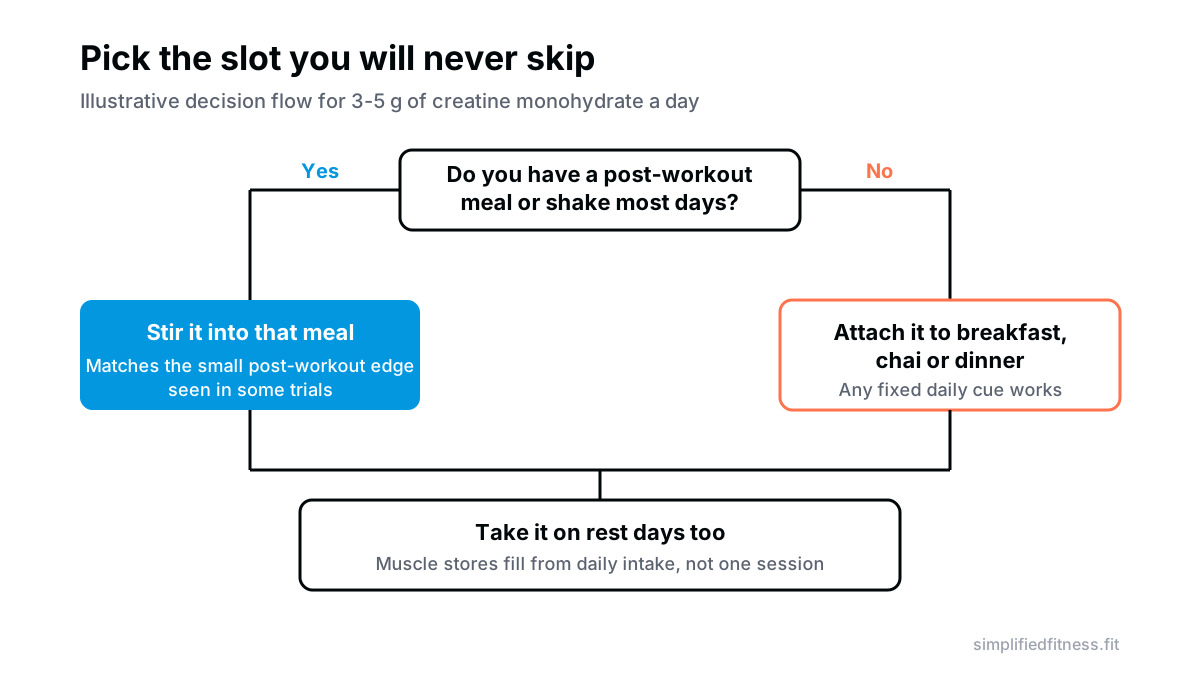
The one you will do every day. Here is a simple way to choose.
- You lift most days and eat afterwards: put the creatine in your post-workout meal or shake. It lines up with the small after-training trend in some trials and builds a habit around something you already do.
- You train irregularly or in the evening: attach it to breakfast, a morning chai or lunch instead. The cue is the point.
- You hate remembering things: keep the tub next to your kettle or your toothbrush.
How should I take it with Indian meals and routines?
Nothing fancy is needed. Plain creatine monohydrate dissolves well enough in room-temperature water, milk, a lassi, curd or a protein shake. Many people find it easier on the stomach with a meal, for example stirred into dahi with breakfast or taken with dal, roti and rice at lunch or dinner.
In hot weather or during long sessions, keep your normal hydration habits. That advice is not unique to creatine, and we cover the broader daily schedule in our daily supplement protocol. For product choice, our comparison of creatine forms explains why monohydrate is still the standard.
You can work out a sensible daily amount for your body weight with the creatine dosage calculator.
What about the scale jump people notice?
Some people notice a bump in scale weight in the first few weeks and wonder if timing caused it. The water shift tracks rising muscle creatine, not the hour you took it. We explain the difference in creatine water weight and bloating.
When to talk to a doctor
Creatine at normal doses has a good safety record in healthy adults; the ISSN position stand reports that short and long-term supplementation (up to 30 g/day for 5 years) was safe and well tolerated in healthy individuals (Kreider et al., 2017). That does not cover everyone. Speak to a doctor before starting if you have kidney disease, take medicines that affect the kidneys, are pregnant or breastfeeding, or have any ongoing medical condition. If you get persistent stomach pain, vomiting or other symptoms after starting, stop and get medical advice.
The bottom line
The studies on creatine timing are small, short and not consistent. The best-known one (Antonio & Ciccone, 2013) found a trend for after-training dosing that did not reach statistical significance, and several later trials found no difference. What every study agrees on is that creatine plus resistance training works.
So take 3-5 g of creatine monohydrate every day, at a time you can sustain, including rest days. If that is right after training, good. If it is with breakfast, equally good. Then spend your energy on the things that move the needle: progressive overload, enough protein and sleep. Our free training plans are a decent place to start.
Frequently Asked Questions
When is the best time to take creatine?
There is no proven best time, because trials comparing timing mostly find no meaningful difference. Creatine works by gradually raising muscle stores over weeks, so the daily habit matters more than the clock. Pick a slot you will not forget, such as breakfast or your post-workout meal, and use it every day.
Should I take creatine before or after a workout?
Either is fine for most people. A small 2013 study saw a slight, non-significant edge for after training, while a 2021 within-person trial and a 2022 8-week trial found no difference. If you train most days and eat after, post-workout is a convenient default, but do not stress over it.
Does the Antonio and Ciccone study prove post-workout creatine is better?
No. The 2013 study of 19 male bodybuilders found no significant difference between pre and post groups, and the post-workout conclusion rested on magnitude-based inference. With so few people and only 4 weeks, it can suggest a hypothesis but cannot settle the question. Treat it as a hint, not a rule.
Do I need to take creatine on rest days?
Yes, ideally. Muscle stores fall back toward baseline over roughly a month after you stop, so skipping days slows the build-up. Take your usual 3-5 g with a meal on rest days as well.
Does creatine need to be taken with food?
It is not required, but many people find it sits easier on the stomach with a meal. Some research combines creatine with carbohydrate or protein, though the practical benefit of that for most lifters is unclear. If a plain glass of water works for you, that is fine.
Is it okay to take creatine at night?
Yes. Because the total amount accumulating over days is what counts, an evening dose is as reasonable as a morning one. Take it with dinner or a glass of milk if that is the meal you never miss.
Can I take creatine with coffee or chai?
Many people do, and there is no strong evidence that a normal cup of coffee or chai cancels the benefit. If you are unsure or you notice stomach upset, take the creatine with water or food instead. Consistency still matters more than the drink.
Should I split my creatine dose into two servings?
For 3-5 g a day, one serving is enough. Splitting can help if you are loading with larger amounts and get stomach discomfort, because smaller portions are easier to tolerate. Otherwise it only adds more chances to forget.
Does timing matter more if I am older or a beginner?
Evidence is limited. One 32-week trial in older adults (50-71 years) found creatine improved strength regardless of timing, with a larger lean mass gain in the after-training group than placebo. The sample was small, so the practical message is the same: take it daily.
Does creatine timing change water weight?
Water retention is linked to your muscle creatine rising, not to the exact hour you drink it. Expect a modest scale increase in the first weeks whenever you take it. You can read the difference between muscle water and bloating in our water weight guide.
What if I forget a dose?
Just take your next scheduled dose and do not double up. Muscle stores decline slowly, so one missed day is unlikely to undo your progress. Anchor the habit to something fixed, like brushing your teeth or your first meal.
Is a pre-workout powder with creatine in it a good idea?
It can be, but check the label because many products contain well under 3-5 g. A small dose in a blend will not do much for muscle stores over time. Plain creatine monohydrate is cheaper and lets you control the amount.
Sources & References
Every claim above is checked against peer-reviewed research (PubMed, U.S. National Library of Medicine) or guidance from established health bodies. How we fact-check.
- Antonio J, et al. The effects of pre versus post workout supplementation of creatine monohydrate on body composition and strength. J Int Soc Sports Nutr. 2013. PMID: 23919405
- Ribeiro F, et al. Timing of Creatine Supplementation around Exercise: A Real Concern? Nutrients. 2021. PMID: 34445003
- Dinan NE, et al. Effects of creatine monohydrate timing on resistance training adaptations and body composition after 8 weeks in male and female collegiate athletes. Front Sports Act Living. 2022. PMID: 36465581
- Forbes SC, et al. Timing of creatine supplementation does not influence gains in unilateral muscle hypertrophy or strength from resistance training in young adults: a within-subject design. J Sports Med Phys Fitness. 2021. PMID: 34610729
- Candow DG, et al. Strategic creatine supplementation and resistance training in healthy older adults. Appl Physiol Nutr Metab. 2015. PMID: 25993883
- Ben Maaoui K, et al. Acute Creatine Ingestion Before Resistance Training Enhances Strength Performance More than Ingestion During or After Training: A Randomized Crossover Pilot Trial. Nutrients. 2026. PMID: 42280432
- Hultman E, et al. Muscle creatine loading in men. J Appl Physiol. 1996. PMID: 8828669
- Kreider RB, et al. International Society of Sports Nutrition position stand: safety and efficacy of creatine supplementation in exercise, sport, and medicine. J Int Soc Sports Nutr. 2017. PMID: 28615996
- Aragon AA, et al. Nutrient timing revisited: is there a post-exercise anabolic window? J Int Soc Sports Nutr. 2013. PMID: 23360586

Umair Hazrami · Founder & Head Coach, Simplified Fitness
Umair Hazrami founded Simplified Fitness and the Simplified Lifter channel to cut through fitness noise. With 4+ years of consistent training and 10+ coaching clients, he writes every guide from the peer-reviewed research and links the sources so you can check them. Our editorial standards.
Educational content only, not medical advice. If you have a medical condition, are pregnant, or take medication, talk to a qualified doctor before changing your diet, supplements or training. Full disclaimer.
Keep reading

Supplements
Alpha-GPC and Huperzine A Pre-Workout: Do Cholinergic Nootropics Help Lifting?
Does an alpha GPC pre workout add power or focus? See what small trials found, why Huperzine A is a poor lifting bet, and the safety flags to know first.
10 min read

Supplements
The Antioxidant Paradox: Can Vitamin C and E Pills Blunt Muscle Growth and Endurance?
Does vitamin C blunt muscle growth? See what trials of 1000 mg vitamin C plus E found for strength, hypertrophy and endurance, and when pills are worth taking.
8 min read

Supplements
Caffeine Powder vs Coffee Before Lifting: Does the Source Really Matter?
Caffeine anhydrous vs coffee for lifting: what research says on absorption speed, peak levels and stomach upset, and whether pills beat your daily cup.
7 min read

Supplements
Caffeine Dosing for Strength and Power: 3-6 mg/kg and When to Take It
Caffeine dosage for strength is 3-6 mg/kg, about 210-420 mg for a 70 kg lifter, taken around 60 minutes before training. Doses, timing and when to stop.
8 min read