Isabgol for Weight Loss: Does Psyllium Husk Really Make a Cut Easier?
Isabgol for weight loss: what trials show on psyllium husk, satiety and blood sugar, the 5-10 g dose, water rules and who should skip it. Every study linked.
TL;DR. The short answer
- Isabgol (psyllium husk) can help with weight loss, modestly. A 2023 meta-analysis of 6 trials (354 people) found about 2.1 kg more weight lost than control, with doses averaging 10.8 g/day taken just before meals.
- It works mechanically: the husk forms a gel that slows stomach emptying and lowers hunger between meals. The popular GLP-1 and PYY claims were not measured in the trials reviewed here.
- A practical dose is 5-10 g a day, started low and mixed into at least 250-500 mL of water. Without enough fluid, psyllium can cause blockage.
- Glucomannan, often sold as a rival, did not beat placebo for weight loss in a 2014 meta-analysis of 8 trials.
- Psyllium is a small tool, not a fat burner. Protein, calories and training still decide your cut, and anyone with swallowing problems, bowel obstruction or diabetes medication should check with a doctor first.
Part of our complete guide: Creatine, Protein Powders, Pre-Workouts and Caffeine: The Science and Safety Guide
Table of contents
Isabgol for weight loss works, but only a little, and only as a hunger tool. In a 2023 meta-analysis of six trials, people who took psyllium husk just before meals lost about 2.1 kg more than controls. That is useful on a cut. It is not a fat burner.
If you already know the basics of protein, calories and training, this is one of the cheapest add-ons in the supplement aisle, and you probably have a packet in your kitchen. (It sits in our guide to creatine, protein powders and caffeine as a boring but practical extra.) Let’s look at what the studies actually show, how to dose it, and where the internet oversells it.
What is isabgol (psyllium husk) and how does it work?
Isabgol is the husk of the Plantago ovata seed. Psyllium is the same thing under its international name. It is mostly soluble fiber that absorbs water and turns into a thick gel. Humans do not digest it, and, unlike many fibers, it is not heavily fermented by gut bacteria.
That gel is the whole trick. The authors of the 2023 weight-loss meta-analysis describe it as increasing the viscosity of stomach and intestinal contents, which slows how fast nutrients are broken down and absorbed (Gibb et al., 2023). A 2026 review lists enhanced satiety and delayed gastric emptying among the mechanisms behind its effects (Kumar et al., 2026).
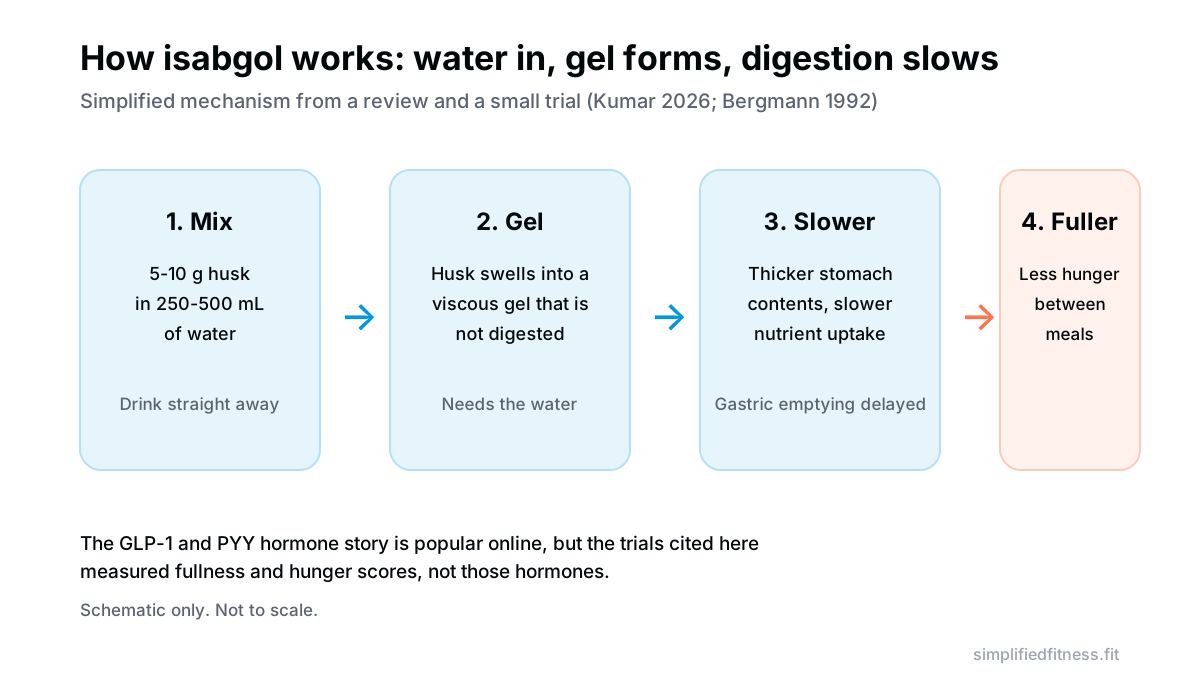
Here is the part you will see overhyped online: “psyllium triggers GLP-1 and PYY.” Those are real satiety hormones. But the trials I reviewed for this article measured gastric emptying and hunger scores, not those hormones. Treat the hormone claim as plausible but unproven here.
Does psyllium husk actually help you eat less?
Short answer: it seems to, over a few hours.
A 1992 crossover trial gave 12 healthy volunteers 10.8 g of psyllium or placebo. Psyllium delayed stomach emptying from the third hour after a meal and increased fullness while lowering hunger at the sixth hour (Bergmann et al., 1992). Tiny study, old, but the mechanism matches the later work.
A 2016 pair of randomized, double-blind, placebo-controlled crossover trials tested 3.4, 6.8 and 10.2 g taken before breakfast and lunch for three days. All three doses moved hunger, desire to eat and fullness in the right direction versus placebo, though not always significantly. The two higher doses beat placebo and 3.4 g, and 6.8 g gave the most consistent effect. A second trial at 6.8 g, paired with a reduced-calorie breakfast, also lowered 3-day hunger. Side effects were mostly mild gut symptoms, similar to placebo (Brum et al., 2016).
Honest caveat: the 2016 trials ran for three days in healthy volunteers, tested Metamucil, and were co-authored by Procter and Gamble researchers. Short-term fullness scores are not the same as losing fat over months.
How much weight can you lose with isabgol?
Modest, steady, not dramatic.
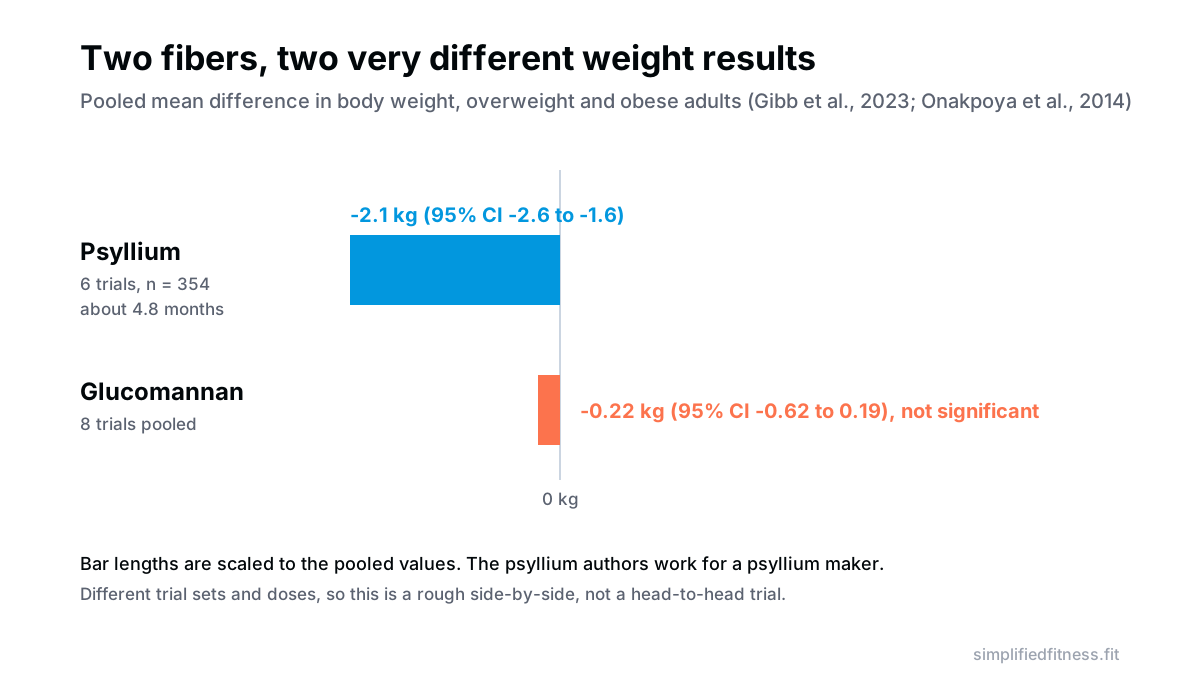
The 2023 meta-analysis pooled six randomized trials (354 overweight or obese adults, at least two months long). Psyllium dosed just before meals, at an average of 10.8 g a day for about 4.8 months, lowered body weight by 2.1 kg (95% CI -2.6 to -1.6), BMI by 0.8 kg/m² and waist circumference by 2.2 cm compared with control (Gibb et al., 2023). The authors are employed by Procter and Gamble, which makes a psyllium product, so keep that in mind.
A separate 52-week trial of 159 overweight and obese adults is a useful reality check. Participants kept their usual habits and took 5 g of a supplement with 500 mL of water 5-10 minutes before meals. Weight in the (proprietary) psyllium group was about 1.1 kg lower than control at 3 months and 2.4 kg lower at 6 months, and body fat was 1.4 kg lower at 12 months (Pal et al., 2016). Note the pattern: the benefit is real but small, and the trial’s main conclusion favoured a different, proprietary fiber blend over plain psyllium.
Psyllium vs glucomannan vs inulin: which fiber supplement is best?
For a cutting diet, psyllium has the best evidence of the common options.
Glucomannan (konjac) is the usual rival, and it is gel-forming too. Yet a 2014 meta-analysis of 8 randomized trials found no statistically significant weight loss versus placebo (mean difference -0.22 kg; 95% CI -0.62 to 0.19), and reported abdominal discomfort, diarrhea and constipation as adverse events. The reporting quality of the trials varied (Onakpoya et al., 2014).
| Fiber | Type | What the evidence looks like |
|---|---|---|
| Psyllium (isabgol) | Gel-forming, mostly non-fermented | Modest weight loss in meta-analysis, satiety trials, lowers LDL |
| Glucomannan | Gel-forming | No significant weight loss in 8-trial meta-analysis |
| Inulin | Fermentable | Not reviewed here, so no claim made. Fermentable fibers generally cause more gas |
I did not look at inulin trials for this piece, so I will not claim it does or does not help. Fermentable fibers do tend to cause more gas, which matters if you train hard and want to feel normal.
How to take isabgol on a cut: dose, timing, water
The mechanism tells you the protocol. You need the gel to form before food, you need a lot of water, and you should build up slowly.
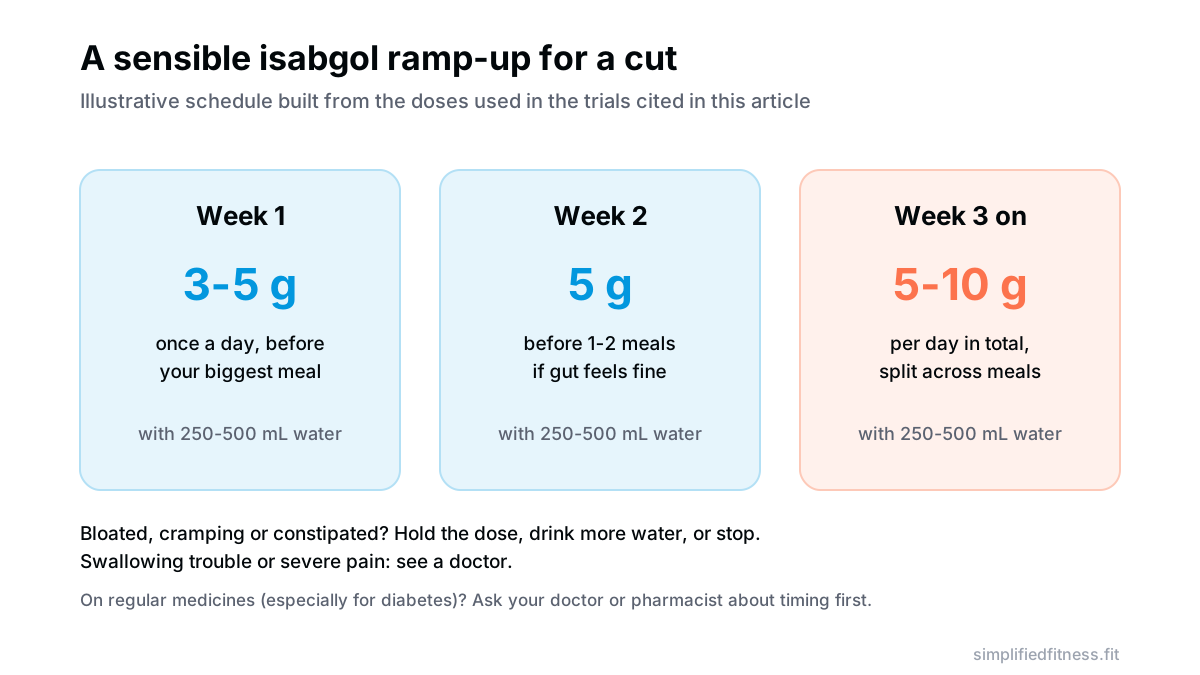
- Dose: 5-10 g a day is a sensible working range. The weight-loss trials averaged 10.8 g a day split before meals, and satiety was most consistent at 6.8 g in the short trials.
- Timing: just before a meal, as in the weight-loss trials. Use it before the meal where you tend to overeat.
- Water: at least 250 mL per dose, up to about 500 mL as used in the year-long trial.
- Ramp up: start at 3-5 g once a day for a week, then add.
You will often see advice to take “5-10 g with 500 mL, 15 minutes before high-calorie meals.” The 15-minute figure is not something I found tested head to head. The trials used “just before meals” or 5-10 minutes before, so that is what I would follow. Do not let a mixed glass sit, because it thickens fast.
In an Indian kitchen, plain isabgol in water with a squeeze of lemon works, and many people stir it into thin buttermilk or curd loosened with water. Work out your hydration with our water intake calculator, especially in summer when you lose more fluid.
Does isabgol control blood sugar and cholesterol?
Yes, in people whose numbers need it. This is where psyllium evidence is strongest, and it matters for a long diet.
A 2015 meta-analysis of 35 randomized trials found that in people with type 2 diabetes, multi-week psyllium dosed before meals lowered fasting glucose by 37.0 mg/dL and HbA1c by 0.97%. There was no significant glucose lowering in people with normal glucose, a modest improvement in pre-diabetes, and the biggest effect in those being treated for type 2 diabetes (Gibb et al., 2015). That analysis also drew on Procter and Gamble trial records. Translation: if your blood sugar is normal, do not expect isabgol to flatten your glucose curve.
For cholesterol, a 2018 meta-analysis of 28 trials (1,924 people) found a median dose of about 10.2 g reduced LDL cholesterol by 0.33 mmol/L, non-HDL cholesterol by 0.39 mmol/L and apoB by 0.05 g/L (Jovanovski et al., 2018).
If you take diabetes medication, speak to your doctor before starting, because psyllium can lower glucose further. Because the gel slows absorption, product labels generally advise taking other medicines a couple of hours apart from psyllium; ask your pharmacist about yours.
Where isabgol fits in a cutting diet
Fiber helps, but it will not rescue a bad plan. Order of operations on a cut:
- A realistic deficit (see moderate vs aggressive calorie deficits). Find yours with the calorie calculator.
- Enough protein, covered in high protein during a cut and protein, satiety and the thermic effect.
- Bulky, low-calorie food. Read high-volume, low-calorie foods for cutting.
- Fiber from real food first, as explained in soluble vs insoluble fibre and gut health. Dal, sabzi, oats and fruit do most of the work.
- Then, if you still struggle with hunger, add isabgol.
For vegetarians eating a lot of dal and sabzi already, fiber may be high and extra husk can mean bloating. Check how your gut feels first. A sample plan for that style of eating is in our Indian vegetarian cutting diet.
Side effects and who should avoid isabgol
The usual complaints are bloating, gas, and changes in stool. The 2026 review also lists allergic reactions and gastrointestinal obstruction from inadequate water as adverse effects (Kumar et al., 2026). Most problems come from starting high or skimping on water.
See a doctor before using psyllium if you:
- have trouble swallowing or a history of esophageal or bowel narrowing
- have new or unexplained constipation, abdominal pain or blood in the stool
- take diabetes medication or other regular medicines
- are pregnant or breastfeeding
- have had an allergic reaction to psyllium
Severe abdominal pain, vomiting or being unable to pass stool or gas needs urgent medical care.
The bottom line
Isabgol is a cheap, low-risk way to feel fuller between meals, backed by a meta-analysis showing about 2 kg of extra weight loss over several months. The effect is modest, much of the evidence comes from overweight adults and some of it from manufacturer-linked authors, and it will not replace a calorie deficit.
Take 5-10 g before a meal, start low, drink plenty of water, and judge it by how well it helps you stick to your plan. If you want the deficit and training mapped out for you, start with our free plans.
Frequently Asked Questions
Does isabgol help with weight loss?
Yes, modestly. A 2023 meta-analysis of 6 randomized trials in overweight and obese adults found about 2.1 kg more weight loss with psyllium than control over roughly 4.8 months. Some of that is increased fullness, so use it to make your deficit easier, not as a substitute for one.
How much isabgol should I take per day for weight loss?
The weight-loss trials averaged about 10.8 g a day, usually split before meals, so 5-10 g a day is a sensible range to work within. A short satiety study found 6.8 g gave more consistent fullness than 3.4 g. Start with 3-5 g once a day and build up over two to three weeks.
Should I take psyllium husk before or after meals?
Before. The trials that showed weight and satiety benefits dosed it just before meals, so the gel is already forming when food arrives. One year-long trial used 5 g with 500 mL of water 5-10 minutes before meals.
Can I take isabgol at night?
Yes, many people do, usually in water or curd. There is no evidence that night is better or worse for fat loss, so choose the time you will repeat. Keep at least a glass of water with it, and avoid taking it right before lying down if you get reflux.
How much water do I need with psyllium husk?
At least 250 mL per dose, and trials often used about 500 mL. The husk absorbs water to form a gel, and with too little fluid it can thicken in the throat or bowel. Drink it straight after stirring and keep drinking through the day.
Is psyllium better than glucomannan for fat loss?
On current evidence, yes. A 2014 meta-analysis of 8 trials found glucomannan produced no significant weight loss versus placebo (-0.22 kg), while psyllium pooled at about -2.1 kg in a separate 2023 analysis. They are different trial sets, so treat it as a rough comparison.
Does isabgol lower blood sugar?
It can, mostly in people who already have raised blood sugar. A 2015 meta-analysis found no significant lowering in people with normal glucose and clear improvements in type 2 diabetes. If you take diabetes medication, talk to your doctor before adding it.
Does psyllium husk lower cholesterol?
Yes. A 2018 meta-analysis of 28 trials found about 10.2 g a day lowered LDL cholesterol by 0.33 mmol/L. The gel binds bile acids, so the body pulls more cholesterol from the blood to make more.
What are the side effects of isabgol?
Bloating, gas and loose or hard stools are the most common, especially when you start too high. Reviews also describe allergic reactions and gastrointestinal obstruction when too little water is used. Start small, drink plenty of fluid and stop if you get pain or vomiting.
Is psyllium husk the best fiber supplement for bodybuilding?
It is the best studied for satiety and weight, and it is cheap in India. Glucomannan has weaker evidence, and fermentable fibers like inulin tend to cause more gas. Use it only if whole foods like dal, vegetables and oats leave you short on fiber or hungry on a cut.
Will isabgol hurt my muscle gain or protein absorption?
There is no good evidence that psyllium reduces muscle growth, but I did not find trials testing that in lifters. The gel slows nutrient uptake rather than blocking it. Keep your protein meals as normal and take the husk before a meal rather than mixed into your shake.
Who should not take isabgol?
Avoid it if you have trouble swallowing, a narrowed bowel, a bowel obstruction or a known psyllium allergy. It can also change blood sugar and may interact with medicines. See a doctor first if you have any of these, if you are pregnant, or if constipation is new and unexplained.
Sources & References
Every claim above is checked against peer-reviewed research (PubMed, U.S. National Library of Medicine) or guidance from established health bodies. How we fact-check.
- Gibb RD, et al. Psyllium is a natural nonfermented gel-forming fiber that is effective for weight loss: A comprehensive review and meta-analysis. J Am Assoc Nurse Pract. 2023. PMID: 37163454
- Gibb RD, et al. Psyllium fiber improves glycemic control proportional to loss of glycemic control: a meta-analysis of data in euglycemic subjects, patients at risk of type 2 diabetes mellitus, and patients being treated for type 2 diabetes mellitus. Am J Clin Nutr. 2015. PMID: 26561625
- Brum JM, et al. Satiety effects of psyllium in healthy volunteers. Appetite. 2016. PMID: 27166077
- Bergmann JF, et al. Correlation between echographic gastric emptying and appetite: influence of psyllium. Gut. 1992. PMID: 1398229
- Onakpoya I, et al. The efficacy of glucomannan supplementation in overweight and obesity: a systematic review and meta-analysis of randomized clinical trials. J Am Coll Nutr. 2014. PMID: 24533610
- Pal S, et al. Effect on body weight and composition in overweight/obese Australian adults over 12 months consumption of two different types of fibre supplementation in a randomized trial. Nutr Metab (Lond). 2016. PMID: 27891167
- Jovanovski E, et al. Effect of psyllium (Plantago ovata) fiber on LDL cholesterol and alternative lipid targets, non-HDL cholesterol and apolipoprotein B: a systematic review and meta-analysis of randomized controlled trials. Am J Clin Nutr. 2018. PMID: 30239559
- Kumar A, et al. Psyllium Husk: A Comprehensive Review of its Functional Properties, Health Benefits, Mechanisms of Action, and Potential Adverse Effects. Curr Nutr Rep. 2026. PMID: 41697448

Umair Hazrami · Founder & Head Coach, Simplified Fitness
Umair Hazrami founded Simplified Fitness and the Simplified Lifter channel to cut through fitness noise. With 4+ years of consistent training and 10+ coaching clients, he writes every guide from the peer-reviewed research and links the sources so you can check them. Our editorial standards.
Educational content only, not medical advice. If you have a medical condition, are pregnant, or take medication, talk to a qualified doctor before changing your diet, supplements or training. Full disclaimer.
Keep reading
Supplements
Alpha-GPC and Huperzine A Pre-Workout: Do Cholinergic Nootropics Help Lifting?
Does an alpha GPC pre workout add power or focus? See what small trials found, why Huperzine A is a poor lifting bet, and the safety flags to know first.
10 min read

Supplements
The Antioxidant Paradox: Can Vitamin C and E Pills Blunt Muscle Growth and Endurance?
Does vitamin C blunt muscle growth? See what trials of 1000 mg vitamin C plus E found for strength, hypertrophy and endurance, and when pills are worth taking.
8 min read

Supplements
Caffeine Powder vs Coffee Before Lifting: Does the Source Really Matter?
Caffeine anhydrous vs coffee for lifting: what research says on absorption speed, peak levels and stomach upset, and whether pills beat your daily cup.
7 min read

Supplements
Caffeine Dosing for Strength and Power: 3-6 mg/kg and When to Take It
Caffeine dosage for strength is 3-6 mg/kg, about 210-420 mg for a 70 kg lifter, taken around 60 minutes before training. Doses, timing and when to stop.
8 min read