Does HMB Build Muscle? What the Research Says for Natural Lifters
Does HMB build muscle in trained lifters? Meta-analyses say no, but it may help during bed rest or age-related loss. See the trials, doses and who it suits.
TL;DR. The short answer
- In trained athletes, a 2018 meta-analysis of 6 randomized trials (193 people) found no meaningful effect of HMB on strength, fat-free mass or fat mass.
- The big 'steroid-like' gains came from a 2014 trial of 12 weeks in resistance-trained people (7.4 kg vs 2.1 kg lean mass). Later pooled data in athletes did not reproduce anything close to that.
- HMB has a more credible role where muscle is being lost: a small trial in older adults found it limited lean mass loss over 10 days of bed rest, and reviews suggest modest function benefits in older adults.
- HMB is made from leucine in your body. Whether extra HMB adds anything for a healthy lifter eating enough protein has not been shown.
- Free acid absorbs faster in some studies, but a 2024 crossover found calcium HMB gave higher blood levels. Neither form has proven better for muscle.
Part of our complete guide: Creatine, Protein Powders, Pre-Workouts and Caffeine: The Science and Safety Guide
Table of contents
Does HMB build muscle? In trained lifters, the best pooled evidence says no. Where it has a more believable case is when muscle is being lost anyway, such as during bed rest, illness or ageing.
HMB (beta-hydroxy-beta-methylbutyrate) is sold as the “anti-catabolic” supplement that gives steroid-like gains. That pitch leans on a handful of studies with huge numbers. This guide looks at those numbers, at what meta-analyses show once more studies are pooled, and at the narrower situations where HMB may actually earn its place. It sits inside our wider guide to creatine, protein powders and caffeine.
Short version first. Then the detail.
What is HMB, and where does it come from?
HMB is a metabolite of leucine, one of the branched-chain amino acids. According to the International Society of Sports Nutrition (ISSN) position stand, it is naturally produced in humans and other animals (Rathmacher et al., 2025). So you already make some, every day, from the protein you eat.
Supplements deliver it in two forms: calcium HMB (HMB-Ca, a powder or capsule) and HMB free acid (HMB-FA, usually a gel or liquid). The proposed mechanism is a dual one, raising muscle protein synthesis and lowering muscle protein breakdown, and the ISSN position stand describes that as the primary mode of action. Much of the fine pathway detail comes from cell and animal work, so treat it as a plausible explanation rather than proof that it matters in a gym-goer.
Where the “steroid-like” HMB claims came from
The most quoted trial is a 2014 randomized, double-blind study of 12 weeks in resistance-trained people taking HMB free acid. It reported a lean mass gain of 7.4 kg in the HMB group versus 2.1 kg on placebo, and a total strength gain (bench, squat and deadlift combined) of 77.1 versus 25.3 kg (Wilson et al., 2014).
Those are eye-catching. A 7 kg lean mass gain in 12 weeks is not what natural, already-trained lifters normally see. Notice also the spread inside the groups: the placebo group’s lean mass change was 2.1 kg with a standard deviation of 6.1 kg, which is a wide scatter for a small trial.
That does not make the trial worthless. It is one randomized study. But two cautions apply. Several co-authors, including J. Rathmacher, were linked to the company that marketed HMB free acid. In the 2025 ISSN position stand, Rathmacher discloses past employment at that company and his name on HMB-related patents. And, as we will see, results pooled across many studies in athletes look nothing like those numbers.
Does HMB build muscle in trained lifters? What the meta-analyses found
A single dramatic trial is a headline. A meta-analysis is the check.
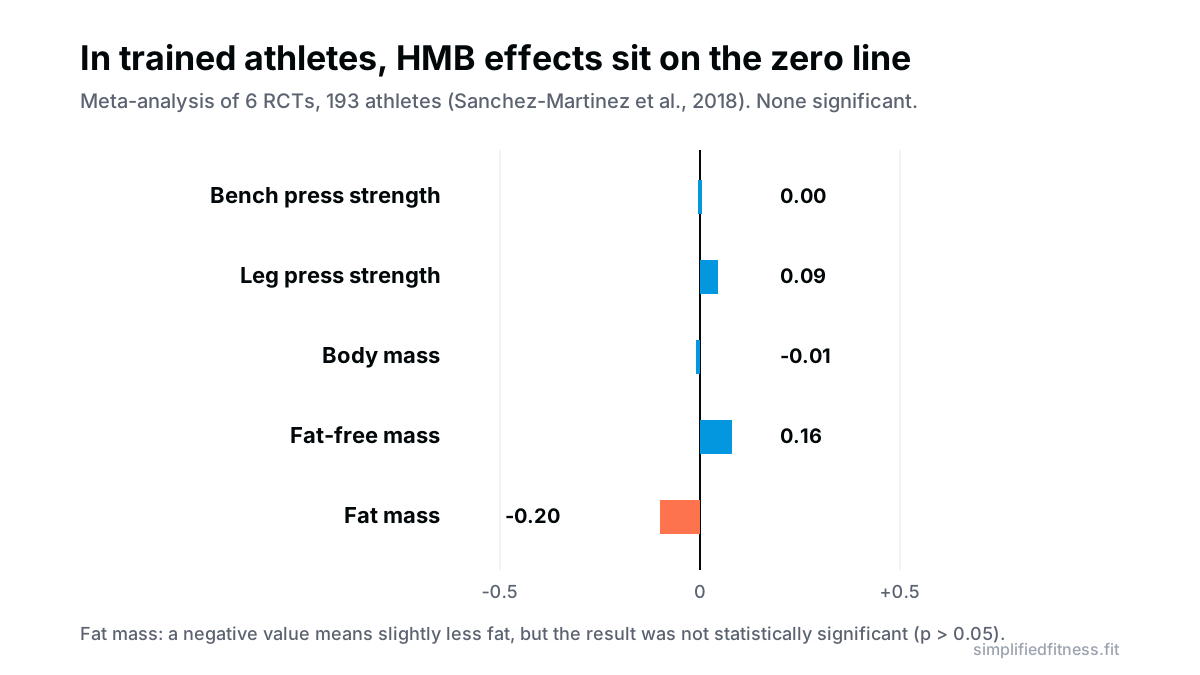
In 2018, researchers pooled six randomized controlled trials in trained and competitive athletes (193 participants). They found trivial, non-significant effect sizes everywhere: bench press 0.00, leg press 0.09, body mass -0.01, fat-free mass 0.16 and fat mass -0.20, with none reaching significance. The result held when they split the data by dose, duration, training level and diet (Sanchez-Martinez et al., 2018). Their conclusion: no effect of HMB on strength and body composition in trained athletes.
A 2022 meta-analysis in athletes (5 to 7 studies depending on the outcome) is a touch more generous. It found HMB may have a small positive effect on fat-free mass (effect size 0.30), but the confidence interval crossed zero (-0.07 to 0.68, p = 0.08) (Holland et al., 2022). The authors noted the effect seemed specific to athletes whose protein intake was suboptimal (below 1.6 g/kg/day). Body mass was unchanged and the effect on fat mass was small and not significant.
Read that second point twice. If HMB only seems to help people who are under-eating protein, then the fix is more protein, not a supplement. You can work out your own target with our protein calculator.
Why do the studies disagree?
Several things can explain the gap between the 2014 trial and the pooled results:
- Population. Trials labelled “trained” vary a lot in how experienced and well-fed the participants really were. Less experienced lifters still gain quickly, which makes small extra effects hard to separate out.
- Diet control. Low protein intake in some studies leaves room for any amino acid-related supplement to look useful.
- Study size and funding. Small trials swing widely, and some HMB trials involved researchers with links to HMB manufacturers.
- Measurement. Lean mass from DXA scans can shift with hydration and glycogen, and small trials are sensitive to this.
The ISSN position stand takes a middle line. It says daily HMB (38 mg/kg) with training may improve body composition across age, sex and training status, with the clearest results in studies with strong training programs and dietary control. On performance, it says HMB may improve strength and power in untrained people, that benefits in trained athletes are mixed, and that they seem larger in studies longer than 6 weeks (Rathmacher et al., 2025). A fair reading: a small benefit is possible in some contexts, but it is not the dependable growth effect the marketing implies.
HMB vs leucine: do you already get enough?
Because your body makes HMB from leucine, the logical first question is whether eating enough leucine already covers it. Honestly, nobody has run the clean head-to-head trial in trained lifters, so we cannot claim it does. What we can say is that leucine comes packaged with protein, and protein has a far stronger evidence base for building muscle.
A commonly cited rule of thumb is roughly 2.5-3 g of leucine per protein-rich meal to cross the muscle protein synthesis threshold. We cover where that number comes from, and its limits, in our article on the leucine trigger hypothesis. In Indian kitchens, that usually means a decent serving of paneer, curd, eggs, soya chunks, dal with roti, chicken or a scoop of whey at each main meal.
Here is the practical order of operations:
- Eat enough total protein across the day.
- Spread it over three or four meals.
- Train close to failure with progressive overload.
- Sleep properly.
- Only then consider whether any extra supplement is worth testing.
HMB belongs at step five, if at all.
Calcium HMB vs HMB free acid
Free acid is marketed as the premium form, often at a higher price. Does the evidence back it?
A 2011 crossover study, run as two experiments with four men and four women each, found free acid gel reached peak blood levels faster (about 38 minutes versus 128 minutes) and higher (249 versus 131 micromol/L) than calcium HMB (Fuller et al., 2011). That fed the free acid hype, though several of its authors worked for the company selling the free acid form.
Then a 2024 crossover in 16 young adults compared calcium HMB in capsules, calcium HMB dissolved in water, and free acid in capsules. Calcium HMB had higher peak concentrations and higher area under the curve than the free acid capsule, and dissolving calcium HMB in water gave the fastest absorption (Ribeiro et al., 2024). The two studies used different formats (gel versus capsule), which may be part of why results differ. The ISSN position stand also calls the picture mixed.
The takeaway is simple. Higher blood levels have not been shown to produce more muscle. If you try HMB, the cheaper calcium form is a reasonable choice, and neither form has proven itself in trained lifters.
| Question | Calcium HMB | HMB free acid |
|---|---|---|
| Form | Powder or capsule | Gel, liquid or capsule |
| Blood levels in 2011 study | Slower, lower peak | Faster, higher peak (gel) |
| Blood levels in 2024 study | Higher bioavailability | Lower bioavailability (capsule) |
| Proven extra muscle gain | Not shown in trained athletes | Not shown in trained athletes |
| Typical dose in research | About 38 mg/kg/day, around 3 g | Same |
Where HMB has a more believable case
This is the part that gets lost under the bodybuilding hype. The research on HMB looks more encouraging in situations where muscle is being lost.
Bed rest and immobilisation
A randomized, double-blind trial in healthy older adults (aged 60-76) put people on complete bed rest for ten days. Those taking 3 g/day of calcium HMB lost far less lean mass than the placebo group, which lost about 2.05 kg on average (Deutz et al., 2013). The catch: only 19 people were evaluable, the lean mass result for the HMB group relied on excluding one subject, and function measures did not differ. The authors themselves said it needs a larger trial.
So this is a promising signal, not a settled fact. The ISSN position stand says HMB may be effective in countering disuse atrophy during inactivity from illness or injury (Rathmacher et al., 2025). If you are in a cast, post-surgery or hospitalised, the sensible step is to ask your doctor or a dietitian. Protein intake and early, doctor-approved movement are usually the bigger levers.
Older adults and sarcopenia
A 2025 systematic review and meta-analysis of 10 randomized trials (596 older adults) compared resistance training plus HMB with resistance training alone. HMB added modest gains in handgrip strength (standardized mean difference 0.24, confidence interval 0.00-0.48) and larger gains in the Short Physical Performance Battery (0.54). There were no significant effects on gait speed, appendicular lean mass, fat mass or body weight (Garcia-Alonso et al., 2025). Half of the trials had a high risk of bias, which limits confidence.
In plain words: in older people, HMB might give a little extra functional benefit on top of training, but it does not clearly add muscle. Lifting and enough protein come first.
Cutting diets: no strong case
Many lifters buy HMB hoping it will “save muscle” on a cut. The direct evidence is thin. The Holland meta-analysis suggested any fat-free mass effect was tied to low protein intake. For a normal fat-loss phase, high protein, heavy lifting and a moderate deficit protect muscle well. Our protein calculator and calorie calculator will get your numbers.
Dose, safety and who should check with a doctor
Studies and the ISSN position stand use about 38 mg per kg of body weight per day, which is around 3 g for an 80 kg person. There is no proven extra benefit from going higher.
On safety, the ISSN position stand concludes that chronic calcium HMB and HMB free acid appear safe for oral use in humans up to at least one year, with no negative effects on glucose tolerance or insulin sensitivity (Rathmacher et al., 2025). Data beyond a year are limited. See a doctor before using it if you have kidney or liver disease, are pregnant or breastfeeding, take regular medication, or are recovering from surgery or a serious illness. Do not use HMB as a substitute for medical care.
Also keep in mind that supplements are lightly regulated. If you buy any, look for third-party testing.
A simple decision guide
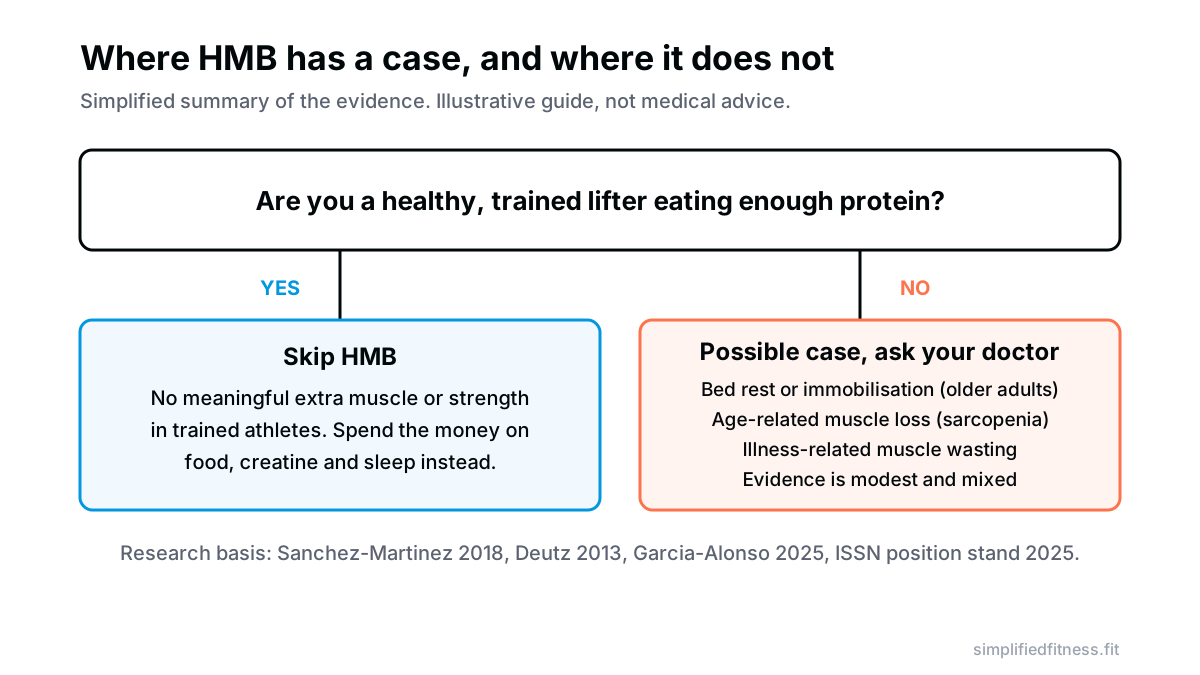
- Healthy natural lifter, protein under control: skip HMB. Spend on food, creatine and a good program.
- Low protein intake you cannot easily fix: raise protein from dal, paneer, curd, eggs or whey before considering HMB.
- Curious and want to experiment: use about 3 g/day of calcium HMB for 8-12 weeks, track strength and a waist or body measurement, and stop if you see nothing.
- Bed rest, injury, ageing or illness: discuss with your doctor or dietitian.
The bottom line
HMB is not a fraud, and it is not a shortcut. In trained athletes the pooled evidence shows effects close to zero. The famous 2014 numbers have not been matched in the broader literature. In older adults and during disuse, there are signs of benefit worth taking seriously, but the trials are small and often at risk of bias.
For a natural lifter in India working with a normal budget, the better return is a solid push pull legs plan, enough protein and consistent sleep. If you want a stimulant-based boost instead, see our guide to caffeine dosing for strength. And if you are weighing another popular recovery supplement, our article on L-carnitine L-tartrate takes the same evidence-first approach.
Frequently Asked Questions
Does HMB build muscle?
In trained lifters, the best pooled evidence says no. A 2018 meta-analysis of six randomized trials in trained and competitive athletes found trivial, non-significant effects on strength and fat-free mass. If you train hard and eat enough protein, put your money into food and consistency first.
Is HMB worth it for bodybuilding?
For most natural lifters it is not a priority. Pooled results in athletes are close to zero, and the one trial with huge gains has not been matched by later analyses. If you still want to test it, treat it as a small experiment after your protein, calories, sleep and creatine are sorted.
HMB vs leucine: which is better?
There is no good head-to-head evidence in trained lifters, so neither can be called better. HMB is a metabolite your body makes from leucine, and leucine is already in whey, eggs, curd, paneer and soya. Hit your daily protein target with leucine-rich foods first, since that is cheaper and covers much more than one signal.
Does HMB work on a cutting diet?
The evidence is thin for a normal fat-loss phase. The 2022 athlete meta-analysis suggested any fat-free mass effect appeared only when protein intake was low, which points to fixing protein first. Keep protein high, lift heavy and run a moderate deficit.
Is HMB free acid better than calcium HMB?
Not clearly. A 2011 crossover found free acid gel reached higher blood levels faster than calcium HMB, but a 2024 crossover in 16 young adults found calcium HMB had higher bioavailability than the free acid capsule. Blood levels are not the same as muscle gain, so do not pay extra for free acid on that basis.
How much HMB should I take?
Studies and the ISSN position stand use about 38 mg per kg of body weight per day, which is roughly 3 g for an 80 kg person. Going well above that has no proven extra benefit. If you try it, stick to about 3 g a day.
Is HMB safe?
The ISSN position stand concludes that calcium HMB and HMB free acid appear safe for oral use in humans for at least one year. Long-term data beyond that are limited. If you have kidney or liver disease, are pregnant or take regular medication, check with your doctor first.
Can HMB help with muscle loss during injury or bed rest?
Possibly. A randomized trial in 19 evaluable older adults found HMB limited lean mass loss during 10 days of complete bed rest, though it was small and needs confirmation. If you are immobilised after an injury or surgery, ask your doctor or dietitian rather than self-prescribing.
Does HMB help older adults with sarcopenia?
It may help function a little. A 2025 meta-analysis of 10 trials (596 older adults) found small gains in handgrip strength and physical performance scores when HMB was added to resistance training, but no significant change in lean mass, and half the trials had high risk of bias. Training and protein remain the foundation.
How does HMB work?
HMB is a leucine metabolite that is proposed to raise muscle protein synthesis and reduce muscle protein breakdown, according to the ISSN position stand. Much of the detailed pathway work comes from cell and animal studies. In practice, resistance training and protein do the same job far more reliably.
Do vegetarians need HMB?
There is no evidence that vegetarians need it. What matters more is total protein and leucine intake from dal, paneer, curd, soya, eggs and whey. If your diet is low in protein, fix that before adding a supplement.
Will HMB make me lose fat?
Probably not in any meaningful way. The 2018 athlete meta-analysis found no significant effect on fat mass, and a 2022 meta-analysis found a small, non-significant effect. Fat loss still comes from a sustainable calorie deficit.
Sources & References
Every claim above is checked against peer-reviewed research (PubMed, U.S. National Library of Medicine) or guidance from established health bodies. How we fact-check.
- Sanchez-Martinez J, et al. Effects of beta-hydroxy-beta-methylbutyrate supplementation on strength and body composition in trained and competitive athletes: A meta-analysis of randomized controlled trials. J Sci Med Sport. 2018. PMID: 29249685
- Holland BM, et al. Does HMB Enhance Body Composition in Athletes? A Systematic Review and Meta-analysis. J Strength Cond Res. 2022. PMID: 31868817
- Wilson JM, et al. The effects of 12 weeks of beta-hydroxy-beta-methylbutyrate free acid supplementation on muscle mass, strength, and power in resistance-trained individuals: a randomized, double-blind, placebo-controlled study. Eur J Appl Physiol. 2014. PMID: 24599749
- Rathmacher JA, et al. International society of sports nutrition position stand: beta-hydroxy-beta-methylbutyrate (HMB). J Int Soc Sports Nutr. 2025. PMID: 39699070
- Deutz NE, et al. Effect of beta-hydroxy-beta-methylbutyrate (HMB) on lean body mass during 10 days of bed rest in older adults. Clin Nutr. 2013. PMID: 23514626
- Garcia-Alonso A, et al. The Role of HMB Supplementation in Enhancing the Effects of Resistance Training in Older Adults: A Systematic Review and Meta-Analysis on Muscle Quality, Body Composition, and Physical Function. Nutrients. 2025. PMID: 41305674
- Fuller JC, et al. Free acid gel form of beta-hydroxy-beta-methylbutyrate (HMB) improves HMB clearance from plasma in human subjects compared with the calcium HMB salt. Br J Nutr. 2011. PMID: 21134325
- Ribeiro HR, et al. Superior bioavailability of the calcium salt form of beta-hydroxy-beta-methylbutyrate compared with the free acid form. Amino Acids. 2024. PMID: 38564019

Umair Hazrami · Founder & Head Coach, Simplified Fitness
Umair Hazrami founded Simplified Fitness and the Simplified Lifter channel to cut through fitness noise. With 4+ years of consistent training and 10+ coaching clients, he writes every guide from the peer-reviewed research and links the sources so you can check them. Our editorial standards.
Educational content only, not medical advice. If you have a medical condition, are pregnant, or take medication, talk to a qualified doctor before changing your diet, supplements or training. Full disclaimer.
Keep reading
Supplements
Alpha-GPC and Huperzine A Pre-Workout: Do Cholinergic Nootropics Help Lifting?
Does an alpha GPC pre workout add power or focus? See what small trials found, why Huperzine A is a poor lifting bet, and the safety flags to know first.
10 min read

Supplements
The Antioxidant Paradox: Can Vitamin C and E Pills Blunt Muscle Growth and Endurance?
Does vitamin C blunt muscle growth? See what trials of 1000 mg vitamin C plus E found for strength, hypertrophy and endurance, and when pills are worth taking.
8 min read

Supplements
Caffeine Powder vs Coffee Before Lifting: Does the Source Really Matter?
Caffeine anhydrous vs coffee for lifting: what research says on absorption speed, peak levels and stomach upset, and whether pills beat your daily cup.
7 min read

Supplements
Caffeine Dosing for Strength and Power: 3-6 mg/kg and When to Take It
Caffeine dosage for strength is 3-6 mg/kg, about 210-420 mg for a 70 kg lifter, taken around 60 minutes before training. Doses, timing and when to stop.
8 min read