Afternoon Caffeine Cutoff: Half-Life, Deep Sleep and Pre-Workout
Afternoon caffeine cutoff for lifters: how caffeine's half-life cuts sleep time and deep sleep even if you fall asleep fine, plus a practical cutoff by bedtime.
TL;DR. The short answer
- Caffeine's half-life is often quoted as about 5-6 hours but varies a lot between people, so a late dose can still be partly active at bedtime and beyond.
- A 2023 meta-analysis of 24 studies found caffeine cut total sleep time by about 45 minutes and deep sleep by about 11 minutes. Falling asleep took only about 9 minutes longer, which is why many people feel they sleep fine.
- The popular claim that caffeine wipes out 20-30% of deep sleep is not what the pooled data show. The measured drop in deep sleep proportion is small, around 1-1.4 percentage points, while lost total sleep time is the bigger cost.
- A workable rule for most lifters is no caffeine in the last 8-10 hours before bed, so 2 pm for a 10-11 pm bedtime. Hard evening trainers should test the cutoff rather than assume they are immune.
- Persistent exhaustion, loud snoring or insomnia lasting weeks is a reason to see a doctor, not to buy another supplement.
Part of our complete guide: Sleep, Circadian Timing & Systemic Recovery: How Lifters Maximize Anabolic Rest & CNS Recovery
Table of contents
A sensible afternoon caffeine cutoff for most lifters is about 8-10 hours before bed, which means roughly 2 pm if you sleep at 10-11 pm. Caffeine can be partly active in your body long after the buzz has faded, and in trials it trims total sleep time and, to a smaller degree, deep sleep, even in people who fall asleep without trouble.
That is the answer to the lifter who takes a 6 pm pre-workout, drops off by 11 pm, and still wakes up flat. This article sits inside our wider guide to sleep, circadian timing and systemic recovery, and zooms in on one lever: when your last caffeine hits.
One correction first. You will see claims online that late caffeine slashes deep sleep by 20-30%. The pooled studies do not show a drop that big. What they show is quieter and, honestly, more annoying: you lose sleep time, sleep gets lighter and more broken, and you may not notice it happening.
What is caffeine’s half-life, and what is the “quarter-life”?
Half-life is the time your body takes to clear half of a dose. Caffeine is mostly broken down in the liver by the CYP1A2 enzyme system (Grzegorzewski et al., 2021). A figure of about 5-6 hours is commonly quoted for healthy adults. Treat it as a rough average only.
Why? Because the same systematic analysis, which pooled data from 141 publications, stresses large differences between people and points to smoking, oral contraceptive use, drug interactions and disease as factors that change how fast caffeine is cleared (Grzegorzewski et al., 2021). Your friend who sleeps like a log after a double espresso and you might be running different engines. If that interests you, our piece on caffeine sensitivity and CYP1A2 genetics goes deeper.
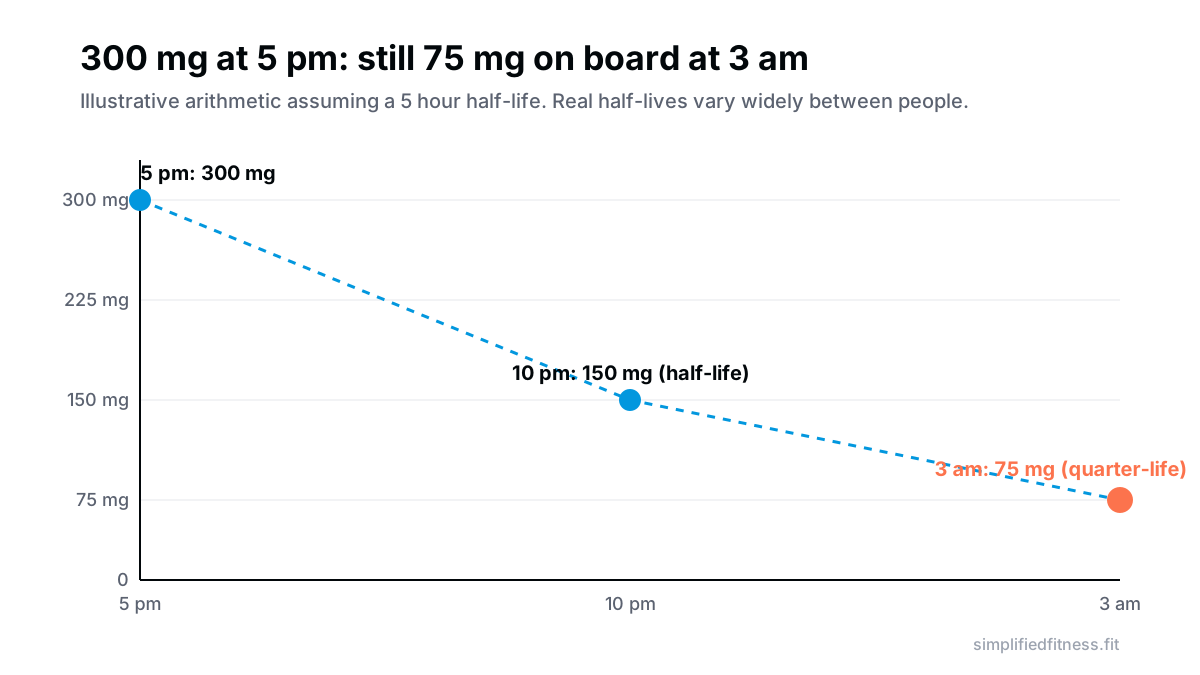
The quarter-life is just two half-lives: the time to drop to 25% of the dose. The arithmetic below is illustrative, using a 5 hour half-life.
How does caffeine mess with sleep at all?
Caffeine blocks adenosine receptors. Adenosine is a chemical that builds up the longer you are awake and pushes you toward sleep. Block it and the pressure to sleep feels lower than it really is, which is the standard explanation for how caffeine works.
This matters for deep sleep specifically. Slow-wave sleep (the deepest non-REM stage) is the stage most tied to how much sleep pressure you have built up. In a small early lab study of eight young men, 100 mg of caffeine at bedtime lengthened the time to fall asleep, reduced sleep efficiency, cut stage 4 sleep and reduced EEG slow-wave activity (Landolt et al., 1995). The slow-wave dip was limited to the first sleep episode, and stage 4 was back to baseline the following night. Small, young, male, and three decades old, so use it as a mechanism clue, not a verdict.
For the full story on why that deep stage matters for lifters, see our guide to sleep architecture, slow-wave sleep and growth hormone.
What does the research say about caffeine and deep sleep?
Here is the best pooled evidence, and where it disagrees.
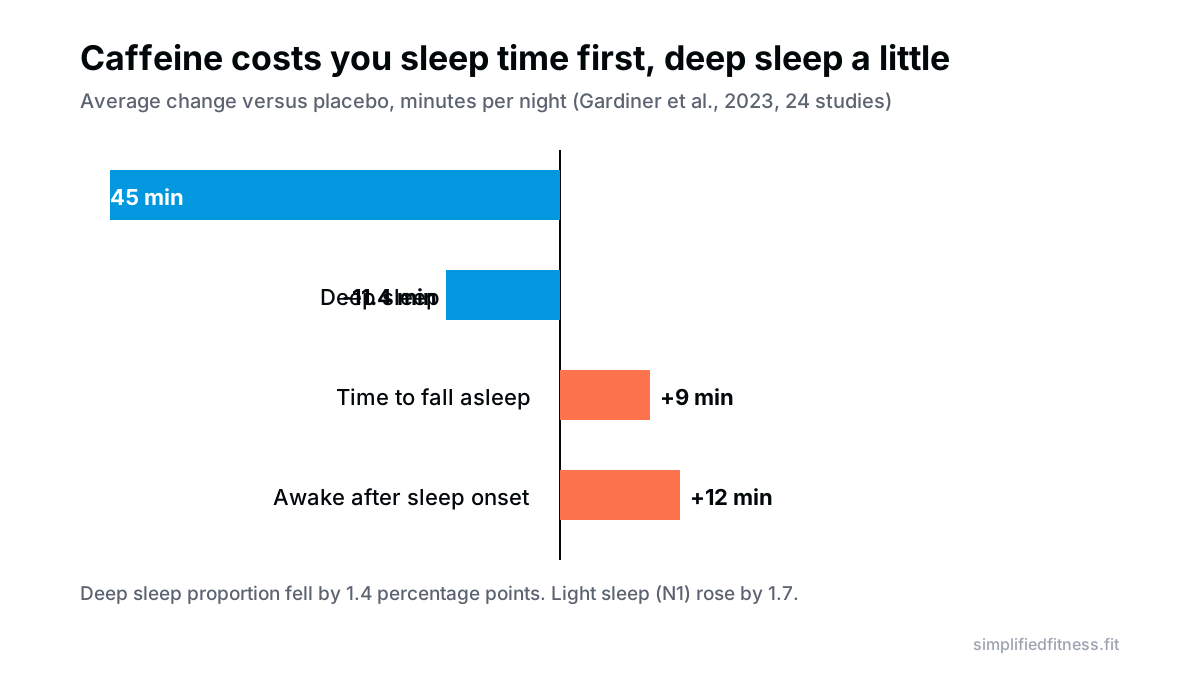
A 2023 systematic review and meta-analysis of 24 studies found caffeine reduced total sleep time by about 45 minutes and sleep efficiency by 7%, increased time to fall asleep by about 9 minutes and increased time awake after falling asleep by about 12 minutes. Light sleep (N1) went up by about 6.1 minutes (1.7%), while deep sleep (N3 and N4) went down by about 11.4 minutes (1.4%) (Gardiner et al., 2023).
A 2025 meta-analysis of 22 crossover trials (956 healthy adults, polysomnography) landed in a similar place: total sleep time down by about 35 minutes, sleep efficiency down by about 4.7%, time to fall asleep up by about 8 minutes, and slow-wave sleep proportion down by about 1% (Chang et al., 2025). REM sleep percentage did not change significantly. High-dose caffeine reduced slow-wave sleep proportion, while the low-dose and high-dose groups did not differ significantly from each other.
So is the 20-30% figure wrong? As a pooled average, it is not supported by these abstracts. Individual people, large doses, sensitive sleepers or very late intake could well lose more, and a meta-analysis average hides that spread. But a flat “caffeine destroys deep sleep” is overselling it.
What the numbers do say, and this is the more useful insight: the damage is mostly in how long and how continuous your sleep is. That is exactly the pattern that lets someone “fall asleep fine” and still wake up wrecked.
“I fall asleep fine.” Why do I still wake up exhausted?
Because falling asleep is the one thing caffeine barely changes. In the 2023 meta-analysis, time to fall asleep rose by only about 9 minutes, while total sleep fell by about 45 minutes and nighttime waking rose by about 12 minutes (Gardiner et al., 2023).
In a home-based study, 400 mg of caffeine taken at bedtime, 3 hours before bed, or 6 hours before bed each significantly disturbed sleep compared with placebo, measured by self-report and a portable monitor (Drake et al., 2013). Even the 6-hour dose mattered. The authors concluded this supports advice to avoid substantial caffeine for at least 6 hours before bed. Note that 400 mg is a big dose, and this was a single study.
In the gym, this can look like a lifter on a 6 pm scoop who gets maybe 40 minutes less sleep than usual, drags through the first alarm, and blames “bad recovery” on the program. Often the program is fine. The sleep is the leak.
Does pre-workout ruin deep sleep?
Not by itself, and not in the dramatic way people claim. But a standard pre-workout is the easiest way to take a large dose late in the day.
The 2023 meta-analysis estimated that a standard pre-workout serve of 217.5 mg should be taken at least 13.2 hours before bedtime to avoid reductions in total sleep time, versus 8.8 hours for a coffee of about 107 mg per 250 mL (Gardiner et al., 2023). Those are strict, model-based numbers aimed at avoiding any measurable loss. They are not a rule that nobody can ever train at 6 pm. For dose planning, our caffeine dosage calculator and the article on caffeine dosing for strength and power can help you use less.
Now the conflicting evidence, for evening trainers. A 2025 meta-analysis of 10 studies in 128 athletes who took caffeine before late afternoon or evening training found a small reduction in sleep efficiency of about 4.9%, but the result did not hold up in leave-one-out sensitivity analyses. Total sleep time showed a non-significant trend toward a 32 minute reduction. Yet the athletes consistently reported substantial subjective sleep impairment after doses of 3-6 mg/kg (Kocak et al., 2025). The authors urge caution because of few studies and mostly male participants.
Why might the two bodies of evidence differ? The athlete studies are small and varied in design, and training itself may change sleep, though the abstracts do not settle this. A cautious reading: evening caffeine probably costs something, athletes feel it, and the exact size is unclear.
Where should your afternoon caffeine cutoff be?
Use the evidence as a range, then test it on yourself.
| Source | What it suggests |
|---|---|
| Drake et al., 2013 (400 mg, home study) | Still disruptive 6 hours before bed |
| Gardiner et al., 2023 (coffee, 107 mg) | At least 8.8 hours before bed |
| Gardiner et al., 2023 (pre-workout, 217.5 mg) | At least 13.2 hours before bed |
| A practical rule here | 8-10 hours before bed |
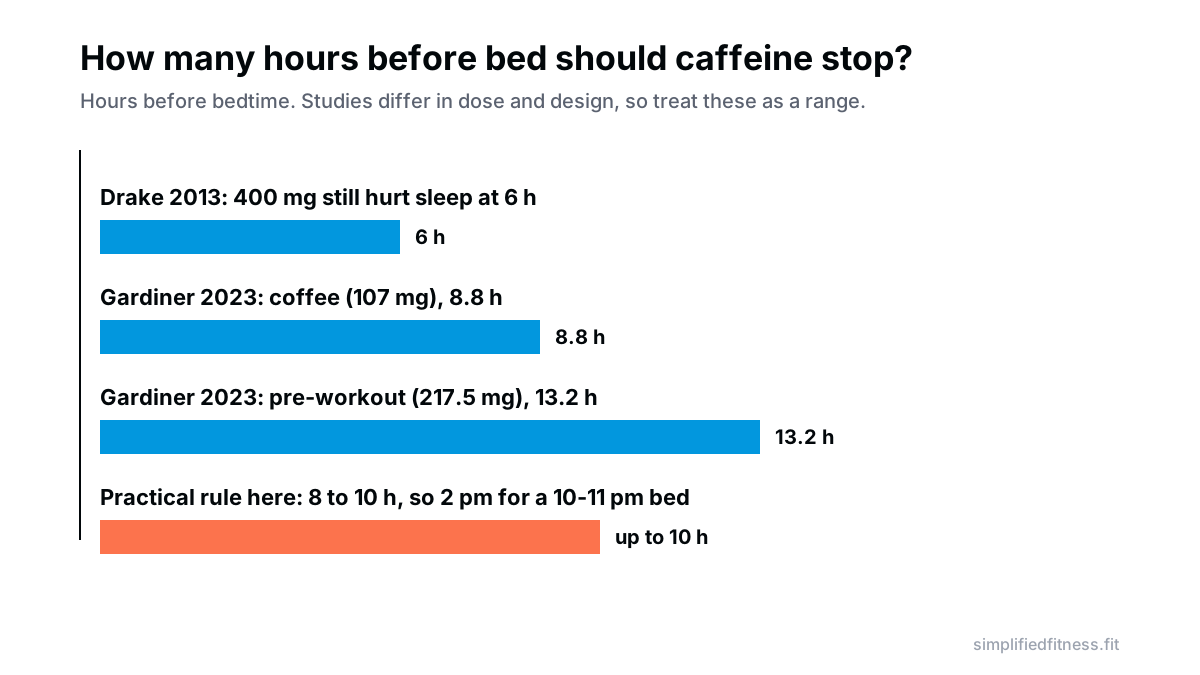
For a 10:30 pm bedtime, an 8.8 hour cutoff for coffee lands around 1:40 pm. That is why a flat 2 pm rule works as a default. If you sleep at 11:30 pm, 2 to 3 pm is closer.
Here is a simple way to run the test:
- Set your cutoff at 2 pm for four weeks.
- Keep bedtime and wake time steady.
- Note the time you sleep, wake-ups, and morning energy.
- Move the cutoff one hour earlier if you still feel unrefreshed.
- Add a little back later only if sleep stays good.
Indian context: chai, filter coffee and the 4 pm cup
Caffeine is not only pre-workout. The office chai at 4 pm, a late filter coffee, cola with dinner and cold coffee after the gym all count. Amounts vary by how strong the drink is brewed, so count caffeinated drinks rather than assuming tea is “light”.
A practical swap: after your cutoff, move to nimbu pani, chaas, plain water, or a caffeine-free herbal tea. If you rely on a pre-workout in a hot evening gym, a lower dose with water and electrolytes is a reasonable try. Sleep also tends to be harder in hot, humid weather, so our sleep hygiene checklist for lifters is worth a read.
Who needs an earlier cutoff?
Evidence points to a few groups.
- Slow metabolizers. Clearance varies widely between people, as the pharmacokinetic data show, and genetics of adenosine signalling and caffeine metabolism contribute to individual sensitivity (Clark & Landolt, 2017).
- Older adults. The same review notes the sleep of older adults may be more sensitive, but the 2025 meta-analysis found no significant linear relationship with continuous age. Mixed evidence, so lean cautious.
- People on certain medicines or hormonal contraception. These can change how quickly caffeine is cleared, according to the pharmacokinetic analysis (Grzegorzewski et al., 2021). Ask your doctor or pharmacist if you are unsure.
- Anyone already short on sleep. Caffeine can mask the problem while taking more from tonight.
Most trials used healthy adults and were done mostly in males, in Western countries, so results for women and for Indian lifters are less certain (Clark & Landolt, 2017).
Does regular use make you immune?
Probably not enough to rely on it. If you train your tolerance up, alertness effects can shrink, but the review of epidemiological studies and RCTs found caffeine typically prolonged sleep latency, reduced total sleep time and sleep efficiency, and worsened perceived sleep quality (Clark & Landolt, 2017). If you want to reset your habit, see our guide on caffeine tolerance and how to reset it.
When to see a doctor
Caffeine is one cause of poor sleep, not the only one. See a doctor if:
- poor sleep lasts for weeks despite a clean cutoff and routine,
- you snore loudly, gasp, or a partner sees you stop breathing,
- you feel exhausted after 7-9 hours in bed,
- you have palpitations, chest discomfort or heavy anxiety with caffeine.
This article is general information, not a diagnosis.
The bottom line
Pick a cutoff, not a feeling. Start at 2 pm for a 10-11 pm bedtime, go earlier if you still wake up flat, and treat pre-workout as the biggest late-day dose in your routine. The evidence does not support the claim that caffeine wipes out a quarter of your deep sleep, but it does support that late caffeine reliably costs sleep time and quality, often without you noticing. Fix that first, then judge your program.
Frequently Asked Questions
What is the half-life of caffeine?
The half-life of caffeine in healthy adults is often quoted as roughly 5-6 hours, but it varies widely from person to person. A systematic analysis of 141 publications highlighted large differences linked to factors such as smoking, oral contraceptive use and disease. Treat 5-6 hours as a rough average, not your personal number, and cut off earlier if you are sensitive.
What is the quarter-life of caffeine and why does it matter?
Quarter-life is the time it takes for caffeine to fall to 25% of the original dose, which is simply two half-lives. With a 5 hour half-life, 300 mg taken at 5 pm leaves about 150 mg at 10 pm and about 75 mg at 3 am. That leftover amount is why a late scoop can still touch your sleep even after you have dozed off.
What time should I stop caffeine to sleep well?
A reasonable target for most lifters is at least 8-10 hours before bed, which is around 2 pm for a 10-11 pm bedtime. A 2023 meta-analysis estimated coffee (107 mg per 250 mL) should be consumed at least 8.8 hours before bed to avoid losing total sleep time, and a typical pre-workout (217.5 mg) at least 13.2 hours. Start with 2 pm, then shift it earlier if you still wake up unrefreshed.
Does pre-workout ruin deep sleep?
Caffeine in pre-workout can modestly reduce deep sleep, but the bigger measured effect is less total sleep and lower sleep efficiency. A 2025 meta-analysis of 22 crossover trials found deep sleep proportion fell by about 1 percentage point overall, and the drop was clearer at higher doses. If you train after work, use a lower-caffeine or caffeine-free pre-workout.
Can I take caffeine at 6 pm and still sleep fine?
Some people fall asleep without trouble, but that does not prove their sleep was unaffected. In a home study, 400 mg of caffeine taken 6 hours before bed still significantly disturbed sleep versus placebo, even though the dose was not at bedtime. Try 4 weeks with a 2 pm cutoff and compare how you feel in the morning.
Why do I wake up tired even though I fall asleep easily?
Caffeine's main effect in pooled studies is shorter total sleep and lower sleep efficiency, while time to fall asleep rises only about 9 minutes. So you can drop off quickly yet spend more of the night awake or in lighter sleep. Move your last caffeine earlier and protect a consistent 7-9 hour sleep window.
Does caffeine reduce slow-wave deep sleep?
Yes, on average it does, though the size is modest. Early lab work found 100 mg at bedtime reduced stage 4 sleep and slow-wave activity in the first sleep episode in eight young men, and a 2023 meta-analysis put the average loss at about 11 minutes of deep sleep. Slow-wave sleep matters for recovery, so protect it by keeping caffeine well away from bedtime.
Is decaf safe for sleep?
Decaf contains much less caffeine than regular coffee, though it is not always zero. Because the sleep effects shown in trials come from doses of roughly 100-400 mg, a small residual amount is unlikely to matter much for most people. If you are very sensitive, switch to herbal tea or plain water after your cutoff.
Does caffeine tolerance mean it stops affecting my sleep?
Not reliably. Regular users may feel less alert from caffeine, but a review of the literature found caffeine typically prolongs sleep latency, reduces total sleep time and worsens perceived sleep quality, with big individual differences. Do not assume tolerance protects your sleep; judge by how you wake up.
Are older adults more sensitive to evening caffeine?
Possibly. A systematic review reported that the sleep of older adults may be more sensitive to caffeine than that of younger adults, though a 2025 meta-analysis found no significant linear effect of continuous age. Because the evidence is mixed, older lifters should lean toward an earlier cutoff.
Does the caffeine in chai and cold coffee count?
Yes, caffeine is caffeine whether it comes from chai, filter coffee, cola, green tea or a pre-workout scoop. Amounts differ a lot by how the drink is made, so count the number of caffeinated drinks rather than assuming tea is harmless. Put your last cup before your cutoff time.
What if I only train in the evening?
Evening trainers can still use caffeine, but should test it. A 2025 meta-analysis of 10 studies in 128 athletes found a small reduction in sleep efficiency that was not robust, and a non-significant trend to less total sleep, while athletes still reported clear subjective sleep problems. Try a lower dose or no caffeine for 2 weeks and compare sleep and training quality.
When should I see a doctor about poor sleep?
See a doctor if poor sleep lasts for weeks, if you snore loudly or stop breathing at night, or if you feel exhausted despite 7-9 hours in bed. Caffeine is only one possible cause, and conditions such as sleep apnea or anxiety need proper assessment. Bring a simple log of your sleep times and caffeine intake to the appointment.
Sources & References
Every claim above is checked against peer-reviewed research (PubMed, U.S. National Library of Medicine) or guidance from established health bodies. How we fact-check.
- Gardiner C, et al. The effect of caffeine on subsequent sleep: A systematic review and meta-analysis. Sleep Med Rev. 2023. PMID: 36870101
- Chang YH, et al. Age- and dose-specific effects of caffeine on sleep: A meta-analysis of controlled crossover trials. Sleep Med. 2025. PMID: 41124973
- Kocak A, et al. The Effect of Consuming Caffeine Before Late Afternoon/Evening Training or Competition on Sleep: A Systematic Review with Meta-Analysis. Sports (Basel). 2025. PMID: 41003623
- Drake C, et al. Caffeine effects on sleep taken 0, 3, or 6 hours before going to bed. J Clin Sleep Med. 2013. PMID: 24235903
- Landolt HP, et al. Caffeine reduces low-frequency delta activity in the human sleep EEG. Neuropsychopharmacology. 1995. PMID: 7612156
- Clark I, et al. Coffee, caffeine, and sleep: A systematic review of epidemiological studies and randomized controlled trials. Sleep Med Rev. 2017. PMID: 26899133
- Grzegorzewski J, et al. Pharmacokinetics of Caffeine: A Systematic Analysis of Reported Data for Application in Metabolic Phenotyping and Liver Function Testing. Front Pharmacol. 2021. PMID: 35280254

Umair Hazrami · Founder & Head Coach, Simplified Fitness
Umair Hazrami founded Simplified Fitness and the Simplified Lifter channel to cut through fitness noise. With 4+ years of consistent training and 10+ coaching clients, he writes every guide from the peer-reviewed research and links the sources so you can check them. Our editorial standards.
Educational content only, not medical advice. If you have a medical condition, are pregnant, or take medication, talk to a qualified doctor before changing your diet, supplements or training. Full disclaimer.
Keep reading

Recovery
Active Recovery on Rest Days: Walking, Light Cycling and Mobility
Active recovery vs passive rest for lifters: what the research says about walking, light cycling and mobility, plus a 20-minute rest day routine you can copy.
7 min read
Recovery
Blue Light, Melatonin and Screen Time: Do Blue-Blockers Actually Help You Sleep?
Blue light screen time melatonin suppression is real, but do blue-blocking glasses fix it? See what the trials found and the free fixes that matter more.
7 min read

Recovery
Is Your CNS Fried? CNS Fatigue vs Plain Lethargy in the Gym
Is my CNS fried from lifting? See what central fatigue really is, how fast it recovers and how to tell it from low motivation or poor sleep. Studies linked.
9 min read
Recovery
Circadian Rhythm and Strength: Why You Peak in the Late Afternoon
Circadian rhythm strength peak explained: why you lift more at 4-7 pm than at 7 am, what body temperature really does, and how to plan PR days.
8 min read