Creatine for Cognitive Function: Does It Really Boost Memory and Focus?
Creatine for brain function may give a small memory boost, most clearly in older adults and the sleep deprived. See what the trials actually found.

TL;DR. The short answer
- Creatine may give a small memory benefit. A 2024 meta-analysis of 16 trials (492 adults) found a memory effect with moderate certainty of evidence, but no clear gain in overall cognition or executive function.
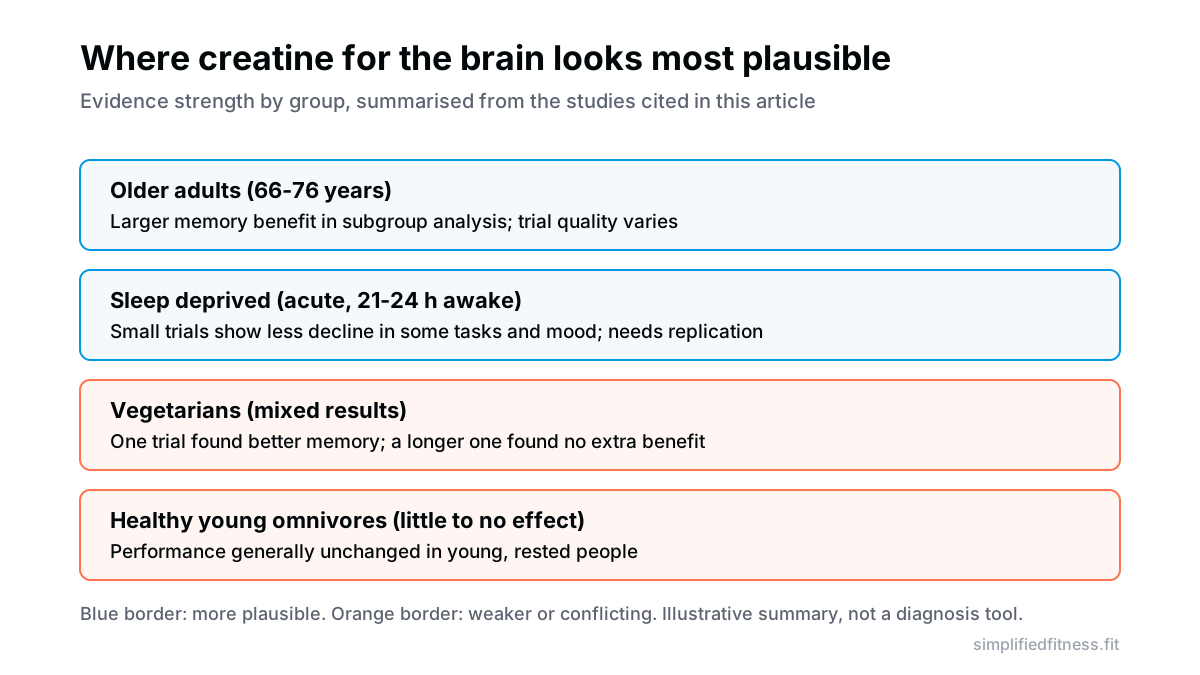
- In an earlier memory meta-analysis, the effect looked larger in older adults (66-76 years) than in young people, where results were basically flat.
- In sleep deprivation, small trials suggest creatine reduces the drop in some mental tasks and mood, but the evidence is early and mostly short-term.
- Vegetarians do not clearly benefit more. One trial saw better memory in vegetarians, a longer and more recent one did not.
- If you already take 3-5 g of creatine monohydrate for training, any brain benefit is a bonus. It is not a reason to expect a focus pill.
Part of our complete guide: Creatine, Protein Powders, Pre-Workouts and Caffeine: The Science and Safety Guide
Table of contents
Does creatine for brain function actually work? Maybe, a little. The best current evidence points to a small memory benefit, strongest in older adults and in people who are sleep deprived, with much weaker support for focus, attention or “being smarter” in healthy young lifters.
If you already know creatine for training, this is the part of the story that gets hyped the most. This article sits under our complete guide to creatine, protein powders and caffeine, and it focuses on what trials in people have really found, not what supplement ads imply.
Why would creatine affect the brain at all?
Your brain is metabolically expensive. It takes a big slice of your resting energy, and it relies on the same ATP system muscles do. Creatine plays a role in brain bioenergetics, and a meta-analysis on memory frames the idea this way: if supplements raise brain creatine stores, memory could improve (Prokopidis et al., 2023).
The mechanism is the same buffer we explain in how creatine recycles ATP. Phosphocreatine hands a phosphate back to ADP so ATP is rebuilt fast. In the brain, the theory is that this helps during bursts of heavy mental work or when energy is short.
Here is the catch. A 2024 systematic review concluded that supplementation can raise brain creatine, but only to a limited extent, and that effects on cognition were “somewhat equivocal” (McMorris et al., 2024). It also pointed out that many trials never measured brain creatine, so we often cannot tell whether a result came from the brain at all.
What does the research say about creatine and memory?
Memory is where the evidence is most consistent.
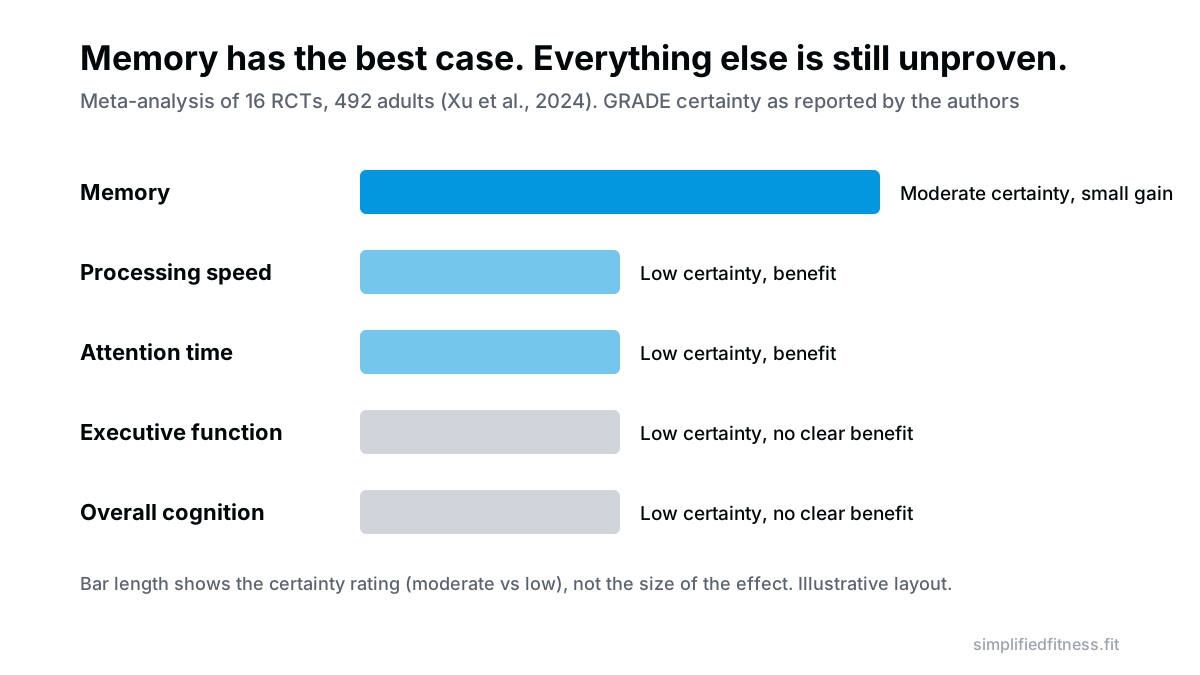
A 2024 meta-analysis pooled 16 randomized trials with 492 participants aged 20.8-76.4 years. Creatine monohydrate improved memory (SMD 0.31, 95% CI 0.18-0.44), and the authors rated the certainty of evidence for memory as moderate (Xu et al., 2024). It also found benefits for attention time and processing speed, but those were rated low certainty, and there was no significant improvement in overall cognition or executive function.
An earlier meta-analysis of 8 trials in healthy people found a similar small memory effect (SMD 0.29, 95% CI 0.04-0.53), with high variability between studies (I2 = 66%) (Prokopidis et al., 2023). Doses ranged from about 2.2 to 20 g a day and durations from 5 days to 24 weeks, and neither clearly changed the result.
An SMD of 0.3 is small. It means you might notice a slight edge on a memory test in a lab, not a transformation in how you study.
Does it matter if you are young or older?
Yes, and this is the most useful pattern in the data.
In the memory meta-analysis, the subgroup of older adults (66-76 years) showed a clear improvement (SMD 0.88, 95% CI 0.22-1.55). Younger participants (11-31 years) showed essentially none (SMD 0.03, 95% CI -0.14 to 0.20) (Prokopidis et al., 2023). The older-adult estimate is wide and the studies disagreed with each other (I2 = 83%), so it is a signal, not a settled fact.
The Xu meta-analysis does not back up that age pattern. Its subgroup analysis found creatine more beneficial in people with diseases, in those aged 18-60, and in females (Xu et al., 2024). The two papers split age groups differently and included different people, so read any age effect cautiously.
A plain reading: if your brain energy system is not stressed, extra creatine may have little to add. That fits with the young, rested, well-fed volunteers who show the smallest effects.
Can creatine help after a bad night’s sleep?
This is the most interesting use case, and also the one with the smallest studies.
In a 2006 double-blind trial, 19 people took either 5 g of creatine four times a day for 7 days (n=10) or placebo (n=9), then stayed awake for 24 hours. At the end, the creatine group showed significantly less decline in random movement generation, choice reaction time, balance and mood (McMorris et al., 2006). The authors concluded creatine helped mood and tasks that stress the prefrontal cortex.
A 2024 trial tried something different: a single high dose of 0.35 g/kg during roughly 21 hours of sleep deprivation. Compared with placebo, creatine changed brain energy markers on MRS scans, prevented a drop in pH, and improved cognitive performance and processing speed (Gordji-Nejad et al., 2024). The authors suggest a high single dose may partially reverse fatigue-related deterioration.
Both are small, short, and done in controlled lab settings. A 0.35 g/kg dose is about 25 g for a 70 kg person, far above a normal daily scoop, and I would not copy it from a paper. Sleep deprivation also hurts lifting, mood and recovery in ways creatine will not fix, which we cover in sleep deprivation, muscle soreness and pain sensitivity.
Do vegetarians get a bigger brain boost?
The theory is neat. Vegetarians eat almost no dietary creatine, so supplements should fill a bigger gap. The data are less neat.
A 2011 double-blind trial gave 128 young women either 20 g of creatine or placebo for 5 days. Memory was better in vegetarians who took creatine, but not in meat eaters, while verbal fluency and vigilance were unchanged (Benton and Donohoe, 2011).
A much later crossover trial of 123 people, about half vegetarian, gave 5 g a day for 6 weeks. Bayesian analysis supported a small beneficial effect overall, but vegetarians did not benefit more than omnivores, and creatine users reported more side effects (Sandkuhler et al., 2023). A review noted that vegetarians responded better in memory tasks but not in other domains (Avgerinos et al., 2018).
Why the mismatch? Different doses (20 g for 5 days vs 5 g for 6 weeks), different tests, and different participants. A sensible takeaway for Indian vegetarians who rely on dal, paneer and curd: you may not get much creatine from food, so supplementation makes sense for training. Do not assume a mental edge on top.
What about mental fatigue and focus?
The focus evidence is thin.
In the Sandkuhler trial, the 123 participants also completed eight exploratory cognitive tests, and there was no indication that creatine improved performance on them (Sandkuhler et al., 2023). On the two main tests, backward digit span bordered on significance (p = 0.064) and Raven’s matrices did not (p = 0.327).
That is worth sitting with if you are a student or a desk worker hoping for sharper concentration. A lab test of working memory is not the same as grinding through a three-hour study block, and none of these trials tested real exam performance.
That mirrors the broader picture. A 2018 systematic review of six trials (281 people) found short-term memory and reasoning might improve, while attention, executive function, reaction time and mental fatigue results were conflicting (Avgerinos et al., 2018). So the idea of creatine as a focus pill is mostly marketing.
Is it a neuroprotective longevity supplement?
Not proven. The trials above measure memory tests over days or weeks, not dementia over decades. The Xu meta-analysis suggests larger trials are needed, and the McMorris review calls for brain creatine measurements and better supplementation protocols (McMorris et al., 2024).
If you are older and worried about memory, a doctor visit, sleep, blood pressure control, exercise and a protein-adequate diet matter much more than a tub of creatine. Anyone with new memory problems, confusion or sudden mental changes should see a doctor.
Should you take creatine for brain function?
The honest answer depends on why you are asking. If the real goal is training, the case is already strong and the brain angle is a footnote. If the real goal is thinking better, the data say the effect is small, uneven between studies, and hard to predict for any one person. Cost matters too, so a basic monohydrate tub is a low-risk experiment, while expensive “brain blend” products add nothing the research supports.
Here is my practical read.
- You lift and want better training: take it. Any mental bonus is a maybe.
- You are older and already training: it is a reasonable fit, since the memory signal is strongest here, but keep expectations small.
- You want a focus boost only: the evidence is not strong enough to justify it on its own.
- You are sleep deprived for work or exams: fix sleep first. Do not try the 0.35 g/kg dose from the trial.
For dose, standard daily monohydrate is the sensible default, and our creatine dosage calculator scales it to your weight. If you are unsure why some people see little effect at all, read creatine non-responders. For loading vs steady dosing, see creatine loading vs daily maintenance.
Check with a doctor first if you have kidney disease, are pregnant or breastfeeding, or take medication that affects your kidneys.
Frequently Asked Questions
Does creatine improve brain function?
It might, slightly. A 2024 meta-analysis found a small memory benefit, but no significant effect on overall cognition or executive function. Treat it as a possible small bonus, not a proven nootropic.
Does creatine help memory?
The best evidence is for memory. Two meta-analyses found small improvements versus placebo, and the larger effect showed up in older adults (66-76 years). Results in young healthy people were mostly close to zero, so do not expect a student exam hack.
Does creatine help with sleep deprivation?
Small trials say it may soften the damage. After about 24 hours awake, a creatine group showed less decline in some tasks and mood, and a 2024 trial found better processing speed after a single high dose. Sleep is still the real fix, and creatine does not replace it.
Is creatine a nootropic?
Not in the way marketing suggests. It does not act like a stimulant, and the trial results for focus and attention are mixed and low certainty. It supports brain energy buffering, which may matter most when the brain is under stress.
How does creatine work in the brain?
The brain stores creatine and uses phosphocreatine to rebuild ATP quickly, much like muscle. Supplements can raise brain creatine, though only modestly and not in every study. Whether that raise turns into better thinking is the open question.
Do vegetarians benefit more from creatine for the brain?
Not reliably. One trial in young women found better memory in vegetarians only, while a 123-person trial found vegetarians did not benefit more than omnivores. If you are vegetarian, take it mainly for training and consider any mental effect a possible extra.
How much creatine for brain benefits?
No dose has been proven best for the brain. Trials have used from about 2.2 g to 20 g a day, and 5 g a day for 6 weeks in one large trial. A normal 3-5 g daily monohydrate dose is a sensible starting point, which our creatine dosage calculator can scale to body weight.
How long does creatine take to work for cognition?
Unclear. The meta-analysis found no significant difference between short (under 4 weeks) and longer interventions. Brain stores appear to rise more slowly than muscle stores, so if you try it, give it several weeks of consistent daily use.
Can creatine help with mental fatigue?
Results are conflicting. A 2018 systematic review found mental fatigue outcomes were mixed across trials, and a 2024 sleep deprivation trial saw better processing speed after a single high creatine dose. Rest and breaks beat any supplement here.
Can creatine prevent dementia?
There is no evidence that it prevents dementia. The trials so far are short and measure test scores, not disease. If you are worried about memory, see a doctor rather than supplementing.
Are there side effects of creatine for the brain?
At normal doses, creatine is generally well tolerated in healthy adults. The 123-person BMC Medicine trial did record more side effects on creatine than placebo, so some people notice stomach upset. Split the dose with food and see a doctor first if you have kidney disease.
Is creatine worth taking just for focus?
Probably not on its own. The cognitive effects are small and uncertain, while the strength benefits are far better established. Take it for training and treat any sharper thinking as a maybe.
Sources & References
Every claim above is checked against peer-reviewed research (PubMed, U.S. National Library of Medicine) or guidance from established health bodies. How we fact-check.
- Xu C, et al. The effects of creatine supplementation on cognitive function in adults: a systematic review and meta-analysis. Front Nutr. 2024. PMID: 39070254
- Prokopidis K, et al. Effects of creatine supplementation on memory in healthy individuals: a systematic review and meta-analysis of randomized controlled trials. Nutr Rev. 2023. PMID: 35984306
- Avgerinos KI, et al. Effects of creatine supplementation on cognitive function of healthy individuals: A systematic review of randomized controlled trials. Exp Gerontol. 2018. PMID: 29704637
- McMorris T, et al. Creatine supplementation research fails to support the theoretical basis for an effect on cognition: Evidence from a systematic review. Behav Brain Res. 2024. PMID: 38582412
- Gordji-Nejad A, et al. Single dose creatine improves cognitive performance and induces changes in cerebral high energy phosphates during sleep deprivation. Sci Rep. 2024. PMID: 38418482
- McMorris T, et al. Effect of creatine supplementation and sleep deprivation, with mild exercise, on cognitive and psychomotor performance, mood state, and plasma concentrations of catecholamines and cortisol. Psychopharmacology (Berl). 2006. PMID: 16416332
- Sandkuhler JF, et al. The effects of creatine supplementation on cognitive performance, a randomised controlled study. BMC Med. 2023. PMID: 37968687
- Benton D, et al. The influence of creatine supplementation on the cognitive functioning of vegetarians and omnivores. Br J Nutr. 2011. PMID: 21118604

Umair Hazrami · Founder & Head Coach, Simplified Fitness
Umair Hazrami founded Simplified Fitness and the Simplified Lifter channel to cut through fitness noise. With 4+ years of consistent training and 10+ coaching clients, he writes every guide from the peer-reviewed research and links the sources so you can check them. Our editorial standards.
Educational content only, not medical advice. If you have a medical condition, are pregnant, or take medication, talk to a qualified doctor before changing your diet, supplements or training. Full disclaimer.
Keep reading

Supplements
Alpha-GPC and Huperzine A Pre-Workout: Do Cholinergic Nootropics Help Lifting?
Does an alpha GPC pre workout add power or focus? See what small trials found, why Huperzine A is a poor lifting bet, and the safety flags to know first.
10 min read

Supplements
The Antioxidant Paradox: Can Vitamin C and E Pills Blunt Muscle Growth and Endurance?
Does vitamin C blunt muscle growth? See what trials of 1000 mg vitamin C plus E found for strength, hypertrophy and endurance, and when pills are worth taking.
8 min read

Supplements
Caffeine Powder vs Coffee Before Lifting: Does the Source Really Matter?
Caffeine anhydrous vs coffee for lifting: what research says on absorption speed, peak levels and stomach upset, and whether pills beat your daily cup.
7 min read

Supplements
Caffeine Dosing for Strength and Power: 3-6 mg/kg and When to Take It
Caffeine dosage for strength is 3-6 mg/kg, about 210-420 mg for a 70 kg lifter, taken around 60 minutes before training. Doses, timing and when to stop.
8 min read