Daily Supplement Protocol: What to Take Morning, Pre-Workout, Post-Workout and at Night
A daily supplement routine for the gym: what to take at breakfast, pre-workout, post-workout and at night, which pairs to separate, and what timing matters.
TL;DR. The short answer
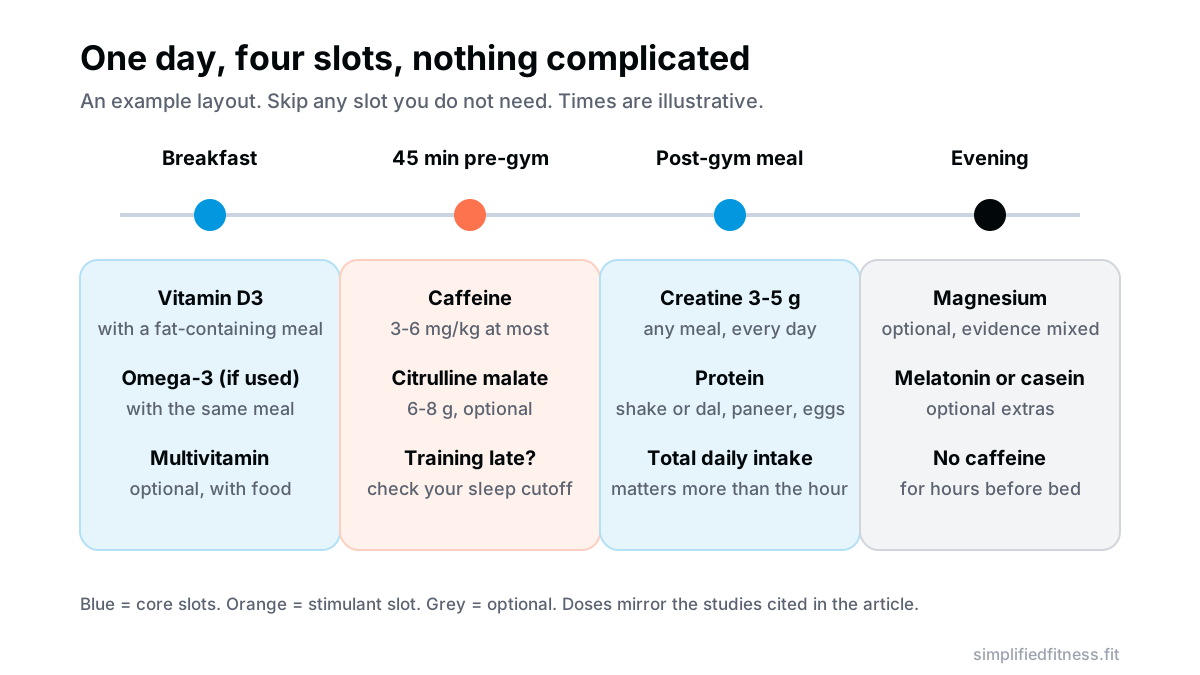
- A sensible daily supplement routine has four slots: breakfast (vitamin D3 with fat, optional multivitamin), pre-workout (caffeine, optional citrulline), a post-workout or daytime meal (creatine and protein), and evening (optional magnesium or melatonin, no caffeine).
- Timing matters most for two things: caffeine (keep it many hours away from bedtime, not just close to training) and fat-soluble vitamin D (take it with a meal that has fat). For creatine and protein, daily consistency beats the clock.
- Most supplement clashes are minor at normal doses. Iron and zinc tablets, or calcium and iron tablets, are the main pairs worth spacing out.
- Six bottles is rarely needed. Creatine, enough protein and a caffeine plan cover most of the proven benefit; the rest is optional.
- Take any prescription medicine, are pregnant, or have a medical condition? Check your schedule with a doctor or pharmacist first.
Part of our complete guide: Creatine, Protein Powders, Pre-Workouts and Caffeine: The Science and Safety Guide
Table of contents
The best daily supplement routine is a short one: vitamin D3 with a fatty breakfast, caffeine before training if you use it, creatine and protein with a meal after the gym, and anything optional in the evening. Only a few supplements are really timing-sensitive, so most of the “schedule” is just attaching each bottle to a meal you already eat.
If you have six bottles on the shelf and no idea which goes where, this guide is the master schedule. It sits on top of our complete guide to creatine, protein powders and caffeine, which explains each product in depth. Here we only care about when, and about what you can safely skip.
What actually needs a time slot?
Not much. Sorting supplements by how much the clock matters helps:
| Supplement | Does timing matter? | Simple rule |
|---|---|---|
| Caffeine | Yes, for performance and sleep | 45-60 min before training, hours before bed |
| Vitamin D3 | Somewhat | With a meal that contains fat |
| Creatine | No | Daily, any meal |
| Protein powder | Barely | Use it to hit your daily total |
| Citrulline malate | Slightly | 40-60 min before training, if you use it |
| Magnesium, melatonin | Evening by convention | Optional, evidence mixed |
That table is the whole logic. Everything below is detail.
Morning: what to take with breakfast
Breakfast is the easiest anchor because most people eat it at the same time daily.
Vitamin D3. This is the one morning supplement with a clear food rule. In a randomized trial of 50 healthy older adults given a single 50,000 IU dose, peak vitamin D3 levels were 32% higher after a fat-containing meal than after a fat-free meal (Dawson-Hughes et al., 2015). The participants were older adults and it was a one-day dose, so treat it as a practical hint rather than a precise rule. Take D3 with eggs, paneer, a paratha with curd, or nuts, not with black coffee alone. For who actually needs it, see vitamin D3 and muscle strength.
Omega-3. If you take fish oil, put it with the same meal. Fat in the meal is the sensible default for fat-based capsules, though I would not oversell the benefit for training.
Multivitamin. Optional. It fills dietary gaps, it does not boost training. With breakfast is fine.
Pre-workout: caffeine and the optional extras
Caffeine is the one gym supplement where timing changes both the benefit and the cost.
A meta-analysis of 10 strength and 10 power studies found caffeine improved maximal strength (SMD 0.20) and muscle power (SMD 0.17), with a significant effect for upper body strength but not lower body strength (Grgic et al., 2018). Those are small effects. Useful, not magical. Dose it by body weight with our caffeine dosage calculator, and read caffeine dosing for strength and power for the range.
Citrulline malate is optional. A meta-analysis of eight studies (137 participants, mostly strength-trained) found that 6-8 g taken 40-60 minutes before exercise added about 3 repetitions over placebo, roughly a 6% gain, with a small effect size (Vårvik et al., 2021). The lower body result only trended toward significance. Small gain, cheap enough, skip if your budget is tight.
Sodium before training is sometimes listed in stacks. I did not find evidence in the sources reviewed for this article to back a specific pre-workout sodium dose, so I would leave it out unless your own doctor or dietitian suggests it, especially if you have blood pressure concerns.
The caffeine cutoff matters more than the pre-gym window
Here is where people get caught. A 2023 meta-analysis of 24 studies found caffeine cut total sleep time by about 45 minutes and sleep efficiency by 7% on average (Gardiner et al., 2023). Its practical estimate: a coffee (107 mg per 250 mL) should be consumed at least 8.8 hours before bed, and a standard pre-workout serve (217.5 mg) at least 13.2 hours before.
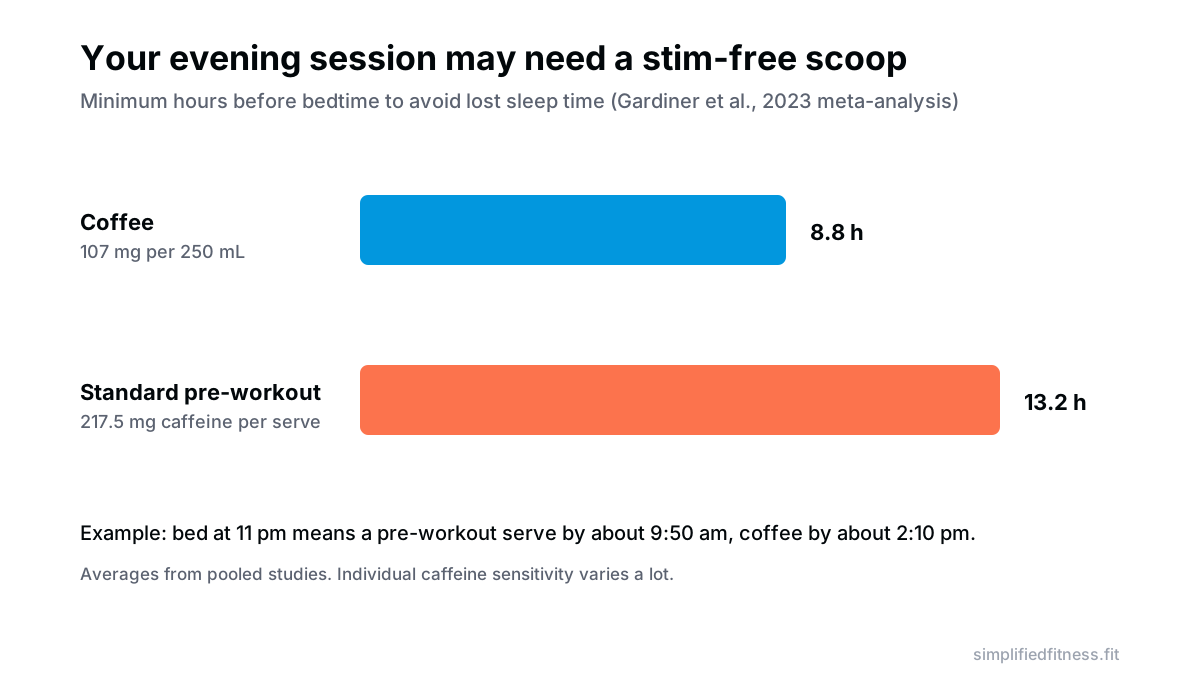
These are pooled averages and many studies were lab-based, so personal sensitivity differs. If you sleep badly and train in the evening, test a week without caffeine. See our guide to pre-workout side effects and fixes for jitters and palpitations, and see a doctor if you get chest pain or a racing heart.
Post-workout and daytime: creatine and protein
This slot is the least fussy.
Creatine monohydrate, 3-5 g daily. The International Society of Sports Nutrition position stand supports creatine as safe and well tolerated in healthy individuals, including long-term use (Kreider et al., 2017). On timing, an 8-week randomized trial in 34 resistance-trained men and women compared 5 g within an hour before versus after training, and the timing made no additional difference to strength or body composition (Dinan et al., 2022). It was a small study, and even the placebo group improved similarly, so it cannot rule out small timing effects. An earlier 4-week study of 19 recreational male bodybuilders found no significant difference either, though a secondary analysis suggested post-workout was “possibly” more beneficial (Antonio and Ciccone, 2013). For more detail, see creatine timing: pre vs post workout.
So the practical rule: put creatine in the shake or with the meal you are least likely to skip, including rest days.
Protein. A meta-analysis pooling 20 strength studies and 23 hypertrophy studies found no significant effect of protein timing once other factors were controlled, and total daily protein was the strongest predictor of muscle gain (Schoenfeld et al., 2013). Translation: the “anabolic window” is not a 30-minute panic. If your post-gym meal is dal, rice, curd and paneer, that counts. Use a powder when food cannot get you to your number. Work yours out with the protein calculator.
Evening: the optional slot
This slot is the weakest for evidence, so keep expectations modest.
Magnesium. It is popular as a night supplement, but trials on sleep are mixed and often small or low quality, so it is a “try it and see” item, not a requirement. Dose by the product label and keep it modest. Read the sleep supplements audit before spending money. If you have kidney disease, ask your doctor first.
Melatonin or casein. Both are optional extras. Melatonin is a hormone, so check dosing with a doctor if you are on medication, are pregnant, or have a sleep disorder. A slow-digesting protein like casein, or just a bowl of curd, can help if you are short on protein for the day.
What the evening slot should not include is caffeine.
Which supplements clash with each other?
Less than the internet claims. A 2001 review explained that at the amounts found in food, most micronutrients use specific absorption routes and are not very vulnerable to interactions, while competition shows up in solutions and at higher intakes (Sandström, 2001). It reported negative effects of iron supplements on zinc and copper status, and of zinc supplements on iron and copper status. It also noted that calcium’s negative effect on iron absorption, seen in short experiments, was not confirmed in long-term supplementation studies.
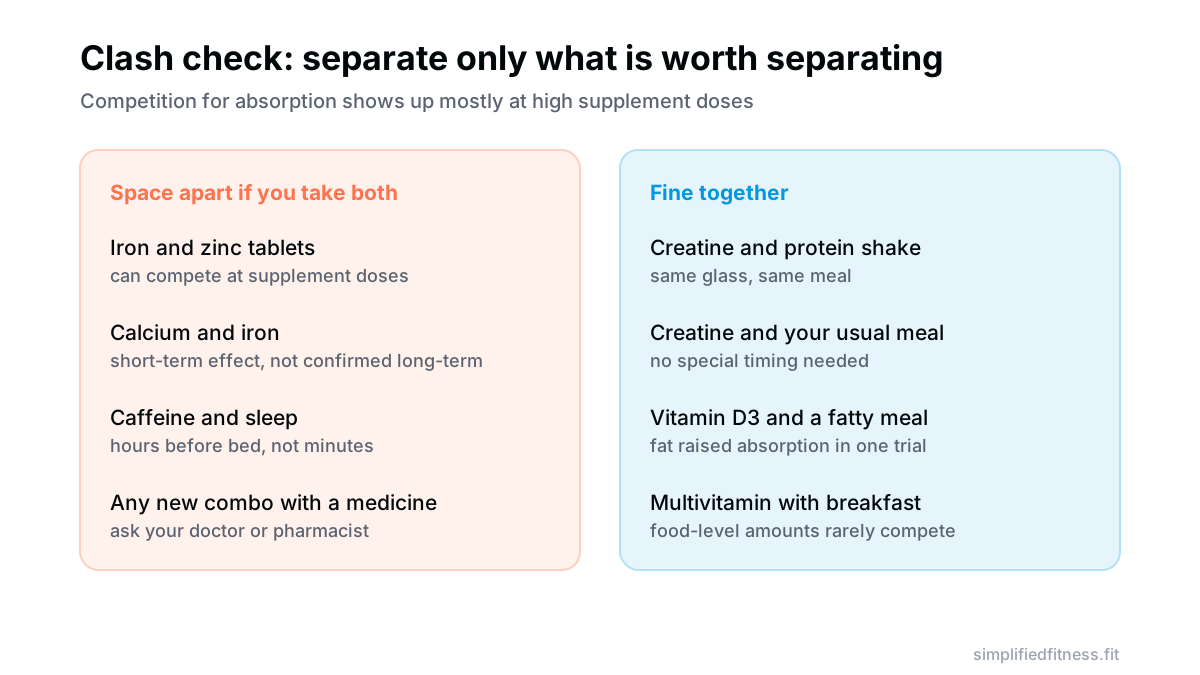
So the practical rule is short. If you take iron, zinc or calcium as separate tablets, space them a few hours apart. If you take only a multivitamin and standard products, do not stress. Taking iron for a diagnosed deficiency? Follow your doctor’s instructions, and see iron deficiency in athletes and calcium and vitamin D for bone health.
A sample daily supplement stack (and the budget version)
Here is one way to lay it out. Adjust to your own needs.
- Breakfast: vitamin D3 (if you need it), optional multivitamin and omega-3, with a meal containing fat.
- 45-60 min pre-gym: caffeine, optional citrulline malate.
- Post-gym or any meal: creatine 3-5 g, protein from food or a shake.
- Evening: optional magnesium or melatonin, no caffeine.
On a budget, creatine monohydrate, enough protein from dal, eggs, paneer, curd or soya, and a sensible caffeine plan (even chai or black coffee) give you most of the evidence-backed benefit. The rest is polish. Also see the pre-workout formulation guide before buying a branded blend.
Who should check with a doctor first?
Talk to a doctor or pharmacist before building a stack if you:
- take prescription medicines (blood thinners, blood pressure drugs, thyroid medication and others can interact with supplements)
- have kidney, liver or heart conditions
- are pregnant or breastfeeding
- are under 18
- get palpitations, dizziness or poor sleep from caffeine
This article is general education, not personal medical advice.
The bottom line
Build the day around meals. Vitamin D3 goes with fat, caffeine goes early enough to protect your sleep, and creatine and protein just need to happen daily. The rest is optional and the evidence for most evening add-ons is modest. Start with our free training plans and the protein calculator, and add supplements only where they fill a real gap.
Frequently Asked Questions
What is the best daily supplement routine for the gym?
A simple routine puts vitamin D3 with a fatty breakfast, caffeine about 45-60 minutes before training if you use it, creatine and protein with a post-workout or daytime meal, and any optional sleep supplement in the evening. This works because only a few supplements are genuinely timing-sensitive, so the rest can ride on meals you already eat. Write the four slots on a note on your phone and attach each bottle to a meal.
When should I take supplements, morning or night?
It depends on the supplement. Vitamin D3 and omega-3 suit a meal with fat, which for most people means breakfast or lunch, while caffeine belongs earlier in the day and any sleep aids belong in the evening. Taking each one when it fits your day beats chasing a perfect clock, so choose slots you will actually keep.
Should I take vitamin D in the morning or at night?
Either works as long as it comes with a meal that contains fat. In a randomized trial of 50 older adults, peak vitamin D3 levels were 32% higher after a fat-containing meal than after a fat-free one. Take it with your biggest or fattiest meal of the day, such as paratha with curd or eggs.
What time should I take creatine?
Any time, as long as you take it daily. An 8-week trial in 34 trained athletes found no extra benefit from taking 5 g before versus after training, and the effect comes from filling muscle stores over weeks. Mix it into your post-workout shake or with any meal you never skip.
Can I take creatine and caffeine together?
Most people take them on the same day with no special spacing, and nothing in the research reviewed here suggests you must separate them. Creatine builds up in muscle over weeks while caffeine acts within hours, so they do different jobs. Keep caffeine away from bedtime, which is the real timing issue.
When should I take pre-workout?
Roughly 45-60 minutes before training is the usual window, and the citrulline meta-analysis used 40-60 minutes. Caffeine is the ingredient in a typical blend with the best evidence for strength and power. Check the label for caffeine milligrams and count it toward your daily total.
How late is too late for pre-workout or coffee?
A 2023 meta-analysis suggested a standard pre-workout serve (about 217.5 mg caffeine) should be taken at least 13.2 hours before bed, and a coffee (107 mg per 250 mL) at least 8.8 hours before, to avoid losing sleep time. These are averages, so sensitive people may need longer gaps. If you train at night, try a stimulant-free pre-workout or none at all.
Should I take magnesium at night?
Many people take it in the evening, but the evidence for better sleep is mixed and often low quality, so treat it as optional. It is cheap and usually well tolerated at standard supplement doses, which is why people try it. If you have kidney problems or take medication, ask your doctor before starting.
Can I take all my supplements at once?
For most people, taking vitamin D, creatine and a multivitamin together with a meal is fine. Competition for absorption mostly appears at high supplement doses, especially with iron and zinc tablets, according to a 2001 review. If you use mineral tablets, space them out by a few hours and ask a pharmacist if unsure.
Do calcium and iron really cancel each other out?
The evidence is weaker than the internet suggests. A 2001 review found that mineral competition is clearly shown in short absorption studies, but the negative effect of calcium on iron absorption was not confirmed in long-term supplementation studies. Spacing them by a few hours costs nothing, but do not worry if you occasionally take them together.
Does protein timing matter for muscle growth?
Less than most people think. A meta-analysis of randomized trials (20 on strength, 23 on hypertrophy) found no significant benefit of timing once total protein intake was accounted for, with total intake the strongest predictor of muscle gain. Hit your daily protein target first, and use the post-workout shake only if it helps you get there.
Do I need a multivitamin if I take other supplements?
Not necessarily. A multivitamin fills dietary gaps rather than boosting training directly, so it is optional if your diet is varied. If your diet is limited, for example strictly vegetarian with few vegetables, a blood test and a doctor's advice will tell you what is actually low.
How many supplements do I actually need to build muscle?
Usually one to three, not six. Creatine monohydrate is backed by a large body of research summarized in the International Society of Sports Nutrition position stand, and caffeine has small but real effects on strength and power. Protein powder is a convenience, not a requirement, if your food already gets you to your target.
Sources & References
Every claim above is checked against peer-reviewed research (PubMed, U.S. National Library of Medicine) or guidance from established health bodies. How we fact-check.
- Kreider RB, et al. International Society of Sports Nutrition position stand: safety and efficacy of creatine supplementation in exercise, sport, and medicine. J Int Soc Sports Nutr. 2017. PMID: 28615996
- Grgic J, et al. Effects of caffeine intake on muscle strength and power: a systematic review and meta-analysis. J Int Soc Sports Nutr. 2018. PMID: 29527137
- Schoenfeld BJ, et al. The effect of protein timing on muscle strength and hypertrophy: a meta-analysis. J Int Soc Sports Nutr. 2013. PMID: 24299050
- Dawson-Hughes B, et al. Dietary fat increases vitamin D-3 absorption. J Acad Nutr Diet. 2015. PMID: 25441954
- Varvik FT, et al. Acute effect of citrulline malate on repetition performance during strength training: a systematic review and meta-analysis. Int J Sport Nutr Exerc Metab. 2021. PMID: 34010809
- Gardiner C, et al. The effect of caffeine on subsequent sleep: a systematic review and meta-analysis. Sleep Med Rev. 2023. PMID: 36870101
- Sandstrom B. Micronutrient interactions: effects on absorption and bioavailability. Br J Nutr. 2001. PMID: 11509108
- Dinan NE, et al. Effects of creatine monohydrate timing on resistance training adaptations and body composition after 8 weeks in male and female collegiate athletes. Front Sports Act Living. 2022. PMID: 36465581
- Antonio J, Ciccone V. The effects of pre versus post workout supplementation of creatine monohydrate on body composition and strength. J Int Soc Sports Nutr. 2013. PMID: 23919405

Umair Hazrami · Founder & Head Coach, Simplified Fitness
Umair Hazrami founded Simplified Fitness and the Simplified Lifter channel to cut through fitness noise. With 4+ years of consistent training and 10+ coaching clients, he writes every guide from the peer-reviewed research and links the sources so you can check them. Our editorial standards.
Educational content only, not medical advice. If you have a medical condition, are pregnant, or take medication, talk to a qualified doctor before changing your diet, supplements or training. Full disclaimer.
Keep reading
Supplements
Alpha-GPC and Huperzine A Pre-Workout: Do Cholinergic Nootropics Help Lifting?
Does an alpha GPC pre workout add power or focus? See what small trials found, why Huperzine A is a poor lifting bet, and the safety flags to know first.
10 min read

Supplements
The Antioxidant Paradox: Can Vitamin C and E Pills Blunt Muscle Growth and Endurance?
Does vitamin C blunt muscle growth? See what trials of 1000 mg vitamin C plus E found for strength, hypertrophy and endurance, and when pills are worth taking.
8 min read

Supplements
Caffeine Powder vs Coffee Before Lifting: Does the Source Really Matter?
Caffeine anhydrous vs coffee for lifting: what research says on absorption speed, peak levels and stomach upset, and whether pills beat your daily cup.
7 min read

Supplements
Caffeine Dosing for Strength and Power: 3-6 mg/kg and When to Take It
Caffeine dosage for strength is 3-6 mg/kg, about 210-420 mg for a 70 kg lifter, taken around 60 minutes before training. Doses, timing and when to stop.
8 min read