Plant-Based Protein Powders: Do Pea and Rice Blends Really Match Whey?
Is a plant based protein powder as good as whey for muscle? See what pea, rice and blend trials show, plus how to fix chalky taste and check sodium.
TL;DR. The short answer
- A plant based protein powder can support muscle growth about as well as whey when total daily protein is high enough and training is hard. Short trials of pea protein found similar gains to whey, but they are small and often industry-funded.
- Single plant proteins are lower in essential amino acids, lysine and methionine on average. Pea and rice have complementary profiles, which is why blends are the smarter buy.
- Large meta-analyses lean slightly toward animal protein for muscle mass. Soy matched milk protein, so the gap shows up with non-soy plant proteins and whole plant-based diets. Hitting your total protein target matters more than the source.
- Chalky taste is fixable: blend with cold soy or oat milk and a banana, add cocoa or cinnamon, and let the shake sit a minute before drinking. Read the label for sodium, because it varies a lot between brands.
- Lactose intolerant or vegan? Plant blends are a reasonable choice. Kidney disease or allergies (pea, soy) mean you should check with a doctor first.
Part of our complete guide: Creatine, Protein Powders, Pre-Workouts and Caffeine: The Science and Safety Guide
Table of contents
A good plant based protein powder can build muscle about as well as whey, as long as you eat enough protein overall and train hard (our pillar guide on creatine, protein powders and caffeine covers the wider picture). Single plant proteins are weaker on paper, but a pea and rice blend closes much of the gap, and the best short trials show similar results.
That is the honest version. The evidence is not as tidy as supplement labels suggest, so below is what the studies show, where they disagree, and how to buy and mix a plant powder you will actually finish.
Is a plant based protein powder as good as whey?
Close, with caveats. It helps to separate three questions: does plant protein build muscle, does it do so as well as whey, and does the type of plant protein matter.
First, protein supplements in general do help. A meta-analysis of 49 trials and 1,863 healthy adults found that protein supplementation added small but real gains in strength and fat-free mass during resistance training, and that gains levelled off once total protein reached about 1.6 g/kg/day (Morton et al., 2018). Total intake is the big lever. The source comes second.
Second, source does seem to matter a little. A 2025 meta-analysis pooled 30 randomized trials and found slightly lower muscle mass after plant protein than animal protein (SMD -0.20), with no difference for strength or physical performance (Reid-McCann et al., 2025). The gap was larger in adults under 60 than in older adults.
Third, the type of plant protein matters. In that same analysis, soy and milk protein did not differ for muscle mass across 17 trials, while animal protein beat non-soy plant proteins such as rice, chia, oat and potato (only 5 trials) and whole plant-based diets (7 trials). A 2021 meta-analysis of 16 trials agreed on the shape: protein source did not change absolute lean mass or strength, yet animal protein favoured percent lean mass, especially in people under 50 (Lim et al., 2021).
Why single plant proteins fall short (and blends fix it)
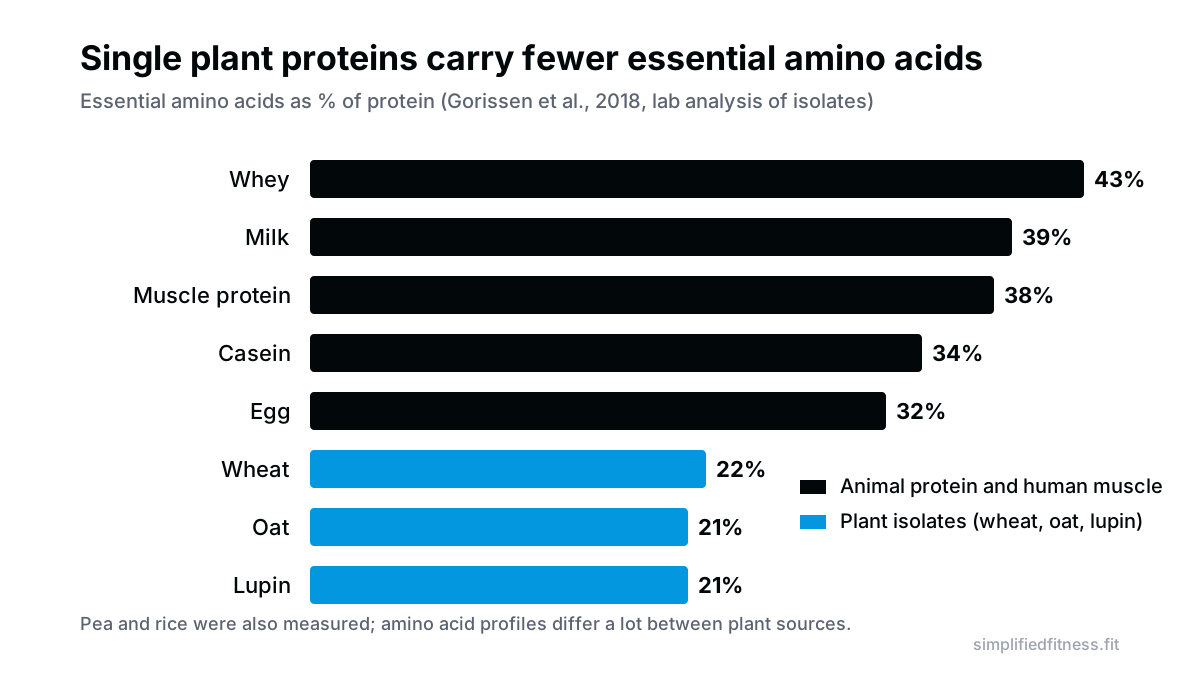
Muscle protein synthesis depends on how many essential amino acids reach your blood, and especially on leucine, lysine and methionine. A Maastricht University team analysed commercial protein isolates in the lab and found that essential amino acids made up about 43% of whey and 32-39% of milk, egg and casein, versus about 21-22% for oat, lupin and wheat (Gorissen et al., 2018).
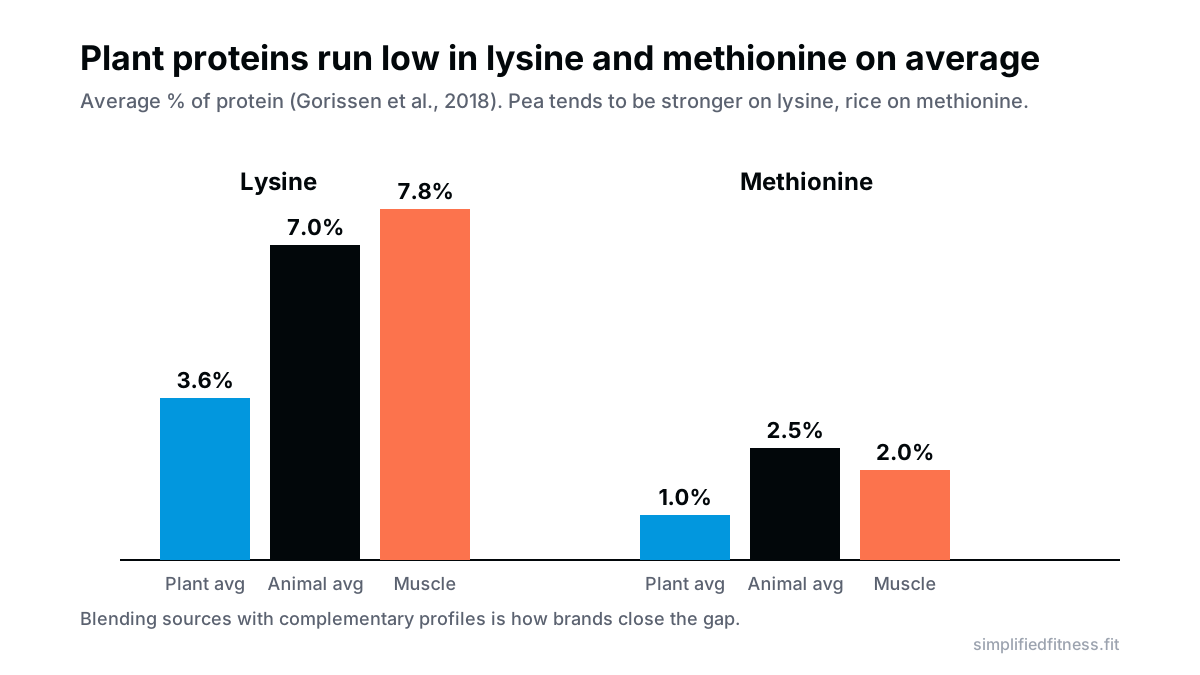
On average, plant isolates had 3.6% lysine and 1.0% methionine, compared with 7.0% and 2.5% in animal proteins. Profiles vary widely between sources, though. Leucine ranged from 5.1% in hemp to 13.5% in corn protein. The authors conclude that combining plant isolates, or blending plant with animal protein, can produce profiles close to animal protein (Gorissen et al., 2018).
Why pea plus rice is the standard pairing
Pea protein is generally richer in lysine, and rice protein in methionine, which is why the two are sold together. What matters for you: the better blends list both proteins, and the best print their amino acid panel. You will also see a “70:30 pea to rice” ratio quoted everywhere; no trial shows it beats other splits. Our guide to pea and rice protein blend ratios goes deeper on formulas.
What about DIAAS?
DIAAS (Digestible Indispensable Amino Acid Score) is a way of rating protein quality that accounts for digestibility, not just amino acid content. Plant proteins usually score lower than dairy on it, and blending can raise the score. Published values for commercial pea and rice powders are scarce, so if a brand prints a DIAAS number, ask where the testing was done. Our DIAAS vs PDCAAS explainer covers how the scores work.
What do the pea and rice protein vs whey studies actually show?
Most “pea equals whey” claims trace back to a handful of trials. Here is each one, plainly.
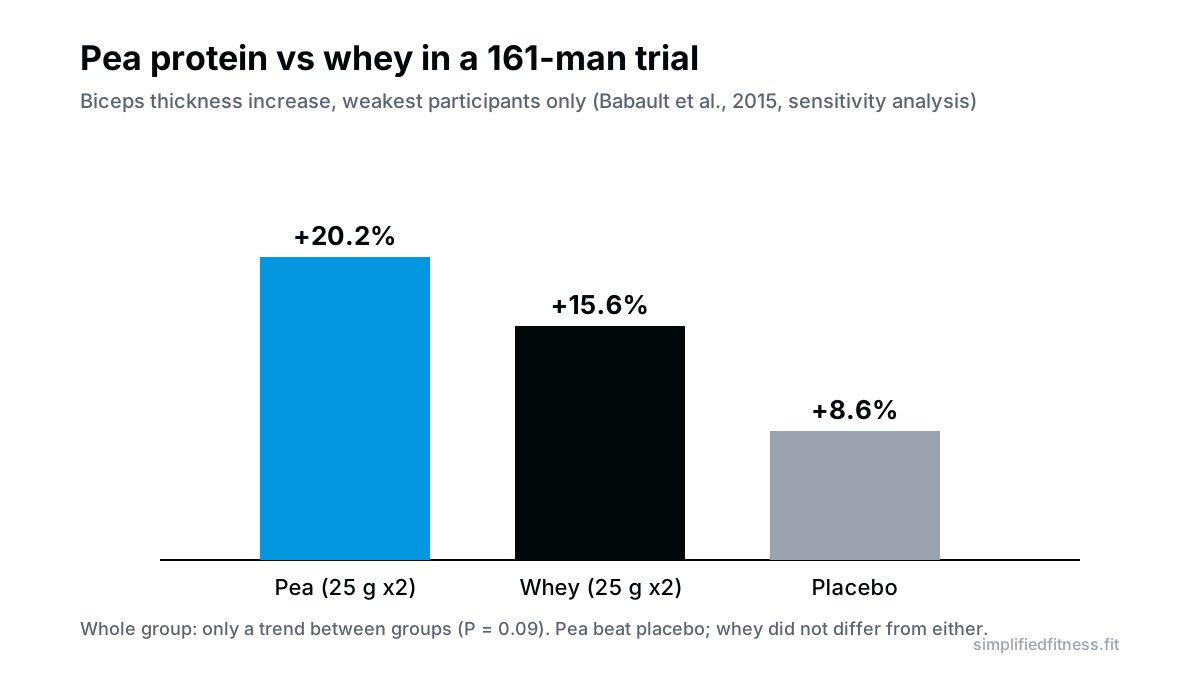
Babault et al., 2015. This was a double-blind trial in 161 men aged 18 to 35, randomized to pea protein (n = 53), whey (n = 54) or placebo (n = 54), taking 25 g twice a day for 12 weeks of upper-limb resistance training. Biceps thickness rose over time in everyone, but between-group differences across the whole sample were only a trend (P = 0.09). In the weakest participants, thickness increased 20.2% with pea, 15.6% with whey and 8.6% with placebo. Pea beat placebo, and whey did not differ from either. Strength rose with time, with no group difference (Babault et al., 2015). Note that several authors were employed by the pea protein maker, and the clearest result came from a sensitivity analysis on a subgroup.
Banaszek et al., 2019. A pilot study of 15 men and women doing 8 weeks of high-intensity functional training, taking 24 g of whey or pea protein around training. Both groups got stronger in the squat and deadlift, neither group gained measurable muscle thickness, and there were no group differences in any measure (Banaszek et al., 2019). With 15 people, a lack of difference is weak evidence, since the study could easily miss a real one.
Joy et al., 2013. This trial compared 8 weeks of whey versus rice protein isolate taken after exercise, in large isocaloric doses. Its published abstract gives the design and aim but not the outcomes, so we have not quoted numbers from it here (Joy et al., 2013).
van der Heijden et al., 2024. This one tested an actual blend: 39.5% pea, 39.5% brown rice and 21.0% canola. Ten resistance-trained adults took 32 g of protein from whey or the blend after leg training, in a double-blind crossover. Blood essential amino acids were about 44% higher after whey, yet muscle protein synthesis rates did not differ between conditions over four hours (van der Heijden et al., 2024). This is mechanistic, very small and was funded by a sports nutrition company, so it shows the blend idea can work rather than proving long-term growth is equal.
Plant based protein powder vs whey: a quick comparison
| Whey | Pea + rice blend | Single plant (e.g. rice only) | |
|---|---|---|---|
| Essential amino acid content | Highest | Moderate, improved by blending | Often lower |
| Lactose | Isolate: very low | None | None |
| Taste and texture | Smooth | Earthy, sometimes gritty | Varies, often chalky |
| Muscle evidence | Strongest | Promising, small trials | Mixed, fewer trials |
| Best for | No dairy issues | Vegan, lactose intolerant | Allergen-free needs |
For the dairy side, see whey isolate vs concentrate.
How to make plant protein not taste like chalk
Texture and bitterness are the real reasons people quit these powders. A few fixes that cost almost nothing:
- Use cold soy or oat milk (or dairy milk or curd if you are not vegan), not water alone. Fat and a little sugar help mask bitterness.
- Add a banana, cocoa, a spoon of peanut butter or instant coffee. Strong flavours cover the earthy note.
- Shake with the liquid first, powder second, then let it sit for 60 seconds so the particles hydrate. Use a shaker ball or blender.
- Bake or cook with it. Stir a scoop into oats, pancake batter or ragi porridge.
- Try a different brand before giving up. Taste varies hugely, and one study traced the main bitter taste of pea isolate to a single pea albumin peptide (Ongkowijoyo et al., 2023).
Check the sodium and the label
Pea protein is often described as high in sodium. There is no reliable general figure, since it depends on the product and how it is processed, so the label is the only guide. Compare sodium per serving across brands. If you have high blood pressure or are told to limit salt, ask your doctor which products suit you.
What else to look for on the tub:
- Protein per 100 g of powder. Lower numbers can mean added thickeners or sweeteners.
- Both pea and rice (or soy) listed, with an amino acid panel if possible.
- Third-party testing, which matters for contaminants. We cover this in heavy metals in protein powders and how to spot amino spiking.
- Few extras. Long ingredient lists with gums and “proprietary blends” add cost, not muscle.
How much plant protein should you take?
Start with your daily total, not the scoop. Work out your target with the protein calculator. The meta-analysis above suggests benefits plateau around 1.6 g/kg/day for most lifters (Morton et al., 2018).
Because many plant proteins carry fewer essential amino acids, and some less leucine, a slightly larger serving than you would use with whey is a reasonable, low-cost hedge. That is a practical read of the amino acid data, not an amount any trial has tested. One scoop after training and one between meals is plenty for most people. How the powder fits with your other supplements is in our daily supplement schedule.
Indian vegetarian context
You do not need powder to hit the numbers. Dal, rajma, chana, paneer, curd, milk and soya chunks all work, and roti plus dal pairs cereal and legume proteins in a similar way to pea plus rice. Powder earns its place when your appetite, budget or schedule makes the whole-food route hard to repeat daily. In hot weather, a shake is also easier to get down than a heavy meal.
Who should check with a doctor first
- You have kidney disease or reduced kidney function.
- You have a pea, soy or other legume allergy.
- You are on a medically advised low-sodium diet.
- You are pregnant, breastfeeding or under 18 and considering high-dose supplements.
The bottom line
Plant protein is a fair alternative to whey. Large reviews lean slightly toward animal protein for muscle mass, especially with single non-soy plant proteins, but short trials of pea protein and a well-designed pea, rice and canola blend show results close to whey. Pick a blend, check sodium and testing, make it taste good, and hit your daily protein. If you want to plug it into a program, start with our free training plans.
Frequently Asked Questions
Is plant protein powder as good as whey for building muscle?
Roughly, yes, if you eat enough total protein and train hard, though whey may hold a small edge. A 2025 meta-analysis of 30 trials found slightly lower muscle mass gains with plant protein than animal protein, but no difference in strength. Add a little extra scoop or use a blend, and focus on hitting your daily protein target.
Is pea and rice protein a complete protein?
A pea and rice blend covers the essential amino acids far better than either one alone. Pea tends to supply more lysine and rice more methionine, which are the two amino acids single plant proteins usually lack. Pick a blend with both on the label rather than relying on one source.
What is the best ratio of pea to rice protein?
There is no single proven ratio. The one blend tested against whey for muscle protein synthesis used equal parts pea and brown rice plus some canola. Choose a product that lists both proteins and a full amino acid profile, and see our guide to pea and rice blend ratios for the details.
How much plant protein powder do I need per serving?
Aim for a serving that gives roughly 25-35 g of protein, adjusted for body size. Because many plant proteins carry fewer essential amino acids, sitting toward the higher end is a sensible, low-cost hedge, though no trial has tested an exact amount. Use the protein calculator to set your daily total, then fill the gap with powder.
Why does vegan protein powder taste chalky or gritty?
Plant protein isolates contain fibre and insoluble particles that do not fully dissolve, and pea protein can carry a bitter, earthy note. Research has traced the main bitter taste in pea protein isolates to one specific peptide. Blend it cold with soy milk, oat milk or a banana, and let the shake sit for a minute so the powder hydrates.
Does pea protein have a lot of sodium?
Sodium varies by brand and process, and some pea protein products are noticeably salty. There is no standard figure, so the label is the only reliable guide. Compare sodium per serving across products, and talk to your doctor if you are on a low-sodium diet for blood pressure.
Is plant protein or whey better for lactose intolerance?
Plant protein is lactose-free by default, so it avoids the issue entirely. Whey isolate has very little lactose and suits many people, as covered in our whey isolate guide. If dairy upsets your stomach, try a plant blend for a week and see how you feel.
Is soy protein better than pea protein?
Soy has the strongest evidence among plant proteins. A 2025 meta-analysis found no difference between soy and milk protein for muscle mass across 17 trials. Pea has far fewer trials, so soy is the safer bet if you tolerate it, and pea or blends are fine if you do not.
Can vegetarians in India build muscle without protein powder?
Yes, powder is a convenience, not a requirement. Dal, paneer, curd, soya chunks, eggs (for ovo-vegetarians) and milk can all reach the targets used in trials. Powder helps when budget, time or appetite make those foods hard to repeat daily.
Are plant protein powders safe for kidneys?
In healthy people, normal protein intakes have not been shown to harm kidneys, though most trials are short. If you have kidney disease, protein targets need medical guidance. See your doctor before adding a high-protein supplement.
Do plant protein powders contain heavy metals?
Contamination is a real quality concern for some protein products, and it is a product issue rather than a plant versus whey issue. Third-party tested brands reduce the risk. Read our heavy metals guide before buying from an unknown seller.
When should I drink plant protein: before or after training?
Timing matters much less than total daily protein. The trials discussed here gave shakes around training or twice a day, and none tested timing, so any convenient time works. Split your protein across 3-4 meals and have the shake wherever you are short.
Sources & References
Every claim above is checked against peer-reviewed research (PubMed, U.S. National Library of Medicine) or guidance from established health bodies. How we fact-check.
- Babault N, et al. Pea proteins oral supplementation promotes muscle thickness gains during resistance training: a double-blind, randomized, placebo-controlled clinical trial vs. whey protein. J Int Soc Sports Nutr. 2015. PMID: 25628520
- Banaszek A, et al. The effects of whey vs. pea protein on physical adaptations following 8-weeks of high-intensity functional training (HIFT): a pilot study. Sports (Basel). 2019. PMID: 30621129
- Gorissen SHM, et al. Protein content and amino acid composition of commercially available plant-based protein isolates. Amino Acids. 2018. PMID: 30167963
- van der Heijden I, et al. Plant protein blend ingestion stimulates postexercise myofibrillar protein synthesis rates equivalently to whey in resistance-trained adults. Med Sci Sports Exerc. 2024. PMID: 38537270
- Reid-McCann RJ, et al. Effect of plant versus animal protein on muscle mass, strength, physical performance, and sarcopenia: a systematic review and meta-analysis of randomized controlled trials. Nutr Rev. 2025. PMID: 39813010
- Lim MT, et al. Animal protein versus plant protein in supporting lean mass and muscle strength: a systematic review and meta-analysis of randomized controlled trials. Nutrients. 2021. PMID: 33670701
- Morton RW, et al. A systematic review, meta-analysis and meta-regression of the effect of protein supplementation on resistance training-induced gains in muscle mass and strength in healthy adults. Br J Sports Med. 2018. PMID: 28698222
- Ongkowijoyo P, et al. Identification of a bitter peptide contributing to the off-flavor attributes of pea protein isolates. J Agric Food Chem. 2023. PMID: 37141411
- Joy JM, et al. The effects of 8 weeks of whey or rice protein supplementation on body composition and exercise performance. Nutr J. 2013. PMID: 23782948

Umair Hazrami · Founder & Head Coach, Simplified Fitness
Umair Hazrami founded Simplified Fitness and the Simplified Lifter channel to cut through fitness noise. With 4+ years of consistent training and 10+ coaching clients, he writes every guide from the peer-reviewed research and links the sources so you can check them. Our editorial standards.
Educational content only, not medical advice. If you have a medical condition, are pregnant, or take medication, talk to a qualified doctor before changing your diet, supplements or training. Full disclaimer.
Keep reading
Supplements
Alpha-GPC and Huperzine A Pre-Workout: Do Cholinergic Nootropics Help Lifting?
Does an alpha GPC pre workout add power or focus? See what small trials found, why Huperzine A is a poor lifting bet, and the safety flags to know first.
10 min read
Supplements
The Antioxidant Paradox: Can Vitamin C and E Pills Blunt Muscle Growth and Endurance?
Does vitamin C blunt muscle growth? See what trials of 1000 mg vitamin C plus E found for strength, hypertrophy and endurance, and when pills are worth taking.
8 min read
Supplements
Caffeine Powder vs Coffee Before Lifting: Does the Source Really Matter?
Caffeine anhydrous vs coffee for lifting: what research says on absorption speed, peak levels and stomach upset, and whether pills beat your daily cup.
7 min read
Supplements
Caffeine Dosing for Strength and Power: 3-6 mg/kg and When to Take It
Caffeine dosage for strength is 3-6 mg/kg, about 210-420 mg for a 70 kg lifter, taken around 60 minutes before training. Doses, timing and when to stop.
8 min read