Best Sleep Supplements for Lifters: Melatonin, Glycine, Magnesium and Apigenin Audited
Looking for the best sleep supplements for lifters? We audit melatonin, glycine, magnesium and apigenin against the studies, with doses, timing and who to skip.
TL;DR. The short answer
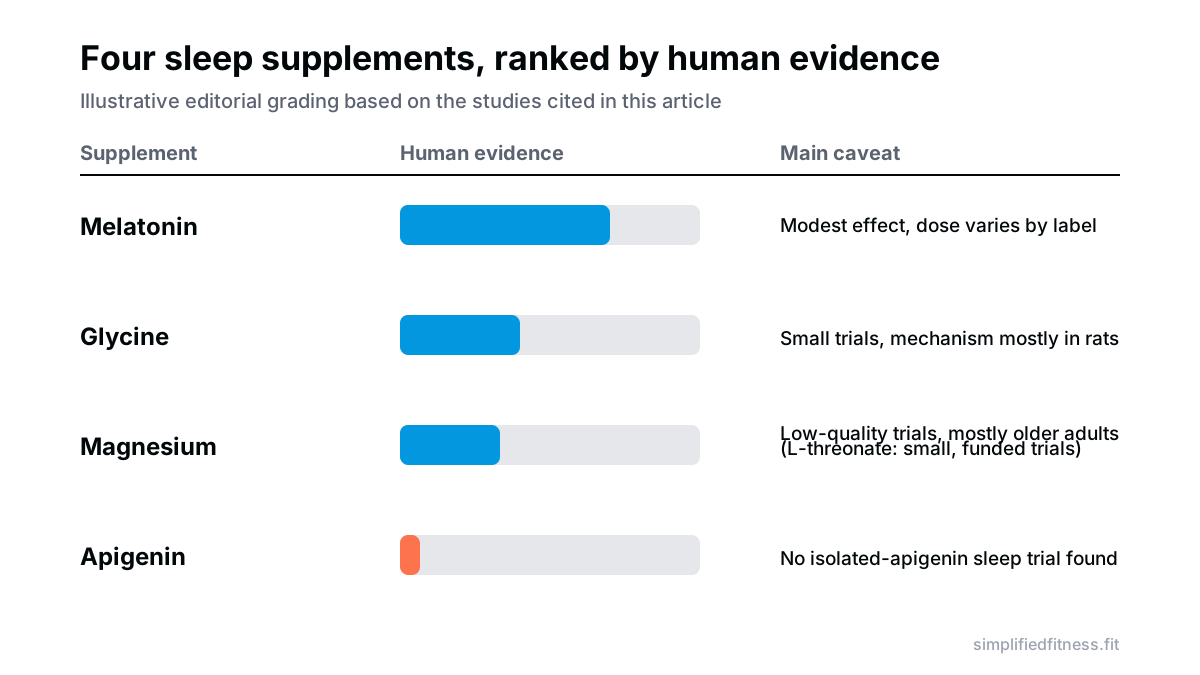
- Melatonin has the strongest evidence of the four, but the effect is modest: about 7 minutes faster sleep onset across 19 trials. More is not clearly better, and label accuracy is a real problem.
- Glycine before bed has small human trials and a plausible mechanism (a drop in core temperature), but most mechanism data comes from rats.
- Magnesium trials are mostly low quality and mostly in older adults. Magnesium L-threonate has a few small, supplier-linked trials, and the cost premium is not yet justified by the evidence.
- We could not find a randomized trial of isolated apigenin for sleep. Chamomile, its usual source, has little insomnia data.
- Fix sleep timing, caffeine and room temperature first. If you try a supplement, change one thing at a time for 2-3 weeks. See a doctor if poor sleep lasts more than a month or you snore and wake unrefreshed.
Part of our complete guide: Creatine, Protein Powders, Pre-Workouts and Caffeine: The Science and Safety Guide
Table of contents
The best sleep supplements for lifters are, in order of evidence, melatonin, then glycine and magnesium, with apigenin last. None of them is a knockout. Trials show effects measured in minutes, not hours, and some of the popular claims (especially around tiny melatonin doses and brain-penetrating magnesium) run ahead of the data.
This audit sits inside our wider guide to the supplements that actually earn their place. Sleep is where recovery is won or lost, so it is worth being precise about what a capsule can and cannot do.
What do sleep supplements actually change?
Before the pills, a quick map of the target. Sleep runs in cycles of lighter stages, deep slow-wave sleep (NREM) and REM. Deep sleep is where much of your growth hormone pulse happens, and REM is tied to memory and mood. We cover that properly in sleep architecture for athletes.
Here is the catch. Most supplement trials measure how fast people fall asleep, how long they sleep, or how they rate their sleep. Very few show a change in slow-wave sleep itself. So when a label promises “deeper sleep”, ask which study measured that.
Melatonin dose for sleep: is micro-dosing really better?
The online claim is that 0.3-1 mg beats the 5-10 mg capsules on the shelf. The truth is more nuanced.
A 2013 meta-analysis pooled 19 placebo-controlled trials (1,683 people with primary sleep disorders). Melatonin cut sleep latency by about 7 minutes and added about 8 minutes of total sleep time. Overall sleep quality improved modestly. Trials using higher doses and longer durations showed larger effects on latency and total sleep time (Ferracioli-Oda et al., 2013). That runs against the “lower is better” story.
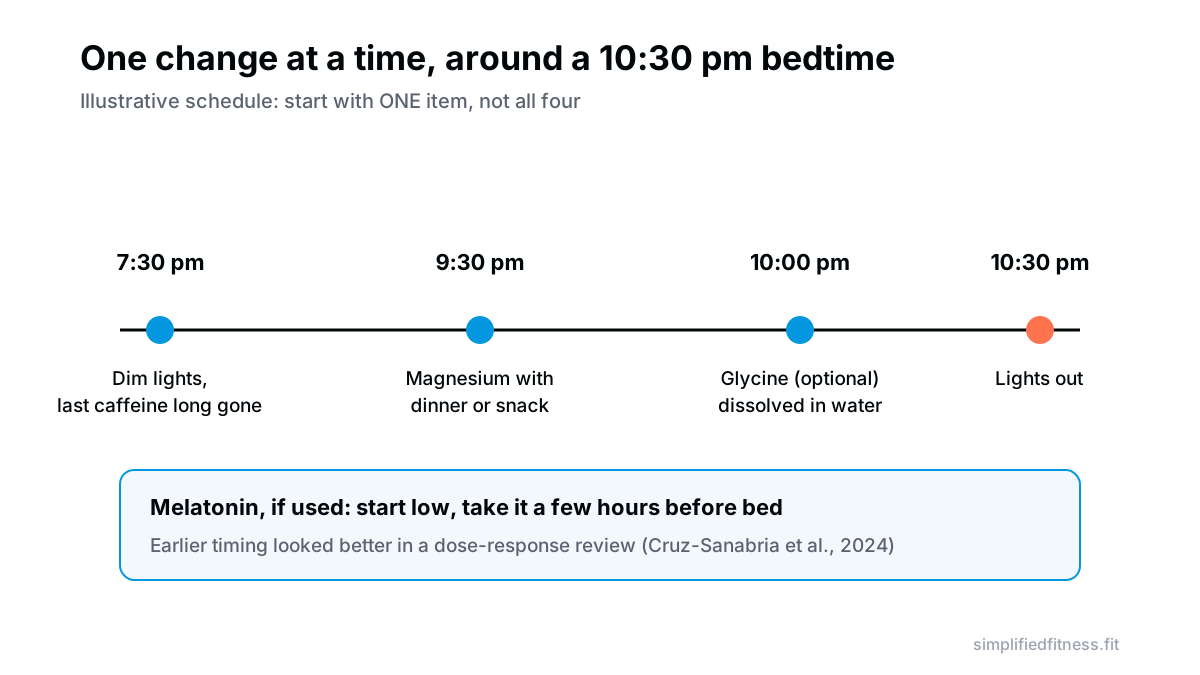
A 2024 dose-response meta-analysis of 26 trials found the benefit peaked around 4 mg a day. It also found that taking melatonin about 3 hours before the desired bedtime looked better than the common routine of 2 mg thirty minutes before bed (Cruz-Sanabria et al., 2024).
So where does the micro-dose idea come from? An MIT study gave 12 healthy young volunteers 0.3 mg or 1.0 mg at 9 pm, two to four hours before their usual bedtime. The 0.3 mg dose brought blood melatonin into the normal night-time range, sleep onset sped up, and nobody reported morning hangover effects (Zhdanova et al., 1996). That shows a small dose is physiologically sufficient. It does not show 0.3 mg beats 4 mg.
We found no evidence that a 10 mg capsule outperforms 4 mg, so there is no reason to start there.
The label problem
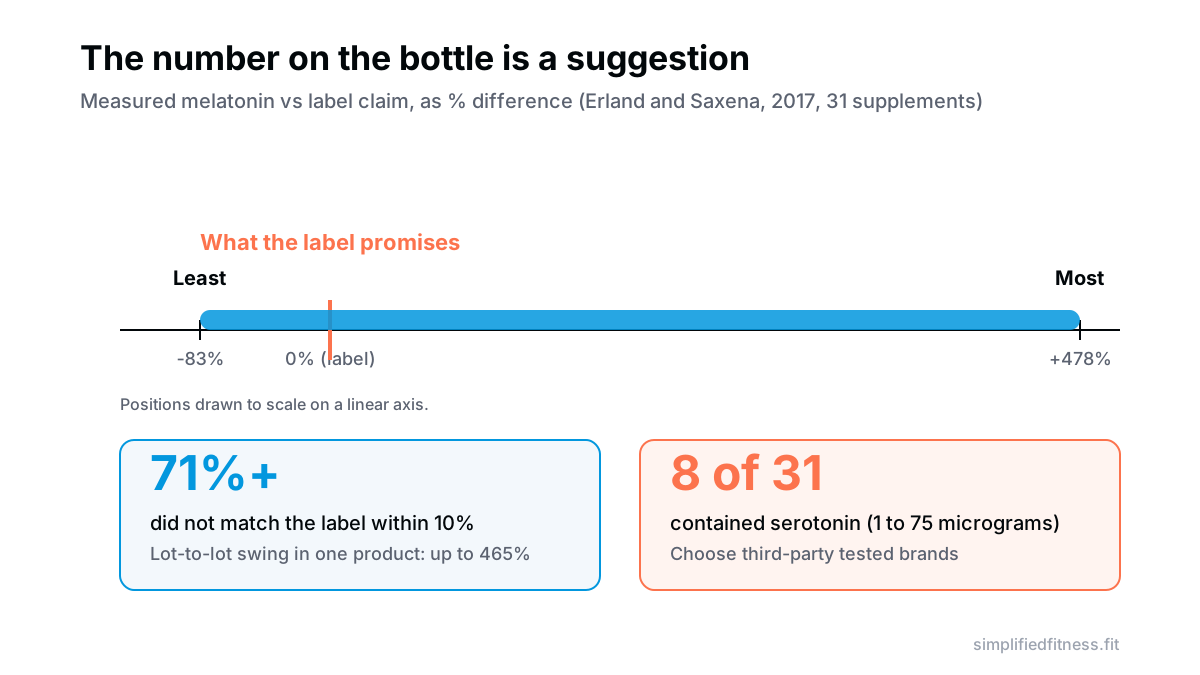
The bigger issue is whether the dose on the bottle is real. A 2017 analysis of 31 commercial products found melatonin ranged from 83% below to 478% above the label claim, with lot-to-lot variation up to 465% inside one product. Eight contained serotonin (Erland and Saxena, 2017).
Melatonin is a timing signal, not a sedative. It is most useful for shifted schedules, jet lag and shift work (see our low-dose melatonin and circadian guide). In India, check that the brand is genuinely licensed and independently tested, as pharmacy and online listings vary.
Does glycine before bed help recovery?
Glycine is a cheap amino acid. The proposed story: it widens blood vessels in the skin, you lose heat, core temperature drops, and that drop helps sleep onset.
The evidence comes in two layers. In rats, oral glycine increased skin blood flow, lowered core temperature and shortened the time to NREM sleep. The effect required the suprachiasmatic nucleus (the body clock), and removing it abolished the sleep effect (Kawai et al., 2015). In humans, a review by the same research group reports that glycine before bedtime improved subjective sleep quality in people with insomniac tendencies (Bannai and Kawai, 2012). Both papers come from a group linked to Ajinomoto, a glycine producer, so independent replication would help.
A broader meta-analysis of 31 trials found amino acid supplements as a group improved subjective sleep quality (mean difference -1.27 on sleep scales) (Chan and Lo, 2022). That pools several amino acids, not just glycine.
A small trial of a blend containing glycine, magnesium, tryptophan, tart cherry and L-theanine in 16 young adults over three days cut sleep onset latency by about 24 minutes (Langan-Evans et al., 2023). Since it was a blend, you cannot credit the glycine.
Practically: about 3 g is the number most people use, but the abstracts we read do not state a dose, so treat it as a common convention. It dissolves in water and costs very little.
Apigenin: what does the research say?
Apigenin is a flavonoid found in chamomile. It became popular through podcast sleep stacks.
Honestly, we could not find a randomized trial of isolated apigenin for sleep in a PubMed search. The nearest human evidence is chamomile. A 2019 systematic review of 12 trials found only one that tested insomnia, and it showed no significant change in the Insomnia Severity Index. Pooled sleep quality scores did improve with chamomile, and so did generalized anxiety scores (Hieu et al., 2019).
That is evidence for chamomile as a whole, not for apigenin pulled out of it. So apigenin is a “maybe” with essentially no direct proof. A warm cup of chamomile tea costs a few rupees and carries the ritual benefit too.
Magnesium and sleep: which form?
Magnesium is the supplement most lifters already take. The sleep evidence is thinner than the marketing.
A 2021 meta-analysis found only three randomized trials (151 older adults). Sleep onset was 17 minutes shorter with magnesium, but all trials had moderate-to-high risk of bias and the evidence was rated low to very low quality (Mah and Pitre, 2021). One of them gave 46 older adults with insomnia 500 mg of magnesium daily for 8 weeks and found better sleep efficiency and shorter latency, though no difference in total sleep time (Abbasi et al., 2012). These are elderly participants, so results may not carry over to a 25-year-old lifter.
Magnesium L-threonate vs bisglycinate
The L-threonate claim rests on a rat study showing that raising brain magnesium with this compound improved learning and memory (Slutsky et al., 2010). That is animal data about memory, not sleep.
Human sleep trials exist, but they conflict. One trial of 80 adults aged 35-55 with sleep problems (1 g a day for 21 days) reported better wearable-measured deep and REM sleep scores than placebo, though several authors were employed by the supplier (Hausenblas et al., 2024). A later trial of 100 adults aged 18-45 (2 g a day for 6 weeks) found no group differences in wearable sleep outcomes and only a small gain in sleep-related impairment on self-report (Lopresti and Smith, 2025).
Why the difference? Different ages, doses, durations and outcome tools. Cautious takeaway: L-threonate is unproven for sleep. We found no head-to-head trial against bisglycinate, and the price premium is hard to justify yet. Our magnesium forms comparison covers the practical differences.
Combining magnesium and melatonin
People ask about stacking them. We found no trial testing the pair together, so any synergy is theory. They do different jobs: magnesium as a nutrient, melatonin as a timing signal. A sensible approach is to take magnesium with an evening meal and, if needed, melatonin a few hours before bed. Add them one at a time.
How to run a sensible sleep experiment
Here is the most common mistake: starting a four-product stack, sleeping better for a week (often because you also went to bed earlier), and crediting the pills.
- Fix the basics for two weeks. Fixed wake time, no caffeine after early afternoon (see our caffeine cutoff guide), dark and cool room.
- Change one thing. Pick the option that fits your problem: trouble falling asleep, try melatonin timing; wake hot, try glycine and a cooler room.
- Track for 2-3 weeks. Note time to fall asleep and how you feel at 8 am. Wearables are noisy, so lean on how you feel.
- Stop if nothing changes. No benefit means stop spending.
For the rest of the plan, our free training plans pair well with a protected sleep window, and our sleep hygiene checklist covers temperature and light.
Who should be careful, and when to see a doctor
Melatonin, glycine and magnesium are generally well tolerated in short-term trials, but data in pregnancy, breastfeeding, children and long-term use are limited. Check with a doctor first if you are pregnant, take blood thinners, antidepressants, blood pressure or diabetes medication, or have kidney disease (magnesium is cleared by the kidneys).
See a doctor if poor sleep lasts more than a month, if you snore loudly, wake choking or feel unrefreshed after a full night, since sleep apnea becomes more likely as body weight rises and no supplement fixes it. Persistent low mood or anxiety also deserves proper care rather than a stack.
The bottom line
Melatonin is the only one with solid meta-analytic support, and its gains are small. Glycine is a cheap low-risk experiment with mostly mechanistic and small-trial backing. Magnesium helps some people but the evidence is low quality, and L-threonate is not proven better. Apigenin is a maybe with no direct trial.
Sleep is the cheapest recovery tool you own. Protect the window first, then test one supplement at a time.
Frequently Asked Questions
What are the best sleep supplements for lifters?
Melatonin has the best evidence, followed by glycine and magnesium, while apigenin has the least human data. Effects in trials are modest, a few minutes to a few tens of minutes of sleep onset, not a knockout. Try one at a time for 2-3 weeks after fixing caffeine, light and room temperature.
What is the best melatonin dose for sleep?
A dose-response meta-analysis found benefits plateauing around 4 mg a day, while a classic study showed 0.3 mg raises blood levels to a normal night-time range. Timing matters too: giving it a few hours before bedtime appeared to work better than right at lights out. Start low and see if it helps before going up.
Is 10 mg of melatonin too much?
There is no clear evidence that 10 mg works better than 0.3-4 mg for sleep, and the meta-analysis found benefits peaking around 4 mg. Some people report feeling groggy on larger doses, though the trials we cite did not test this directly. Step down to a lower dose and judge it over a week or two.
Does melatonin affect muscle growth or recovery?
We did not find trials showing that melatonin supplements improve muscle growth in lifters. Its job is shifting sleep timing, and any recovery benefit would come indirectly from sleeping better. Treat it as a sleep tool, not a muscle supplement.
Does glycine before bed actually help sleep?
Small human trials suggest glycine can improve subjective sleep quality in people with mild sleep complaints. The proposed mechanism is widening of skin blood vessels, which lowers core body temperature, but the detailed mechanism work was done in rats. If you try it, treat it as a low-risk experiment and track how you feel.
How much glycine should I take before bed?
About 3 g is the figure usually quoted online, though the abstracts we reviewed do not state a dose, so treat it as a commonly used amount rather than a proven one. Glycine powder dissolves in water and tastes mildly sweet. Take it 30-60 minutes before bed and judge it over two weeks.
Does apigenin help you sleep?
There is no good human evidence for isolated apigenin as a sleep aid. A meta-analysis of chamomile, a common source, found only one trial on insomnia and it showed no significant change, though pooled sleep quality scores did improve with chamomile itself. That is chamomile, not isolated apigenin, so do not buy apigenin expecting a proven effect.
Is magnesium L-threonate better than magnesium glycinate for sleep?
Not proven. L-threonate has two small recent trials with mixed objective sleep results, while glycinate has no head-to-head trial against it that we found. Because L-threonate is typically pricier, a cheaper form is a reasonable first experiment.
Can I take magnesium and melatonin together?
There is no evidence of harm in healthy adults from the combination, but we found no trial testing the pair against either one alone. They act differently, one as a mineral supplement and one as a timing signal. Add them one at a time so you know which is helping.
Do sleep supplements cause morning grogginess?
Some people feel groggy after melatonin taken late or in a large dose. The early low-dose melatonin studies found no hangover effects the next morning. If you feel foggy, lower the dose and take it earlier in the evening.
Are melatonin supplements accurate?
Often not. A 2017 analysis of 31 supplements found content ranged from 83% below to 478% above the label. Choose a brand with independent third-party testing and avoid assuming the label dose is what you are getting.
When should I see a doctor about sleep problems?
See a doctor if sleep trouble lasts more than a month, if you snore loudly or stop breathing at night, or if you feel exhausted despite eight hours. Supplements can mask a problem such as sleep apnea or anxiety instead of treating it. Get checked before spending months on a stack.
Sources & References
Every claim above is checked against peer-reviewed research (PubMed, U.S. National Library of Medicine) or guidance from established health bodies. How we fact-check.
- Ferracioli-Oda E, et al. Meta-analysis: melatonin for the treatment of primary sleep disorders. PLoS One. 2013. PMID: 23691095
- Cruz-Sanabria F, et al. Optimizing the Time and Dose of Melatonin as a Sleep-Promoting Drug: A Systematic Review of Randomized Controlled Trials and Dose-Response Meta-Analysis. J Pineal Res. 2024. PMID: 38888087
- Zhdanova IV, et al. Effects of low oral doses of melatonin, given 2-4 hours before habitual bedtime, on sleep in normal young humans. Sleep. 1996. PMID: 8843534
- Erland LA, et al. Melatonin Natural Health Products and Supplements: Presence of Serotonin and Significant Variability of Melatonin Content. J Clin Sleep Med. 2017. PMID: 27855744
- Bannai M, et al. New therapeutic strategy for amino acid medicine: glycine improves the quality of sleep. J Pharmacol Sci. 2012. PMID: 22293292
- Kawai N, et al. The sleep-promoting and hypothermic effects of glycine are mediated by NMDA receptors in the suprachiasmatic nucleus. Neuropsychopharmacology. 2015. PMID: 25533534
- Chan V, et al. Efficacy of dietary supplements on improving sleep quality: a systematic review and meta-analysis. Postgrad Med J. 2022. PMID: 33441476
- Mah J, et al. Oral magnesium supplementation for insomnia in older adults: a Systematic Review & Meta-Analysis. BMC Complement Med Ther. 2021. PMID: 33865376
- Abbasi B, et al. The effect of magnesium supplementation on primary insomnia in elderly: A double-blind placebo-controlled clinical trial. J Res Med Sci. 2012. PMID: 23853635
- Hausenblas HA, et al. Magnesium-L-threonate improves sleep quality and daytime functioning in adults with self-reported sleep problems: A randomized controlled trial. Sleep Med X. 2024. PMID: 39252819
- Lopresti AL, et al. The effects of magnesium L-threonate (Magtein) on cognitive performance and sleep quality in adults: a randomised, double-blind, placebo-controlled trial. Front Nutr. 2025. PMID: 41601871
- Slutsky I, et al. Enhancement of learning and memory by elevating brain magnesium. Neuron. 2010. PMID: 20152124
- Hieu TH, et al. Therapeutic efficacy and safety of chamomile for state anxiety, generalized anxiety disorder, insomnia, and sleep quality: A systematic review and meta-analysis of randomized trials and quasi-randomized trials. Phytother Res. 2019. PMID: 31006899
- Langan-Evans C, et al. Nutritional Modulation of Sleep Latency, Duration, and Efficiency: A Randomized, Repeated-Measures, Double-Blind Deception Study. Med Sci Sports Exerc. 2023. PMID: 36094342

Umair Hazrami · Founder & Head Coach, Simplified Fitness
Umair Hazrami founded Simplified Fitness and the Simplified Lifter channel to cut through fitness noise. With 4+ years of consistent training and 10+ coaching clients, he writes every guide from the peer-reviewed research and links the sources so you can check them. Our editorial standards.
Educational content only, not medical advice. If you have a medical condition, are pregnant, or take medication, talk to a qualified doctor before changing your diet, supplements or training. Full disclaimer.
Keep reading
Supplements
Alpha-GPC and Huperzine A Pre-Workout: Do Cholinergic Nootropics Help Lifting?
Does an alpha GPC pre workout add power or focus? See what small trials found, why Huperzine A is a poor lifting bet, and the safety flags to know first.
10 min read

Supplements
The Antioxidant Paradox: Can Vitamin C and E Pills Blunt Muscle Growth and Endurance?
Does vitamin C blunt muscle growth? See what trials of 1000 mg vitamin C plus E found for strength, hypertrophy and endurance, and when pills are worth taking.
8 min read

Supplements
Caffeine Powder vs Coffee Before Lifting: Does the Source Really Matter?
Caffeine anhydrous vs coffee for lifting: what research says on absorption speed, peak levels and stomach upset, and whether pills beat your daily cup.
7 min read

Supplements
Caffeine Dosing for Strength and Power: 3-6 mg/kg and When to Take It
Caffeine dosage for strength is 3-6 mg/kg, about 210-420 mg for a 70 kg lifter, taken around 60 minutes before training. Doses, timing and when to stop.
8 min read