Vitamin D for Muscle Strength: Fix a Deficiency, Skip the Mega-Dose
Vitamin D for muscle strength helps mainly if you are deficient. See what the trials show, why many Indian lifters run low, and how to supplement D3 safely.

TL;DR. The short answer
- Vitamin D can improve muscle strength when you are clearly deficient. In people who already have adequate levels, trials mostly find no meaningful strength effect.
- Deficiency is common in South Asia: a meta-analysis of 65 studies found about 68% of adults deficient, and 67% in India, though results varied a lot between studies.
- In athletes, supplements reliably raise blood 25(OH)D, but a 13-trial review found no significant performance improvement over about 12 weeks.
- Vitamin D3 raised blood levels more than D2 in a meta-analysis, but the gap disappeared with daily dosing. Either works for fixing a deficiency.
- Get a 25(OH)D blood test before supplementing, let your doctor choose the dose, and retest. Mega-dosing has no proven muscle upside.
Part of our complete guide: Creatine, Protein Powders, Pre-Workouts and Caffeine: The Science and Safety Guide
Table of contents
Vitamin D for muscle strength works best as a repair job, not a performance booster. If your blood level is low, bringing it up can help your muscles. If your level is already adequate, the trials mostly show no extra strength from taking more.
That distinction matters because vitamin D is one of the easiest supplements to overdo and one of the easiest to under-test. This is one of the secondary supplements covered in our complete guide to creatine, protein powders and caffeine. Unlike creatine, it only makes sense after you know your number.
Why would a vitamin affect muscle at all?
Vitamin D behaves more like a hormone than a typical vitamin. Your skin makes it from sunlight, your liver and kidneys convert it, and cells in different tissues respond to it through a vitamin D receptor (VDR). Skeletal muscle has these receptors, which is the main reason researchers have looked for strength effects (Ceglia et al., 2013).
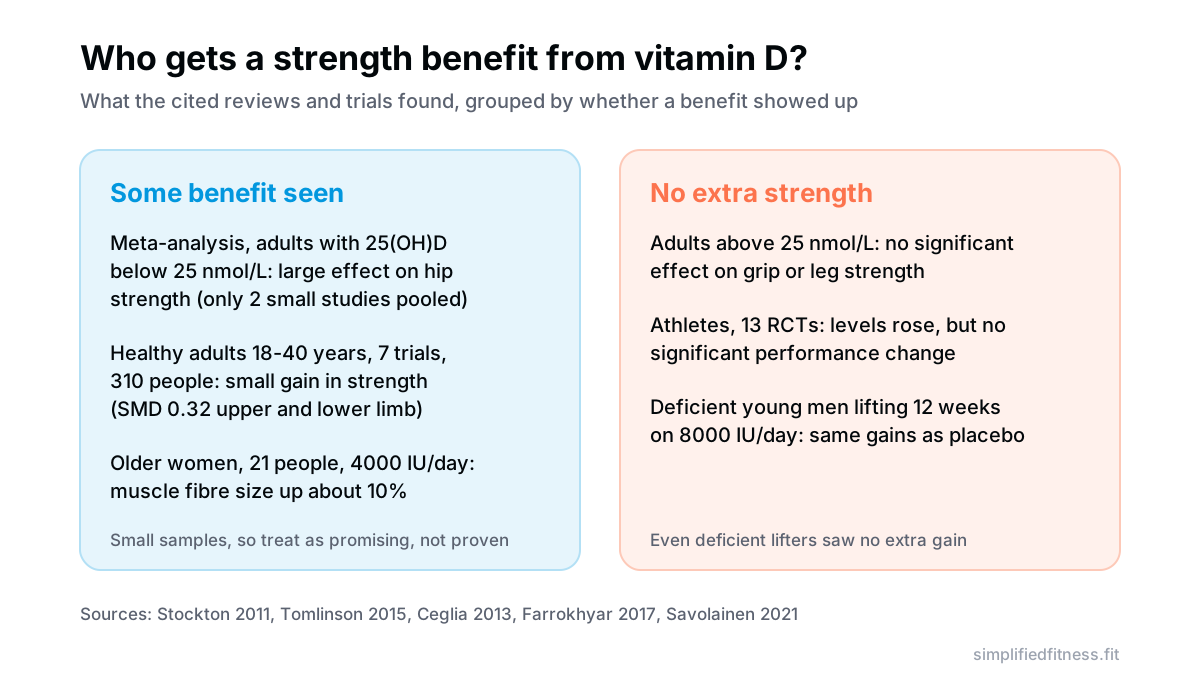
In that 2013 randomized trial, 21 older, mobility-limited women with low-to-moderate vitamin D took 4000 IU/day of D3 or placebo for four months. Their muscle VDR concentration rose about 30% and muscle fibre size about 10%, with a more pronounced change in type II (fast-twitch) fibres. The authors noted that further work is needed to show whether the fibre change runs through the receptor.
Read that carefully before getting excited. It is 21 women aged 65 and over, not young lifters. It supports a plausible mechanism, not a gym promise.
Does vitamin D help muscle strength? What the reviews say
The pattern across meta-analyses is consistent: starting level decides the outcome.
A 2011 review pooled 17 randomized trials (5,072 people). In adults with 25(OH)D above 25 nmol/L, vitamin D had no significant effect on grip strength or proximal leg strength. In two studies of deficient adults (below 25 nmol/L), the pooled effect on hip muscle strength was large (Stockton et al., 2011). Only two studies fed that deficient estimate, so the authors called the evidence limited.
A 2015 meta-analysis of healthy 18-40 year olds found a small positive effect: standardized mean difference 0.32 for both upper and lower limb strength across 7 trials and 310 people, with doses from 4000 IU/day to 60,000 IU/week (Tomlinson et al., 2015). That is more favourable than Stockton, and the studies were small and short (4 weeks to 6 months).
Why do they differ? Different populations, different baselines, different doses and strength tests. The honest reading is “possible small benefit in some groups, clearest when starting low.”
What about lifters and athletes?
This is where the hype falls apart. A 2017 systematic review of 13 randomized trials in 532 athletes found that supplementation raised blood 25(OH)D, with 3000 IU and 5000 IU daily reaching sufficiency during winter in athletes who started low and trained at latitudes above 45 degrees. Yet of the seven trials that measured physical performance, none showed a significant effect over about 12 weeks (Farrokhyar et al., 2017). Heterogeneity between studies was large.
A direct test in lifters is even more telling. In a 12-week trial, 39 young men with levels below 50 nmol/L did the same supervised resistance training with either 8000 IU/day of vitamin D or placebo. Blood levels rose from about 36 to 142 nmol/L in the vitamin D group. Strength and lean mass gains were equal in both groups, and the placebo group gained more in chest press and seated row (Savolainen et al., 2021). The trial was quasi-randomized and small, so it does not close the question.
Put these together: correcting a deficiency is sensible, but you should not expect it to turn into a bigger squat. If strength is stalling, check training volume, sleep and protein first.
How common is deficiency in Indian lifters?
Very common, by most measures. A meta-analysis of 65 studies and 44,717 South Asian adults found a pooled deficiency prevalence of 68%. India’s pooled figure was 67%, and women had higher prevalence than men. The authors flagged very high heterogeneity, so the average hides a wide range (Siddiqee et al., 2021).
Athletes outside India show a similar story. A meta-analysis of 2,313 athletes found 56% had inadequate vitamin D (below 32 ng/mL), with risk higher in winter and spring and in indoor sports (Farrokhyar et al., 2015).
What does that mean for a desk worker who lifts at 6 pm? You leave home before sunrise or after sunset, spend the day in an air-conditioned office, and train indoors. Dal, roti, rice and paneer contribute very little vitamin D, and few common Indian foods contain much. Skin pigment, clothing and pollution can lower what you make from sunlight further. None of this proves you are deficient. It only means your risk is real and a test is worth the few hundred rupees.
Reading your result: ng/mL vs nmol/L
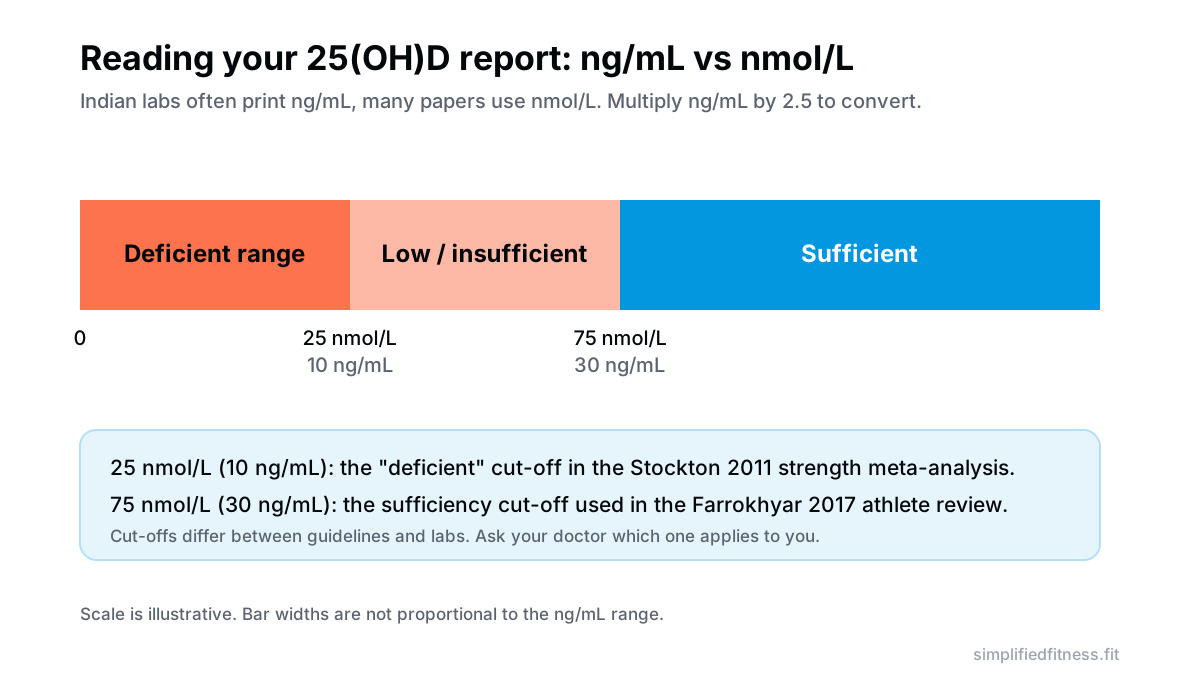
Many Indian labs print ng/mL. Many studies use nmol/L. To convert, multiply ng/mL by 2.5, so 30 ng/mL is 75 nmol/L.
Different sources use different cut-offs. The strength meta-analysis above defined deficiency as below 25 nmol/L (10 ng/mL), while the athlete review used 75 nmol/L (30 ng/mL) as sufficiency (Stockton et al., 2011); (Farrokhyar et al., 2017). Your doctor may use another threshold, which is fine. The point is to know which scale you are looking at.
There is also a nuance worth knowing. A review of athlete vitamin D noted that Black athletes often have low total 25(OH)D without apparent bone consequences, possibly due to genetic differences in vitamin D binding protein that leave more “free” vitamin D available (Owens et al., 2018). The authors suggested that, without any pathology, routine screening may be unnecessary in some groups and thresholds may need revisiting. That is a research debate, not permission to ignore a low result. If you are darker-skinned and your number looks low, discuss it with a doctor rather than drawing your own conclusion.
D3 vs D2: which form should you take?
D3 (cholecalciferol) is the form most supplements use. D2 (ergocalciferol) is plant or fungus derived.
A meta-analysis of randomized trials found D3 raised serum 25(OH)D more than D2. The difference was clear with bolus doses and was lost with daily supplementation (Tripkovic et al., 2012). The authors concluded D3 could be the preferred choice, with more research needed across age, sex and ethnicity. The Endocrine Society guideline, for its part, recommended either D2 or D3 for people with deficiency (Holick et al., 2011).
Practical takeaway: daily D3 is the simple default. If you are vegetarian or vegan, check whether the D3 in a product comes from lanolin (sheep wool) or lichen, since labels vary.
How much vitamin D3 daily? Why I will not give you one number
The right dose depends on your blood level, sun exposure, body size and diet, so any universal figure is guesswork. What the trials do show is the range researchers have used under supervision:
| Study | Who | Dose | Outcome |
|---|---|---|---|
| Ceglia 2013 | 21 older women | 4000 IU/day, 4 months | Fibre size up about 10% |
| Farrokhyar 2017 | Athletes, 13 RCTs | 3000-5000 IU/day | Levels rose, no performance change |
| Savolainen 2021 | 39 deficient young men | 8000 IU/day, 12 weeks | No extra strength or lean mass |
| Tomlinson 2015 | Healthy adults, 7 trials | 4000 IU/day to 60,000 IU/week | Small strength gain |
These are trial doses, not self-prescribing targets. In the athlete review, 3000 IU and 5000 IU per day brought athletes who started low to sufficiency (Farrokhyar et al., 2017), but that does not make those numbers right for you.
Our companion articles go deeper on serum targets for vitamin D3 and on D3 and K2 dosing. This one stays on the muscle question.
Is mega-dosing worth it?
No evidence says so. In the 8000 IU trial the extra vitamin D did not help training gains. In a 112-person randomized trial of male conscripts, 4000 IU reduced deficiency compared with 600 IU but made no difference to fitness tests or grip strength (Rips et al., 2024).
There is also a safety side. The athlete review notes toxic effects have been argued to occur only above 180 nmol/L, but the authors say data from their lab suggested high-dose supplementation could be problematic (Owens et al., 2018). Excess vitamin D can raise blood calcium. Because the long-term effects of very high doses in healthy lifters are not well studied, “more is better” is not a safe assumption.
Where does vitamin K2 fit in?
K2 (MK-7) comes up often alongside D3 because it helps carboxylate proteins involved in inhibiting arterial calcification. The idea is that D3 raises calcium absorption and K2 helps direct it away from vessels.
The evidence is mixed. In a randomized trial of 365 older men with existing aortic valve calcification, 720 µg MK-7 plus vitamin D for 24 months did not slow calcification progression compared with placebo, although a blood marker of K-dependent proteins did improve (Diederichsen et al., 2022). A 2023 meta-analysis of 14 randomized trials (1,533 patients) found vitamin K slowed coronary calcium progression slightly (mean difference -17.37, p = 0.04) with no significant difference in adverse events, but the authors called for better-designed trials (Li et al., 2023).
Neither study measured muscle strength. Those trials were also in older adults, many with existing calcification or kidney disease, not young lifters, so they say little about whether you need K2 for muscle or whether a healthy lifter benefits. If you take blood thinners such as warfarin, vitamin K can interfere, so check with your doctor first.
A simple test, correct, retest plan
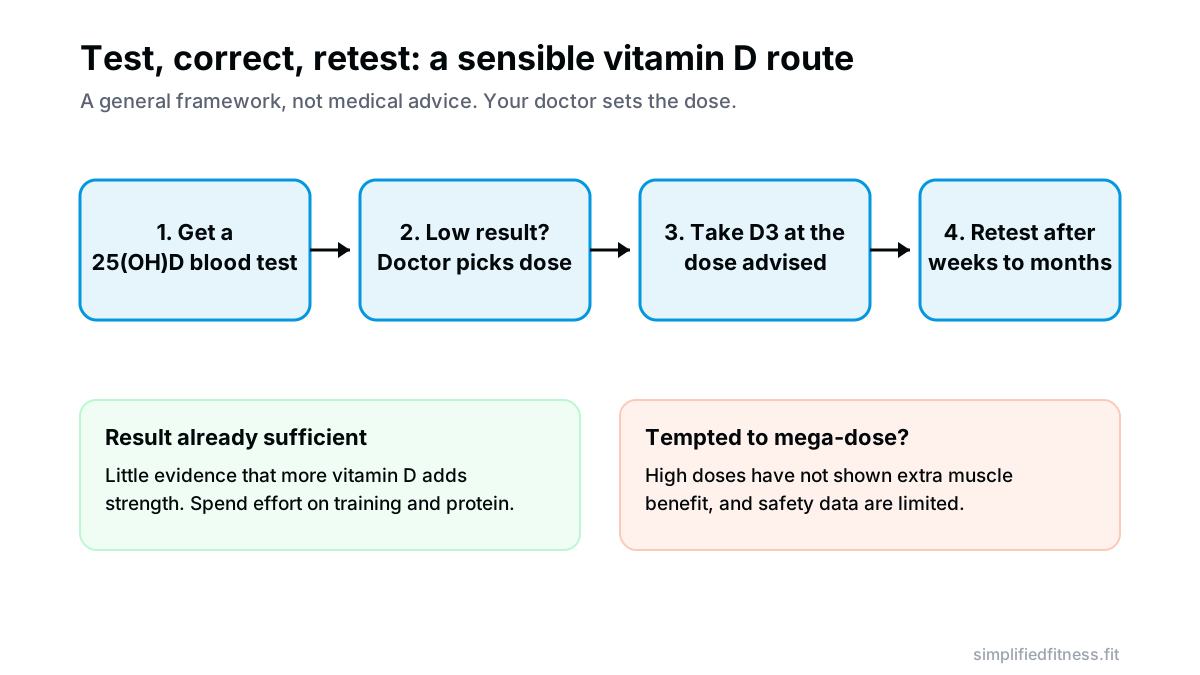
- Test. Ask for a 25(OH)D blood test, especially if you work indoors, live in a high-latitude or heavily polluted area, have darker skin, or have symptoms your doctor wants to investigate.
- Interpret with a clinician. They will consider your number, season, health history and medications.
- Correct if low. Daily D3 at a dose your doctor sets is the usual route. Take it consistently.
- Retest. Check again after the interval your doctor suggests, instead of guessing or topping up indefinitely.
- If sufficient, stop worrying. Put the effort into progressive overload, protein and sleep. Our protein calculator is a better next step than a bigger vitamin D dose.
If you are covering more micronutrients, see our take on multivitamins for lifters and the guide to iron deficiency and ferritin in athletes, since low iron is another common, fixable reason for flat energy. For bone health and calcium pairing, read calcium and vitamin D for bone density in lifters.
When to see a doctor
See a doctor rather than self-treating if you have persistent muscle weakness, bone pain, frequent fractures, or a history of kidney stones, kidney disease, high blood calcium or parathyroid problems. Also speak to them before starting high-dose vitamin D if you are pregnant, take medications that interact with calcium or vitamin K, or have a condition that affects absorption. Low vitamin D can be a symptom of something else, and this article cannot diagnose you.
The bottom line
Vitamin D for muscle strength is a “fix the hole” supplement. If a blood test shows you are low, correcting it is reasonable and may help your muscles, particularly if you were clearly deficient. If you are sufficient, the best trials in athletes and lifters do not show a strength payoff from more.
Test first. Let numbers, not Instagram, set the dose. Then go back to the things that actually build muscle: heavy sets close to failure, enough protein and sleep. If you want a structure for that, start with our free push, pull and legs plans.
Frequently Asked Questions
Does vitamin D help muscle strength?
It can, mainly if you start out deficient. A meta-analysis of 17 trials found no significant strength effect in adults above 25 nmol/L, while a small number of studies in deficient adults showed gains in hip strength. If you do not know your level, get a blood test before buying anything.
Can vitamin D deficiency cause muscle weakness?
Low vitamin D is linked with weaker muscles in some groups, and trials in deficient adults have shown strength improving with supplementation. Muscle contains vitamin D receptors, which is the proposed route. Weakness has many causes, so see a doctor rather than self-diagnosing from symptoms.
Does vitamin D build muscle?
Not on its own. In a 2013 trial in older, mobility-limited women, 4000 IU/day of D3 for 4 months increased muscle fibre size by about 10%, but that was only 21 people. In young deficient men lifting weights, 8000 IU/day gave no extra lean mass compared with placebo, so training and protein remain the drivers.
How much vitamin D3 daily should I take?
There is no single right number because it depends on your blood level, sun exposure and diet. Trials in this article used anywhere from 600 IU to 8000 IU a day under supervision. Ask your doctor to set a dose from your 25(OH)D result and retest after a few months.
What is the optimal vitamin D level for athletes?
Studies in athletes often use 75 nmol/L (30 ng/mL) as the sufficiency cut-off, but guidelines and labs differ. There is no proven performance benefit from pushing levels well above sufficiency. Aim to be sufficient, not as high as possible.
Is vitamin D deficiency common in bodybuilders and lifters?
It is common in athletes generally: a meta-analysis of 2,313 athletes found 56% had inadequate levels, with higher risk for indoor sports and in winter or spring. Lifters who train in a gym and work indoors fit that pattern. A blood test is the only way to know where you stand.
Should I take vitamin D3 with K2?
There is no evidence that K2 improves muscle outcomes, and the vascular data are mixed. A 24-month trial in 365 older men found MK-7 plus vitamin D did not slow aortic valve calcification, while a pooled analysis of 14 trials suggested a small slowing of coronary calcium. If you are curious, discuss it with your doctor, and read our dedicated D3 and K2 guide.
Is vitamin D3 better than D2?
D3 raised blood 25(OH)D more than D2 in a meta-analysis of randomized trials, mainly with bolus doses, and the difference was lost with daily supplementation. The Endocrine Society guideline says either form can treat deficiency. Daily D3 is the common, practical choice.
Can you take too much vitamin D?
Yes. Very high intake can raise blood calcium and cause harm, and one review of athlete data suggests high-dose supplementation could be problematic. Toxicity is rare at normal doses, but there is no muscle benefit from megadoses. Do not take high-dose products without a blood test and medical advice.
Do Indians really have low vitamin D despite all the sun?
Yes, a meta-analysis of 44,717 South Asian adults found 68% pooled deficiency, with India at 67%. Indoor work, clothing, air pollution and darker skin pigment can all reduce vitamin D made from sunlight. Results varied widely between studies, so your own blood test matters more than the average.
How long does it take to fix a vitamin D deficiency?
In trials, blood levels moved within weeks to months: an 8000 IU/day dose took young men from 36 to 142 nmol/L in 12 weeks. Your own response depends on baseline, dose and body size. Retest as your doctor advises rather than guessing.
Do darker-skinned athletes need higher vitamin D levels?
Not necessarily. A review noted that Black athletes often show low total 25(OH)D without bone or health consequences, possibly because of differences in vitamin D binding protein. This is still being studied, so treat it as a reason to interpret results with a doctor, not to ignore them.
Does vitamin D improve athletic performance?
In athletes who are already sufficient, evidence says mostly no. A 2017 review of 13 randomized trials found supplementation raised levels but produced no significant change in physical performance. If you were deficient, correcting it is still worthwhile for general health.
Sources & References
Every claim above is checked against peer-reviewed research (PubMed, U.S. National Library of Medicine) or guidance from established health bodies. How we fact-check.
- Stockton KA, et al. Effect of vitamin D supplementation on muscle strength: a systematic review and meta-analysis. Osteoporos Int. 2011. PMID: 20924748
- Tomlinson PB, et al. Effects of vitamin D supplementation on upper and lower body muscle strength levels in healthy individuals. A systematic review with meta-analysis. J Sci Med Sport. 2015. PMID: 25156880
- Ceglia L, et al. A randomized study on the effect of vitamin D3 supplementation on skeletal muscle morphology and vitamin D receptor concentration in older women. J Clin Endocrinol Metab. 2013. PMID: 24108316
- Savolainen L, et al. Vitamin D supplementation does not enhance resistance training-induced gains in muscle strength and lean body mass in vitamin D deficient young men. Eur J Appl Physiol. 2021. PMID: 33821332
- Farrokhyar F, et al. Effects of vitamin D supplementation on serum 25-hydroxyvitamin D concentrations and physical performance in athletes: a systematic review and meta-analysis of randomized controlled trials. Sports Med. 2017. PMID: 28577257
- Siddiqee MH, et al. High prevalence of vitamin D deficiency among the South Asian adults: a systematic review and meta-analysis. BMC Public Health. 2021. PMID: 34627207
- Tripkovic L, et al. Comparison of vitamin D2 and vitamin D3 supplementation in raising serum 25-hydroxyvitamin D status: a systematic review and meta-analysis. Am J Clin Nutr. 2012. PMID: 22552031
- Owens DJ, et al. Vitamin D and the athlete: current perspectives and new challenges. Sports Med. 2018. PMID: 29368183

Umair Hazrami · Founder & Head Coach, Simplified Fitness
Umair Hazrami founded Simplified Fitness and the Simplified Lifter channel to cut through fitness noise. With 4+ years of consistent training and 10+ coaching clients, he writes every guide from the peer-reviewed research and links the sources so you can check them. Our editorial standards.
Educational content only, not medical advice. If you have a medical condition, are pregnant, or take medication, talk to a qualified doctor before changing your diet, supplements or training. Full disclaimer.
Keep reading

Supplements
Alpha-GPC and Huperzine A Pre-Workout: Do Cholinergic Nootropics Help Lifting?
Does an alpha GPC pre workout add power or focus? See what small trials found, why Huperzine A is a poor lifting bet, and the safety flags to know first.
10 min read

Supplements
The Antioxidant Paradox: Can Vitamin C and E Pills Blunt Muscle Growth and Endurance?
Does vitamin C blunt muscle growth? See what trials of 1000 mg vitamin C plus E found for strength, hypertrophy and endurance, and when pills are worth taking.
8 min read

Supplements
Caffeine Powder vs Coffee Before Lifting: Does the Source Really Matter?
Caffeine anhydrous vs coffee for lifting: what research says on absorption speed, peak levels and stomach upset, and whether pills beat your daily cup.
7 min read

Supplements
Caffeine Dosing for Strength and Power: 3-6 mg/kg and When to Take It
Caffeine dosage for strength is 3-6 mg/kg, about 210-420 mg for a 70 kg lifter, taken around 60 minutes before training. Doses, timing and when to stop.
8 min read