Pre-Workout Formulation Science: Clinical Dosages of Caffeine, Citrulline, and Beta-Alanine
Pre-workout formulation clinical dosages, checked against meta-analyses: caffeine, citrulline, beta-alanine, tyrosine and alpha-GPC, plus a label checklist.

TL;DR. The short answer
- Of the ingredients you take right before training, caffeine has the strongest, most consistent evidence. The ISSN position stand supports 3-6 mg/kg body mass about 60 minutes before training, and effects may start near 2 mg/kg.
- Citrulline malate at 6-8 g, taken 40-60 minutes before lifting, added about 3 reps per exercise on average in one meta-analysis. The effect is small and results across studies are mixed.
- Beta-alanine only works as a daily habit, not as a pre-workout hit. The ISSN position is 4-6 g a day for at least 2-4 weeks, split into smaller doses to limit tingling.
- L-tyrosine and alpha-GPC have weak or preliminary evidence for lifting performance, so they are optional extras at best.
- A good label lists every ingredient with its dose. If a product hides amounts inside a proprietary blend, you cannot check it against the research.
Part of our complete guide: Creatine, Protein Powders, Pre-Workouts and Caffeine: The Science and Safety Guide
Table of contents
A good pre-workout formula comes down to one proven ingredient and a few modest ones. Caffeine at 3-6 mg/kg, citrulline malate at 6-8 g and beta-alanine at 4-6 g a day are the doses that research has actually tested, and the effects are small. Tyrosine and alpha-GPC are optional extras at best.
This guide audits pre-workout formulation against clinical dosages so you can read a label, spot underdosing and decide whether to buy or mix your own. It sits inside our wider guide to creatine, protein powders and caffeine.
One honest caveat first. None of this is a substitute for sleep, food and a plan you can repeat. A pre-workout is a small edge, and nothing here is medical advice.
What does a pre-workout formula actually need?
Think of a formula as a short list with a dose and a timing attached to each line. If an ingredient has no tested dose, you are paying for hope.
A review of multi-ingredient pre-workouts describes the typical blend as caffeine, creatine, beta-alanine, amino acids and nitric oxide agents (Harty et al., 2018). The same review found that acute use may help muscular endurance and mood, with mixed results for force and power.
So the realistic promise is a bit more energy and maybe a rep or two. Not a transformation.
Creatine is the odd one out. It has strong evidence for high-intensity performance and training adaptations (Kreider et al., 2017), but like beta-alanine it works by building up in muscle with daily use, so timing it before a session is not the point. See creatine timing, pre vs post workout.
Caffeine: the ingredient doing most of the work
If a pre-workout feels powerful, it is probably the caffeine. The ISSN position stand says caffeine has consistently improved performance at 3-6 mg/kg body mass, and that minimal effective doses may be as low as 2 mg/kg (Guest et al., 2021). Very high doses, such as 9 mg/kg, bring a high rate of side effects without being needed for a benefit.
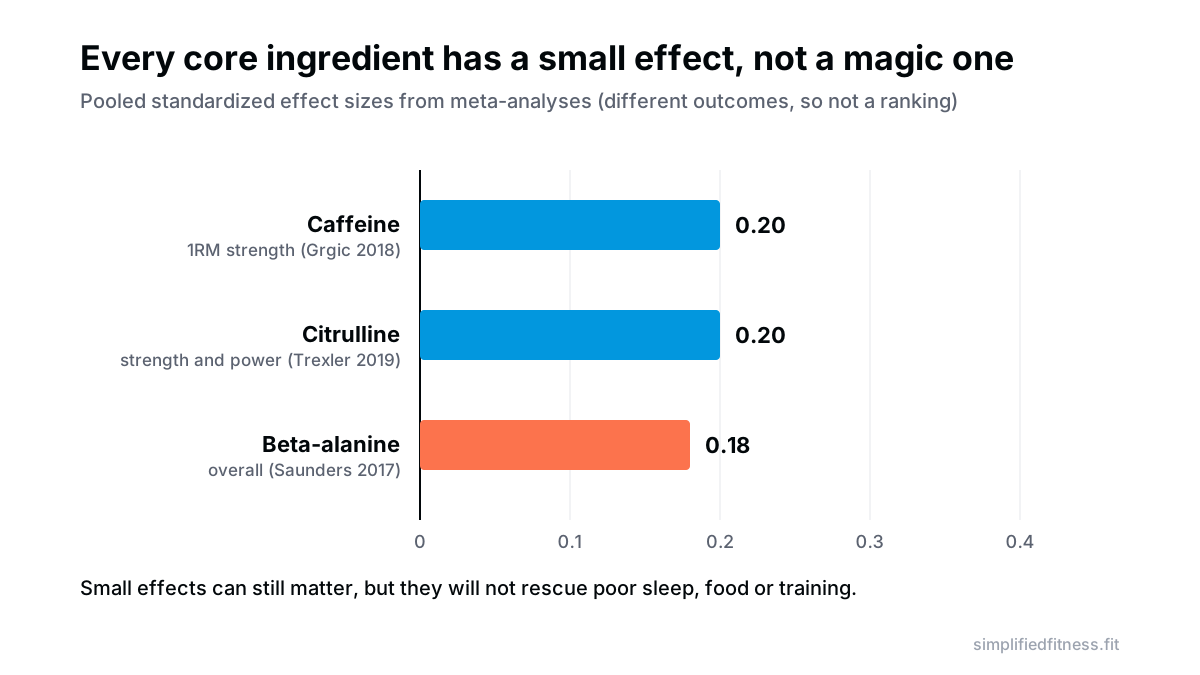
For strength specifically, a meta-analysis found caffeine improved 1RM strength (SMD 0.20) and power (SMD 0.17), with a significant effect for upper body but not lower body strength (Grgic et al., 2018). Those are small numbers.
Here is the arithmetic, using the ISSN range and the lower 2 mg/kg figure:
| Body weight | About 2 mg/kg | 3-6 mg/kg range |
|---|---|---|
| 60 kg | 120 mg | 180-360 mg |
| 70 kg | 140 mg | 210-420 mg |
| 80 kg | 160 mg | 240-480 mg |
| 90 kg | 180 mg | 270-540 mg |
Check the caffeine figure on your scoop against this table. Start near the low end: a large systematic review concluded that up to 400 mg a day from all sources is generally not linked to overt adverse effects in healthy adults, and up to 300 mg a day in healthy pregnant women (Wikoff et al., 2017). The top of the 3-6 mg/kg range goes past that for heavier lifters, so count your coffee and chai too. “Inside the range” is not the same as “best for you”. Our caffeine dosage calculator does the sums for your weight.
Timing: the position stand says 60 minutes before exercise is the most common approach, and that gums may need a shorter wait. Habitual intake and genetics affect how you respond, so there is real person-to-person variation. One disclosure worth knowing: several position stand authors, and the ISSN itself, report funding or advisory ties to supplement companies. We look at the dose in more depth in caffeine dosing for strength and power and at powder versus coffee in caffeine anhydrous vs natural caffeine.
Citrulline: what does 6-8 g actually do?
Citrulline is the “pump” ingredient. The theory is that it raises nitric oxide and blood flow, though researchers also discuss ammonia handling and the malate part of citrulline malate.
The best direct evidence is a meta-analysis of 8 studies and 137 participants, mostly strength-trained. Taking 6-8 g of citrulline malate 40-60 minutes before training increased repetitions by about 3 (6.4%) compared with placebo, with a small effect size of 0.196 (Varvik et al., 2021). The upper body effect alone was not significant.
A separate meta-analysis of 12 studies on strength and power found a small pooled effect (0.20), with confidence intervals for every single study crossing zero (Trexler et al., 2019). The authors suggest it could matter to high-level athletes where margins are thin.
So: a small plausible benefit in repetitions, mixed elsewhere. If you want the pump angle without stimulants, see non-stimulant pump pre-workouts.
Beta-alanine: a daily habit, not a pre-workout trick
Beta-alanine is the ingredient people misuse most. It raises carnosine in muscle over weeks, and carnosine helps buffer acid. It does not work as a one-off hit before your session.
The ISSN position stand says 4-6 g a day for at least 2-4 weeks improves exercise performance, with larger effects in tasks lasting 1-4 minutes (Trexler et al., 2015). The only reported side effect is tingling (paraesthesia), which can be reduced with divided lower doses (1.6 g) or a sustained-release form. The same document says more research is needed on strength outcomes.
A larger meta-analysis of 40 studies and 1,461 people found an overall effect of 0.18, with exercise duration moderating the result (Saunders et al., 2017). Within 0.5-10 minute efforts, the benefit was clearer for exercise capacity than for performance.
What does that mean for a lifter? A heavy set of 5 lasts under 30 seconds, which is not where beta-alanine shines. It may help higher-rep sets, conditioning and repeated hard efforts. Be realistic about that.
Tyrosine and alpha-GPC: the “focus” lines
These two appear on labels to sell focus, but the lifting evidence is weak.
On tyrosine, a review concluded that its potential for enhancing physical exercise seems minimal, while it appears to help cognition in short-term stressful or demanding situations when dopamine or noradrenaline is temporarily depleted (Jongkees et al., 2015). A normal training session is rarely that situation. More in our L-tyrosine breakdown.
On alpha-GPC, a small crossover trial of 13 young men gave 600 mg a day for 6 days. Mid-thigh pull peak force rose by about 99 N compared with a 39 N drop on placebo, while the upper body test did not reach significance (Bellar et al., 2015). It is one small study. See alpha-GPC and nootropics for more.
If a product leans on these for its price, you are paying for the weakest evidence on the label.
Pre-workout label audit: a quick checklist
Use this before you buy. It takes two minutes.
- Is every ingredient listed with its amount in mg or g?
- Is caffeine per serving written clearly, and does it fit your weight?
- Does it say citrulline malate or L-citrulline, and is the dose near 6-8 g?
- If beta-alanine is present, is a day’s total close to 4-6 g across the day?
- Are tyrosine and alpha-GPC priced like extras, or like the main event?
- Is there a proprietary blend hiding amounts?
- Is there third-party testing?
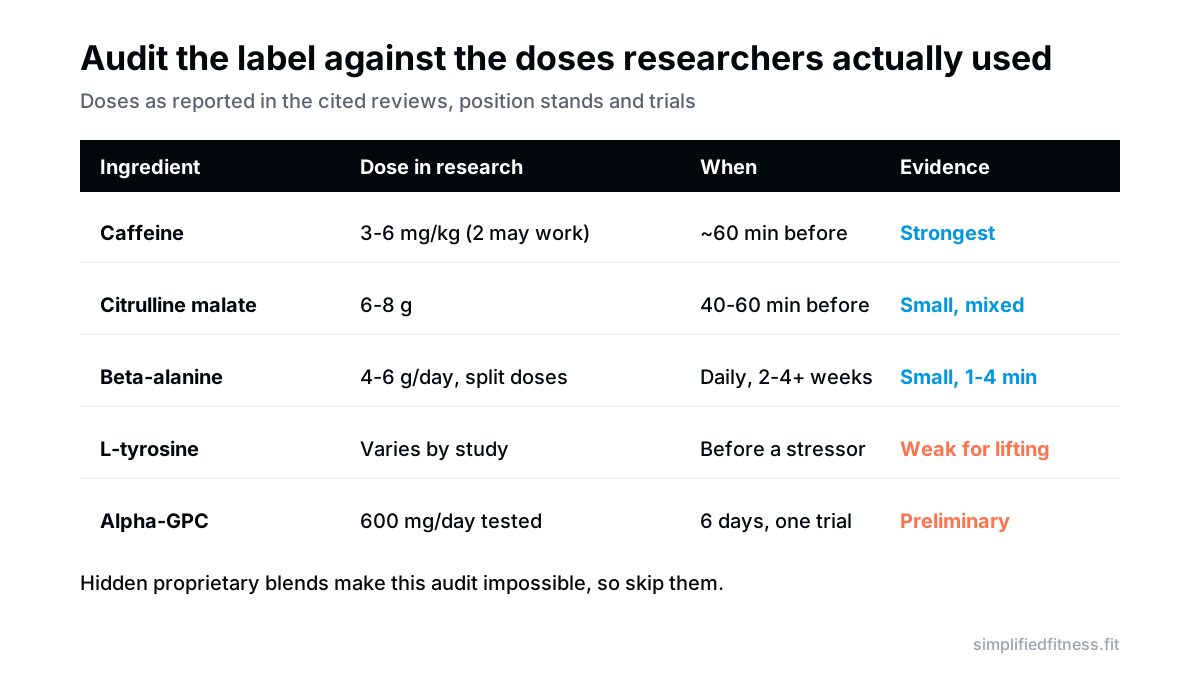
Proprietary blends are the biggest red flag, because they hide the numbers you need. The review of multi-ingredient products says they make comparisons between formulations “challenging and often impossible” (Harty et al., 2018). Our guides on decoding proprietary blends and spotting them on a label go deeper.
Can you build your own pre-workout at home?
You can, and it is often cheaper per serving, but compare actual prices rather than trusting a headline figure. The evidence-backed ingredients are sold as single powders, which makes a DIY version simple on paper.
A sensible home formula looks like this:
- Caffeine: dose it from your body weight, from coffee, tablets or a precise measure.
- Citrulline malate: roughly 6-8 g, if you want to test it.
- Beta-alanine: handled separately, daily, in split doses.
- Optional extras: only if you have a reason.
Two practical cautions. First, caffeine powder is easy to overdose because a tiny weighing error becomes a large dose error, so without a precise scale use tablets or coffee instead. Second, buy from brands that publish third-party tests, since the review above notes that products can contain banned substances or contaminants.
In India, a strong filter coffee or a black coffee before training covers the caffeine step cheaply. Add citrulline malate in water if you want it. In a hot climate, drink water with it and avoid a big caffeine dose on an empty stomach if that upsets you.
Who should skip pre-workout?
Talk to a doctor before using high-caffeine products if you have a heart rhythm problem, high blood pressure, anxiety, or are pregnant. Skip evening use if it wrecks your sleep, because lost sleep costs more than the supplement gives.
Safety studies on multi-ingredient products are mostly short, under about 8 weeks, so long-term data are limited (Harty et al., 2018). For side effects and fixes, see pre-workout jitters, cramps and palpitations. For when to take each supplement across the day, see our daily supplement schedule.
The bottom line
Caffeine does the heavy lifting. Citrulline malate and beta-alanine add small, plausible edges at the doses studied. Tyrosine and alpha-GPC are optional. Before you buy, check that every dose is on the label and compare it with the research. Then spend the savings on food. If you need a training plan to go with it, start with our free push pull legs plan.
Frequently Asked Questions
What are the best pre-workout ingredients?
Caffeine has the strongest evidence, followed by citrulline malate and beta-alanine, which show small average benefits. Caffeine acts on adenosine receptors and has repeatedly improved strength, power and endurance in meta-analyses, while the others work on fatigue and blood flow with smaller effects. If you only buy one thing, make it caffeine, then check the label for honest doses of the rest.
What is the clinical dose of caffeine for a pre-workout?
The ISSN position stand backs 3-6 mg/kg body mass, taken about 60 minutes before exercise. A 70 kg lifter would land at roughly 210-420 mg, but benefits may appear from about 2 mg/kg and very high doses cause more side effects without extra benefit. Start low, near 3 mg/kg, stay there if it works, and keep your total from all sources in mind.
How much citrulline do I need in a pre-workout?
A 2021 meta-analysis found benefits using 6-8 g of citrulline malate taken 40-60 minutes before training. The mechanism is thought to involve nitric oxide and blood flow, though the research is mixed and effects are small. Check whether the label means citrulline malate or pure L-citrulline, because 8 g of the malate form contains less actual citrulline.
How much beta-alanine should be in a pre-workout?
Check whether your daily total reaches the 4-6 g the ISSN position stand describes, because a single scoop may not. Beta-alanine raises muscle carnosine over weeks, so what counts is your total daily intake over at least 2-4 weeks, not one scoop before training. Take it daily in split doses of about 1.6 g or a sustained-release form if tingling bothers you.
Does beta-alanine work right away?
No. It works by slowly building up carnosine in muscle, which acts as an acid buffer, and that takes weeks of daily use. A single dose before the gym mostly gives you tingling. Take it every day, including rest days, and judge it after about a month.
Is L-tyrosine worth including in a pre-workout?
Probably not for lifting. A review of tyrosine research concluded that its potential for enhancing physical exercise seems minimal, while it may help thinking under short-term stress. If you like it for mental focus, treat it as optional rather than a core ingredient.
Does alpha-GPC improve strength?
Evidence is preliminary. One small crossover trial of 13 young men found a gain in isometric mid-thigh pull force after 6 days of 600 mg a day, but upper body force did not reach significance. Treat it as an unproven extra, not a reason to pay more for a product.
Can I make my own pre-workout at home?
Yes, in principle, because the evidence-backed ingredients are all sold as single powders. The catch is accurate measuring, especially for caffeine, where small weighing errors become big dose errors. If you do not own a precise scale, use caffeine tablets or coffee and add citrulline by the gram.
Are proprietary blends bad?
They are a problem because you cannot see how much of each ingredient you are getting. A review of multi-ingredient pre-workouts notes that proprietary blends make direct comparison between products challenging and often impossible. Prefer a product that lists every dose, or build your own.
Is a multi-ingredient pre-workout safe?
In studies lasting under about 8 weeks, they appear relatively safe in healthy people, but long-term safety data are limited. Some products may also contain banned substances or contaminants, which matters for tested athletes. Pick third-party tested products, keep total caffeine in check, and speak to a doctor if you have a heart condition or high blood pressure.
Should I take pre-workout every day?
You do not need to, and a lot of the benefit comes from caffeine, which your body can adapt to. Beta-alanine is the exception because it has to be taken daily to work. Use caffeine on harder sessions if you want it to keep working, and keep beta-alanine as a separate daily habit.
How long before training should I take a pre-workout?
The ISSN position stand says the most common timing for caffeine is about 60 minutes before exercise. Citrulline malate trials mostly used 40-60 minutes before lifting. Take your scoop roughly 40-60 minutes before your first working set.
Do I even need a pre-workout?
No. Training, protein, calories and sleep matter far more, and a coffee gives you the one ingredient with the best evidence. A pre-workout is a small edge on top of a good routine, not a replacement for one. If you feel flat despite poor sleep, fix the sleep first.
Sources & References
Every claim above is checked against peer-reviewed research (PubMed, U.S. National Library of Medicine) or guidance from established health bodies. How we fact-check.
- Wikoff D, et al. Systematic review of the potential adverse effects of caffeine consumption in healthy adults, pregnant women, adolescents, and children. Food Chem Toxicol. 2017. PMID: 28438661
- Kreider RB, et al. International Society of Sports Nutrition position stand: safety and efficacy of creatine supplementation in exercise, sport, and medicine. J Int Soc Sports Nutr. 2017. PMID: 28615996
- Guest NS, et al. International society of sports nutrition position stand: caffeine and exercise performance. J Int Soc Sports Nutr. 2021. PMID: 33388079
- Grgic J, et al. Effects of caffeine intake on muscle strength and power: a systematic review and meta-analysis. J Int Soc Sports Nutr. 2018. PMID: 29527137
- Trexler ET, et al. Acute effects of citrulline supplementation on high-intensity strength and power performance: a systematic review and meta-analysis. Sports Med. 2019. PMID: 30895562
- Varvik FT, et al. Acute effect of citrulline malate on repetition performance during strength training: a systematic review and meta-analysis. Int J Sport Nutr Exerc Metab. 2021. PMID: 34010809
- Saunders B, et al. Beta-alanine supplementation to improve exercise capacity and performance: a systematic review and meta-analysis. Br J Sports Med. 2017. PMID: 27797728
- Trexler ET, et al. International society of sports nutrition position stand: beta-alanine. J Int Soc Sports Nutr. 2015. PMID: 26175657
- Harty PS, et al. Multi-ingredient pre-workout supplements, safety implications, and performance outcomes: a brief review. J Int Soc Sports Nutr. 2018. PMID: 30089501
- Jongkees BJ, et al. Effect of tyrosine supplementation on clinical and healthy populations under stress or cognitive demands: a review. J Psychiatr Res. 2015. PMID: 26424423
- Bellar D, et al. The effect of 6 days of alpha glycerylphosphorylcholine on isometric strength. J Int Soc Sports Nutr. 2015. PMID: 26582972

Umair Hazrami · Founder & Head Coach, Simplified Fitness
Umair Hazrami founded Simplified Fitness and the Simplified Lifter channel to cut through fitness noise. With 4+ years of consistent training and 10+ coaching clients, he writes every guide from the peer-reviewed research and links the sources so you can check them. Our editorial standards.
Educational content only, not medical advice. If you have a medical condition, are pregnant, or take medication, talk to a qualified doctor before changing your diet, supplements or training. Full disclaimer.
Keep reading
Supplements
Alpha-GPC and Huperzine A Pre-Workout: Do Cholinergic Nootropics Help Lifting?
Does an alpha GPC pre workout add power or focus? See what small trials found, why Huperzine A is a poor lifting bet, and the safety flags to know first.
10 min read

Supplements
The Antioxidant Paradox: Can Vitamin C and E Pills Blunt Muscle Growth and Endurance?
Does vitamin C blunt muscle growth? See what trials of 1000 mg vitamin C plus E found for strength, hypertrophy and endurance, and when pills are worth taking.
8 min read

Supplements
Caffeine Powder vs Coffee Before Lifting: Does the Source Really Matter?
Caffeine anhydrous vs coffee for lifting: what research says on absorption speed, peak levels and stomach upset, and whether pills beat your daily cup.
7 min read

Supplements
Caffeine Dosing for Strength and Power: 3-6 mg/kg and When to Take It
Caffeine dosage for strength is 3-6 mg/kg, about 210-420 mg for a 70 kg lifter, taken around 60 minutes before training. Doses, timing and when to stop.
8 min read