Probiotics for Athletes: Do Lifters Need Them for Immunity and Gut Health?
Probiotics for athletes will not build muscle, but some strains may ease colds, gut upset and antibiotic side effects. See which ones the research backs.
TL;DR. The short answer
- Probiotics do not directly build muscle. The International Society of Sports Nutrition (ISSN) lists the muscle and body composition benefits as early, preclinical and in need of better human trials.
- Evidence for fewer or milder colds in athletes is real but mixed. One meta-analysis of 14 trials found lower symptom severity but no change in the number or duration of infections.
- Benefits are strain-specific and dose-specific. A label that just says 'probiotic' tells you almost nothing, so look for genus, species, strain and CFU count.
- Bacillus coagulans taken with whey or milk protein raised blood amino acid levels in two small trials, but we do not know if that adds up to more muscle.
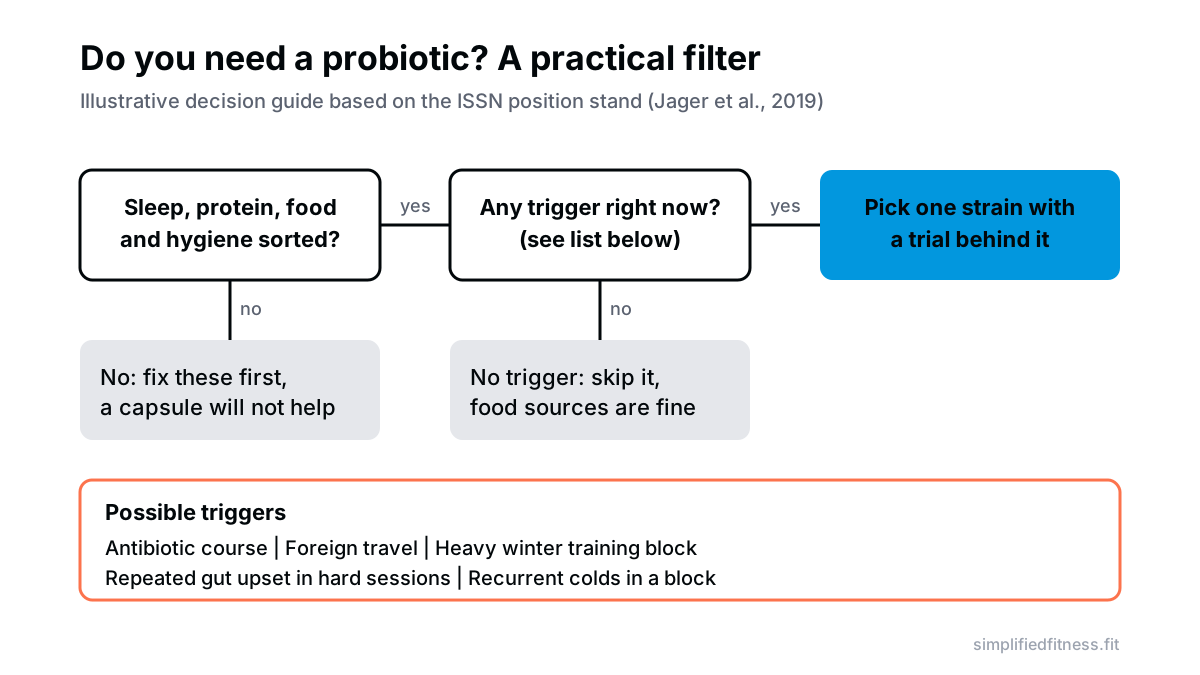
- Most healthy lifters can skip them. They make most sense during antibiotics, foreign travel or a rough training block, and anyone with a weak immune system should ask a doctor first.
Part of our complete guide: Creatine, Protein Powders, Pre-Workouts and Caffeine: The Science and Safety Guide
Table of contents
Probiotics for athletes are not a muscle builder. The research says they may help in narrower ways: a milder cold, fewer stomach problems on the road, or a gentler time on antibiotics. All of that depends heavily on the exact strain.
That makes probiotics a small, situational tool rather than a daily must-have. This article covers what the research supports and what it does not. It also covers how to choose a product and when a lifter can safely skip it. For where gut supplements sit alongside creatine, protein and caffeine, see our guide to creatine, protein powders and caffeine.
What do probiotics actually do for athletes?
The ISSN position stand defines probiotics as live microorganisms that, given in adequate amounts, give the host a health benefit. It says gut and immune health are the most researched uses, and that the benefits are strain- and dose-dependent (Jäger et al., 2019).
Here is what that position stand actually claims, in plain terms:
- Certain strains may increase absorption of nutrients such as amino acids from protein.
- Specific strains can reduce the number, severity and duration of upper respiratory tract infections (URTIs) in athletes.
- Some strains may improve gut barrier function during intense, prolonged exercise, especially in the heat.
- Selected anti-inflammatory strains have been linked to better recovery from muscle-damaging exercise.
- Benefits like better body composition, lean mass, testosterone or cortisol changes are described as preclinical or early human research that needs validation in more rigorous studies.
Notice the wording: “certain”, “specific”, “selected”. The position stand also states that the minimum effective dose depends on validation studies for that particular strain. It is a consensus document from a society whose authors include people with industry links, and the paper discloses those conflicts openly. That does not make it wrong, but it is a reason to read the claims with care.
What is the gut-muscle axis, and does it matter for bodybuilding?
The “gut-muscle axis” is a popular label for the idea that gut bacteria, the gut lining and immune signalling influence inflammation, nutrient uptake and recovery. It is a reasonable hypothesis, but for gut muscle axis bodybuilding claims the human evidence is thin.
What we do know from the ISSN document is narrower. Athletes’ gut bacteria differ from sedentary people’s, and the differences link mostly to training volume and protein intake. Whether those differences change how well a probiotic works is unknown (Jäger et al., 2019).
So the practical reading is: your training and protein intake already shape your gut bacteria. Feeding them well (fibre, variety, enough total food) is the foundation. If you are eating very little fibre, our guide to psyllium husk (isabgol) for cutting covers one cheap way to fix that.
Do probiotics reduce colds and infections in athletes?
This is the headline claim, and it is where honest reading matters. You may see a figure like “30% shorter colds” repeated online. I could not confirm a figure like that in the abstracts of the studies reviewed for this article, so I will not repeat it as fact. Here is what was actually found.
What supports a benefit. The ISSN says specific strains can reduce the number, severity and duration of URTIs in athletes (Jäger et al., 2019). A 2021 meta-analysis of 14 randomized trials in athletes found probiotics lowered the total URTI symptom severity score (-0.65; 95% CI -1.05 to -0.25), and lowered interleukin 6 and tumor necrosis factor alpha levels, which are inflammatory markers (Łagowska and Bajerska, 2021).
What does not. That same meta-analysis found no effect on days of illness, or on the mean number or duration of URTI episodes. The authors called for larger studies and noted that the best timing, duration, composition and dose still need to be worked out. A 2022 systematic review of 41 studies, in athletes, recreationally active people and untrained adults, found large differences in strains, delivery, duration and outcomes. It concluded the effects on immunity, URTI and gut symptoms remain inconclusive (Heimer et al., 2022).
Why they may disagree. Different strains, doses and durations, different athlete levels, and different ways of counting a “cold” (self-report versus symptom scores) all change the result. Pooling them can hide a real effect in one strain or exaggerate a weak one.
Cautious takeaway. A probiotic might make a cold milder. It has not been shown to reliably stop you catching one. Sleep, hand hygiene and not training hard while feverish will do more than a capsule.
Do probiotics help with protein absorption?
Some trials suggest certain strains can raise how much amino acid shows up in your blood after protein. The evidence is small and comes mostly from one genus, Bacillus coagulans.
In a crossover trial of 30 adults (14 men, 16 women), people took 25 g of milk protein concentrate with or without Bacillus coagulans GBI-30, 6086 for two weeks each. Adding the probiotic increased the peak concentration of total and essential amino acids and arginine levels, and several amino acids peaked sooner (Stecker et al., 2020). The authors noted bigger differences in women than in men and called for follow-up work.
A second trial tested Bacillus coagulans Unique IS-2 in resistance-trained men (average age about 21). Both groups took 20 g of whey protein concentrate daily for 60 days with a controlled resistance program, with or without 2 billion CFU of the probiotic. The probiotic group had higher total plasma amino acids (+16.1%) and BCAAs (+33.1%), plus bigger improvements in leg press 1RM (+16.61%) and vertical jump power (+7.86%) (Tarik et al., 2022). The study was carried out at AIIMS in New Delhi, and two of the 13 authors work for the company that makes the strain.
For the full look at probiotics and digestive enzymes as protein boosters, see our article on whether enzymes or probiotics improve protein absorption. If you are choosing a protein powder, the form and lactose content probably matter more than a probiotic. Our whey isolate vs concentrate comparison helps you pick, and the protein calculator gives you a daily target before you buy anything extra.
Bacillus coagulans vs Lactobacillus vs Bifidobacterium: does strain matter?
Yes, it is the single most important thing to understand. The ISSN says health benefits are strain- and dose-dependent, and that labels must list genus, species and strain for each microorganism, plus the total quantity at the end of shelf life in CFU (Jäger et al., 2019).
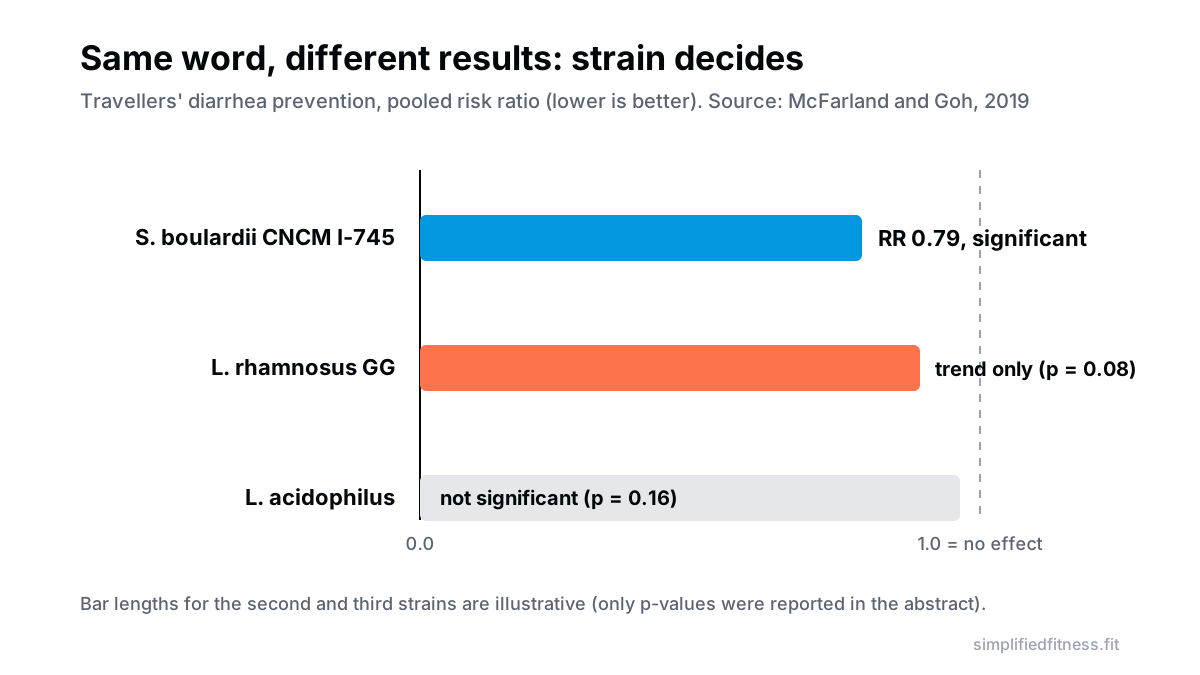
The travellers’ diarrhoea research shows why. A meta-analysis grouped trials by strain. Saccharomyces boulardii CNCM I-745 cut travellers’ diarrhoea incidence (RR 0.79, 95% CI 0.72-0.87). Lactobacillus rhamnosus GG showed only a trend (p = 0.08), and Lactobacillus acidophilus showed no significant effect (McFarland and Goh, 2019). All three get sold as “probiotics”. Only one passed the test.
Spore-forming vs refrigerated probiotics: which is better?
There is no head-to-head evidence in the sources reviewed here, so I cannot say one is better.
What can be said is limited. Bacillus coagulans is a spore-forming bacterium. The 2020 trial notes it becomes active in the small intestine after germination (Stecker et al., 2020). Spore-formers are commonly marketed as shelf-stable, which is convenient for a gym bag in an Indian summer. Refrigerated cultures such as Lactobacillus and Bifidobacterium blends have the larger body of research in athletes and antibiotic users. I did not verify the shelf-stability claims against a trial, so treat them as a practical convenience, not a proven advantage.
What matters more than the format:
- The label names the exact strain, not just “Lactobacillus blend”.
- The CFU count is stated at the end of shelf life, not at manufacture.
- The strain has at least one human trial in a population like you.
- It has third-party testing (the same contamination worries we covered in heavy metals in protein powders apply to any supplement).
When should you take probiotics?
Think in situations, not routines. Three come up most for lifters.
During antibiotics. A 2021 meta-analysis of 42 randomized trials (11,305 adults) found that taking probiotics with antibiotics reduced the risk of antibiotic-associated diarrhoea by 37% (RR 0.63). The quality of evidence was moderate, only certain species (mainly Lactobacillus and Bifidobacterium) worked, and people with a low baseline risk did not benefit (Goodman et al., 2021). Ask your doctor or pharmacist about the strain and timing.
Foreign travel. Per the strain data above, S. boulardii has the best support for preventing travellers’ diarrhoea, but the number of trials is limited. It is a backup to food and water hygiene, not a replacement. Severe, bloody or persistent diarrhoea, or fever, means seeing a doctor.
Heavy training blocks, winter or crowded events. The ISSN notes that infection risk rises with heavy training load, stress, poor sleep, crowds and foreign travel. A 2024 systematic review of 13 trials (513 participants) suggested that at least 15 billion CFU daily for 28 days or more may help reduce perceived or actual fatigue, though the trials varied a lot (Kearns et al., 2024). Treat that as a rough starting point for a trial on yourself, not a prescription.
Can curd, dahi and buttermilk do the same job?
For general gut comfort, yes, a daily bowl of dahi or a glass of chaas is a sensible and cheap habit. Whether it matches the benefits seen in athlete trials is a different question. Those trials test specific strains at stated doses, and your home curd varies in which bacteria it contains and how many.
So eat fermented foods because they are food: protein, calcium and a useful way to hit your daily total. Do not assume they deliver the effect of a studied supplement strain. On a vegetarian budget, a litre of curd a day often does more for your protein intake than a probiotic capsule does for your gut.
Who should avoid probiotics or ask a doctor first?
Probiotics are live organisms. They are generally well tolerated by healthy people, but speak to a doctor before using them if you:
- have a weakened immune system or are on immunosuppressant medication
- have a central venous catheter or a serious underlying illness
- are pregnant or breastfeeding
- have ongoing gut symptoms such as blood in stool, unexplained weight loss, severe pain or diarrhoea lasting more than a few days
Gut symptoms that persist are a medical question, not a supplement question. This article is general information, not a diagnosis, and a doctor should look at persistent symptoms.
The bottom line
Probiotics for athletes sit in the “maybe useful, in the right situation” bucket. The ISSN supports strain-specific benefits for immunity and gut function, while larger reviews call the overall picture inconsistent. Nothing here shows they build muscle. The Bacillus coagulans amino acid data is interesting but small.
If you are healthy, sleeping well and eating enough protein and fibre, you can safely skip them. If you are about to start antibiotics, fly abroad or grind through a hard training block, a single well-labelled strain is a reasonable thing to try, with your doctor’s input where relevant. Spend the money on food first. Then build the base with our free training plans.
Frequently Asked Questions
Do probiotics help athletes?
They can help in specific situations, but the evidence is mixed. The ISSN position stand says certain strains can reduce the number, severity and duration of upper respiratory tract infections in athletes, while a 2022 systematic review of 41 studies called the overall findings inconsistent. If you want to test one, pick a single strain with trial data and judge it over a full training block.
Do probiotics build muscle?
No, there is no solid evidence that probiotics build muscle on their own. The ISSN describes better body composition and lean mass as promising but needing validation in more rigorous human studies in athletes. Spend your effort on training, protein and sleep first, and treat any probiotic as a small extra.
Do lifters need probiotics?
Most healthy lifters do not need them. Curd, buttermilk and other fermented foods cover the basics for many people, and there is no proof that a capsule adds muscle. Consider a supplement only if you have a clear trigger such as an antibiotic course, travel or repeated gut upset.
What is the gut-muscle axis?
It is the idea that gut bacteria and gut lining health influence immunity, inflammation, nutrient absorption and possibly muscle recovery. Human evidence in athletes is still early, and the ISSN calls many proposed muscle benefits preliminary. Think of it as a reason to eat enough fibre and protein and sleep well, not as a shortcut to gains.
Is Bacillus coagulans good for the gym?
It has the most gym-relevant data of the strains discussed here, but the data is small. A 60-day trial in 21-year-old trained men using Unique IS-2 with whey protein reported higher blood BCAA levels and gains in leg press 1RM and vertical jump power versus placebo. Two of its authors work for the strain's maker, so it needs independent repeats.
What is a spore-forming probiotic?
Spore-formers such as Bacillus coagulans are bacteria that can exist in a dormant spore state and become active in the small intestine after germination. This is why they are often sold as shelf-stable products that do not need a fridge. Check the label for CFU at the end of shelf life, because the ISSN says labels should state it.
How long should I take probiotics before I notice anything?
There is no universal answer because the ISSN says the minimum effective dose depends on the specific strain. A 2024 systematic review suggested at least 15 billion CFU daily for 28 days or more for fatigue outcomes, but that is a loose guide from mixed trials. Pick one product, take it consistently for 4 weeks, and stop if you see no benefit.
Should I take probiotics with antibiotics?
It may be worth discussing with your doctor. A 2021 meta-analysis of 42 trials (11,305 adults) found probiotics given alongside antibiotics cut the risk of antibiotic-associated diarrhoea by 37%, with moderate-quality evidence. Ask your doctor or pharmacist about timing and which strain to use.
Can probiotics prevent traveller's diarrhoea?
Only some strains show a benefit, and none is a guarantee. A 2019 meta-analysis found Saccharomyces boulardii lowered traveller's diarrhoea risk (RR 0.79), while L. rhamnosus GG showed only a trend and L. acidophilus showed no significant effect. Food and water hygiene still matters more, and severe or bloody diarrhoea needs a doctor.
Are probiotics safe?
They are generally well tolerated in healthy people, but safety is not the same for everyone. People with weakened immune systems, central lines or serious illness should only use them on medical advice. If you get fever, severe pain or persistent symptoms after starting one, stop and see a doctor.
Can probiotics replace a good diet?
No. The ISSN notes that athletes' gut bacteria differ mainly with training volume and protein intake, which points back to diet and training, not capsules. Fibre from dal, vegetables, fruit and whole grains feeds the gut bacteria you already have. Fix the plate first, then think about supplements.
Sources & References
Every claim above is checked against peer-reviewed research (PubMed, U.S. National Library of Medicine) or guidance from established health bodies. How we fact-check.
- Jäger R, et al. International Society of Sports Nutrition Position Stand: Probiotics. J Int Soc Sports Nutr. 2019. PMID: 31864419
- Łagowska K, et al. Probiotic Supplementation and Respiratory Infection and Immune Function in Athletes: Systematic Review and Meta-Analysis of Randomized Controlled Trials. J Athl Train. 2021. PMID: 33481001
- Heimer M, et al. Health Benefits of Probiotics in Sport and Exercise: Non-existent or a Matter of Heterogeneity? A Systematic Review. Front Nutr. 2022. PMID: 35284446
- Stecker RA, et al. Bacillus coagulans GBI-30, 6086 improves amino acid absorption from milk protein. Nutr Metab (Lond). 2020. PMID: 33110439
- Tarik M, et al. The effect of Bacillus coagulans Unique IS-2 supplementation on plasma amino acid levels and muscle strength in resistance trained males consuming whey protein: a double-blind, placebo-controlled study. Eur J Nutr. 2022. PMID: 35249118
- McFarland LV, et al. Are probiotics and prebiotics effective in the prevention of travellers' diarrhea: A systematic review and meta-analysis. Travel Med Infect Dis. 2019. PMID: 30278238
- Goodman C, et al. Probiotics for the prevention of antibiotic-associated diarrhoea: a systematic review and meta-analysis. BMJ Open. 2021. PMID: 34385227
- Kearns RP, et al. Do probiotics mitigate GI-induced inflammation and perceived fatigue in athletes? A systematic review. J Int Soc Sports Nutr. 2024. PMID: 39193818

Umair Hazrami · Founder & Head Coach, Simplified Fitness
Umair Hazrami founded Simplified Fitness and the Simplified Lifter channel to cut through fitness noise. With 4+ years of consistent training and 10+ coaching clients, he writes every guide from the peer-reviewed research and links the sources so you can check them. Our editorial standards.
Educational content only, not medical advice. If you have a medical condition, are pregnant, or take medication, talk to a qualified doctor before changing your diet, supplements or training. Full disclaimer.
Keep reading
Supplements
Alpha-GPC and Huperzine A Pre-Workout: Do Cholinergic Nootropics Help Lifting?
Does an alpha GPC pre workout add power or focus? See what small trials found, why Huperzine A is a poor lifting bet, and the safety flags to know first.
10 min read

Supplements
The Antioxidant Paradox: Can Vitamin C and E Pills Blunt Muscle Growth and Endurance?
Does vitamin C blunt muscle growth? See what trials of 1000 mg vitamin C plus E found for strength, hypertrophy and endurance, and when pills are worth taking.
8 min read
Supplements
Caffeine Powder vs Coffee Before Lifting: Does the Source Really Matter?
Caffeine anhydrous vs coffee for lifting: what research says on absorption speed, peak levels and stomach upset, and whether pills beat your daily cup.
7 min read

Supplements
Caffeine Dosing for Strength and Power: 3-6 mg/kg and When to Take It
Caffeine dosage for strength is 3-6 mg/kg, about 210-420 mg for a 70 kg lifter, taken around 60 minutes before training. Doses, timing and when to stop.
8 min read