Hydrolyzed Whey Protein: Is Pre-Digested Whey Worth the Higher Cost?
Is hydrolyzed whey protein worth it? Faster absorption is real, but better muscle growth is unproven. See the studies, the bitter taste and who might pay extra.
TL;DR. The short answer
- For most lifters, hydrolyzed whey is not worth the extra money. It reaches the blood faster, but the two training trials that compared it with ordinary whey (8 and 12 weeks) found no extra muscle or strength.
- Hydrolyzed whey is whey that has been broken into shorter peptides before you drink it. Studies show faster amino acid appearance in blood and a higher insulin spike than intact whey.
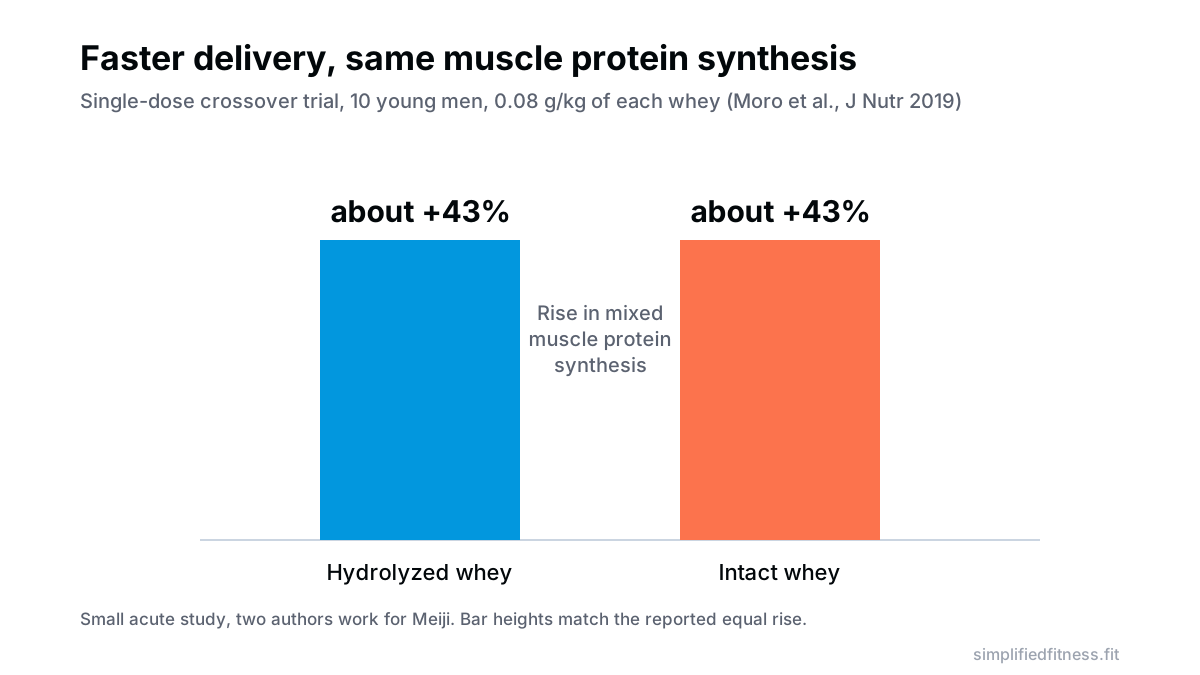
- In one small crossover trial in young men, hydrolyzed whey and intact whey raised muscle protein synthesis by about the same amount (about 43%).
- Total daily protein matters more. A large meta-analysis found extra gains in muscle mass stopped above roughly 1.6 g/kg/day of total protein.
- Hydrolysates taste bitter and usually cost more per serving. The few cases where it may help are repeated hard sessions within hours, and even there the evidence is thin.
Part of our complete guide: Creatine, Protein Powders, Pre-Workouts and Caffeine: The Science and Safety Guide
Table of contents
Is hydrolyzed whey protein worth it? For most lifters, no. It really is absorbed faster than ordinary whey, but nobody has shown that the speed turns into more muscle, and you pay more for it and put up with a bitter taste.
This guide sits inside our complete guide to creatine, protein powders and caffeine. Here we look only at hydrolysate: what it is, what the studies measured, and who, if anyone, should pay the premium. For the wider whey family, see our whey concentrate vs isolate vs hydrolysate comparison.
Is hydrolyzed whey protein worth it? Start with what it is
Whey is a mix of milk proteins. Hydrolyzed whey (also called whey hydrolysate) has been put through enzymes or acid during manufacturing, which chops those long protein chains into shorter peptides. “Pre-digested” is the marketing word for it.
The idea sounds logical. Shorter pieces should leave the stomach and get absorbed quicker, so amino acids reach your muscles sooner. And that part is true, at least in the blood.
It is also worth separating this from isolate. Isolate is about purity: fat and lactose are filtered out, but the proteins stay intact. Hydrolysate is about speed. A hydrolysate can be made from either concentrate or isolate. If lactose is your issue, read isolate vs concentrate first, because that is a cheaper fix.
Does hydrolyzed whey absorb faster?
Yes. In a human trial that compared soy and whey with their hydrolysed forms, the hydrolysates appeared more rapidly as plasma amino acids than the non-hydrolysed proteins (Morifuji et al., 2010). The study was small, though: 10 subjects in total, with 5 on each protein.
Another trial gave 16 men 45 g of whey isolate or hydrolysate. Peak insulin was 28% higher after the hydrolysate and came later (about 60 vs 40 minutes). Interestingly, the estimated rate of gastric emptying did not differ between the two (Power et al., 2009). So the benefit is not simply “it leaves your stomach faster.”
Faster blood levels, then. The real question is what your muscles do with them.
Does faster absorption build more muscle?
Here is where the marketing runs ahead of the research.
The clearest short-term test is a randomized, double-blind crossover trial. Ten young men took a small dose (0.08 g/kg body weight) of either hydrolysate or intact whey. Both raised mixed muscle protein synthesis by about 43%, and both activated the mTORC1 pathway to a similar degree. The only difference: phenylalanine use for synthesis stayed elevated at 3 hours only after the hydrolysate. The authors concluded the anabolic potency was similar to intact whey (Moro et al., 2019). Two of the authors work for Meiji, a Japanese food company, and this was a single dose in 10 people, so treat it as a hint, not a verdict.
Now the studies people quote in favour of hydrolysate. Let’s be honest about what they compared.
- Tang et al. (2009): 18 young men (6 per group) drank whey hydrolysate, casein or soy, each dose matched to provide 10 g of essential amino acids. After resistance exercise, muscle protein synthesis was about 122% higher with whey hydrolysate than casein and 31% higher than soy (Tang et al., 2009). Notice what is missing: ordinary whey. The study shows fast proteins beat slow ones, not that hydrolysed beats intact.
- Rahbek et al. (2014): 24 people trained for 12 weeks while taking either hydrolysate plus carbohydrate or carbohydrate alone. Muscle grew more in the protein group (7.3% vs 3.4%) (Rahbek et al., 2014). That tells you protein helps. It does not tell you hydrolysate beats standard whey, because there was no standard whey group.
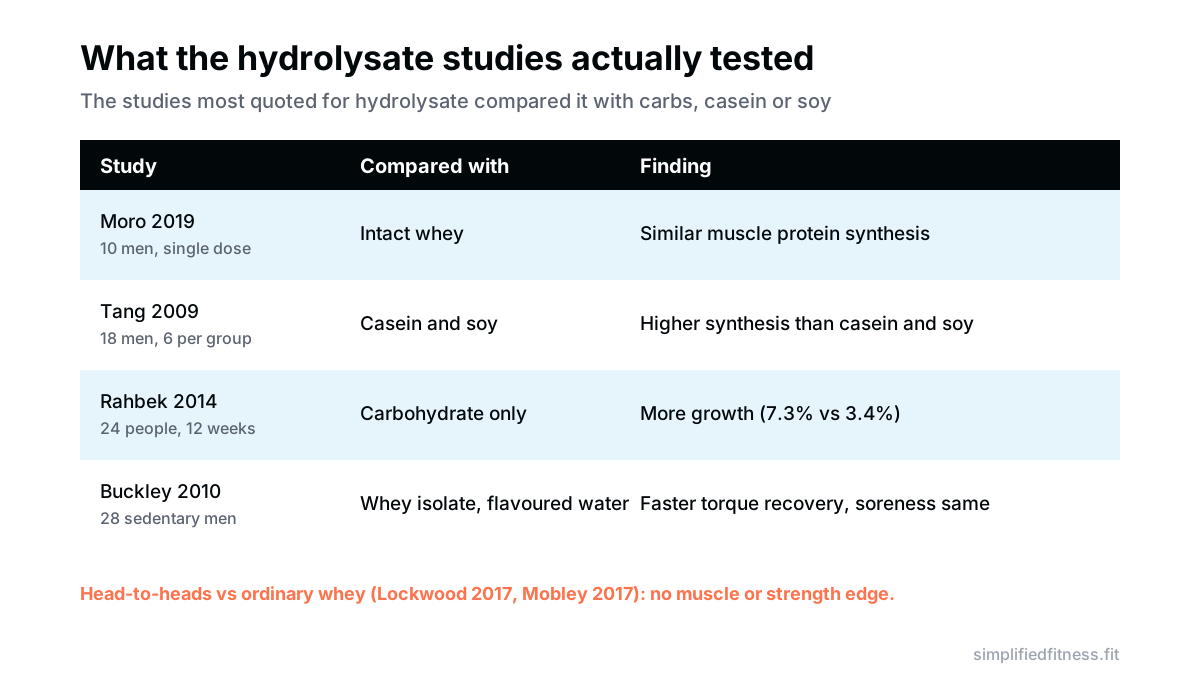
So has anyone run the proper test, hydrolysate against ordinary whey over weeks of training? Yes, twice.
- Lockwood et al. (2017): 56 resistance-trained men did 8 weeks of training while taking two 30 g servings a day of placebo, whey concentrate, a lactoferrin-rich concentrate or an extensively hydrolyzed concentrate. Strength rose similarly in every group and total body muscle mass increased in all of them. Hydrolysate did cut fat mass by about 6% versus a 4.4% gain on placebo, and the authors concluded it may augment fat loss but gave no other advantage (Lockwood et al., 2017). The lead author runs a supplement consultancy, and the fat result was against placebo, not against the other wheys.
- Mobley et al. (2017): 75 untrained young men trained for 12 weeks on placebo, leucine, whey concentrate, whey hydrolysate or soy, with servings matched for leucine. No supplement, hydrolysate included, added muscle mass or strength beyond placebo. Every group was already eating above the recommended protein intake, which leaves little room for any powder to show an effect (Mobley et al., 2017).
Two trials, both in young men, neither large. But they point the same way as the acute data: similar results to ordinary whey. On current evidence, nothing justifies the premium for muscle growth.
What matters more than the type of whey?
Total protein. A meta-analysis of 49 randomized trials (1,863 participants) found that protein supplementation increased fat-free mass by 0.30 kg on average during resistance training. Past about 1.62 g/kg/day of total protein intake, there were no further gains in fat-free mass. Gains were also larger in resistance-trained people and smaller with increasing age (Morton et al., 2018).
That is a measure of total protein, not of whey type. If you weigh 70 kg, about 110 g a day gets you near that plateau. Use our protein calculator to set your own target, then see our guide on optimal daily protein intake for how the numbers behave.
The same logic applies to timing. A review of the post-exercise anabolic window noted that the importance, and even the existence, of a narrow window varies by situation (Aragon et al., 2013). If you are not racing to absorb protein in 30 minutes, “faster” has little to offer. More on that in our anabolic window myth article, and on speed generally in fast vs slow absorbing proteins.
Is hydrolyzed whey better for recovery?
This is the one place the data is a little more interesting, and still thin.
In a double-blind trial, 28 sedentary men did 100 maximal eccentric contractions of the knee extensors. They then drank flavoured water, 25 g of isolate, or 25 g of a hydrolysed isolate. Peak torque had dropped about 23%. It stayed low with water and plain isolate but recovered fully by 6 hours in the hydrolysate group. Soreness, however, did not differ between groups, and only 6 men were in the hydrolysate group (Buckley et al., 2010).
Small, untrained, one-off damage. That is a long way from your normal Tuesday leg session.
Taste, cost and the practical downsides
Bitterness is built in. Cutting proteins into peptides releases fragments that taste bitter, and food scientists spend real effort on masking them. One study tested 24 known bitter-taste inhibitors on two whey hydrolysates and found sweeteners such as sucralose, fructose and sucrose, plus some salts, worked (Leksrisompong et al., 2012). Which tells you what is probably in the tub to make it drinkable.
Cost. Hydrolysate needs an extra processing step, and it is generally sold at a higher price per serving. Prices vary a lot by brand and shop, so do the maths per 25 g of protein, not per tub. In India, check that the label is genuine before you spend more; our guide on spotting fake protein covers that.
Stomach. The idea that “pre-digested” means gentler is plausible, but solid human data is limited. In practice, if whey upsets you, lactose is a common cause, and isolate is the cheaper first step. Anyone with a milk allergy should avoid all whey. See a doctor if you get hives, swelling or breathing trouble after any dairy.
Who might consider hydrolyzed whey?
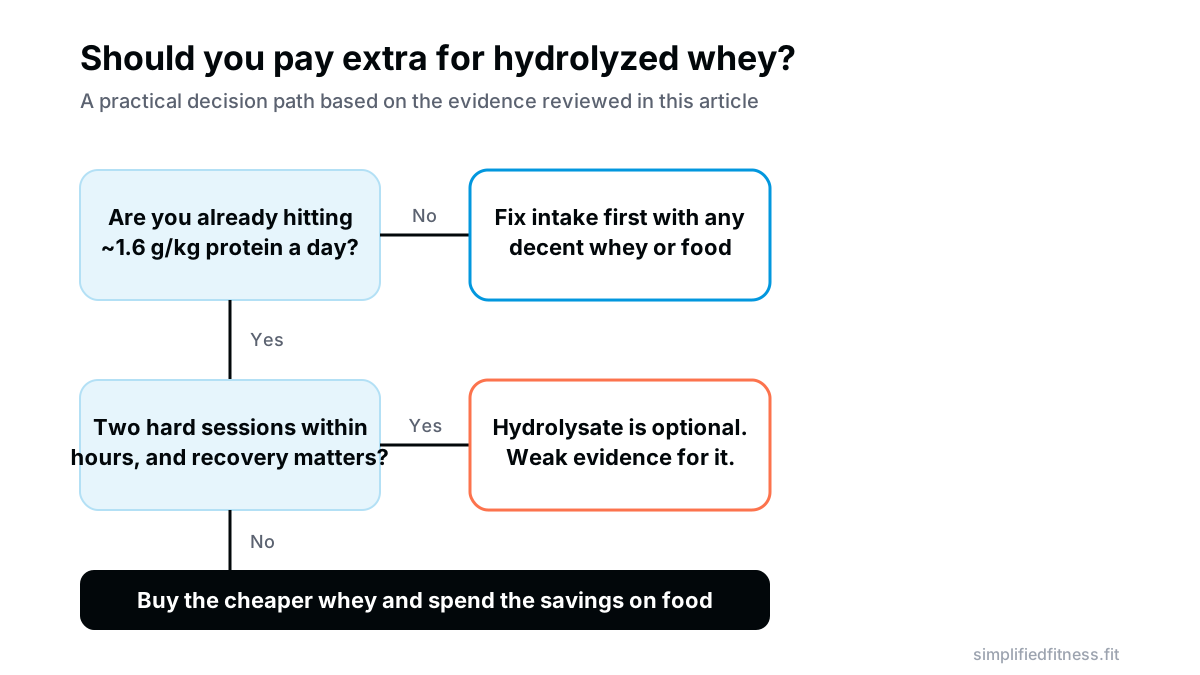
A small group. If you do two hard sessions within a few hours and every bit of recovery counts, hydrolysate has a thin but real argument. It is also sometimes used in products for people who tolerate regular whey poorly, though again, the evidence is limited.
If that is not you, the decision path is short.
How to spend your protein budget instead
- Hit the daily number first. About 1.6 g/kg/day is the point where extra protein stopped adding fat-free mass in the meta-analysis.
- Pick a standard whey from a brand with a clear label and third-party testing. Concentrate is fine if you tolerate lactose.
- Use the savings on food. Curd, paneer, eggs, dal, soya chunks and milk deliver protein for less than most powders.
- Spread it out across 3-4 meals rather than worrying about a 30-minute window.
- Train hard and sleep. No powder replaces that.
The bottom line
Hydrolyzed whey is a real product with a real property: it hits your blood faster. What nobody has shown is that this speed grows more muscle than ordinary whey. In the acute test, muscle protein synthesis rose by the same amount with both, and in 8 and 12 week training trials hydrolysate gave no muscle or strength edge over concentrate. The recovery data is intriguing but small. For most Indian lifters on a normal budget, a standard whey and a protein-rich diet gets you the same result for less.
If you want a program to pair with your protein plan, start with our free training plans.
Frequently Asked Questions
Is hydrolyzed whey protein worth it?
For most people lifting a few times a week, no. Hydrolyzed whey is absorbed faster, but training trials lasting 8 and 12 weeks found it did not build more muscle than ordinary whey concentrate. Put the extra money into more food or simply more of a cheaper whey.
What does hydrolyzed whey protein mean?
It means the whey proteins have been partly broken down into shorter chains of amino acids called peptides before they reach your stomach. This is done with enzymes or acid during manufacturing. Check the label for words like hydrolysate or hydrolyzed to see whether a tub contains it.
Is hydrolyzed whey absorbed faster than whey isolate?
Yes, in studies that measured blood levels. A trial comparing soy and whey with their hydrolysates found hydrolysates were absorbed more rapidly as plasma amino acids than the intact proteins. Faster appearance in blood is not the same as more muscle, so do not pay extra for it alone.
Does hydrolyzed whey build more muscle than regular whey?
There is no good evidence that it does. In one crossover trial in 10 young men, hydrolyzed and intact whey increased muscle protein synthesis by about the same amount. In an 8-week trial in 56 trained men and a 12-week trial in 75 untrained men, hydrolysate gave no muscle or strength advantage over whey concentrate.
What is the difference between hydrolyzed whey and whey isolate?
Isolate is whey filtered to remove most fat and lactose, but its proteins are still intact. Hydrolysate has had the proteins pre-broken into peptides, and it can be made from isolate or concentrate. Isolate is about purity, hydrolysate is about speed.
Why does hydrolyzed whey taste bitter?
Breaking proteins into peptides releases short fragments that taste bitter. Researchers have identified specific bitter peptides in a commercial whey hydrolysate. Manufacturers add sweeteners and flavours to mask it, which is one reason a tub can taste sweeter than expected.
Is pre-digested protein easier on the stomach?
It might be for some people, but good human data on this is limited. One trial found that hydrolysis did not change the estimated rate of gastric emptying of 45 g of whey. If regular whey upsets your stomach, lactose is a common culprit, so try isolate first.
Does hydrolyzed whey spike insulin more?
In a trial of 16 men, peak insulin was 28% higher after 45 g of hydrolyzed whey than after intact whey isolate. That sounds impressive, but there is no proof it improves muscle growth in people eating enough protein. It is not a reason to buy it.
Is hydrolyzed whey better for recovery?
Possibly in specific situations, but the evidence is small. One trial in 28 untrained men found strength recovered faster after hydrolysate than after isolate, yet soreness was the same and the hydrolysate group had only 6 people. Normal lifters recover mainly through food, sleep and sensible training volume.
Who might actually benefit from hydrolyzed whey?
Athletes with two hard sessions within a few hours may be the only group with a reasonable argument. The case rests on small studies, not on proof of better adaptation. If that is not you, a standard whey and a full meal will do the job.
Is hydrolyzed whey safe?
It is made from milk protein, so it is generally as safe as other whey products for healthy people. It still contains milk, so anyone with a milk allergy should avoid it. See a doctor if you have kidney disease or any medical condition before raising your protein intake.
How much protein do I need if I use whey?
A meta-analysis of 49 trials found that gains in fat-free mass stopped growing above about 1.6 g/kg/day of total protein. That means a 70 kg person gets most of the benefit near 110 g a day. Use our protein calculator to set your own target and fill the gap with food first.
Do I need to drink whey right after my workout?
Not urgently. A review of the post-exercise anabolic window noted that its importance, and even its existence, varies by situation. Hitting your daily protein total matters more than racing to a shaker bottle.
Sources & References
Every claim above is checked against peer-reviewed research (PubMed, U.S. National Library of Medicine) or guidance from established health bodies. How we fact-check.
- Morton RW, et al. A systematic review, meta-analysis and meta-regression of the effect of protein supplementation on resistance training-induced gains in muscle mass and strength in healthy adults. Br J Sports Med. 2018. PMID: 28698222
- Tang JE, et al. Ingestion of whey hydrolysate, casein, or soy protein isolate: effects on mixed muscle protein synthesis at rest and following resistance exercise in young men. J Appl Physiol. 2009. PMID: 19589961
- Moro T, et al. Whey protein hydrolysate increases amino acid uptake, mTORC1 signaling, and protein synthesis in skeletal muscle of healthy young men in a randomized crossover trial. J Nutr. 2019. PMID: 31095313
- Morifuji M, et al. Comparison of different sources and degrees of hydrolysis of dietary protein: effect on plasma amino acids, dipeptides, and insulin responses in human subjects. J Agric Food Chem. 2010. PMID: 20614926
- Power O, et al. Human insulinotropic response to oral ingestion of native and hydrolysed whey protein. Amino Acids. 2009. PMID: 18679613
- Buckley JD, et al. Supplementation with a whey protein hydrolysate enhances recovery of muscle force-generating capacity following eccentric exercise. J Sci Med Sport. 2010. PMID: 18768358
- Rahbek SK, et al. Effects of divergent resistance exercise contraction mode and dietary supplementation type on anabolic signalling, muscle protein synthesis and muscle hypertrophy. Amino Acids. 2014. PMID: 25005782
- Leksrisompong P, et al. Bitter taste inhibiting agents for whey protein hydrolysate and whey protein hydrolysate beverages. J Food Sci. 2012. PMID: 22809256
- Lockwood CM, et al. Effects of Hydrolyzed Whey versus Other Whey Protein Supplements on the Physiological Response to 8 Weeks of Resistance Exercise in College-Aged Males. J Am Coll Nutr. 2017. PMID: 27710436
- Mobley CB, et al. Effects of Whey, Soy or Leucine Supplementation with 12 Weeks of Resistance Training on Strength, Body Composition, and Skeletal Muscle and Adipose Tissue Histological Attributes in College-Aged Males. Nutrients. 2017. PMID: 28869573
- Aragon AA, et al. Nutrient timing revisited: is there a post-exercise anabolic window? J Int Soc Sports Nutr. 2013. PMID: 23360586

Umair Hazrami · Founder & Head Coach, Simplified Fitness
Umair Hazrami founded Simplified Fitness and the Simplified Lifter channel to cut through fitness noise. With 4+ years of consistent training and 10+ coaching clients, he writes every guide from the peer-reviewed research and links the sources so you can check them. Our editorial standards.
Educational content only, not medical advice. If you have a medical condition, are pregnant, or take medication, talk to a qualified doctor before changing your diet, supplements or training. Full disclaimer.
Keep reading
Supplements
Alpha-GPC and Huperzine A Pre-Workout: Do Cholinergic Nootropics Help Lifting?
Does an alpha GPC pre workout add power or focus? See what small trials found, why Huperzine A is a poor lifting bet, and the safety flags to know first.
10 min read

Supplements
The Antioxidant Paradox: Can Vitamin C and E Pills Blunt Muscle Growth and Endurance?
Does vitamin C blunt muscle growth? See what trials of 1000 mg vitamin C plus E found for strength, hypertrophy and endurance, and when pills are worth taking.
8 min read

Supplements
Caffeine Powder vs Coffee Before Lifting: Does the Source Really Matter?
Caffeine anhydrous vs coffee for lifting: what research says on absorption speed, peak levels and stomach upset, and whether pills beat your daily cup.
7 min read

Supplements
Caffeine Dosing for Strength and Power: 3-6 mg/kg and When to Take It
Caffeine dosage for strength is 3-6 mg/kg, about 210-420 mg for a 70 kg lifter, taken around 60 minutes before training. Doses, timing and when to stop.
8 min read