L-Tyrosine for Stress and Sleep Loss: Focus Aid, Not a Gym Booster
L-tyrosine benefits for pre workout use are narrow: it may protect focus under cold or sleep loss, but it does not lift strength. See doses, NALT and studies.
TL;DR. The short answer
- L-tyrosine is a building block for dopamine and norepinephrine, not a stimulant. It does not give a caffeine-style buzz.
- Small trials using about 150 mg/kg found it reduced working memory and vigilance drops during cold exposure and overnight sleep loss. Effects were short and the groups were small.
- A 2023 meta-analysis of 10 interventions found no effect on endurance (time to exhaustion SMD 0.02, time trial SMD -0.04), and we found no trial showing it raises 1RM or sprint speed in rested lifters.
- N-acetyl-L-tyrosine (NALT) has no good evidence of being better absorbed. The one human study we found (IV infusion) showed over half was lost in urine.
- If you take antidepressants, thyroid medication or levodopa, or have a medical condition, speak to your doctor before trying it.
Part of our complete guide: Creatine, Protein Powders, Pre-Workouts and Caffeine: The Science and Safety Guide
Table of contents
Do l-tyrosine benefits for pre workout use actually exist? Mostly no. Tyrosine is the raw material your brain uses to make dopamine and norepinephrine, and it seems to help protect focus when those are temporarily drained by things like cold or a sleepless night. It has not been shown to raise strength or sprint speed in a rested lifter.
That narrow niche is why it is such a confusing ingredient. It sits on pre-workout labels next to caffeine as if they do the same job, and they do not. (For the bigger picture on what is worth buying, see our complete guide to creatine, protein powders and caffeine.)
What is L-tyrosine and how does it relate to dopamine?
L-tyrosine is an amino acid you get from ordinary protein. Your body converts it step by step into L-DOPA, then dopamine, then norepinephrine. Together dopamine and norepinephrine are called catecholamines, and they are involved in alertness, working memory and how hard a task feels.
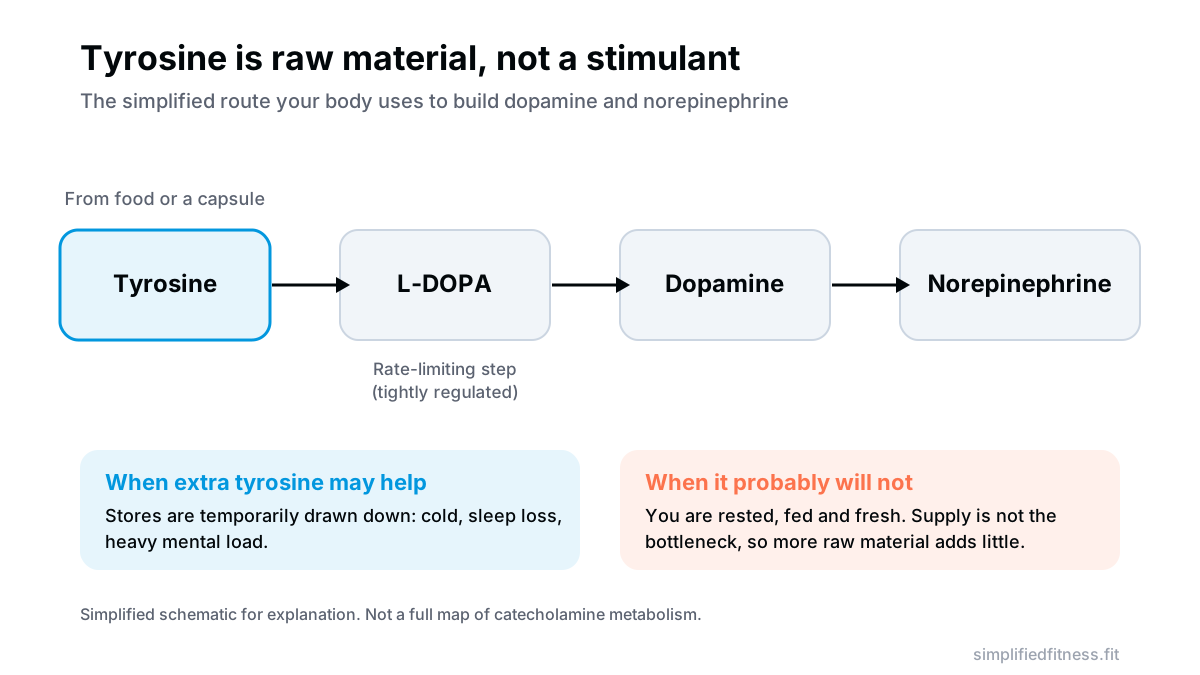
The idea behind supplementing is simple. Under heavy stress, catecholamine stores can fall faster than you replace them, and extra precursor might blunt the drop.
The key detail is “temporarily depleted.” If your dopamine system is not short of anything, more tyrosine is unlikely to push it higher. That single idea explains most of the mixed results below.
Does L-tyrosine work as a pre-workout?
For lifting, there is no good evidence that it does. A 2015 review of the tyrosine literature concluded that its potential for enhancing physical exercise “seems minimal as well,” perhaps because the link between exercise and catecholamine function is mediated by many other factors (Jongkees et al., 2015).
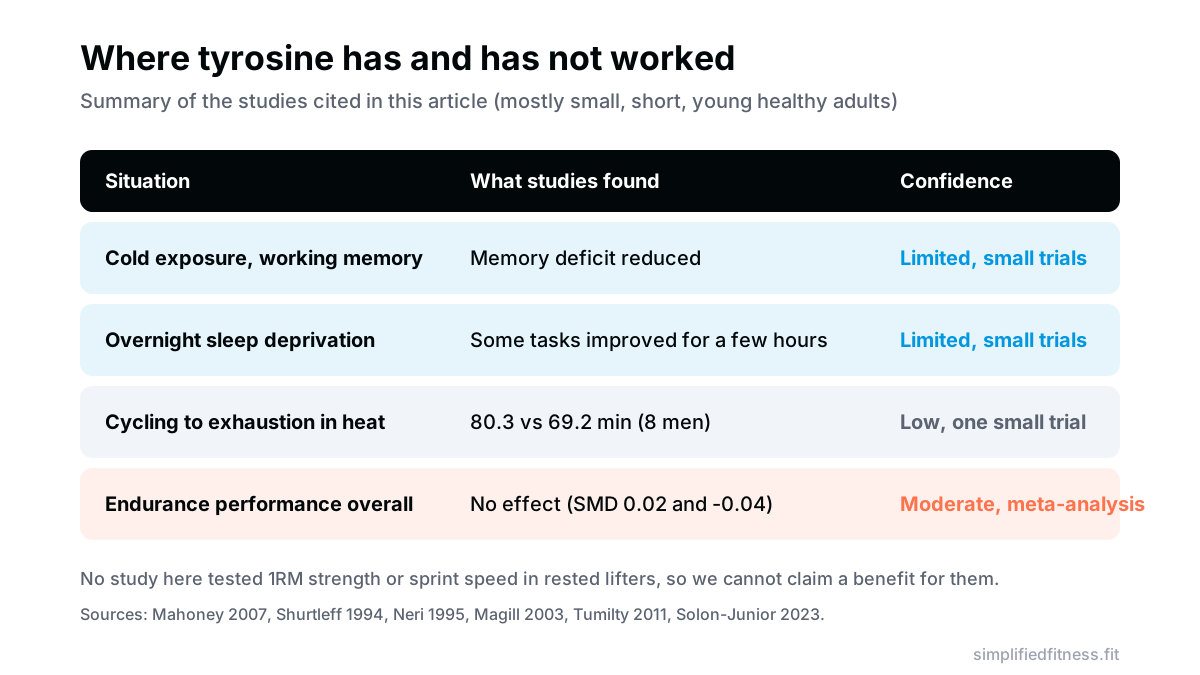
The more recent data point the same way. A 2023 systematic review and meta-analysis pooled 10 interventions from 8 studies in physically active people. It found no difference from placebo for time to exhaustion (SMD = 0.02) or time trial performance (SMD = -0.04), with moderate-quality evidence (Solon-Junior et al., 2023). Note this was endurance exercise. We did not find a controlled trial of tyrosine on 1RM strength or sprint speed in rested lifters, so the honest statement is “no evidence of benefit,” not “proven useless.”
Does tyrosine give you energy?
Not in a way you will feel like caffeine. Caffeine blocks the receptors that make you feel sleepy and acts within the hour. Tyrosine does not stimulate anything. It supplies a building block.
When researchers compared the two directly during sleep deprivation, healthy young men received placebo, tyrosine 150 mg/kg, caffeine 300 mg/70 kg, phentermine or D-amphetamine after an overnight without sleep. All the drugs improved at least some aspects of performance, and tyrosine, though less effective than D-amphetamine, improved several tests (Magill et al., 2003). That is a modest result from a lab setting, not proof that it behaves like a stimulant on a normal gym day. If you want the stimulant you can actually feel, caffeine dosing for strength and power is the better-supported tool.
Does L-tyrosine help with sleep deprivation?
This is where the evidence is most interesting, though still small.
In one US Navy lab study, subjects stayed up through a night of continuous work. Six hours in, half received 150 mg/kg of tyrosine in a split dose and half got cornstarch. Tyrosine was linked to a significant reduction in the usual decline on a psychomotor task and fewer lapses on a vigilance task. The improvement lasted on the order of 3 hours (Neri et al., 1995).
The Magill trial above found a similar story: some tests improved after tyrosine and others did not, and the authors said it “may deserve further testing” (Magill et al., 2003).
What this means in practice: tyrosine may take the edge off a bad night for a couple of hours in specific tasks. It does not fix sleep loss, and sleep deprivation also hurts recovery, appetite and lifting quality in ways these tests did not measure. If you are chronically short on sleep, the answer is sleep. Our look at sleep supplements like melatonin, glycine and magnesium covers the options.
Can tyrosine help with cold and acute stress?
Cold exposure is the best-studied stressor, and the results are fairly consistent, although every trial is small.
- Shurtleff et al., 1994: eight men did a memory task at 4 degrees C. Cold reduced matching accuracy after placebo, and tyrosine (150 mg/kg) brought it back to the level seen at 22 degrees C. At 22 degrees C, tyrosine had no effect (Shurtleff et al., 1994).
- Mahoney et al., 2007: 19 volunteers did two 90-minute water immersions in cold water. Cold worsened memory and reaction time, and tyrosine (150 mg/kg before each immersion, 300 mg/kg total) alleviated working memory decrements (Mahoney et al., 2007).
Note the pattern in the first study: no benefit in comfortable conditions. That fits the “only when depleted” model. Also note these studies came from military research labs and used young, healthy volunteers, so the findings may not carry over to older adults or people with medical conditions.
What about exercise in the heat?
One trial is often quoted. Eight healthy men took 150 mg/kg of tyrosine or placebo an hour before cycling to exhaustion at about 68% of VO2peak in 30 degrees C and 60% humidity. They lasted longer on tyrosine (80.3 vs 69.2 minutes), while heart rate, core temperature and perceived exertion were similar (Tumilty et al., 2011).
That is a real result, but it is eight people in a crossover design. When the 2023 meta-analysis pooled endurance studies as a whole, the average effect was essentially zero (Solon-Junior et al., 2023). Different protocols, doses and participants may explain the gap, and I would not build a hot-weather plan around one small study. If you train in an Indian summer, hydration, acclimatisation and pacing are better investments.
Why do the studies disagree?
Mostly because “stress” differs from study to study and because rested people already have enough supply. In the cold and sleep loss studies, participants were probably running low on catecholamines, and tyrosine helped some tasks. In the endurance studies, participants were typically fed and fresh, and tyrosine did nothing on average. Small samples, different tests and different timing also add noise. The takeaway is cautious: tyrosine looks situational, not general.
What is the tyrosine dose used in studies, and is it practical?
The dose in almost every positive trial above was 150 mg/kg. That is roughly 10.5 g for a 70 kg person and 12 g for an 80 kg person. Mahoney used 300 mg/kg in total across two feedings. Neri split the dose.
A typical capsule or pre-workout scoop that lists tyrosine at all provides only a small fraction of that, so check the label. A standard serving is not doing what the studies did. I would not suggest anyone copy these research doses on their own, because we do not have long-term safety data from the abstracts we reviewed. The Navy study described 150 mg/kg as “relatively benign” in its volunteers, but the sample was small and the follow-up short (Neri et al., 1995).
NALT vs L-tyrosine: is the acetylated form better?
NALT (N-acetyl-L-tyrosine) is marketed as more soluble and better absorbed. The evidence for that is thin.
The one human study I found infused 5 g of NALT intravenously into 11 healthy volunteers. Plasma tyrosine rose about 25%, but 56% of the infused NALT was excreted in urine within 4 hours, and the authors concluded that its usefulness as a tyrosine precursor was “not apparent” (Magnusson et al., 1989).
Two cautions. First, that was IV, not oral, so it does not directly tell us how a capsule behaves. Second, all the performance and stress trials above used plain L-tyrosine. So if you try tyrosine at all, the form with the research behind it is L-tyrosine, and NALT is an unproven upgrade.
| L-tyrosine | NALT | |
|---|---|---|
| Used in the cold, sleep loss and heat trials above | Yes | No |
| Human data we found | Multiple small RCTs | One IV infusion study |
| Evidence it absorbs better | Not applicable | Not shown |
| Typical cost | Lower | Usually higher |
Who should skip tyrosine or ask a doctor first?
Tyrosine feeds the same pathways that several medicines act on. As general caution rather than a finding from these studies, ask a doctor first if you take antidepressants (especially MAOIs), thyroid medication or levodopa, or if you have a thyroid condition, high blood pressure or heart rhythm problems. Pregnant or breastfeeding women and teenagers should also not experiment on their own, as these groups were not the focus of these trials.
See a doctor if you feel palpitations, severe headaches or anxiety after taking it, and do not use a supplement to push through exhaustion that does not go away. Persistent fatigue or low mood deserves a proper check, not a capsule.
So what should you do instead?
If your goal is better sessions, a few boring things beat tyrosine easily:
- Sleep 7-9 hours when you can. No amino acid replaces it.
- Eat enough protein and a real pre-workout meal.
- Use creatine monohydrate daily. Our creatine dosage calculator gives you a number, and the creatine and cognition article covers its brain angle.
- Use caffeine strategically, and watch tolerance.
If you still want to experiment because you have a rare stressful situation (a night shift or long cold exposure), treat it as a one-off with medical advice, expect a modest effect at best, and do not assume it will do anything for your bench press. The research stays quiet on that last point, and it deserves to stay quiet in your supplement budget too.
Frequently Asked Questions
Does L-tyrosine work as a pre-workout?
Probably not for lifting. A review of tyrosine research concluded its potential for enhancing physical exercise seems minimal, and a 2023 meta-analysis found no effect on endurance performance. If you are well rested, your dopamine supply is not the limiting factor, so spend your money on creatine and caffeine instead.
Does tyrosine give you energy?
Not in the way caffeine does. Tyrosine supplies raw material for dopamine and norepinephrine rather than blocking sleepiness signals or directly stimulating you. In studies the benefit showed up as less decline in focus under stress, not as extra alertness in rested people, so do not expect a buzz.
What is the L-tyrosine dose used in studies?
Most of the cold, sleep loss and heat studies used about 150 mg/kg of body weight, which is roughly 10 g for a 70 kg person. This is a research dose, far above what many capsules provide per serving. Do not copy it casually, and check with a doctor first if you have any health condition or take medication.
Can L-tyrosine help with sleep deprivation?
It may soften some of the damage for a few hours. In a Naval study, 150 mg/kg given in a split dose during a night of sleep loss reduced the usual decline on a psychomotor task and lowered vigilance lapses, with effects lasting around 3 hours. The trials were small and short, so tyrosine is not a replacement for actual sleep.
Is L-tyrosine the same as NALT?
No. NALT is N-acetyl-L-tyrosine, tyrosine with an acetyl group attached, sold on the idea that it is better absorbed. The one human study we found infused it intravenously and concluded its usefulness as a tyrosine precursor was not apparent, so plain L-tyrosine is the better-studied choice.
Does L-tyrosine increase dopamine?
It can raise the supply of the precursor, and the idea is that catecholamine supply can run short under stress. In rested, well-fed people the body tightly regulates this pathway, so extra tyrosine may add little. The cognitive benefits in studies appeared mainly when dopamine or norepinephrine was probably temporarily depleted.
Is L-tyrosine good for focus and studying?
Possibly in short, stressful or mentally demanding situations, not as a daily focus pill. A 2015 review concluded tyrosine enhances cognition mainly when neurotransmitter function is intact and dopamine or norepinephrine is temporarily depleted. For everyday focus, sleep, food and caffeine do more, so fix those first.
Can L-tyrosine help in hot weather workouts?
One small trial hints at it, but the broader evidence does not back it up. Eight men cycled about 11 minutes longer in 30 degrees C heat after 150 mg/kg, yet the 2023 meta-analysis of endurance studies found no overall benefit. Hydration, acclimatisation and pacing are far better bets in an Indian summer.
Are there side effects or people who should avoid tyrosine?
The Naval study called 150 mg/kg a relatively benign treatment in healthy volunteers, but the sample was small and the follow-up short. Because tyrosine feeds the same pathways that some medicines target, people on MAOI or other antidepressants, thyroid medication or levodopa, or with thyroid or blood pressure problems, should ask a doctor first. If you feel jittery, get headaches or notice palpitations, stop and speak to a clinician.
Which foods contain tyrosine?
Tyrosine occurs in most protein foods, including paneer, curd, eggs, chicken, fish, soya and peanuts. Eating adequate protein throughout the day already supplies it. A capsule only matters if you want a large acute dose for a specific situation, and food will not reach 150 mg/kg.
Should I take L-tyrosine every day?
There is no evidence for daily use in healthy people. The positive studies gave single or split doses just before a specific stressor, such as cold exposure or a sleepless night. Using it that way, rarely, is closer to what the research supports than a daily habit.
Sources & References
Every claim above is checked against peer-reviewed research (PubMed, U.S. National Library of Medicine) or guidance from established health bodies. How we fact-check.
- Tumilty L, et al. Oral tyrosine supplementation improves exercise capacity in the heat. Eur J Appl Physiol. 2011. PMID: 21437603
- Magill RA, et al. Effects of tyrosine, phentermine, caffeine D-amphetamine, and placebo on cognitive and motor performance deficits during sleep deprivation. Nutr Neurosci. 2003. PMID: 12887140
- Neri DF, et al. The effects of tyrosine on cognitive performance during extended wakefulness. Aviat Space Environ Med. 1995. PMID: 7794222
- Shurtleff D, et al. Tyrosine reverses a cold-induced working memory deficit in humans. Pharmacol Biochem Behav. 1994. PMID: 8029265
- Mahoney CR, et al. Tyrosine supplementation mitigates working memory decrements during cold exposure. Physiol Behav. 2007. PMID: 17585971
- Jongkees BJ, et al. Effect of tyrosine supplementation on clinical and healthy populations under stress or cognitive demands: a review. J Psychiatr Res. 2015. PMID: 26424423
- Solon-Junior LJF, et al. The effect of tyrosine supplementation on whole-body endurance performance in physically active population: a systematic review and meta-analysis including GRADE qualification. J Sports Sci. 2023. PMID: 38290812
- Magnusson I, et al. N-acetyl-L-tyrosine and N-acetyl-L-cysteine as tyrosine and cysteine precursors during intravenous infusion in humans. Metabolism. 1989. PMID: 2507878

Umair Hazrami · Founder & Head Coach, Simplified Fitness
Umair Hazrami founded Simplified Fitness and the Simplified Lifter channel to cut through fitness noise. With 4+ years of consistent training and 10+ coaching clients, he writes every guide from the peer-reviewed research and links the sources so you can check them. Our editorial standards.
Educational content only, not medical advice. If you have a medical condition, are pregnant, or take medication, talk to a qualified doctor before changing your diet, supplements or training. Full disclaimer.
Keep reading
Supplements
Alpha-GPC and Huperzine A Pre-Workout: Do Cholinergic Nootropics Help Lifting?
Does an alpha GPC pre workout add power or focus? See what small trials found, why Huperzine A is a poor lifting bet, and the safety flags to know first.
10 min read

Supplements
The Antioxidant Paradox: Can Vitamin C and E Pills Blunt Muscle Growth and Endurance?
Does vitamin C blunt muscle growth? See what trials of 1000 mg vitamin C plus E found for strength, hypertrophy and endurance, and when pills are worth taking.
8 min read
Supplements
Caffeine Powder vs Coffee Before Lifting: Does the Source Really Matter?
Caffeine anhydrous vs coffee for lifting: what research says on absorption speed, peak levels and stomach upset, and whether pills beat your daily cup.
7 min read

Supplements
Caffeine Dosing for Strength and Power: 3-6 mg/kg and When to Take It
Caffeine dosage for strength is 3-6 mg/kg, about 210-420 mg for a 70 kg lifter, taken around 60 minutes before training. Doses, timing and when to stop.
8 min read