Curcumin and Piperine for Joint Pain: Does Turmeric Help Lifters or Hurt Gains?
Curcumin for joint pain lifting: what trials show for knee arthritis and DOMS, how piperine helps, and if it could blunt muscle growth. Dose and timing inside.

TL;DR. The short answer
- Curcumin has the best evidence for knee osteoarthritis pain, where trials of about 1,000 mg/day of curcumin show pain relief versus placebo, though the studies are small and short.
- For DOMS the evidence is mixed. One meta-analysis found slightly less soreness and lower creatine kinase, while another found no statistically significant effects.
- Piperine (black pepper extract) raised curcumin blood levels by about 2000% in a small 1998 human study, which is why most good products pair them or use a special delivery form.
- No human trial we found shows curcumin blunts muscle growth, but the question is untested, so avoid taking high doses right around every workout and use it for a reason.
- Rare liver injury has been reported with high-dose, high-absorption turmeric products. See a doctor first if you have liver problems or take regular medication.
Part of our complete guide: Creatine, Protein Powders, Pre-Workouts and Caffeine: The Science and Safety Guide
Table of contents
Curcumin, the main active compound in turmeric (haldi), has decent evidence for easing knee osteoarthritis pain, mixed evidence for post-workout soreness, and no clear evidence either way on muscle growth. If you are a lifter with achy joints, curcumin for joint pain lifting is worth understanding properly before you add another capsule to your stack. It is one of the “secondary” options in our complete guide to creatine, protein powders and caffeine, well behind the basics.
This article covers what the trials actually show, what piperine does, how to choose a product, and the real controversy: does an anti-inflammatory supplement get in the way of the inflammation your muscles need to grow?
Does curcumin actually work for joint pain?
For one specific problem, yes, probably. That problem is knee osteoarthritis.
A 2016 systematic review of 8 randomized trials in arthritis found that turmeric or curcumin reduced pain scores versus placebo (a mean difference of -2.04 on a pain visual analogue scale across three trials) and lowered WOMAC scores, a standard knee function and pain questionnaire (Daily et al., 2016). Compared with pain medication, there was no significant difference in pain. The authors supported about 1,000 mg/day of curcumin, but also said the trials were too few and too small to be definitive.
Newer trials point the same way. In an 8-week randomized, placebo-controlled study of 101 adults with knee osteoarthritis, 500 mg twice daily of a standardised extract reduced knee pain scores more than placebo, and pain medication use fell in 37% of the curcumin group versus 13% on placebo (Lopresti et al., 2021). The company that makes the extract helped design the study and write the paper, which is worth knowing.
An Indian trial compared curcumin (BCM-95, 500 mg three times a day) with diclofenac 50 mg twice a day in 139 people with knee OA over 28 days. Pain relief was similar, and side effects were lower with curcumin (13% versus 38%) (Shep et al., 2019). It was open-label, so participants knew what they were taking, which can inflate results.
That is the honest summary: encouraging, small trials, short durations, some industry involvement.
What does piperine do, and is the 2000% number real?
Plain curcumin is absorbed badly. Your gut wall and liver rapidly chemically tag it for removal (a process called glucuronidation), so very little makes it into the blood.
Piperine, the pungent compound in black pepper, inhibits that process. In a 1998 study, healthy volunteers who took 2 g of curcumin alone had serum levels that were undetectable or very low. With 20 mg of piperine added, levels were much higher between 15 minutes and an hour after dosing, and the authors reported a bioavailability increase of 2000% (Shoba et al., 1998). In rats the increase was 154%.
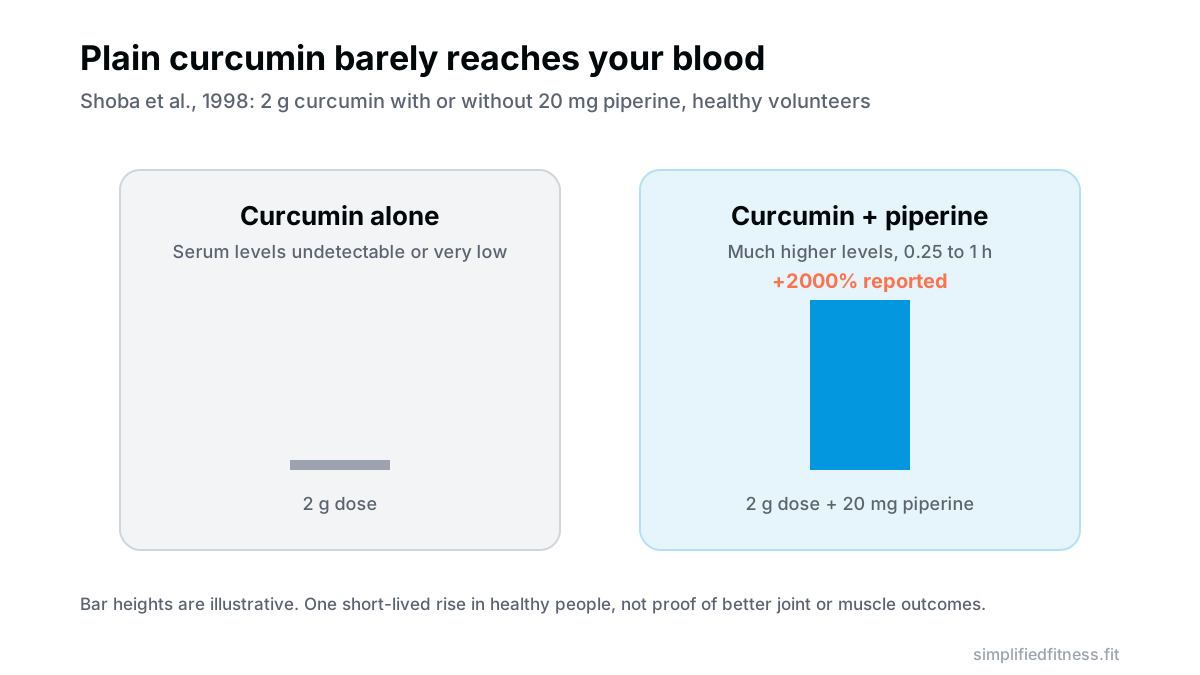
Read that number carefully. It comes from one small study of healthy volunteers, measuring blood levels for a short window, using a 2 g dose. It does not prove that joints hurt less by 2000%, or that pepper makes every product 20 times better. The joint trials above used standardised extracts, and some used enhanced-absorption forms rather than piperine.
Other delivery forms try to solve the same problem. The knee trials above used enhanced extracts (BCM-95 and Curcugen), and phospholipid complexes are another common approach. Piperine also affects how the body handles some medicines, which is why drug interactions are worth asking your doctor about.
Does curcumin help with DOMS?
This is where the studies disagree, so let’s lay it out fairly.
A small crossover trial gave 17 men 2.5 g of curcumin twice daily, starting two days before heavy eccentric leg press exercise and continuing three days after. Compared with placebo, curcumin likely reduced pain at 24 and 48 hours and small reductions in creatine kinase (a muscle damage marker) were seen (Nicol et al., 2015). That dose is far higher than most capsule labels suggest.
The pooled evidence splits. A 2022 meta-analysis of 10 trials found lower CK (-65.98 IU/L) and slightly less soreness (-0.56 points) (Beba et al., 2022), while a 2024 meta-analysis drawing on 16 papers found no statistically significant effects on muscle damage, soreness or inflammation from 0 to 96 hours (Oxley and Peart, 2024). Our dedicated piece on curcumin for muscle soreness unpacks why these reviews disagree; this article stays focused on joints and growth.
My takeaway: curcumin might shave a bit off soreness for some people, but it is not a reliable fix. If DOMS is your problem, fix the cause first. Our guide on DOMS versus muscle growth explains why soreness is a poor yardstick anyway, and tart cherry juice is the sibling option with its own mixed evidence.
Does curcumin blunt muscle growth?
Here is the honest answer: nobody knows, and the claim is stronger in blog posts than in the literature.
The worry goes like this. Curcumin is studied for dampening inflammatory signalling, including the NF-kB pathway and cytokines such as TNF-alpha. Training stress triggers some inflammation, and that signalling is part of how muscle repairs and adapts. So in theory, taking a strong anti-inflammatory every day might dull the signal.
That reasoning is plausible, but note what it rests on:
- Mechanism studies are mostly in cells and mice (the DOMS paper above notes the cytokine and regeneration findings were in mice).
- In the one trial above that measured interleukin-6, curcumin did not simply suppress it. IL-6 rose at 0 and 48 hours versus baseline.
- We did not find a human randomized trial of curcumin alongside resistance training with muscle growth as the outcome.
A related debate exists for high-dose antioxidants and for NSAIDs, which is why we wrote about the antioxidant paradox and ibuprofen and muscle growth. Evidence there is also mixed, and it should not be assumed to transfer to curcumin.
When should lifters take curcumin?
Based on the gaps above, I would be conservative.
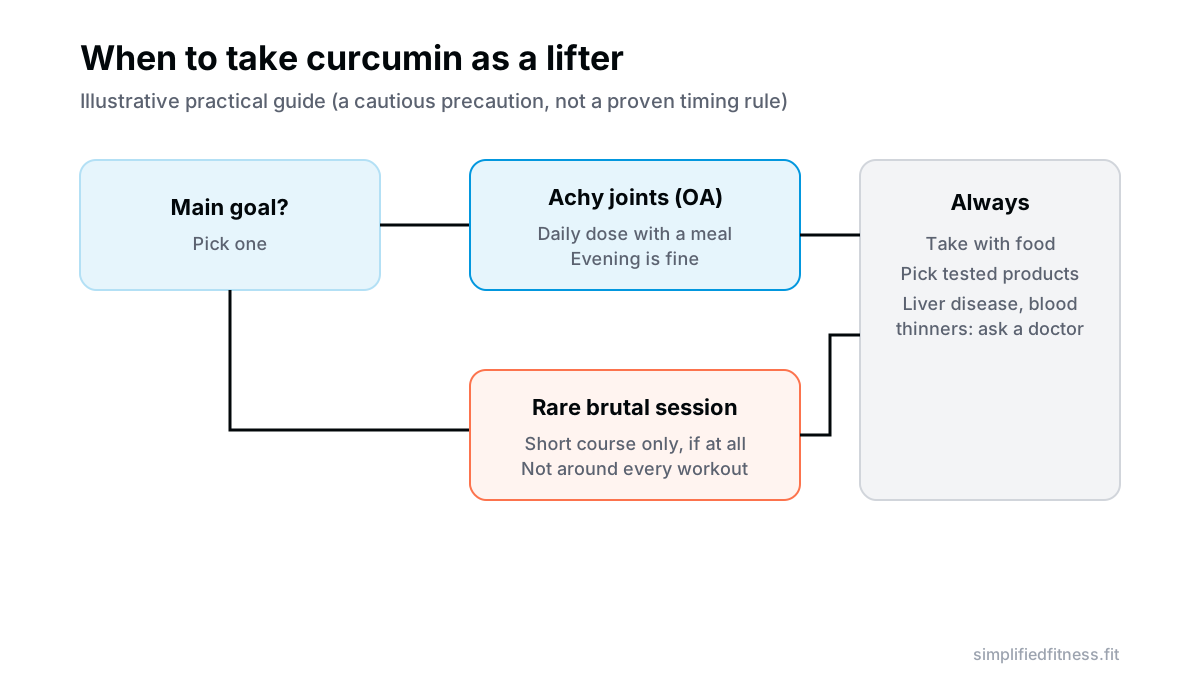
- For joint pain: take it daily with a meal containing fat. Consistency matters more than the exact hour. An evening meal is fine.
- For DOMS: it is optional, and if you try it, think of a short course around an unusually hard block, not a permanent habit.
- For hypertrophy blocks with no joint issues: you probably do not need it at all.
The evening-meal suggestion is a precaution, not a proven rule. It simply keeps the supplement away from the hours straight after you train, when adaptation signalling is most active, and curcumin needs food anyway.
Safety: the part most supplement pages skip
Turmeric in food is fine. Concentrated supplements are a different matter.
A 2021 analysis of the Italian phytovigilance database plus a systematic review described cases of acute hepatitis linked to turmeric supplements. In the seven Tuscan cases, the products were high-bioavailability formulations at high curcumin doses, and most patients improved after stopping (Lombardi et al., 2021). The authors point out that supplements are poorly regulated and that many patients in the wider literature were also taking other drugs.
This does not mean curcumin is dangerous for everyone. These cases are rare reports, and we cannot get a risk rate from them. It does mean the “more absorption, more dose” instinct deserves restraint.
See a doctor before using it if you:
- have liver or gallbladder disease
- take blood thinners, diabetes medication or regular painkillers
- are pregnant or breastfeeding
- are scheduled for surgery
And stop and get checked if you notice yellowing skin or eyes, dark urine, itching or unusual fatigue. Joint pain that is swollen, hot, worsening or waking you at night also needs a proper assessment, not a capsule.
How to choose a curcumin supplement
No single product is proven best. Use a checklist instead.
| Look for | Why it matters |
|---|---|
| Curcuminoids stated per capsule (for example 500 mg) | “Turmeric root powder” can contain very little curcumin |
| Piperine or a studied delivery form (phospholipid, BCM-95-type) | Plain curcumin is poorly absorbed |
| Dose near trial ranges (about 500 mg twice daily) | Megadoses add risk and cost, not proven benefit |
| Third-party testing | Supplements are loosely regulated and quality varies |
| No proprietary “blend” hiding the amounts | You cannot dose what you cannot see |
On budget: in India, a plain turmeric-capsule bottle can look cheap, but if it holds mostly turmeric powder, you are not buying the studied dose. Cooking with haldi daily is a perfectly good habit, just do not expect it to match an extract. If money is tight, spend it on protein and a decent diet plan first, and treat curcumin as the last 1%.
For other options aimed at joint comfort, see our comparison of joint health supplements like glucosamine, MSM and collagen.
The bottom line
Curcumin earns a spot for knee osteoarthritis pain, with modest, short-term trial evidence. Piperine helps absorption in the lab but is not a magic multiplier for results. For DOMS, the research disagrees. For muscle growth, there is no human data either way, so be modest with dose and timing.
Most lifters with sore joints will do better fixing exercise selection, volume and recovery first. If you do try it, make it a deliberate experiment with a start date and a stop date.
Frequently Asked Questions
Does curcumin help joint pain in lifters?
It may help if your joint pain comes from knee osteoarthritis, where randomized trials show less pain than placebo. Most of that evidence is from people with diagnosed arthritis, not from healthy young lifters with a tweaky elbow. If your pain is sharp, getting worse or tied to one movement, fix the exercise and see a physio first.
How much curcumin should I take per day?
A 2016 meta-analysis of arthritis trials supported about 1,000 mg/day of curcumin, and common trial doses were 500 mg twice daily. Higher intake mostly adds cost and stomach upset rather than proven extra benefit. Start low with a meal and check the label for actual curcuminoid content, not just 'turmeric root'.
Does curcumin blunt muscle growth?
We did not find a human trial showing that curcumin reduces muscle growth, so there is no proof of harm. The concern is theoretical, because some inflammatory signalling helps drive training adaptation, and that has been raised more for antioxidants and anti-inflammatories in general. Until trials exist, keep doses moderate and avoid taking it around every session.
Is turmeric powder in food enough?
Cooking with turmeric is healthy, but the amount of curcumin is small and its absorption is poor. Studies of joint pain use concentrated extracts delivering hundreds of milligrams of curcumin. Keep the haldi in your dal and sabzi for flavour and treat a supplement as a separate decision.
Why take piperine with curcumin?
Curcumin is quickly metabolised in the gut wall and liver, so very little reaches the blood. In a 1998 study, adding 20 mg of piperine to 2 g of curcumin raised human bioavailability by about 2000%. That boost is short-lived and its real-world clinical value is less clear, so do not assume more pepper means more benefit.
Does curcumin help with DOMS?
Possibly a little, but the evidence disagrees. A 2022 meta-analysis found a small drop in soreness and creatine kinase, while a 2024 meta-analysis found no statistically significant effects. Consider it optional, and rely on sleep, food and gradually increasing training load first.
What is the best time to take curcumin?
Take it with a meal that contains some fat, since curcumin is fat-soluble. For joint pain, a consistent daily dose matters more than the clock. Lifters worried about growth can take it with an evening meal rather than right before or after training, though that timing is a precaution, not a proven rule.
Which curcumin supplement is best?
There is no single proven winner. The knee trials cited here used standardised extracts such as BCM-95 and Curcugen. Pick a product that states curcuminoid content per capsule, uses a tested delivery form or piperine, and carries third-party testing.
Is curcumin safe for the liver?
For most people short-term use appears well tolerated in trials, but a 2021 Italian case series and systematic review linked turmeric supplements to acute liver injury, and the Italian cases all involved high-dose, high-absorption products. Most cases improved after stopping. Stop and see a doctor if you notice dark urine, yellow eyes or skin, or unusual tiredness, and avoid it if you have liver disease.
Can I take curcumin with ibuprofen or other medicines?
Curcumin trials compared it with diclofenac and found similar pain relief with fewer side effects in one Indian study, but that does not mean you can stack or swap medicines yourself. Talk to your doctor or pharmacist, especially if you take blood thinners or have diabetes. Piperine can change how some drugs are absorbed, so declare it.
How long does curcumin take to work?
Knee osteoarthritis trials ran for 4 to 8 weeks and measured benefits at those points. DOMS studies dose for a few days around a hard session. If you notice nothing after 8 weeks at a sensible dose, stop paying for it.
Is curcumin better than ibuprofen for gym pain?
Not proven. In one 28-day trial in knee OA, curcumin matched diclofenac for pain, but that is a different drug and a different condition than ordinary gym soreness. Regular NSAID use has its own muscle-growth question, which we cover in a separate article.
Sources & References
Every claim above is checked against peer-reviewed research (PubMed, U.S. National Library of Medicine) or guidance from established health bodies. How we fact-check.
- Daily JW, et al. Efficacy of turmeric extracts and curcumin for alleviating the symptoms of joint arthritis: a systematic review and meta-analysis of randomized clinical trials. J Med Food. 2016. PMID: 27533649
- Shoba G, et al. Influence of piperine on the pharmacokinetics of curcumin in animals and human volunteers. Planta Med. 1998. PMID: 9619120
- Nicol LM, et al. Curcumin supplementation likely attenuates delayed onset muscle soreness (DOMS). Eur J Appl Physiol. 2015. PMID: 25795285
- Beba M, et al. The effect of curcumin supplementation on delayed-onset muscle soreness, inflammation, muscle strength, and joint flexibility: a systematic review and dose-response meta-analysis of randomized controlled trials. Phytother Res. 2022. PMID: 35574627
- Oxley RA, et al. The effect of curcumin supplementation on functional strength outcomes and markers of exercise-induced muscle damage: a systematic review and meta-analysis. Nutr Health. 2024. PMID: 37408367
- Lombardi N, et al. Acute liver injury following turmeric use in Tuscany: an analysis of the Italian Phytovigilance database and systematic review of case reports. Br J Clin Pharmacol. 2021. PMID: 32656820
- Lopresti AL, et al. An investigation into the effects of a curcumin extract (Curcugen) on osteoarthritis pain of the knee: a randomised, double-blind, placebo-controlled study. Nutrients. 2021. PMID: 35010916
- Shep D, et al. Safety and efficacy of curcumin versus diclofenac in knee osteoarthritis: a randomized open-label parallel-arm study. Trials. 2019. PMID: 30975196

Umair Hazrami · Founder & Head Coach, Simplified Fitness
Umair Hazrami founded Simplified Fitness and the Simplified Lifter channel to cut through fitness noise. With 4+ years of consistent training and 10+ coaching clients, he writes every guide from the peer-reviewed research and links the sources so you can check them. Our editorial standards.
Educational content only, not medical advice. If you have a medical condition, are pregnant, or take medication, talk to a qualified doctor before changing your diet, supplements or training. Full disclaimer.
Keep reading
Supplements
Alpha-GPC and Huperzine A Pre-Workout: Do Cholinergic Nootropics Help Lifting?
Does an alpha GPC pre workout add power or focus? See what small trials found, why Huperzine A is a poor lifting bet, and the safety flags to know first.
10 min read
Supplements
The Antioxidant Paradox: Can Vitamin C and E Pills Blunt Muscle Growth and Endurance?
Does vitamin C blunt muscle growth? See what trials of 1000 mg vitamin C plus E found for strength, hypertrophy and endurance, and when pills are worth taking.
8 min read
Supplements
Caffeine Powder vs Coffee Before Lifting: Does the Source Really Matter?
Caffeine anhydrous vs coffee for lifting: what research says on absorption speed, peak levels and stomach upset, and whether pills beat your daily cup.
7 min read
Supplements
Caffeine Dosing for Strength and Power: 3-6 mg/kg and When to Take It
Caffeine dosage for strength is 3-6 mg/kg, about 210-420 mg for a 70 kg lifter, taken around 60 minutes before training. Doses, timing and when to stop.
8 min read