L-Carnitine L-Tartrate: Does It Aid Recovery or Burn Fat?
L-carnitine l-tartrate benefits: modest recovery help, weak fat-loss evidence. See dose, carb needs, TMAO concerns and who it suits, with every study linked.
TL;DR. The short answer
- L-carnitine l-tartrate (LCLT) has its best support as a recovery aid: small trials using about 2 g of LCLT a day for 3 to 5 weeks found less soreness and less muscle damage after hard sessions.
- Oral carnitine is poorly absorbed (about 5 to 18% bioavailability per a pharmacokinetic review), and trials in trained people found no change in fat oxidation, so it is a weak fat-loss tool.
- Muscle carnitine only rose (about 21%) in a trial where people took it with about 80 g of carbohydrate, twice daily, for 24 weeks. A capsule on its own is unlikely to do much.
- A study in 10 trained men taking LCLT (2 g of carnitine a day) reported higher androgen receptor content, but it is small and has not shown extra strength or muscle.
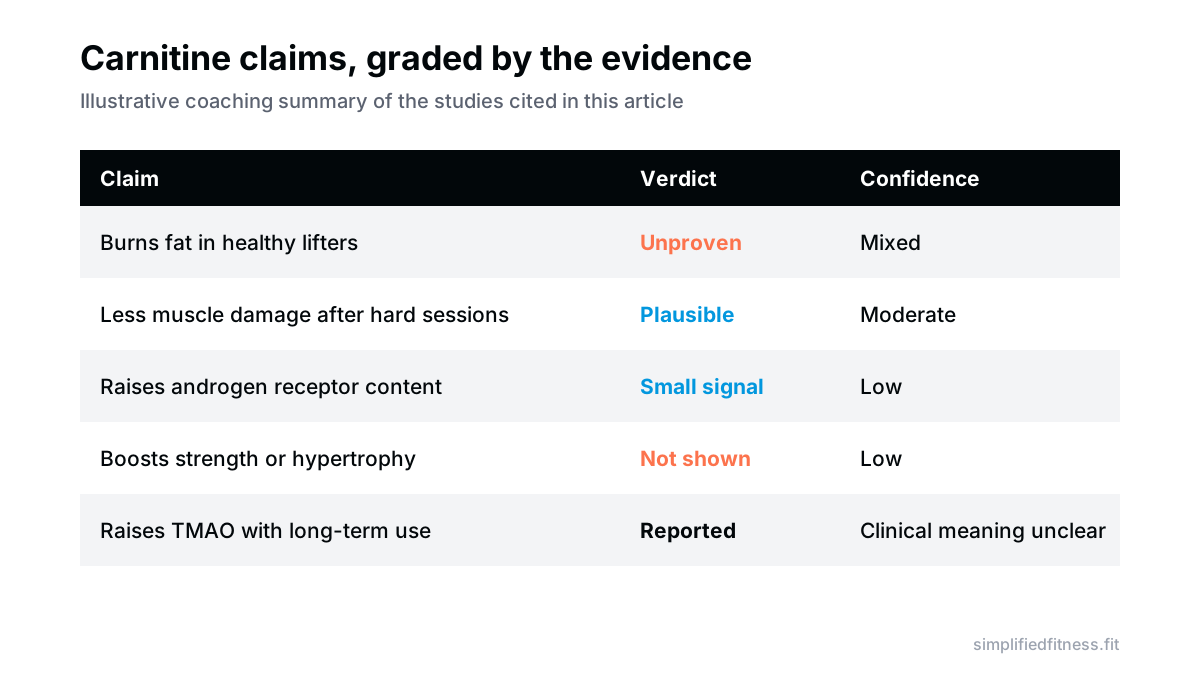
- Long-term supplementation raises TMAO, a gut-derived compound linked to cardiovascular risk, though its clinical meaning here is unproven. Heart or kidney conditions: ask your doctor first.
Part of our complete guide: Creatine, Protein Powders, Pre-Workouts and Caffeine: The Science and Safety Guide
Table of contents
The l-carnitine l-tartrate benefits that have real trial support are modest: a bit less soreness and fewer muscle damage markers after hard training. The fat-burning claim on the tub is much weaker. In healthy lifters, oral carnitine is poorly absorbed and has not been shown to change how much fat you burn during exercise.
That is the short answer. The rest of this article covers why, what the best studies actually found, and who might still want to try it. It sits inside our wider guide to creatine, protein powders and caffeine, where carnitine is a “secondary” supplement, meaning nice to have at best.
What does L-carnitine actually do in your body?
Carnitine is a shuttle. Long-chain fatty acids cannot cross into the mitochondria (the part of your muscle cell that burns fuel) on their own, so carnitine, working with an enzyme called CPT-1, carries them across. That is where the “fat burner” story comes from: more carnitine, more fat moved in, more fat burned.
It sounds neat, but your muscle is not short of carnitine to begin with. Your body makes it and you get some from food, and the pool inside healthy muscle is tightly regulated. Adding more at the gate does not automatically speed up the traffic, because the speed of fat burning is driven mostly by how much energy you demand, your diet and your hormones. Opening extra toll booths does not help when the road is not jammed.
Is oral L-carnitine even absorbed?
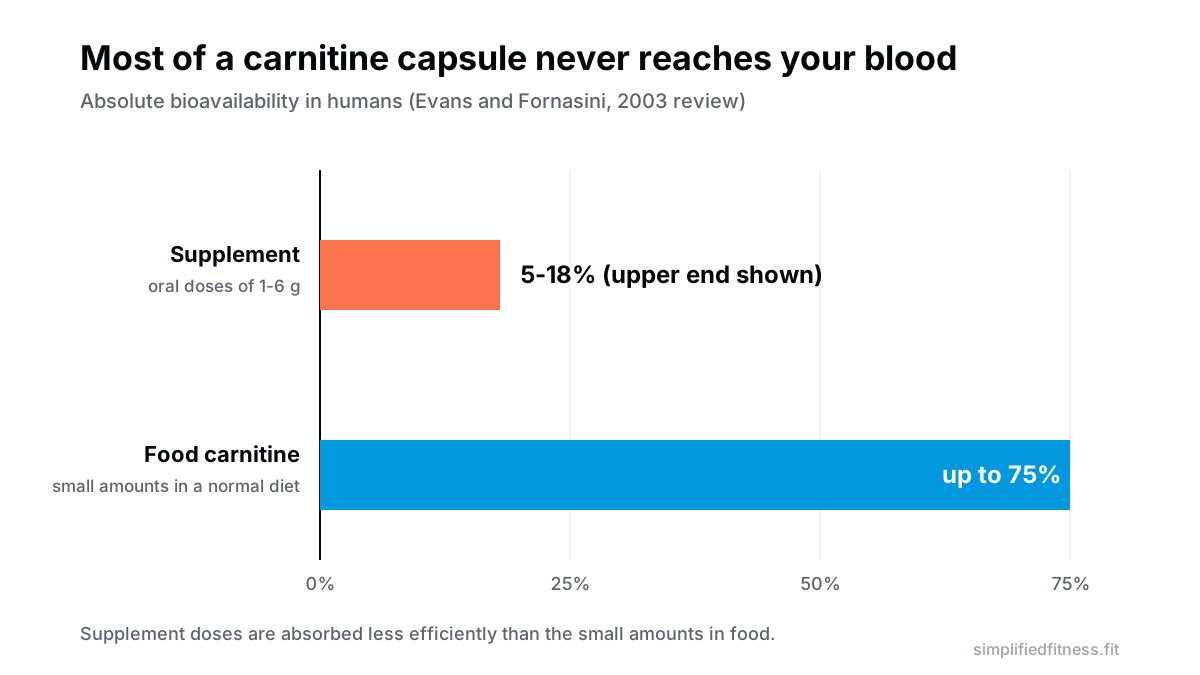
Not very well. A pharmacokinetic review reports that after oral doses of 1 to 6 g, absolute bioavailability is only about 5 to 18%, whereas carnitine from ordinary food can be absorbed at up to around 75% (Evans et al., 2003). Supplement doses are absorbed less efficiently than the smaller amounts in a meal.
The same review notes that the kidneys reabsorb about 98 to 99% of filtered carnitine under baseline conditions, so the body defends its pool carefully. Once blood levels rise above normal, that reabsorption drops off, so more of any extra carnitine you absorb ends up in urine.
Does L-carnitine burn fat? What the research shows
Here the evidence is mixed, so let’s give both sides fairly.
The positive signal. A 2016 meta-analysis of 9 randomized trials (911 adults) found that people taking carnitine lost about 1.33 kg more weight than controls, with a small BMI drop. But the authors also found the weight-loss effect decreased with longer duration of use (Pooyandjoo et al., 2016). The abstract does not tell us that these participants were healthy, trained lifters, so I would not stretch this result to gym-goers.
The negative signal in athletes. In a double-blind crossover trial, 15 trained men took 3 g of LCLT or placebo for 4 weeks. Fat and carbohydrate oxidation during 90 minutes of cycling did not differ, and the authors concluded LCLT had no effect on substrate use or endurance performance (Broad et al., 2005). It is a small study, but it tested the actual mechanism directly.
Why they may differ. The meta-analysis pooled broader adult populations, and about 1.3 kg across trials is small compared with what a calorie deficit delivers. The athlete trial measured fat oxidation, which is not the same as fat lost on the scale. My cautious read: carnitine may nudge weight slightly in some people, but there is no solid evidence it makes a lean, trained lifter burn more fat.
Why do studies say you need carbs with carnitine?
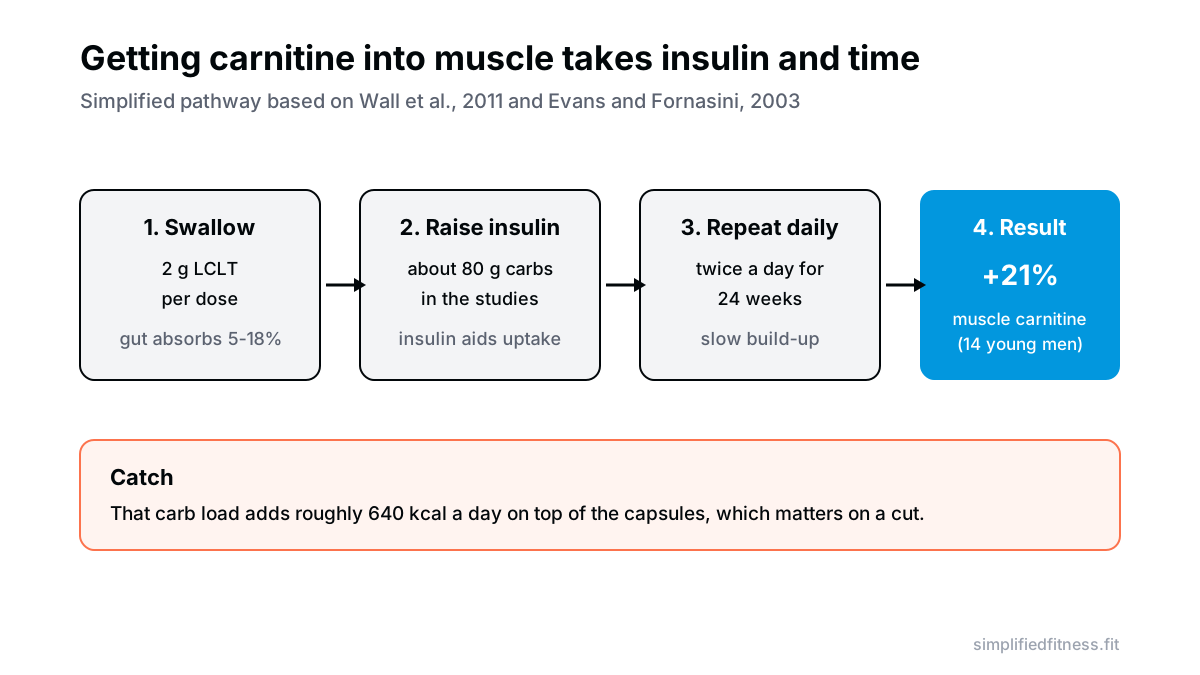
This is the detail most product labels skip. In the trial that did raise muscle carnitine, 14 healthy young men took 2 g of LCLT plus 80 g of carbohydrate twice daily for 24 weeks, while the control group took the carbohydrate alone. Muscle total carnitine rose by about 21% in the carnitine group and did not change in controls. The carnitine group also used less muscle glycogen at moderate intensity, and raised work output in a performance trial by 11% from baseline, while controls did not change (Wall et al., 2011).
The abstract notes that all significant effects appeared only after 24 weeks. Not 3 weeks, not 5 weeks. It was also 14 men, so treat it as promising rather than settled.
The practical problem is obvious: 160 g of carbohydrate a day on top of your meals is roughly 640 kcal of extra carbohydrate. That might suit a hard-gainer in a bulk and wreck a cut.
Does L-carnitine help post-workout recovery?
This is where LCLT looks best, though the studies are small and at least one was industry-funded.
In a crossover study, 10 recreationally trained men took 2 g of LCLT daily for 3 weeks and did a heavy squat protocol (5 sets of 15-20 reps). Over recovery, LCLT reduced muscle tissue damage assessed by MRI scans of the thigh. The hormone concentrations barely changed, apart from higher IGFBP-3 (Kraemer et al., 2003).
A larger, longer trial recruited 80 adults aged 21-65 for 5 weeks. Compared with placebo, the LCLT group reported better perceived recovery and less soreness, and had lower serum creatine kinase. Strength and power dropped less after a high-volume exercise challenge, and results did not depend on age or sex (Stefan et al., 2021). The paper states the study was funded by a company that makes the ingredient, which is worth keeping in mind.
So the signal points the same way but is small, and it rests on a handful of studies. If you are a lifter who gets wrecked by high-volume leg days, it is a plausible extra. If your sleep is five hours and your protein is low, fix those first. Our free protein calculator is a better first step than any capsule.
What about androgen receptor density?
This claim gets inflated online, so here is exactly what was found. In 10 resistance-trained men taking LCLT (equivalent to 2 g of carnitine a day) for 21 days, pre-exercise androgen receptor (AR) content in muscle biopsies was higher than on placebo (12.9 vs 11.2 arbitrary units). Post-exercise feeding also raised AR content in both conditions. The authors suggest LCLT “may promote recovery” (Kraemer et al., 2006).
Note the limits. It is 10 men, a mechanism measure from biopsies, and not a measure of muscle size or strength. Nobody has shown from this that extra AR content translates into extra muscle. Useful hypothesis, not a muscle-building result.
What about TMAO and heart risk?
Gut bacteria convert some carnitine into trimethylamine, which the liver turns into TMAO. A 2020 systematic review of 11 studies in healthy people taking carnitine orally for 12-24 weeks (1-4 g a day) found that supplementation raised fasting plasma TMAO. The review calls TMAO a compound “supposed to be pro-atherogenic,” but found no change in the inflammatory or oxidative markers they checked. They concluded that long-term cardiovascular effects need more study (Sawicka et al., 2020).
So: a signal worth knowing about, not proof of harm. If you have heart disease, high cholesterol, kidney problems, or a family history of early heart disease, discuss it with your doctor before starting. This is also another reason not to take it indefinitely “just in case.”
Oral vs injection, and LCLT vs ALCAR
Injection. Intravenous carnitine skips the gut, so the 5 to 18% absorption problem disappears. But it is a clinical treatment, used for carnitine deficiency disorders and some dialysis patients according to the pharmacokinetic review above. I am not aware of trials showing that injections improve gym results in healthy people, and unregulated injectables are a bad idea.
LCLT vs acetyl-L-carnitine (ALCAR). LCLT is the form used in the exercise recovery studies above. ALCAR is typically marketed for focus and brain health, a topic I have not reviewed here. For recovery, pick LCLT. For a deeper look at forms and what is in a fat-burner tub, see our article on fat burner ingredients.
Should vegetarians and Indian lifters take it?
Meat is the main dietary source of carnitine, so people assume vegetarians, which includes a large share of Indian lifters, would benefit more. The evidence is not that simple. A study of 41 young adults found vegetarians had lower muscle carnitine and lower expression of the muscle carnitine transporter than non-vegetarians, and infused carnitine did not raise their muscle stores (Stephens et al., 2011). I would not assume a vegetarian diet means you need a supplement.
Cost matters too. Carnitine tubs are not cheap, and the carbohydrate-loading protocol adds a lot of calories. For most Indian budgets, a daily protein source like dal, paneer, curd, eggs or soya chunks plus a consistent training plan will outperform any carnitine purchase. If you do want to experiment, try it only after your basics are solid.
A sensible way to try LCLT (or skip it)
- Skip it if your sleep, protein and training are still sloppy. Those give far bigger returns. See our evidence-based supplement guide and the supplement hierarchy for where it ranks.
- If you try it: the recovery studies used about 2 g of LCLT a day (one used LCLT supplying 2 g of carnitine) for 3 to 5 weeks. Read the label, because the tartrate salt is not 100% carnitine.
- Judge it honestly: track soreness and performance in your next high-volume block, compared with the last one. If you cannot tell the difference after five weeks, stop buying it.
- Do not expect fat loss, or a testosterone-like effect.
- Check first with a doctor if you have heart or kidney conditions, or are pregnant or breastfeeding.
The bottom line
LCLT is not a fat burner and it is not a hormone booster. The best-supported use is as a minor recovery aid after hard training, at about 2 g of LCLT a day for several weeks. Absorption is low, muscle uptake appears to need a lot of carbohydrate and a long time, and long-term use raises TMAO in ways we do not yet understand.
If you want one small, evidence-backed supplement first, creatine has far stronger data. Carnitine can wait.
Frequently Asked Questions
What are the benefits of L-carnitine L-tartrate?
The best-supported benefit is a modest reduction in soreness and muscle damage markers after hard training. Small randomized trials using about 2 g of LCLT a day for 3 to 5 weeks found less MRI-visible muscle damage, lower creatine kinase and better perceived recovery than placebo. If you try it, treat it as a minor recovery extra and judge it by how you feel over about five weeks.
Does L-carnitine burn fat?
Not reliably in healthy lifters. A meta-analysis of 9 trials found about 1.33 kg more weight loss than control, but the effect shrank with longer use, and two trials in trained men found no change in fat oxidation during exercise. Fat loss still comes from a calorie deficit, protein and training, so spend the money on food first.
How much L-carnitine L-tartrate should I take?
The trials cited here used 2 to 3 g of LCLT a day, which supplies roughly 1.4 to 2 g of L-carnitine. That range is behind the recovery results, and no evidence shows that more helps. Check your label, because the tartrate form is only about two thirds carnitine by weight.
Is L-carnitine L-tartrate better than acetyl-L-carnitine?
They have been studied for different goals, so neither is simply better. LCLT is the form used in exercise recovery trials, while acetyl-L-carnitine is mostly discussed for brain and nerve outcomes, where I have not covered the evidence here. For gym recovery, LCLT is the one with trial data.
Does L-carnitine increase androgen receptors?
One crossover study in 10 resistance-trained men found higher pre-exercise androgen receptor content after 3 weeks of LCLT (12.9 vs 11.2 arbitrary units). The sample is tiny and the study did not show that this turned into more strength or muscle. Do not buy LCLT expecting a testosterone-style effect.
Why do you need carbs with L-carnitine?
Insulin helps muscle take up carnitine, which is why researchers paired it with carbohydrate. In the 24-week trial that raised muscle carnitine, people took it with about 80 g of carbohydrate twice daily. If you take it without a carb source, muscle uptake is likely small.
Is injectable L-carnitine better than oral?
Intravenous carnitine bypasses the gut, so absorption is not the issue, but it is a medical treatment used in carnitine deficiency and dialysis, not a gym product. I found no trial showing that injections improve lifting results in healthy people. Do not buy injectable carnitine online, and speak to a doctor if you suspect a deficiency.
Does L-carnitine help post-workout recovery?
It may help a little. In a 5-week trial of 80 adults, LCLT improved perceived recovery and soreness and lowered serum creatine kinase versus placebo, although the trial was funded by the manufacturer. Sleep, protein and total training load will matter far more than this.
Does L-carnitine build muscle or strength?
There is no good evidence that it does in healthy trained people. The recovery studies reduced damage markers, but a 24-week trial in healthy older women found no change in muscle strength. Spend your effort on progressive overload and enough protein.
What is TMAO and should I worry about L-carnitine?
TMAO is a compound produced when gut bacteria break down carnitine and choline. A systematic review reported that long-term carnitine supplementation raised fasting TMAO, which is thought to be pro-atherogenic, but no change in inflammatory markers was seen. If you have heart disease or high cardiovascular risk, talk to your doctor before taking it.
Can vegetarians benefit more from L-carnitine?
Not necessarily. Vegetarians eat little carnitine, but a study of 41 young adults found they also had lower muscle carnitine and lower transporter expression, and infused carnitine did not raise their muscle stores. I would not assume a vegetarian diet makes a supplement worthwhile.
Are there side effects of L-carnitine?
Long-term use raises TMAO as above, and evidence on other side effects in healthy lifters is limited, so I cannot give you a clean list. Stop and see a doctor if you get persistent symptoms, and avoid it if you are pregnant or have kidney disease unless a doctor agrees.
Sources & References
Every claim above is checked against peer-reviewed research (PubMed, U.S. National Library of Medicine) or guidance from established health bodies. How we fact-check.
- Stephens FB, et al. Vegetarians have a reduced skeletal muscle carnitine transport capacity. Am J Clin Nutr. 2011. PMID: 21753065
- Evans AM, et al. Pharmacokinetics of L-carnitine. Clin Pharmacokinet. 2003. PMID: 12908852
- Kraemer WJ, et al. Androgenic responses to resistance exercise: effects of feeding and L-carnitine. Med Sci Sports Exerc. 2006. PMID: 16826026
- Kraemer WJ, et al. The effects of L-carnitine L-tartrate supplementation on hormonal responses to resistance exercise and recovery. J Strength Cond Res. 2003. PMID: 12930169
- Pooyandjoo M, et al. The effect of (L-)carnitine on weight loss in adults: a systematic review and meta-analysis of randomized controlled trials. Obes Rev. 2016. PMID: 27335245
- Stefan M, et al. L-Carnitine Tartrate Supplementation for 5 Weeks Improves Exercise Recovery in Men and Women: A Randomized, Double-Blind, Placebo-Controlled Trial. Nutrients. 2021. PMID: 34684429
- Wall BT, et al. Chronic oral ingestion of L-carnitine and carbohydrate increases muscle carnitine content and alters muscle fuel metabolism during exercise in humans. J Physiol. 2011. PMID: 21224234
- Broad EM, et al. Effects of four weeks L-carnitine L-tartrate ingestion on substrate utilization during prolonged exercise. Int J Sport Nutr Exerc Metab. 2005. PMID: 16521850
- Sawicka AK, et al. The bright and the dark sides of L-carnitine supplementation: a systematic review. J Int Soc Sports Nutr. 2020. PMID: 32958033

Umair Hazrami · Founder & Head Coach, Simplified Fitness
Umair Hazrami founded Simplified Fitness and the Simplified Lifter channel to cut through fitness noise. With 4+ years of consistent training and 10+ coaching clients, he writes every guide from the peer-reviewed research and links the sources so you can check them. Our editorial standards.
Educational content only, not medical advice. If you have a medical condition, are pregnant, or take medication, talk to a qualified doctor before changing your diet, supplements or training. Full disclaimer.
Keep reading
Supplements
Alpha-GPC and Huperzine A Pre-Workout: Do Cholinergic Nootropics Help Lifting?
Does an alpha GPC pre workout add power or focus? See what small trials found, why Huperzine A is a poor lifting bet, and the safety flags to know first.
10 min read

Supplements
The Antioxidant Paradox: Can Vitamin C and E Pills Blunt Muscle Growth and Endurance?
Does vitamin C blunt muscle growth? See what trials of 1000 mg vitamin C plus E found for strength, hypertrophy and endurance, and when pills are worth taking.
8 min read

Supplements
Caffeine Powder vs Coffee Before Lifting: Does the Source Really Matter?
Caffeine anhydrous vs coffee for lifting: what research says on absorption speed, peak levels and stomach upset, and whether pills beat your daily cup.
7 min read

Supplements
Caffeine Dosing for Strength and Power: 3-6 mg/kg and When to Take It
Caffeine dosage for strength is 3-6 mg/kg, about 210-420 mg for a 70 kg lifter, taken around 60 minutes before training. Doses, timing and when to stop.
8 min read