Indian High-Protein Nutrition Guide: Cutting and Muscle Building on Vegetarian and Non-Veg Diets
A high protein Indian diet is doable on a budget. See how much protein you need, the best desi sources, soya myths, and cutting plans, with every study linked.
TL;DR. The short answer
- Most lifters do well on about 1.6-2.2 g of protein per kg of body weight a day. For a 70 kg person that is roughly 110-155 g, and the research gains flatten out around 1.6 g/kg in most trials.
- A high protein Indian diet works on vegetarian and non-veg plates. The trick is picking dense sources (soya chunks, paneer, curd, eggs, chicken, dal) and watching the oil, ghee and rice that quietly carry the calories.
- Soya chunks do not lower testosterone or feminise men at normal food intakes. A 2021 meta-analysis of 41 clinical studies found no effect on testosterone, estradiol or SHBG.
- Dal is a useful protein side, not a main protein source. A katori gives a modest amount for its calories, so it needs backup from paneer, curd, soya, eggs or whey.
- When cutting, protein needs go up, not down. A systematic review in lean, trained athletes suggests 2.3-3.1 g per kg of lean mass, scaled up with leanness and the size of the deficit.
Table of contents
A high protein Indian diet is completely realistic, on a vegetarian plate or a non-veg one, and it does not need a big budget. Most lifters do well on about 1.6-2.2 g of protein per kg of body weight a day. The hard part is not the number. It is that a typical thali is built around rice, roti and oil, so protein has to be planned, not hoped for.
This guide is the map. We cover how much protein you actually need, which desi sources are worth your rupee, what the research says about soya chunks, how paneer compares with chicken, and how to run a cut or a lean bulk on Indian food. Where a topic deserves its own deep dive, you will find a link. If you want the general science first, start with our complete protein guide for hypertrophy.
Why Indian lifters struggle to hit protein targets
Plates built around grains tend to run short on protein. A 2025 analysis of the ICMR-INDIAB survey, covering 18,090 Indian adults, described typical Indian diets as high in low-quality carbohydrates (white rice, milled whole grains and added sugar) and saturated fat, with low protein intake (Anjana et al., 2025). In the same data, modelled swaps of carbohydrate calories for plant, dairy, egg or fish protein were associated with lower odds of type 2 diabetes and prediabetes. That is observational modelling, not a trial, but it points the same way as gym advice.
Vegetarians face a second layer. In the Indian Migration Study (6,555 adults), vegetarians ate about 6.4 g/day less protein than non-vegetarians, though the authors concluded vegetarian diets were still adequate against recommended allowances for the general population (Shridhar et al., 2014). Allowances for the general population are not lifting targets, though. If you train hard, you need more than a sedentary adult does.
Our deeper take on this is in the traditional Indian diet protein gap.
How much protein do you need on a high protein Indian diet?
Start with research ranges, then translate to grams.
A meta-analysis of 49 trials with 1,863 participants found that protein supplementation during resistance training modestly increased strength and lean mass, and that adding protein beyond a total intake of about 1.62 g/kg/day produced no further lean mass gains (Morton et al., 2018). The ISSN position stand says 1.4-2.0 g/kg/day is sufficient for most exercising people, with higher intakes sometimes useful during calorie restriction (Jager et al., 2017).
Many coaches round up to 2.0-2.2 g/kg. That is a sensible safety margin, not a magic threshold.
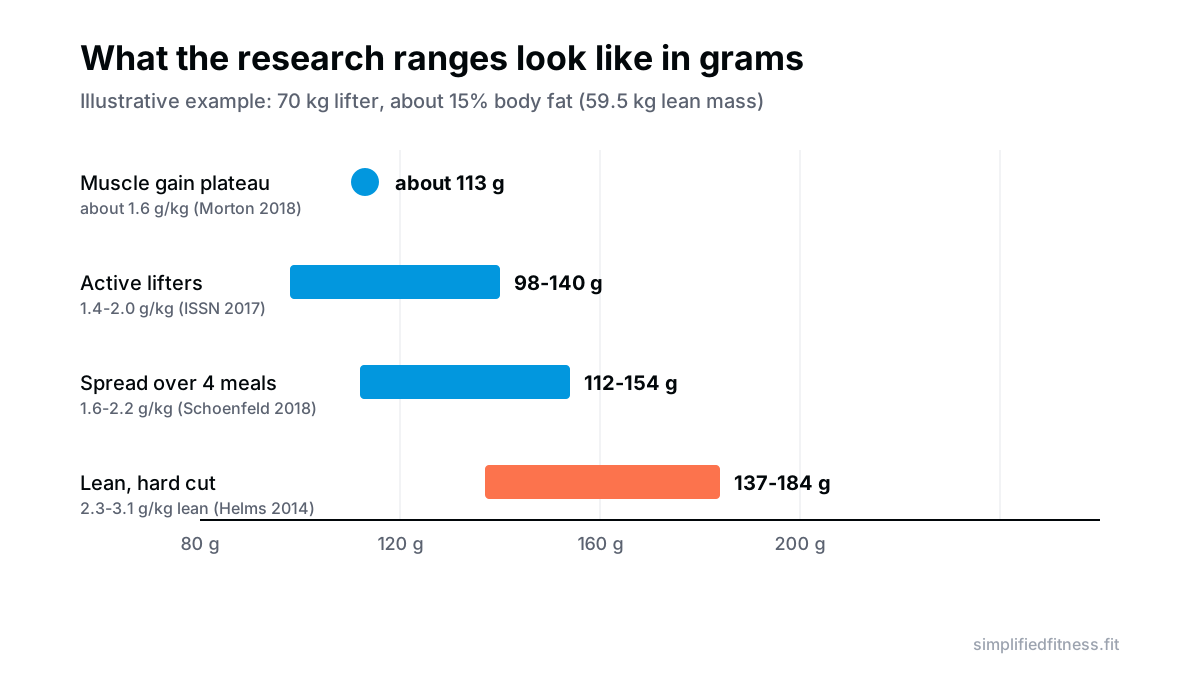
Use our protein calculator for your own number. A 70 kg person aiming for 1.6-2.2 g/kg lands on roughly 112-154 g.
How should you spread it across the day?
A review by Schoenfeld and Aragon concluded that about 0.4 g/kg per meal across at least four meals is a practical way to reach 1.6 g/kg/day, with up to 0.55 g/kg per meal if you aim for 2.2 g/kg over the same four meals (Schoenfeld and Aragon, 2018). For a 70 kg lifter, that is about 28 g per meal.
Many of us eat a light breakfast and lunch and a protein-heavy dinner. Does that matter? A short 9-day trial in 40 healthy young adults found no difference in daily muscle protein synthesis between balanced and unbalanced distributions, on either omnivorous or vegan diets (Askow et al., 2025). The trial was short, measured protein synthesis rather than muscle size, and fed only 1.1-1.2 g/kg. So distribution probably matters less than total intake, but spreading protein is easy and low-risk.
Which Indian foods give the most protein for the calories?
Protein density matters more on a cut than on a bulk. Here is a rough ranking by protein per 100 kcal. The numbers are rounded approximations for raw or dry weight, and brands vary, so read the label on your pack.
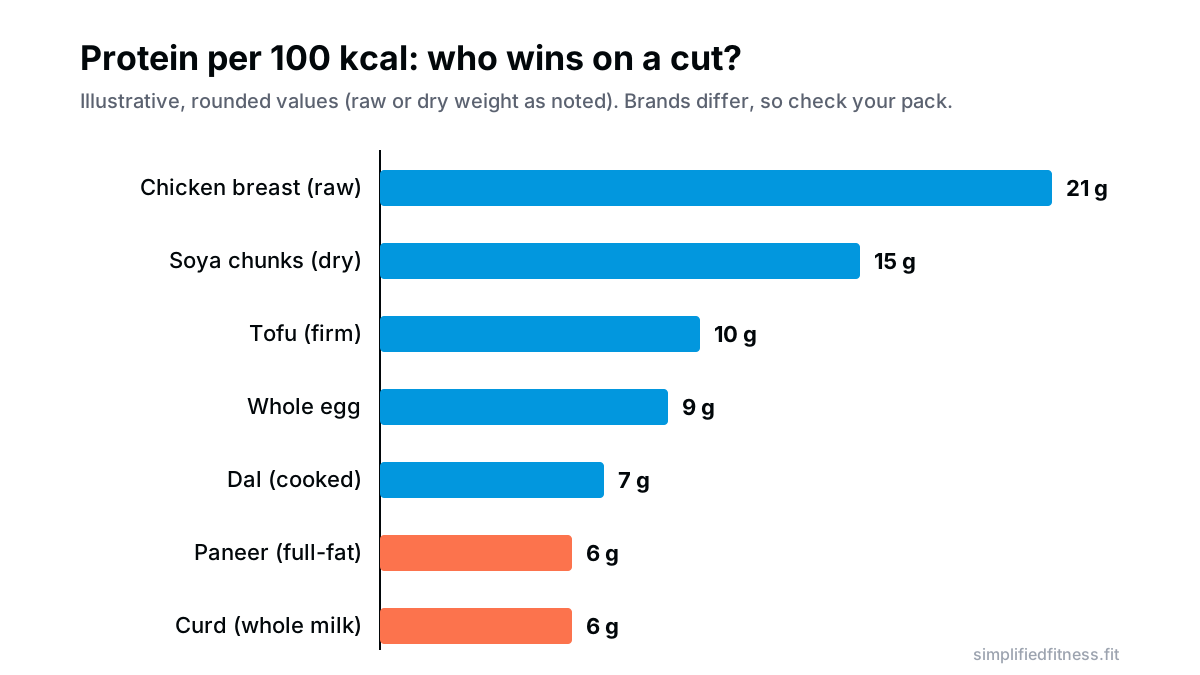
A few things jump out.
- Soya chunks are the vegetarian heavyweight on both density and cost.
- Chicken breast wins on pure protein per calorie, if it fits your diet.
- Eggs sit in the middle and are easy to cook.
- Dal, paneer and curd are good foods, but none is a protein-dense food on a per-calorie basis.
Each of these has its own guide: soya chunks, paneer, dals and pulses, curd and Greek yogurt, eggs, chicken and fish and tofu. For a bigger ranked list, see our high protein foods and meal prep guide.
Soya chunks: do they lower testosterone?
This is the single most common worry we hear about soya chunks, so let’s go to the data.
Soy contains isoflavones, plant compounds that weakly bind estrogen receptors. That is where the “feminising” claim comes from. But clinical trials measure what actually happens to hormones. A 2021 meta-analysis pooled 41 clinical studies, with total testosterone measured in 1,753 men and estradiol in 1,000 men, and found no significant effect of soy protein or isoflavone intake on testosterone, free testosterone, estradiol, estrone or SHBG, regardless of dose or study duration (Reed et al., 2021).
A 12-week trial in 47 previously untrained college-aged men found the same pattern in lifters. Soy protein concentrate did not appreciably change markers of androgen or estrogen signalling in muscle and fat, while testosterone rose with training, more so in the whey group (Haun et al., 2018). That was untrained men, one soy product, 12 weeks, so it is not the last word.
Practical note: soya chunks are weighed dry, soaked, then squeezed. Eating 30-50 g dry as part of a varied day is common in the gym world. There is no need to make it your only protein source.
Paneer vs chicken protein
Both are good. They do different jobs.
Per 100 kcal, raw chicken breast gives roughly three times the protein of full-fat paneer (approximate values), which makes chicken the easier tool on a cut. Paneer brings more fat, which is more filling for some people and a calorie trap for others. If you are vegetarian, the trick is measuring paneer on a food scale and pairing it with leaner sources like curd, soya and dal. Our paneer vs low-fat paneer guide goes through homemade chenna and portioning.
The dal reality check
Dal is nutritious and cheap. It is also not a high protein food.
Cooked dal has roughly 5-8 g of protein per 100 g depending on thickness, with a good chunk of carbohydrate alongside. A typical katori delivers a modest amount, depending on how thick you make it. So dal works well as a supporting actor, but if you rely on it for protein, you will be eating a lot of it.
There is also a quality angle. A 2015 review notes that plant proteins generally have lower digestibility and lower leucine content than animal proteins, and that eating larger amounts or mixing multiple sources are strategies to compensate (van Vliet et al., 2015). A 2025 review adds that for incomplete plant proteins, consuming complementary proteins may help, and that diets high in whole plant proteins may need more total protein and energy to make up for lower quality (Matthews et al., 2025). Both are reviews, so treat the details as directional, not exact.
In plain terms: rice and dal, roti and dal, and curd with a dal meal are not just tradition. They are a sensible mix.
Can you build muscle on a vegetarian Indian diet?
Yes. The evidence in humans is encouraging, with sensible caveats.
A meta-analysis of nine long-term training studies (266 participants) found that soy protein and whey (or other animal proteins) both increased strength and lean mass, with no significant difference between them (Messina et al., 2018). Acute studies often favour whey because of its leucine content, but over 6 weeks or more the gap did not show up.
A 2025 randomized trial found that muscle protein synthesis was similar across vegan and omnivorous dietary patterns in young adults (Askow et al., 2025). Again, it was 9 days, healthy young people, and a protein synthesis outcome.
So what is the honest takeaway? If total protein is high enough and training is hard, a vegetarian diet does not appear to block muscle growth. If protein is low, it will. Lacto-vegetarian diets also have dairy, which helps. Our vegetarian meal prep blueprint shows how to put this on a week’s menu, and our lean bulking plan for vegetarians covers the surplus side.
What about eggs and cholesterol?
If you are eggetarian or non-veg, eggs are the easiest protein hit in India.
A 2020 BMJ study pooled three large US cohorts (about 215,000 people at baseline across NHS, NHS II and HPFS) and found that eating at least one egg a day was not associated with cardiovascular disease risk after adjusting for lifestyle and diet. The paired meta-analysis concluded that up to one egg a day is not associated with cardiovascular risk overall, and potentially lower risk in Asian populations (Drouin-Chartier et al., 2020). These are observational data, and eating habits that go with high egg intake can muddy things.
Practical: the best data cover up to about one egg a day, which fits most healthy lifters. Many lifters eat two or three, but there is less evidence at those intakes, so keep an eye on your blood lipids. If you have high LDL cholesterol, diabetes or heart disease in the family, talk to your doctor about your own limit. More in our eggs in the Indian diet guide.
Fat loss and cutting on Indian food
Cutting is where protein planning pays off most.
A systematic review of six studies in energy-restricted, resistance-trained, lean athletes concluded that protein needs are likely 2.3-3.1 g/kg of lean mass, scaled upwards with severity of calorie restriction and leanness (Helms et al., 2014). It is a small evidence base in lean, trained people, so it does not automatically apply to someone with a lot of fat to lose. A beginner at 28% body fat does not need to chase 3 g/kg. The upper end is for lean, advanced lifters in a hard deficit.
For most people, a moderate deficit with 1.8-2.2 g/kg of body weight is a safe, practical target. Our guide on energy balance for fat loss, bulking and recomposition covers calories, and our macro calculator can set your starting numbers.
Hidden calories: the real enemy on Indian plates
You rarely overshoot a cut because of dal or chicken. You overshoot because of the oil, ghee, butter and cream in the pan. A tablespoon of oil is a large energy load in a small spoon, and a tadka or restaurant gravy can carry several of them. Our guide on hidden calorie traps in Indian cooking shows where to measure.
An example cutting day (about 1,800 kcal)
Here is a vegetarian layout with about 148 g of protein. It uses five protein anchors and measured oil. It is an illustrative sketch with rounded estimates, so adjust with a food scale and the labels on your products.
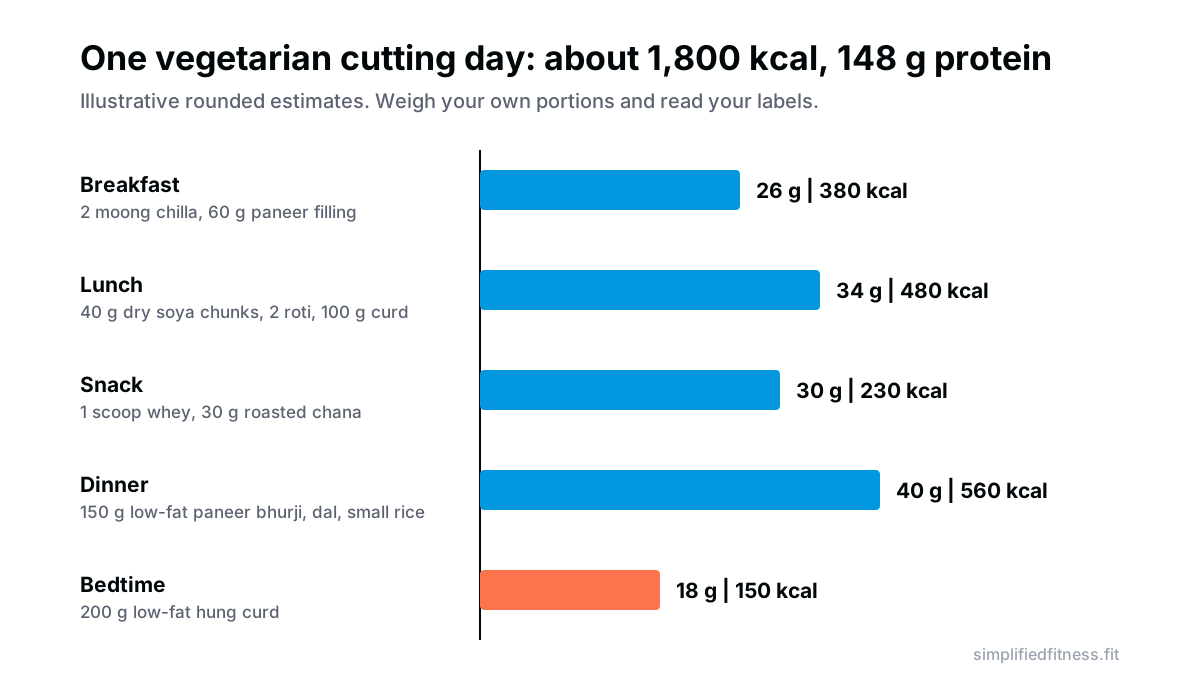
| Meal | Anchor | Approx. protein | Approx. kcal |
|---|---|---|---|
| Breakfast | Moong chilla with paneer | 26 g | 380 |
| Lunch | Soya chunks, roti, curd | 34 g | 480 |
| Snack | Whey, roasted chana | 30 g | 230 |
| Dinner | Low-fat paneer bhurji (150 g), dal, small rice | 40 g | 560 |
| Bedtime | Low-fat hung curd (200 g) | 18 g | 150 |
If you eat meat, swap the paneer dinner for grilled chicken or fish and keep the rest. Full day-by-day versions live in our vegetarian 1,800 kcal cutting diet and non-vegetarian 1,800 kcal plan. Want a template to start from? Our free diet plan page has one.
High protein Indian breakfasts, snacks and sattu
Breakfast is where most Indian days go wrong, because the default is paratha, poha or upma with little protein. Swap in chilla, egg bhurji, paneer wraps or a curd-based bowl. Recipes are in high protein Indian breakfasts, and for between meals, high protein Indian snacks covers roasted chana, makhana and soya options.
Sattu gets called “desi whey” a lot. It is a roasted gram flour with useful protein and plenty of carbs, but it is not a protein powder equivalent, as we explain in sattu: desi whey myth or reality.
Budget: can you do it on Rs 100-200 a day?
Often yes, if you lean on the cheapest dense sources. Soya chunks, dal, milk, curd and eggs generally cost far less per gram of protein than paneer, chicken in many cities, or branded supplements. Prices vary by city and season, so treat any rupee figure as a rough guide and check your local rates.
A budget-friendly rotation looks like this:
- Soya chunks or dal at two meals
- Eggs or curd as the cheap daily top-up
- Milk as a convenient add-on
- Paneer or chicken as the occasional upgrade
- Whey only if it fits and you need the gap filled
We walk through the arithmetic in the budget Indian diet guide.
Dining out, festivals and family
Real life breaks plans. A few rules help.
Eating out. Choose tandoori or grilled items, dal, and plain curd. Creamy gravies and fried starters carry the fat. Order protein first, then add rice or roti to fit. The detail is in dining out in India.
Fasting days. Grains and legumes may be off the menu, so lean on milk, curd, paneer and makhana where your fast allows. See protein during Navratri.
Family doubts. If home is sceptical about protein powder, our guide to convincing Indian parents about whey walks through the safety questions.
Who should be careful
Higher protein is well studied in healthy adults: a 2018 meta-analysis of 28 randomised trials in people without kidney disease found no adverse effect on kidney filtration (Devries et al., 2018). But those trials were mostly short, and the finding does not cover everyone. Check with a doctor or registered dietitian if you:
- have kidney disease or reduced kidney function
- have diabetes, high cholesterol or heart disease and plan to change your diet significantly
- are pregnant, breastfeeding or under 18
- have a thyroid condition or take medication that interacts with diet
- are vegetarian and have never had your vitamin B12 checked. The Indian Migration Study found vegetarians had lower B12 intake, and the authors flagged it as an ongoing concern (Shridhar et al., 2014)
The simple plan
- Get your protein target from the protein calculator. Aim for 1.6-2.2 g/kg.
- Split it across 4 or more meals, about 0.4 g/kg each.
- Pick 3-4 anchors you will actually eat (soya, paneer, curd, dal, eggs, chicken).
- Measure oil, ghee and rice. They are where the calories hide.
- Train hard with a plan. Start with our push, pull and leg day plans and track strength.
- Review every 2-4 weeks and adjust.
The bottom line
A high protein Indian diet does not need imported foods, expensive powders or a total rebuild of your plate. It needs a number, a handful of reliable anchors and a measuring spoon for oil. The evidence says 1.6-2.2 g/kg is enough for most people, soya chunks are not a testosterone threat in normal food amounts, and vegetarian diets can support muscle when protein is matched.
What it does not do is replace training or sleep. Food gives your muscles the material. The lifting tells them to use it.
Go deeper: every guide in this topic
- Budget Indian Diet for 120g Protein Under ₹100 a Day (Student Plan)
- Chicken Breast and Fish in India: Where to Buy, How to Cook, and Cost per 30 g Protein
- How to Convince Indian Parents About Whey Protein: Kidney Fears, 'Chemicals' and the Real Evidence
- Curd vs Greek Yogurt vs Hung Curd: Protein Yield and the Home Recipe
- Is Dal a Good Source of Protein? Moong, Chana and Rajma Reality Check
- Dining Out in India on a Diet: Tandoori Chicken, Paneer Tikka, and Ordering Hacks
- Eggs in the Indian Diet: Whole Eggs vs Egg Whites, Cost per Gram, and Cholesterol Facts
- Hidden Calorie Traps in Indian Cooking: Mustard Oil, Ghee, Tadka, and Creamy Gravies
- High-Protein Indian Breakfasts: Besan/Moong Chilla, Paneer Paratha Hacks, and Egg Scrambles
- High-Protein Indian Snacks: Makhana, Roasted Chana, Soya Chunks and Boiled Eggs Ranked
- High-Protein Indian Vegetarian Meal Prep: Balancing Roti, Rice, Paneer, and Soya Chunks
- Indian Non-Vegetarian Cutting Diet: Structuring 1,800 Calories Around Chicken, Eggs, and Whey
- Indian Vegetarian Cutting Diet: How to Hit 130-150g Protein on 1,800 Calories Without Meat
- Indian Vegetarian Lean Bulking Diet: 2,500+ Clean Calories with Whole Grains, Dairy, and Soya
- Navratri and Religious Fasting: How to Keep Your Protein Up and Hold Onto Muscle
- Paneer vs Low-Fat Paneer (Chenna): Macros, Fat Content and a High-Protein Homemade Recipe
- Sattu (Roasted Gram Flour): Nutritional Reality and the 'Desi Whey' Myth
- Soya Chunks Protein: How Much Per 100g, Is It Safe, and Does It Cause Man Boobs?
- Tofu and Edamame in Indian Cooking: Plant-Based Protein for Indian Vegans
- Traditional Indian Diet and Protein Deficiency: Why Roti, Dal and Rice Stall Muscle Growth
Frequently Asked Questions
How much protein do I need per day on an Indian diet?
Most lifters do well on 1.6-2.2 g per kg of body weight a day, so about 110-155 g for a 70 kg person. A 2018 meta-analysis found that extra protein beyond about 1.62 g/kg/day added no further lean mass in training studies. Use our protein calculator to get your number, then build meals around it.
Can I build muscle on a vegetarian Indian diet?
Yes, if total protein is high enough and you train hard. Soy protein and whey gave similar strength and lean mass gains in a meta-analysis of nine training studies, and a 2025 trial found vegan and omnivorous patterns stimulated muscle protein synthesis similarly. Plan 4 protein-anchored meals a day and include soya, paneer, curd and dal in rotation.
Is soya chunks protein a myth?
No, soya chunks are one of the densest and cheapest protein sources in India. They are dried and defatted soy, so protein is high per rupee and per calorie. Weigh them dry, soak well, and treat them as one source among several rather than your only one.
Do soya chunks lower testosterone or cause man boobs?
Current clinical evidence says no. A meta-analysis of 41 studies found no significant effect of soy protein or isoflavones on testosterone, free testosterone, estradiol, estrone or SHBG, whatever the dose or duration. Eat soya as part of a varied diet, and see a doctor if you notice breast tissue changes or other hormonal symptoms.
Paneer vs chicken protein: which is better?
Chicken breast gives far more protein per calorie, while paneer is a convenient vegetarian option that brings more fat along with its protein. Per 100 kcal, raw chicken breast gives roughly three times the protein of full-fat paneer (approximate values). If you are vegetarian, use paneer in measured portions and pair it with lower-calorie sources like curd, soya and dal.
Is dal a good source of protein?
Dal helps, but it is not protein dense. Cooked dal has roughly 5-8 g of protein per 100 g depending on how thick it is, and most of its calories come from carbohydrate, so a katori gives a modest amount. Combine it with rice or roti for a better amino acid balance, and add a denser source at the same meal.
How can I get 120 g of protein on a budget in India?
Lean on soya chunks, dal, curd, milk, eggs and whey if it fits your budget, and use paneer or chicken as the occasional premium item. Soya chunks and dal usually cost far less per gram of protein than paneer or supplements, though prices vary by city. Plan the week's shopping around your protein target, not around what looks healthy.
What is the best Indian vegetarian protein source?
There is no single winner, because each has a trade-off. Soya chunks are dense and cheap, paneer is tasty but calorie heavy, curd is easy but low in protein per serving, and dal is humble but needs support. Rotating 3 or 4 sources through the day is the practical answer.
How many eggs can I eat per day as a bodybuilder in India?
For healthy people, one egg a day was not linked to higher heart disease risk in a large 2020 analysis of three US cohorts plus a meta-analysis. Those are observational data, and the signal was neutral to possibly protective in Asian populations. If you have high LDL cholesterol, diabetes or a family history of heart disease, ask your doctor before eating many eggs daily.
Are egg whites better than whole eggs for cutting?
Egg whites give protein for very few calories, while whole eggs add fat, vitamins and satiety. On a tight cut, using 1-2 whole eggs plus extra whites is a practical middle path. Choose based on your calorie budget and how full you feel, not on fear of the yolk.
Is a high protein diet safe for my kidneys?
For healthy people, a 2018 meta-analysis of 28 randomised trials found higher-protein diets did not adversely affect kidney filtration (GFR), though most trials were short. People with kidney disease are a different case and need individual advice. If you have kidney disease, diabetes complications or a family history, speak to your doctor before raising protein.
Is Indian food too high in carbs for muscle building?
Carbs are not the enemy, but a large national survey of 18,090 Indian adults found diets heavy in low-quality carbohydrates (white rice, milled grains, sugar) and low in protein. Carbs fuel training, so you do not need to remove them. Swap some rice or roti volume for protein-dense foods and keep portions measured.
What does a high protein Indian cutting diet look like?
A typical 1,800 kcal plan with about 140-150 g protein uses 4-5 protein anchors across the day, such as paneer, soya chunks, curd, dal and optional whey or eggs. Oil, ghee and rice are measured rather than eyeballed. Our dedicated vegetarian and non-veg cutting plans give the full meal breakdown.
How much protein should I eat per meal?
A reasonable target is about 0.4 g per kg of body weight per meal across at least four meals, which is roughly 28 g for a 70 kg person. A 2018 review concluded this distribution best supports muscle building toward 1.6 g/kg/day. Total daily protein matters most, so do not stress over exact timing.
Is whey protein necessary for Indian lifters?
No, whey is a convenience, not a requirement. Food can cover your needs, but whey is a fast, low-calorie way to close a gap when paneer and chicken are not practical. Pick a third-party tested product and use it to top up your target.
Do I need to combine dal and rice for complete protein?
You do not need to combine them in the same bite, but the combination helps. Plant proteins differ in which essential amino acids they are short on, and eating a mix across the day helps cover gaps. If you eat dal, soya, curd and paneer across the day, you are already doing this.
How do I eat high protein when eating out in India?
Choose grilled or tandoori items, dal, and plain curd, and go easy on creamy gravies and fried starters. Oil and butter hide in sauces, so protein per calorie drops quickly in restaurant curries. Order the protein first, then add rice or roti to fit your calorie budget.
Can I lose fat and keep muscle on a vegetarian diet?
Yes, but protein needs to be high and the deficit moderate. A systematic review in lean trained athletes suggests that protein needs rise as calories drop, with 2.3-3.1 g/kg of lean mass as the proposed range. Keep training heavy, aim for a modest deficit, and use soya, paneer, curd and whey to hit the numbers.
Do I need vitamin B12 as a vegetarian lifter?
Vegetarians are at higher risk of low B12, and an Indian Migration Study found vegetarians had lower B12 intake than non-vegetarians. B12 supports nerves and blood cells, and muscle building does not replace it. Ask your doctor about a blood test and supplementation rather than guessing.
Does cooking affect protein quality?
It can, in both directions. A 2025 review notes that processing and cooking methods that reduce antinutrients and denature proteins improve protein quality, while prolonged storage and very high surface temperatures can reduce it. Soak and cook dal and soya properly and avoid burning your food.
How should I handle protein during Navratri or fasting days?
Protein is harder to hit when grains and legumes are off the menu. Lean on milk, curd, paneer and makhana-based options if your fast allows them. Our Navratri guide covers specific swaps.
Should I take supplements or just eat food?
Food first, supplements to fill gaps. A meta-analysis of 49 studies found protein supplementation modestly increased lean mass and strength during resistance training, with the benefit flattening above about 1.6 g/kg/day total intake. If your diet already reaches your target, extra powder is optional.
How long until I see results on a high protein Indian diet?
Strength usually improves within weeks, while visible muscle gain takes months of consistent training and enough food. Fat loss depends mainly on your calorie deficit, with protein helping keep lean mass. Track weight trends and gym performance every 2-4 weeks rather than daily.
Sources & References
Every claim above is checked against peer-reviewed research (PubMed, U.S. National Library of Medicine) or guidance from established health bodies. How we fact-check.
- Morton RW, et al. A systematic review, meta-analysis and meta-regression of the effect of protein supplementation on resistance training-induced gains in muscle mass and strength in healthy adults. Br J Sports Med. 2018. PMID: 28698222
- Helms ER, et al. A systematic review of dietary protein during caloric restriction in resistance trained lean athletes: a case for higher intakes. Int J Sport Nutr Exerc Metab. 2014. PMID: 24092765
- Jager R, et al. International Society of Sports Nutrition Position Stand: protein and exercise. J Int Soc Sports Nutr. 2017. PMID: 28642676
- Schoenfeld BJ, et al. How much protein can the body use in a single meal for muscle-building? Implications for daily protein distribution. J Int Soc Sports Nutr. 2018. PMID: 29497353
- Reed KE, et al. Neither soy nor isoflavone intake affects male reproductive hormones: An expanded and updated meta-analysis of clinical studies. Reprod Toxicol. 2021. PMID: 33383165
- Messina M, et al. No difference between the effects of supplementing with soy protein versus animal protein on gains in muscle mass and strength in response to resistance exercise. Int J Sport Nutr Exerc Metab. 2018. PMID: 29722584
- Haun CT, et al. Soy protein supplementation is not androgenic or estrogenic in college-aged men when combined with resistance exercise training. Sci Rep. 2018. PMID: 30042516
- van Vliet S, et al. The skeletal muscle anabolic response to plant- versus animal-based protein consumption. J Nutr. 2015. PMID: 26224750
- Matthews JJ, et al. Understanding dietary protein quality: digestible indispensable amino acid scores and beyond. J Nutr. 2025. PMID: 40675340
- Askow AT, et al. Impact of vegan diets on resistance exercise-mediated myofibrillar protein synthesis in healthy young males and females: a randomized controlled trial. Med Sci Sports Exerc. 2025. PMID: 40197715
- Drouin-Chartier JP, et al. Egg consumption and risk of cardiovascular disease: three large prospective US cohort studies, systematic review, and updated meta-analysis. BMJ. 2020. PMID: 32132002
- Anjana RM, et al. Dietary profiles and associated metabolic risk factors in India from the ICMR-INDIAB survey-21. Nat Med. 2025. PMID: 41028544
- Devries MC, et al. Changes in kidney function do not differ between healthy adults consuming higher- compared with lower- or normal-protein diets: a systematic review and meta-analysis. J Nutr. 2018. PMID: 30383278
- Shridhar K, et al. Nutritional profile of Indian vegetarian diets: the Indian Migration Study (IMS). Nutr J. 2014. PMID: 24899080

Umair Hazrami · Founder & Head Coach, Simplified Fitness
Umair Hazrami founded Simplified Fitness and the Simplified Lifter channel to cut through fitness noise. With 4+ years of consistent training and 10+ coaching clients, he writes every guide from the peer-reviewed research and links the sources so you can check them. Our editorial standards.
Educational content only, not medical advice. If you have a medical condition, are pregnant, or take medication, talk to a qualified doctor before changing your diet, supplements or training. Full disclaimer.
Keep reading
Indian Diet
The 3-Hour Weekly Batch Meal Prep: Cooking 5 Days of Lunches and Dinners for Busy Lifters
Batch meal prep for the week in 3 hours: a station-by-station Sunday plan for 10 high-protein lunches and dinners, with Indian options and safe storage rules.
7 min read
Indian Diet
Budget Indian Diet for 120g Protein Under ₹100 a Day (Student Plan)
A budget Indian diet for 120g protein under 100 rupees a day: soya, eggs, milk and chana, with protein per rupee maths and two student plans you can copy.
8 min read
Indian Diet
Chicken Breast and Fish in India: Where to Buy, How to Cook, and Cost per 30 g Protein
Chicken breast price per kg India: compare wet market vs apps, learn safe handling, a brine method for juicy meat, and rohu vs chicken cost per 30 g protein.
11 min read
Indian Diet
How to Convince Indian Parents About Whey Protein: Kidney Fears, 'Chemicals' and the Real Evidence
How to convince Indian parents about whey protein: explain it as paneer-water dairy, answer the kidney fear with trial data, and read the label together.
9 min read