Creatine Forms Compared: Monohydrate vs HCl vs Kre-Alkalyn vs Nitrate
Creatine monohydrate vs HCl vs Kre-Alkalyn: what head-to-head trials show, why ethyl ester flopped, and how to avoid paying extra for fancy creatine forms.
TL;DR. The short answer
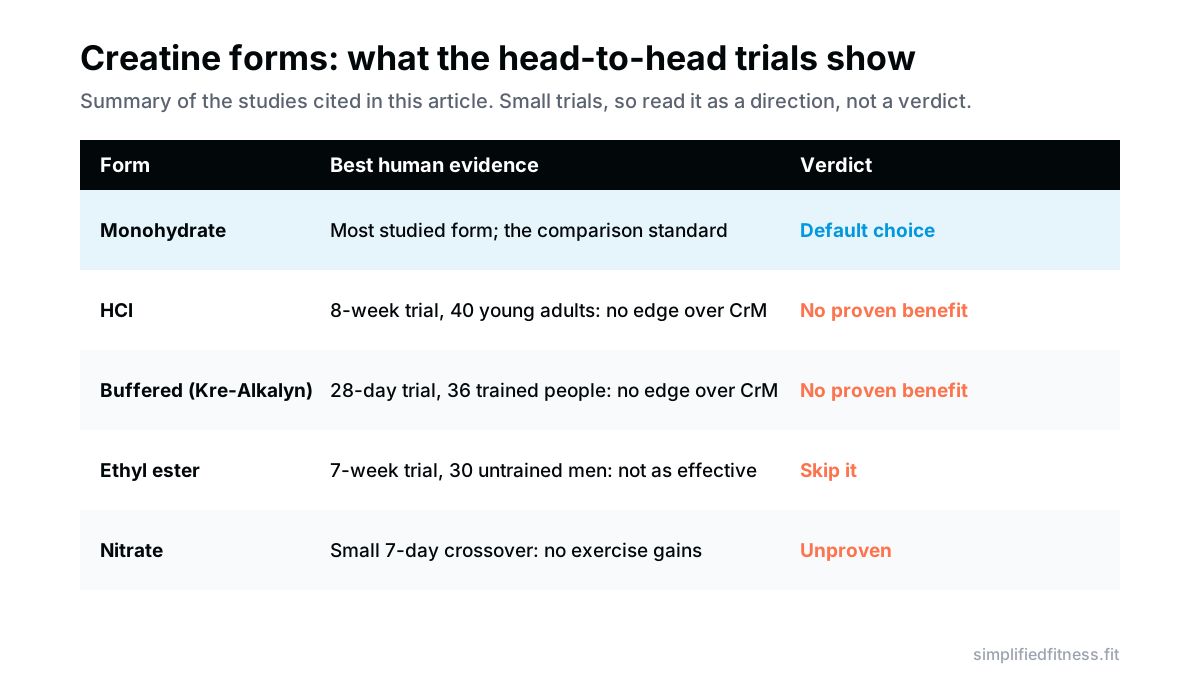
- Creatine monohydrate is still the best-supported form. In every head-to-head trial reviewed here, no other form beat it, and it is the cheapest.
- Buffered creatine (Kre-Alkalyn) did not raise muscle creatine, strength or body composition more than monohydrate in a 28-day trial of 36 trained people.
- Creatine HCl dissolves better in water, but an 8-week trial in 40 young adults found no advantage over monohydrate for strength or muscle.
- Creatine ethyl ester did worse than monohydrate at raising blood creatine in a 7-week trial and is not worth buying.
- Pick plain monohydrate with third-party testing, take 3-5 g a day, and compare price per 5 g serving, not the marketing on the tub.
Part of our complete guide: Creatine, Protein Powders, Pre-Workouts and Caffeine: The Science and Safety Guide
Table of contents
Plain creatine monohydrate is still the best form to buy. When researchers have put creatine monohydrate vs HCl vs Kre-Alkalyn (and ethyl ester) head to head, none of the fancy versions has beaten it for muscle creatine, strength or body composition, and monohydrate costs the least.
That matters because the shelf is full of tubs promising “better absorption”, “no bloating” and “no loading”. Some cost noticeably more per serving. This article sorts the marketing from the trials. For the bigger picture on creatine, protein powder and caffeine, start with our complete guide to creatine, protein powders and caffeine.
Why are there so many forms of creatine?
Creatine monohydrate is a creatine molecule bound to one water molecule. It is cheap to make, and it has decades of research behind it. That is exactly the problem for a supplement company: plain monohydrate is a commodity, so it is hard to charge a premium for it.
So brands tweak the chemistry. Attach hydrochloride, add an alkaline buffer, swap in an ethyl group or a nitrate, and you get a new name, a new claim and a new price. The new claim is usually one of three things: it dissolves better, it survives your stomach better, or it needs a smaller dose.
Fair questions. But “sounds plausible” and “works better in lifters” are different things, and only the second one builds muscle. The mechanism that makes creatine useful is the same for all of them: more creatine in muscle, more phosphocreatine to rebuild ATP between hard reps (we explain this in how creatine works at the cellular level). So the only question that counts is whether a given form gets more creatine into muscle, or gets you better training results, than monohydrate does.
What does the research say overall?
A 2022 systematic review set out to answer exactly this. It pulled in 17 randomized placebo-controlled trials on alternative forms: magnesium-creatine chelate, creatine citrate, malate, ethyl ester, nitrate and pyruvate. Only 3 of those trials compared the alternative form directly with monohydrate, and there were no consistent performance gains from alternative forms compared with placebo. The reviewers also found monohydrate to be the lowest-cost form on the market, and concluded it remains the most studied form with demonstrated efficacy, safety and the lowest cost (Fazio et al., 2022).
Read that carefully. It does not prove every other form is useless. It says the evidence for them is thin, and where it exists it does not show an advantage. That is the honest position, and it is still a long way from “worth paying extra for”.
Creatine monohydrate: the form everything else is measured against
Monohydrate is the reference standard in the research. The International Society of Sports Nutrition position stand reviewed creatine’s safety and efficacy and concluded that supplementation, including doses up to 30 g a day for up to 5 years, was safe and well tolerated in healthy individuals (Kreider et al., 2017). Almost all of that evidence is on monohydrate.
You will sometimes see “100% bioavailable” used as a selling point. Be a little careful with that line. A 2018 rat study measured the oral bioavailability of monohydrate at about 53% at a low dose and 16% at a high dose, so absorption is dose-dependent and not literally complete (Alraddadi et al., 2018). That is animal data, and two of its authors hold patents on creatine hydrochloride, so treat the conclusions with caution. In humans, the more useful fact is simpler: muscle creatine rises on monohydrate, and performance follows when you also train hard.
Is creatine HCl worth it?
Creatine hydrochloride (HCl) is creatine bound to hydrochloric acid, which makes it dissolve much more easily in water. The pitch: you can take a much smaller dose, so no bloating, no stomach upset.
Here is what the human evidence looks like.
An 8-week trial. Researchers split 40 people aged 18-25 into four groups doing resistance training: creatine HCl at 0.03 g per kg of body mass, monohydrate with a loading phase, monohydrate without loading, and placebo. All the creatine groups improved strength, muscle cross-sectional area and skeletal muscle mass more than placebo, and the authors concluded that Cr-HCl showed no benefit over monohydrate (Eghbali et al., 2024). Note that the HCl group used a similar per-kilo dose to the monohydrate maintenance group, not a “tiny” dose.
A small-dose trial in women. A randomized trial published in 2025 split 36 perimenopausal and menopausal women into four groups for 8 weeks: 750 mg or 1,500 mg a day of creatine HCl, an HCl plus ethyl ester mix, or placebo. The 1,500 mg group raised frontal brain creatine by 16.4% versus 0.9% in placebo, with better reaction time, and all treatments were well tolerated (Korovljev et al., 2026). It is an interesting result, but it had no monohydrate group, so it cannot tell you whether HCl is better than the cheap stuff. It also measured brain and cognition outcomes, not muscle.
If monohydrate gives you stomach discomfort, try 2-3 g with food, two or three times a day, before changing products. In the trial data we have, the stomach issue is linked to big single doses.
Kre-Alkalyn vs monohydrate: what did the 2012 trial find?
Kre-Alkalyn is a “buffered” creatine with an alkaline powder added. The claim: monohydrate partly turns into creatinine (a useless waste product) in your stomach acid, so you need less of the buffered version, and you get fewer side effects.
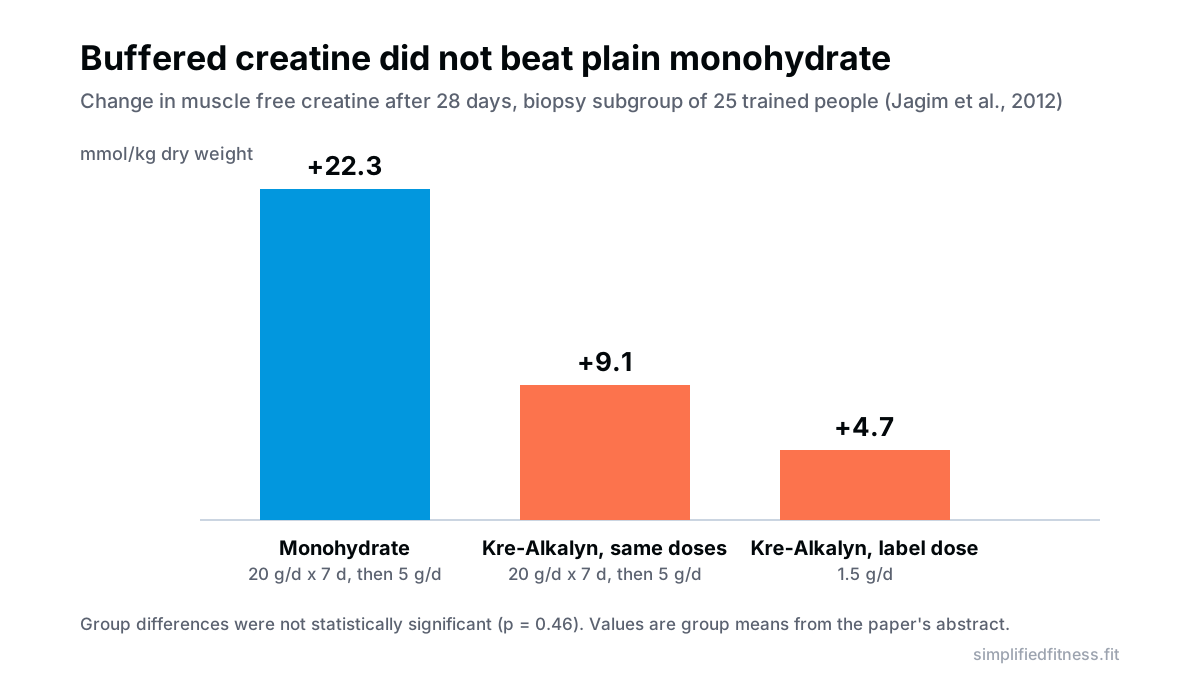
Researchers at Texas A&M tested it directly. They randomized 36 resistance-trained people to one of three setups for 28 days: monohydrate (loading 4 x 5 g a day for 7 days, then 5 g a day), Kre-Alkalyn at the label dose of 1.5 g a day, or Kre-Alkalyn at those same higher monohydrate-style doses. They took muscle biopsies and measured body composition, 1RM and Wingate sprint performance (Jagim et al., 2012).
The results:
- Muscle free creatine, measured in a biopsy subgroup of 25, rose over time with no significant differences between groups (p = 0.46). The monohydrate group’s change tended to be larger than the label-dose buffered group’s (p = 0.053).
- No significant group differences in body mass, fat-free mass, bench and leg press 1RM, or Wingate power.
- No evidence of fewer side effects than monohydrate.
The authors concluded the findings do not support claims that a buffered form is more effective or safer.
Does monohydrate really degrade in stomach acid?
This is the heart of the buffered-creatine pitch, and the evidence is less supportive than the marketing. A simulated-digestion study tested several creatine derivatives and found that all of them showed high stability with negligible formation of creatinine (Hageböck et al., 2014). That was a lab model, not live people, so it is not the last word. But it undercuts the claim that monohydrate is being destroyed on the way down.
One honest limit on the 2012 trial: 36 people over 28 days is small, and its design was not built to prove two forms are identical. Nothing in it, though, supports paying for the buffer.
Creatine ethyl ester: what happened in the trial?
Creatine ethyl ester (CEE) was marketed as a more absorbable form, as the ester was supposed to cross membranes more easily. A 2009 trial compared it directly. Thirty non-resistance-trained men took placebo, monohydrate or CEE (about 20 g a day for 5 days, then about 5 g a day for 42 days) while doing heavy resistance training.
Serum creatine was higher in the monohydrate and placebo groups than in the CEE group, and serum creatinine was higher with CEE than with either of the others. Total muscle creatine rose in both creatine groups compared with placebo, with no difference between monohydrate and CEE. Strength, power and body composition improved over time but did not differ between groups, leading the authors to conclude that CEE was not as effective as monohydrate at raising serum and muscle creatine or at improving body composition, strength and power, and that the improvements were most likely due to training (Spillane et al., 2009).
The group was untrained men and the study was small, so I would not call it the final word. But it never showed a benefit, so there is no reason to try it.
What about creatine nitrate?
Creatine nitrate is creatine bound to nitrate. The pitch is a double benefit: creatine plus nitric-oxide-style “pump”. The human evidence is sparse. In a 2024 randomized crossover trial, 12 resistance-trained men took 5 g a day of creatine nitrate for 7 days, with or without caffeine. There were no significant improvements in exercise performance (bench and leg press at 70% 1RM, Wingate). Cognitive scores improved when creatine nitrate was co-ingested with caffeine, and no adverse events were reported (Mabrey et al., 2024).
Twelve men for a week is a pilot, not a verdict. It shows nothing for performance and it is not a reason to pay extra.
Why do the forms look better on the label than in the gym?
Three reasons keep showing up.
- Chemistry is not outcomes. Better solubility or a different salt describes a property of the powder. It does not mean more creatine ends up in muscle.
- Muscle fills up anyway. Your muscles can only store so much creatine. Once they are saturated, a “better absorbed” form has nowhere extra to go. (Our loading vs daily dosing guide shows how monohydrate saturates.)
- Price needs a story. A cheap commodity needs a reason to cost more. That reason is often a mechanism, not a result.
How to buy creatine without overpaying
Skip the research rabbit hole. Run three checks.
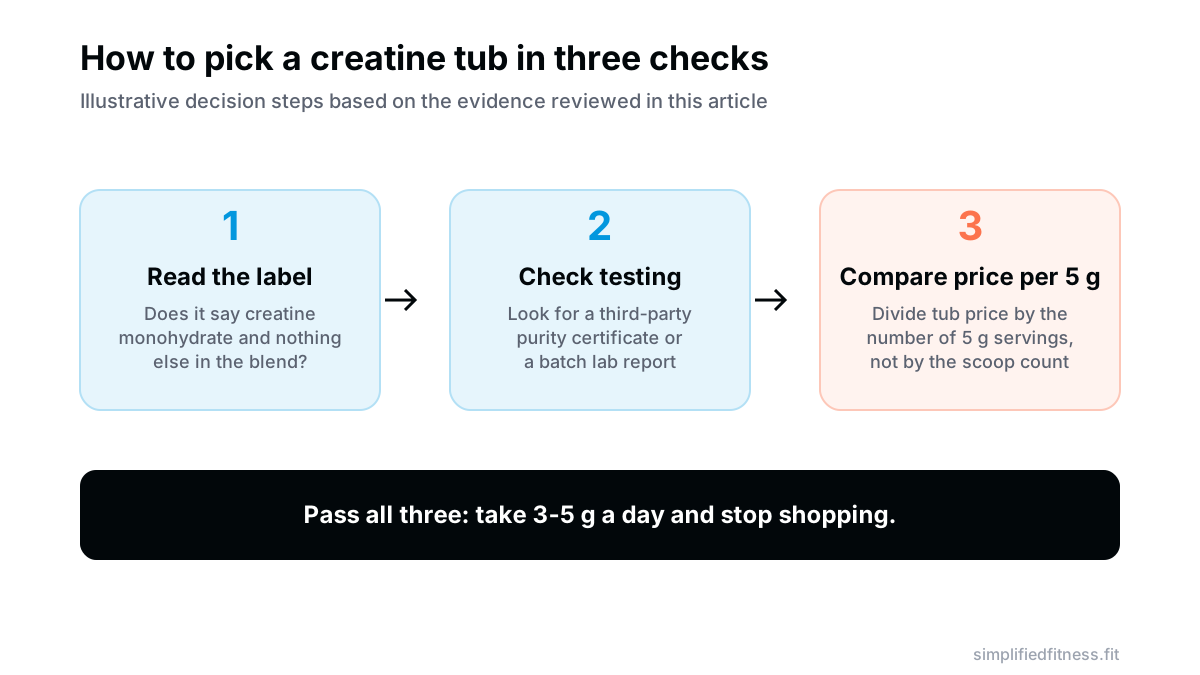
- Read the label. You want “creatine monohydrate” as the single active ingredient. Avoid tubs where creatine hides inside a proprietary blend with a vague total. We cover the trick in decoding proprietary blends.
- Check for testing. A third-party certificate or batch lab report tells you more than a pretty label. See third-party supplement certifications for what to look for. Pure monohydrate also has less to hide, so the question is mostly purity.
- Compare price per 5 g. Divide the tub price by the number of 5 g servings. A 300 g tub gives about 60 servings, but check the label, because some brands use smaller scoops. A cheap, plain tub is a perfectly good choice, and you can see how this fits a tight budget in our budget supplement guide.
In a hot Indian summer, store the tub sealed, away from the stove and out of direct sun, and keep the scoop dry. Creatine powder is stable, but damp clumps are a sign something has gone wrong.
How much should I take?
For plain monohydrate, 3-5 g a day is the usual maintenance range. Smaller lifters can use the lower end and larger ones the upper end. Our creatine dosage calculator gives a number from your body weight. A loading phase is optional, not required.
If you have kidney disease, are pregnant or breastfeeding, or take medication that affects the kidneys, talk to a doctor before starting any form of creatine. Also tell your doctor you take it before blood tests, since creatine can nudge blood creatinine up.
Bottom line
Monohydrate, HCl, buffered, ethyl ester and nitrate all contain creatine. Only monohydrate has the research, the track record and the low price. HCl and buffered versions did not outperform it in the trials that compared them, ethyl ester looked worse, and nitrate is largely unproven. The honest caveat is that most of these trials are small and short, so a surprise is possible. Until a good trial shows otherwise, plain monohydrate is the default in our supplement hierarchy, and your money is better spent on protein, food and a plan like our free training plans.
Frequently Asked Questions
What is the best form of creatine?
Creatine monohydrate is the best-supported form because it is the one used in most of the research and the one other forms are compared against. A 2022 systematic review found no consistent performance gains from alternative forms and called monohydrate the most studied, effective and cheapest option. Buy plain monohydrate and take 3-5 g a day.
Is creatine HCl better than monohydrate?
Not as far as current evidence shows. Creatine HCl dissolves more easily in water, but an 8-week trial in 40 young adults found it gave no benefit over monohydrate for strength, muscle size or hormones. Unless you truly cannot tolerate monohydrate, there is no evidence-based reason to pay more for it.
Is creatine HCl worth the extra money?
Probably not. Solubility sounds impressive, but the trial that compared HCl with monohydrate directly found HCl gave no extra benefit, and a systematic review found monohydrate is the cheapest form on the market. If monohydrate upsets your stomach, try a smaller split dose first before spending more.
Is Kre-Alkalyn better than creatine monohydrate?
No. In a 28-day trial of 36 resistance-trained people, buffered creatine at the label dose of 1.5 g a day or at 5 g a day did not raise muscle creatine, strength or body composition more than monohydrate. It also did not cause fewer side effects. A small trial is not final proof, but nothing so far supports the marketing.
Does creatine monohydrate really break down in your stomach?
The claim is overstated. Buffered-creatine marketing says monohydrate turns into useless creatinine in stomach acid, yet a simulated-digestion study found all tested creatine derivatives were highly stable with negligible creatinine formation. That is a lab model, not people, but it means the main selling point for buffered forms is weak. Monohydrate keeps working in real trials.
Is creatine ethyl ester a scam?
It is at best unproven and at worst a waste of money. In a 7-week trial of 30 untrained men, ethyl ester raised blood creatine less than monohydrate and did not improve strength or body composition beyond training alone. Choose monohydrate instead.
Does creatine nitrate work better?
There is no good evidence that it does. A small 2024 crossover trial in 12 trained men gave 5 g a day of creatine nitrate for 7 days and found no improvement in exercise performance, though cognitive scores improved when it was combined with caffeine. That is far too little data to justify the higher price.
Does creatine monohydrate have 100% bioavailability?
Be careful with that claim. A rat study found oral bioavailability of monohydrate was about 53% at a low dose and 16% at a high dose, so absorption is not literally complete. But human muscle creatine rises reliably on monohydrate, and trials of other forms have not shown they raise it more, so the practical question is what works in lifters.
Why do some brands claim their creatine is absorbed better?
Solubility and absorption are easy to market because they sound scientific. One rat study often quoted for HCl only tested monohydrate in animals and estimated HCl with a computer simulation, and two of its authors hold patents on creatine hydrochloride. Look for human trials with muscle creatine or performance outcomes, not solubility charts.
Can creatine monohydrate cause stomach problems, and is HCl gentler?
In the trial data, stomach upset is linked to large single doses: 10 g in one serving caused more diarrhoea than 2 x 5 g. The buffered-creatine trial found no evidence of fewer side effects compared with monohydrate. Splitting your dose into 2-3 g servings with food may help, and you can use our creatine dosage calculator to size it.
How do I know which creatine product to buy in India?
Look for a label that lists creatine monohydrate as the only active ingredient, a batch test or third-party certificate, and a clear price per 5 g serving. Be wary of tubs that hide creatine inside a proprietary blend with a lower total dose. Check the manufacturing date too, because heat and humidity affect storage.
Do I need a loading phase with any creatine form?
No. Loading about 20 g a day for a week fills muscle faster, but 3-5 g a day reaches similar levels over a few weeks. The form matters far less than taking it daily. Our guide to loading versus daily dosing covers both approaches.
Is micronized creatine different from monohydrate?
Micronized creatine is still monohydrate, just ground finer so it mixes better. None of the trials reviewed here tested micronization as a separate form, so I cannot say it improves results. Pick whichever dissolves well enough for you and costs less per 5 g.
Sources & References
Every claim above is checked against peer-reviewed research (PubMed, U.S. National Library of Medicine) or guidance from established health bodies. How we fact-check.
- Jagim AR, et al. A buffered form of creatine does not promote greater changes in muscle creatine content, body composition, or training adaptations than creatine monohydrate. J Int Soc Sports Nutr. 2012. PMID: 22971354
- Spillane M, et al. The effects of creatine ethyl ester supplementation combined with heavy resistance training on body composition, muscle performance, and serum and muscle creatine levels. J Int Soc Sports Nutr. 2009. PMID: 19228401
- Fazio C, et al. Efficacy of alternative forms of creatine supplementation on improving performance and body composition in healthy subjects: a systematic review. J Strength Cond Res. 2022. PMID: 36000773
- Eghbali E, et al. Supplementing with which form of creatine (hydrochloride or monohydrate) alongside resistance training can have more impacts on anabolic/catabolic hormones, strength and body composition? Physiol Res. 2024. PMID: 39545789
- Hageböck M, et al. Stability of creatine derivatives during simulated digestion in an in vitro model. Food Funct. 2014. PMID: 24366174
- Alraddadi EA, et al. Absolute oral bioavailability of creatine monohydrate in rats: debunking a myth. Pharmaceutics. 2018. PMID: 29518030
- Mabrey G, et al. The effect of creatine nitrate and caffeine individually or combined on exercise performance and cognitive function: a randomized, crossover, double-blind, placebo-controlled trial. Nutrients. 2024. PMID: 38542677
- Korovljev D, et al. The effects of 8-week creatine hydrochloride and creatine ethyl ester supplementation on cognition, clinical outcomes, and brain creatine levels in perimenopausal and menopausal women (CONCRET-MENOPA): a randomized controlled trial. J Am Nutr Assoc. 2026. PMID: 40854087
- Kreider RB, et al. International Society of Sports Nutrition position stand: safety and efficacy of creatine supplementation in exercise, sport, and medicine. J Int Soc Sports Nutr. 2017. PMID: 28615996

Umair Hazrami · Founder & Head Coach, Simplified Fitness
Umair Hazrami founded Simplified Fitness and the Simplified Lifter channel to cut through fitness noise. With 4+ years of consistent training and 10+ coaching clients, he writes every guide from the peer-reviewed research and links the sources so you can check them. Our editorial standards.
Educational content only, not medical advice. If you have a medical condition, are pregnant, or take medication, talk to a qualified doctor before changing your diet, supplements or training. Full disclaimer.
Keep reading
Supplements
Alpha-GPC and Huperzine A Pre-Workout: Do Cholinergic Nootropics Help Lifting?
Does an alpha GPC pre workout add power or focus? See what small trials found, why Huperzine A is a poor lifting bet, and the safety flags to know first.
10 min read

Supplements
The Antioxidant Paradox: Can Vitamin C and E Pills Blunt Muscle Growth and Endurance?
Does vitamin C blunt muscle growth? See what trials of 1000 mg vitamin C plus E found for strength, hypertrophy and endurance, and when pills are worth taking.
8 min read

Supplements
Caffeine Powder vs Coffee Before Lifting: Does the Source Really Matter?
Caffeine anhydrous vs coffee for lifting: what research says on absorption speed, peak levels and stomach upset, and whether pills beat your daily cup.
7 min read

Supplements
Caffeine Dosing for Strength and Power: 3-6 mg/kg and When to Take It
Caffeine dosage for strength is 3-6 mg/kg, about 210-420 mg for a 70 kg lifter, taken around 60 minutes before training. Doses, timing and when to stop.
8 min read