How to Detect Amino Spiking (Nitrogen Spiking) in Protein Powders
How to detect amino spiking in protein powder: why the nitrogen test can be gamed, what an Indian lab study found, and three label checks to run before you buy.
TL;DR. The short answer
- Amino spiking means adding cheap free amino acids such as glycine, taurine or creatine to a powder so a nitrogen-based lab test reads a higher protein number than the whey actually supplies.
- Standard Kjeldahl and combustion tests measure nitrogen, not protein, so they cannot tell real protein from nitrogen-rich additives.
- A 2025 lab study of 34 whey powders sold in India found taurine-based nitrogen spiking in 89% of medical-pharmaceutical powders and 12.5% of nutraceutical ones. It is one small observational study, not a verdict on every brand.
- Three checks help: scan the ingredients for separate glycine, taurine or creatine, ask for the full amino acid profile (especially leucine), and prefer batch-specific independent lab results or a third-party seal.
- No home test (burning, smelling, mixing in water) reliably catches spiking.
Part of our complete guide: Creatine, Protein Powders, Pre-Workouts and Caffeine: The Science and Safety Guide
Table of contents
If you want to know how to detect amino spiking in a protein powder, start here: you cannot do it by taste, smell or a kitchen trick. You do it by reading the ingredients, checking the amino acid profile, and trusting only batch-specific lab reports from an independent lab.
Amino spiking (also called nitrogen spiking) is when a brand adds cheap free amino acids to a powder so the lab number for protein looks higher than the real whey inside. This guide is part of our complete guide to creatine, protein powders and caffeine, and it gives you three checks you can run before you spend money on a tub.
What is amino spiking, and why would a brand do it?
Whey protein is the expensive part of a protein powder. Glycine, taurine and similar compounds cost far less per kilogram. If a brand can make a cheap powder read as “24 g protein per scoop” on paper while using less whey, it keeps the difference as profit.
The trick only works because of how protein is usually measured. Which brings us to the loophole.
How can a nitrogen test be fooled?
The standard lab methods for total protein, Kjeldahl and combustion (Dumas), measure the nitrogen in a sample and convert it into a protein figure. A review from the US Pharmacopeial Convention points out that these methods lack selectivity for protein because they measure protein on the basis of nitrogen content, and that adulteration incidents exploiting this weakness, such as melamine, show they are not enough on their own to protect the public (Moore et al., 2010).
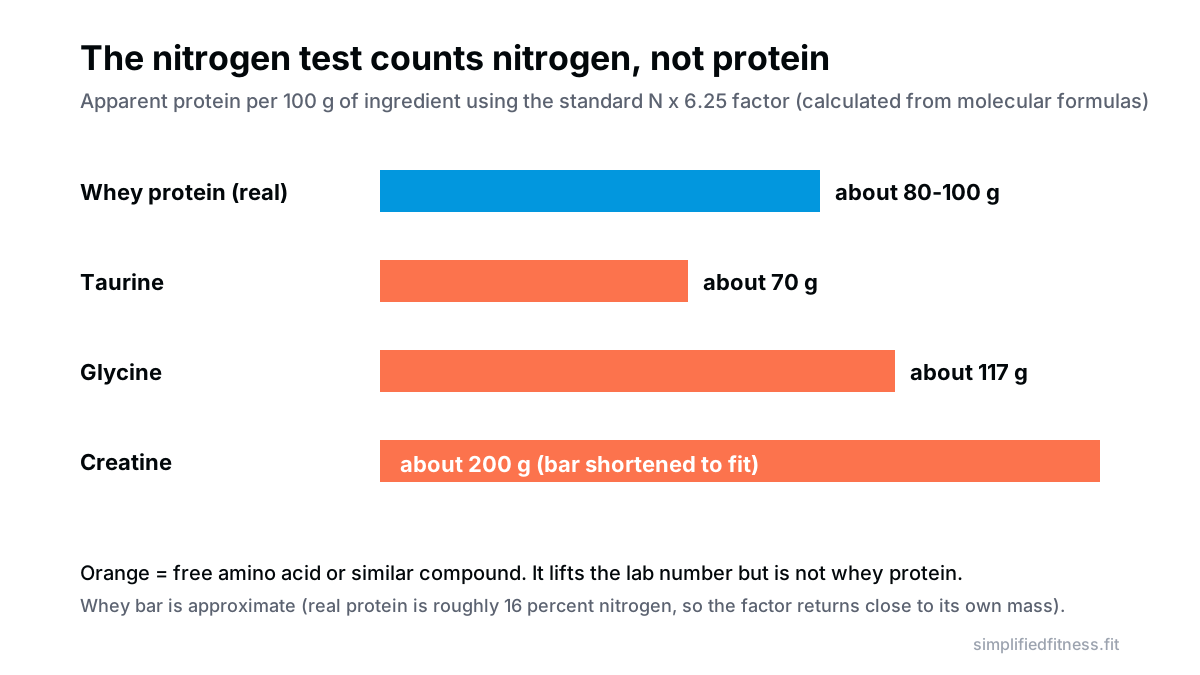
Put simply: the test cannot tell nitrogen that sits in a real protein from nitrogen that sits in a cheap additive.
A lab study that deliberately adulterated milk with melamine, ammonium sulphate or urea found that Kjeldahl responded to the added nitrogen compounds, while classic spectrophotometric protein methods (Biuret, Lowry, Bradford, Markwell) did not. Reading the two together flagged the adulteration (Finete et al., 2013).
To get a feel for the size of the effect, here is my own arithmetic using the conventional nitrogen-to-protein factor of 6.25. It is calculated from molecular formulas, not taken from a study, so treat it as a rough illustration.
What did the Indian lab study find?
The most relevant evidence for Indian buyers is a 2025 crowd-funded laboratory study. It compared 18 medical-pharmaceutical and 16 nutraceutical whey protein powders sold in India, analysing macronutrients, amino acid profiles, sugars, heavy metals and more (Philips et al., 2025).
The headline numbers:
- Nutraceutical powders averaged 75.6 g protein per 100 g and closely matched their labels; 94% met a 60 g per 100 g benchmark.
- Medical-pharmaceutical powders averaged 29.1 g protein per 100 g; 83% were mislabeled by more than 5%, and only one reached the benchmark.
- Taurine-based nitrogen spiking was detected in 89% of the pharmaceutical powders versus 12.5% of the nutraceutical ones.
- 44% of the pharmaceutical powders contained at least 2 g of sucrose or fructose per 100 g, often unlabeled.
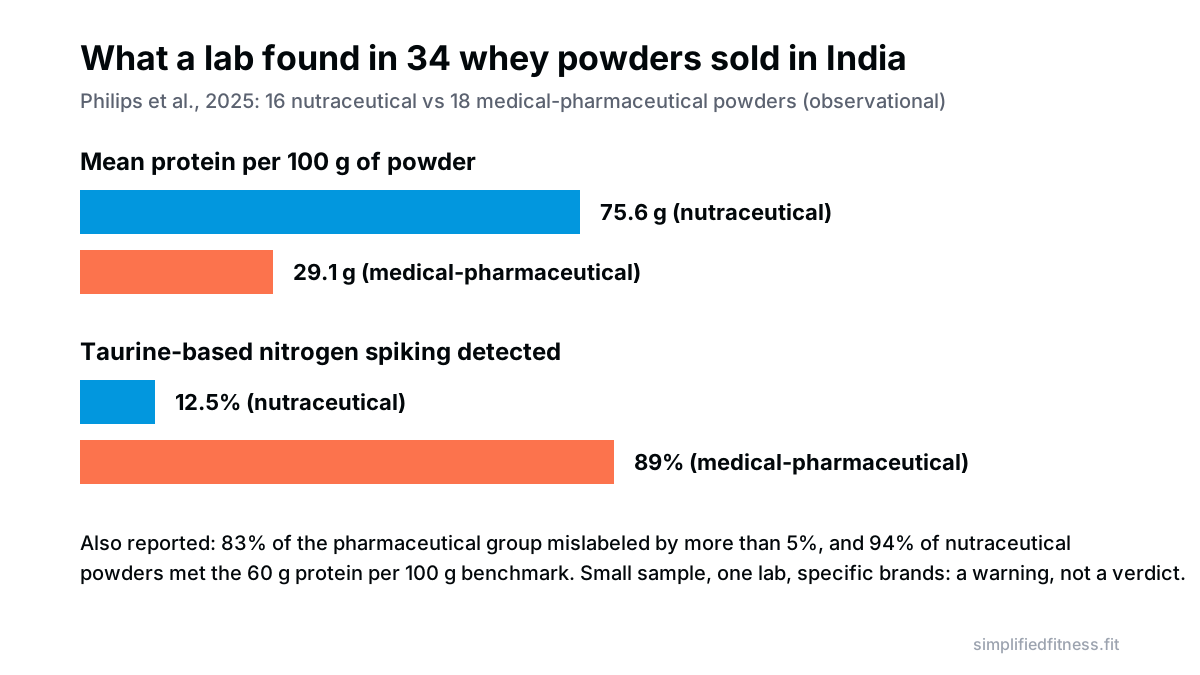
Be careful with how you read this. It is an observational study of 34 products, so it shows what was on shelves at one time, not how common spiking is across the whole market. The “medical-pharmaceutical” group is also a specific type of product, and you should not assume your favourite brand falls in either bucket. The authors report no conflicts of interest, but one lab analysis is still one lab analysis. It has not, to my knowledge, been independently replicated.
Check 1: Read the ingredients list for separate amino acids
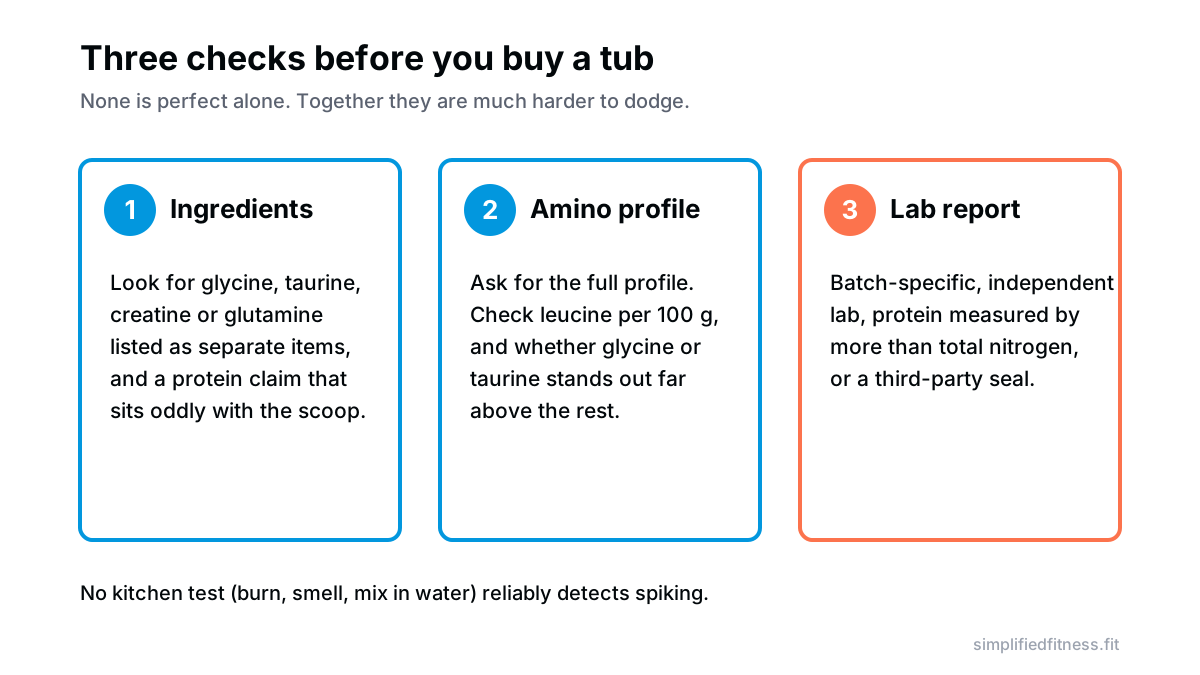
Start with the cheapest check. Whey protein concentrate or isolate should be the first ingredient. Then scan for items such as glycine, taurine, creatine or glutamine listed separately.
Some of these are legitimate when declared and doseable, for example creatine in a creatine product. What you are looking for is an unexplained free amino acid in a plain “whey” product, especially one with a vague proprietary blend. (We cover that tactic in decoding supplement proprietary blends.)
Also check the arithmetic on the label:
- Look at protein per serving and the serving (scoop) weight.
- Divide: protein g divided by scoop g, times 100, gives protein per 100 g.
- Whey concentrate is typically lower than isolate, but the Indian study used 60 g per 100 g as its pass line. A figure far below that for a “whey” product needs an explanation.
Check 2: Ask for the full amino acid profile
A spiked powder hides in the total. An amino acid profile does not. Whey has a recognisable pattern, rich in leucine and the other essential amino acids. Add a lot of glycine or taurine and the pattern shifts.
In the Indian study, nutraceutical powders showed high essential amino acid density with up to 8.5 g leucine per 100 g, while none of the pharmaceutical powders exceeded 5 g leucine per 100 g (Philips et al., 2025). That is a useful clue: if leucine is low relative to total protein, something other than whey may be filling the number.
Separate research on milk powders shows why this approach is practical. Five laboratories built an amino acid fingerprint of 39 authentic nonfat dry milk and skim milk powders and showed that spiking with pea, soy, rice, whey, fish gelatin and arginine changed the fingerprint, though not wheat protein or melamine (Bhandari et al., 2022). So a profile is a strong tool, but not a perfect one, and that study was on milk powder, not sports whey.
What to look for in a profile:
- Leucine, isoleucine and valine listed per 100 g or per serving.
- No single non-essential amino acid towering over the rest.
- A profile that comes from a lab, not just copied from a generic whey table on the brand’s website.
If a brand will not share one, that tells you something too.
Check 3: Look for batch-specific lab results or a third-party seal
Independent testing is the third line. The better ones are batch-specific certificates of analysis (COA) from an outside lab, with the batch number matching your tub.
Researchers are building better detection methods too. Near-infrared spectroscopy with machine learning predicted low concentrations (0.5% to 3% w/w) of urea, glycine, taurine and melamine in whey powder, and even worked through a plastic bag with a handheld device (Zaukuu et al., 2020). A later comparison of several instruments found the best benchtop model came close to a 0.1% limit of detection for melamine and urea (Lukacs et al., 2024). These are research tools, not something you can buy at a gym shop, but they show the problem is detectable by labs that look for it.
On certification, a clinical review of prohibited contaminants in supplements concluded that third-party certified products are one way to mitigate the risk, and that muscle-building supplements were more likely to be contaminated (Mathews, 2018). That review is about banned substances and contamination, not protein content, so a seal is a useful signal and not proof that a tub is unspiked. Check what the seal actually tests for.
Can I test protein powder at home?
No, not in a way that means anything. Burning it, smelling it, watching it foam or checking whether it dissolves does not measure protein. At spiking levels of a few percent, the powder looks and mixes the same. Anyone selling a “home test” for this should be viewed with caution.
What you can do at home is the label arithmetic above and a price-per-protein comparison.
Does spiking actually hurt you?
Mostly, it hurts your wallet. I did not find evidence in these studies that small amounts of glycine or taurine are directly harmful to healthy people. The practical issue is getting less protein than you paid for.
That said, the study also reported heavy-metal outliers (cadmium, arsenic, copper), aflatoxin and progesterone more often in the pharmaceutical group (Philips et al., 2025), which is a separate quality concern. If you have kidney or liver disease, are pregnant, or take regular medication, speak to your doctor before using any protein supplement.
For more on metals specifically, see our guide to heavy metals in protein powders.
How much does a shortfall matter for muscle?
It depends on the rest of your diet. A meta-analysis of 49 randomized trials (1,863 participants) found protein supplements modestly increased strength and lean mass during resistance training, with no further gain in fat-free mass once total intake passed about 1.62 g/kg/day (Morton et al., 2018). Note that one author had received support from the US National Dairy Council, which funded some of the trials in the analysis.
So if your food already gets you near that figure, a slightly weaker tub changes little. If your meals are low in protein, a mislabeled powder can leave a real gap. Work out your target with the protein calculator.
A practical Indian approach:
- Build the base from dal, eggs, paneer, curd, chicken, fish and soya.
- Use powder to top up the last 20-30 g, not as the foundation.
- If you are vegetarian, our guide to plant-based protein powders covers how to judge blends, and the isolate vs concentrate comparison helps you decide what is worth paying for.
A simple buying routine
- Check the ingredients for separate glycine, taurine or creatine.
- Calculate protein per 100 g from the label.
- Ask the brand for the amino acid profile and latest batch COA.
- Prefer an independent lab or a third-party seal, and check what it tests.
- Compare rupees per 100 g of protein, not per kg of powder.
- Buy the smallest tub first and see how it performs and tastes.
Bottom line
Amino spiking works because common protein tests count nitrogen, not protein. One Indian study found it in most of the medical-pharmaceutical powders tested and in a small share of the nutraceutical ones, though the evidence is limited to 34 products. Read the ingredients, check the amino acid profile, and ask for batch-specific lab results. If the brand will not show them, there are other tubs on the shelf.
Frequently Asked Questions
What is amino spiking in protein powder?
Amino spiking, also called nitrogen spiking, is adding cheap free amino acids or other nitrogen-rich compounds to a powder so it appears to contain more protein. It works because the common lab method counts nitrogen rather than actual protein. Check the ingredients list for separately listed glycine, taurine or creatine, and be cautious if they appear without a clear reason.
How does the Kjeldahl nitrogen test work and why can it be fooled?
The Kjeldahl method measures total nitrogen in a sample and converts it to a protein figure, so it cannot tell protein nitrogen from non-protein nitrogen. A review by the US Pharmacopeia notes these methods lack selectivity for protein, which is why melamine-type frauds exploited them. Look for brands that also report an amino acid profile, which is harder to fake.
Is amino spiking illegal?
Rules differ by country and I cannot give you a legal ruling, but a label that overstates protein is misleading at the very least. Declared amino acids are not illegal; the problem is when they inflate the protein number. If you suspect a product, you can report it to your national food safety authority.
Which amino acids are used for spiking?
Research on adulterated protein powders has looked at urea, melamine, glycine and taurine, and the Indian study specifically reported taurine-based spiking. Creatine and glutamine are also commonly named by consumer watchdogs, though I could not confirm their frequency from the studies I read. Treat any large, separately listed free amino acid as a flag.
How can I tell if my protein powder is fake at home?
You cannot do it reliably at home. Burn, smell, foam and solubility tests do not measure protein, and a few percent of an added amino acid is invisible to the eye. The best home step is to read the label and compare protein per 100 g against the price per kg.
What should a good protein powder label show?
A good label shows protein per serving and per 100 g, a serving size that matches the claim, and an ingredient list with whey as the first ingredient. Better brands also publish an amino acid profile and recent lab reports. Prefer products that show leucine and the other essential amino acids, not just a total protein figure.
How much protein should a whey scoop contain?
It varies by product and scoop size, so work it out from the label. The Indian study used 60 g protein per 100 g as a quality benchmark for whey powders. If your scoop gives far less than that fraction, ask why.
What is a certificate of analysis and how do I read it?
A certificate of analysis (COA) is a lab report for a specific batch, listing measured protein, moisture, fat and sometimes amino acids and contaminants. Check that it names the batch number printed on your tub, an independent lab, and the method used. A COA that only shows total nitrogen-based protein cannot rule out spiking.
Does third-party testing prove a protein powder is not spiked?
Not automatically, because different certifications test for different things, often banned substances rather than protein content. A clinical review of contaminated supplements recommends third-party certified products to lower the risk of contamination, which is related but not identical to spiking. Use certification as one signal, then also check the amino acid profile.
Do expensive protein powders avoid spiking?
Price alone is not a guarantee, but very low price per gram of protein is a reason to look closer. Real whey protein costs more than glycine or taurine, which is the whole incentive to cheat. Work out rupees per 100 g of protein using the label figure and compare it across brands.
Can spiked protein powder harm me?
For most healthy people, small amounts of glycine or taurine are not dangerous in themselves; the main harm is paying for protein you are not getting. I did not find evidence in these studies of direct health harm from taurine or glycine spiking. If you have kidney or liver disease, talk to your doctor about protein supplements in general.
Does amino spiking affect muscle building?
It can, if you are getting less real protein than you think. A large meta-analysis found protein supplements stopped adding lean mass once total intake passed about 1.6 g/kg/day, so a shortfall matters most if your food intake is already low. Check your total daily protein with a calculator and rely on whole foods such as dal, paneer, eggs and curd for the base.
Sources & References
Every claim above is checked against peer-reviewed research (PubMed, U.S. National Library of Medicine) or guidance from established health bodies. How we fact-check.
- Philips CA, et al. The Citizens Protein Project 2: The first publicly crowd-funded observational study on exhaustive analysis of popular whey protein supplements in India reveal poor quality and deceptive marketing claims of medical pharmaceutical- compared to nutraceutical- industry powders. Medicine (Baltimore). 2025. PMID: 41239695
- Moore JC, et al. Total Protein Methods and Their Potential Utility to Reduce the Risk of Food Protein Adulteration. Compr Rev Food Sci Food Saf. 2010. PMID: 33467839
- Finete VL, et al. Is it possible to screen for milk or whey protein adulteration with melamine, urea and ammonium sulphate, combining Kjeldahl and classical spectrophotometric methods? Food Chem. 2013. PMID: 23993532
- Bhandari SD, et al. Amino Acid Fingerprinting of Authentic Nonfat Dry Milk and Skim Milk Powder and Effects of Spiking with Selected Potential Adulterants. Foods. 2022. PMID: 36140996
- Zaukuu JZ, et al. Detecting Low Concentrations of Nitrogen-Based Adulterants in Whey Protein Powder Using Benchtop and Handheld NIR Spectrometers and the Feasibility of Scanning through Plastic Bag. Molecules. 2020. PMID: 32481691
- Lukacs M, et al. Comparison of Multiple NIR Spectrometers for Detecting Low-Concentration Nitrogen-Based Adulteration in Protein Powders. Molecules. 2024. PMID: 38398532
- Mathews NM. Prohibited Contaminants in Dietary Supplements. Sports Health. 2018. PMID: 28850291
- Morton RW, et al. A systematic review, meta-analysis and meta-regression of the effect of protein supplementation on resistance training-induced gains in muscle mass and strength in healthy adults. Br J Sports Med. 2018. PMID: 28698222

Umair Hazrami · Founder & Head Coach, Simplified Fitness
Umair Hazrami founded Simplified Fitness and the Simplified Lifter channel to cut through fitness noise. With 4+ years of consistent training and 10+ coaching clients, he writes every guide from the peer-reviewed research and links the sources so you can check them. Our editorial standards.
Educational content only, not medical advice. If you have a medical condition, are pregnant, or take medication, talk to a qualified doctor before changing your diet, supplements or training. Full disclaimer.
Keep reading
Supplements
Alpha-GPC and Huperzine A Pre-Workout: Do Cholinergic Nootropics Help Lifting?
Does an alpha GPC pre workout add power or focus? See what small trials found, why Huperzine A is a poor lifting bet, and the safety flags to know first.
10 min read
Supplements
The Antioxidant Paradox: Can Vitamin C and E Pills Blunt Muscle Growth and Endurance?
Does vitamin C blunt muscle growth? See what trials of 1000 mg vitamin C plus E found for strength, hypertrophy and endurance, and when pills are worth taking.
8 min read
Supplements
Caffeine Powder vs Coffee Before Lifting: Does the Source Really Matter?
Caffeine anhydrous vs coffee for lifting: what research says on absorption speed, peak levels and stomach upset, and whether pills beat your daily cup.
7 min read
Supplements
Caffeine Dosing for Strength and Power: 3-6 mg/kg and When to Take It
Caffeine dosage for strength is 3-6 mg/kg, about 210-420 mg for a 70 kg lifter, taken around 60 minutes before training. Doses, timing and when to stop.
8 min read