Complete Lower-Body & Core Training Guide: Quads, Glutes, Hamstrings, Calves & Abs Science
A leg workout guide built on MRI studies: which squats, curls, hip thrusts and calf raises grow each muscle, how many sets to do, and what ab training can't do.
TL;DR. The short answer
- Train each leg muscle through its main job: squats or presses for quads, deep squats or hip thrusts for glutes, a knee-bending curl plus a hip hinge for hamstrings, and straight-knee calf raises for calves.
- Seated leg curls grew the whole hamstrings more than lying curls (+14% vs +9%) in a 12-week MRI study, because the hip is bent and the hamstrings work at a longer length.
- Full squats grew the glutes and adductors more than half squats in a 10-week trial, while quad growth was similar and the hamstrings barely changed with either.
- Standing calf raises grew the gastrocnemius far more than seated raises in a 12-week study, so make them your main calf exercise.
- Ab exercises make your abs stronger, but the evidence that they burn the fat covering them is weak and mixed. Visible abs mostly come down to overall body fat.
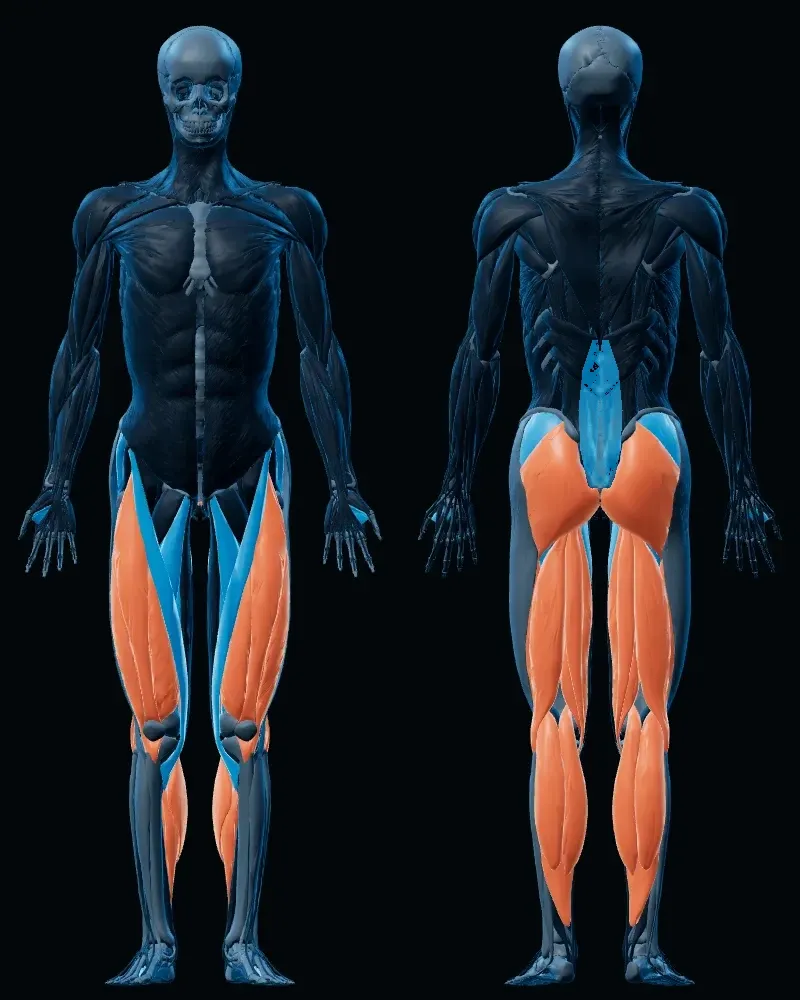
Muscles worked: leg day
Main movers: quads, glutes, hamstrings and calves
Assisting: lower back, adductors and gluteus medius
Table of contents
The best leg workout guide is simple: give each leg muscle an exercise that matches its job, take it through a deep range of motion, and do roughly 10 or more hard sets per muscle each week. Squats or presses for the quads. Deep squats or hip thrusts for the glutes. A seated leg curl plus a Romanian deadlift for the hamstrings. Standing calf raises for the calves.
That covers most of it. The rest of this guide is the “why”, built on MRI and ultrasound studies rather than gym folklore, plus the details that decide whether your legs actually grow.
Your lower body is a huge share of your total muscle mass. It also gets skipped, rushed and half-repped more than any other body part. Let’s fix that, one muscle at a time.
How to use this leg workout guide
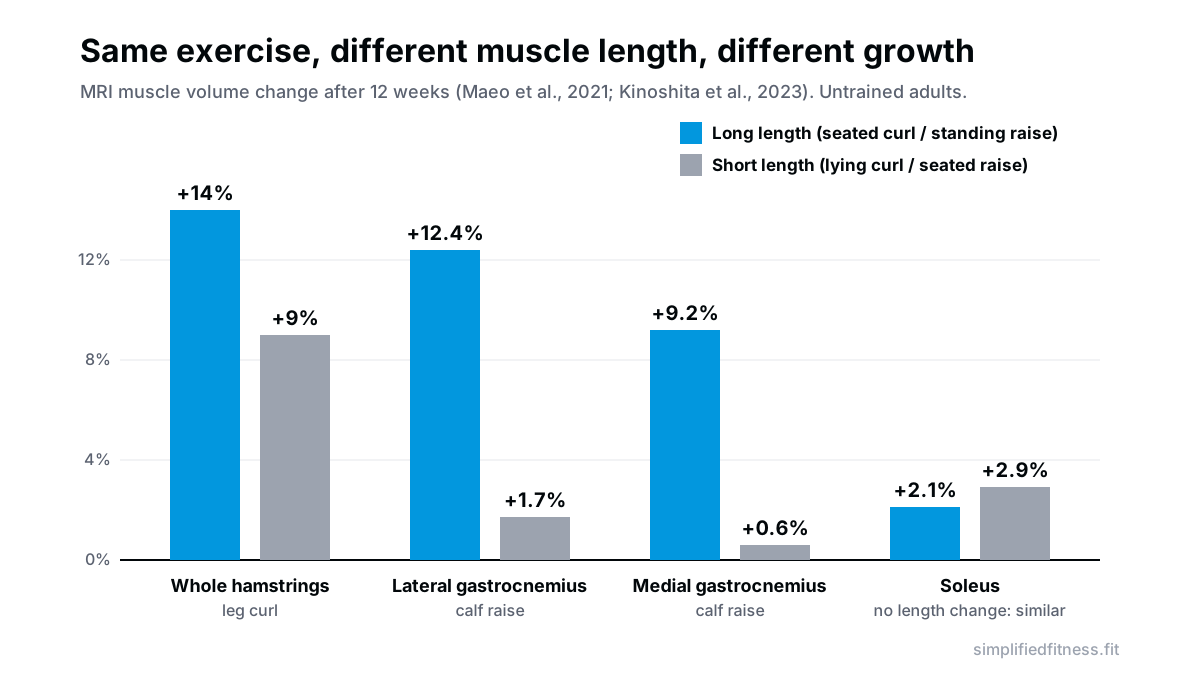
Think of each muscle as having a job:
- Quads straighten the knee.
- Glutes extend the hip (drive it forward).
- Hamstrings bend the knee and extend the hip.
- Adductors pull the thigh inward and help extend the hip.
- Calves point the foot.
- Abs flex the spine and stop it from moving under load.
Pick an exercise that loads the job, then make sure the muscle is stretched under load at some point in the rep. That second part is where most of the newer research points, and it is covered in depth in our pillar on range of motion and stretch-mediated hypertrophy.
Why muscle length matters so much for legs
For years, the default advice was “always use full range of motion.” That still holds up well for legs. A 2020 systematic review of six studies (135 participants in total) concluded that full range of motion training produced better lower-body hypertrophy than partial range (Schoenfeld & Grgic, 2020).
But the story got more specific. A 2023 systematic review of 11 studies found that partial reps in the initial part of the movement, where the muscle is longest, grew muscle about as well as full reps, and better at some sites, while partials at the short end lagged behind (Kassiano et al., 2023). For example, stretched-position partials produced more growth in the upper (proximal) rectus femoris than full range.
So the refined rule is this. The bottom of the rep, where the muscle is stretched, does a lot of the work. Cutting it out is the expensive mistake.
Two leg studies show this clearly.
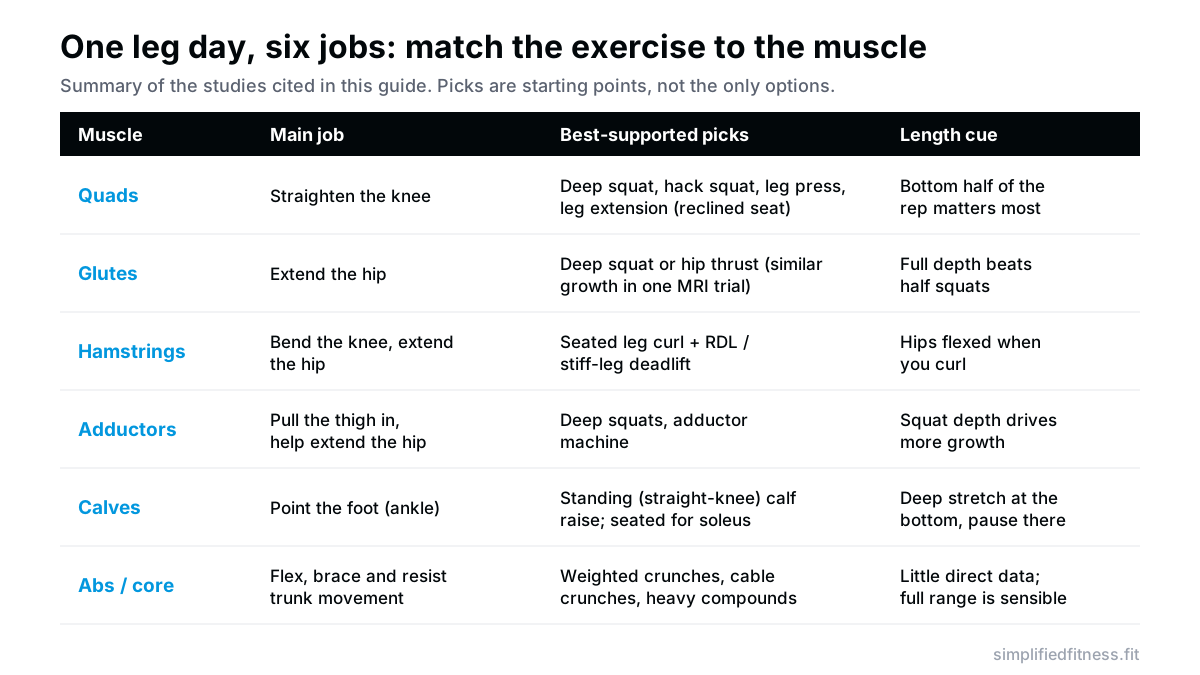
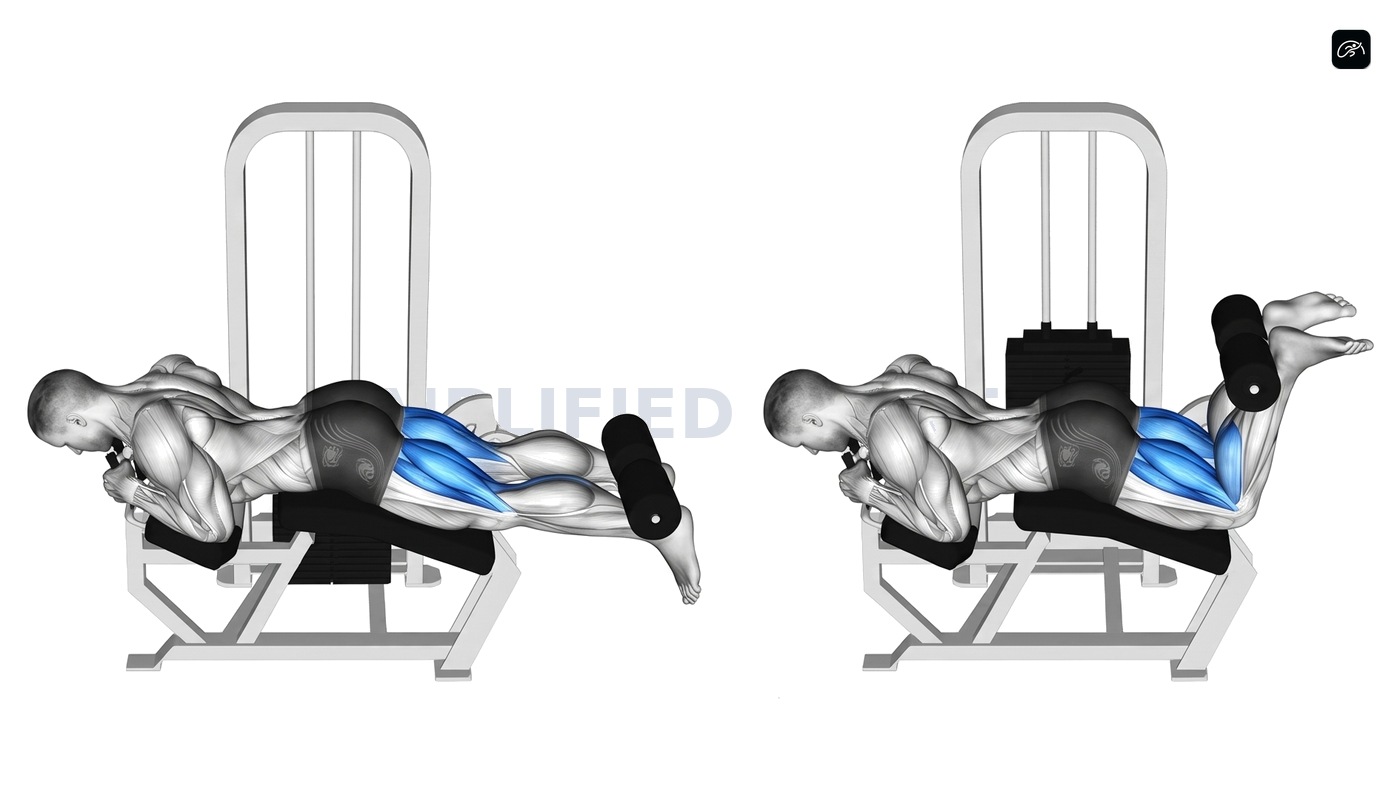
Hamstrings. In a 2021 MRI study, 20 healthy adults trained one leg with seated leg curls and the other with lying (prone) curls for 12 weeks. The seated leg grew more: about +14% whole-hamstring volume versus +9% (Maeo et al., 2021). Sitting bends the hip, which stretches the hamstrings that cross both joints.
Calves. In a 2023 study using the same design, 14 untrained adults trained one leg with standing (straight-knee) calf raises and the other with seated (bent-knee) raises for 12 weeks. The lateral gastrocnemius grew 12.4% versus 1.7%, and the medial gastrocnemius 9.2% versus 0.6% (Kinoshita et al., 2023). The soleus, which does not cross the knee and so is not lengthened by standing, grew about the same in both.
Quads: how to grow the front of your thighs
The quadriceps are four muscles. Three of them (the vasti) cross only the knee. The fourth, the rectus femoris, crosses both the knee and the hip, and that changes everything about how it responds. Our quadriceps anatomy breakdown goes deeper on each head.
Squats, hack squats and leg presses
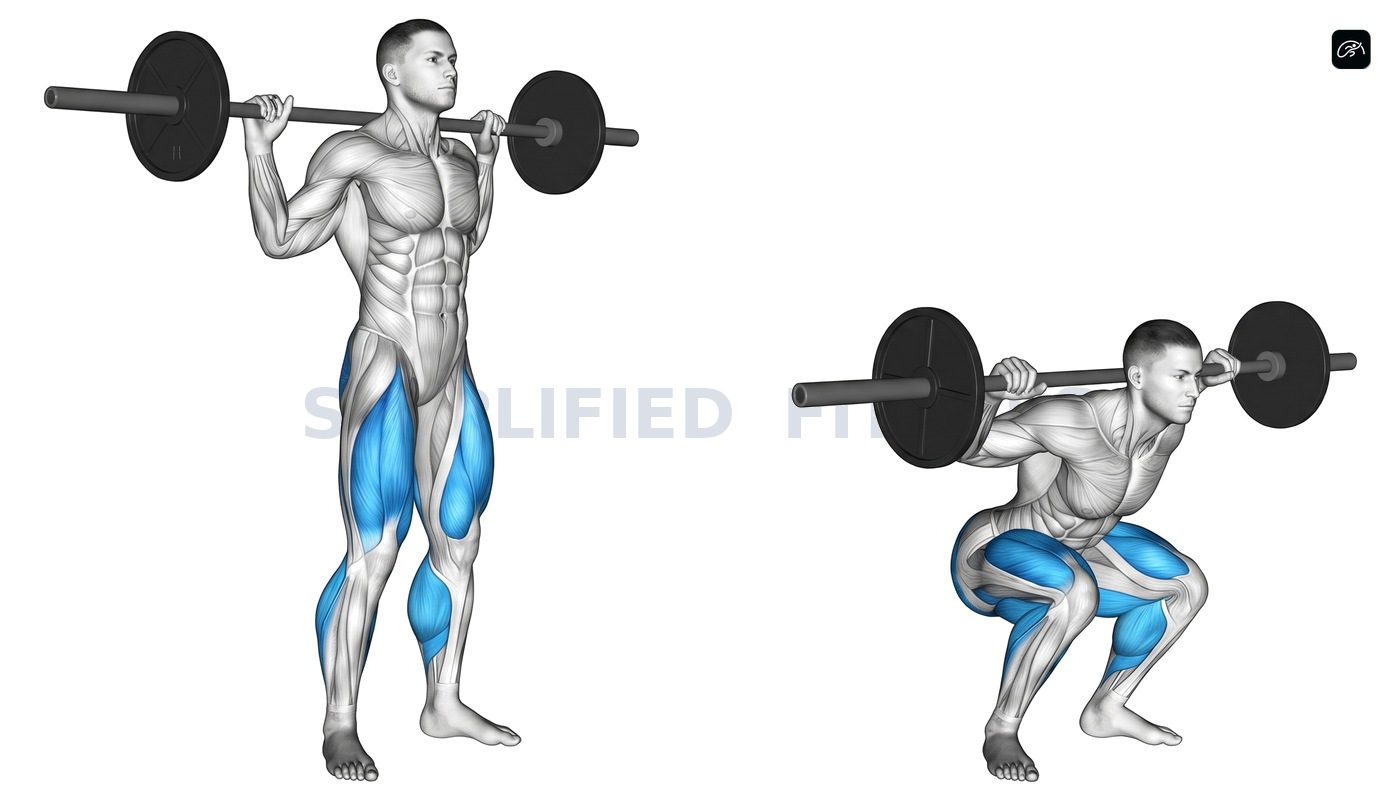
Any deep knee-bending press grows the vasti well. In a 10-week trial, knee extensor volume rose by about 4.9% with full squats and 4.6% with half squats, a similar result (Kubo et al., 2019). The surprise: rectus femoris volume did not change in either group.
Why? In a squat, the hip bends as the knee bends. The rectus femoris gets shortened at one end while it lengthens at the other, so it never gets a strong stretch under load.
Which squat pattern suits you depends on your build and goals. High bar versus low bar is a real biomechanical difference, broken down in our high-bar vs low-bar squat guide, and the front squat vs back squat comparison covers which one loads the quads more. Machines matter too. The hack squat often gives a strong quad stimulus with less lower back fatigue, and leg press foot placement shifts the work between quads and glutes.
Leg extensions: the rectus femoris fix
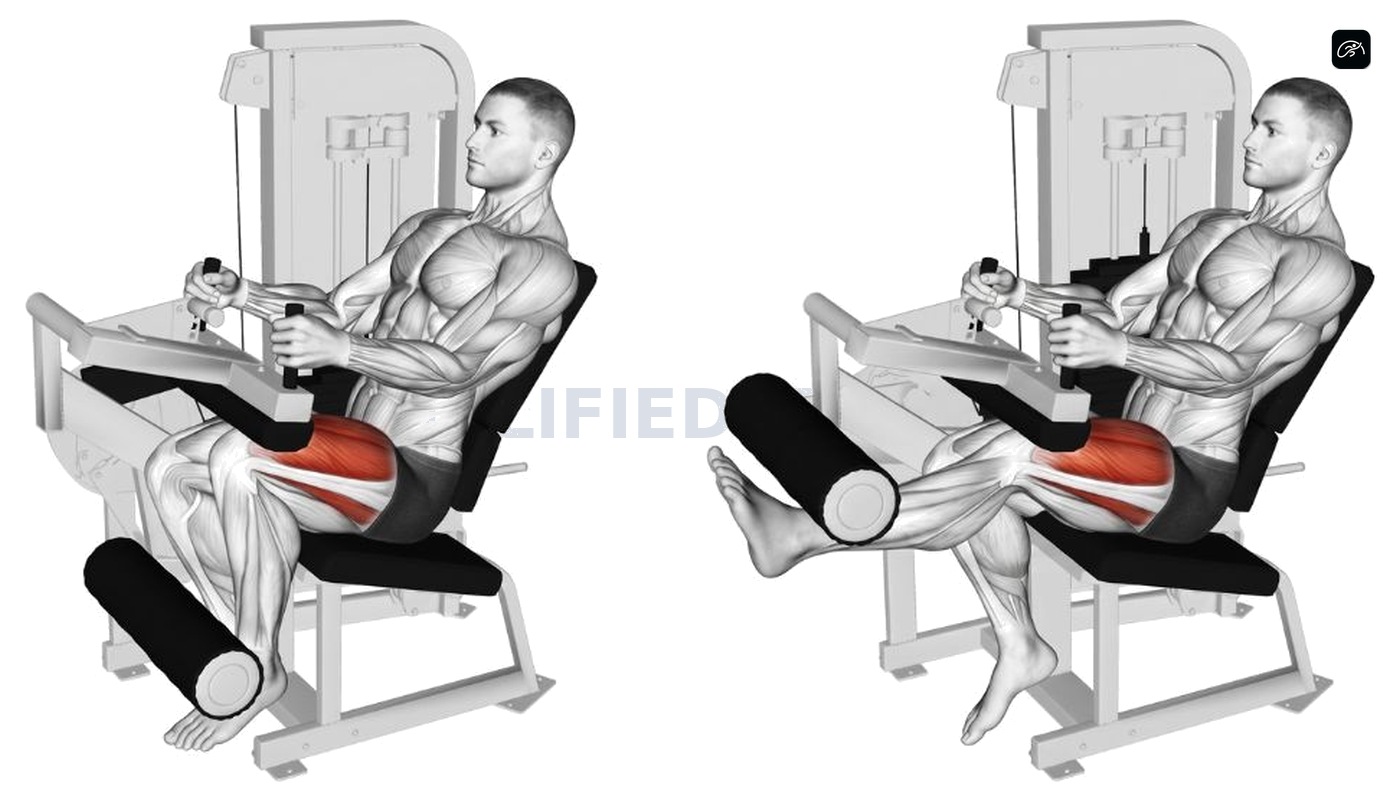
Since squats barely touch the rectus femoris, the leg extension earns its place. Two details make it better.
- Recline the seat. A 2025 study had 22 untrained men train one leg with the hip at 40 degrees of flexion (reclined) and the other at 90 degrees (upright) for 10 weeks. The reclined position produced clearly greater rectus femoris growth, while the vastus lateralis grew about the same in both (Larsen et al., 2025).
- Own the bottom half. In 45 untrained women, training only the initial part of the knee extension (from 100 to 65 degrees of knee bend) grew certain quad regions more than full range or top-half partials (Pedrosa et al., 2022).
More on setup and knee comfort in our leg extension guide. If you want an even longer quad stretch, sissy squats and reverse Nordics are worth a look.
Glutes: squats, hip thrusts or both?
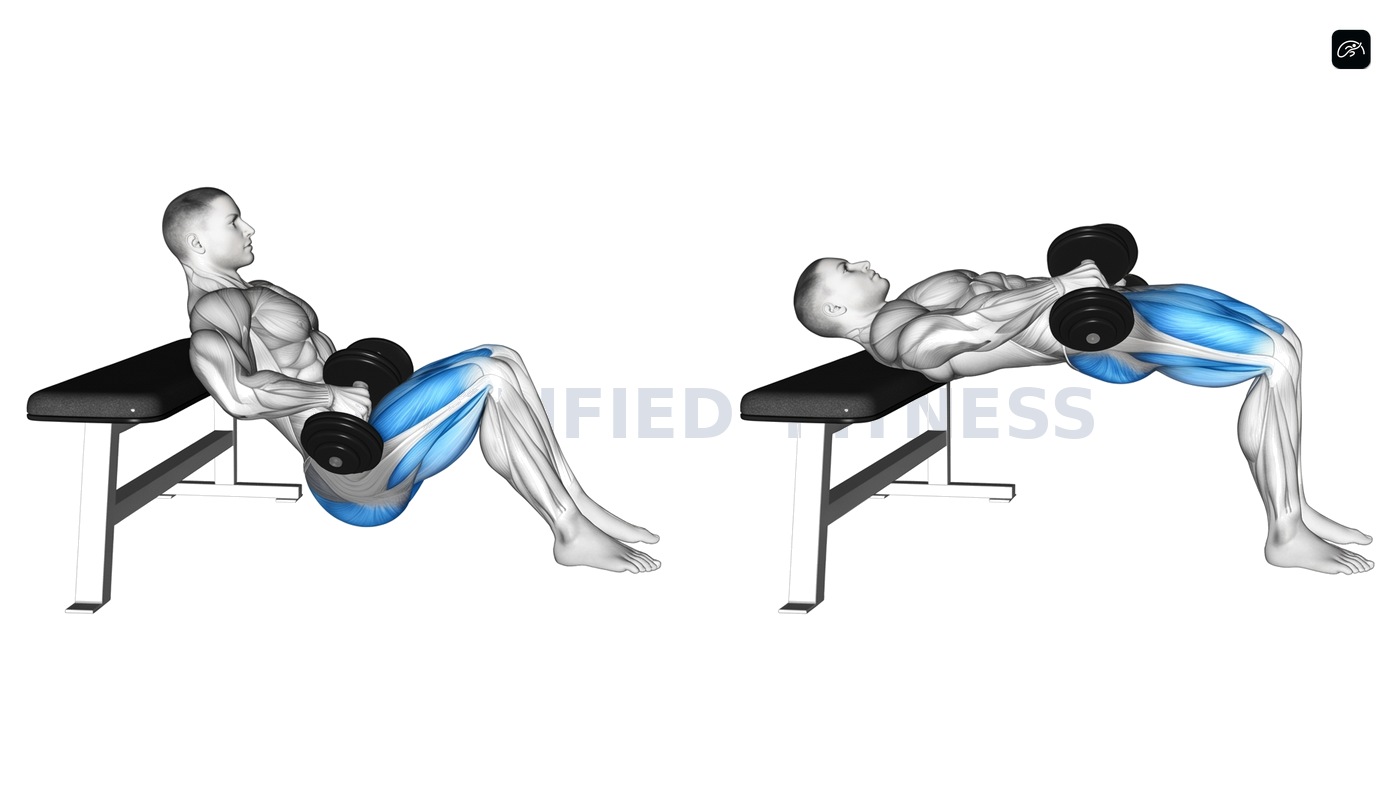
The gluteus maximus is one of the largest muscles in your body, and its main job is hip extension. Two exercise families load it well: deep squats and hip thrusts.
Squat depth matters for the glutes
In the same 10-week Kubo trial, full squats grew the gluteus maximus by about 6.7%, versus 2.2% for half squats (Kubo et al., 2019). The adductors showed a similar pattern (6.2% versus 2.7%). Quad growth, as noted, was about the same.
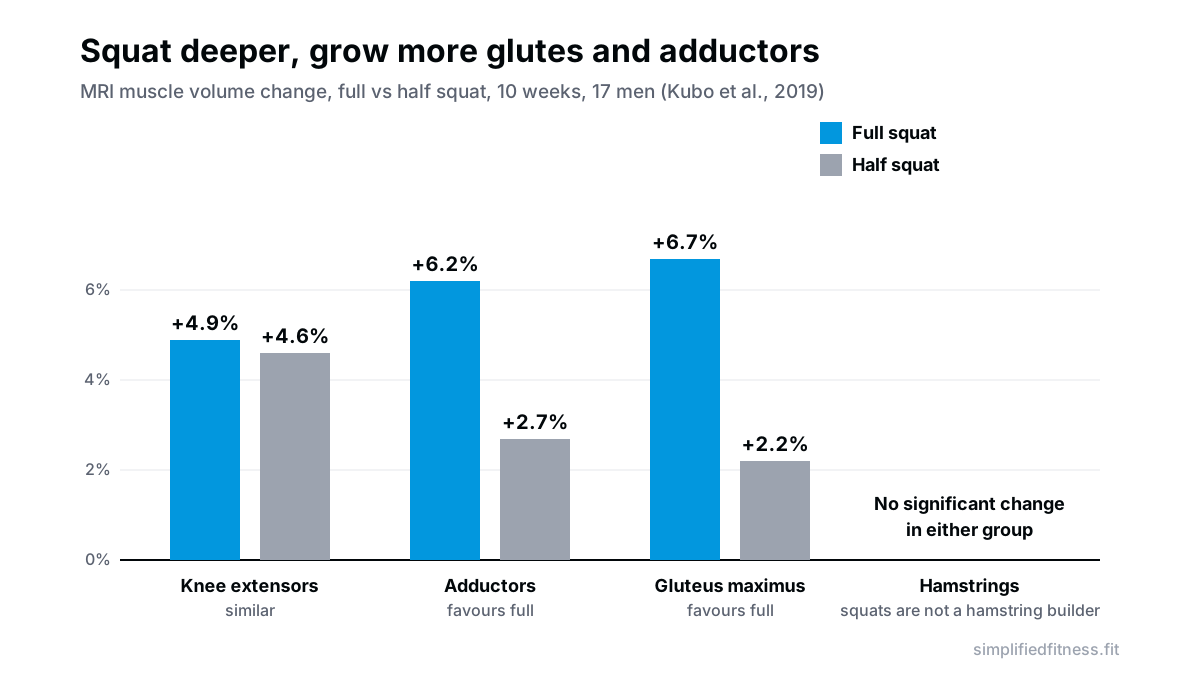
This is a small trial (17 men), so read the numbers as direction rather than exact values. For the full depth debate, see squat depth science: parallel vs deep.
The hip thrust vs squat question
Hip thrusts produce much higher glute EMG (electrical activity) than squats, and for years that was taken as proof they build bigger glutes. A 2023 trial put that to the test.
Thirty-four untrained college-aged adults did either hip thrusts or back squats for 9 weeks, with sets equated, and had MRI scans before and after. Glute growth was similar between groups, with estimates leaning slightly toward the hip thrust but with wide uncertainty. The squat group grew more quad and adductor muscle. The higher EMG in the hip thrust did not consistently predict who grew more glute (Plotkin et al., 2023).
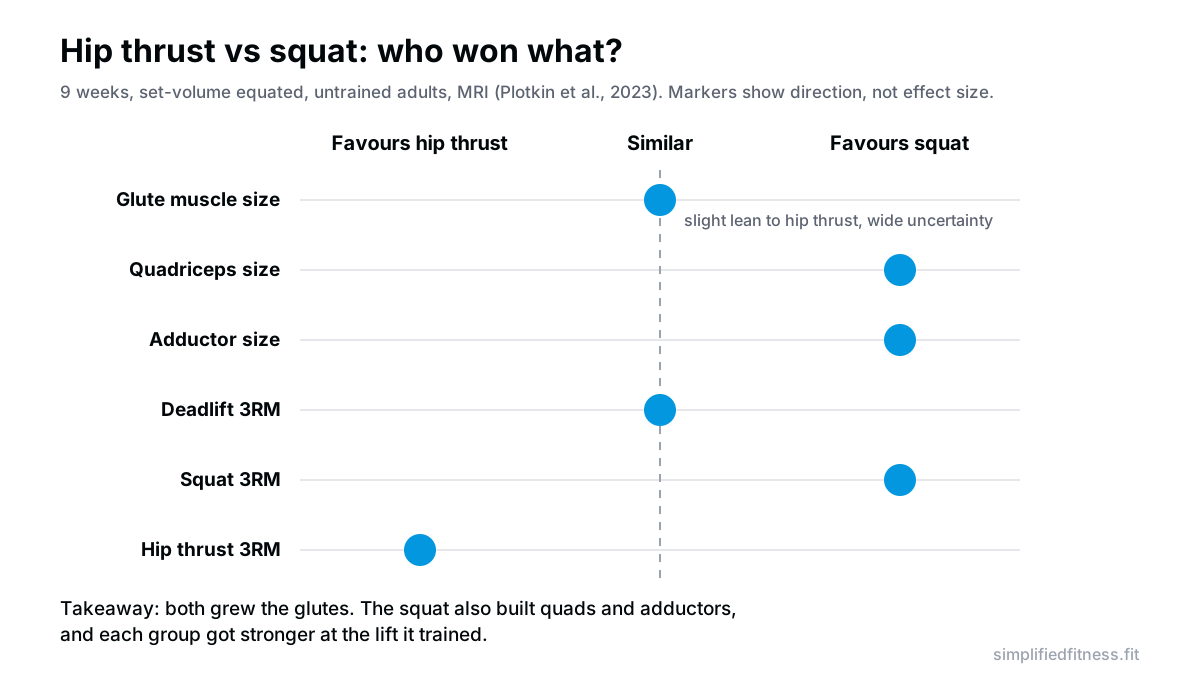
Practical read: if your squat is deep and progressing, your glutes are already getting trained hard. Hip thrusts are a great addition if squats bother your back or knees, or if glutes are your top priority and you want more volume without more quad fatigue. The full comparison lives in our gluteus maximus guide: hip thrust vs squats. For the side glutes, which neither lift targets well, see glute medius and minimus training.
Hamstrings: why you need a curl and a hinge
The hamstrings are four muscles at the back of the thigh. Three of them (semitendinosus, semimembranosus and biceps femoris long head) cross both hip and knee. The biceps femoris short head crosses only the knee. Our hamstring anatomy guide maps each one.
That two-joint design explains two things:
- Squats do almost nothing for them. Hamstring volume did not change with full or half squats in the Kubo trial.
- Seated curls beat lying curls. In the Maeo study, the advantage showed up in the two-joint muscles. The one-joint short head grew about the same (+10% versus +9%).
Seated vs lying leg curl
This is one of the cleaner findings in leg training research. If your gym has a seated leg curl, make it your main curl. We cover setup, seat angle and common errors in our dedicated seated vs lying leg curl breakdown.
Lying curls still grew the hamstrings by about 9% in that study. They are not useless. They just look like the second-best option.
Romanian deadlifts and Nordic curls
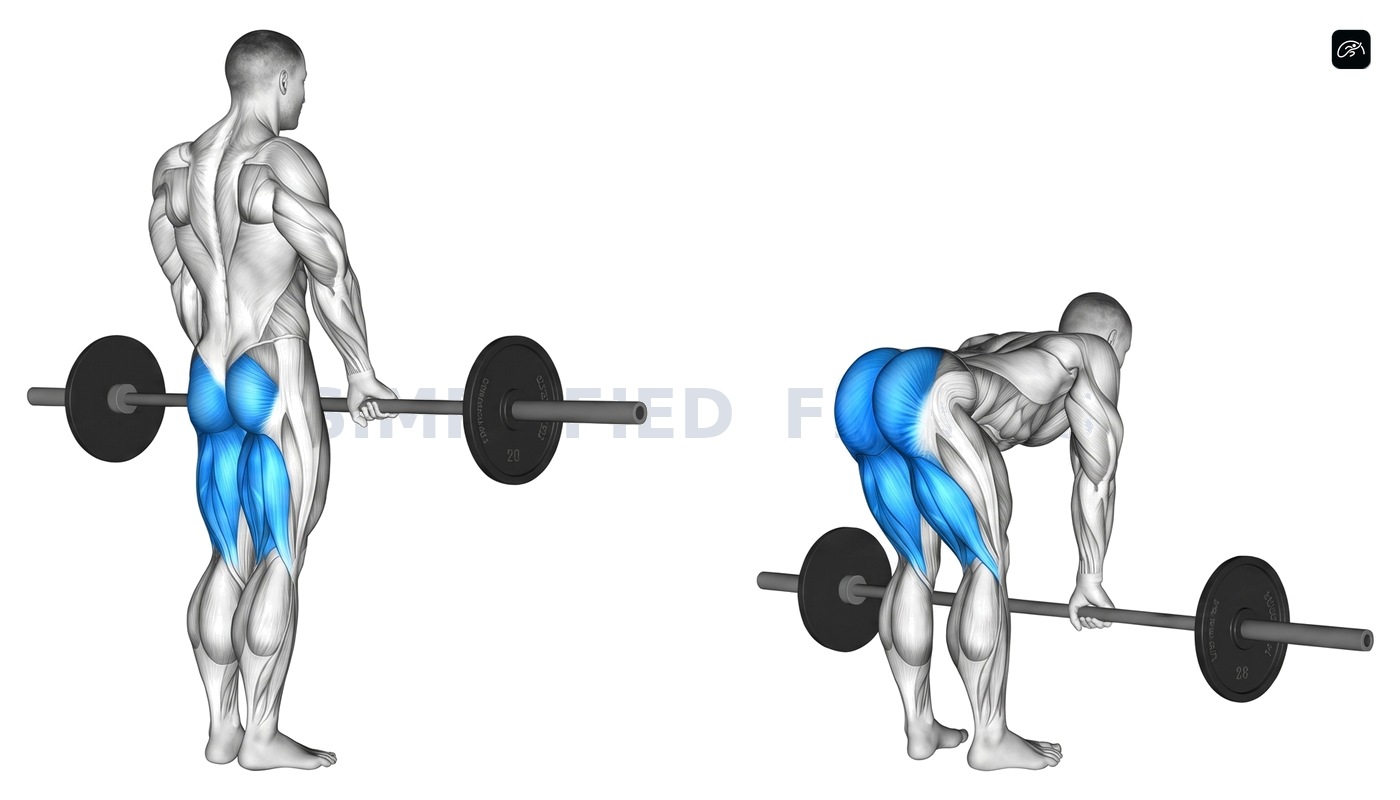
Hip hinges like the Romanian deadlift (RDL) load the hamstrings through hip extension with the muscle stretched at the bottom.
In a 2025 trial, 32 young adults did either eccentric-focused RDLs or Nordic hamstring curls twice a week for 6 weeks. Both groups increased biceps femoris long head fascicle length by about 9% and hamstring cross-sectional area by about 10%, with no difference between exercises (Crawford et al., 2025). Fascicle length gains disappeared after two weeks of detraining; the size gains held.
One more humbling finding. In a 9-week trial of 45 participants (including a non-training control group), people did seated leg curls and stiff-leg deadlifts with either heavy loads or light loads with blood flow restriction. Growth was spread unevenly across the hamstring muscles, and the pattern varied a lot from person to person (Frouin et al., 2024). The authors concluded it is very hard to predict where a given person will add muscle.
That is a good argument for using at least two hamstring exercises, a curl and a hinge, rather than chasing one “best” movement.
Knee health is another reason to keep hamstrings strong relative to quads. The hamstring-to-quadriceps ratio guide explains what that ratio means and where the evidence is weaker than people claim.
Adductors: the inner thigh you are already training
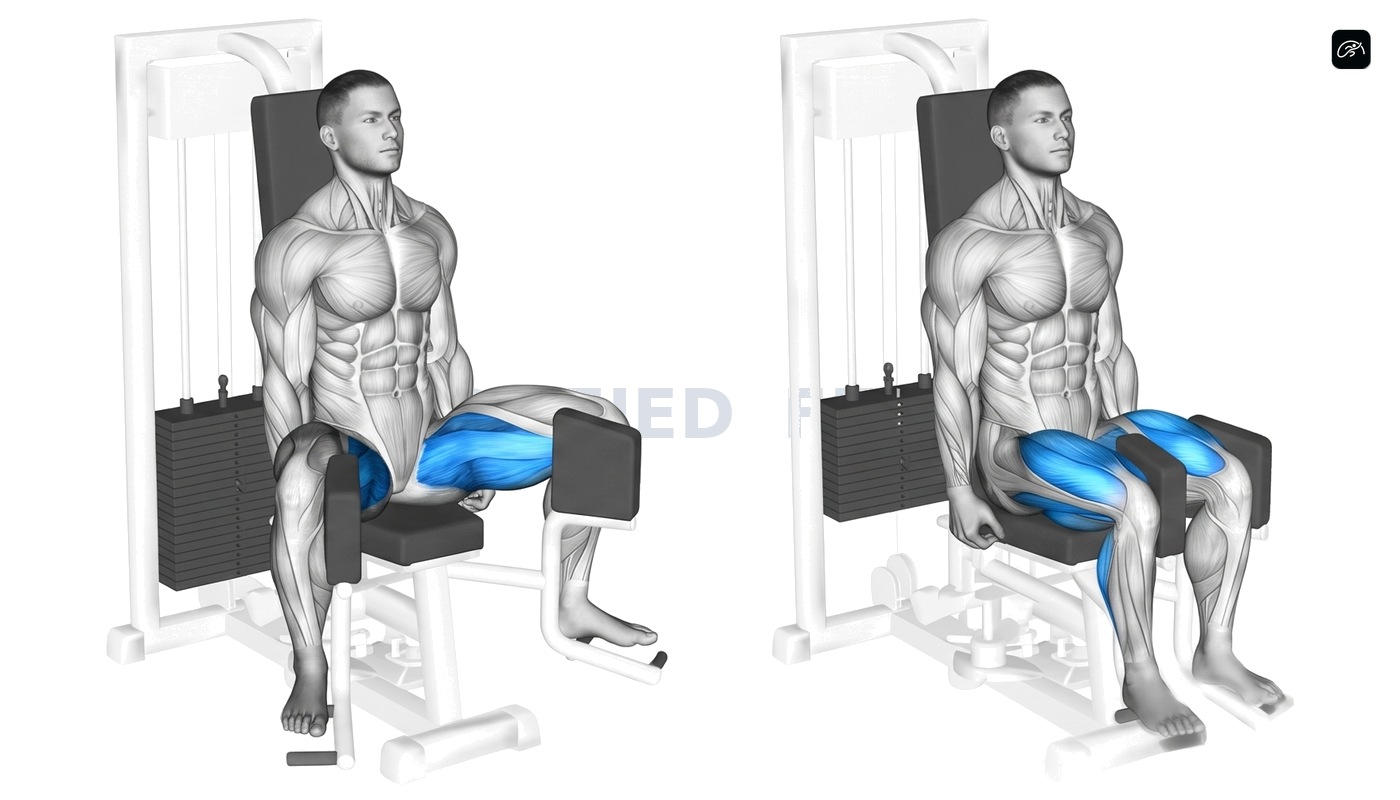
The adductors are a big muscle group, and the adductor magnus in particular acts as a strong hip extender. They respond well to deep squats: full squats grew them more than half squats in the Kubo trial, and back squats grew them more than hip thrusts in the Plotkin trial.
So if you squat deep, your adductors are working. An adductor machine adds direct work if you squat shallow, use mostly hip thrusts, or want more inner-thigh size. Our adductor magnus training guide has the details.
Calves: anatomy, fibre types and what actually works
The calf has two main muscles. The gastrocnemius crosses both the knee and ankle. The soleus sits underneath and crosses only the ankle. The soleus is generally described as rich in slow-twitch fibres, which is why people argue calves need very high reps, though the training studies here do not settle that.
Calves have a reputation for being stubborn. The Kinoshita paper describes the triceps surae as relatively unresponsive to resistance training and prone to shrinking with inactivity. Some coaches also blame the springy Achilles tendon for stealing work from the muscle; that idea is plausible but has not been well tested in training studies.
What the research does show:
- Standing beats seated for the gastrocnemius. Straight-knee raises stretch it; bent-knee raises slacken it (Figure 2).
- The stretch is where calves grow. In 42 young women training for 8 weeks, partial calf raises in the stretched half of the range grew the medial gastrocnemius by 15.2%, versus 6.7% for full range and 3.4% for the top-half partials (Kassiano et al., 2023).
- Foot angle fine-tunes it. In 22 young men training for 9 weeks, toes-out raises favoured the inner (medial) head and toes-in favoured the outer (lateral) head (Nunes et al., 2020).
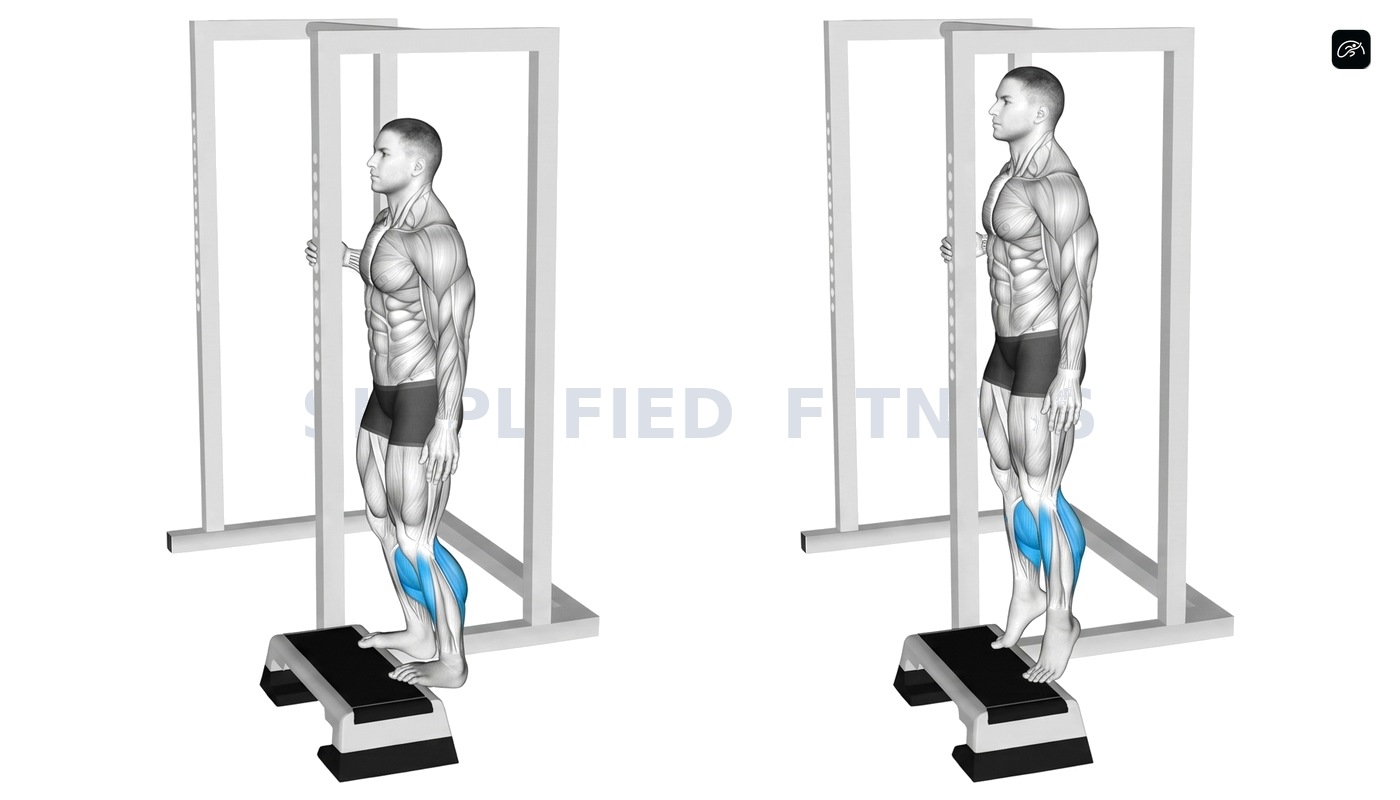
Note that the Kassiano calf study used a leg-press calf raise, so “full range” there was not identical to a step-edge standing raise. The overall pattern still matches the other length studies.
Our calf hypertrophy guide on standing vs seated raises and the anatomy piece on straight-leg vs bent-knee calf raises go further. Don’t forget the front of the shin, either: tibialis anterior training is cheap insurance for people who run or jump.
Abs and core: what training can and cannot do
Here is the honest part. There is far less direct research on ab hypertrophy than on legs. One review noted that no study had yet looked at how range of motion affects growth of the trunk muscles (Schoenfeld & Grgic, 2020). So most ab training advice borrows from what works for other muscles.
Sensible rules, then:
- Treat abs like a muscle. Use load (cable crunches, weighted crunches, machine crunches) and progress it.
- Use a full range: let the spine extend at the start of a crunch, then curl fully.
- Two or three sets, two or three times a week, is a reasonable start.
- Heavy squats and deadlifts train bracing well. If you want to brace properly, our guide to intra-abdominal pressure and the Valsalva manoeuvre explains how.
Can ab exercises burn belly fat?
This is a case of conflicting research, so here are both sides.
Study A. Twenty-four sedentary adults did seven ab exercises, 2 sets of 10 reps, 5 days a week for 6 weeks while keeping their diet stable. Ab endurance improved, but there was no change in body fat, belly fat, waist size or abdominal skinfolds compared with controls (Vispute et al., 2011).
Study B. Overweight men did 10 weeks of either treadmill running alone or a mix of running plus loaded torso rotations and crunches, with the researchers aiming to match energy expenditure. The ab group lost more trunk fat (about 1.2 kg, 7%), while total fat loss was similar between groups. The authors concluded spot reduction exists (Brobakken et al., 2023).
Why they might differ. Study B was longer, used heavier and higher-volume ab work, and measured trunk fat with DEXA. Study A was shorter and used unloaded bodyweight exercises. Both were small.
Cautious takeaway. If spot reduction exists, it looks modest and needs a lot of targeted work. Getting your overall body fat down with a calorie deficit is still what reveals your abs. Train abs for strength and size, not as a fat-burning tool.
How many sets, reps and days for legs?
A 2017 meta-analysis found a graded dose-response between weekly sets and muscle growth: more sets were linked to more growth, with each extra weekly set tied to a small additional gain (Schoenfeld et al., 2017). That does not mean infinite sets. Heavy leg work is tiring, and in practice your recovery and session quality usually set the ceiling before the research does.
A practical starting point for most natural lifters:
| Muscle | Weekly hard sets | Example exercises | Rep range |
|---|---|---|---|
| Quads | 10-16 | Squat or hack squat, leg extension | 6-12 compounds, 10-20 extensions |
| Glutes | 8-12 (plus squat overlap) | Deep squat, hip thrust | 6-15 |
| Hamstrings | 8-12 | Seated leg curl, RDL | 8-15 curls, 6-12 RDLs |
| Adductors | 0-6 direct | Adductor machine | 10-20 |
| Calves | 8-12 | Standing calf raise, seated raise | 8-20 with a pause |
| Abs | 6-10 | Cable crunch, weighted crunch | 8-20 |
These are starting ranges, not rules. Use our training volume calculator to tally your weekly sets, and the RIR and RPE calculator to keep your effort honest. For how close to failure to go and how long to rest, the load, rep ranges and rest intervals guide has the details. The training volume and frequency guide covers how to adjust these numbers over time.
Frequency: twice per week per muscle is a practical default. It splits the volume so your last sets are not junk. Our workout splits and session architecture guide shows how to fit two leg days into a week, and the leg workout programming guide lays out full sessions.
Order: do the most demanding exercise first while you are fresh, usually the squat pattern. Put leg extensions, curls and calves later.
Single-leg work, knees and setup details
Unilateral exercises like Bulgarian split squats and lunges let you train each leg hard with lighter loads. That is useful in small or crowded gyms where the squat rack is always taken, and helpful if your lower back limits heavy barbell work.
Knee worries keep a lot of people away from deep squats. In healthy lifters, the evidence does not show that squatting with sensible progression damages the knees; our article on whether squats are bad for your knees walks through it. Foot position and knee tracking matter more for comfort than for safety in most cases, which is covered in foot pronation, knee valgus and squat shoes.
Fuelling leg growth on an Indian diet
Legs are big muscles, and they need the same daily protein as the rest of you, commonly cited at about 1.6-2.2 g per kg of body weight. There is no special “leg day” protein. Hitting your daily number is what counts.
For vegetarians, that usually means stacking several sources: dal with rice or roti, paneer, curd or Greek-style hung curd, soya chunks, milk, and whey if your budget allows. A 70 kg lifter aiming for around 120 g a day might spread it across four meals of 25-35 g each. Work out your own number with the protein calculator, and if you want meal structure, our Indian diet plan lays one out.
One more Indian-specific point: summer gyms can be hot and humid, and leg sessions are long and sweaty. Drink water before and during training. Performance dips on hot days are normal and are not a sign that your program is failing.
Building your leg day: a simple template
Here is how the research above turns into a session. Two of these a week, with the exercises rotated, covers every muscle in this guide:
- Squat pattern (back squat, hack squat or leg press): 3-4 sets of 6-10, full depth.
- Hip hinge (RDL or stiff-leg deadlift): 3 sets of 8-12.
- Seated leg curl: 3 sets of 10-15, hips well bent.
- Leg extension (seat reclined if possible): 2-3 sets of 12-20, slow bottom half.
- Standing calf raise: 3-4 sets of 10-15 with a 1-2 second pause in the stretch.
- Cable or weighted crunch: 2-3 sets of 10-15.
Swap the squat for hip thrusts on one day if glutes are a priority. Add adductor machine work if your squats are shallow.
That is the whole system. Match the exercise to the muscle’s job. Work the stretched position. Do enough hard sets, twice a week, and add weight or reps over time. If you want to go deeper on strength-focused squatting, the maximal strength and powerlifting guide picks up where this one ends.
Go deeper: every guide in this topic
- Adductor Magnus Training: Seated Adductor Machine and Copenhagen Planks for Thigh Mass
- High Bar vs Low Bar Squat: Which Builds More Quad Muscle?
- Calf Hypertrophy Science: Standing vs Seated Calf Raises (Gastrocnemius vs Soleus)
- Complete Leg Workout Programming: Quad Day vs Hamstring and Glute Day
- Foot Pronation, Knee Valgus, and Squat Mechanics: Flat Feet, Arches, and Lifting Shoes
- Front Squat vs Back Squat for Quads: Which Builds More Muscle?
- Functional Anatomy of the Hamstrings: Biceps Femoris, Semitendinosus, Semimembranosus
- Quadriceps Anatomy: Rectus Femoris and the Three Vasti, and How to Train Them
- Gluteus Maximus Hypertrophy: Hip Thrusts vs Deep Squats vs Back Extensions
- Gluteus Medius and Minimus: Cable Kickbacks, Hip Abduction Machines and Hip Dips
- Hack Squats for Quad Growth: Foot Position, Ankle Mobility and Fatigue Cost
- Hamstring-to-Quadriceps (H:Q) Ratio: What It Means for Your Knees
- Leg Extensions: Rectus Femoris Length-Tension, Knee Joint Forces, and Knee Safety
- Leg Press Foot Placement: Quads vs Glutes, Depth and Lower Back Safety
- Nordic Hamstring Curls: Do They Build Muscle or Just Prevent Pulls?
- Romanian Deadlifts (RDL): Hip Hinge Cues, Pelvic Positioning, and Hamstring Tension
- Sissy Squats and Reverse Nordic Curls: High-Tension Lengthened Quad Training
- Tibialis Anterior Exercises: Do Tib Raises Really Fix Shin Splints and Knees?
- Bulgarian Split Squats vs Lunges: Which Single-Leg Exercise Builds the Most Muscle?
Frequently Asked Questions
How many sets per week should I do for legs?
Most lifters grow well on roughly 10 or more hard sets per week for each major leg muscle, spread over two sessions. A meta-analysis found a graded dose-response, where each extra weekly set was linked to slightly more growth, though returns shrink as recovery gets harder. Start near 10 sets per muscle and add sets only if you are recovering and progressing.
Is a seated leg curl better than a lying leg curl?
For hamstring size, the seated leg curl has the stronger evidence. In a 12-week MRI study, seated curls grew the whole hamstrings by about 14% versus 9% for lying curls, likely because the bent hip keeps the hamstrings longer. If your gym only has a lying curl, keep it and pair it with Romanian deadlifts.
Do squats build the hamstrings?
Not much, according to the available MRI data. In a 10-week trial, hamstring volume did not change with either full or half squats, because the hamstrings cross both the hip and knee and stay at a fairly constant length during a squat. Add a dedicated leg curl and a hip hinge like the RDL for hamstring growth.
Are hip thrusts better than squats for glutes?
Not clearly. A 9-week MRI trial in untrained adults found similar glute growth from hip thrusts and back squats, with a slight, uncertain lean toward the hip thrust. The squat also grew the quads and adductors more, so choose based on what else you want from the exercise and what your joints tolerate.
How deep should I squat for muscle growth?
Squat as deep as you can while keeping control and a neutral position, which for most people means at least parallel. Full squats grew the glutes and adductors more than half squats in a 10-week MRI study, while quad growth was similar. If mobility limits you, a heel-elevated squat or hack squat can help you reach depth safely.
Why won't my calves grow?
Calves are often slow to respond, and one MRI study described the triceps surae as relatively unresponsive to resistance training compared with other muscles. Many lifters also bounce through short reps and skip the deep stretch at the bottom, which is where research suggests calves grow best. Do standing calf raises with a 1-2 second pause in the stretched position and train them at least twice a week.
Are standing calf raises better than seated calf raises?
Yes, for overall calf size. A 12-week trial found standing raises grew the gastrocnemius far more than seated raises (about 9-12% versus under 2%), while soleus growth was similar. Make standing raises your main calf exercise and add seated raises only if you want extra soleus work.
Should I point my toes in or out on calf raises?
Foot angle can shift which part of the calf grows, but it is a fine-tuning detail. A 9-week study in young men found toes-out raises grew the medial (inner) gastrocnemius more, while toes-in raises favoured the lateral (outer) head. Use a neutral foot position most of the time and only rotate if one head is clearly lagging.
Do leg extensions build the quads?
Yes, leg extensions are one of the best ways to target the rectus femoris, the quad head that squats grow poorly. A 10-week study found the rectus femoris grew more when the seat was reclined (40 degrees of hip flexion) than upright (90 degrees). Recline the backrest if your machine allows it, and control the bottom half of every rep.
Are partial reps good for leg growth?
Partial reps in the stretched part of the movement can work well, but partials at the top usually do not. Studies on leg extensions and calf raises found that training the initial, stretched portion grew muscle as well as or better than full range, while top-half partials lagged. Use full range as your default and add stretched-position partials at the end of a set if you want.
Can you spot reduce belly fat with ab exercises?
The evidence is mixed, and any spot-reduction effect looks small. A 6-week trial of ab training 5 days a week found no change in belly fat, while a 10-week trial in 16 overweight men found more trunk fat loss when part of their running was swapped for loaded ab work at matched energy cost. Overall fat loss through a calorie deficit is still the main driver of visible abs.
How should I train abs for hypertrophy?
Train abs like any other muscle: load them, use a full range of motion and progress the weight or reps. Direct research on ab hypertrophy is limited, so this advice borrows from what works for other muscles rather than ab-specific trials. Two or three sets of a weighted crunch or cable crunch, two or three times a week, is a sensible start.
Do squats and deadlifts train the core enough?
Heavy compound lifts make your trunk muscles work hard to brace, which builds useful stability. They are not a substitute for direct ab work if you want bigger, more visible rectus abdominis, because the abs mostly hold still rather than move through a range. Keep your big lifts, then add a few sets of loaded crunches.
Are Romanian deadlifts or Nordic curls better for hamstrings?
In a 6-week trial, eccentric-focused RDLs and Nordic curls produced similar increases in biceps femoris fascicle length (about 9%) and hamstring cross-sectional area (about 10%). That suggests you can choose based on equipment and tolerance rather than chasing one magic exercise. Most gym-goers will find RDLs easier to load progressively.
How often should I train legs per week?
Training each leg muscle twice a week is a practical default for most natural lifters. It lets you spread 10 or more weekly sets into sessions that are not so long that quality falls apart. A split like upper-lower or push-pull-legs repeated twice a week covers this easily.
What rep range is best for leg hypertrophy?
A wide range works, roughly 5-30 reps, as long as sets end close to failure. Heavy squats in the 5-10 range are often easier to recover from than squats to failure at 25 reps, which are brutal on the lungs and heart. Use moderate reps for big compounds and higher reps for leg extensions, curls and calves.
Is the leg press as good as the squat for quads?
For quad growth, the leg press is a reasonable alternative, especially when you take it deep and keep progressing the load. The squat adds more balance demand and trunk work, while the leg press lets you push the quads hard with less lower back fatigue. Many lifters do best using both across the week.
Are squats bad for your knees?
For healthy people, squatting with good control and sensible progression is not considered harmful to the knees. Pain usually comes from doing too much too soon, poor load management, or an existing problem rather than depth itself. If you have ongoing knee pain, swelling or locking, see a doctor or physiotherapist before loading it.
Do I need to train adductors directly?
Usually not, if you squat deep. Full squats grew the adductors more than half squats in a 10-week MRI study, and back squats grew them more than hip thrusts in another trial. Add an adductor machine if your squats are shallow or you want extra inner-thigh size.
Can I grow my legs with only bodyweight exercises at home?
Yes, as long as sets are taken close to failure, though progression is harder once bodyweight gets easy. Load matters less for growth than effort, so split squats, single-leg Romanian deadlifts and slow, deep calf raises can still work. Add a backpack with books or water bottles when reps climb past about 30.
How much protein do I need to grow my legs?
Leg muscles grow from the same daily protein intake as the rest of your body, commonly cited as about 1.6-2.2 g per kg of body weight. There is no special leg protein requirement, and timing matters far less than hitting your daily total. Vegetarians can reach this with dal, paneer, curd, soya chunks and milk spread across meals.
Why do my legs feel weaker on some days?
Leg strength swings with sleep, food, stress and leftover fatigue from earlier sessions, so one bad day means little. Hot, humid gyms can also reduce performance, which matters in Indian summers. Track your lifts over weeks, not single sessions, and drink enough fluid before training.
Sources & References
Every claim above is checked against peer-reviewed research (PubMed, U.S. National Library of Medicine) or guidance from established health bodies. How we fact-check.
- Schoenfeld BJ, Grgic J. Effects of range of motion on muscle development during resistance training interventions: a systematic review. SAGE Open Med. 2020. PMID: 32030125
- Kassiano W, et al. Which ROMs lead to Rome? A systematic review of the effects of range of motion on muscle hypertrophy. J Strength Cond Res. 2023. PMID: 36662126
- Maeo S, et al. Greater hamstrings muscle hypertrophy but similar damage protection after training at long versus short muscle lengths. Med Sci Sports Exerc. 2021. PMID: 33009197
- Kinoshita M, et al. Triceps surae muscle hypertrophy is greater after standing versus seated calf-raise training. Front Physiol. 2023. PMID: 38156065
- Kubo K, et al. Effects of squat training with different depths on lower limb muscle volumes. Eur J Appl Physiol. 2019. PMID: 31230110
- Plotkin DL, et al. Hip thrust and back squat training elicit similar gluteus muscle hypertrophy and transfer similarly to the deadlift. Front Physiol. 2023. PMID: 37877099
- Larsen S, et al. The effects of hip flexion angle on quadriceps femoris muscle hypertrophy in the leg extension exercise. J Sports Sci. 2025. PMID: 39699974
- Pedrosa GF, et al. Partial range of motion training elicits favorable improvements in muscular adaptations when carried out at long muscle lengths. Eur J Sport Sci. 2022. PMID: 33977835
- Crawford SK, et al. Hamstrings muscle architecture and morphology following 6 wk of an eccentrically biased Romanian deadlift or Nordic hamstring exercise intervention. Med Sci Sports Exerc. 2025. PMID: 40085810
- Frouin A, et al. Individual distribution of muscle hypertrophy among hamstring muscle heads: adding muscle volume where you need is not so simple. Scand J Med Sci Sports. 2024. PMID: 38515303
- Kassiano W, et al. Greater gastrocnemius muscle hypertrophy after partial range of motion training performed at long muscle lengths. J Strength Cond Res. 2023. PMID: 37015016
- Nunes JP, et al. Different foot positioning during calf training to induce portion-specific gastrocnemius muscle hypertrophy. J Strength Cond Res. 2020. PMID: 32735428
- Vispute SS, et al. The effect of abdominal exercise on abdominal fat. J Strength Cond Res. 2011. PMID: 21804427
- Brobakken MF, et al. Abdominal aerobic endurance exercise reveals spot reduction exists: a randomized controlled trial. Physiol Rep. 2023. PMID: 38010201
- Schoenfeld BJ, et al. Dose-response relationship between weekly resistance training volume and increases in muscle mass: a systematic review and meta-analysis. J Sports Sci. 2017. PMID: 27433992

Umair Hazrami · Founder & Head Coach, Simplified Fitness
Umair Hazrami founded Simplified Fitness and the Simplified Lifter channel to cut through fitness noise. With 4+ years of consistent training and 10+ coaching clients, he writes every guide from the peer-reviewed research and links the sources so you can check them. Our editorial standards.
Educational content only, not medical advice. If you have a medical condition, are pregnant, or take medication, talk to a qualified doctor before changing your diet, supplements or training. Full disclaimer.
Keep reading
Exercise Technique
3D Shoulder Protocol: Weekly Volume, Frequency (2-3x/Week) and Rep Ranges
How to build 3D shoulders: how many weekly sets, how often to train side and rear delts, and which rep ranges to use, with an 8-week plan and the research.
8 min read
Exercise Technique
Adductor Magnus Training: Seated Adductor Machine and Copenhagen Planks for Thigh Mass
Adductor magnus training explained: what research says on deep squats, the adductor machine and Copenhagen planks for thicker inner thighs and groin strength.
7 min read
Exercise Technique
Antagonist Arm Supersets: Biceps and Triceps Pairing for a Faster, Pumpier Arm Day
A biceps triceps superset workout can shorten arm day while keeping volume close to straight sets. See the research, pairing tips and a 20-minute routine.
9 min read

Exercise Technique
Are Front Raises Necessary? Why Bench Pressers Rarely Need Direct Front Delt Work
Are front raises necessary if you bench and overhead press? See what EMG and volume research says, when they can still help, and where to spend those sets.
8 min read