Straight-Leg vs Bent-Knee Calf Raises: Gastrocnemius vs Soleus Length-Tension
Straight leg vs seated calf raise: why bending your knee shuts off most of the gastrocnemius, what an MRI trial found, and how to train both calf muscles.
TL;DR. The short answer
- The gastrocnemius crosses the knee and the ankle, so bending the knee to 90 degrees (seated calf raise) takes much of its tension away. The soleus, which only crosses the ankle, picks up the slack.
- In a 12-week MRI trial in 14 untrained adults, standing calf raises grew the gastrocnemius far more than seated ones (about 9-12% vs under 2%), while soleus growth was similar.
- The diamond-shaped, visible part of the calf is mostly gastrocnemius, so straight-leg work (standing, donkey, leg-press calf raise) should be your base.
- Seated raises are not useless. They train the soleus well, which adds calf thickness from the side and the back, so many lifters use one set of each type.
- Go deep into the bottom stretch, pause briefly, and push close to failure. The best evidence is short-term and in untrained people, so treat the details as a starting point.
Part of our complete guide: Muscle Length, Range of Motion and Stretch-Mediated Hypertrophy: What the Research Actually Shows
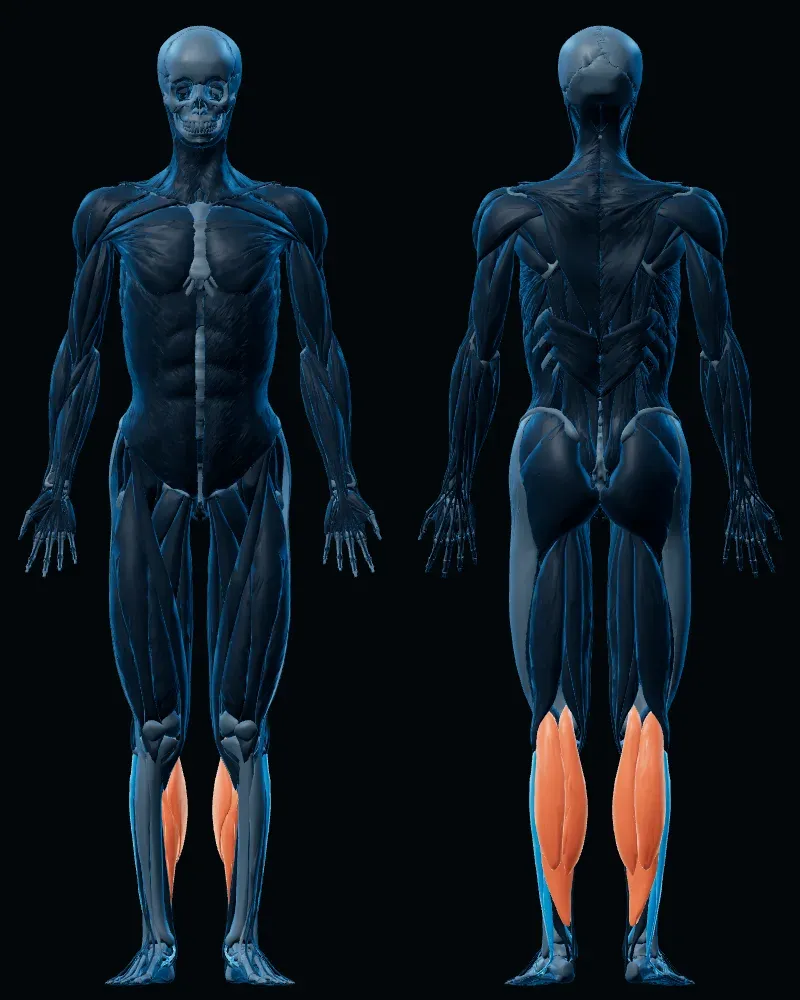
Muscles worked: calves
Main movers: gastrocnemius and soleus
Table of contents
If your calves refuse to grow even though you smash seated calf raises every week, the exercise is probably the problem. In the straight leg vs seated calf raise comparison, the straight-knee version wins for the big visible calf muscle (the gastrocnemius), because bending your knee takes most of its tension away. Seated raises still train the soleus, the muscle underneath.
This is one of the clearest examples of the length-tension ideas in our guide to range of motion and stretch-mediated hypertrophy. Below: what each muscle does, what the trial data show, and a simple way to program both.
Why does knee angle change a calf raise?
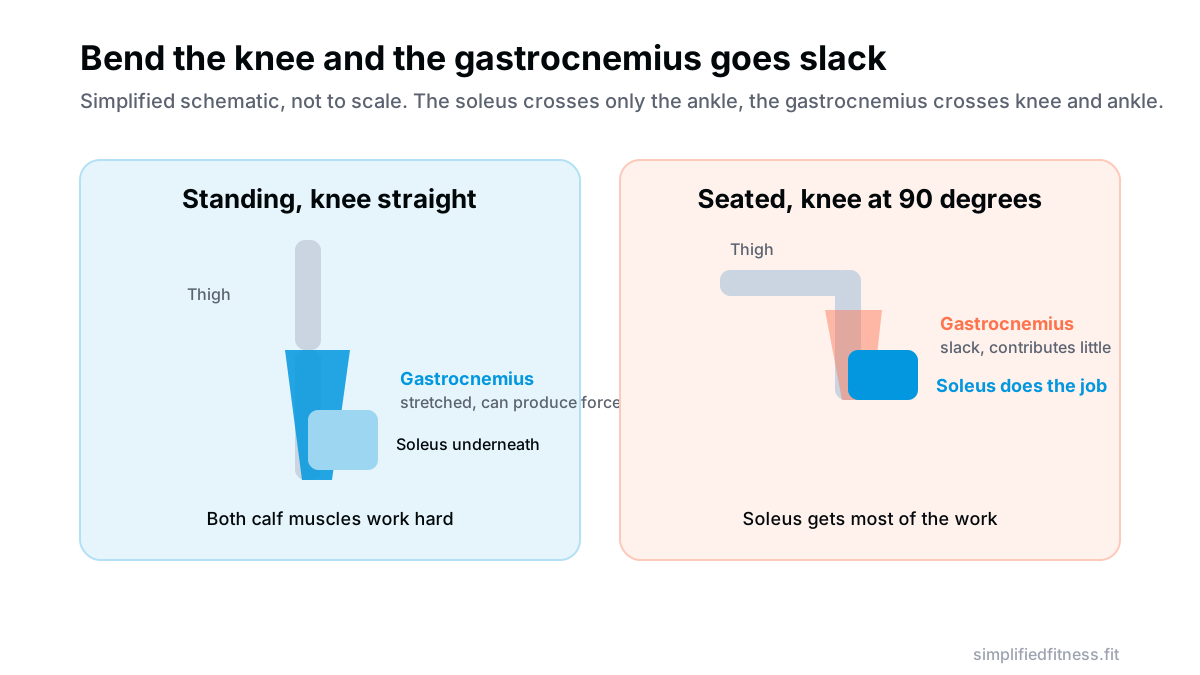
Your calf is really two muscles that share the Achilles tendon. The soleus attaches below the knee and crosses only the ankle. The gastrocnemius (the two-headed muscle you see from behind) starts above the knee, so it crosses both joints. It plantarflexes your ankle and also helps bend your knee.
That two-joint design is the whole story. A muscle can only produce good force within a certain length range. Bend the knee to 90 degrees and the gastrocnemius is shortened from its upper end, so it has less ability to contribute. Straighten the knee and it is held at a longer length, where it can produce more force. This is the same logic we cover in active vs passive insufficiency in biarticular muscles.
What does the research say about gastrocnemius vs soleus?
Several lines of lab evidence agree, though most are small studies in healthy young adults.
- Torque drops with a bent knee. In nine active men, maximal isometric plantar flexor torque was about 40% lower with the knee flexed than extended (about 93 vs 154 N·m) (Kovács et al., 2024). Gastrocnemius size tracked torque with the knee straight, but only soleus and total calf size tracked it with the knee bent.
- Motor units hand off. During a light, steady calf contraction, moving the knee into flexion lowered gastrocnemius motor unit firing, with most units de-recruited near full flexion, while soleus activity rose (Lauber et al., 2014).
- Same pattern with knee extension. Adding knee extensor effort to plantar flexion lowered medial gastrocnemius EMG and raised soleus EMG in ten men (Suzuki et al., 2014).
Notice the limits. These are acute measurements, not growth outcomes, and EMG is only a rough proxy for how much a muscle will grow. The growth data come next.
Does standing really grow more calf than seated?
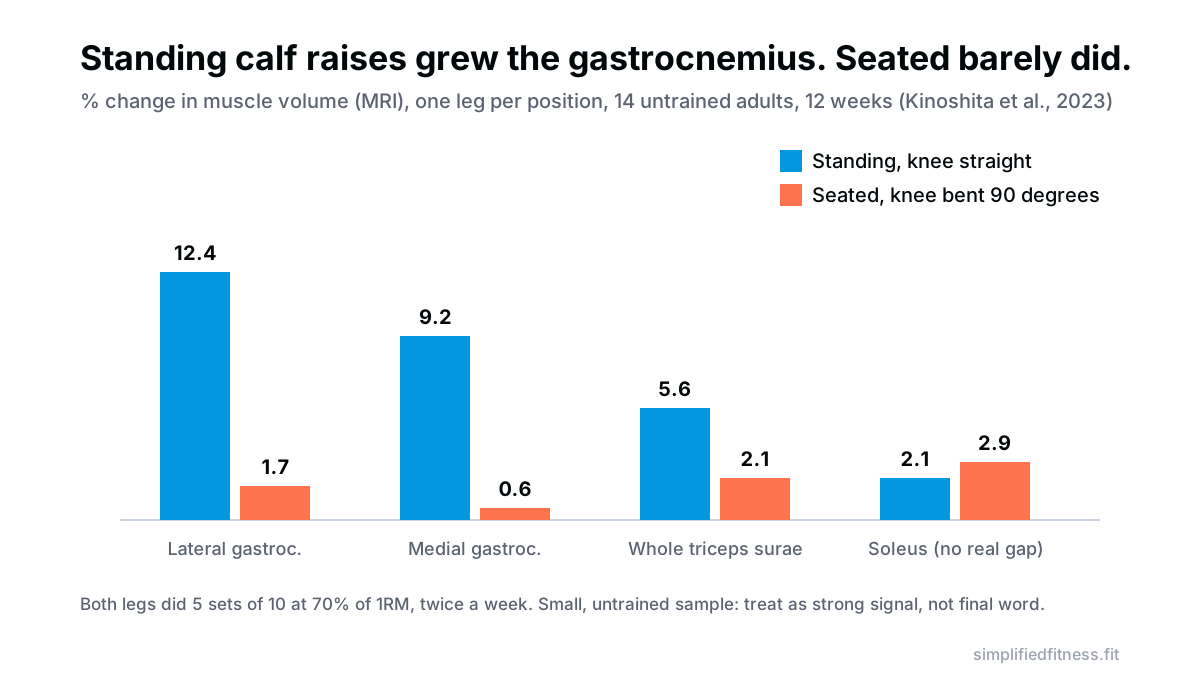
The best direct test is a 12-week within-person trial. Fourteen untrained adults trained one leg with standing, straight-knee calf raises and the other with seated raises at a 90-degree knee bend. Both legs did 5 sets of 10 reps at 70% of 1RM, twice a week, and MRI measured muscle volume (Kinoshita et al., 2023).
The results were not subtle:
- Lateral gastrocnemius: 12.4% vs 1.7% (standing vs seated)
- Medial gastrocnemius: 9.2% vs 0.6%
- Whole triceps surae: 5.6% vs 2.1%
- Soleus: 2.1% vs 2.9%, with no significant difference
The seated leg’s gastrocnemius growth was not statistically significant at all. The soleus grew about the same either way.
A systematic review of range of motion studies points the same way for the lower body: full-ROM training tends to beat partial ROM for hypertrophy there, though the review included only six studies and noted the response may be muscle-specific (Schoenfeld and Grgic, 2020).
Which calf muscle gives the “diamond” look?
From behind, the rounded, diamond-shaped bulk is mostly the two heads of the gastrocnemius. The soleus lies underneath and shows up as extra width and thickness toward the lower calf, especially from the side and front. I would not promise any specific shape change from any exercise, because tendon length and genetics also shape how calves look. But if you want the muscle most people mean by “big calves”, straight-knee work should come first.
You may see the soleus described as a slow-twitch, endurance-type muscle. That is a common teaching point, but I did not find a source I could verify here, and the programming advice below does not depend on it.
How do I train both properly?
Here is how I would set it up for a lifter in a normal commercial gym.
Straight-leg options (gastrocnemius priority):
- Standing calf raise (machine or smith)
- Donkey calf raise
- Leg-press calf raise with the knees straight but not hard-locked
- Single-leg standing raise on a step with a dumbbell
Bent-knee options (soleus priority):
- Seated calf raise
- Smith-machine or barbell raise with the knees bent
- Bent-knee raise with a dumbbell on the thigh
A simple weekly layout:
| Session | Exercise | Sets | Reps |
|---|---|---|---|
| Day A | Standing calf raise | 3 | 8-12 |
| Day A | Seated calf raise | 2 | 10-15 |
| Day B | Leg-press or donkey raise | 3 | 8-12 |
| Day B | Seated calf raise | 1-2 | 10-15 |
That lands at roughly 9-10 hard sets a week, in line with our usual 6-10 range, and puts about two-thirds of the work on the gastrocnemius. You can check your numbers with the training volume calculator or drop these into a leg day plan.
How deep should I go at the bottom?
Deep. The bottom of a calf raise is where the gastrocnemius is longest, and that is the position that seems to matter. Let the heel drop below the platform, hold the stretch for about a second so you do not bounce off the Achilles tendon, then rise to a full top squeeze.
The most common mistake here is bouncing through half reps with a heavy stack. It looks like a lot of weight, but the stretched range is exactly the part being skipped.
Some trials suggest the lengthened range may be especially useful for gastrocnemius growth:
- In 23 untrained men over 10 weeks, adding past-failure partial reps in the lengthened (dorsiflexed) position grew the medial gastrocnemius by 9.6% vs 6.7% for sets to failure alone, with the authors reporting strong Bayesian support (Larsen et al., 2025).
- In 16 untrained men, half as many sets with lengthened partials after full-ROM failure produced the same 8% thickness gain as standard sets, which means more growth per set but not more growth overall (Goli et al., 2026).
- In 23 resistance-trained men and women over 8 weeks, partials in the stretched range from the first rep edged out full-ROM sets finished with partials at the top, but the evidence for a difference was only anecdotal and both approaches worked (Larsen et al., 2025).
So the picture is: lengthened-range work looks good, but which exact method is best is unsettled, and every one of these was short-term. More on this in our guide to lengthened partials.
What about stubborn calves?
Calves have a reputation for a reason. The authors of the MRI trial describe the triceps surae as relatively unresponsive to resistance training compared with other muscles, though prone to shrinking when inactive (Kinoshita et al., 2023). Here is the checklist I would run:
- Are you doing straight-knee raises at all?
- Do you reach a deep stretch every rep?
- Are you finishing within 1-3 reps of failure?
- Do you train them at least twice a week?
- Are you adding reps or load over months, or just repeating the same numbers?
Quick comparison
| Straight-knee raise | Bent-knee raise | |
|---|---|---|
| Main target | Gastrocnemius (plus soleus) | Soleus |
| Gastrocnemius length | Long, more tension | Short, little tension |
| MRI growth, gastroc (12 wk) | 9-12% | Under 2% |
| MRI growth, soleus (12 wk) | 2.1% | 2.9% |
| Best use | Base of calf training | Add-on for soleus |
Where this fits with the rest of your calf training
This article is about one variable: knee angle, and what it does to each calf muscle. Volume, frequency, rep ranges and the full weekly picture live in our calf hypertrophy guide to standing vs seated raises. The short version holds either way. Keep the knee straight for most of your sets, go deep, and push hard. Protein matters for every muscle, calves included, so check your daily target with the protein calculator, whether you eat meat or rely on dal, paneer and curd.
When to see a doctor
Normal calf soreness fades in a few days. Sudden sharp pain, a swollen, warm or red calf on one side, or calf pain after a long trip needs medical assessment, since it could be a muscle or tendon injury or a clot. Do not train through it.
The bottom line
Bending your knee removes most of the gastrocnemius from the exercise, and the soleus takes over. For visible calf growth, build the base from straight-knee raises with a deep stretch, then add seated raises for the soleus. The best direct data are one 12-week MRI trial in untrained adults plus lab studies of muscle activation, so expect to refine the details, not abandon the principle. Pair this with a sensible weekly plan and enough protein, and give it a few months.
Frequently Asked Questions
Is a standing or seated calf raise better for growing calves?
For the gastrocnemius, the big visible calf muscle, standing is clearly better. In a 12-week MRI trial in untrained adults, standing calf raises grew the gastrocnemius about 9-12% while seated raises grew it under 2%. Make standing (or any straight-knee) calf work your main movement and add seated raises as a second exercise.
Does the seated calf raise work the gastrocnemius at all?
Only a little. With the knee bent to 90 degrees the gastrocnemius is shortened and its contribution drops sharply, so the soleus does most of the work. In lab work at low effort, many gastrocnemius motor units switched off as the knee bent. If your calves look flat from behind, switching to straight-leg raises is the first change to try.
What muscle does the seated calf raise work?
Mainly the soleus, the flatter muscle that sits under the gastrocnemius. Research on knee angle shows the soleus gets more active as the knee flexes while the gastrocnemius gets less active. Use seated raises to build the soleus, which helps calf thickness and day-to-day ankle strength.
Why are my calves not growing?
From a knee-angle point of view, the classic cause is relying only on seated raises, which barely grew the gastrocnemius in an MRI trial. Shallow reps, easy sets and training calves rarely are the other usual suspects. Add straight-knee raises with a full stretch, and see our full calf hypertrophy guide for volume and frequency.
How do I work the gastrocnemius and soleus separately?
Keep the knee straight to emphasise the gastrocnemius and bend it to about 90 degrees to emphasise the soleus. Standing calf raises, donkey raises and leg-press calf raises keep the knee straight. Seated calf raises or a bent-knee version on a smith machine bias the soleus.
Are donkey calf raises better than standing calf raises?
Both keep the knee straight, so both train the gastrocnemius at a long length, and I am not aware of a direct trial that crowns one. Donkey raises let you bend at the hips and stretch the calf deeply, but they are awkward to load. Pick whichever lets you reach a deep stretch with strict form.
How low should I go on a calf raise?
As low as you can control without bouncing, with your heel clearly below the step. Trials in untrained people have found good gastrocnemius growth when sets include the lengthened, dorsiflexed position. Pause for a second at the bottom, then drive up to a full squeeze.
How many sets of calf raises per week do I need?
A reasonable starting range is 6-10 hard sets per week, split across two or three sessions, and more if progress stalls. The 12-week trial above used 10 sets per week per leg and produced clear gastrocnemius growth with standing raises. Add a set or two only if your reps and size stop improving.
Do I need to train calves with heavy weight or high reps?
Both can work if the set is taken close to failure with a full range of motion. The MRI trial used loads around 70% of one-rep max for 10 reps. Choose a load where 8-15 controlled reps with a deep stretch are tough.
Are partial reps at the bottom useful for calves?
They look promising but the evidence is early. Two 10-week trials in untrained men found extra lengthened partials after failure were at least as good as standard sets, and one favoured them, while an 8-week study in trained lifters found only anecdotal differences between partial methods. Finish a set with a few short bounces in the stretched range if you like, but do not lean on them.
Is genetics the reason my calves are small?
Genetics probably plays a part, including tendon length and muscle shape, but the evidence for exact limits is thin. Calves are also described as slow to grow with training in the MRI trial's background. Fix the exercise choice and range of motion first, then judge after several months.
Should I see a doctor about calf pain or swelling?
Yes if you have sudden sharp pain, one swollen or warm calf, or pain after a long flight or sitting. These can signal a tear or a blood clot, which need medical assessment. Normal training soreness should settle in a few days.
Sources & References
Every claim above is checked against peer-reviewed research (PubMed, U.S. National Library of Medicine) or guidance from established health bodies. How we fact-check.
- Kinoshita M, et al. Triceps surae muscle hypertrophy is greater after standing versus seated calf-raise training. Front Physiol. 2023. PMID: 38156065
- Schoenfeld BJ, et al. Effects of range of motion on muscle development during resistance training interventions: A systematic review. SAGE Open Med. 2020. PMID: 32030125
- Lauber B, et al. Reciprocal activation of gastrocnemius and soleus motor units is associated with fascicle length change during knee flexion. Physiol Rep. 2014. PMID: 24920126
- Suzuki T, et al. Gastrocnemius and soleus are selectively activated when adding knee extensor activity to plantar flexion. Hum Mov Sci. 2014. PMID: 24922619
- Kovács B, et al. Effects of knee joint position on the triceps Suræ torque-size relationship during plantarflexion in healthy young adults. J Biomech. 2024. PMID: 39577118
- Larsen S, et al. Resistance training beyond momentary failure: the effects of past-failure partials on muscle hypertrophy in the gastrocnemius. Front Psychol. 2025. PMID: 39995432
- Goli A, et al. Does performing partial repetitions beyond momentary failure enhance muscle hypertrophy in volume-load-equated calf-raise resistance training? Int J Exerc Sci. 2026. PMID: 42006449
- Larsen S, et al. Resistance training beyond momentary failure: the effects of past-failure partials versus initial partials on calf muscle hypertrophy among a resistance-trained cohort. Eur J Sport Sci. 2025. PMID: 40850937

Umair Hazrami · Founder & Head Coach, Simplified Fitness
Umair Hazrami founded Simplified Fitness and the Simplified Lifter channel to cut through fitness noise. With 4+ years of consistent training and 10+ coaching clients, he writes every guide from the peer-reviewed research and links the sources so you can check them. Our editorial standards.
Educational content only, not medical advice. If you have a medical condition, are pregnant, or take medication, talk to a qualified doctor before changing your diet, supplements or training. Full disclaimer.
Keep reading
Hypertrophy
Active vs Passive Insufficiency: How Two-Joint Muscles Change Your Exercise Choice
Active vs passive insufficiency explained for lifters: why hamstrings, triceps, quads and calves grow differently depending on your second joint position.
10 min read
Hypertrophy
Squat Mobility With Long Femurs: Adapting Range of Motion to Your Hips
Squat mobility with long femurs is mostly a lever and hip-socket issue, not a flaw. Learn how to adjust depth, stance and heels without risking your hips.
10 min read
Hypertrophy
Dumbbell Pullovers vs Cable Lat Pull-ins: Training Lats at Long Muscle Lengths
Training lats at long muscle lengths: is the dumbbell pullover a lat or chest exercise, and why a cable lat pull-in may keep tension where you want it.
7 min read
Hypertrophy
Full vs Partial Range of Motion: What the Hypertrophy Research Shows
Full vs partial ROM hypertrophy explained: what two meta-analyses and recent trials found, where lengthened partials fit, and how to set your range of motion.
8 min read