Bulgarian Split Squats vs Lunges: Which Single-Leg Exercise Builds the Most Muscle?
Bulgarian split squat vs lunges: which builds more leg muscle? Compare walking lunges and deficit reverse lunges, torso lean, foot position and loading.
TL;DR. The short answer
- No single-leg exercise has been shown to beat the others for muscle growth. Bulgarian split squats, walking lunges and deficit reverse lunges all load the quads and glutes heavily, so pick the one you can progress and tolerate.
- A 2025 meta-analysis of 9 studies found no significant difference in muscle hypertrophy between unilateral and bilateral training, so single-leg work is a valid swap for squats, not a magic upgrade.
- Leaning your torso forward adds glute and hamstring work to a split squat. In one EMG study of 21 female athletes, trunk flexion raised glute max, biceps femoris and even rectus femoris activity, so leaning does not simply take work away from the quads.
- Longer forward lunge steps raised glute, quad, hamstring and adductor muscle activity in a 2025 EMG study, so step length is a real dial for overall lunge difficulty and glute work.
- Smith machine and free-weight squats produced similar thigh growth in an 8-week trial in students, so a Smith machine split squat is a fair option if balance limits your load.
Part of our complete guide: Complete Lower-Body & Core Training Guide: Quads, Glutes, Hamstrings, Calves & Abs Science
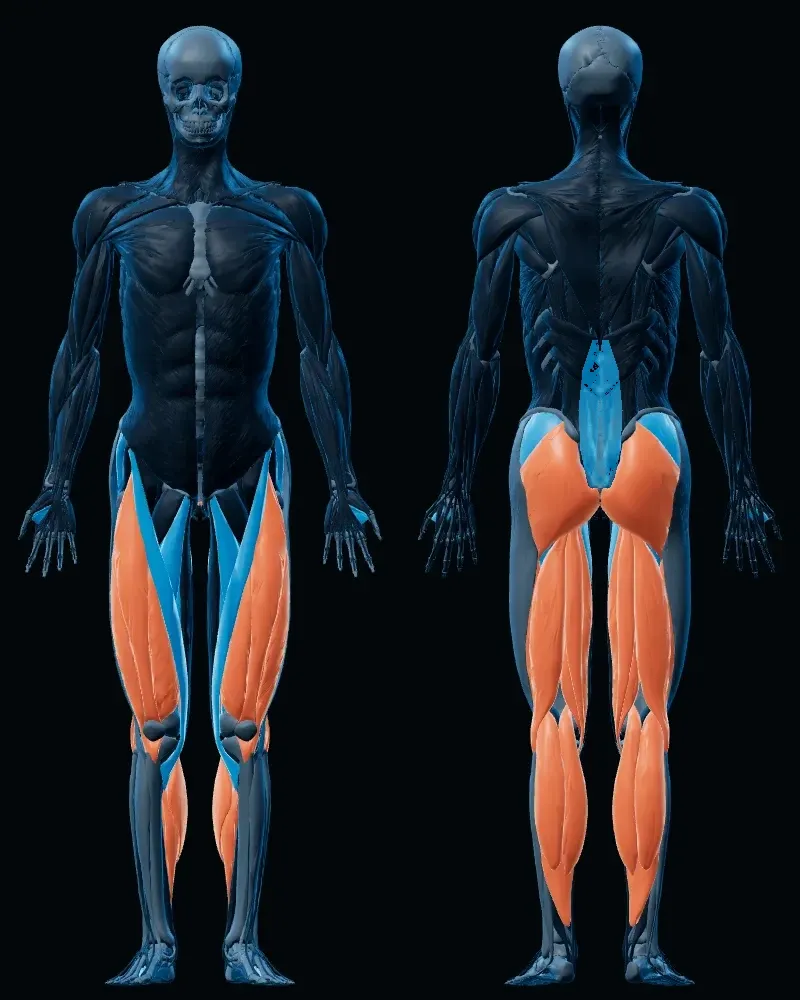
Muscles worked: leg day
Main movers: quads, glutes, hamstrings and calves
Assisting: lower back, adductors and gluteus medius
Table of contents
Bulgarian split squat vs lunges is a debate with a boring but useful answer: no study has shown that one of them builds clearly more muscle than the other. Both load the quads and glutes hard, and the “best” one is the version you can load progressively, week after week, without your knee or your balance getting in the way.
This guide compares the three single-leg staples most people argue about (Bulgarian split squats, walking lunges and deficit reverse lunges), then shows how torso lean, step length and equipment change what you feel. It sits inside our complete lower body and core training guide, so it stays focused on the exercises themselves.
Do single-leg exercises build as much muscle as squats?
Probably, yes. A 2025 systematic review and meta-analysis (Kassiano et al., 2025) pooled 9 studies and found no significant difference in muscle hypertrophy between unilateral and bilateral training. Strength followed specificity: bilateral training improved bilateral strength more, while unilateral training improved single-leg strength more.
Two cautions. The authors described the literature as limited, and the included studies carried moderate risk of bias. So the honest reading is “no evidence of a difference”, not “proven identical”.
For a deeper look at when each makes sense, see our article on unilateral vs bilateral training for hypertrophy. The short version is that single-leg work is a good swap when you want less spinal loading or want to expose left-right differences, and a fair addition rather than a replacement for squatting.
Bulgarian split squat: what makes it different?
The back foot is on a bench, the front foot does most of the work, and the range of motion is long. A 2021 study of 20 resistance-trained men (Mackey & Riemann, 2021) compared it with the back squat. The split squat was done at 35% of back squat 1RM, the back squat at 70%. Both were hip-dominant, and the knee contributed relatively less in the split squat, with less knee bend at the bottom. The authors suggested it can suit situations where you want to emphasise hip extension while limiting knee demands, such as early knee rehab.
That fits what lifters report: you get a big stretch through the front hip and a lot of work on the glute and quad without needing a heavy barbell on your back. It does not prove the split squat grows more muscle, only that the loading profile is different.
Quads or glutes: how torso lean changes the split squat
This is the most useful adjustment you can make. In a cross-sectional EMG study of 21 trained female athletes (Aygun-Polat et al., 2025), flexing the trunk forward increased activation of the gluteus maximus, biceps femoris and rectus femoris compared with a neutral trunk. A suspension-trainer version mostly raised spinal erector activity.
That partly matches what coaches teach: hinge from the hips with a slight forward lean and the glutes and hamstrings join in. The common cue that staying tall shifts work onto the quads was not borne out here, since rectus femoris activity actually went up with the lean. An upright torso with the knee travelling forward is still a sensible quad-led setup, just not a proven one.
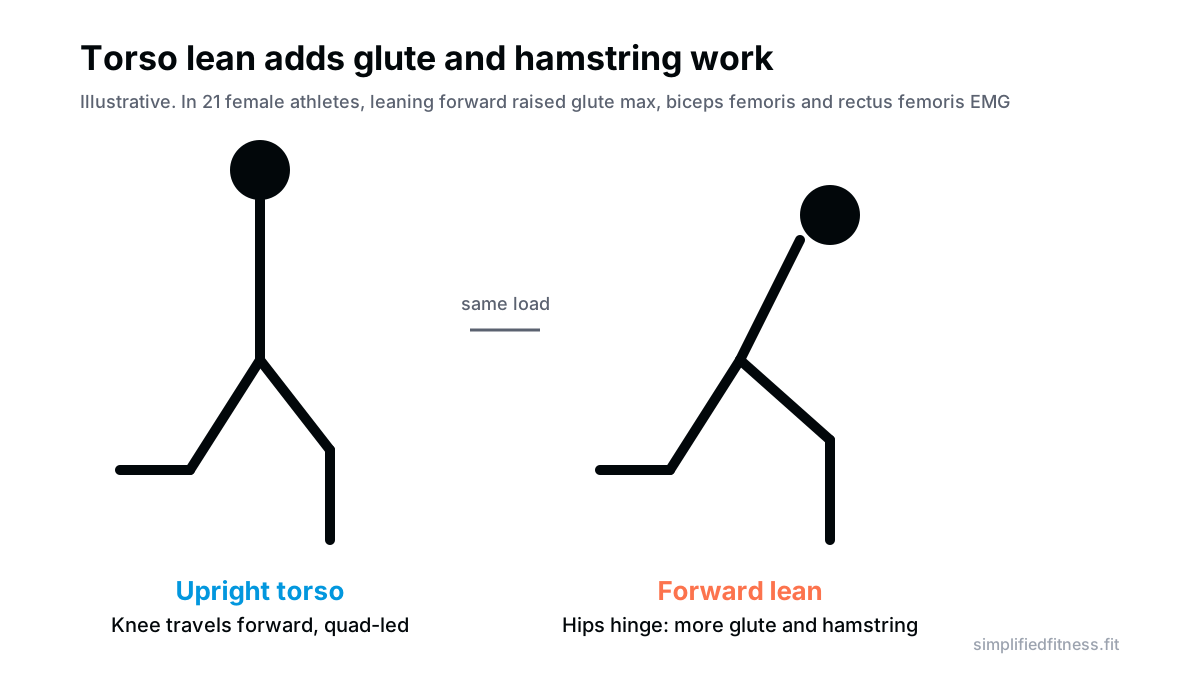
Remember this was a small study in one group, and EMG shows activity, not growth. Use it as a guide for how the set feels, not as a promise.
Foot position in practice
Put your front foot far enough forward that your heel stays flat at the bottom. Too close and the front knee crashes forward and your heel lifts. Too far and you run out of hip mobility and the set turns into a stretch you cannot control.
Test with two or three bodyweight reps. Adjust by a few centimetres, then lock that position in for the whole set so both sides are comparable.
Walking lunges: a quad and glute volume tool
Walking lunges are dynamic, which makes them handy for higher reps. The closest data come from forward lunges rather than true walking lunges. A 2025 EMG study of 20 adults at their 12-rep max (Escamilla et al., 2025) compared short vs long steps, and stepping out and back vs lunging with the feet stationary. Quadriceps, hamstring, adductor and glute max activity were greater with a long step than a short one, and glute max and glute medius activity were greater with a stride than without. The authors concluded that loaded forward lunges produced high to very high activity in the quads, glute max and glute medius, with moderate activity in the hamstrings, calves and adductor longus.
So a longer step and a real stride are the glute-friendly settings. Shorter steps lowered activity in most muscles measured, quads included, so they are the easier option rather than a quad-specific one. Again, EMG tells us about muscle activity, not guaranteed muscle size.
A systematic review of glute max activation during strength and hypertrophy exercises (Neto et al., 2020) also listed the split squat, in-line lunge and traditional lunge among exercises with very high glute max activation (above 60% of maximal voluntary contraction). For a wider glute comparison, see hip thrusts vs squats for glute growth.
Deficit reverse lunge: why lifters like it
The deficit reverse lunge puts your front foot on a low platform (a 2-5 cm plate is plenty to start) and steps the other leg back. The back knee gets lower than the front foot, which lengthens the front-leg hip and glute under load.
The reason that matters is range of motion. A systematic review of full vs partial range (Schoenfeld & Grgic, 2020) found that full-range training had beneficial effects on lower-body hypertrophy versus partial range. That review included six studies, mostly in men, so it supports “do not cut the bottom off your reps” rather than “deeper is always better”.
On knee safety, many lifters find the reverse lunge friendlier than the forward lunge because the shin stays more upright on the working leg. I could not find a controlled trial that confirms deficit reverse lunges are safer for knees, so please treat that as a practical coaching observation, not a proven effect.
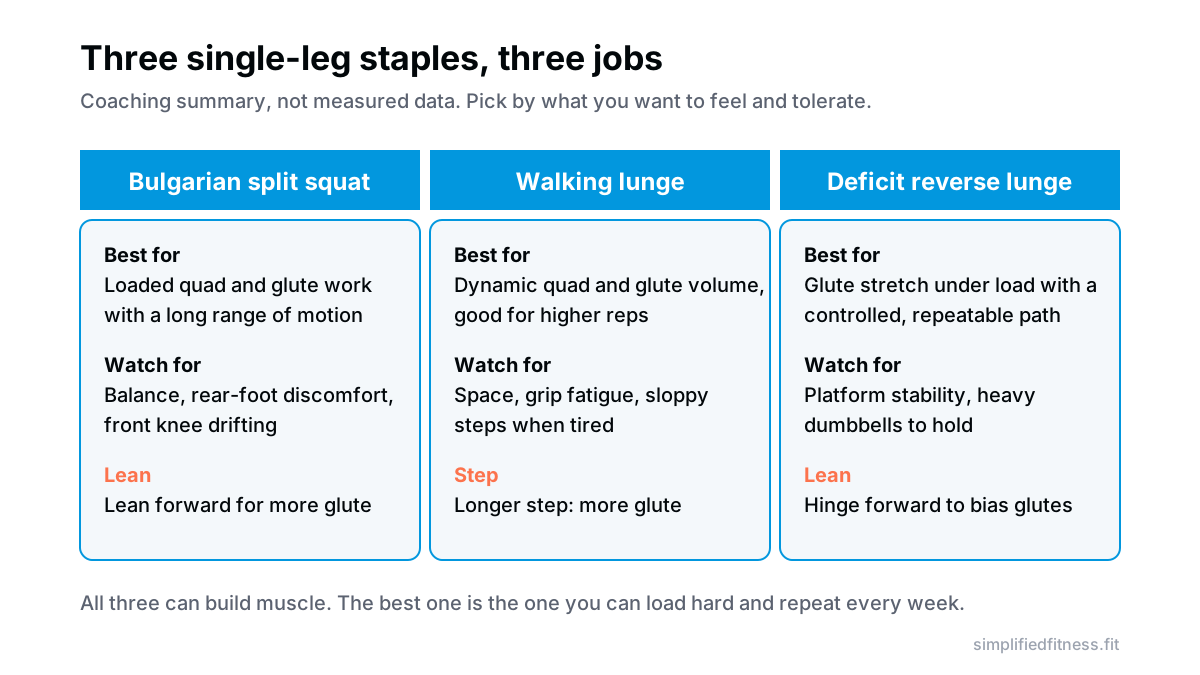
Bulgarian split squat vs lunges vs deficit reverse lunge
| Exercise | Typical strength | Common limiter | Simple emphasis dial |
|---|---|---|---|
| Bulgarian split squat | Loaded stretch, stable bench support | Balance, rear-foot comfort | Lean forward for more glute |
| Walking lunge | Dynamic reps, easy to chain sets | Space, grip, sloppy steps | Longer step for more glute |
| Deficit reverse lunge | Controlled path, long hip range | Platform setup, holding weights | Hinge forward for more glute |
If you only pick one, pick the one you can add load or reps to every week for 6-8 weeks. Progress is what makes muscle, not the name of the exercise.
Dumbbells vs Smith machine for single-leg work
Free weights are the default because they are cheap and available everywhere. If balance limits your load, a Smith machine can help you push the legs harder.
An 8-week trial in 37 sport-science students (Marcos-Frutos et al., 2025) compared free-weight and Smith machine back squats and found comparable growth in vastus lateralis cross-sectional area. Strength gains were larger when the training and testing conditions matched. That trial used two-leg squats in students, not split squats, so the transfer to single-leg work is an assumption.
The practical read: a Smith machine split squat is a fair option, especially if wobbling on dumbbells is what ends your set early.
Embracing the burn without wrecking your knees
Split squats feel awful, and that is normal: a lot of tension, a long range, one leg doing the work. A strong burn in the thigh or glute is fine. Sharp pain at the front of the knee, pain that lingers afterward or a knee that gives way is not.
Stop the set if that happens, simplify the exercise (shorter range, lighter weight, a different variation) and see a physiotherapist or doctor if it persists. This article is general education, not a diagnosis.
How to program unilateral leg work
Treat single-leg movements as part of your weekly leg volume, not as an add-on. A simple template for most lifters:
- One heavy bilateral lift (squat or leg press) first.
- One single-leg movement second, 2-3 hard sets per leg.
- Start with the weaker leg and match the reps on the stronger side.
- Use the same dumbbell weight on both sides and only add weight when the weaker side can do it.
For squat variation specifics, see our high-bar vs low-bar squat guide. To place these exercises in a full week, use the complete leg workout programming guide and check weekly hard sets with the training volume calculator. Our free leg day plan is also a good starting point.
On a vegetarian Indian diet, getting enough protein (dal, paneer, curd, soya) matters more for leg growth than which lunge variation you choose, so make sure the basics are covered first.
Bottom line
Bulgarian split squats, walking lunges and deficit reverse lunges can all build leg muscle. The evidence does not crown a winner, so choose the exercise you can load safely and progress consistently. Use torso lean and step length to steer the emphasis, keep your range of motion full, and judge the set by how well you control it, not by how much it hurts.
Frequently Asked Questions
Is the Bulgarian split squat better than lunges?
Neither has been shown to be better for muscle growth. Both load the quads and glutes with high muscle activity, and the difference is mostly practical: the split squat is stationary and easier to load heavy, while lunges are more dynamic. Choose the one where you can add weight or reps over the weeks.
Do unilateral leg exercises build as much muscle as squats?
Probably yes, based on current evidence. A 2025 meta-analysis of 9 studies found no significant difference in hypertrophy between unilateral and bilateral training, though the literature is limited and risk of bias was moderate. Use single-leg work when you want less spinal loading or need to find and fix left-right differences.
Do Bulgarian split squats work quads or glutes?
Both. In a study of 21 trained female athletes, trunk flexion increased glute max, biceps femoris and rectus femoris activation, so a forward lean adds glute and hamstring work without obviously reducing quad activity. Coaches often cue an upright torso with the knee travelling forward for a quad focus, but that specific shift has not been shown in the data.
How do I make walking lunges target glutes instead of quads?
Take a longer step. A 2025 EMG study of forward lunges found glute max and hamstring activity was higher with a long step than a short step, and quad activity rose too. A slight forward lean may add glute work, based on split squat data. Keep the front foot flat and drive through the whole foot.
What is a deficit reverse lunge?
It is a reverse lunge where the front foot stands on a low platform, so the back knee travels deeper and the front hip works through a longer range. Evidence on lower-body training suggests full range of motion helps growth compared with partial range. Start with a 2-5 cm plate or step and add height only if you control the bottom.
Is the deficit reverse lunge safe for knees?
Many lifters find reverse lunges kinder on the knee than forward lunges, but I could not find a trial that confirms this, so treat it as a practical observation. Stepping back keeps your shin more vertical on the working leg for most people. If a movement causes sharp or persistent knee pain, stop and see a physiotherapist or doctor.
How far forward should my front foot be in a Bulgarian split squat?
Far enough that your front shin stays roughly vertical or slightly forward at the bottom without your heel lifting. As a coaching rule of thumb, a longer stance tends to feel more hip and glute heavy, and a shorter one more quad heavy, though this has not been tested directly. Test it with two or three warm-up reps and adjust by a few centimetres.
Can I use a Smith machine for split squats?
Yes. In an 8-week trial of 37 sport-science students, free-weight and Smith machine squats gave comparable thigh muscle growth, with differences showing up in strength tests that matched the training style. A Smith machine can help if balance, not leg strength, is stopping you from loading the set.
How many sets of single-leg exercises should I do per week?
Treat them as part of your weekly leg volume, not extra on top. Most lifters do well with roughly 2-3 hard working sets per leg of a unilateral movement per session, 2 times a week, inside a total leg plan. Track weekly hard sets with our training volume calculator and adjust by recovery.
Why do Bulgarian split squats feel so hard?
Balance, a long range of motion and a loaded hip stretch all pile onto one leg at once. Your stabilisers work harder than in a two-leg squat, so you usually lift a lot less. Lower the load, slow the descent and let the burn be a sign of effort, not a reason to bail.
Which leg should I start with if one is weaker?
Start with the weaker leg, then match the reps on the stronger side. This stops the strong leg from setting a standard the weak one cannot hit. Use the same dumbbell weight on both sides and only progress when the weaker leg can do it.
Should I do single-leg work before or after squats?
Do your heaviest, most technical lift first and the single-leg movement second. Split squats leave the legs and balance tired, which makes a heavy back squat harder to control. If single-leg work is your main leg lift for the day, put it first.
Sources & References
Every claim above is checked against peer-reviewed research (PubMed, U.S. National Library of Medicine) or guidance from established health bodies. How we fact-check.
- Kassiano W, et al. Comparison of Muscle Growth and Dynamic Strength Adaptations Induced by Unilateral and Bilateral Resistance Training: A Systematic Review and Meta-analysis. Sports Med. 2025. PMID: 39794667
- Mackey ER, et al. Biomechanical Differences Between the Bulgarian Split-Squat and Back Squat. Int J Exerc Sci. 2021. PMID: 34055144
- Aygun-Polat E, et al. Targeted muscle activation in Bulgarian split squat variations: effects of trunk position and suspension-based execution. BMC Sports Sci Med Rehabil. 2025. PMID: 40867012
- Neto WK, et al. Gluteus Maximus Activation during Common Strength and Hypertrophy Exercises: A Systematic Review. J Sports Sci Med. 2020. PMID: 32132843
- Escamilla RF, et al. Effects of Step Length and Stride Variation During Forward Lunges on Lower-Extremity Muscle Activity. J Funct Morphol Kinesiol. 2025. PMID: 39982282
- Schoenfeld BJ, et al. Effects of range of motion on muscle development during resistance training interventions: A systematic review. SAGE Open Med. 2020. PMID: 32030125
- Marcos-Frutos D, et al. Comparative Effects of the Free Weights and Smith Machine Squat and Bench Press: The Important Role of Specificity for Strength Adaptations. Int J Sports Physiol Perform. 2025. PMID: 39740659

Umair Hazrami · Founder & Head Coach, Simplified Fitness
Umair Hazrami founded Simplified Fitness and the Simplified Lifter channel to cut through fitness noise. With 4+ years of consistent training and 10+ coaching clients, he writes every guide from the peer-reviewed research and links the sources so you can check them. Our editorial standards.
Educational content only, not medical advice. If you have a medical condition, are pregnant, or take medication, talk to a qualified doctor before changing your diet, supplements or training. Full disclaimer.
Keep reading
Exercise Technique
Adductor Magnus Training: Seated Adductor Machine and Copenhagen Planks for Thigh Mass
Adductor magnus training explained: what research says on deep squats, the adductor machine and Copenhagen planks for thicker inner thighs and groin strength.
7 min read
Exercise Technique
High Bar vs Low Bar Squat: Which Builds More Quad Muscle?
High bar vs low bar squat for hypertrophy: what torso lean, knee travel and EMG studies show, why high-bar leans quad, and when low-bar still makes sense.
8 min read
Exercise Technique
Calf Hypertrophy Science: Standing vs Seated Calf Raises (Gastrocnemius vs Soleus)
Calf hypertrophy explained: why calves seem stubborn, what the trials say on exercise choice, stretch and foot position, plus weekly sets, reps and frequency.
9 min read
Exercise Technique
Complete Leg Workout Programming: Quad Day vs Hamstring and Glute Day
Best leg workout routine science: split leg day into a quad session and a hamstring-glute session, with sets, order and a 5-week plan that avoids burnout.
9 min read