Front Squat vs Back Squat for Quads: Which Builds More Muscle?
Front squat vs back squat quads: what lab studies show on quad activation, knee load and lower back stress, plus setup fixes for wrists and upper back.
TL;DR. The short answer
- In trained lifters, the front squat and back squat produced similar overall leg muscle activity in the lab (15 trained people, Gullett 2009), so neither is clearly the better quad builder on EMG alone.
- The front squat put less compressive force and a lower knee extensor moment on the knee than the back squat in that study, which is why it is often suggested for sore knees. Another study found the knee demand is about the same once you compare each squat at its own maximum.
- Moving the load forward makes you stand more upright, but it did not reduce low-back demand in one study (Goršič 2024): low-back extension moments went up. The idea that front squats are automatically 'easy on the back' is not well supported.
- The main practical barriers are wrist comfort and upper back strength. Crossed arms or lifting straps usually help with wrist discomfort, and moderate sets of about 6-12 reps make it less likely your upper back gives out before your legs.
- Training the quads through a full, controlled range matters more than the label on the bar. If your knees or back hurt persistently, see a doctor or physio before changing exercises.
Part of our complete guide: Complete Lower-Body & Core Training Guide: Quads, Glutes, Hamstrings, Calves & Abs Science
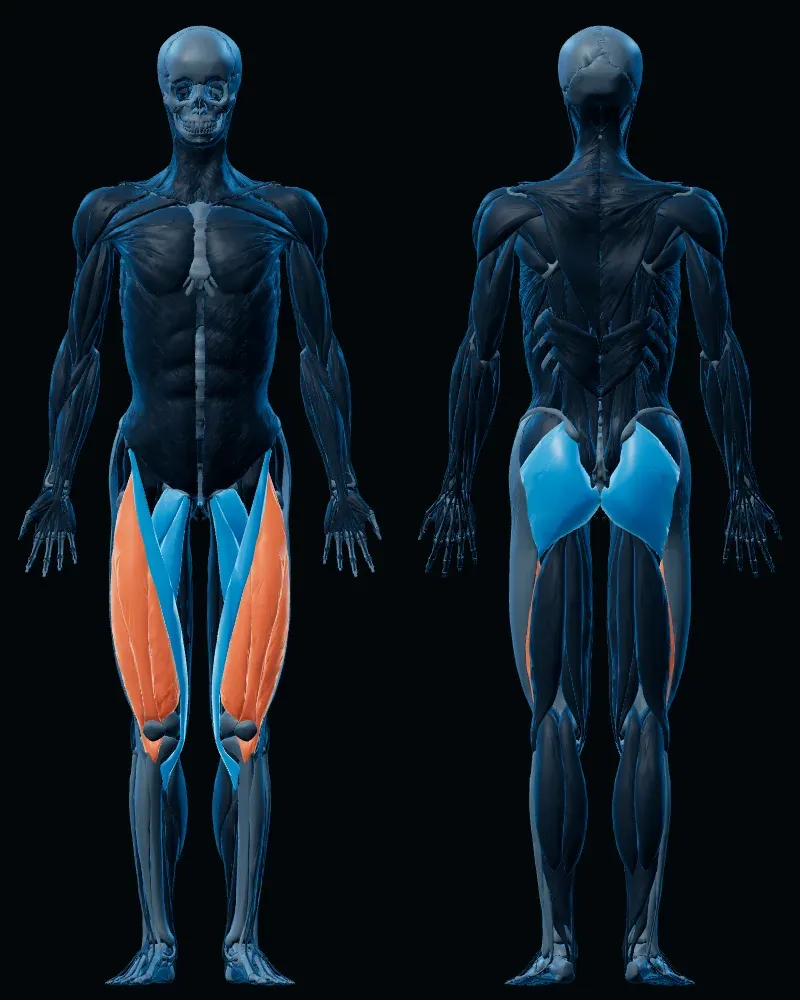
Muscles worked: quads
Main movers: rectus femoris and the three vasti
Assisting: adductors, sartorius and glutes
Table of contents
Front squat vs back squat quads: on current evidence, neither is clearly the better quad builder (see our complete lower body and core training guide for the full picture). In trained lifters the two lifts recruited the leg muscles to a similar degree, so the better choice is whichever one lets you train your quads hard, through a full range, for months.
That said, they feel very different, and the differences are worth understanding. The front squat shifts the bar forward, keeps you more upright, asks more of your upper back and wrists, and usually means a lighter bar. This guide covers what the research says, where it conflicts, and how to set the lift up. If you want the other side of this comparison, read our breakdown of high bar vs low bar back squat mechanics.
What actually changes between a front squat and a back squat?
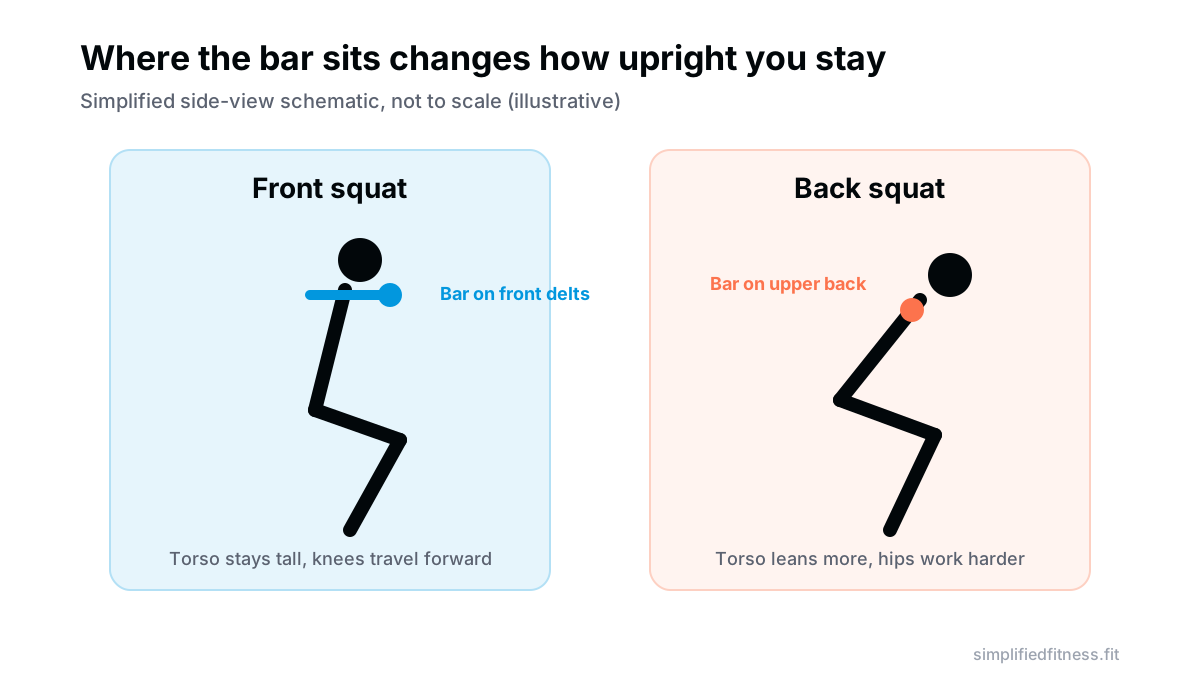
One thing: where the bar sits. In a front squat it rests on your front delts and collarbone. In a back squat it sits on your upper back. Everything else follows from that.
With the load in front of you, you have to stay tall or the bar rolls forward. With the load behind you, you can lean and let your hips and lower back share the work.
You may have read that this makes the front squat a pure quad exercise. The data does not say that, as the next sections show.
Front squat vs back squat quads: what does the research show?
Here is what the main studies found. All are small, so treat them as signals.
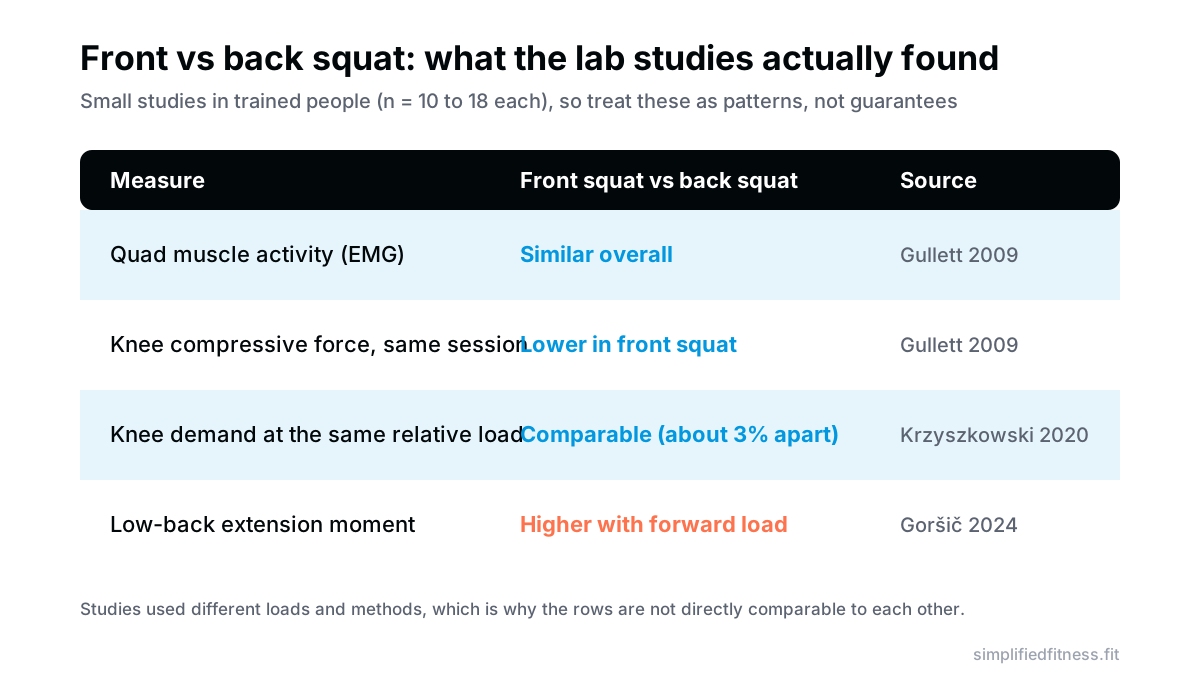
Quad activation looks similar. In a crossover study of 15 healthy trained people, bar position did not change muscle activity, and the authors concluded the front squat was as effective as the back squat for overall muscle recruitment (Gullett et al., 2009). A review of 18 EMG studies on the barbell squat reached a similar conclusion about common variations, including the front squat (Clark et al., 2012).
Some muscles do differ. In 10 male competitive bodybuilders squatting at 80% of 1RM, rectus femoris activity was greater in the front squat than the full-depth back squat during the ascent. Vastus medialis showed no difference. On the way down, glute and iliocostalis (a lower back muscle) activity was higher in the front squat (Coratella et al., 2021). The authors suggested the front squat needs more backward stabilisation while descending.
So the quads are working in both, and the front squat nudges the rectus femoris a bit more in one small group. That is not the same as proof of bigger quads. EMG measures activity, not growth, and no study here measured muscle size.
Are front squats really knee friendly?
This is the most common claim, and the evidence is real but mixed.
What study A found. In the 15 trained people mentioned above, the back squat produced higher knee compressive forces and higher knee extensor moments than the front squat. Shear forces at the knee were small and did not differ. The authors suggested front squats may be advantageous for people with knee problems such as meniscus tears (Gullett et al., 2009).
What study B found. In 11 NCAA Division-I athletes squatting at 40%, 60% and 80% of their front squat 1RM, knee extensor moments were actually higher in the front squat at 80%. Hip extensor moments were higher in the back squat. But when the researchers predicted values at each lift’s own 1RM, peak knee demand was only about 3% higher in the back squat (Krzyszkowski & Kipp, 2020).
Why they may differ. The studies used different loads, athletes and methods. Study B suggests that at the same bar weight the front squat loads the knee more and the hips less, while at each lift’s own maximum the knee demand is similar. One reasonable reading is that the front squat feels gentler on the knee mostly because people use a lighter bar, not because the movement itself is magically different. That is an interpretation, not something either study tested directly.
Practical takeaway. If your knees feel better in front squats, that is plausible and the lab data allows for it. But it is not guaranteed, and it is not a treatment. If you have persistent knee pain, get it assessed. Our guides on whether squats are bad for your knees and knee pain leg workout modifications go deeper.
Does the front squat spare your lower back?
Many articles say yes. The research is less certain.
In 18 people (10 men, 8 women) squatting at a constant 70% of their front squat 1RM, putting the load further forward made them stand more upright, as expected. But it increased low-back extension moments, with medium to large effect sizes, while hip, knee and ankle moments stayed generally similar (Goršič et al., 2024). The authors noted that people with low-back impairment should consider the different trunk angles and moments.
Does that mean front squats are bad for your back? No. Note the study fixed the load, whereas in real life you front squat with a lighter bar. It simply means the claim “front squats take the back out of the equation” is oversimplified. The upper and lower back still work hard to keep you upright.
If you have back pain, do not guess which squat is safer. Speak to a doctor or physio.
Why is the front squat so demanding on the upper back?
Because the bar tries to pull you forward and your upper back has to resist it. That is where the thoracic extension demand comes from. If the upper back rounds, the elbows drop, the bar rolls, and the set ends before your quads have done much.
For many lifters, the set does not end because the quads are spent. The upper back or wrists give out first. The fix is a combination of positioning and rep choice.
Elbows high. Drive your elbows up so your upper arms are roughly parallel to the floor. This creates a shelf for the bar.
Brace and breathe. Take a breath into your belly, tighten your trunk, and keep your chest proud.
Moderate reps. Sets of 6-12 reps are a sensible coaching default. On longer sets, the upper back and rack position often become the weak link.
Upper back work. Rows and face pulls help. Our guide to chest supported rows for upper back hypertrophy covers a good option.
How do you set up a front squat if your wrists hurt?
Wrist discomfort is another common reason people avoid the lift. You do not need a perfect clean grip.
- Cross-arm grip. Cross your arms and rest your fingers on the bar. Your shoulders hold the bar, not your hands. This suits lifters with tight wrists or forearms.
- Lifting straps. Loop straps around the bar and hold them with your hands. This gives a stable “shelf” without wrist extension.
- Fingertip clean grip. Two or three fingers under the bar is enough. Your hands only stabilise, they do not carry the weight.
- Warm up your wrists. Gentle wrist circles and forearm stretches before your first set are cheap insurance.
Front squat vs back squat: how heavy will you go?
Usually lighter in the front squat, because your upper back and torso become the limit before your legs do. The gap varies a lot between people, so ignore any fixed percentage you see online. Test a set of 8 in each lift and compare with the 1RM calculator.
Does that lighter load mean fewer gains? Not necessarily. Muscle growth responds to hard sets close to failure and to range of motion, not to how many plates are on the bar. A 2020 systematic review of six training studies, four of them on the lower body, concluded that full range of motion favoured lower-body hypertrophy over partial range (Schoenfeld & Grgic, 2020). So the depth you reach and control matters more than which squat you picked. We compare depth choices in squat depth science.
Which squat should you use?
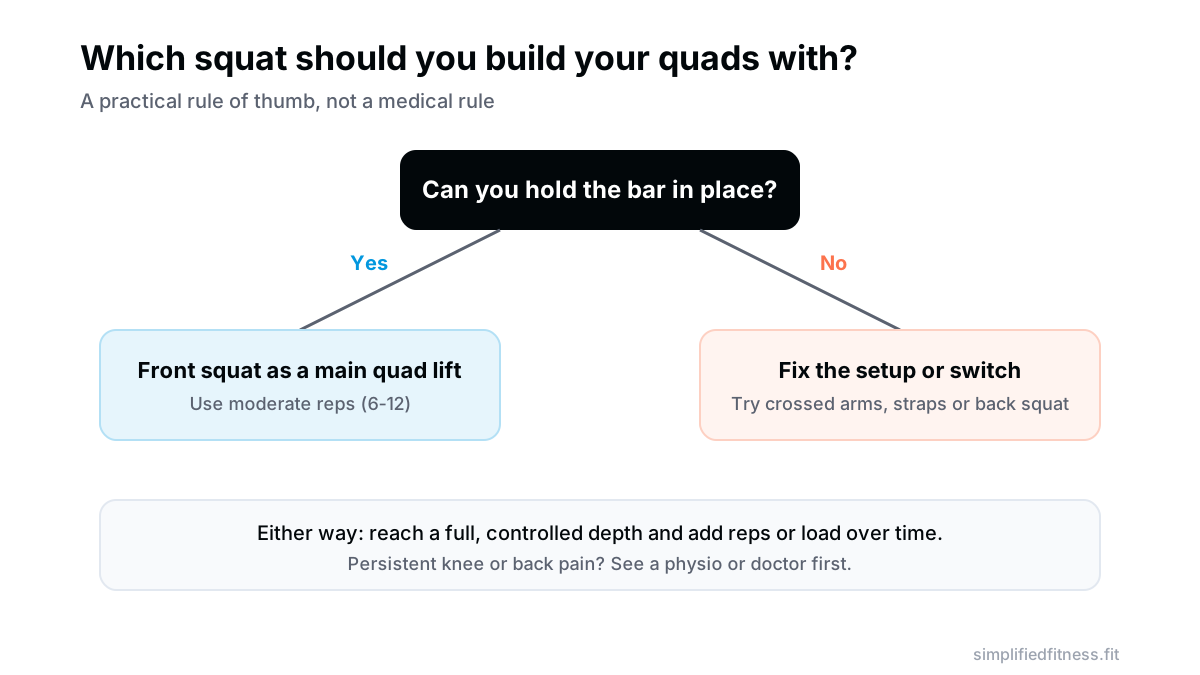
A simple way to decide:
| Your situation | Reasonable choice | Why |
|---|---|---|
| Want an upright, quad-focused squat | Front squat | Torso stays tall, rectus femoris active in some data |
| Strong upper back, comfortable rack position | Front squat | You can push the legs hard |
| Weak upper back or wrists limiting sets | Back squat or a different quad lift | Your limiter is not your quads |
| Want to lift the heaviest weights | Back squat | Bar sits where the body can support more |
| Sore knees but no diagnosis | Try both lightly, see a physio | Evidence is mixed |
Many lifters do best rotating them. Run the back squat as the main lift for a block, then switch to front squats, or use one as a secondary movement. If your goal is purely quad size and the squat setup is the bottleneck, look at the hack squat stimulus to fatigue ratio and leg extensions for rectus femoris hypertrophy.
How to program front squats for quads
- Frequency: once or twice a week.
- Sets and reps: 3-4 sets of 6-10 reps, leaving 1-3 reps in reserve (use the RIR and RPE calculator if you need a guide).
- Tempo: about 2 seconds down, controlled drive up.
- Depth: as deep as you can reach with heels down and torso tall.
- Pairing: follow with a leg extension or hack squat to finish the quads without the upper back limit.
- Progression: add a rep each week, then add 2.5 kg.
For a ready-made workout, see the free leg day plan.
When to see a doctor
Squatting should not cause sharp or persistent knee, back or wrist pain. See a doctor or physio if you have pain that lingers after training, swelling in a joint, locking or giving way, or numbness down a limb. Do not try to push through it by switching squat types.
The bottom line
The research on front squat vs back squat quads shows more overlap than difference. Overall muscle activation was similar, the knee advantage of the front squat shows up in some data but may largely reflect the lighter loads people use, and the claim that it spares the back is not well supported. Choose the version you can set up well and train hard, go deep, and progress steadily. For the broader picture, return to the lower body and core training guide.
Frequently Asked Questions
Are front squats better than back squats for quads?
Not clearly. In a crossover study of 15 trained people, overall muscle recruitment was similar between the two lifts, and a review of 18 EMG studies found that front squat variations do not significantly change muscle activation. Quad growth depends mostly on hard sets, range of motion and progression, so pick the version you can train hardest and most consistently.
Do front squats work the quads more than the glutes?
The evidence is mixed. In 10 competitive bodybuilders, rectus femoris activity was higher in the front squat than the full back squat on the way up, but gluteal activity was also higher in the front squat on the way down. Both squats train quads and glutes together, so treat the front squat as a quad-friendly option, not a quad-only one.
Are front squats knee friendly?
Sometimes. One study found lower knee compressive force and lower knee extensor moments in the front squat, and the authors suggested it may suit people with knee problems. A second study found that at each lift's own 1RM, knee demands were comparable, so front squats are not a guaranteed fix. If a squat hurts your knee, lower the load, shorten the range slightly, and speak to a physio.
Do front squats put less stress on the lower back?
Not necessarily. A study in 18 people found that placing the load further forward made participants stay more upright, yet increased low-back extension moments. The load is lighter in a front squat, which helps, but you cannot assume it is gentler on your spine. If you have back pain, get it checked and let a professional guide your squat choice.
Can I front squat if I have poor wrist mobility?
Yes. You do not need a full clean grip. Cross your arms in front, or use lifting straps looped around the bar so your fingertips and shoulders do the holding. Warm up your wrists and forearms, and keep your elbows high so the bar rests on your shoulders, not your hands.
Why do front squats feel so hard on the upper back?
Because the bar pulls you forward and your upper back has to hold you tall. Muscles in the thoracic region of the erector spinae were active during front squats in recreationally trained men (n = 7), which matches that feeling. Build up gradually with sets of 6-10 reps and a controlled tempo rather than heavy singles.
How much lighter will my front squat be than my back squat?
It is usually lower, but the exact gap varies person to person, so use your own numbers instead of a fixed percentage. The reason is that the upper back, grip and torso position become limiting before your legs do. Test a set of 8 in each lift and use the 1RM calculator to compare.
How many reps should I do front squats for hypertrophy?
Sets of about 6-12 reps work well for most people, because they keep the load high enough to challenge the quads but low enough that your upper back does not fail first. Hypertrophy occurs across a wide rep range when sets are taken close to failure. Stop a rep or two before form breaks down, particularly on heavy sets.
Should I do front squats and back squats in the same program?
You can. They are similar enough that doing both in the same session is rarely necessary, but rotating them across weeks or mesocycles gives variety. Run one as your main lift and use the other as a lighter secondary lift or in a different phase.
Does squat depth matter more than the type of squat?
It likely matters a lot. A 2020 systematic review of six training studies (four of them on the lower body) concluded that full range of motion favoured lower body hypertrophy over partial range of motion. Whichever squat you choose, go as deep as you can control, and keep your heels down.
Is a front squat safe for beginners?
It can be, if you start light and learn the rack position. Beginners often find the front squat teaches an upright torso naturally because the bar tips them forward if they lean. Start with a goblet squat or an empty bar, and consider asking a qualified coach to check your setup.
Do I need a squat rack for front squats?
A rack with adjustable safety pins is strongly recommended. Unracking a bar at shoulder height and being able to dump it forward safely makes heavy front squats far less stressful. In a crowded Indian gym where racks are shared, set the pins just below your bottom position and take turns.
Should I use heel elevation for front squats?
It can help if tight ankles stop you from staying upright. Small heel lifts or weightlifting shoes let the knees travel forward more easily, which increases knee bend at the bottom. Use it as a tool, not a crutch, and keep working on ankle mobility.
Sources & References
Every claim above is checked against peer-reviewed research (PubMed, U.S. National Library of Medicine) or guidance from established health bodies. How we fact-check.
- Gullett JC, et al. A biomechanical comparison of back and front squats in healthy trained individuals. J Strength Cond Res. 2009. PMID: 19002072
- Krzyszkowski J, et al. Load-dependent mechanical demands of the lower extremity during the back and front squat. J Sports Sci. 2020. PMID: 32544021
- Goršič M, et al. Biomechanical comparisons of back and front squats with a straight bar and four squats with a transformer bar. Sports Biomech. 2024. PMID: 33161870
- Coratella G, et al. The Activation of Gluteal, Thigh, and Lower Back Muscles in Different Squat Variations Performed by Competitive Bodybuilders: Implications for Resistance Training. Int J Environ Res Public Health. 2021. PMID: 33477561
- Bautista D, et al. A Comparison of Muscle Activation Among the Front Squat, Overhead Squat, Back Extension and Plank. Int J Exerc Sci. 2020. PMID: 32509107
- Clark DR, et al. Muscle activation in the loaded free barbell squat: a brief review. J Strength Cond Res. 2012. PMID: 22373894
- Schoenfeld BJ, et al. Effects of range of motion on muscle development during resistance training interventions: A systematic review. SAGE Open Med. 2020. PMID: 32030125

Umair Hazrami · Founder & Head Coach, Simplified Fitness
Umair Hazrami founded Simplified Fitness and the Simplified Lifter channel to cut through fitness noise. With 4+ years of consistent training and 10+ coaching clients, he writes every guide from the peer-reviewed research and links the sources so you can check them. Our editorial standards.
Educational content only, not medical advice. If you have a medical condition, are pregnant, or take medication, talk to a qualified doctor before changing your diet, supplements or training. Full disclaimer.
Keep reading
Exercise Technique
Adductor Magnus Training: Seated Adductor Machine and Copenhagen Planks for Thigh Mass
Adductor magnus training explained: what research says on deep squats, the adductor machine and Copenhagen planks for thicker inner thighs and groin strength.
7 min read
Exercise Technique
High Bar vs Low Bar Squat: Which Builds More Quad Muscle?
High bar vs low bar squat for hypertrophy: what torso lean, knee travel and EMG studies show, why high-bar leans quad, and when low-bar still makes sense.
8 min read
Exercise Technique
Calf Hypertrophy Science: Standing vs Seated Calf Raises (Gastrocnemius vs Soleus)
Calf hypertrophy explained: why calves seem stubborn, what the trials say on exercise choice, stretch and foot position, plus weekly sets, reps and frequency.
9 min read
Exercise Technique
Complete Leg Workout Programming: Quad Day vs Hamstring and Glute Day
Best leg workout routine science: split leg day into a quad session and a hamstring-glute session, with sets, order and a 5-week plan that avoids burnout.
9 min read