Calf Hypertrophy Science: Standing vs Seated Calf Raises (Gastrocnemius vs Soleus)
Calf hypertrophy explained: why calves seem stubborn, what the trials say on exercise choice, stretch and foot position, plus weekly sets, reps and frequency.
TL;DR. The short answer
- Standing (straight-knee) calf raises grew the gastrocnemius far more than seated raises in a 12-week MRI study: about 12% vs 2% in the lateral head, with similar soleus growth in both.
- In the calf trials reviewed here, training from a deep stretch at the bottom of the rep grew the gastrocnemius well. Full range with a pause at the bottom is a sensible default.
- Weekly hard sets matter more than any trick. A sensible start is roughly 8-12 hard sets a week, split over 2-3 sessions, adding volume only if progress stalls.
- Calves are not 'genetically unfixable'. They are usually under-trained, trained through half a rep, or never taken close to failure.
- If a calf suddenly hurts, swells, or you have persistent pain in the lower leg, see a doctor or physio instead of training through it.
Part of our complete guide: Complete Lower-Body & Core Training Guide: Quads, Glutes, Hamstrings, Calves & Abs Science
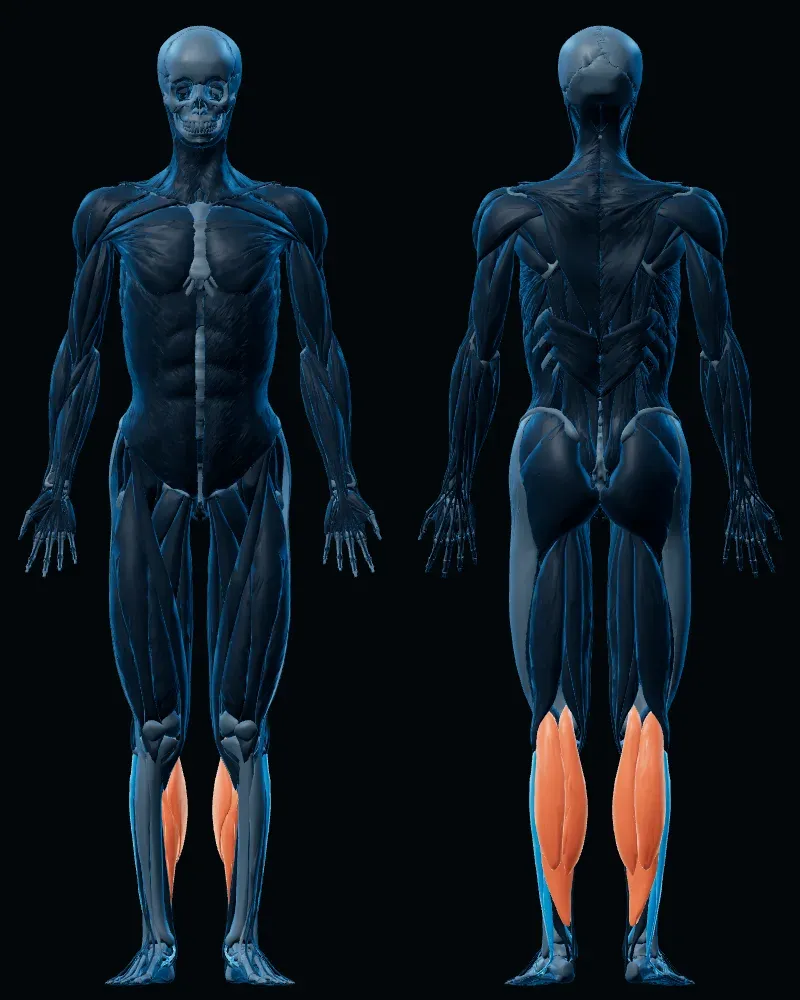
Muscles worked: calves
Main movers: gastrocnemius and soleus
Table of contents
Calf hypertrophy is not a genetics lottery. The best direct evidence says standing, straight-knee calf raises grow the big gastrocnemius far better than seated raises, and that training from a deep stretch at the bottom of each rep is what matters most.
If your calves have stayed flat despite years of “a few sets at the end of leg day”, this guide covers the anatomy, the studies, and a plan you can actually run. It sits inside our complete lower body and core training guide. It is the programming guide for calves: how much, how often and how to run the sets. For the knee-angle mechanics behind standing and seated raises, our straight-leg vs bent-knee calf raise guide goes deeper.
Why are calves so hard to grow?
The calf is really three muscles that share one tendon: the medial and lateral heads of the gastrocnemius, and the soleus underneath. Together they are called the triceps surae.
Researchers describe this group as relatively unresponsive to resistance training compared with other muscles, while being prone to shrinking with inactivity (Kinoshita et al., 2023). That fits what most lifters see: quads and lats respond quickly, calves feel stubborn.
Part of the reason is practical, not mystical. You walk on your calves all day. They are used to load. A set of 12 bouncy half-reps at the end of a tired session barely registers.
The most common mistake here is treating calves as a finisher you do while checking your phone. They need the same intent as a squat: a real load, a real stretch, and sets taken close to failure.
Gastrocnemius vs soleus: what each muscle does
The two muscle groups are built differently, and that is why knee position changes the exercise.
The gastrocnemius is biarticular. It crosses both the knee and the ankle. With a straight knee it is lengthened, and it can produce a lot of force. When you bend the knee to 90 degrees, as in a seated raise, the gastrocnemius is shortened and slack.
The soleus sits below the knee and only crosses the ankle. Its length does not change with knee position, so it works in both seated and standing raises. It is generally described as the more endurance-oriented, slow-twitch-dominant calf muscle, though fibre makeup varies between people.
That is the whole story behind “standing for gastrocnemius, seated for soleus”. The length-tension detail lives in our straight-leg vs bent-knee calf raise guide; here we only need the practical result.
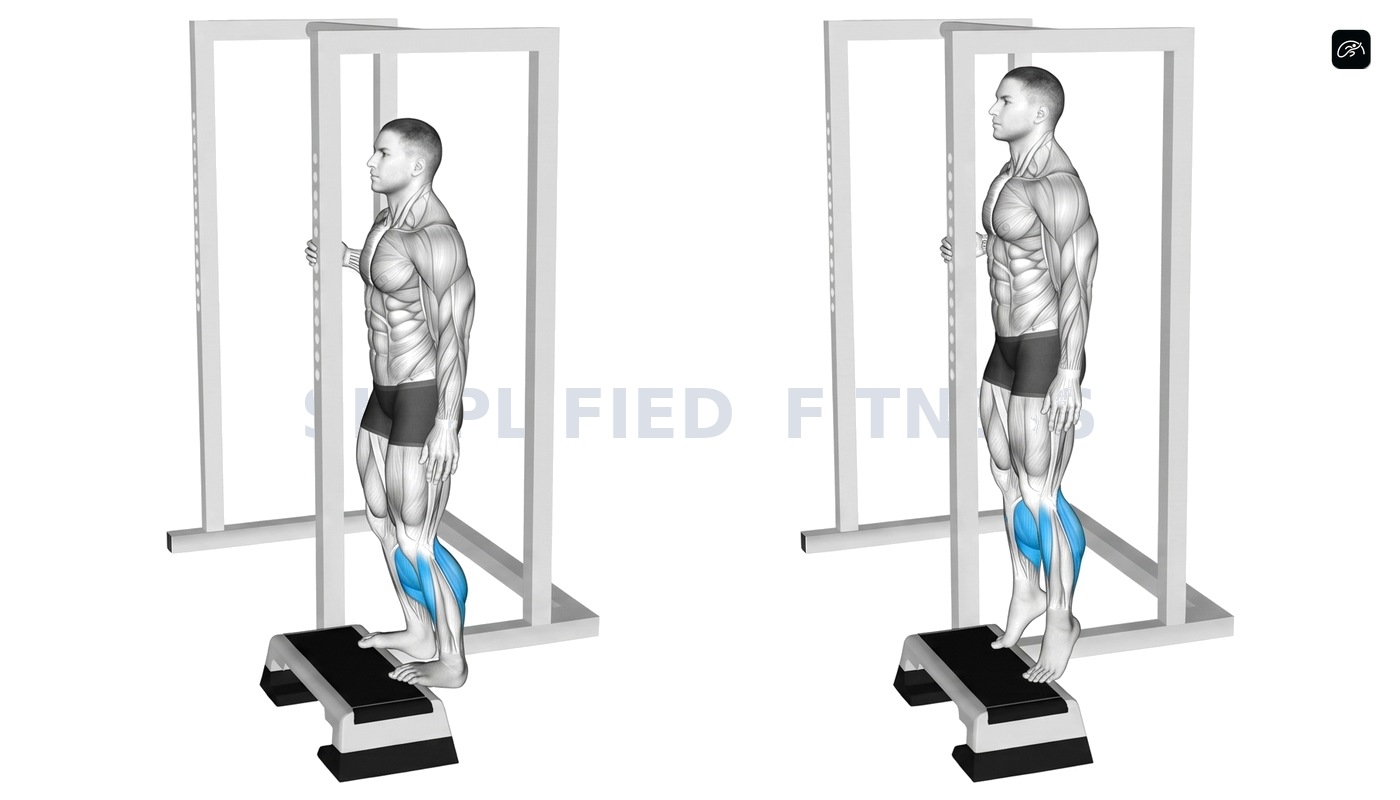
Standing vs seated calf raises: what the research found
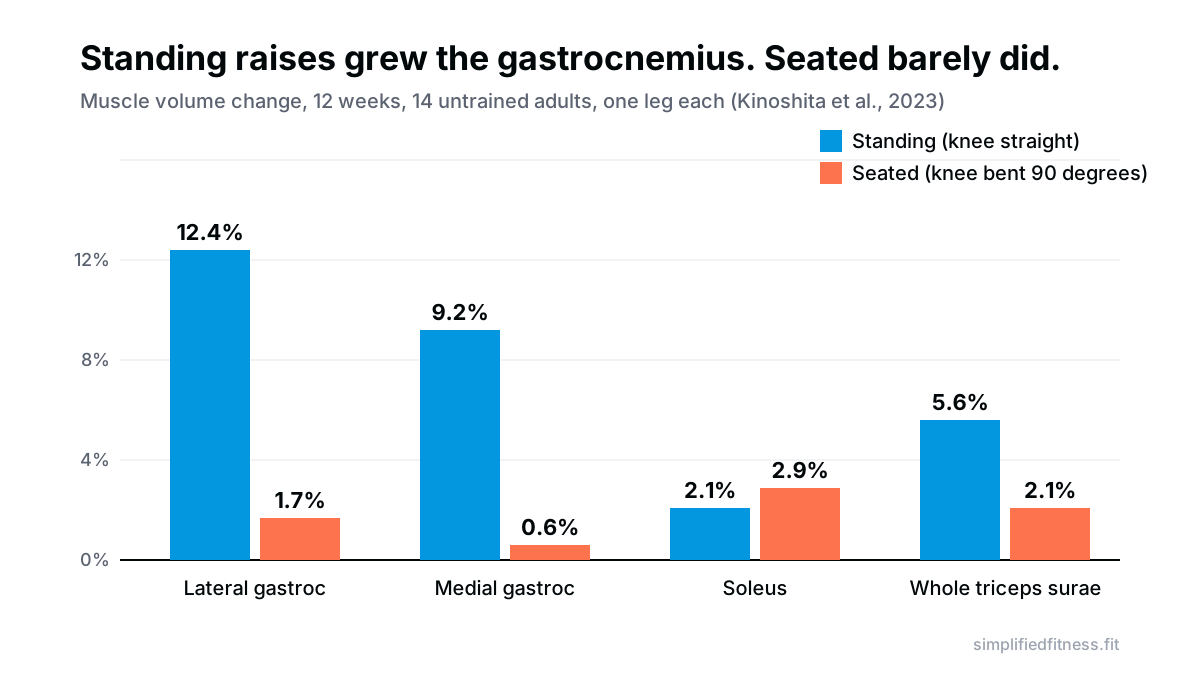
One study answers this question directly. Kinoshita and colleagues had 14 untrained adults train one leg with standing raises and the other with seated raises, at 70% of 1RM, 5 sets of 10 reps, twice a week for 12 weeks. They measured muscle volume with MRI (Kinoshita et al., 2023).
Standing raises produced much more gastrocnemius growth:
- Lateral gastrocnemius: 12.4% (standing) vs 1.7% (seated)
- Medial gastrocnemius: 9.2% vs 0.6%
- Whole triceps surae: 5.6% vs 2.1%
- Soleus: 2.1% vs 2.9%, not significantly different
The seated leg’s gastrocnemius growth was not statistically significant at all. The authors concluded standing raises are more effective for the gastrocnemius and the whole calf, and suggested that training at long muscle lengths promotes growth.
Two honest caveats. The sample was small (14) and the participants were untrained, so a bigger, trained sample may show smaller gaps. And the soleus still grew under both conditions, so it is still worth training. But no direct evidence suggests the seated raise beats standing for visible calf size.
Does the stretch at the bottom matter?
This is the part most lifters skip. Several calf studies point in the same direction: the lengthened part of the movement is a major driver of growth.
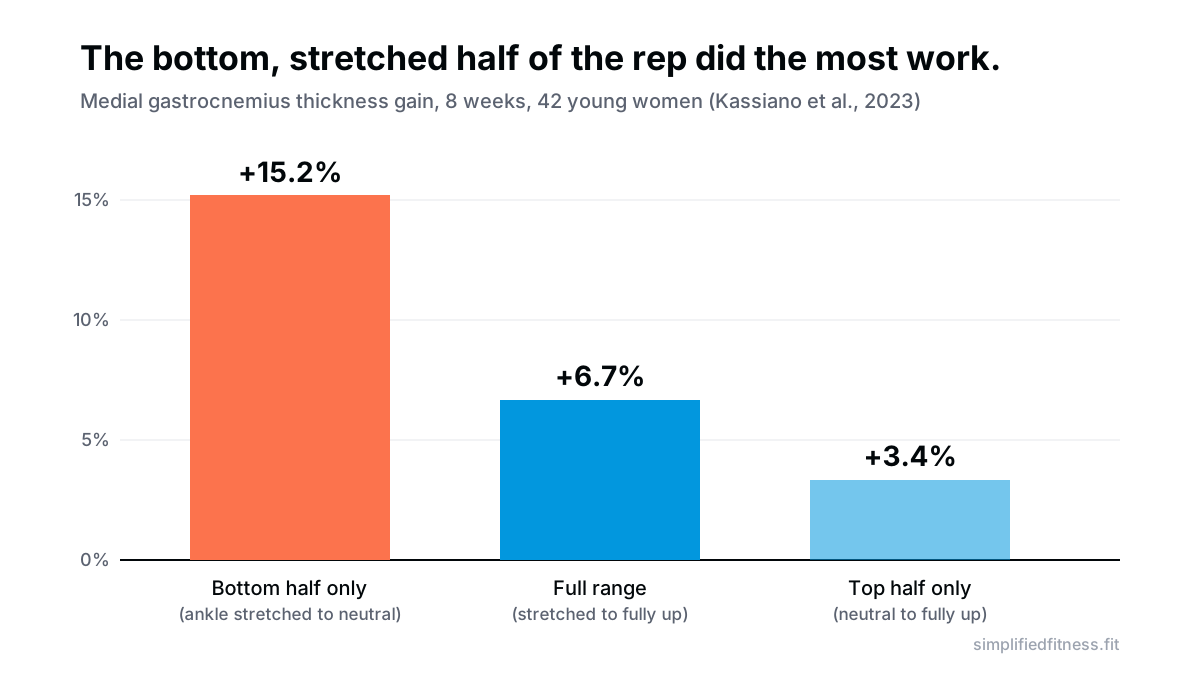
Kassiano and colleagues trained 42 young women for 8 weeks, 3 days per week, on a calf raise in a leg-press machine, in 3 sets of 15-20 repetition maximum. One group used full range, one used only the bottom (stretched) half, and one only the top half. Medial gastrocnemius thickness grew about 15.2% with the bottom-half group, 6.7% with full range, and 3.4% with the top half (Kassiano et al., 2023). For the lateral head, bottom-half partials beat top-half partials, but the difference versus full range was not statistically significant.
A broader systematic review reached a related conclusion for the lower body: full range of motion had beneficial effects on hypertrophy compared with partial range, with only six studies available (Schoenfeld & Grgic, 2020). Calves are the interesting exception, because “partial” in the stretched position performed well. The takeaway is not “partial reps are magic”, it is “do not skip the stretch”.
A newer trial in 23 resistance-trained people compared training only the stretched portion against full reps plus extra partials past failure. The stretched-only leg gained slightly more medial gastrocnemius thickness, but the authors called the evidence only “anecdotal” and said both strategies are viable (Larsen et al., 2025). That fits the broader picture: both are fine, and the deep stretch is the common thread. We cover the technique in more depth in stretch-mediated hypertrophy and lengthened partials.
Why pause at the bottom of a calf raise?
Your Achilles tendon is a spring. At the bottom of a quick rep it stores energy and gives it back, which means a fast bounce can lift the weight with less work from the muscle itself.
I should be clear about the evidence: none of the studies above tested pause length directly. Pausing is a coaching rule that follows from the stretched-range findings, not a proven dose. But it is cheap and sensible.
- Lower the heel slowly to a full, comfortable stretch.
- Hold 2-3 seconds at the bottom without bouncing.
- Drive up through the big toe side to a full squeeze at the top.
- Do not count a rep unless it passed through the bottom pause.
Using less weight with a real pause beats more weight with a bounce.
How many sets and reps for calf growth?
No calf-specific volume dose has been established, so lean on general evidence. A meta-regression found each additional weekly set was associated with a small increase in muscle growth, about 0.37% per set on average, in a graded dose-response pattern (Schoenfeld et al., 2017). A newer meta-regression of 67 studies also found muscle growth rises with weekly volume, with diminishing returns (Pelland et al., 2026). Those studies are mostly in young adults and not calf-specific, so use them as direction, not a prescription.
A practical starting point:
- Weekly sets: about 8-12 hard sets across the week, adjusted to how you recover.
- Reps: 8-15 for standing raises, 12-20 for seated raises. The calf trials above used both heavy (about 10 reps at 70% 1RM) and high-rep (15-25) schemes.
- Effort: finish most sets with about 1-2 reps left, and take the last set or two close to failure with a full range.
- Progression: add a rep, or a small amount of load, once you hit the top of your rep range with a full pause. Our double progression guide explains the method.
Want to count sets across your whole week? Use the training volume calculator.
How often should you train calves?
For general muscle growth, a meta-analysis of 25 studies found no significant or meaningful effect of frequency on hypertrophy when volume is equated, and found it held for lower body and for trained participants (Schoenfeld et al., 2019). The more recent meta-regression likewise found frequency’s effect on hypertrophy compatible with negligible (Pelland et al., 2026).
So why recommend 2-3 sessions a week? Because it makes the volume easier to do well. Ten calf sets in one session usually means the last six are low quality. Splitting them over two or three days means every set gets real effort.
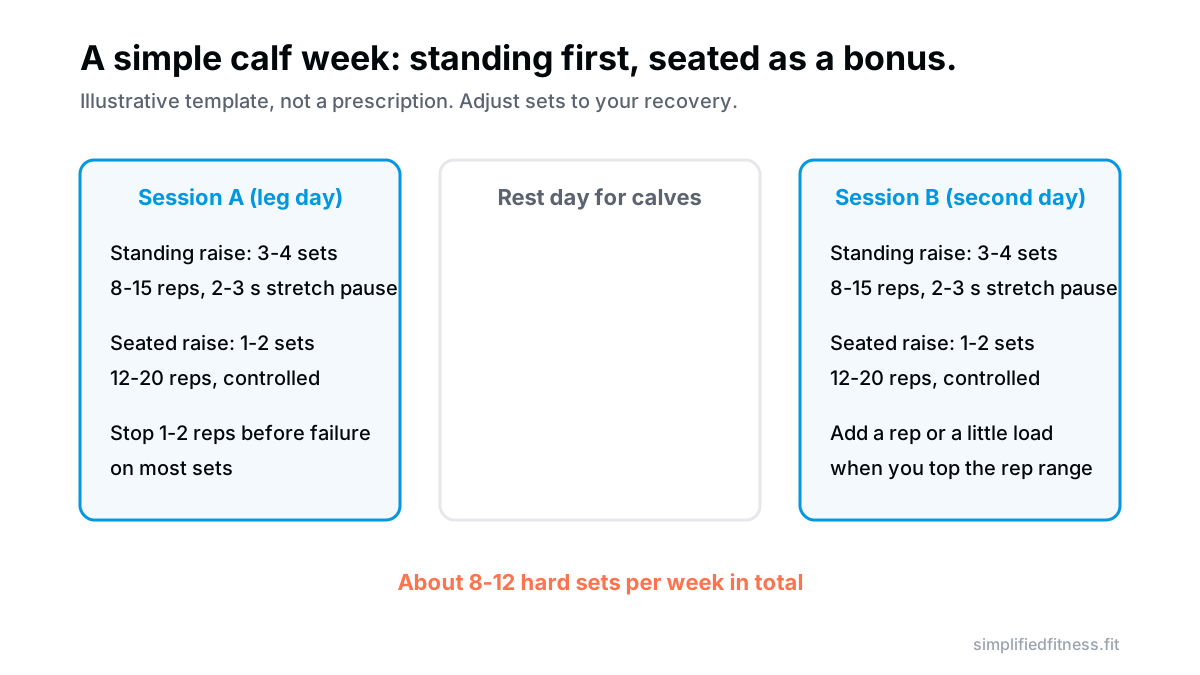
You can put calves on your regular leg days. Our leg workout programming guide shows where they fit, and our free leg day plan already includes them.
Does foot position (toes in, toes out) matter?
A little, maybe. In a 9-week study of 22 young men, each leg used a different foot angle: toes out, toes in, or forward. Medial gastrocnemius thickness grew 8.4% with toes out versus 3.8% with toes in, while the lateral head grew 9.1% with toes in versus 5.5% with toes out (Nunes et al., 2020).
It is a small study, and all the participants were young men, so treat this as a fine-tuning idea rather than a rule. Most lifters will do well keeping the foot mostly forward and comfortable. If you want to experiment, rotate foot angle across your two weekly sessions and keep what feels good for your knees and ankles.
A simple calf routine
| Exercise | Sets | Reps | Notes |
|---|---|---|---|
| Standing calf raise (machine, Smith or step) | 3-4 | 8-15 | Full stretch, 2-3 s pause, straight knees |
| Seated calf raise | 1-2 | 12-20 | Optional extra for the soleus |
| Frequency | 2 sessions per week | Add a third only if recovery is easy |
No standing calf machine? A step with dumbbells works, and a leg press or Smith machine are options used in the trials above. Hold something for balance, and do one leg at a time when bodyweight gets easy.
On a budget, a single-leg bodyweight raise off a stair, performed slowly with a pause, can be made hard by slowing the tempo and adding reps. Plenty of lifters in India train at home or in basic gyms, and this still works if you progress it.
What if my calves still don’t grow?
Run this check before blaming genetics:
- Is your heel dropping to a real stretch on every rep?
- Do you pause, or bounce?
- Are most sets within 1-2 reps of failure?
- Have you done roughly 8-12 hard sets a week for at least 8-12 weeks?
- Have the weights or reps actually gone up?
If all five are a yes and growth is still slow, you may simply be a slower responder. That is normal variation, not failure. Keep training them with effort and stay patient.
When to see a doctor
Calf raises are generally safe for healthy people when built up gradually. But sudden calf pain, swelling, warmth or redness in one lower leg should be checked by a doctor promptly, since it can signal a blood clot. Pain that does not settle should also be assessed, as should persistent pain in the Achilles tendon or heel. Do not try to train through it. If you have a known ankle, tendon or circulation problem, check with your doctor or physiotherapist before loading calves heavily.
The bottom line
- Make standing, straight-knee raises your main calf lift.
- Add seated raises if you want extra soleus work.
- Use a full range, with a pause in the stretch.
- Aim for roughly 8-12 hard sets a week across 2 sessions, and progress them.
- Judge results after 8-12 weeks, not 2.
Frequently Asked Questions
How do you grow stubborn calves?
Train them like any other muscle: a full stretched range, controlled reps, hard sets and progressive overload. In the trials we have, calves grew when training was done from the stretched position, near failure, for several weeks. Pick standing calf raises as your main lift and add something heavy and progressive each week.
Are standing or seated calf raises better for calf growth?
Standing is better for the big, visible gastrocnemius. In a 12-week MRI study of 14 untrained adults, standing raises grew the whole triceps surae about 5.6% versus 2.1% for seated, while soleus growth was similar. Make standing raises your base and add seated raises if you want extra soleus work.
How many sets of calves per week do I need?
A reasonable starting point is about 8-12 hard sets per week, though individual response varies a lot. Meta-analyses show hypertrophy generally rises with weekly volume, with diminishing returns. Start lower, track your calf size and reps, and add sets only if you stop progressing.
How often should I train calves?
2-3 sessions per week is practical and common. Meta-analyses suggest that when weekly volume is equal, frequency itself has little effect on muscle growth. Choose the frequency that lets you do every set with good effort, for example calves at the end of two leg or lower-body sessions.
What rep range is best for calves?
Calf trials have used everything from about 8-10 reps to 15-25 reps and grown muscle. The key is getting close to failure with full control, not hitting an exact number. A mix of 8-15 reps for standing raises and 12-20 for seated is a simple, tolerable option.
Why won't my calves grow?
Common reasons are too few hard sets, bouncing through short reps, never reaching a deep stretch, and stopping far from failure. Genetics, such as muscle belly length and tendon length, may also affect shape and size, but that is rarely the first problem. Fix technique and volume for 8-12 weeks before blaming genetics.
Should I pause at the bottom of a calf raise?
Yes, a 2-3 second pause in the stretched position is a sensible habit, though no trial has tested pause length directly. Trials that emphasised the stretched range found good growth, and pausing stops you from bouncing off the Achilles tendon instead of loading the muscle. Pause, then drive up under control.
Do calf raises on a leg press or Smith machine work?
Yes. Several calf trials used leg-press or Smith machine calf raises and found growth. The best option is the one that allows a deep stretch, stable footing and easy load progression. Use whichever machine your gym has that feels stable.
Do toe-in and toe-out foot positions change calf growth?
A small 9-week study in 22 young men found some head-specific differences, with toes out favouring the medial gastrocnemius and toes in favouring the lateral head. The study was small and the effects were modest, so treat it as a fine-tuning option. Keep your toes mostly forward and comfortable, and rotate foot position only if your joints are happy.
Are walking, running and cycling enough to build calves?
Everyday walking is usually not enough load to grow already-trained calves. Calves cope with high daily use, so they often need heavy, progressive resistance work to grow further. Keep your walking and add proper calf raises.
Can I train calves every day?
It is possible but not necessary, and there is no strong evidence that daily calf training beats 2-3 sessions per week. Because calves are used all day, a daily routine can turn into low-effort filler reps. Aim for fewer, harder sessions.
Do calf raises hurt your Achilles tendon?
Calf raises are a common part of Achilles rehab and training, but a sudden jump in volume or load can irritate the tendon. Build up gradually and avoid bouncing through the bottom. If you have persistent heel or tendon pain, see a physiotherapist or doctor before pushing on.
Sources & References
Every claim above is checked against peer-reviewed research (PubMed, U.S. National Library of Medicine) or guidance from established health bodies. How we fact-check.
- Kinoshita M, et al. Triceps surae muscle hypertrophy is greater after standing versus seated calf-raise training. Front Physiol. 2023. PMID: 38156065
- Kassiano W, et al. Greater gastrocnemius muscle hypertrophy after partial range of motion training performed at long muscle lengths. J Strength Cond Res. 2023. PMID: 37015016
- Larsen S, et al. Resistance training beyond momentary failure: the effects of past-failure partials versus initial partials on calf muscle hypertrophy among a resistance-trained cohort. Eur J Sport Sci. 2025. PMID: 40850937
- Nunes JP, et al. Different foot positioning during calf training to induce portion-specific gastrocnemius muscle hypertrophy. J Strength Cond Res. 2020. PMID: 32735428
- Schoenfeld BJ, Grgic J. Effects of range of motion on muscle development during resistance training interventions: a systematic review. SAGE Open Med. 2020. PMID: 32030125
- Schoenfeld BJ, Ogborn D, Krieger JW. Dose-response relationship between weekly resistance training volume and increases in muscle mass: a systematic review and meta-analysis. J Sports Sci. 2017. PMID: 27433992
- Schoenfeld BJ, Grgic J, Krieger J. How many times per week should a muscle be trained to maximize muscle hypertrophy? A systematic review and meta-analysis. J Sports Sci. 2019. PMID: 30558493
- Pelland JC, et al. The resistance training dose response: meta-regressions exploring the effects of weekly volume and frequency on muscle hypertrophy and strength gains. Sports Med. 2026. PMID: 41343037

Umair Hazrami · Founder & Head Coach, Simplified Fitness
Umair Hazrami founded Simplified Fitness and the Simplified Lifter channel to cut through fitness noise. With 4+ years of consistent training and 10+ coaching clients, he writes every guide from the peer-reviewed research and links the sources so you can check them. Our editorial standards.
Educational content only, not medical advice. If you have a medical condition, are pregnant, or take medication, talk to a qualified doctor before changing your diet, supplements or training. Full disclaimer.
Keep reading

Exercise Technique
Adductor Magnus Training: Seated Adductor Machine and Copenhagen Planks for Thigh Mass
Adductor magnus training explained: what research says on deep squats, the adductor machine and Copenhagen planks for thicker inner thighs and groin strength.
7 min read
Exercise Technique
High Bar vs Low Bar Squat: Which Builds More Quad Muscle?
High bar vs low bar squat for hypertrophy: what torso lean, knee travel and EMG studies show, why high-bar leans quad, and when low-bar still makes sense.
8 min read
Exercise Technique
Complete Leg Workout Programming: Quad Day vs Hamstring and Glute Day
Best leg workout routine science: split leg day into a quad session and a hamstring-glute session, with sets, order and a 5-week plan that avoids burnout.
9 min read
Exercise Technique
Foot Pronation, Knee Valgus, and Squat Mechanics: Flat Feet, Arches, and Lifting Shoes
Knees caving in on squats with flat feet? See what research says about pronation, short foot, hip strength and lifting shoes, and what to try first.
8 min read