3D Shoulder Protocol: Weekly Volume, Frequency (2-3x/Week) and Rep Ranges
How to build 3D shoulders: how many weekly sets, how often to train side and rear delts, and which rep ranges to use, with an 8-week plan and the research.

TL;DR. The short answer
- To build 3D shoulders, most lifters do well on roughly 12-20 hard weekly sets for the side and rear delts, spread over 2-3 sessions, with presses at 6-10 reps and raises at 15-25 reps.
- Meta-analyses link more weekly sets to more muscle growth, with diminishing returns. Frequency matters mainly because it lets you spread those sets across the week without junk volume.
- When weekly volume is matched, training a muscle 2-3 times per week has not been shown to beat once or twice. Choose the frequency that lets you keep rep quality high.
- Muscle growth looks similar across a wide range of loads when sets are taken near failure, so light raises for 15-25 reps are a valid choice for the delts.
- Ramp sets slowly over about 7 weeks, then deload. If a joint hurts, or pain lingers, see a doctor or physio instead of pushing through.
Part of our complete guide: Complete Shoulder, Delt & Neck Training Guide: 3D Deltoid Anatomy, Rotator Cuff & Traps
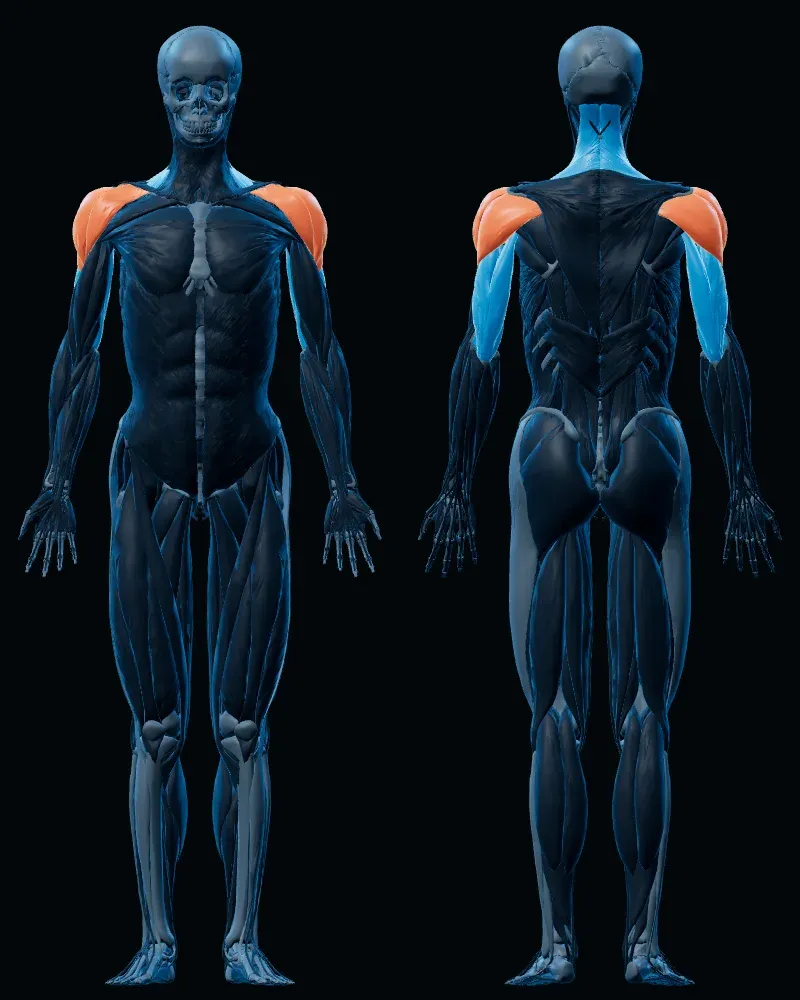
Muscles worked: shoulders
Main movers: all three heads of the deltoid
Assisting: supraspinatus, upper traps and triceps
Table of contents
If you are wondering how to build 3D shoulders, the short answer is this. Do roughly 12-20 hard weekly sets for the side and rear delts, spread over 2-3 sessions, with heavier presses at 6-10 reps and lighter raises at 15-25 reps. Add sets slowly and judge the block on measurements, not on how sore you feel.
This is the aggressive specialization version of our complete shoulder and delt training guide. Use it when your shoulders are flat, your chest and arms have outgrown them, and a normal push day is not moving the needle. Here is the logic, the evidence, and a full 8-week plan.
What does “3D shoulders” actually mean?
Three heads, one look. The front delt rounds the top of the arm from the front, the side (lateral) delt creates width, and the rear delt fills the back of the shoulder. Flat shoulders are usually missing the second and third.
Front delts get plenty of work from every bench and overhead press you do. Side and rear delts usually do not. That gap is why this program puts its volume there. If you want the anatomy first, see our breakdown of the functional anatomy of the deltoid heads.
How many weekly sets do deltoids need?
More sets are linked to more growth, up to a point. A meta-regression of 15 studies found a graded dose-response: each additional weekly set was associated with a 0.37% larger gain in muscle size, and higher-volume groups gained about 3.9 percentage points more than lower-volume groups (Schoenfeld et al., 2017).
A newer meta-regression pooled 67 studies and 2,058 participants. It also found that gains rise with weekly volume, but with diminishing returns (Pelland et al., 2026). Each extra set buys you less than the one before.
Neither paper was about the deltoids alone, and the 2026 sample was mostly young men (average age about 25, 79% male). So the numbers below are a coaching translation, not a deltoid-specific dose.
| Weekly direct sets (side + rear delts) | Who it suits | Notes |
|---|---|---|
| 6-9 | Beginners, or a maintenance phase | Often enough for visible progress early on |
| 10-14 | Most intermediate lifters | A solid default |
| 15-20 | Specialization block, good recovery | Add gradually, not overnight |
| 20+ | Rarely needed | Risk of junk sets and sore elbows |
“Direct” means sets where the delt is the target, such as lateral raises and reverse flyes. Presses count for something, but less, which is why I would not count them one-for-one. Our weekly set volume dose-response guide shows how that counting works, and the training volume calculator can total your week.
Why can side delts handle 2-3 sessions a week?
Here is the coaching rationale. Lateral and rear delt work uses light weights, short ranges and little spinal loading. A set of cable lateral raises costs far less recovery than a set of heavy squats. So many lifters can repeat it often without feeling wrecked.
I should be clear about the limits. That is a practical observation, not a measured result. None of the studies cited here directly tested recovery of the lateral delt versus other muscles. For a fuller look at how muscle size changes tolerance, see muscle-specific volume tolerance.
The real reason to use frequency is simpler: it spreads volume. Twelve hard sets in one session means the last six are done tired and sloppy. Four sets on three days means every set is fresh.
Does training delts more often build more muscle?
Not by itself. The research here is split, and the split is about how the studies were designed.
A 2016 meta-analysis of only 10 studies found that training a muscle twice a week beat once a week, with an effect size of 0.49 for higher frequency versus 0.30 for lower (Schoenfeld et al., 2016). The authors could not say whether three times beat twice.
A larger 2019 meta-analysis of 25 studies then found no significant difference between higher and lower frequency when volume was equated. That held for trained people and for upper-body muscles. Studies that did not match volume leaned toward higher frequency, but the gap was modest (Schoenfeld et al., 2019). The 2026 meta-regression agrees: the effect of frequency on hypertrophy was compatible with negligible once volume is accounted for (Pelland et al., 2026).
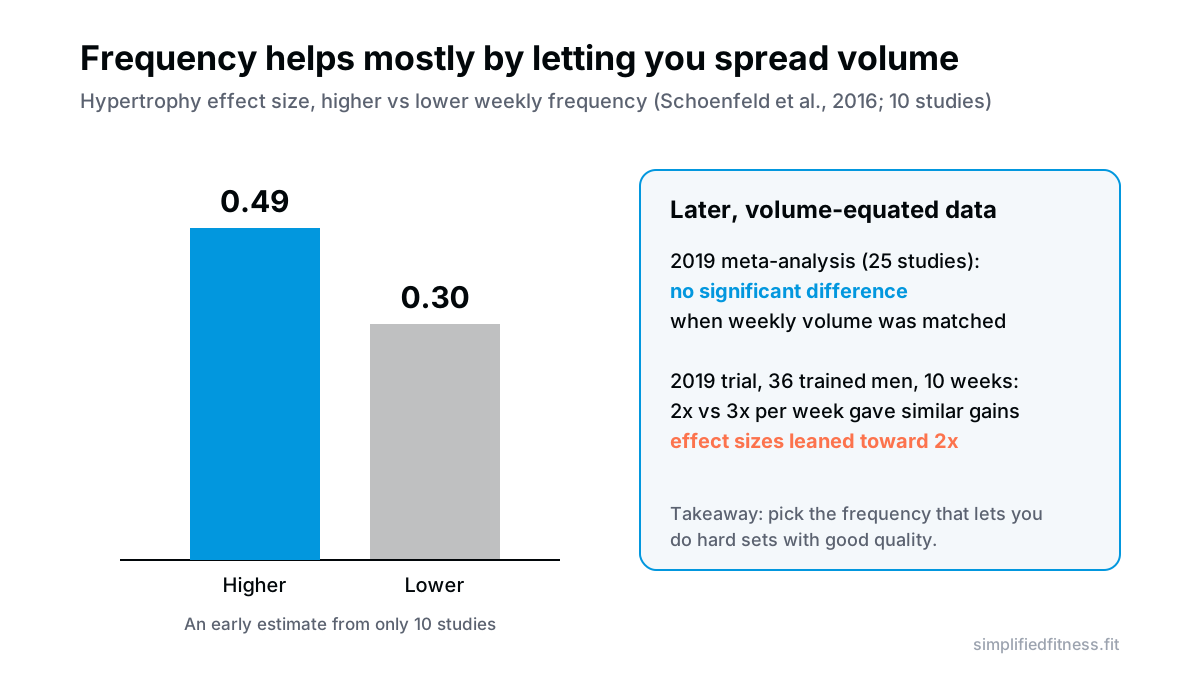
Individual trials in trained men tell the same story. In 36 trained men (28 finished), training muscles twice or three times per week gave similar strength and size gains over 10 weeks, though effect sizes leaned toward twice a week (Lasevicius et al., 2019). In 27 men, 3 versus 6 sessions per week also gave similar results over 6 weeks when volume was equal (Saric et al., 2019). Both studies were short, so treat them as supportive, not final.
Why do the findings differ? The 2019 review had more than twice as many studies, and in it, the frequency advantage only showed up in studies where more sessions also meant more total sets. Match the sets and the advantage disappears.
My cautious takeaway: train delts 2-3 times a week because it makes 12-20 sets practical, not because three sessions are magical. For the broader picture see our guide to training frequency of 1x vs 2x vs 3x with equated volume.
What rep ranges should I use for delts?
Use a split. Presses go heavier, raises go lighter.
A meta-analysis of 21 studies compared low-load (60% of 1RM or less) and high-load training with all sets taken to momentary failure. Strength gains favored heavy loads, but hypertrophy was similar between conditions (Schoenfeld et al., 2017). The authors conclude that muscle growth can be achieved across a spectrum of loading ranges.
That is why the delts do not need heavy triples. Lateral raises are awkward to load heavy. Past a point you start swinging, shrugging, and turning the exercise into a trap and momentum drill. Light loads at 15-25 reps keep the middle delt doing the work.
- Overhead presses: 6-10 reps, so you can keep adding load over the weeks.
- Lateral raises: 12-25 reps, strict and controlled.
- Rear delt flyes: 15-25 reps.
Most lifters will want reps in reserve on the heavy presses and close to failure on the last raise set. Our RIR and RPE calculator helps if you are unsure how close to failure you are going.
On exercise choice, a systematic review of 33 electromyography studies found that for the middle deltoid, abductions and horizontal abductions gave the greatest activation, with lateral raises using internal rotation ranking highest (Rabello et al., 2024). A separate study of 10 competitive bodybuilders found a neutral-grip raise activated the medial delt more than externally rotated or flexed-elbow versions, while internal rotation shifted more work to the posterior delt, upper trap and triceps (Coratella et al., 2020). Both are acute EMG studies, not growth trials, so use them as hints. For hand position details, read our article on the pouring pitcher cue, and for tools, see dumbbells vs cables vs machines for lateral delts.
What does a weekly delt layout look like?
Here is one way to land on about 18 direct sets across three days. It is illustrative, so adapt it to your split.
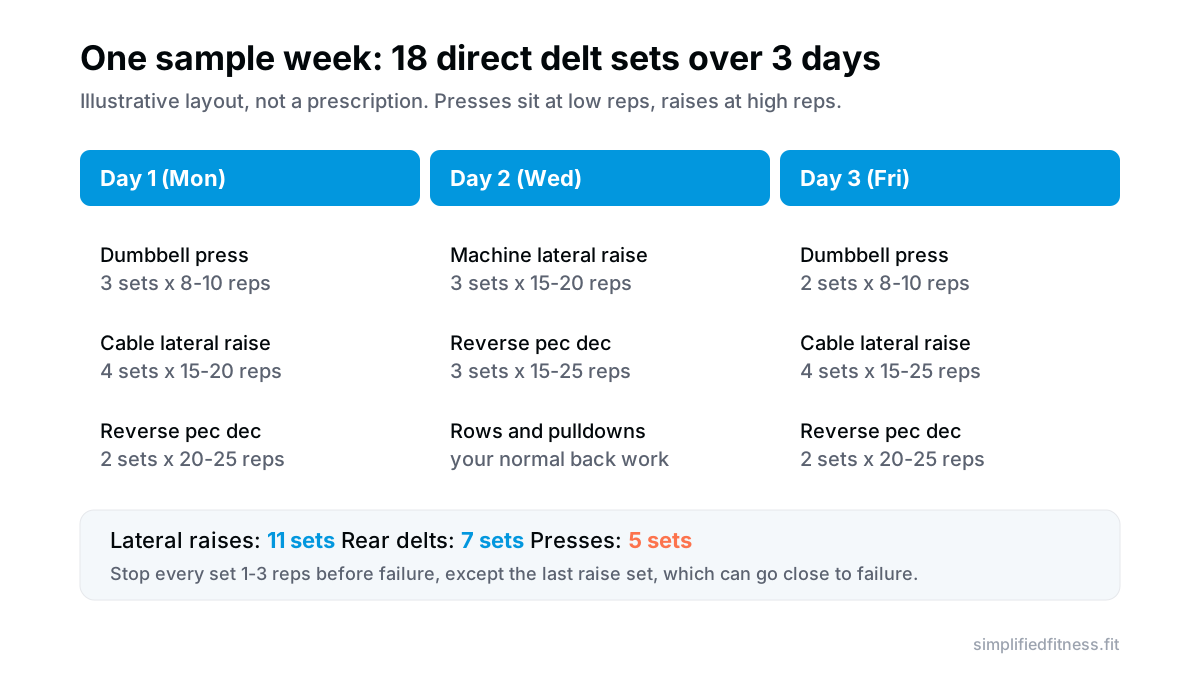
Place the presses early in a session when you are strongest, then the raises. If you are using a push, pull, legs routine, our guide on structuring a shoulder and arm workout on push day vs a split covers where each piece fits. Use the same dumbbell press you already know.
For rear delts, a reverse pec dec is simple to learn and easy to take close to failure. If you prefer cables, compare options in our rear delt training guide.
How do I run an 8-week shoulder specialization?
Start from your current volume, not from 20. If you do 6 direct sets now, begin the block at 10-12.
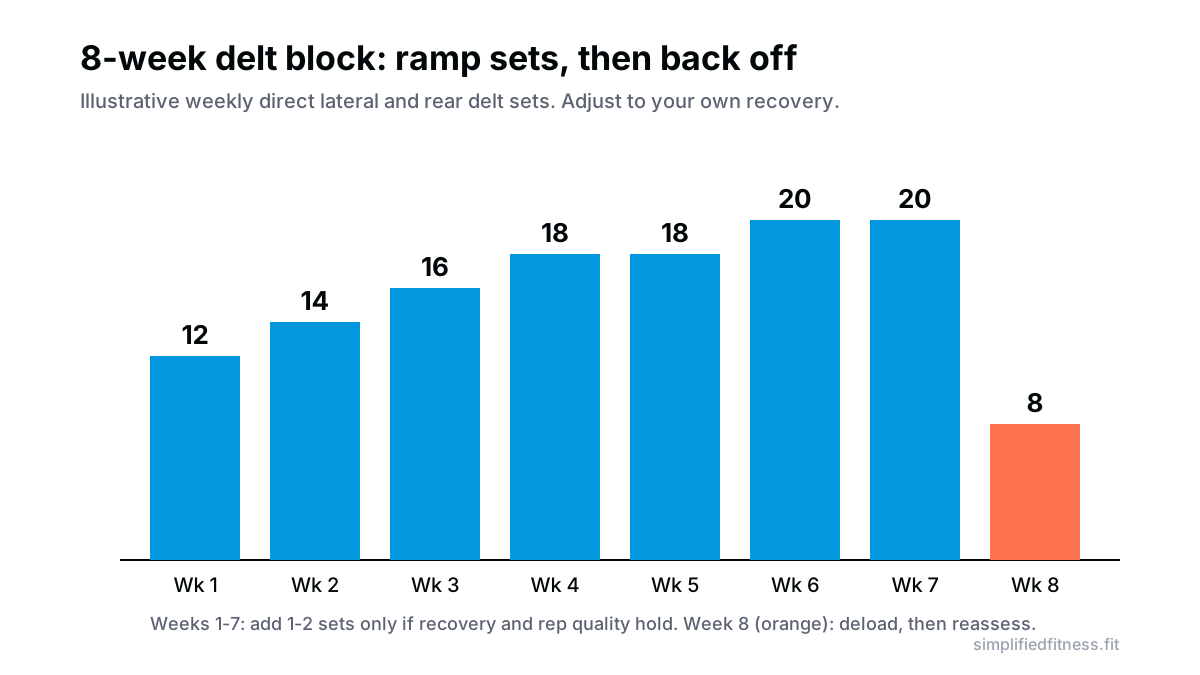
- Weeks 1-2 (12-14 sets): learn the movements. Stop most sets 2-3 reps short of failure.
- Weeks 3-5 (16-18 sets): add a set to a raise or rear delt exercise only if last week’s reps were hit.
- Weeks 6-7 (20 sets): the peak. Take the final raise set close to failure.
- Week 8 (about 8 sets): deload. Keep the weights moving, cut volume roughly in half.
Progress by double progression. When you hit the top of the rep range on all sets, add the smallest weight jump you can. For how to build volume across a block, see mesocycle volume progression from MEV to MRV.
Measure at the start and end: shoulder circumference at the same spot, a front-relaxed photo in the same light, and your best press and raise numbers. Be aware that the studies behind these numbers mostly ran 6-12 weeks, so slow visible change is normal. Individual response varies a lot.
Indian diet and lifestyle notes
Muscle gain needs protein and enough total food. For vegetarian lifters, dal, paneer, curd, soya chunks and eggs (if you eat them) can cover protein, and our diet plan shows sample meals. Hot-weather training can shorten how long you can keep sets high quality, so drink water and shorten rests if you are cramping. Sleep matters as much as the sets.
When should I see a doctor?
See a doctor or physiotherapist if shoulder pain lasts more than a couple of weeks, wakes you at night, comes with numbness, tingling or weakness, or follows a fall or an injury. Sharp pain on overhead lifts or lateral raises can point to a joint or tendon problem that more volume will not fix. This article does not diagnose anything, so get a proper assessment before you keep pushing.
Frequently Asked Questions
How do you build 3D shoulders fast?
Do hard sets for the side and rear delts, often 12-20 per week, and spread them over 2-3 sessions. Meta-analyses show more weekly sets are tied to more growth, with diminishing returns, so progress comes from consistency rather than speed. Add sets slowly, track your reps, and keep eating enough protein and calories.
How many sets per week do delts need?
A reasonable starting range for side and rear delts is about 8-12 direct sets per week, working toward 12-20 if recovery allows. A meta-regression of 67 studies found gains rise with weekly volume but flatten out. Raise the number only when your rep quality and joint comfort stay good.
Can I train side delts 3 times a week?
Yes, many lifters do it comfortably because lateral raises are light, low-fatigue work. Frequency itself has not been shown to beat lower frequency when volume is matched, but 3 days lets you keep each session short. If your elbows, shoulders or rep quality suffer, drop back to 2 days.
Is training delts every day too much?
For most people daily direct delt work is unnecessary. A 6-week trial in trained men found 3 versus 6 sessions per week gave similar gains when volume was equal, so extra days did not add much. Three or four days per week covers the benefit with more rest between hard sets.
What rep range is best for lateral raises?
Roughly 12-25 reps works well for lateral raises. A meta-analysis found hypertrophy was similar between low-load and high-load training when sets were taken to failure. Light loads also let you keep strict form instead of swinging the weight.
Should I train delts heavy or light?
Use both. Presses at 6-10 reps let you progress load and train the front and side delts hard, while raises at 15-25 reps keep the work clean. Research shows muscle size can grow across loading ranges, but heavy training builds more maximal strength.
How long does it take to build bigger shoulders?
Visible change usually takes months, not weeks, and varies with genetics, training history, diet and sleep. Most studies run 6-12 weeks and measure small changes in muscle thickness. Treat an 8-week block as a test, then compare photos, measurements and your lift numbers.
Why are my side delts not growing?
The usual causes are too few hard sets, stopping far from failure, swinging the weight, or rushing progression. Evidence links higher weekly volume to more growth, with diminishing returns. Count your real hard sets for a month, clean up your technique, and add one or two sets per week.
Do overhead presses build side delts?
Presses train the delts, mostly the front and side heads, and also work the triceps and upper chest. Raises appear to load the middle head more directly in the EMG research, which is why most programs use both. Treat presses as the heavy base and raises as the direct volume.
Do I need rear delt work if I do rows and pulldowns?
Rows and pulldowns give the rear delts some stimulus, but many lifters add 6-10 direct sets per week because the rear delts are often the lagging head. A reverse pec dec or cable fly lets you train the rear delt directly and take sets close to failure. Add one and see how your shoulders fill out.
How long should an 8-week shoulder specialization last?
Ramp volume for about 6-7 weeks, then deload in week 8. Gradual increases are safer than jumping to 20 sets at once, since the volume you can recover from varies by person. After the deload, reassess your measurements and decide whether to repeat, hold or cut back.
Can women follow the same shoulder program?
Yes. The same principles of progressive volume, sensible frequency and a mix of rep ranges apply to women. The big meta-analyses leaned toward young men (79% male in the 2026 one), so individual recovery matters more than a fixed number. Start at the lower end of the range and adjust.
When should I see a doctor about shoulder pain?
See a doctor or physiotherapist if you have pain that lasts more than a couple of weeks, pain at night, numbness, weakness, or pain after an injury. Training through sharp or worsening pain can make a problem worse. Until you are checked, swap painful movements for pain-free ones.
Sources & References
Every claim above is checked against peer-reviewed research (PubMed, U.S. National Library of Medicine) or guidance from established health bodies. How we fact-check.
- Schoenfeld BJ, et al. Dose-response relationship between weekly resistance training volume and increases in muscle mass: a systematic review and meta-analysis. J Sports Sci. 2017. PMID: 27433992
- Schoenfeld BJ, et al. Effects of resistance training frequency on measures of muscle hypertrophy: a systematic review and meta-analysis. Sports Med. 2016. PMID: 27102172
- Schoenfeld BJ, et al. How many times per week should a muscle be trained to maximize muscle hypertrophy? A systematic review and meta-analysis of studies examining the effects of resistance training frequency. J Sports Sci. 2019. PMID: 30558493
- Pelland JC, et al. The resistance training dose response: meta-regressions exploring the effects of weekly volume and frequency on muscle hypertrophy and strength gains. Sports Med. 2026. PMID: 41343037
- Schoenfeld BJ, et al. Strength and hypertrophy adaptations between low- vs. high-load resistance training: a systematic review and meta-analysis. J Strength Cond Res. 2017. PMID: 28834797
- Lasevicius T, et al. Similar muscular adaptations in resistance training performed two versus three days per week. J Hum Kinet. 2019. PMID: 31531139
- Saric J, et al. Resistance training frequencies of 3 and 6 times per week produce similar muscular adaptations in resistance-trained men. J Strength Cond Res. 2019. PMID: 30363041
- Rabello R, et al. Activation of the three deltoid muscle portions during common strengthening exercises: a systematic review. J Bodyw Mov Ther. 2024. PMID: 39593452
- Coratella G, et al. An electromyographic analysis of lateral raise variations and frontal raise in competitive bodybuilders. Int J Environ Res Public Health. 2020. PMID: 32824894

Umair Hazrami · Founder & Head Coach, Simplified Fitness
Umair Hazrami founded Simplified Fitness and the Simplified Lifter channel to cut through fitness noise. With 4+ years of consistent training and 10+ coaching clients, he writes every guide from the peer-reviewed research and links the sources so you can check them. Our editorial standards.
Educational content only, not medical advice. If you have a medical condition, are pregnant, or take medication, talk to a qualified doctor before changing your diet, supplements or training. Full disclaimer.
Keep reading

Exercise Technique
Are Front Raises Necessary? Why Bench Pressers Rarely Need Direct Front Delt Work
Are front raises necessary if you bench and overhead press? See what EMG and volume research says, when they can still help, and where to spend those sets.
8 min read

Exercise Technique
Behind-the-Neck Press: Shoulder Mobility, Neck Safety and Muscle Bias
Behind the neck press safety explained: who has the shoulder mobility for it, what EMG studies show for delts, and which swaps work if you do not.
10 min read

Exercise Technique
Cable Lateral Raises: Behind-the-Back vs Cross-Body Setup, Which Is Better?
Cable lateral raise behind the back vs in front: what the research says, which setup suits most lifters, and a step-by-step guide to pulley height and cuffs.
9 min read

Exercise Technique
Converging Machine Shoulder Press: Why It Feels Easier on Your AC Joint
Why does a converging shoulder press machine feel smoother than a barbell press? Setup, grip, depth and failure rules for sore AC joints, with studies linked.
8 min read