Antagonist Arm Supersets: Biceps and Triceps Pairing for a Faster, Pumpier Arm Day
A biceps triceps superset workout can shorten arm day while keeping volume close to straight sets. See the research, pairing tips and a 20-minute routine.

TL;DR. The short answer
- A biceps triceps superset workout means doing a curl, then a triceps exercise straight after it, then resting. A 2025 meta-analysis of 19 studies found supersets give similar total reps and volume load in less time than straight sets.
- Pairing opposing muscles (agonist-antagonist) held up best for volume. Subgroup analysis showed more reps completed than with straight sets, while same-muscle pairings lost volume load.
- Over weeks of training, supersets and straight sets produced similar strength and muscle growth in the meta-analysis. The benefit is time, not extra hypertrophy.
- The arm pump feels bigger, but acute muscle swelling was not measurably higher in the pooled data. Blood lactate and perceived effort were higher, so supersets feel harder.
- A practical starting point is two curl and triceps pairs, 3 rounds each, 60-90 seconds of rest after each pair. Drop back to straight sets if your reps fall off badly.
Part of our complete guide: Arm Workout Science: The Complete Guide to Biceps, Triceps, Brachialis and Forearm Growth
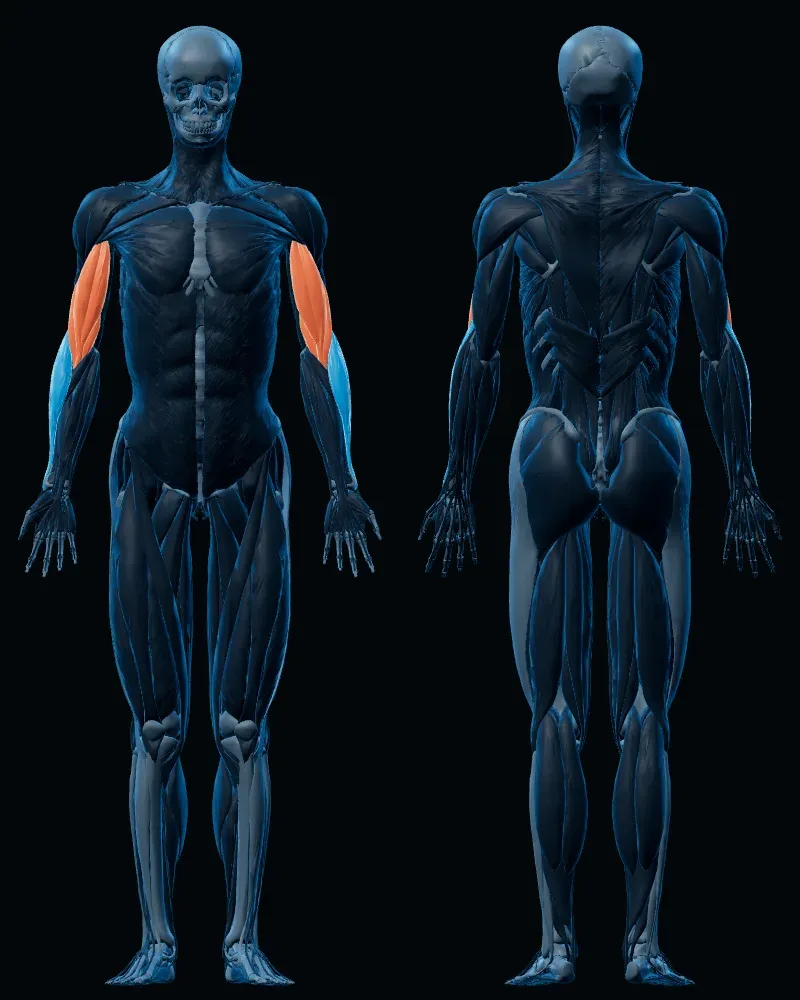
Muscles worked: biceps
Main movers: biceps brachii and brachialis
Assisting: brachioradialis
Table of contents
A biceps triceps superset workout means doing a curl and a triceps exercise back to back, then resting. The research says it can shorten arm day noticeably while keeping your total reps and volume close to what straight sets give you. The biggest time savings in the studies, around 45-50%, came from setups that often gave up some volume. It does not appear to build more muscle on its own. It simply lets you do the same work in less time.
This guide is part of our complete arm and forearm training guide. Here we focus on the pairing itself: what the studies show, where they fall short, and how to build a 20-minute arm session around it.
What is an antagonist arm superset?
Your biceps bend the elbow. Your triceps straighten it. They are opposing (antagonist) muscles, so while one is working, the other is mostly resting.
An antagonist superset exploits that. You do a set of curls, move straight to a triceps pushdown with little rest, then take your proper rest. Then you repeat.
Compare that with straight sets, where you finish all your curl sets with a full rest between each, then do all your triceps sets. The total work is the same. The clock is not.
Does a biceps triceps superset really save time?
Yes, and this is the best-supported benefit. A 2025 systematic review and meta-analysis pooled 19 studies with 313 participants. Compared with traditional sets, supersets produced a similar total number of repetitions and similar volume load, with a shorter session and higher training efficiency (Zhang et al., 2025).
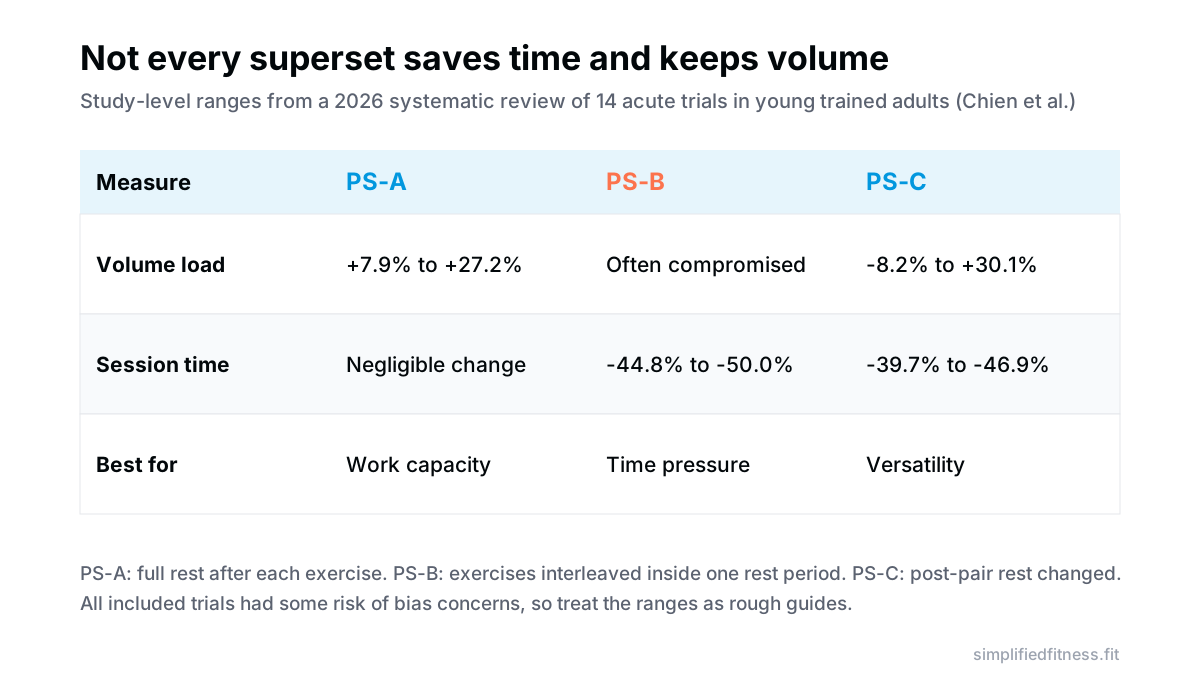
A 2026 systematic review of paired-set trials in young trained adults looked at how the pairs were set up. When the second exercise was slotted into the rest period of the first (called PS-B in the review), session duration dropped by 44.8-50.0%, though reps and volume load were often lower depending on the exercise. Keeping full rest after each exercise (PS-A) did the opposite: more total work, with almost no time saved (Chien et al., 2026).
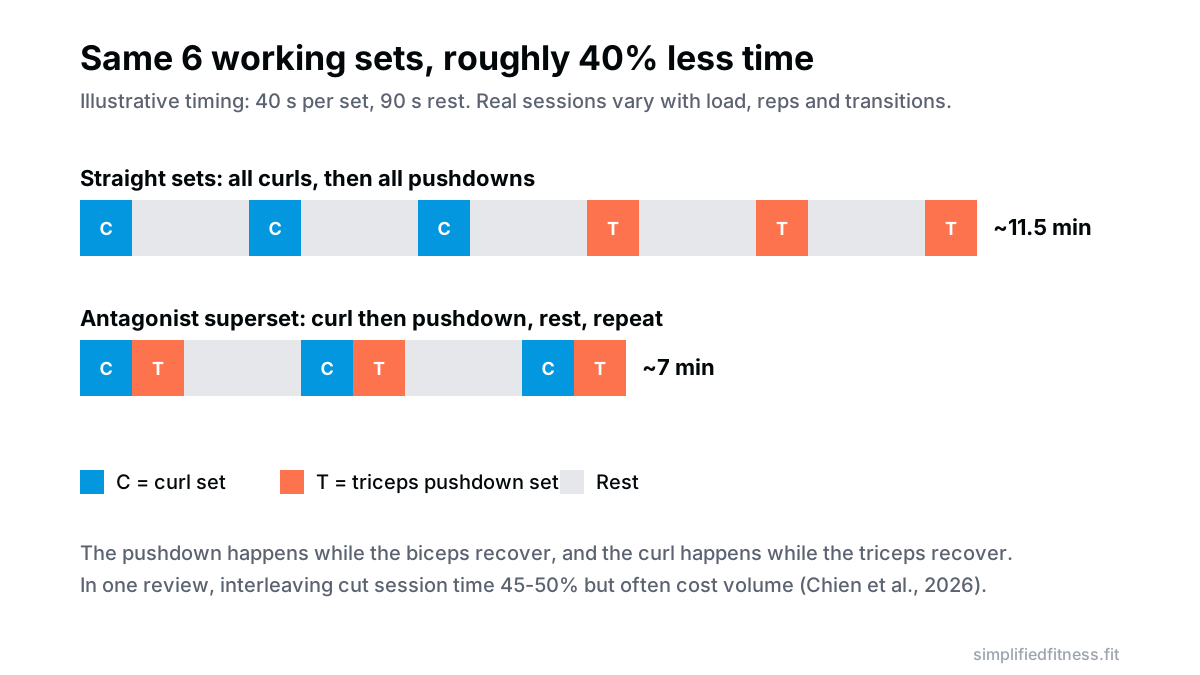
One honest caveat on that number. The studies were short, acute sessions in young trained adults, and the reviewers rated all of them as having “some concerns” for risk of bias. So treat 45-50% as a best case in a controlled setting, often bought with some lost volume, not a guarantee for your gym, where you also wait for a free cable stack.
Do you lose reps by pairing biceps and triceps?
Mostly no, and sometimes you gain them. This is where the studies disagree a little, so here is the fair picture.
What one study found. In 15 trained men doing bench press and wide-grip seated row, the paired version produced more volume load in all sets than the straight-set version, with a 2-minute rest between pairs (Paz et al., 2017). Another 16-man study using bench pull and bench press found paired sets maintained volume load better than straight sets with a 2-minute rest, and was more efficient per minute (Robbins et al., 2010).
What a second study found. A companion study from the same lab, again with bench pull and bench press, found no difference in volume load between the two methods, only a better efficiency for the paired version (Robbins et al., 2010).
Why they may differ. The rest periods and loads were not identical, and the straight-set rests of 2-4 minutes may or may not have been enough to recover. None of these trials used curls and pushdowns specifically. They used big upper-body pairs, so the arm version is an extrapolation.
The practical takeaway. The pooled meta-analysis subgroup is the best summary: agonist-antagonist supersets allowed more repetitions than traditional sets (a standardized difference of 0.68), while “similar biomechanical” supersets, which hit the same muscle twice, lost volume load (Zhang et al., 2025). In plain language, curl plus pushdown is a good pairing. Curl plus another curl variation is not a time saver, it is just a harder set.
Do supersets build bigger arms than straight sets?
No, not on current evidence. Across the chronic studies in the 2025 meta-analysis, supersets and traditional sets produced similar gains in maximal strength, strength endurance and muscle hypertrophy (hypertrophy standardized difference of -0.05, essentially zero) (Zhang et al., 2025).
An older systematic review concluded that agonist-antagonist supersets may add a stimulus and an advantage for time efficiency, while stating there was insufficient evidence to give specific guidelines for volume or frequency (Krzysztofik et al., 2019). Read together: supersets are a legitimate way to train, not a growth hack.
Why does a biceps triceps superset give such a big pump?
Because it feels brutal. In the same meta-analysis, supersets produced higher blood lactate during and after training, a higher energy cost, and a higher rating of perceived exertion than straight sets (Zhang et al., 2025).
But here is the part gym talk skips. Acute muscle swelling, the measurable version of the pump, was not significantly different between supersets and traditional sets in those pooled results (a standardized difference of -0.28, p = 0.36). Muscle activation on surface EMG was also similar.
So the huge pump is real as a feeling, and it is useful feedback that you pushed hard. Just do not assume it proves extra growth.
You will also see “reciprocal inhibition” used to explain why antagonist pairs work, the idea that the resting muscle relaxes to help the working one. I did not find arm-specific trials showing that this drives the benefit, so I would not lean on it. The evidence points to the simpler explanation: one muscle recovers while the other works.
How to pair curls and pushdowns
Choose pairs that do not make you fight for equipment, and that you can load properly. Three that work well:
- Preacher curl + straight-bar pushdown. Both are stable and easy to take close to failure. We cover the curl in preacher curls and distal biceps growth and the pushdown bar choice in straight bar vs V-bar vs rope pushdowns.
- Cable hammer curl + overhead triceps extension. Good if you want the long head of the triceps trained in a stretch. See overhead cable extensions vs pushdowns.
- Dumbbell curl + bench dip or rope pushdown. Handy in a crowded gym because it uses little equipment.
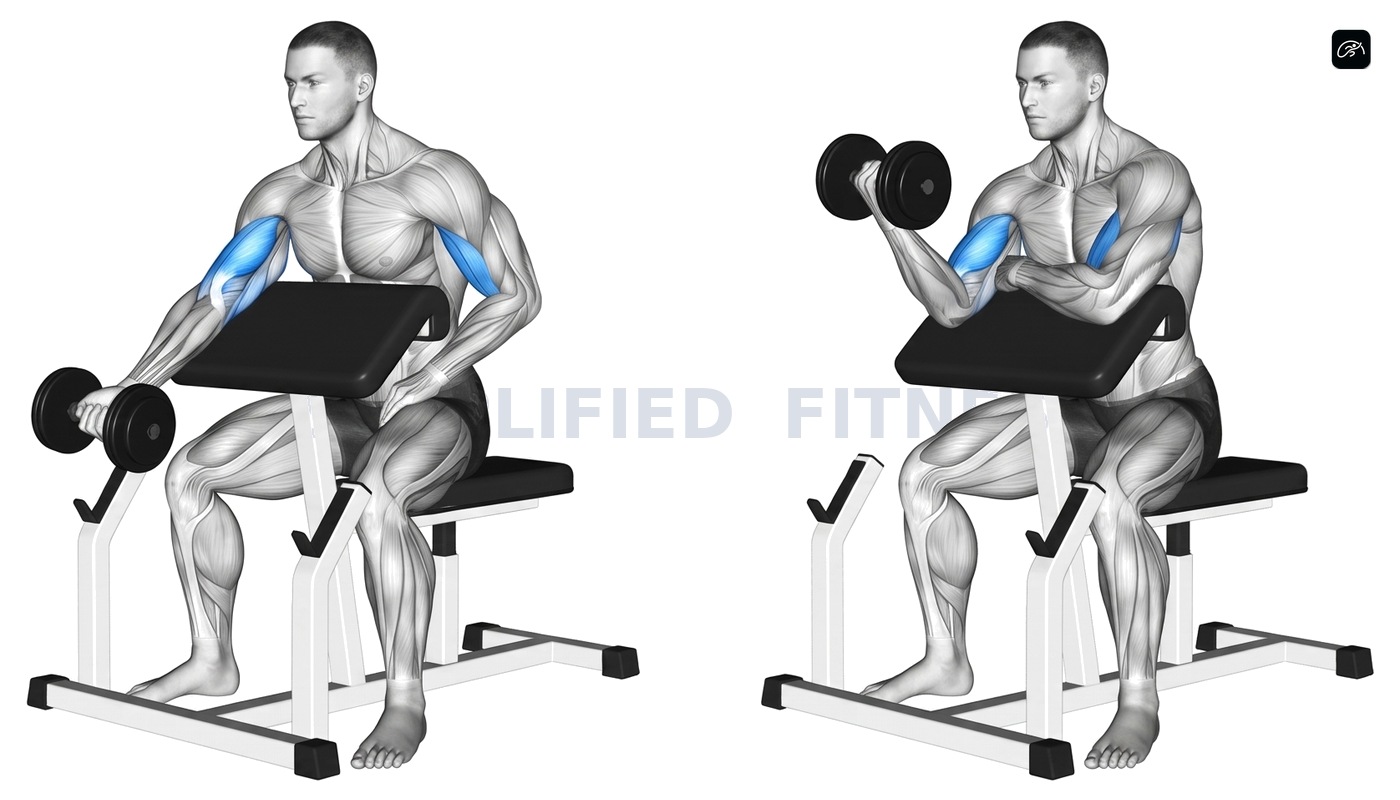
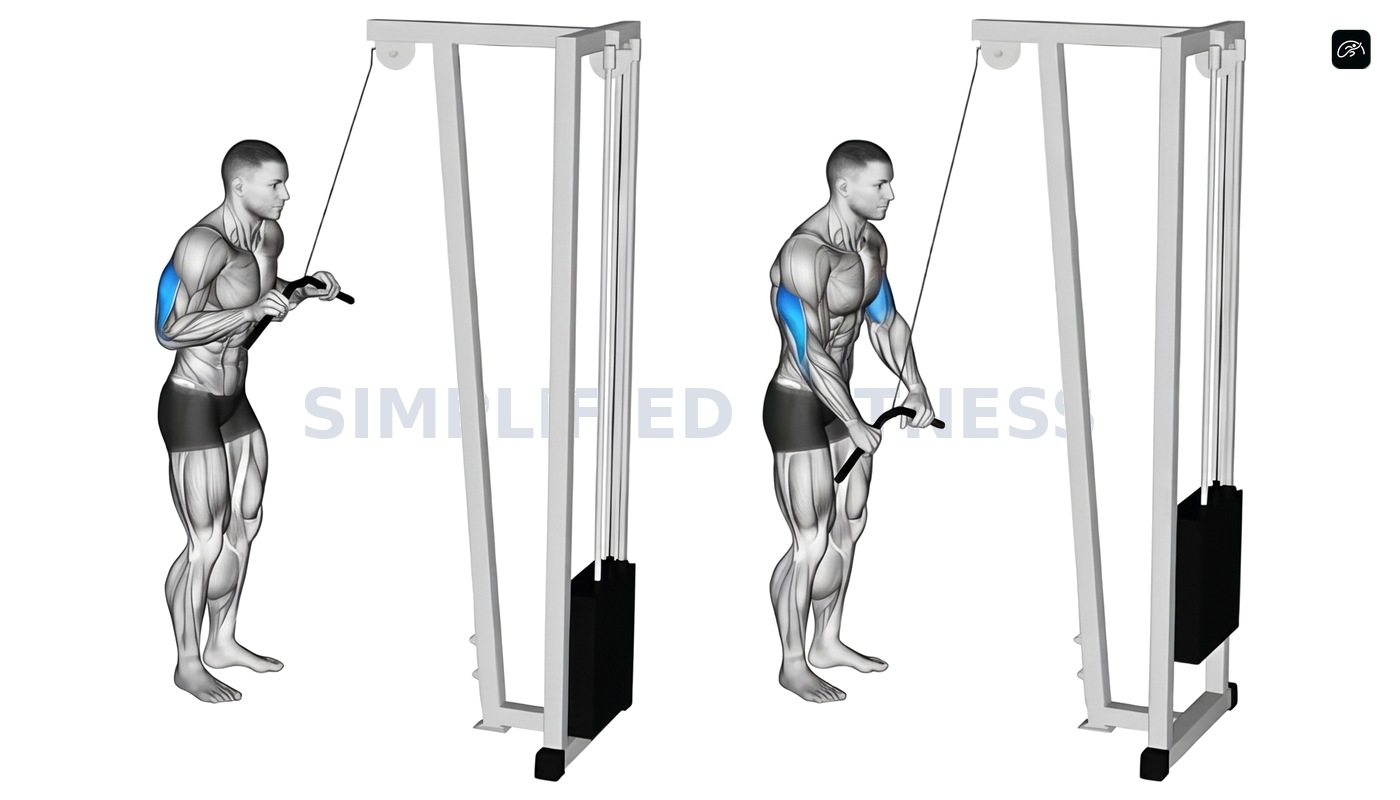
Keep the transition quick (10-20 seconds), then rest after the pair. If walking between machines takes 40 seconds, you are no longer supersetting, you are just changing exercises.
How long should you rest between arm supersets?
Start with 60-90 seconds after each pair, then adjust by feel. The rest after the pair is doing the recovery work for both muscles, so cutting it too short is the usual way people ruin the idea.
There is a reason not to rush. In an 8-week trial, 21 young resistance-trained men did either 1-minute or 3-minute rests on the same program. The 3-minute group gained more strength, and more thickness in the anterior thigh, with a trend toward more triceps thickness (p = 0.06) (Schoenfeld et al., 2016). That study used straight sets across the whole body, not arm pairs, so the direct application is limited. But it is a fair warning against gutting your rest.
A practical rule: if your reps fall by more than one or two between rounds, take 2 minutes. Our broader guide on rest intervals for hypertrophy explains when short rests make sense.
A 20-minute arm superset workout
This is a template, not a prescription. It assumes you are not training arms indirectly to exhaustion elsewhere that week.
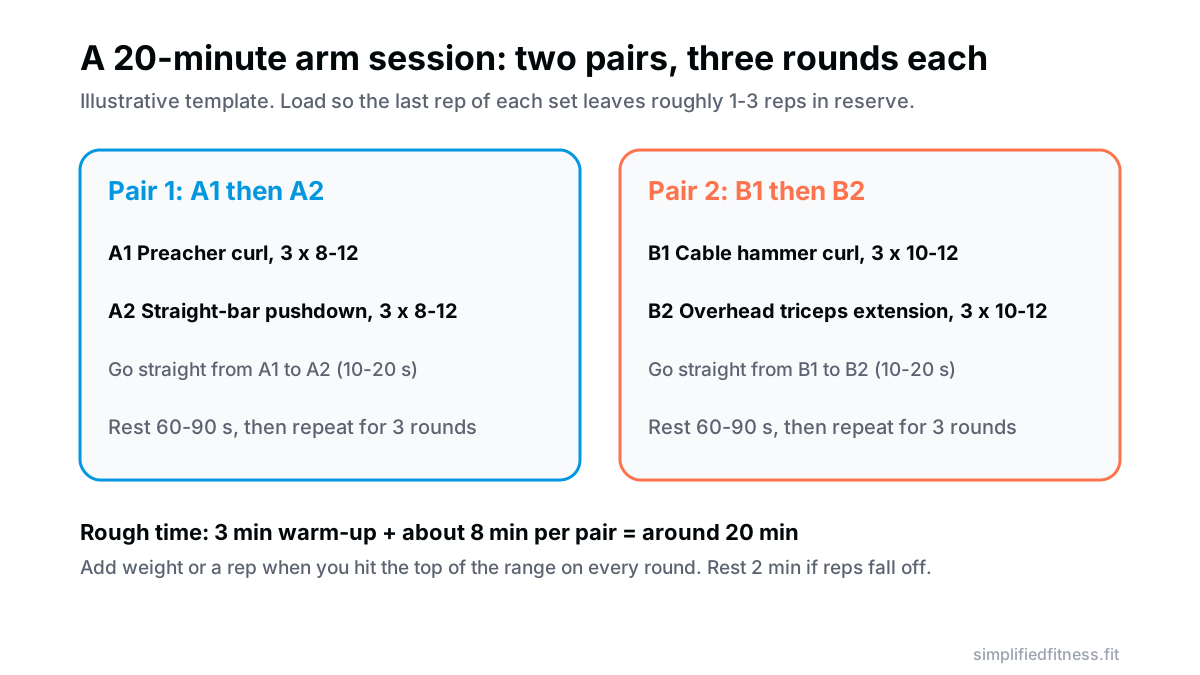
Warm-up (3 minutes): a light set of each of your first two exercises, about 12-15 easy reps.
Pair 1: preacher curl (3 sets of 8-12) then straight-bar pushdown (3 sets of 8-12). Rest 60-90 seconds after each pair.
Pair 2: cable hammer curl (3 sets of 10-12) then overhead triceps extension (3 sets of 10-12). Same rest.
Stop each set with roughly 1-3 reps in reserve, and add a rep or a little weight once you hit the top of the range on every round. You can use the 5-day or 3-day split in our free plans and drop this in at the end of a push or pull day.
How many sets you need depends on how much indirect work your chest, back and shoulders already give. We walk through that in direct vs indirect arm volume, and you can check your weekly total with the training volume calculator.
Who should and should not superset arms
Supersets suit lifters who are short on time, like someone fitting a 40-minute lunch session around work. They also work for people who tend to skip arm training because it feels like an extra 30 minutes.
They are a worse fit if you are chasing top-end strength on heavy compound lifts. Supersets generally raise internal load, muscle damage and perceived exertion, so they may need longer recovery between sessions (Zhang et al., 2025). Keep heavy compounds as straight sets and save supersets for the isolation work.
The evidence is also mostly from trained men in short studies. Results in women, beginners and older adults are less certain. If a superset leaves you dizzy, with chest pain or with sharp elbow pain that does not settle, stop and see a doctor.
Related: our wider guide on antagonist paired sets and time efficiency shows how the same idea applies to chest and back, and shoulder and arm workout structuring covers where arms fit in a split.
The bottom line
A biceps triceps superset workout is a good way to protect your arm training when time is tight. The best evidence says it saves time while keeping reps, volume and long-term gains close to straight sets. It does not look like a shortcut to bigger arms, and the evidence for arm-specific pairs is thinner than for big upper-body pairs.
Pick two pairs, keep your rest at 60-90 seconds after each pair, and judge it by whether your reps and loads climb over the next month. If they do, the 20 minutes is working.
Frequently Asked Questions
What is a biceps and triceps superset?
It is two exercises done back to back with little or no rest between them, one for the biceps (an elbow flexor) and one for the triceps (an elbow extensor). Because the two muscles do opposite jobs, one can rest while the other works. Pick one curl and one triceps movement, do them in a row, then rest before the next round.
Do biceps and triceps supersets build more muscle?
Not more than straight sets, according to current evidence. A 2025 meta-analysis found similar muscle hypertrophy and strength gains between supersets and traditional sets over several weeks of training. The advantage is finishing the same work in less time, so use them when time is your limit.
How much time does an arm superset save?
Up to about half in some setups, but the biggest savings came with a cost. A 2026 systematic review found that slotting the second exercise into the first exercise's rest period cut session time by about 45-50%, though reps and volume load were often lower depending on the exercise. Your own saving depends on your rest times, so time one arm day each way and compare.
How long should I rest between biceps and triceps supersets?
A sensible starting range is 60-90 seconds after each pair, with only a short transition (about 10-20 seconds) between the two exercises. Research on straight sets suggests longer rests of around 3 minutes helped strength and some growth outcomes versus 1 minute in trained men. If your reps drop by more than a rep or two on later rounds, extend the rest to 2 minutes.
Should I do biceps or triceps first in a superset?
Either order works, so start with the muscle you most want to grow, because it gets the freshest first set. The triceps make up a large share of upper arm size, so many lifters put triceps first on some days and curls first on others. Swap the order every few weeks to keep both fresh.
Why does a biceps triceps superset give such a big arm pump?
Hard sets with short rests keep blood and fluid in the working muscles, and supersets raise blood lactate and perceived effort compared with straight sets. Pooled data did not show greater acute muscle swelling, though, so the pump may feel bigger than it measures. Treat the pump as feedback that you worked hard, not as proof of extra growth.
Is reciprocal inhibition why antagonist supersets work?
It is a popular explanation, but I did not find arm-specific trials showing that it drives the benefit. What studies do show is that trained lifters keep their volume in antagonist pairs, with similar muscle activation to straight sets. Use the pairing because it saves time, not because of a proven nervous system trick.
Are arm supersets good for beginners?
They can be, but the evidence mostly comes from trained men, so findings may not carry over fully to beginners. Beginners often grow well on simple straight sets, and supersets add fatigue and require juggling equipment. If you are new, try one pair at the end of your session and see how it feels.
Can I superset biceps and triceps in a crowded Indian gym?
Yes, but pick pairs that use different stations so you do not lose your spot. A dumbbell curl plus a rope pushdown works if the cable is free, and a dumbbell curl plus a bodyweight bench dip needs almost no equipment. If the cable is always taken, use a dumbbell overhead extension instead.
How many sets should I do in an arm superset workout?
Most people do well with two pairs of 3 rounds each, which gives 6 curl sets and 6 triceps sets across a session. Whether that is enough depends on how much your chest, back and shoulder training already hits the arms. Use our training volume calculator and the direct vs indirect arm volume guide to fit it to your week.
Are supersets riskier for the elbows?
There is no evidence that antagonist supersets cause elbow injury, but fatigued tendons can feel irritated if you jump up in volume quickly. Reviews note supersets create higher internal load and more muscle damage than straight sets, which may mean you need more recovery. If you get sharp or lingering elbow pain, stop and see a doctor or physio.
How often can I train arms with supersets?
Two arm sessions per week is a common, workable setup, spaced at least 48 hours apart. Superset training tends to feel more tiring and may need extra recovery between sessions. If your arms still feel sore or flat at the next session, lower the volume or add a rest day.
Do antagonist supersets work for other body parts?
Yes. Chest and back, quads and hamstrings, and biceps and triceps are the classic antagonist pairs, and the research on them is mostly in the upper body. For a broader look at how supersets fit across the whole program, see our guide to antagonist paired sets and time efficiency.
Sources & References
Every claim above is checked against peer-reviewed research (PubMed, U.S. National Library of Medicine) or guidance from established health bodies. How we fact-check.
- Zhang X, et al. Superset Versus Traditional Resistance Training Prescriptions: A Systematic Review and Meta-analysis Exploring Acute and Chronic Effects on Mechanical, Metabolic, and Perceptual Variables. Sports Med. 2025. PMID: 39903375
- Chien KY, et al. Effects of Different Paired-Set Configurations and Rest Intervals on Acute Volume Load, Repetitions, and Training Efficiency: A Systematic Review. J Funct Morphol Kinesiol. 2026. PMID: 42783664
- Paz GA, et al. Volume Load and Neuromuscular Fatigue During an Acute Bout of Agonist-Antagonist Paired-Set vs. Traditional-Set Training. J Strength Cond Res. 2017. PMID: 28933712
- Robbins DW, et al. The effect of an upper-body agonist-antagonist resistance training protocol on volume load and efficiency. J Strength Cond Res. 2010. PMID: 20847705
- Robbins DW, et al. Physical performance and electromyographic responses to an acute bout of paired set strength training versus traditional strength training. J Strength Cond Res. 2010. PMID: 20440121
- Marquez G, et al. Effects of Varying Antagonist Exercise Volume in Upper-Body Supersets on Mechanical, Metabolic, and Perceptual Responses in Resistance-Trained Men. J Funct Morphol Kinesiol. 2025. PMID: 41283526
- Krzysztofik M, et al. Maximizing Muscle Hypertrophy: A Systematic Review of Advanced Resistance Training Techniques and Methods. Int J Environ Res Public Health. 2019. PMID: 31817252
- Schoenfeld BJ, et al. Longer Interset Rest Periods Enhance Muscle Strength and Hypertrophy in Resistance-Trained Men. J Strength Cond Res. 2016. PMID: 26605807

Umair Hazrami · Founder & Head Coach, Simplified Fitness
Umair Hazrami founded Simplified Fitness and the Simplified Lifter channel to cut through fitness noise. With 4+ years of consistent training and 10+ coaching clients, he writes every guide from the peer-reviewed research and links the sources so you can check them. Our editorial standards.
Educational content only, not medical advice. If you have a medical condition, are pregnant, or take medication, talk to a qualified doctor before changing your diet, supplements or training. Full disclaimer.
Keep reading
Exercise Technique
Barbell vs EZ-Bar Curls: Why Straight Bars Hurt the Pinky Side of Your Wrist
Barbell vs EZ bar curls for wrist pain: what EMG research says about biceps activation, forearm rotation and the carrying angle, plus fixes you can use today.
8 min read
Exercise Technique
Bayesian Cable Curls: Form, Setup and Whether They Build Bigger Biceps
Bayesian cable curl form explained step by step: pulley height, step-forward distance, elbow position, sets and reps, and what the research really shows.
8 min read
Exercise Technique
Close-Grip Bench Press: Triceps Loading, Wrist Spacing, and Elbow Stress
Close grip bench press triceps guide: how narrow to go, what the grip width research shows, and how to protect wrists and elbows. Setup cues included.
8 min read
Exercise Technique
Cross-Body Cable Triceps Extensions: Setup, Form and What the Science Says
Cross body cable triceps extension explained: exact setup, what it does to your elbows and wrists, and what research says about the lateral head claim.
7 min read