Leg Extensions: Rectus Femoris Length-Tension, Knee Joint Forces, and Knee Safety
Are leg extensions bad for knees? For healthy knees the evidence says no, and they grow the rectus femoris better than squats. Setup, form cues and ACL notes.
TL;DR. The short answer
- For healthy knees, there is no good evidence that leg extensions are harmful. The fear comes largely from lab models of joint forces, not from studies showing injuries in lifters who train them sensibly.
- Leg extensions are one of the few exercises that clearly grow the rectus femoris. In a 12-week MRI trial, rectus femoris volume rose 13.2% with knee extensions versus 1.1% with the leg press.
- Leaning the backrest back (about 40 degrees of hip flexion instead of 90) grew the rectus femoris more in a 10-week trial of untrained men, while the vastus lateralis grew the same either way.
- Use a controlled lift, a pause at the top and a 2-3 second lowering, with the knee in line with the machine pivot. Stop if you feel sharp pain at the front of the knee.
- If you have knee pain, a recent injury or ACL surgery, ask your doctor or physio before loading leg extensions. Timing and range of motion matter in that case.
Part of our complete guide: Complete Lower-Body & Core Training Guide: Quads, Glutes, Hamstrings, Calves & Abs Science
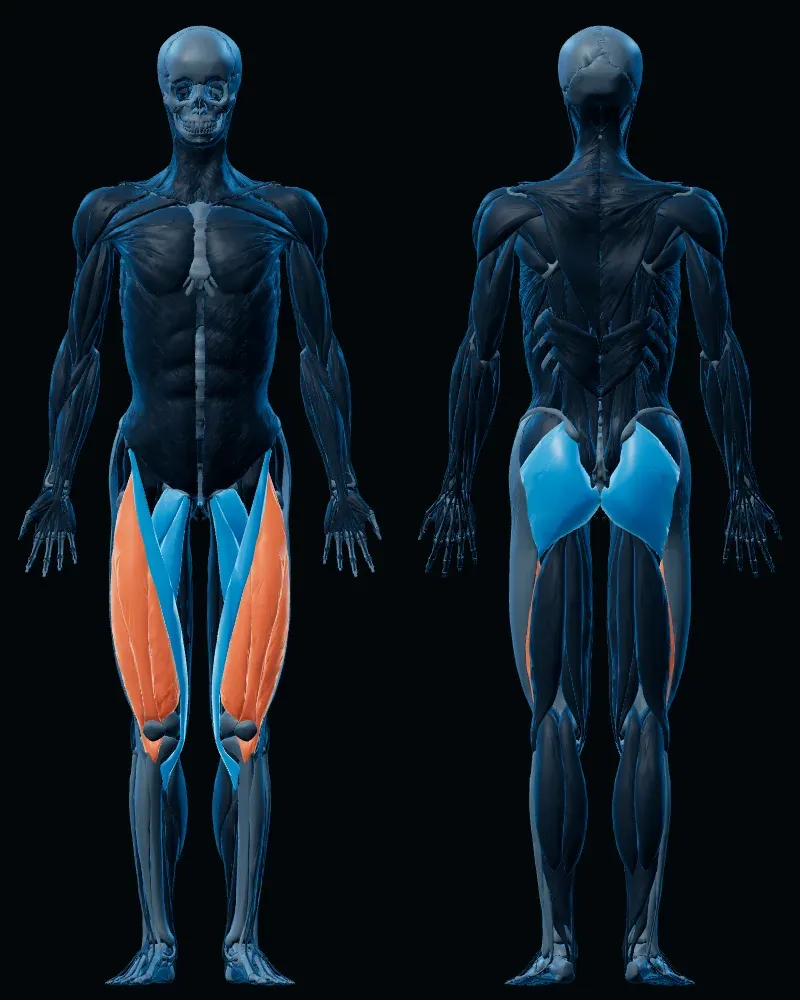
Muscles worked: quads
Main movers: rectus femoris and the three vasti
Assisting: adductors, sartorius and glutes
Table of contents
Are leg extensions bad for knees? For healthy knees, the research does not say so. The exercise loads the knee differently from a squat, and it is one of the few movements that reliably grows the rectus femoris, the quad muscle that squats and leg presses tend to miss.
This article sits inside our complete lower-body and core training guide. Here we stay on one machine: what the knee actually experiences, why the rectus femoris loves this exercise, how to set the seat, and when to be careful.
Are leg extensions bad for knees?
The “leg extensions ruin your knees” line comes from a simple observation. In a leg extension the shin swings freely and the resistance sits at your ankle. That is called an open kinetic chain exercise, and it loads the knee joint differently from a squat, where your foot is fixed to the floor. We cover that distinction in depth in open vs closed kinetic chain for hypertrophy.
What does the biomechanics research say? In a classic lab study, ten men did squats, leg presses and knee extensions at their 12-rep max while researchers estimated joint forces. Patellofemoral compressive force (the squeeze between kneecap and thigh bone) peaked near full knee bend in the squat, and in the mid-range of the extending phase in the knee extension (Escamilla et al., 1998). Tension in the ACL showed up only in the open chain exercise, and only near full extension.
Read that carefully. It says the forces are different and sit at different angles. It does not say they are harmful. This was ten men in a single session of three reps, with modelled (not directly measured) internal forces. Nobody followed lifters for years to see whose knees broke down.
What you can control is execution. Knees generally adapt to load that is built up gradually. Jumping to the whole stack, kicking the weight up with momentum and slamming the lockout is a poor bet for any joint, and it is the part of this exercise worth worrying about.
Why the rectus femoris needs leg extensions
Your quadriceps has four heads. Three (the vasti) only cross the knee. The fourth, the rectus femoris, also crosses the hip. That detail changes everything about how to train it.
In a squat or leg press, your hips and knees extend together. The rectus femoris is stretched across the hip while it shortens at the knee, so it contributes less. In a leg extension, the hip stays put and only the knee moves, so the muscle gets a direct, loaded contraction. The 1998 lab study found exactly that pattern: open chain knee extension produced more rectus femoris activity, closed chain exercises more vasti activity (Escamilla et al., 1998).
Do the growth trials agree? Yes, and the gaps are large.
- Versus leg press (12 weeks, MRI). Seventeen untrained adults trained one leg with knee extensions and the other with the leg press. Rectus femoris volume rose 13.2% with knee extensions versus 1.1% with the press. Vasti growth (about 5.0-7.2% vs 4.4-6.2%) and whole-quad growth (7.1% vs 4.9%) were comparable (Kinoshita et al., 2026).
- Versus back squat (8 weeks, ultrasound). Sixty-three untrained young women did either a Smith machine squat or leg extensions, 3 sets of 8-12, twice a week. Leg extensions grew the rectus femoris more at every site measured (for example +17.5% vs +7.9% distally). The squat grew the distal vastus lateralis more (+18.2% vs +11.2%) (Kassiano et al., 2026).
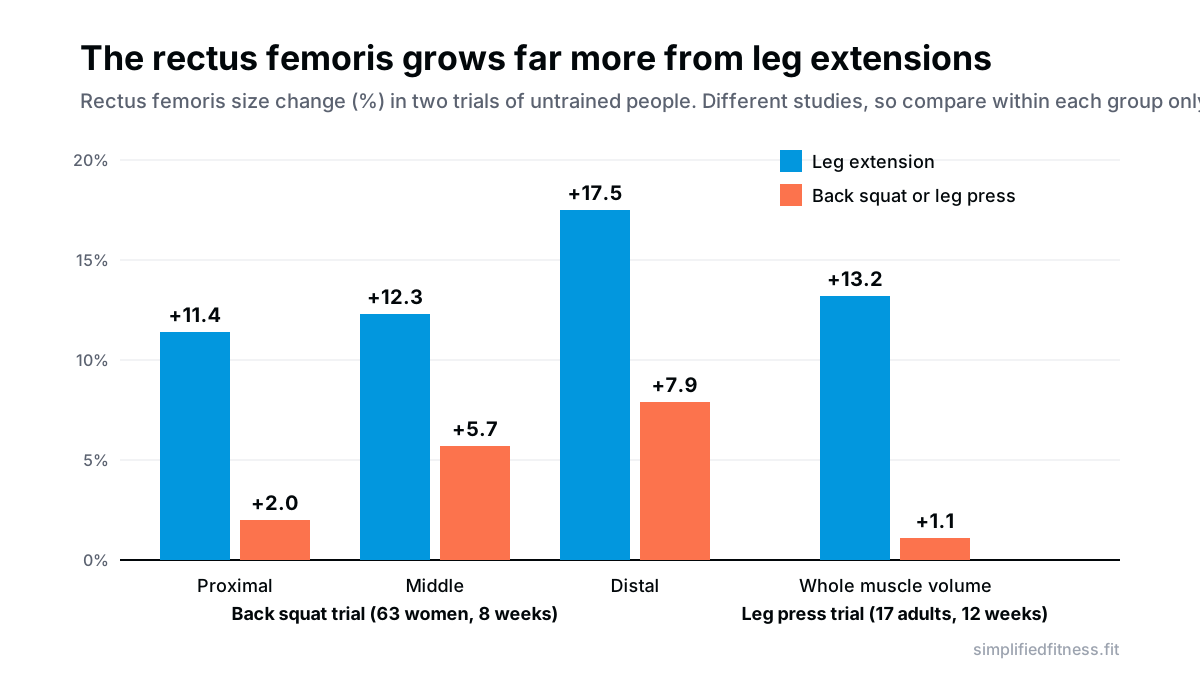
The authors of the MRI trial put it plainly: the leg press is time efficient for the vasti and glutes, but knee extension is essential for effectively targeting the rectus femoris (Kinoshita et al., 2026).
One caveat applies to both trials. Participants were untrained, and the interventions lasted 8-12 weeks. Trained lifters may respond differently, so treat the sizes as indicative rather than guaranteed. If you want the other end of the lengthened-quad spectrum, see sissy squats and reverse Nordic curls.
Do you need leg extensions at all?
Not always. A 2017 review of single- versus multi-joint exercises concluded that lifters may not need single-joint work to get equivalent muscle activation and hypertrophy, and that single-joint exercises may mainly be needed for muscles like the lumbar extensors or for fixing imbalances (Gentil et al., 2017).
How does that square with the rectus femoris data? The review looked at prime movers and overall size, and its long-term hypertrophy comparisons came mainly from upper-limb studies. The newer trials look at individual quad heads with imaging. Both can be true: a squat or press pattern can grow the quads well overall while the rectus femoris lags.
So here is a cautious takeaway. If you are short on time, a leg press or hack squat covers most of the quad. If you want complete development, or you notice your upper thigh looks underdeveloped compared with your outer quad, add leg extensions. For a squat-focused comparison, see hack squats and quad stimulus-to-fatigue.
Seat angle: why leaning back may help
Most machines have an adjustable backrest, and most people never touch it. Because the rectus femoris crosses the hip, the hip angle changes how stretched it is. A more reclined backrest opens the hip and puts the muscle on a longer length before you start.
A 2025 trial tested this directly. Twenty-two untrained men trained each leg with a different hip angle, 90 degrees versus 40 degrees of hip flexion, for ten weeks, two sessions a week. The 40-degree (more reclined) side showed more rectus femoris hypertrophy, while the vastus lateralis grew the same either way (Larsen et al., 2025). The authors suggest reduced hip flexion if you want to maximise rectus femoris growth, and note that both options are viable for the quads overall.
Two honest limits. It was untrained men over ten weeks, and the machine settings in your gym will not map exactly onto those angles. So treat it as a direction, not a prescription: recline the backrest a few notches, keep your hips planted and see how it feels.
Leg extension form cues
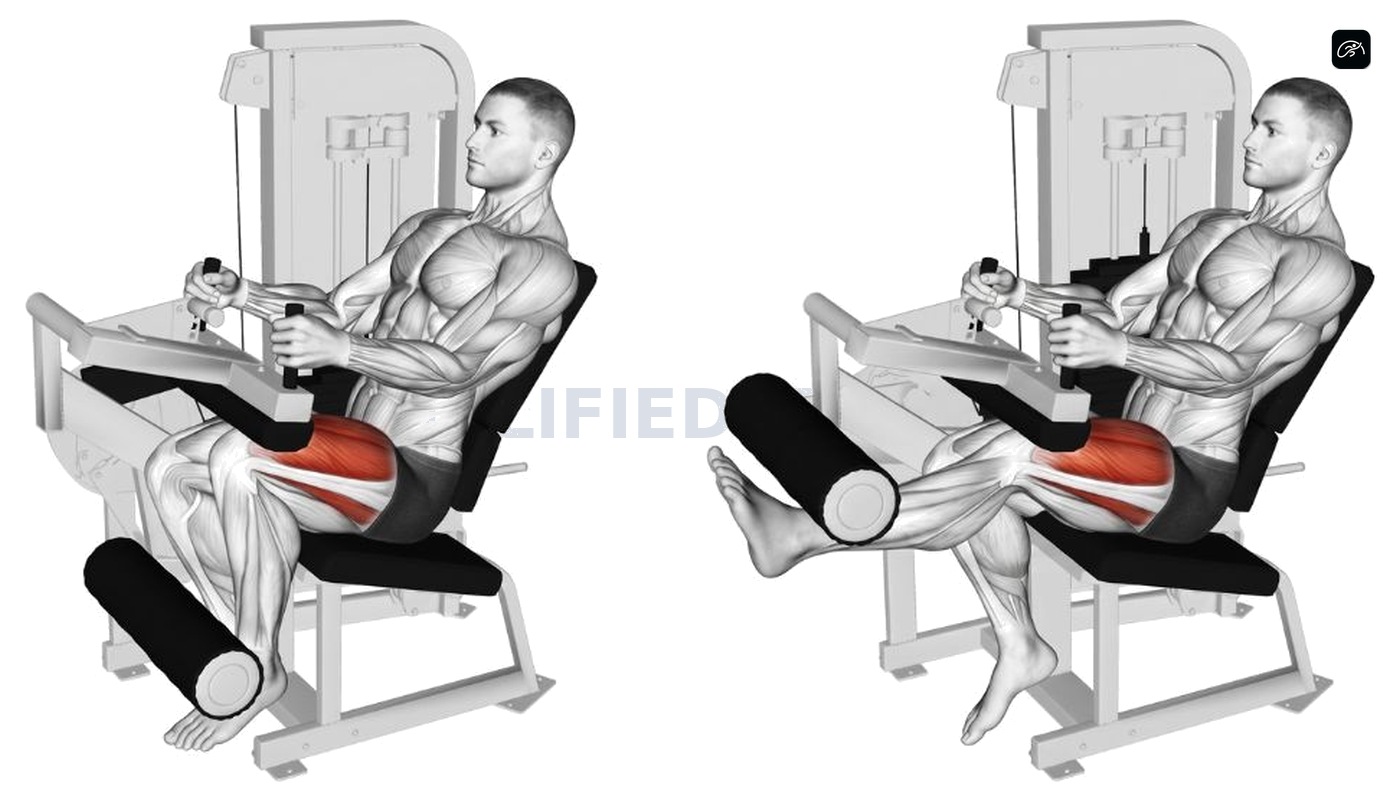
Good form here is mostly about removing momentum and respecting the knee. The steps below are practical coaching guidance built around the seat-angle finding, not a protocol from one study.
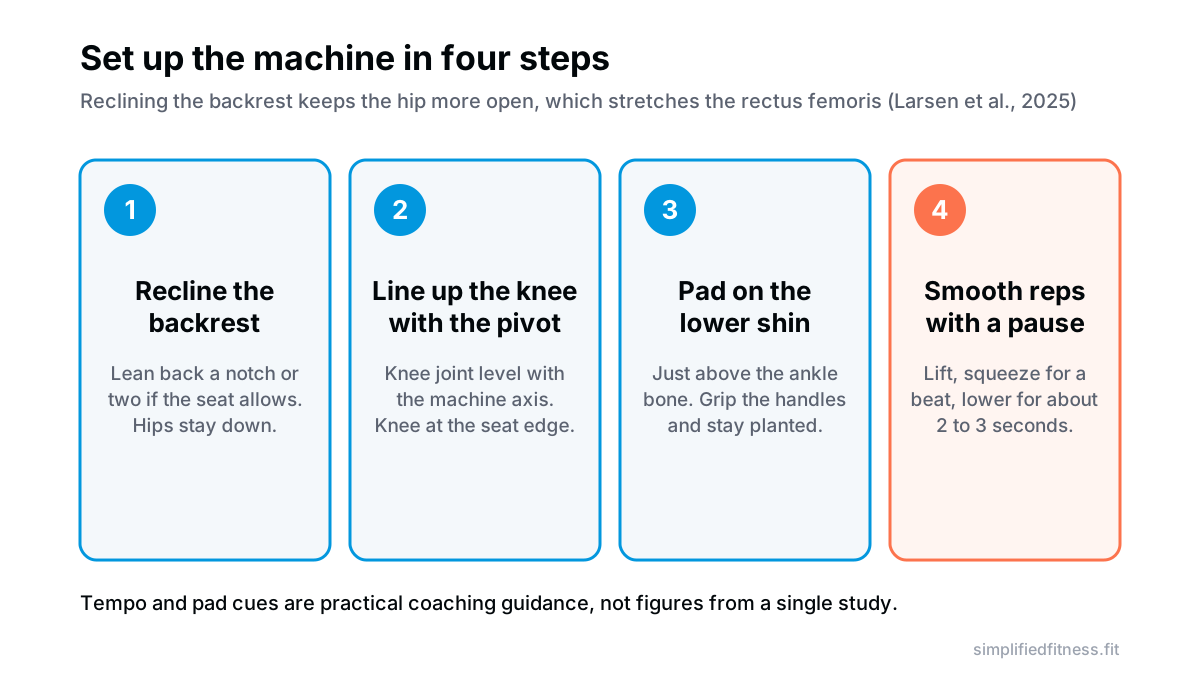
- Line up the pivot. Your knee joint should sit level with the machine’s axis. A pad that is misaligned drags the knee around a path it does not want to take.
- Pad on the lower shin. Just above the ankle bone, not on the top of the foot.
- Stay glued to the seat. Hips down, hands on the handles. If your hips lift, the load is too heavy or the seat is too far forward.
- Lift, pause, lower. Squeeze for a beat at the top without slamming into lockout. Take roughly 2-3 seconds on the way down.
- Use a range you control. A systematic review found that full-range training favours lower-body muscle growth compared with partial range (Schoenfeld & Grgic, 2020). That review did not test leg extensions, so apply it sensibly: go as deep as you can without the weight bouncing.
- Toes neutral or slightly up. There is little good evidence that toe position changes quad growth, so pick what is comfortable.
A common mistake here is loading the stack and kicking it up. That turns a quad exercise into a momentum exercise and dumps load on a knee that is still extending at speed.
How many sets, and where it fits
The trials above used about 3 sets of 8-12 reps, 2 sessions a week (Kassiano et al., 2026), or 5 sets of 10 reps at 70% of one-rep max (Kinoshita et al., 2026). Both used untrained participants over short periods, so they are a starting range, not a ceiling.
For most lifters, 2-4 hard sets, once or twice a week, after a compound lift is plenty. Stop a rep or two shy of failure on early sets and push the last set closer. Add weight when you can hit the top of your rep range with clean form. To check your weekly total across all quad work, use the training volume calculator, and see our leg day plan for where this sits in a session.
Leg extensions with knee pain or after ACL surgery
This is where blanket advice stops working, so let’s be careful.
Patellofemoral pain (pain around or behind the kneecap). A randomized trial of 112 people with long-standing patellofemoral pain compared knee-focused exercise, hip-focused exercise and free activity, each with education. After three months, there were no differences in pain scores between groups (Hott et al., 2019). Everyone improved. The takeaway is not that leg extensions fix knee pain. It is that the choice of exercise mattered less than staying active and understanding the problem. If you have this kind of pain, work with a physio, and see our guide to knee pain and leg workout modifications.
After ACL reconstruction. A 2025 scoping review of 26 studies notes that open chain strengthening appears safe and improves quadriceps strength, but many clinicians remain reluctant because of worries about graft laxity. Median time to allow it was 15 postoperative days, with a huge range (1 to 270 days), and fewer than one in three studies added clinical criteria on top of the calendar (Forelli et al., 2025). In other words, there is no consensus timeline.
A small lab study of 15 patients after double-bundle ACL reconstruction found that a loaded (10 kg) seated knee extension produced more anterior tibial translation and anteromedial graft elongation at low flexion angles than a single-leg lunge. The authors note that some translation is physiological and does not by itself mean danger (Zhang et al., 2025).
See a doctor if you have swelling, locking, giving way, pain that wakes you at night, or pain that does not settle within a few days of backing off. Those are not “push through it” signs.
How to keep the leg extension knee-friendly
- Build load over weeks. Do not start at the top of the stack.
- Keep the lowering slow and the lockout soft.
- If front-of-knee pain appears at one angle, shorten the range slightly or lighten the load before dropping the exercise.
- Pair it with a squat or press pattern rather than relying on it alone, as in the back squat versus front squat comparison. For the wider squat-and-knees question, see are squats bad for your knees.
- Training straight after a long commute or a desk day? Do a light set or two first so the knee is warmed up before the working sets.
The practical takeaway
Healthy lifters can use leg extensions without fear if they progress load sensibly and control the rep. They are a well-supported way to grow the rectus femoris, particularly with the backrest reclined a little. They are not mandatory for every program, and they are not the right call for a knee that is hurting or recently operated on until a professional clears it.
Frequently Asked Questions
Are leg extensions bad for your knees?
For healthy knees, current evidence does not show that leg extensions are harmful when loads are sensible and reps are controlled. Biomechanics work shows the knee joint is loaded differently than in a squat, but different is not the same as damaging. If a set causes sharp or pinching pain at the front of the knee, lower the weight, shorten the range or swap the exercise.
Are leg extensions necessary for quad growth?
They are not necessary for the whole quad, but they are very useful for one muscle. Squats and leg presses grow the vasti well, yet the rectus femoris responds much better to knee extensions in MRI and ultrasound trials. If you want every head of the quad to grow, a leg extension earns its place.
Why does the rectus femoris respond so well to leg extensions?
The rectus femoris crosses both the hip and the knee, so it does little work in squat-type movements where the hip and knee bend and straighten together. A leg extension isolates the knee joint, which gives the muscle a direct, loaded contraction. That is why it shows far larger growth than the leg press in the studies we cite.
Should I lean back on the leg extension machine?
Probably, if you care about rectus femoris growth. A 2025 trial found more rectus femoris hypertrophy at 40 degrees of hip flexion than at 90 degrees in untrained men, with no difference for the vastus lateralis. Recline the backrest a notch or two, keep your hips pinned down and see if you still feel comfortable.
Is a full range of motion better on leg extensions?
Full range of motion looks better for lower-body muscle growth in general. A systematic review found full ROM beneficial for lower-body hypertrophy versus partial ROM, though it did not test leg extensions specifically. Use the range you can control without the hips lifting or the knee cramping.
Are leg extensions safe after ACL surgery?
They can be part of ACL rehab, but only on your surgeon's or physio's schedule. Reviews suggest open chain exercise appears safe when introduced with precautions, yet there is no agreed timeline and loaded work near full extension can stress the graft. Follow your rehab plan rather than guessing.
How many sets and reps of leg extensions should I do?
Two to four hard sets of roughly 8-15 reps once or twice a week is a sensible starting point for most lifters. Trials in this area used about 3 sets of 8-12 reps twice a week, and they were short and in untrained people, so treat it as a starting range. Add weight or reps slowly and track your total weekly sets.
Can leg extensions cause patellar tendon pain?
Any exercise can aggravate a sensitive tendon, and heavy, fast reps on a machine are no exception. The lab data show patellofemoral loading peaks mid-range in a leg extension, so a slower tempo and lighter load are the first fixes. If pain at the kneecap or tendon lasts for days, see a doctor or physio.
Are leg extensions better than squats?
They do different jobs, so neither wins outright. In a trial of young women, leg extensions grew the rectus femoris more while back squats grew the distal vastus lateralis more, and squats built more squat strength. Most lifters do best with a squat or press pattern plus one extension variation.
Do leg extensions build the vastus medialis (teardrop)?
Leg extensions train all four quad heads to some degree, but we do not have strong evidence that they target the teardrop region in particular. Trials show comparable vasti growth from knee extension and leg press. Any exercise that works your quads hard through a decent range will challenge the vastus medialis.
What weight should I use on the leg extension?
Pick a load you can lift smoothly for 8-15 reps with 1-3 reps left in the tank on early sets. The 12-week MRI trial used 70% of one-rep max for 10 reps, which feels moderately heavy rather than a grind. If you have to swing the torso or kick to finish a rep, drop the weight.
Do I need a leg extension if I do hack squats or leg press?
If you only care about overall quad size, leg press alone grew the whole quadriceps almost as much as knee extension in one MRI trial. The gap shows up in the rectus femoris, which barely grew from the leg press. Add leg extensions if you want that muscle covered.
How do I fit leg extensions into a leg day?
Put them after your heavy squat or press pattern, or first if you want to pre-fatigue the quads and keep the loads light. Two to three sets is usually enough alongside a compound lift. Our leg day plan shows one way to slot them in.
Sources & References
Every claim above is checked against peer-reviewed research (PubMed, U.S. National Library of Medicine) or guidance from established health bodies. How we fact-check.
- Larsen S, et al. The effects of hip flexion angle on quadriceps femoris muscle hypertrophy in the leg extension exercise. J Sports Sci. 2025. PMID: 39699974
- Kassiano W, et al. Comparison of muscle hypertrophy and strength adaptations induced by back squat and leg extension resistance exercises. J Strength Cond Res. 2026. PMID: 41379528
- Kinoshita M, et al. Hypertrophic effects of single- versus multi-joint exercise: a direct comparison between knee extension and leg press. Med Sci Sports Exerc. 2026. PMID: 41630124
- Escamilla RF, et al. Biomechanics of the knee during closed kinetic chain and open kinetic chain exercises. Med Sci Sports Exerc. 1998. PMID: 9565938
- Forelli F, et al. Criteria-based decision making for introducing open kinetic chain exercise after ACL reconstruction: a scoping review. Sports Med Open. 2025. PMID: 40220107
- Zhang L, et al. Loaded open kinetic chain exercises caused more anterior tibial translation and anteromedial graft elongation than closed kinetic chain following double-bundle anterior cruciate ligament reconstruction. J Sport Rehabil. 2025. PMID: 39798554
- Hott A, et al. Effectiveness of isolated hip exercise, knee exercise, or free physical activity for patellofemoral pain: a randomized controlled trial. Am J Sports Med. 2019. PMID: 30958707
- Schoenfeld BJ, Grgic J. Effects of range of motion on muscle development during resistance training interventions: a systematic review. SAGE Open Med. 2020. PMID: 32030125

Umair Hazrami · Founder & Head Coach, Simplified Fitness
Umair Hazrami founded Simplified Fitness and the Simplified Lifter channel to cut through fitness noise. With 4+ years of consistent training and 10+ coaching clients, he writes every guide from the peer-reviewed research and links the sources so you can check them. Our editorial standards.
Educational content only, not medical advice. If you have a medical condition, are pregnant, or take medication, talk to a qualified doctor before changing your diet, supplements or training. Full disclaimer.
Keep reading
Exercise Technique
Adductor Magnus Training: Seated Adductor Machine and Copenhagen Planks for Thigh Mass
Adductor magnus training explained: what research says on deep squats, the adductor machine and Copenhagen planks for thicker inner thighs and groin strength.
7 min read
Exercise Technique
High Bar vs Low Bar Squat: Which Builds More Quad Muscle?
High bar vs low bar squat for hypertrophy: what torso lean, knee travel and EMG studies show, why high-bar leans quad, and when low-bar still makes sense.
8 min read
Exercise Technique
Calf Hypertrophy Science: Standing vs Seated Calf Raises (Gastrocnemius vs Soleus)
Calf hypertrophy explained: why calves seem stubborn, what the trials say on exercise choice, stretch and foot position, plus weekly sets, reps and frequency.
9 min read
Exercise Technique
Complete Leg Workout Programming: Quad Day vs Hamstring and Glute Day
Best leg workout routine science: split leg day into a quad session and a hamstring-glute session, with sets, order and a 5-week plan that avoids burnout.
9 min read