Maximal Strength, Neuromuscular Adaptations & Powerlifting Science for General Lifters
How to build maximal strength: how your nervous system, muscle size and technique combine to set your 1RM, plus squat, bench, deadlift and peaking guidance.
TL;DR. The short answer
- To build maximal strength, train the big barbell lifts with heavy loads (often 1-5 reps) for practice and neural drive, and keep building muscle size with moderate loads, because a 2017 meta-analysis found heavy loads gave greater 1RM gains while muscle growth was similar across load ranges.
- Max strength is size plus nervous system plus technique. Muscle cross-sectional area, motor unit recruitment, rate coding and synchronization all contribute, which is why strength can rise before muscle visibly grows.
- Training frequency matters less than total volume and intensity. In a 6-week trial of 28 trained men, 3 and 6 sessions a week gave similar 1RM gains when volume and intensity were matched.
- Belts, sleeves and bracing can help a heavy lift, but they are tools and not a substitute for strength. One 2026 trial found a belt increased squat reps without objectively improving postural stability.
- Peaking for a meet is mostly trial and error. A 2020 review concluded that evidence-based tapering protocols for powerlifters are still lacking, so test your taper in training first.
Table of contents
If you want to know how to build maximal strength, the short answer is this: lift heavy loads on the big barbell lifts, keep adding muscle with moderate-load work, and practise the technique until a max attempt feels familiar. Strength is not one quality. It is muscle size, nervous system output and skill, working together.
That is why a stronger lifter is not always a bigger lifter, and why two people with the same biceps can pull very different numbers. This guide connects the powerlifting side (technique, belts, peaking) with the bodybuilding side (muscle size), which we cover in our muscle hypertrophy guide for natural lifters. It is written for general lifters, not just meet competitors.
One note before we start. Much of the research here is short-term and often done in young, healthy men. Where that matters, I say so.
What actually determines your max strength?
Think of your 1RM as the product of three things.
A 2018 review in Sports Medicine lists the contributors: muscle cross-sectional area and architecture, musculotendinous stiffness, motor unit recruitment, rate coding, motor unit synchronization and neuromuscular inhibition (Suchomel et al., 2018). Translate that out of physiology and you get muscle, nervous system, and the tendons that connect it all.
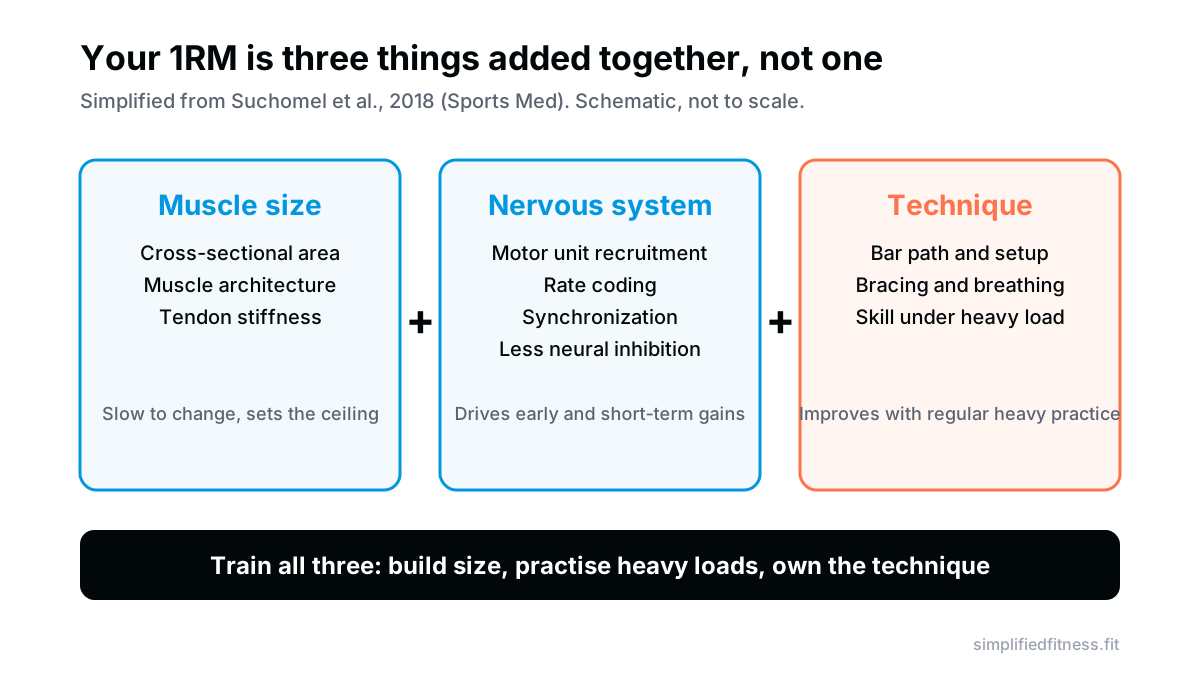
Here is what each term means in the gym.
- Recruitment: how many motor units (a nerve plus the fibres it controls) switch on. Heavy loads demand high recruitment.
- Rate coding: how fast those nerves fire. Faster firing means more force from each unit.
- Synchronization: how well units fire together.
- Inhibition: protective brakes that limit how much force you use. Training may reduce them.
None of these are things you feel. You just notice the bar moves faster than it did last month.
Is strength neural or muscular?
Both. The popular version, “beginner gains are all neural, then it is all muscle,” is too tidy.
A 2025 meta-analysis of resistance training studies reported meaningful increases in maximal strength (SMD 0.77) alongside increases in muscle thickness (SMD 0.55), and also found larger EMG amplitude, though that effect varied with contraction type and training experience (Rong et al., 2025). So heavy training moves the nervous system and the muscle in the same programme.
What we can say with reasonable confidence:
- Early gains lean on coordination and neural drive, because you are learning the skill.
- Over longer periods, muscle size keeps raising your ceiling.
- Technique and neural efficiency still matter at every level.
The practical message is not to pick a side. For the muscle side, our muscle cross-sectional area and strength ceiling article goes deeper, and the neural basics are in neuromuscular foundations of maximal strength.
How heavy do you need to lift to get strong?
The classic rule says 1-5 reps for strength, 6-12 for size, 15+ for endurance. It is a decent starting point. It is not a law.
What the heavy-load studies found. A 2017 meta-analysis of 21 studies compared low-load (60% of 1RM or less) and high-load training with all sets to failure. Gains in 1RM were significantly greater with high loads, isometric strength did not differ, and hypertrophy was similar between conditions (Schoenfeld et al., 2017).
What the lighter-load study found. In a 12-week trial of 49 resistance-trained men, a group using about 30-50% of 1RM for 20-25 reps and a group using about 75-90% for 8-12 reps, all to failure, both increased strength and muscle fibre size. Only bench press improved significantly more in the heavier group (14 vs 9 kg) (Morton et al., 2016).
Why they differ. The comparisons use different exercises, programme lengths and training status, and strength is measured on a heavy single, which heavy training rehearses. A 2021 review argues that adaptations can be obtained across a wide spectrum of loading zones, which reframes the old repetition continuum (Schoenfeld et al., 2021).
What to do. Treat heavy sets as practice for a max, not as the only stimulus. If your goal is a bigger 1RM, spend your first and heaviest work on the competition lifts at heavy loads, then use moderate loads for size. Our deeper dive on this is the principle of specificity: why strength needs low reps, and the broader load question is in the guide to load, rep ranges, RIR and rest.
Does training frequency matter for strength?
Less than people think. Total volume and intensity do most of the work.
In a 6-week trial, 28 resistance-trained men were randomised to train 3 or 6 times a week. Squat 1RM rose 16.8 vs 16.7 kg, bench 7.8 vs 8.8 kg, and deadlift 19 vs 21 kg, with no significant group differences when volume and intensity were equated (Colquhoun et al., 2018).
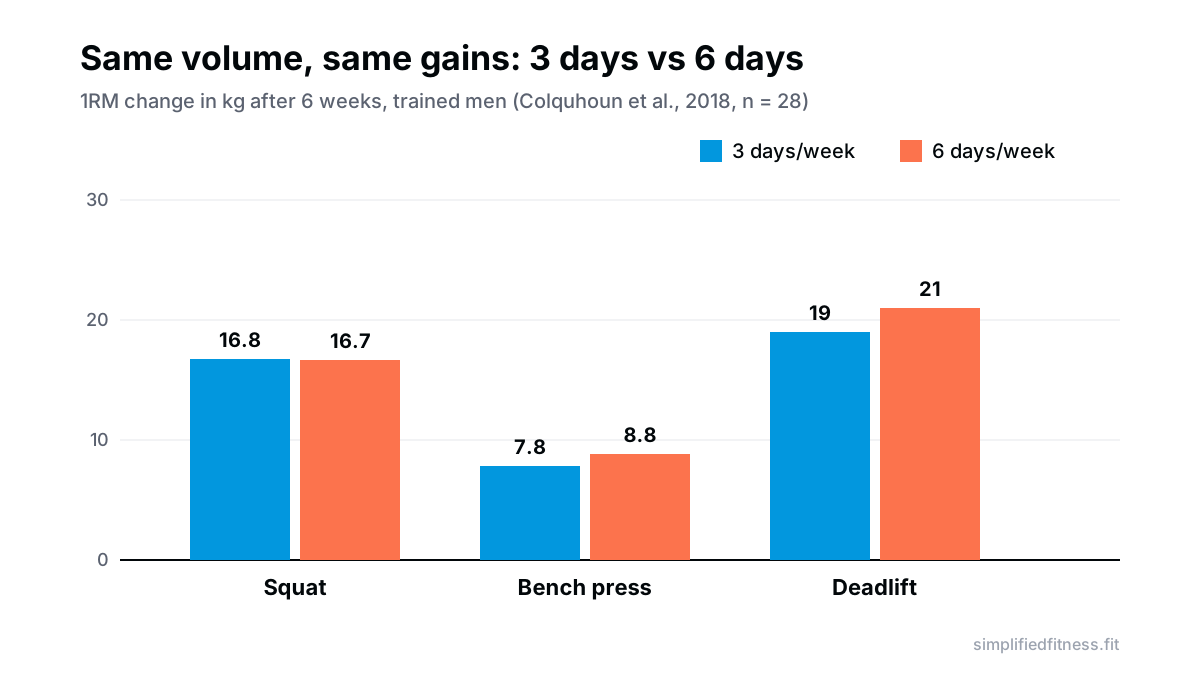
Caveats: it was 6 weeks, in young men, with matched volume. That is a narrow situation. The sensible conclusion is that you do not need to live in the gym; schedule the work you can recover from. If you are choosing a split, our workout splits guide helps.
Heavy singles, RPE and back-off sets
Once you are past the beginner phase, you need a way to choose today’s load. Percentages are a start. How you feel on the day matters too.
A common structure is a heavy top single or double at a hard effort, followed by lighter back-off sets for volume. The effort is usually judged with RPE or reps in reserve. Our RPE-based powerlifting guide covers the method, and you can use the RIR and RPE calculator to translate between them.
Two honest cautions. Rating effort is a skill, and it is usually more accurate close to failure than far from it. And the 2018 Sports Medicine review notes that training to failure may not be necessary to improve maximum strength (Suchomel et al., 2018). Most heavy sets should end with a rep or two left in the tank.
1RM testing: how to do it and how to estimate it
Testing a max gives you a number, a benchmark and some practice at being under a maximal bar. It also costs fatigue.
The test itself is reliable. A systematic review of 32 studies (pooled n = 1595) found test-retest ICCs from 0.64 to 0.99 with a median of 0.97, and good reliability regardless of training experience, number of familiarization sessions, sex or age (Grgic et al., 2020). A single well-run test is a trustworthy measure.
A sensible protocol:
- Warm up with a few lighter sets, then work up in jumps that shrink as the bar gets heavy.
- Rest several minutes between attempts.
- Take roughly 3-5 attempts after the warm-up, not 10.
- Use a spotter or safeties.
- Keep the same exercise standards (depth, pause) each time.
If you do not want to max out, estimate it from a hard set using the 1RM calculator. Estimates drift when sets are far from failure or form changes. Our article on 1RM testing protocols vs estimation equations covers the trade-offs.
Rate of force development and explosive training
Max strength is slow by nature. A heavy squat grind can take over a second. But rate of force development (RFD), how quickly you build force, still matters for sport and for the start of a lift.
A 2016 review concluded that early RFD (first 50-75 ms) is mainly determined by the ability to reach maximal voluntary activation, particularly via higher motor unit discharge rate, and that both explosive and heavy-resistance training can improve it (Maffiuletti et al., 2016). The same review notes it is difficult to measure validly and reliably.
In practice, lift heavy weights with the intent to move them fast, even when the bar moves slowly. If you want a deeper treatment, see rate of force development and explosive training and tendon stiffness and the stretch-shortening cycle.
Do plyometrics build your max squat? The 2018 review says bodyweight, isolation, plyometric, unilateral and kettlebell work may be limited in potential to improve maximal strength, but they challenge time-limited force expression (Suchomel et al., 2018). So they add something different; they do not replace the barbell.
Squat, bench and deadlift mechanics
Powerlifting rewards efficient technique: the bar travels the shortest sensible path, the joints stay stacked and the muscles pull in their strongest positions. Here is the simple version of each lift, without the rabbit holes.
Squat
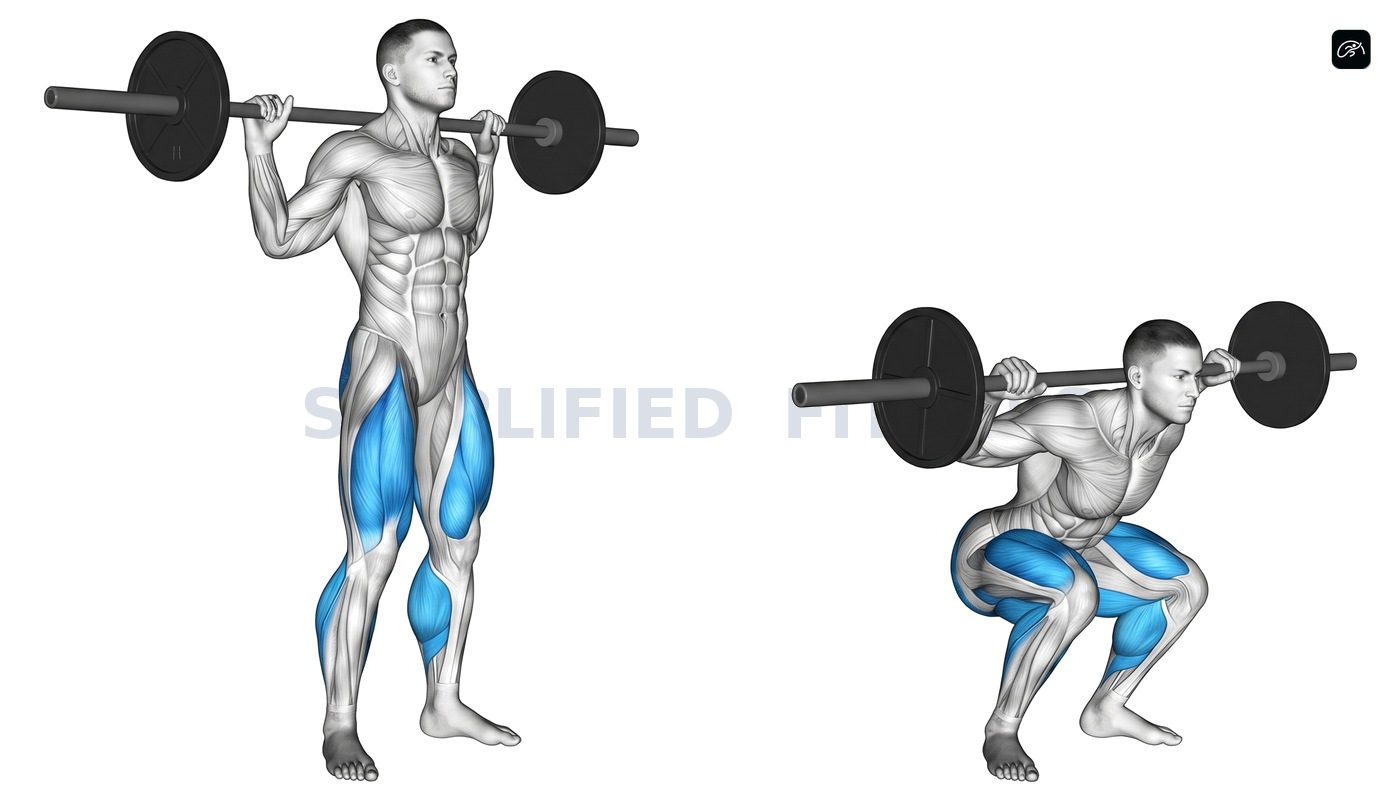
Brace, take the bar on your upper back, sit between the hips and drive up. Low-bar and high-bar positions shift the load between hips and knees. We break down the details in the low-bar squat biomechanics guide.
Bench press
Set the upper back, plant the feet and press along a slightly curved path. Leg drive and a modest arch are standard in competition. See competition bench technique, leg drive and bar path. Our free push day plan includes pressing volume.
Deadlift
Conventional and sumo both work. In a 2019 study of 47 deadlift-naive people, sumo and conventional 1RMs did not differ on average, and only one weak anthropometric relationship appeared (longer torsos slightly favoured sumo) (Cholewa et al., 2019). Treat that as a hint, not a rule: try both. Details are in conventional vs sumo deadlifts.
Sticking points: find them, then fix them
A sticking point is the region of a lift where the bar slows most or fails. A 2025 systematic review of experienced lifters (22 studies, 293 participants) found that heavier loads and fatigue consistently reduced bar velocity and power, with the biggest changes in the acceleration and sticking regions, and that lifters may adopt different mechanical strategies near the sticking point (Bakhshinejad et al., 2025). Only two studies looked at the deadlift, so conclusions are weaker there.
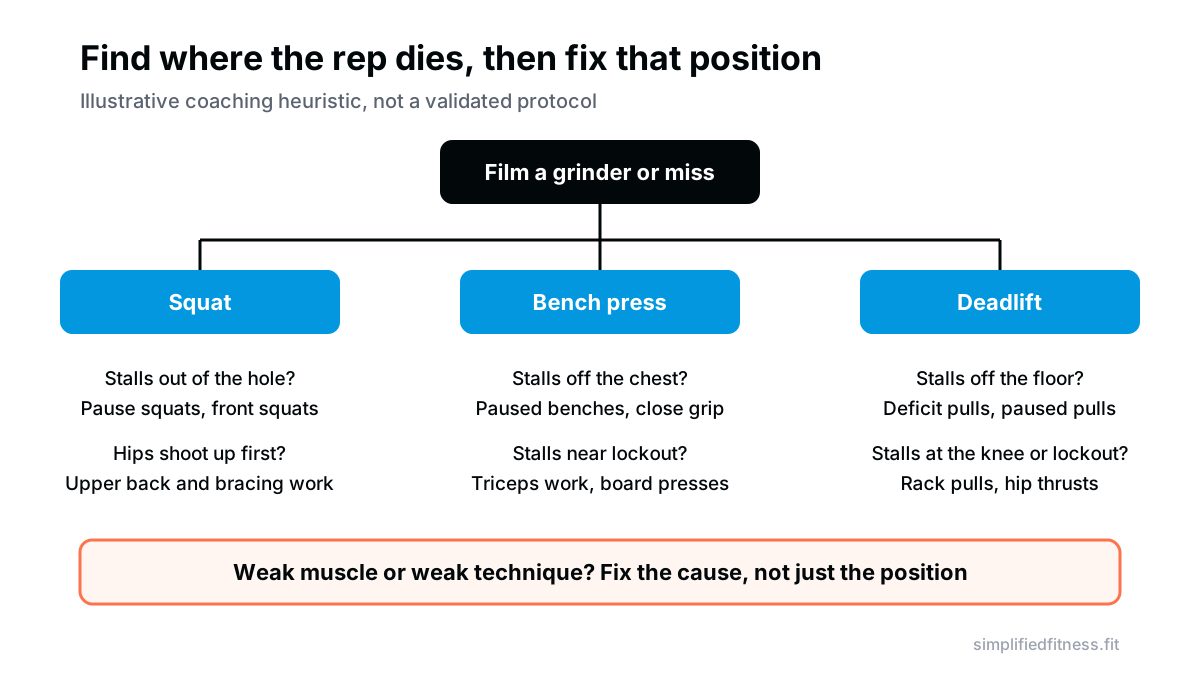
The table below is a coaching heuristic. It is not a validated protocol.
| Lift | Where it stalls | Possible limiter | Training idea |
|---|---|---|---|
| Squat | Out of the hole | Quads, bracing, position | Pause squats, front squats |
| Squat | Hips rise first | Upper back, quads | Tempo squats, rows |
| Bench | Off the chest | Chest, setup | Paused bench |
| Bench | Near lockout | Triceps, shoulders | Close-grip, triceps work |
| Deadlift | Off the floor | Quads, setup | Deficit or paused pulls |
| Deadlift | At lockout | Glutes, lats | Hip thrusts, rack pulls |
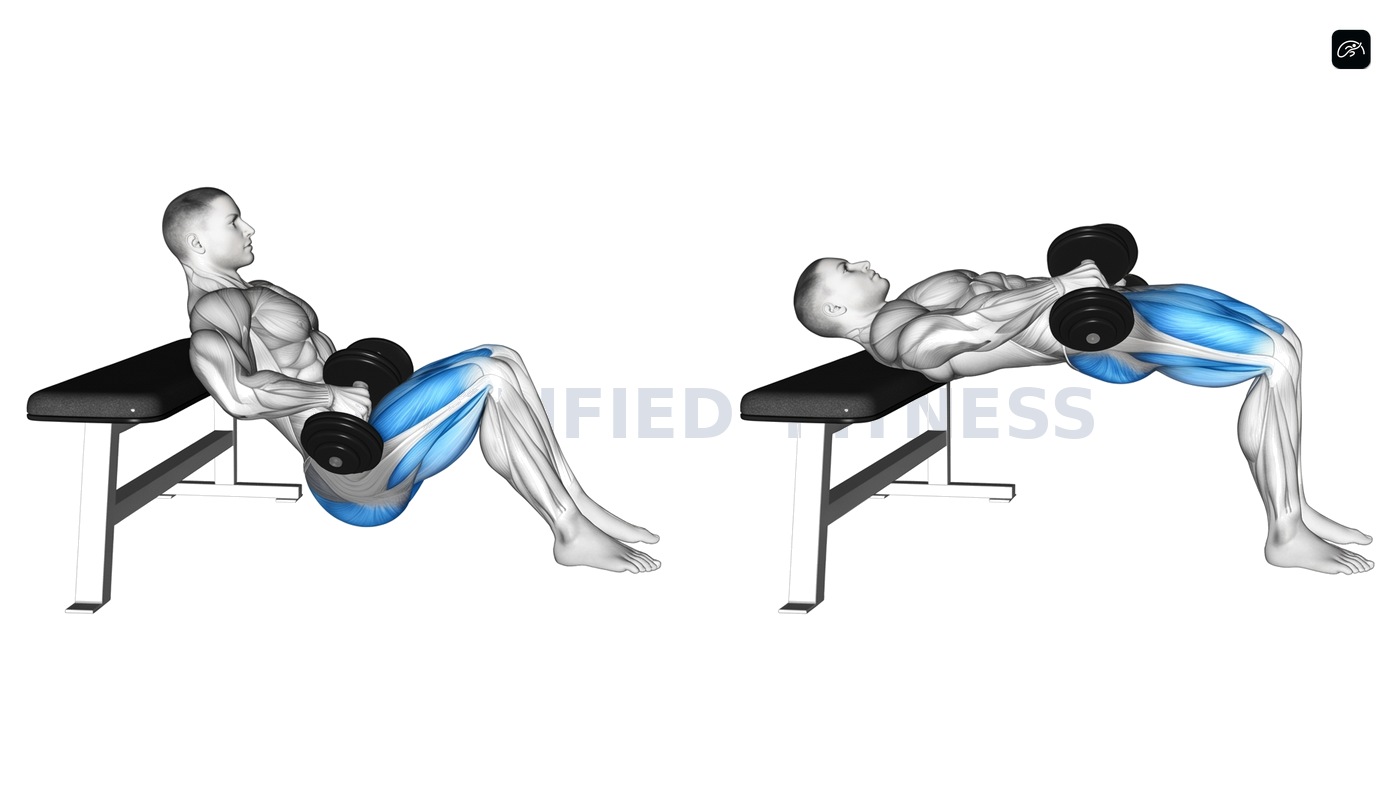
For the full method, see sticking-point analysis for squat, bench and deadlift and paused reps and deficit movements. If lockout is your weak spot, hip thrusts are a common glute builder:
Bracing, belts, sleeves and wraps
Gear is the part of powerlifting that gets the most opinions and the least data.
Bracing and the Valsalva. Holding your breath and bracing raises intra-abdominal pressure. A 2013 review found the Valsalva maneuver increases IAP, which may help trunk rigidity, and that it raises blood pressure, though the health risks of its use in resistance exercise remain unconfirmed (Hackett et al., 2013). If you have high blood pressure, a heart condition, a hernia or you get dizzy under load, talk to a doctor first.
Belts. A 2026 trial of 49 men and women found that wearing a belt raised squat repetitions at the same load (8.1 vs 6.5) and shortened the concentric phase, but did not objectively improve postural stability, even though lifters felt more stable (Veltzke et al., 2026). So belts seem to help performance, but it is not clear why. See belt science and IAP and the bracing guide.
Sleeves and wraps. Sleeves keep the knees warm and add mild compression. Wraps are long bandages used much more tightly. They are different tools, and we compare them in knee sleeves vs knee wraps.
Periodization and peaking
You cannot test a max every week. Planning helps you cycle load, volume and fatigue.
A 2022 meta-analysis of 35 volume-equated studies found periodized training gave greater 1RM gains than non-periodized (ES 0.31), and undulating beat linear periodization for 1RM (ES 0.31). Trained subgroups drove the undulating advantage, and hypertrophy did not differ (Moesgaard et al., 2022). Those effects are small and some intervals are close to zero, so I would call it a mild nudge rather than a mandate. For practical templates, see daily undulating periodization and powerbuilding and accommodating resistance with bands and chains.
Peaking. Peaking for a meet is less settled than you might expect. A 2020 review said evidence on tapering for strength and power athletes is lacking, and that practitioners frequently rely on trial and error (Travis et al., 2020). The general logic is to reduce fatigue while keeping some heavy exposure. Rehearse it first on a practice cycle. More in strength peaking and tapering for a meet.
Mental prep also matters on the day. See psychological readiness and arousal for max lifting.
Strength, hypertrophy and cardio: how they fit together
Getting strong does not mean ignoring size. Muscle cross-sectional area is one contributor to strength, and strength training also builds muscle. A reasonable blend is heavy compound work first, then moderate-load work for size.
If you also run or do conditioning, the two can compete for recovery. Our cardio and concurrent training guide covers how to combine them, and the progressive overload and plateaus guide helps when progress stalls.
Strength in older adults
Strength matters across the lifespan. A network meta-analysis of 151 trials (n = 6306) in people aged 60 and over found that low volume improved physical function, lean mass and muscle size, while moderate and high volume were most effective for lower-limb strength. Evidence was limited in physically impaired people (Radaelli et al., 2025).
That means even small amounts help, and more may be needed for strength. Anyone over 60 or with a medical condition should get cleared, build up slowly and choose loads they can control. We cover this in strength training for older adults and sarcopenia.
A simple strength template for general lifters
- Main lift, heavy: 3-5 sets of 2-5 reps at an effort leaving 1-3 reps in reserve.
- Variation: a paused or close variation for 3 sets of 4-6.
- Accessories: 2-3 exercises for 6-12 reps (rows, hip thrusts, triceps).
- Frequency: each main lift 1-2 times a week to start.
- Rest: as long as needed, often 2-5 minutes on heavy sets.
- Food and sleep: protein across the day (dal, paneer, curd, eggs, soya if you eat vegetarian), enough carbohydrate from rice and roti, and 7+ hours of sleep.
That is a starting point and not the only way. Our free training plans and diet plan give you a place to begin.
Final word
Maximal strength is a skill you grow into. Lift heavy often enough to practise it, build the muscle that raises your ceiling, brace properly and peak sensibly. Test sometimes, but not constantly.
Go deeper: every guide in this topic
- 1-Rep Max Testing vs 1RM Formulas: Which Is More Accurate and What Does Each Cost You?
- Accommodating Resistance: Do Bands and Chains Really Match the Squat and Bench Strength Curve?
- Competition Bench Press Technique: Arch, Leg Drive, Lats and Bar Path Explained
- Conventional vs Sumo Deadlift: Which Suits Your Hips, Limbs and Back?
- Daily Undulating Periodization (DUP) for Concurrent Strength and Hypertrophy
- Intra-Abdominal Pressure and the Valsalva Maneuver: How to Brace Under Heavy Load
- Knee Sleeves vs Knee Wraps for Squats: What Each One Really Does
- Low-Bar Squat Biomechanics: Bar Placement, Torso Lean and Hip Drive
- Muscle Size vs Strength Ceiling: How Cross-Sectional Area Sets Your Long-Term Max
- Neuromuscular Adaptations in Strength Training: How Your Nervous System Builds a Bigger 1RM
- Paused Squats, Spoto Press and Deficit Deadlifts: Do They Work?
- The Principle of Specificity (SAID): Do You Really Need Low Reps (1-5) for Maximal Strength?
- Psychological Readiness and Arousal in Max Lifting: Visualization, Cues, and Nervous System Prep
- Rate of Force Development (RFD): How to Train Explosive Strength
- RPE-Based Powerlifting Programming: Top Singles and Back-Off Sets Explained
- Sticking Point Analysis: How to Fix Weak Points in Squat, Bench and Deadlift
- Strength Peaking and Tapering: How to Cut Volume and Peak Maximal Strength for Meet Day
- Strength Training for Older Adults: Halting Sarcopenia, Dynapenia, and Bone Density Loss
- Tendon Stiffness and the Stretch-Shortening Cycle: How Tendons Store and Release Energy
- Lifting Belts Science: Do Belts Weaken Your Core and Who Needs One?
Frequently Asked Questions
How do I build maximal strength?
Train the squat, bench press and deadlift (or close variations) with heavy loads, enough total volume and enough rest between hard sets. Heavy training builds the skill and neural drive that a 1RM needs, while a systematic review found heavier loads gave greater 1RM gains than light loads. Pick 2-4 heavy exercises per session, add load slowly and keep most sets short of failure.
How many reps build the most strength?
Sets of roughly 1-5 reps at heavy loads are the classic choice and the most specific to a max lift. A 2017 meta-analysis of 21 studies found greater 1RM gains with high-load training, but a 2016 trial in trained men found strength gains were mostly similar with lighter loads when sets were taken to failure. Use heavy sets for your main lifts and moderate sets for accessories.
Is strength mostly neural or muscular?
It is both, and the balance shifts over time. Reviews list muscle cross-sectional area, motor unit recruitment, rate coding and synchronization as contributors to strength, and neural changes tend to matter more early in training. Keep training for both by lifting heavy and also adding hypertrophy work.
Why do beginners get stronger without gaining much muscle?
Early strength gains are partly your nervous system and technique improving, not only muscle growth. Better activation of the working muscles and better coordination let you express more force from the muscle you already have. Take advantage of it by practising the main lifts with good form two or three times a week.
Do I need to train to failure to get stronger?
No. A 2018 review concluded that training to failure may not be necessary to improve maximal strength, and it adds fatigue that can cut into later sets. Leave a rep or two in reserve on heavy work and save true grinders for tests or occasional top sets.
How often should I train the squat, bench and deadlift?
Two to three exposures per lift per week is a sensible range for most lifters. In a 2018 trial of resistance-trained men, 3 and 6 sessions per week gave similar strength gains over 6 weeks when volume and intensity were equal. Choose the frequency you can recover from and actually keep.
How do I test my one-rep max safely?
Warm up with progressively heavier singles, use a spotter or safeties, and take a few well-spaced attempts. A systematic review of 32 studies found the 1RM test has good to excellent test-retest reliability, including in people without much training experience. If you do not want to max out, estimate it from a hard set with our 1RM calculator.
How accurate are 1RM calculators?
They are estimates, and they usually work best when the set is hard and close to failure. Individual differences in fatigue resistance, technique and exercise choice add error. Treat the output as a planning number and confirm it with a heavy single or by autoregulating your top sets.
What is rate of force development?
Rate of force development (RFD) is how quickly you can build force, especially in the first fraction of a second of a contraction. A 2016 review says early RFD is mainly determined by maximal voluntary activation and motor unit discharge rate, and that both explosive and heavy-resistance training can improve it. Lift heavy with intent to move the bar fast.
Do I need plyometrics or Olympic lifts to get a bigger squat?
Not necessarily. They can help with explosiveness, but a 2018 review says plyometrics and some other methods may be limited for improving maximal strength itself. If your goal is a bigger 1RM, get most of your work from heavy barbell lifts and add jumps or fast lifts if you enjoy them or play a sport.
Is the Valsalva maneuver safe when lifting heavy?
For most healthy lifters it is a normal part of heavy lifting, but it does raise blood pressure. A 2013 review found that it increases intra-abdominal pressure and may help trunk rigidity, while health risks remain unconfirmed. If you have high blood pressure, heart disease, an aneurysm history or you feel dizzy, check with your doctor before lifting maximally.
Do weightlifting belts actually work?
They can help a heavy set, though not for the reason most people assume. A 2026 trial found that a belt increased squat repetitions and movement speed in men and women, but postural stability did not objectively improve. Use one for your heaviest sets if you like it, and still train bracing without it.
Should I use a belt for every set?
There is no evidence that you need to. Your trunk muscles get the most training when you brace hard without a belt on lighter and medium sets. If you use a belt at all, save it for your heaviest sets.
Are knee sleeves and knee wraps the same thing?
No. Sleeves are thin neoprene tubes for warmth and light compression, while wraps are long bandages that store elastic energy when wound tightly. Sleeves are the simpler choice for most lifters, and research on them is thin. Try sleeves for warmth and comfort and use wraps only if your federation allows them and you have practised with them.
Is sumo or conventional deadlift stronger?
It depends on your build. In a 2019 study of 47 deadlift-naive people, sumo and conventional 1RMs did not differ on average, and longer torsos favoured sumo slightly. Test both for a few weeks and pick the one you pull more with and tolerate better.
Where should I look for my sticking point?
Film the rep and note where the bar slows or you stall. A 2025 review of experienced lifters found that increasing load and fatigue consistently slowed bar velocity, especially in the acceleration and sticking regions. Train that position with paused reps or partials, and check whether the cause is a weak muscle or a technique leak.
How do I peak for a powerlifting meet?
Most lifters reduce volume while keeping some heavy work in the final 1-3 weeks. A 2020 review says that evidence for powerlifting-specific tapering is limited and that practitioners often rely on trial and error. Rehearse your taper on a practice cycle so there are no surprises on meet day.
Is periodization better than just adding weight every week?
For maximal strength, a 2022 meta-analysis found periodized training had a modest advantage over non-periodized when volume was equated. Undulating periodization did better than linear in trained lifters in the same analysis, though the confidence intervals touched zero. Vary intensity and volume across the week or month, and keep the plan simple enough to follow.
Can I build maximal strength and muscle at the same time?
Yes, and most lifters should. Muscle size is one of the factors that sets your ceiling, and heavy practice teaches you to use it. Combine heavy compound sets with moderate-load hypertrophy sets, as covered in our hypertrophy guide.
Do older adults need heavy lifting for strength?
Higher-volume training appears to help strength most, but low volume still brings benefits. A network meta-analysis of 151 trials in people 60 and older found low volume improved function and muscle size, while moderate and high volume were most effective for lower-limb strength. Older lifters or anyone with a medical condition should get medical clearance and build up gradually.
How much rest do I need between heavy sets?
Longer rests usually suit heavy sets, with 2-5 minutes often suggested for strength work. A 2018 review says rest needs can vary with training age, fibre type and genetics. Rest until you can repeat your target performance, not until a timer says so.
How long does it take to increase my max squat, bench or deadlift?
It depends on training age. In a 6-week trial of trained men, squat 1RM rose by about 17 kg and deadlift by about 19-21 kg, but those gains reflect that group and that programme, not a promise. Expect faster progress as a novice and slower, lumpier progress as you get stronger.
When should I see a doctor before maximal lifting?
See a doctor if you have chest pain, unexplained breathlessness, fainting, high blood pressure, a known heart or vascular condition, a hernia, or sharp pain during lifts. Maximal efforts raise blood pressure and spinal load briefly. Get cleared first, and stop any set that causes pain beyond normal effort.
Sources & References
Every claim above is checked against peer-reviewed research (PubMed, U.S. National Library of Medicine) or guidance from established health bodies. How we fact-check.
- Schoenfeld BJ, et al. Strength and hypertrophy adaptations between low- vs. high-load resistance training: a systematic review and meta-analysis. J Strength Cond Res. 2017. PMID: 28834797
- Schoenfeld BJ, et al. Loading recommendations for muscle strength, hypertrophy, and local endurance: a re-examination of the repetition continuum. Sports (Basel). 2021. PMID: 33671664
- Morton RW, et al. Neither load nor systemic hormones determine resistance training-mediated hypertrophy or strength gains in resistance-trained young men. J Appl Physiol. 2016. PMID: 27174923
- Suchomel TJ, et al. The importance of muscular strength: training considerations. Sports Med. 2018. PMID: 29372481
- Colquhoun RJ, et al. Training volume, not frequency, indicative of maximal strength adaptations to resistance training. J Strength Cond Res. 2018. PMID: 29324578
- Santos PDG, et al. Long-term neurophysiological adaptations to strength training: a systematic review with cross-sectional studies. J Strength Cond Res. 2023. PMID: 37369087
- Rong W, et al. Effects of strength training on neuromuscular adaptations in the development of maximal strength: a systematic review and meta-analysis. Sci Rep. 2025. PMID: 40456806
- Maffiuletti NA, et al. Rate of force development: physiological and methodological considerations. Eur J Appl Physiol. 2016. PMID: 26941023
- Grgic J, et al. Test-retest reliability of the one-repetition maximum (1RM) strength assessment: a systematic review. Sports Med Open. 2020. PMID: 32681399
- Travis SK, et al. Tapering and peaking maximal strength for powerlifting performance: a review. Sports (Basel). 2020. PMID: 32917000
- Moesgaard L, et al. Effects of periodization on strength and muscle hypertrophy in volume-equated resistance training programs: a systematic review and meta-analysis. Sports Med. 2022. PMID: 35044672
- Hackett DA, et al. The Valsalva maneuver: its effect on intra-abdominal pressure and safety issues during resistance exercise. J Strength Cond Res. 2013. PMID: 23222073
- Veltzke F, et al. A weight lifting belt increases squat performance and subjectively perceived but not objectively measured postural stability. J Strength Cond Res. 2026. PMID: 41860443
- Cholewa JM, et al. Anthropometrical determinants of deadlift variant performance. J Sports Sci Med. 2019. PMID: 31427866
- Bakhshinejad JA, et al. Effects of intensity and fatigue on the kinetics and kinematics of the barbell squat, bench press, and deadlift in experienced lifters: a systematic review. Sports Med Open. 2025. PMID: 41085612
- Radaelli R, et al. Effects of resistance training volume on physical function, lean body mass and lower-body muscle hypertrophy and strength in older adults: a systematic review and network meta-analysis of 151 randomised trials. Sports Med. 2025. PMID: 39405023

Umair Hazrami · Founder & Head Coach, Simplified Fitness
Umair Hazrami founded Simplified Fitness and the Simplified Lifter channel to cut through fitness noise. With 4+ years of consistent training and 10+ coaching clients, he writes every guide from the peer-reviewed research and links the sources so you can check them. Our editorial standards.
Educational content only, not medical advice. If you have a medical condition, are pregnant, or take medication, talk to a qualified doctor before changing your diet, supplements or training. Full disclaimer.
Keep reading
Strength & Cardio
1-Rep Max Testing vs 1RM Formulas: Which Is More Accurate and What Does Each Cost You?
1RM testing vs calculation: how accurate are Epley and Brzycki, when a true max is worth the risk, and a safe protocol if you do test. Studies linked.
9 min read
Strength & Cardio
Accommodating Resistance: Do Bands and Chains Really Match the Squat and Bench Strength Curve?
Accommodating resistance with bands and chains makes the top of a lift heavier. See what trials show on power and strength, and how to set it up safely.
9 min read
Strength & Cardio
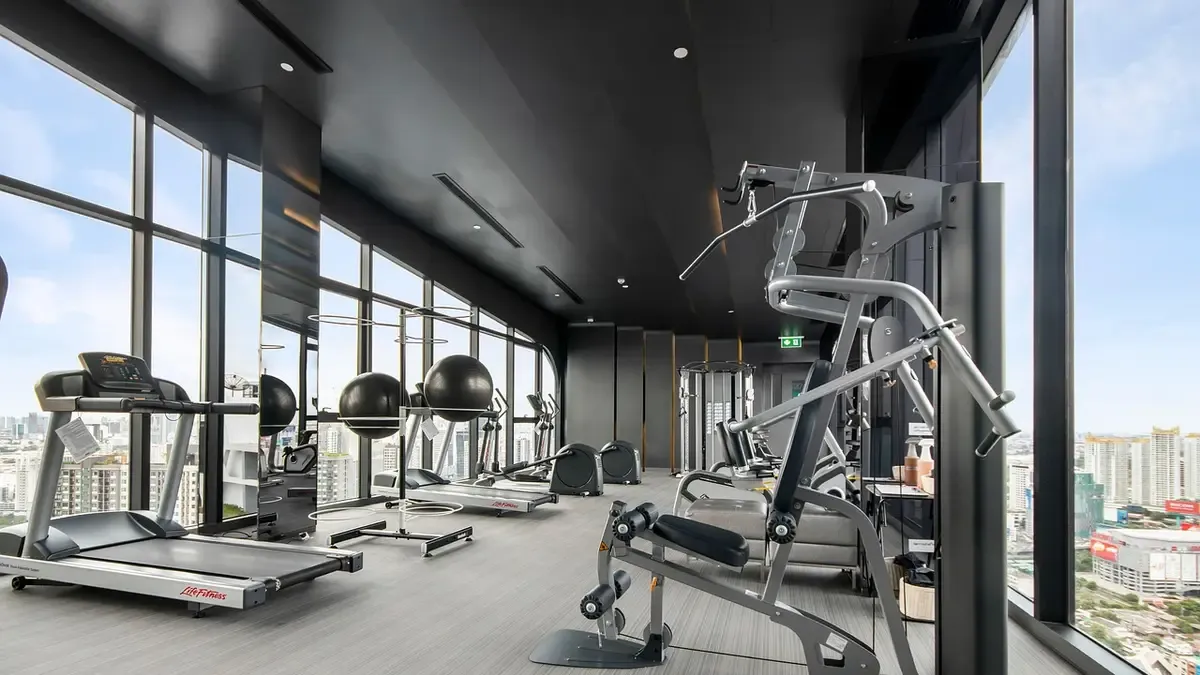
Aerobic Conditioning and Hypertrophy: How Work Capacity Improves Inter-Set Recovery
Does better cardio help you recover between sets? See what work capacity resistance training research says, where theory outruns data, and what to do.
9 min read
Strength & Cardio
Can Cardio Cause Muscle Loss? The Calorie and Volume Thresholds Behind the Fear
Does cardio cause muscle loss? Not at normal doses. See what the meta-analyses say about deficits, protein and running volume, and how to protect your muscle.
9 min read