Seated vs Lying Leg Curl: Why Hip Flexion Builds More Hamstring
Seated vs lying leg curl: one 12-week MRI trial found +14% vs +9% hamstring growth. See why hip position matters, what it misses and how to set up.
TL;DR. The short answer
- In a 12-week MRI trial of 20 healthy adults, seated leg curls grew the whole hamstrings by about 14%, versus about 9% for lying (prone) curls on the other leg (Maeo et al., 2021).
- The gap came from the biarticular hamstring heads, which cross both hip and knee. The monoarticular head (biceps femoris short head) grew about the same on both machines (+10% vs +9%).
- The likely reason is hip position. Sitting flexes the hip, which stretches the biarticular heads, and training at long muscle lengths appears to favour growth.
- Lying curls still work. If a lying machine is the only option you have, or you rotate machines, you are not wasting your time.
- Evidence is one well-controlled trial in healthy adults plus supporting work. Treat it as a strong lean towards seated, not a law.
Part of our complete guide: Muscle Length, Range of Motion and Stretch-Mediated Hypertrophy: What the Research Actually Shows
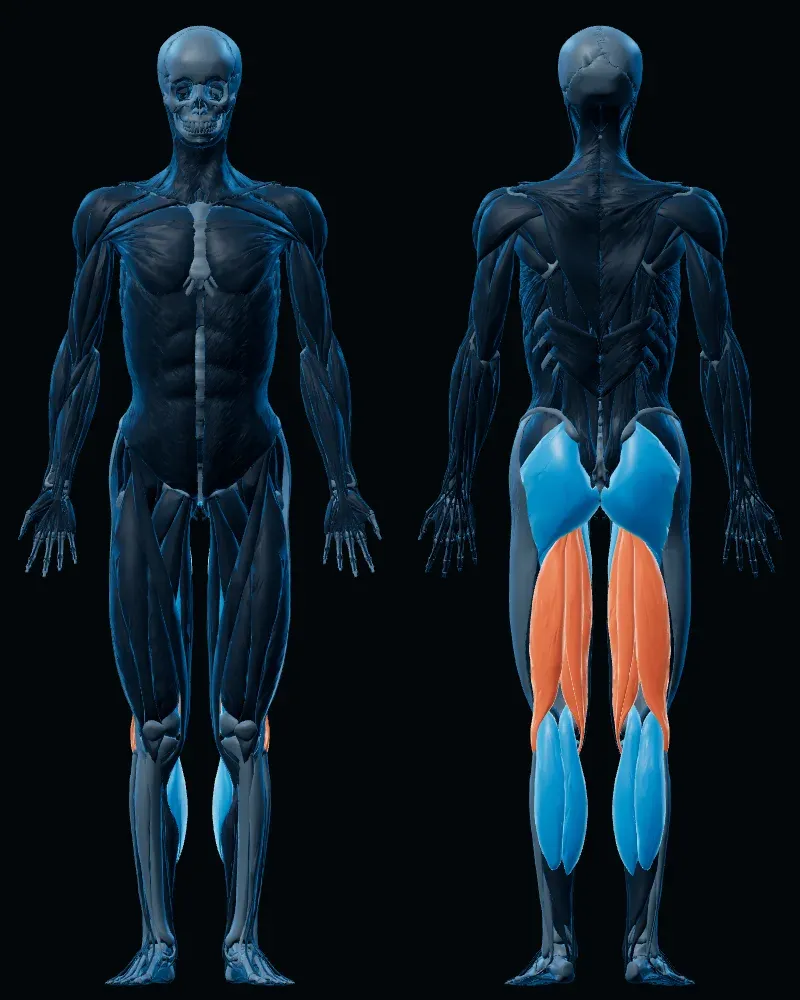
Muscles worked: hamstrings
Main movers: biceps femoris, semitendinosus and semimembranosus
Assisting: glutes, calves and adductor magnus
Table of contents
In the seated vs lying leg curl debate, seated wins for hamstring size, at least in the best study we have. In a 12-week MRI trial, the seated leg grew about 14% in total hamstring volume while the leg trained on a lying machine grew about 9% (Maeo et al., 2021). The likely reason is hip position, not magic.
This article is part of our guide to range of motion and stretch-mediated hypertrophy. Here we stay focused on one question: what actually differs between the two machines, how big is the difference, and what should you do on Monday.
Seated vs lying leg curl: what the Maeo study actually did
Most gym debates run on opinion. This one has a clean experiment behind it, which is rare.
Twenty healthy adults trained one leg on a seated leg curl and the other on a prone (lying) leg curl. Same load rule (70% of 1RM), same volume (5 sets of 10 reps), twice a week for 12 weeks. Because each person trained both legs, genetics, diet and sleep were shared across conditions, which removes a lot of noise. MRI then measured the volume of each hamstring muscle before and after (Maeo et al., 2021).
The results:
- Whole hamstrings: about +14% seated vs about +9% prone.
- Biarticular heads (cross hip and knee): about +8% to +24% seated vs +4% to +19% prone.
- Monoarticular head (crosses only the knee): about +10% vs +9%, no meaningful difference.
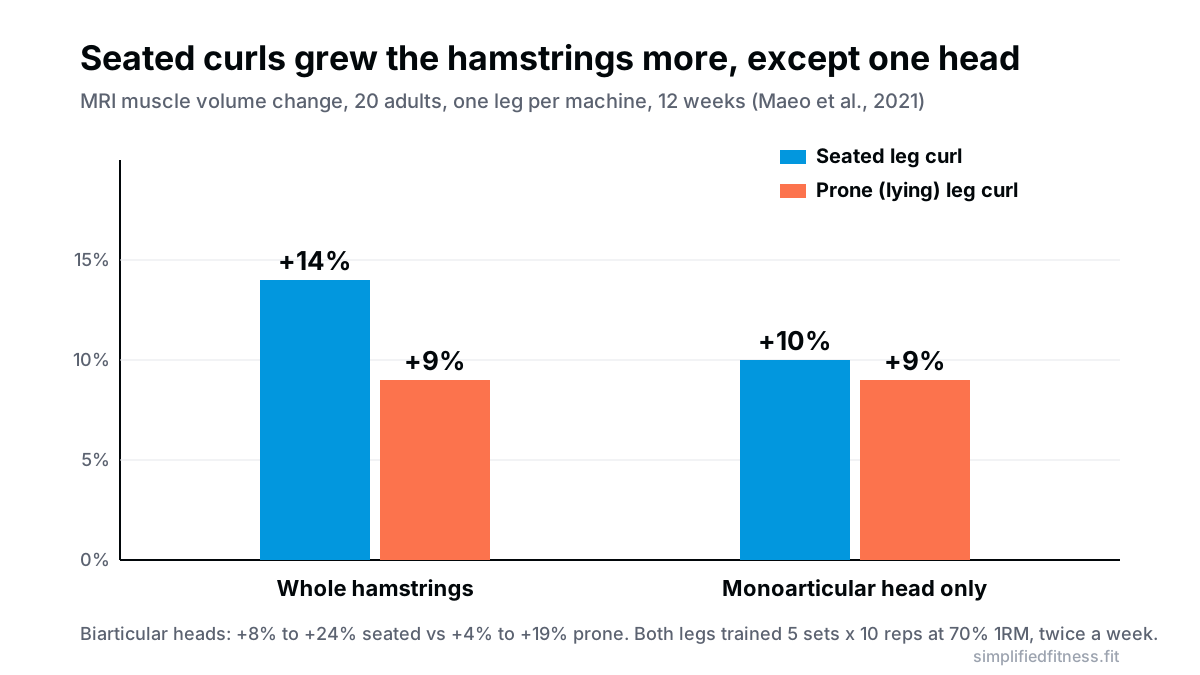
That is roughly half again as much growth for the same sets and reps. One caveat now, so it does not get lost: this is one trial in healthy adults, 12 weeks long. It is a well-designed one, but still one.
Why hip flexion changes the exercise
Three of the hamstring muscles (semitendinosus, semimembranosus and the long head of biceps femoris) run from your sit bones past the hip to below the knee. They work at both joints. They flex the knee and extend the hip.
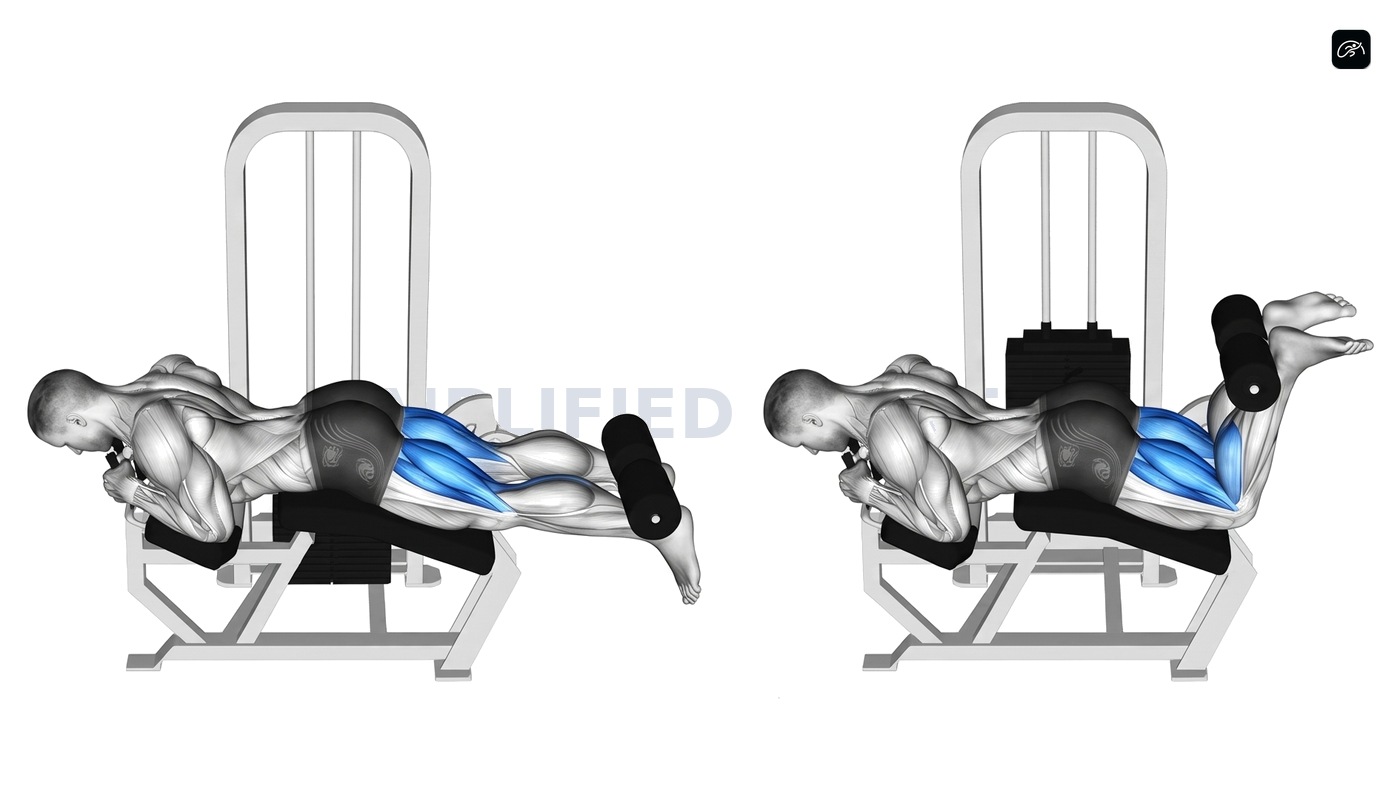
That matters because of a simple geometry fact. Bend your hip and the sit bone moves away from the shin, so those muscles are already pulled long before the knee even starts bending. On a seated machine, your hips are flexed. On a lying machine, your hip is close to straight, so the same muscles start out shorter.
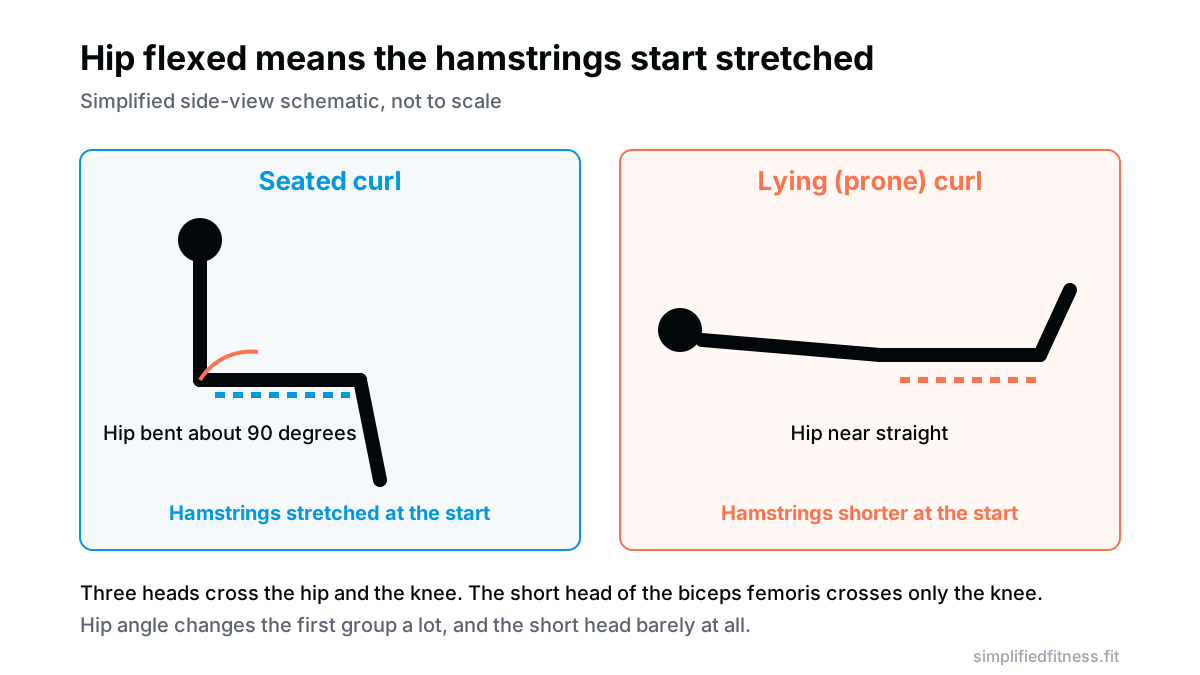
The short head of the biceps femoris starts on the thigh bone and crosses only the knee. Hip angle barely changes its length, which fits with it growing about the same on both machines. For the deeper mechanics of two-joint muscles, see our piece on active and passive insufficiency in biarticular muscles.
Why seated feels harder
If you have ever switched from lying to seated and felt your numbers drop, that is normal. A muscle that starts stretched usually feels heavier and more demanding at the bottom of the rep, and the machine’s resistance profile differs too.
In the trial, each version was loaded at 70% of its own 1RM, so the relative effort was matched even if the plates were not. Your gym stack will not be calibrated like that, so go by effort. Drop the weight 10-20% when you switch and aim to finish sets 1-3 reps short of failure.
Is it just muscle length? What the broader evidence says
The seated result fits a wider pattern. A systematic review of full versus partial range of motion found that training through a full range benefits lower body hypertrophy compared with partial range, though evidence for the upper body was limited and conflicting, and responses may be muscle specific (Schoenfeld and Grgic, 2020). We cover that more generally in full vs partial range of motion and long muscle length training.
A later trial from the same lead author compared Nordic hamstring training with a weight-stack curl done in an accentuated hip-flexed position, in 42 healthy young men split into three groups of 14 (one of them a no-training control). The hip-flexed work produced bigger gains in total hamstrings (+18% vs +11%) and in the biceps femoris long head (+19% vs +5%), but the Nordics grew the knee flexors that do not extend the hip about 1.9-fold more (Maeo et al., 2024).
Two things to take from that. First, the direction agrees: hip-flexed knee flexion is a strong hamstring builder. Second, hamstring growth is exercise-specific, so no single movement trains every part equally.
What seated vs lying does not tell you
Be honest about the limits.
- Sample size. 20 healthy adults. Results may differ in older or highly trained lifters.
- Duration. 12 weeks. We do not know how the gap behaves over years.
- Volume. 5 sets of 10, twice a week is a lot for one muscle group. Your own program will likely use less.
- Muscle damage. After hard eccentric work, seated and prone legs showed no significant difference in damage markers, and both were far better protected than a control leg (Maeo et al., 2021). So the seated advantage is about growth, not about soreness protection.
- Injury prevention. The seated curl was not tested for injury risk. The best-known injury evidence is for Nordics: a meta-analysis of 15 studies found programmes including the Nordic hamstring exercise had about half the rate of hamstring injuries (van Dyk et al., 2019). If you play sprinting or kicking sports, that matters. See our guide to Nordic hamstring curls.
How to do a seated leg curl for hamstring growth
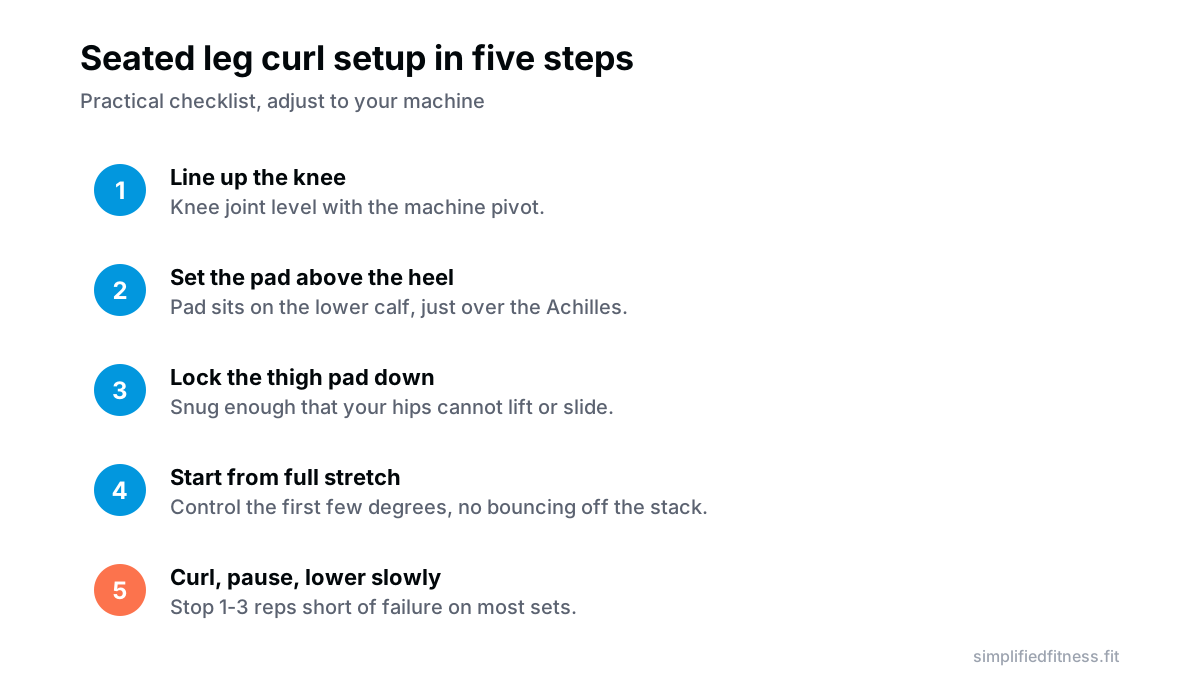
Some detail on each step:
- Align the pivot. The machine’s axis should sit level with your knee joint. If it is off, the cable path and the pad will drift as you curl.
- Pad above the heel. Resting on the lower calf, just above the Achilles tendon, is comfortable and stable.
- Lock the thigh pad. If your thighs can lift, your hips will help, and the stretch you are paying for disappears.
- Start from stretch. Let the weight stretch you at the top of each rep, then curl without a bounce.
- Lower slowly. Two to three seconds on the way back is plenty. Do not drop the stack.
Many seated machines have a back pad you can tilt. A slightly reclined back is fine, but keep the hip clearly bent.
How to program it
You do not need to copy 5 sets of 10 at 70% 1RM, twice a week. That was a research protocol, not a prescription.
- Frequency: twice a week works well for most people.
- Sets: 3-4 hard sets per session, so roughly 6-8 for the week on top of hinge work.
- Reps: 8-15, finishing 1-3 reps from failure.
- Pairing: add a hip-extension movement such as the Romanian deadlift. Curls and hinges train different jobs.
- Progression: add a rep or two each week, then add a small amount of load.
For where this fits in a lower-body day, see our free leg day plan. To check your weekly volume, use the training volume calculator. To learn the anatomy behind each head, read functional anatomy of the hamstrings.
Seated vs lying leg curl: quick comparison
| Seated leg curl | Lying (prone) leg curl | |
|---|---|---|
| Hip position | Flexed | Near straight |
| Whole hamstring volume change (12 wk) | About +14% | About +9% |
| Biarticular heads | About +8% to +24% | About +4% to +19% |
| Monoarticular head | About +10% | About +9% |
| Damage protection afterwards | Similar | Similar |
| Typical feel | Harder at the stretch | Easier to start |
What if you only have a lying machine?
Do not panic. A lying curl still grew hamstrings by about 9% in the study. Train it close to failure with a controlled lowering phase, and add a hinge for the hip-extension side.
A cheap workaround some lifters use is to flex the hips slightly with an angled pad or bench, but we do not have trial data on it, so treat it as an experiment. If you train at home in India without machines, hip hinges with a slow lowering phase and a loaded Nordic variation are the realistic options, and a single adjustable-bench setup covers most needs.
If you have a current hamstring pain, a tear or a history of strains, check with a doctor or physiotherapist before loading the muscle hard.
The bottom line
If you have both machines, make seated your default hamstring curl. It put more growth into the two-joint hamstring muscles in the cleanest trial we have, probably because sitting loads them in a stretched position. Do not overthink it beyond that: keep the sets hard, the range full and your hips glued to the seat, and add a hinge. Consistency across months beats the choice of machine.
For coaching help building this into a full program, you can start with our free workout plans.
Frequently Asked Questions
Is the seated leg curl better than the lying leg curl?
For most lifters seated is the better default for hamstring size. In a 12-week trial each participant trained one leg on each machine, and seated curls produced about +14% hamstring volume versus about +9% for prone curls. Use seated as your main curl and keep lying curls as a fallback.
Why is the seated leg curl harder than the lying one?
Sitting puts your hip in flexion, which stretches the two-joint hamstring muscles before you even start curling. That lengthened start position makes the bottom of the rep feel heavier and more demanding. Drop the load by 10-20% when you switch, and judge the set by effort, not the number on the stack.
What did the Maeo seated leg curl study find?
Maeo and colleagues trained 20 healthy adults for 12 weeks, one leg seated and the other prone, at 70% 1RM for 5 sets of 10, twice a week. MRI showed whole hamstring volume rose about 14% on the seated leg and about 9% on the prone leg. Both setups protected equally well against later muscle damage, so the difference was in growth.
Does the lying leg curl still build hamstrings?
Yes. The prone leg in that trial still gained about 9% hamstring volume over 12 weeks. It is just less efficient for the biarticular heads. If your gym only has a lying machine, train it hard, close to failure, and add a hip hinge like the Romanian deadlift.
Which hamstring muscles does the seated curl grow more?
The biarticular heads: semitendinosus, semimembranosus and the long head of biceps femoris. Their gains were about 8-24% seated versus 4-19% prone. The monoarticular short head of biceps femoris did not differ much between machines, so it is not where the benefit comes from.
Is the seated leg curl enough for hamstrings, or do I need deadlifts too?
A seated curl mainly trains the knee-flexion job of the hamstrings, so pairing it with a hip-extension exercise covers both jobs. Studies in this area often combine a curl with a stiff-leg or Romanian deadlift. A simple option is one hinge and one curl per week, each in the 6-10 hard sets weekly range for the muscle overall.
How do you set up a seated leg curl properly?
Line your knee up with the machine pivot, set the pad just above your heels and lock the thigh pad snugly. Then start each rep from a full, controlled stretch. This keeps the hamstrings loaded in their lengthened position instead of letting your hips do the work.
How many sets and reps of seated leg curls should I do?
The trial used 5 sets of 10 at 70% 1RM twice a week, which is a high dose that you do not have to copy. Most lifters do fine with 3-4 hard sets per session, 8-15 reps, 1-3 reps from failure, twice a week. Add reps or load slowly across weeks rather than chasing a big jump.
Do seated leg curls reduce hamstring injury risk?
The research on injury is mostly about Nordic curls, not seated machines. A meta-analysis of 15 studies found programmes including the Nordic hamstring exercise had about half the hamstring injury rate. A seated curl is a good size-building tool, but do not assume it carries the same injury protection, and see a physio for a current injury.
Are Nordic curls better than seated leg curls for hamstring growth?
A 2024 trial compared Nordics with a hip-flexed lengthened-state curl and found the hip-flexed work grew total hamstrings more (+18% vs +11%). Nordics grew the muscles that do not extend the hip more. So the two are complementary, not rivals.
Can the seated leg curl lengthen the muscle or build sarcomeres?
Nobody has shown that from this trial, because it measured muscle volume with MRI, not sarcomere number. The proposed link is mechanical: more stretch under load seems to favour growth. Treat the sarcomere explanation as a hypothesis and focus on the measured result, which is bigger hamstrings.
Should I switch from lying to seated leg curls right now?
If you have access to both, yes, make seated your main curl for the next training block. Keep your weekly set count the same so you can tell whether progress changes. If seated bothers your knees or hips, stay with the version you can do pain-free and talk to a physio.
Sources & References
Every claim above is checked against peer-reviewed research (PubMed, U.S. National Library of Medicine) or guidance from established health bodies. How we fact-check.
- Maeo S, et al. Greater Hamstrings Muscle Hypertrophy but Similar Damage Protection after Training at Long versus Short Muscle Lengths. Med Sci Sports Exerc. 2021. PMID: 33009197
- Maeo S, et al. Hamstrings Hypertrophy Is Specific to the Training Exercise: Nordic Hamstring versus Lengthened State Eccentric Training. Med Sci Sports Exerc. 2024. PMID: 38857522
- Schoenfeld BJ, et al. Effects of range of motion on muscle development during resistance training interventions: A systematic review. SAGE Open Med. 2020. PMID: 32030125
- Frouin A, et al. Individual distribution of muscle hypertrophy among hamstring muscle heads: Adding muscle volume where you need is not so simple. Scand J Med Sci Sports. 2024. PMID: 38515303
- van Dyk N, et al. Including the Nordic hamstring exercise in injury prevention programmes halves the rate of hamstring injuries: a systematic review and meta-analysis of 8459 athletes. Br J Sports Med. 2019. PMID: 30808663

Umair Hazrami · Founder & Head Coach, Simplified Fitness
Umair Hazrami founded Simplified Fitness and the Simplified Lifter channel to cut through fitness noise. With 4+ years of consistent training and 10+ coaching clients, he writes every guide from the peer-reviewed research and links the sources so you can check them. Our editorial standards.
Educational content only, not medical advice. If you have a medical condition, are pregnant, or take medication, talk to a qualified doctor before changing your diet, supplements or training. Full disclaimer.
Keep reading
Hypertrophy
Active vs Passive Insufficiency: How Two-Joint Muscles Change Your Exercise Choice
Active vs passive insufficiency explained for lifters: why hamstrings, triceps, quads and calves grow differently depending on your second joint position.
10 min read
Hypertrophy
Squat Mobility With Long Femurs: Adapting Range of Motion to Your Hips
Squat mobility with long femurs is mostly a lever and hip-socket issue, not a flaw. Learn how to adjust depth, stance and heels without risking your hips.
10 min read
Hypertrophy
Dumbbell Pullovers vs Cable Lat Pull-ins: Training Lats at Long Muscle Lengths
Training lats at long muscle lengths: is the dumbbell pullover a lat or chest exercise, and why a cable lat pull-in may keep tension where you want it.
7 min read
Hypertrophy
Full vs Partial Range of Motion: What the Hypertrophy Research Shows
Full vs partial ROM hypertrophy explained: what two meta-analyses and recent trials found, where lengthened partials fit, and how to set your range of motion.
8 min read