Squat Depth Science: Parallel vs Below Parallel for Quad and Glute Growth
Squat depth for hypertrophy: what trials say about parallel vs deep squats for quads, glutes and adductors, plus when going lower stops being worth it.
TL;DR. The short answer
- Deeper squats generally build at least as much quad size as shallow ones, and in two small trials they grew more thigh, glute and adductor muscle. Half squats are the weakest option.
- No trial we found compared a parallel squat with a rock-bottom squat by those names, and studies define half and full depth differently, so the claim that going lower than parallel builds extra quads is not proven either way.
- Pick the deepest range you can control with your spine and pelvis stable. Past the point where your lower back rounds, extra depth adds risk and fatigue for an unknown gain.
- Squat depth is individual. Femur length, hip shape and ankle mobility decide how deep is comfortable, so stop judging yourself against other people's videos.
- Deep squats are not shown to damage healthy knees. If a squat hurts, see a physio or doctor rather than pushing through.
Part of our complete guide: Muscle Length, Range of Motion and Stretch-Mediated Hypertrophy: What the Research Actually Shows
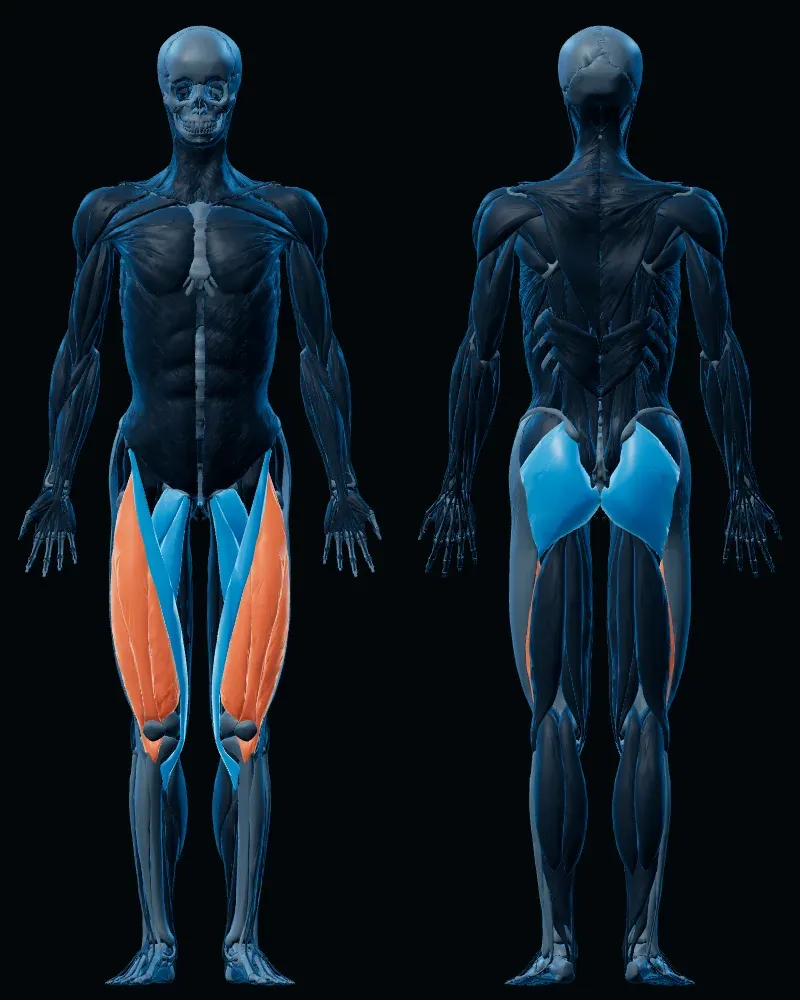
Muscles worked: quads
Main movers: rectus femoris and the three vasti
Assisting: adductors, sartorius and glutes
Table of contents
Does squat depth for hypertrophy actually matter, or is “ass to grass” just gym-floor elitism? Short answer: deeper beats shallow, but the extra payoff beyond parallel is not proven. Trials mostly show half squats lag behind, while parallel and full squats look like solid choices, with a hint that full depth helps the glutes and adductors more.
This article is one piece of our guide to range of motion and stretch-mediated hypertrophy. Here we isolate one variable, depth, and ask what it does to quads, glutes and adductors. We keep the evidence honest, because most of it comes from small trials in young men.
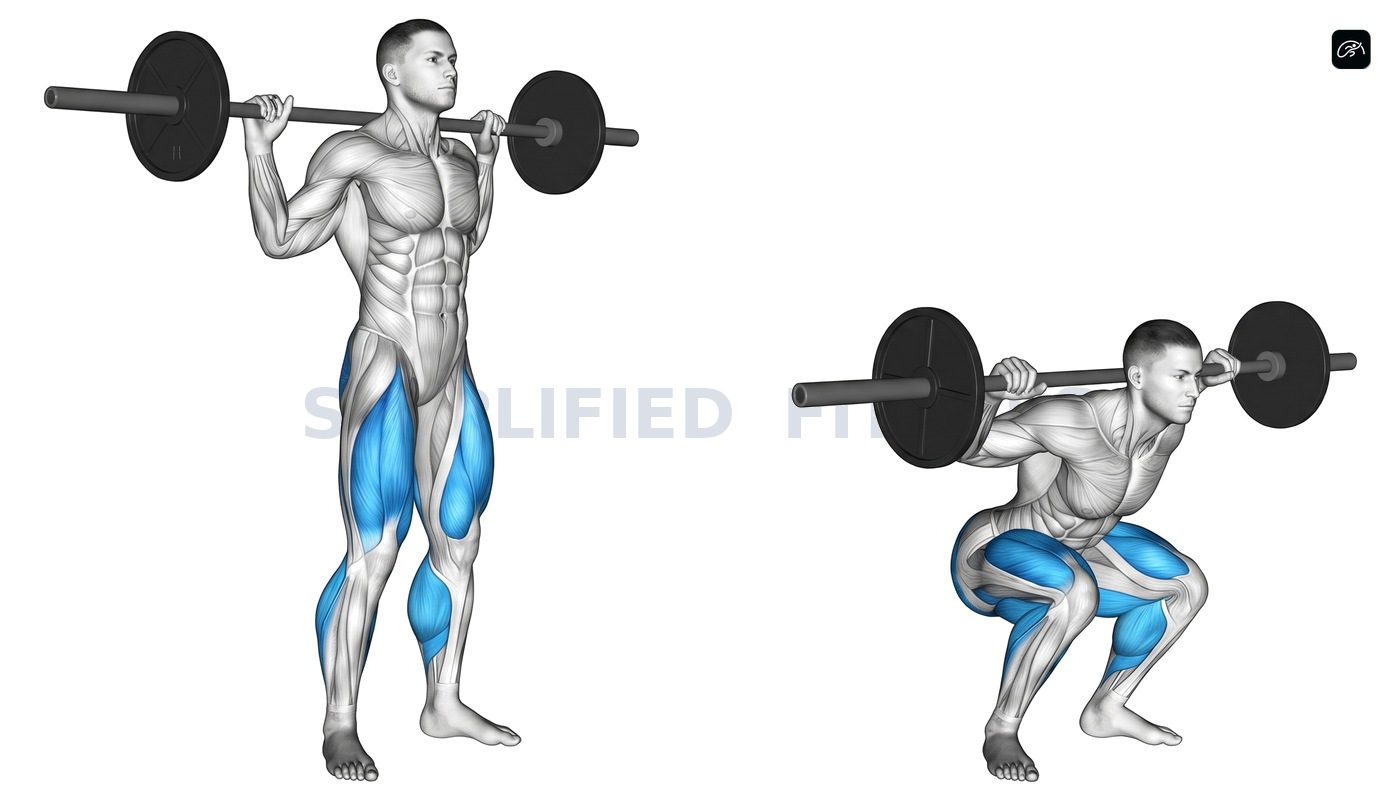
Does squatting deeper build more muscle?
Compared with half squats, usually yes. A 2021 meta-analysis of 16 studies concluded that full range of motion training is more effective than partial range for muscle strength and lower-limb hypertrophy (Pallarés et al., 2021). An earlier systematic review of six trials reached a similar view for the lower body, and noted that results for the upper body were limited and conflicting (Schoenfeld & Grgic, 2020).
The squat trials themselves are worth looking at one by one, because they do not all say the same thing.
Trial 1: deep vs shallow, 12 weeks
Seventeen male students trained either a deep squat (0-120 degrees of knee flexion) or a shallow squat (0-60 degrees) for 12 weeks. The deep group gained 4-7% more front-thigh muscle cross-sectional area, and also did better in knee extension strength and squat jump height (Bloomquist et al., 2013). Strength followed the range trained: the shallow group improved its shallow 1RM by 36% but its deep 1RM by only 9%.
Trial 2: full vs half, MRI muscle volumes
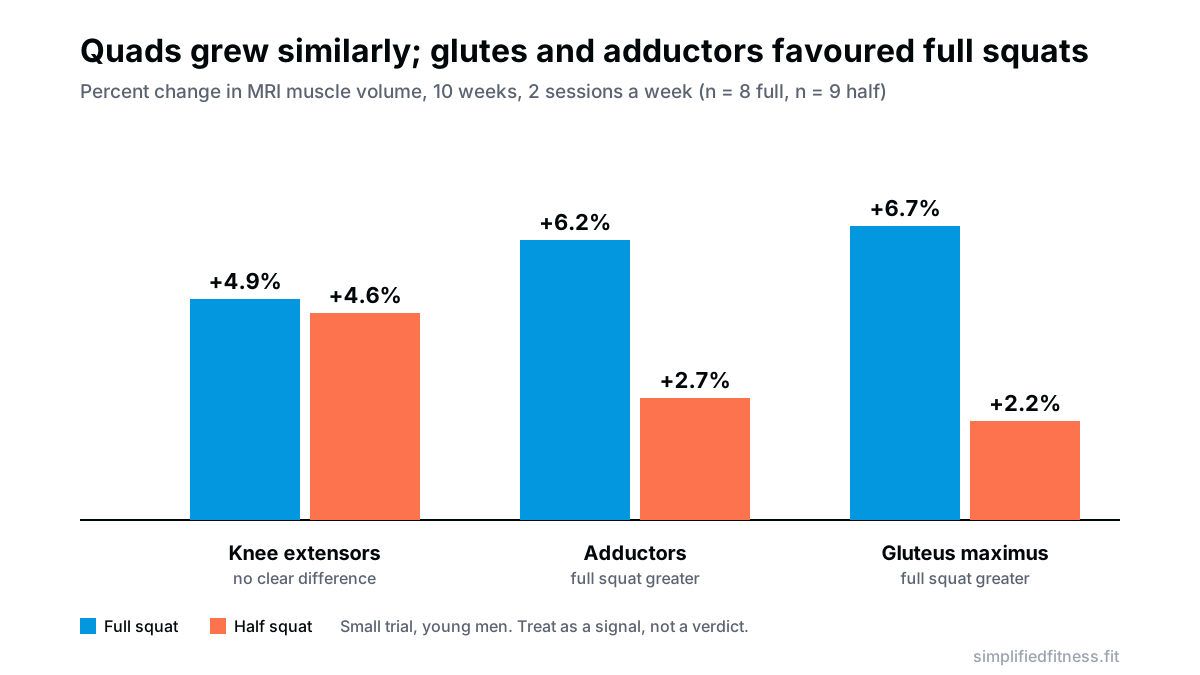
In 17 young men, 10 weeks of full or half squats grew the knee extensors by almost the same amount (4.9% vs 4.6%). The difference showed up elsewhere: adductor volume rose 6.2% with full squats versus 2.7% with half squats, and gluteus maximus rose 6.7% versus 2.2% (Kubo et al., 2019). Rectus femoris and hamstring volumes did not change in either group.
Trial 3: the one that disagrees
In 28 highly trained boys (average age about 14) playing tennis, 8 weeks of full or half squats with matched training volume both improved muscle hypertrophy. Full squats did better for body fat and bar velocity, but not for hypertrophy itself (Hammami et al., 2025).
Why might trial 3 differ? Teenage athletes, a short 8-week block, and a squat load that was not maximal could all blur the gap. In practice this suggests the depth effect is real but not huge for the quads, and may matter more for the muscles around the hip.
Why would depth change muscle growth?
Two mechanisms are plausible, and both are hypotheses, not proof.
1. Muscles work harder at the bottom. In 10 strength-trained women, knee extensor effort relative to their capacity rose as squats got deeper, but not as the bar got heavier, while hip extensor effort rose with both depth and load (Bryanton et al., 2012). The authors suggest the knee extensors can be trained at lower relative loads in a deep squat. This is a mechanics study, not a muscle growth study, so it supports the idea without proving it.
2. Stretch under load. Deeper squats lengthen the glutes and adductors at the point of greatest demand. That ties into the broader idea that training at long muscle lengths drives growth, which we cover in long muscle length training for hypertrophy. The adductor angle is unpacked in hip flexion depth and adductor magnus recruitment.
Parallel vs below parallel: what we actually know
| Question | What the evidence says | Confidence |
|---|---|---|
| Half squat vs full squat | Full range grew more lower-limb muscle in meta-analysis | Moderate |
| Quads: deep vs half | Mixed, from similar to 4-7% greater with deep | Low to moderate |
| Glutes and adductors: full vs half | Greater with full in one MRI trial | Low |
| Parallel vs ass to grass | Not directly tested for muscle size | Very low |
| Strength carryover | Specific to the range trained | Moderate |
Strength is worth a note: in a 10-week trial of 53 resistance-trained men, full squats gave the best neuromuscular and functional gains, parallel was second, and half squats produced no increase in performance (Pallarés et al., 2020). The half squat group was also the only one reporting more pain and stiffness. That study did not measure hypertrophy, so treat it as supporting evidence only.
Are deep squats bad for your knees and lower back?
Here the internet is loud and the evidence is quieter.
Knees. A 2013 review argued that concerns about deep squats damaging healthy knees are unfounded, because the contact area between kneecap and thigh bone grows with bend and retropatellar stress is highest around 90 degrees (Hartmann et al., 2013). It also argued that heavy half squats may be harder on joints over time. That is one review, and it assumes supervised technique and gradual loading. Our full breakdown of whether squats are bad for your knees goes deeper on this.
There is a counterpoint. In 16 recreationally trained men, peak knee flexion moments increased with depth and load, and the lighter bar used for deeper squats did not offset it (Cotter et al., 2013). A bigger moment is not the same as an injury. It simply means deep squats ask more of the knee muscles, which is also why they can build them.
Lower back. A small acute study of 13 young people compared Smith machine parallel and half squats at 80% of 1RM. The parallel squat reduced a disc water marker at L4/5 and L5/S1, and more at L5/S1 than half squats, which the authors linked to smaller lumbar curve and pelvic tilt at the bottom (Yanagisawa et al., 2021). That is a short-term finding in 13 people, not proof of long-term damage.
What is butt wink, and when should you stop going deeper?
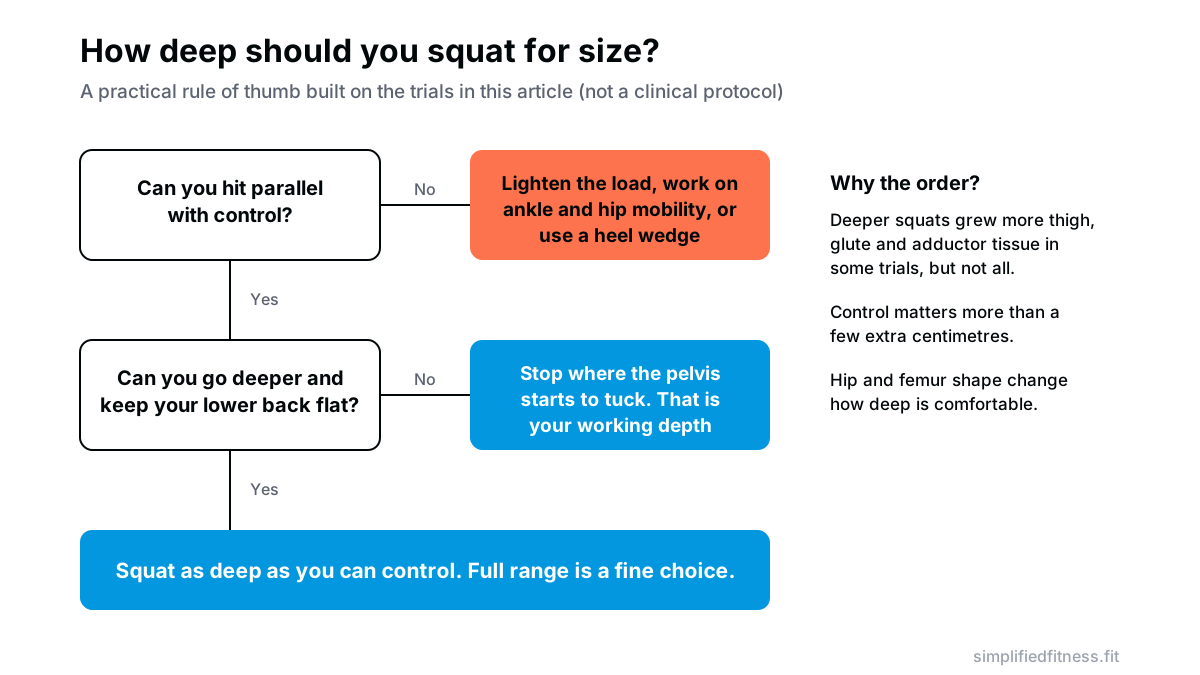
Butt wink is the pelvis tucking under and the lower back rounding at the bottom of the squat. It tends to appear when you run out of hip, ankle or femur room, then keep descending anyway.
The most common mistake here is chasing a depth you have not earned, with a heavy bar, because someone online said “below parallel only counts.” My practical rule is simple: depth is whatever you can reach with the lower back steady. That is also your working depth for the next few weeks.
Femur length and hip socket shape change this a lot. Two lifters with the same mobility can have different comfortable depths. We cover this in adapting range of motion to your anthropometry, and stance changes in stance width and foot placement for squats.
How deep should you squat for muscle growth?
A sensible plan, based on current evidence:
- Beginners: squat to a box at or just below parallel, with a light load. Control matters more than depth for the first months.
- Intermediate lifters: squat to parallel or slightly below, and add 1 set of a deeper variation if your back stays steady, such as a front squat or a high-bar squat with a small heel lift.
- Advanced lifters chasing leg size: pair squats at your controlled depth with a leg extension or hack squat so you can add quad volume without chasing more depth. Our article on hack squats for quad stimulus covers that trade-off.
Not sure how many hard sets your legs can handle each week? Use the training volume calculator, or run our free leg day plan as a starting point. If you are weighing bar position instead, see front squat vs back squat for quad hypertrophy.
Indian gym context: ankles, shoes and heat
Many lifters in India train in flat sports shoes or barefoot in crowded gyms, and ankle range varies a lot from person to person. If your heels lift or your pelvis tucks, a small plate under the heels is a free fix. Warm up well in hot weather as well, since a sweaty, rushed warm-up often shortens your depth.
What the research cannot tell you
- Most trials are 8-12 weeks long and use young men, often untrained or recreationally trained.
- Sample sizes are small, usually around 8-15 per group.
- “Deep” means different things in each study, from 120 degrees of knee flexion to loosely defined full squats.
- Women, older lifters and people with joint problems are under-represented.
So the honest conclusion is a range, not a number. Go to parallel or slightly below with control, stay curious about deeper if your body allows it, and judge by how your legs and back respond over several months.
The bottom line
Deep squats are not a trap, and they are not a requirement. Half squats look like the weak option for size and strength, while parallel and deeper squats both look like sound choices. If your hips, ankles and back let you go lower with control, the evidence leans mildly in your favour, especially for glutes and adductors. If they do not, parallel with sensible volume and a solid quad accessory is a very good plan. Anyone with persistent knee or back pain should speak to a doctor or physio before loading deeper ranges.
Frequently Asked Questions
Do deeper squats build more muscle?
Usually yes compared with half squats, but the evidence for going beyond parallel is thin. A 2021 meta-analysis found full range of motion produced greater lower-limb hypertrophy than partial range, and two small trials found deeper squats grew more thigh, glute and adductor tissue. Squat as deep as you can control and keep the load steady.
Is parallel squat depth enough for quad growth?
Probably, for most lifters. Parallel sits between the shallow squats that underperformed in trials and the very deep squats that nobody has tested head to head. Pair it with a leg extension or hack squat if you want extra quad volume without chasing more depth.
Does ass to grass build more glutes?
It may, but the proof is limited. In a 2019 trial of 17 young men, full squats grew gluteus maximus volume by 6.7% versus 2.2% for half squats. That trial did not test parallel against ass to grass, so use hip thrusts or lunges for extra glute work if deep squats feel awkward.
Are ass to grass squats bad for your knees?
Probably not in healthy knees. A widely cited 2013 review found no good evidence that deep squats raise injury risk to passive tissues such as cartilage and ligaments, partly because load spreads over more joint surface as the knee bends. If you have pain or a past injury, ask a physio before loading deep ranges.
Are deep squats bad for your lower back?
Not automatically, but rounding the lower back at the bottom is the part to watch. In one small acute study, high-load parallel squats put more stress on the lowest lumbar discs than half squats, linked to less lumbar curve at the bottom. Keep your trunk braced, stop before your pelvis tucks under, and see a doctor if you get lasting back pain or leg symptoms.
What is butt wink and should I fix it?
Butt wink is the pelvis tucking under and the lower back rounding at the bottom of a squat. It often appears when you run out of hip or ankle range, and it is usually a sign to reduce depth slightly rather than force the position. Train to the depth where your back stays steady, and improve mobility slowly over weeks.
Half squat vs full squat for muscle growth, which wins?
Full squats win in most direct comparisons. A 2013 trial found 0-120 degrees of knee flexion grew front-thigh muscle 4-7% more than 0-60 degrees, and a 2020 trial found half squats gave no strength gains. One 2025 trial in teenage tennis players found both depths grew muscle, so the gap is not always large.
How deep should I squat for hypertrophy?
Aim for at least parallel, then add depth only if you can keep control. The trials point to deeper being better than shallow, but none shows a clear extra payoff from the very bottom. Film one set from the side and check that your lower back stays steady.
Why do I get stronger on shallow squats but not bigger?
Strength is specific to the range you train. In a 2013 trial the shallow group improved shallow squat 1RM by 36% but deep 1RM by only 9%. If you want size through the whole thigh, train a longer range and use shallow work only as a supplement.
Does my femur length change my squat depth?
Yes. Longer femurs relative to your torso usually lean you forward more, and hip socket shape changes how far your thigh can travel. Adjust stance width, toe angle and heel height until the depth feels natural, rather than copying someone else's stance.
Do I need heel wedges or lifting shoes to squat deeper?
They are optional tools, not cheats. Raising the heel reduces the ankle range you need, which can let you reach depth without your pelvis tucking. Try a small wedge, a plate under the heels or lifting shoes and keep the one that lets your back stay steady.
Are leg presses and hack squats a good swap if deep squats bother me?
They can be. Machines let you reach deep knee bend with the trunk supported, which many lifters find easier on the lower back. Use them for extra quad volume and keep squats at the depth you can control.
Sources & References
Every claim above is checked against peer-reviewed research (PubMed, U.S. National Library of Medicine) or guidance from established health bodies. How we fact-check.
- Kubo K, et al. Effects of squat training with different depths on lower limb muscle volumes. Eur J Appl Physiol. 2019. PMID: 31230110
- Bloomquist K, et al. Effect of range of motion in heavy load squatting on muscle and tendon adaptations. Eur J Appl Physiol. 2013. PMID: 23604798
- Hammami R, et al. Full Squats Enhance Performance and Body Composition, but Not Hypertrophy, Compared to Half Squats in Elite Young Tennis Players. J Funct Morphol Kinesiol. 2025. PMID: 41283547
- Pallares JG, et al. Effects of range of motion on resistance training adaptations: A systematic review and meta-analysis. Scand J Med Sci Sports. 2021. PMID: 34170576
- Schoenfeld BJ, et al. Effects of range of motion on muscle development during resistance training interventions: A systematic review. SAGE Open Med. 2020. PMID: 32030125
- Pallares JG, et al. Full squat produces greater neuromuscular and functional adaptations and lower pain than partial squats after prolonged resistance training. Eur J Sport Sci. 2020. PMID: 31092132
- Bryanton MA, et al. Effect of squat depth and barbell load on relative muscular effort in squatting. J Strength Cond Res. 2012. PMID: 22797000
- Hartmann H, et al. Analysis of the load on the knee joint and vertebral column with changes in squatting depth and weight load. Sports Med. 2013. PMID: 23821469
- Cotter JA, et al. Knee joint kinetics in relation to commonly prescribed squat loads and depths. J Strength Cond Res. 2013. PMID: 23085977
- Yanagisawa O, et al. Acute effects of varying squat depths on lumbar intervertebral disks during high-load barbell back squat exercise. Scand J Med Sci Sports. 2021. PMID: 33038028

Umair Hazrami · Founder & Head Coach, Simplified Fitness
Umair Hazrami founded Simplified Fitness and the Simplified Lifter channel to cut through fitness noise. With 4+ years of consistent training and 10+ coaching clients, he writes every guide from the peer-reviewed research and links the sources so you can check them. Our editorial standards.
Educational content only, not medical advice. If you have a medical condition, are pregnant, or take medication, talk to a qualified doctor before changing your diet, supplements or training. Full disclaimer.
Keep reading
Hypertrophy
Active vs Passive Insufficiency: How Two-Joint Muscles Change Your Exercise Choice
Active vs passive insufficiency explained for lifters: why hamstrings, triceps, quads and calves grow differently depending on your second joint position.
10 min read
Hypertrophy
Squat Mobility With Long Femurs: Adapting Range of Motion to Your Hips
Squat mobility with long femurs is mostly a lever and hip-socket issue, not a flaw. Learn how to adjust depth, stance and heels without risking your hips.
10 min read
Hypertrophy
Dumbbell Pullovers vs Cable Lat Pull-ins: Training Lats at Long Muscle Lengths
Training lats at long muscle lengths: is the dumbbell pullover a lat or chest exercise, and why a cable lat pull-in may keep tension where you want it.
7 min read
Hypertrophy
Full vs Partial Range of Motion: What the Hypertrophy Research Shows
Full vs partial ROM hypertrophy explained: what two meta-analyses and recent trials found, where lengthened partials fit, and how to set your range of motion.
8 min read