Gluteus Medius and Minimus: Cable Kickbacks, Hip Abduction Machines and Hip Dips
Gluteus medius exercises for the upper glutes: what EMG research says about abduction machines, cable kickbacks and single-leg work, plus the truth on hip dips.
TL;DR. The short answer
- The best-supported gluteus medius exercises are side-lying hip abduction, the hip abduction machine, single-leg squats and deadlifts, and side planks. EMG and force-modelling studies rank them above clams and lunges.
- Machine hip abduction activated the gluteus medius at least as much as side-lying abduction and clams in one small lab study, with less tensor fasciae latae (TFL) involvement.
- Cable kickbacks at about 45 degrees combine hip extension and abduction, so they are a reasonable choice, but I could not find a study that tested that exact angle.
- Hip dips are usually explained by pelvis and femur shape. Training can thicken the muscle above the dip, but no exercise has been shown to fill the bone-driven gap.
- In untrained people, nine weeks of squats or hip thrusts produced little to no measurable growth in gluteus medius plus minimus, so give direct work a few months before judging it.
Part of our complete guide: Complete Lower-Body & Core Training Guide: Quads, Glutes, Hamstrings, Calves & Abs Science
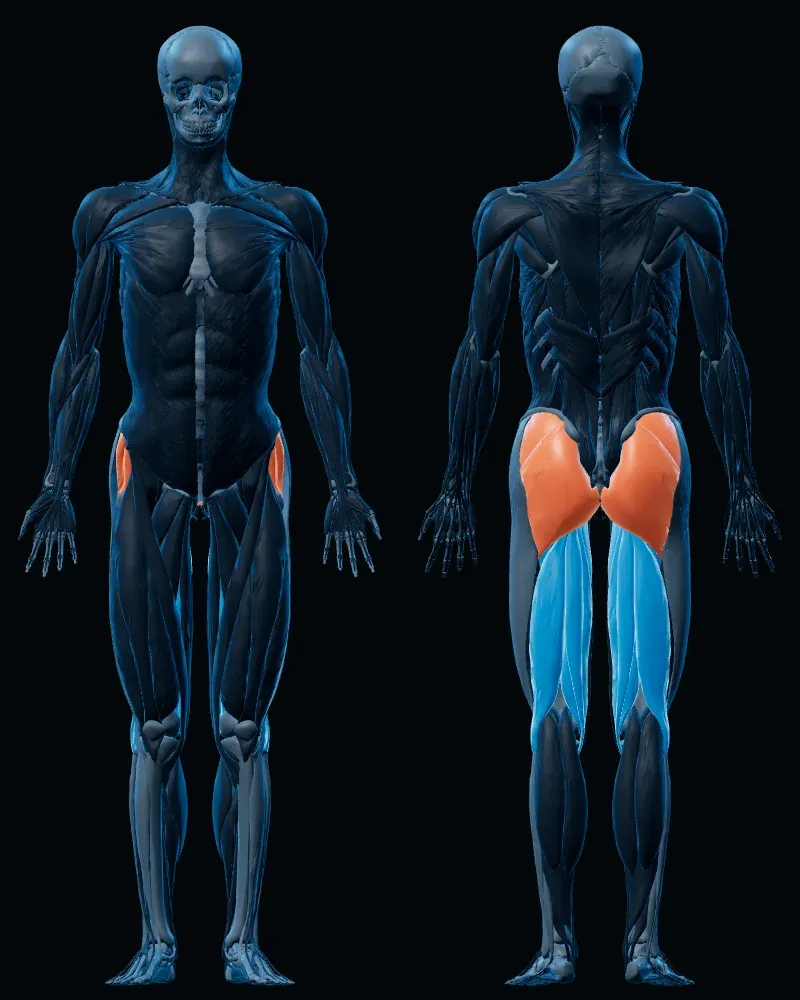
Muscles worked: glutes
Main movers: gluteus maximus, medius and minimus
Assisting: hamstrings and adductor magnus
Table of contents
The best gluteus medius exercises are the ones that make your thigh move out to the side or make you hold your pelvis level on one leg: hip abduction (machine, side-lying or standing), single-leg squats and deadlifts, and side planks. They build the upper, outer glutes and help with single-leg stability. They will not fill a hip dip if that dip comes from your bone structure, which is the usual explanation.
This article sits inside our complete lower body and core training guide, and it covers the muscle most people skip: the gluteus medius and its smaller partner, the gluteus minimus. If you are after the big, rounded part of the glutes instead, start with gluteus maximus training: hip thrust vs squats.
What do the gluteus medius and minimus actually do?
Both muscles sit on the side of the pelvis. The medius is the bigger one, fan-shaped and fairly superficial. The minimus lies underneath it. Together with the tensor fasciae latae (TFL) they form the hip abductor group.
A review of hip abductor anatomy describes their jobs as pelvic stabilisation during walking, plus abduction and rotation at the hip joint (Flack et al., 2012). The same review is candid that the evidence on their internal structure is thin. Several studies suggest the medius and minimus have separate compartments, but the authors say that is hard to confirm from the literature so far.
Here is the gym version. Stand on one leg. Your standing-side gluteus medius stops the opposite hip from dropping. That is “pelvic leveling”. Every step you take, every lunge, every step-up leans on it.
Which gluteus medius exercises work best?
Researchers rank exercises mostly by surface EMG, which is the electrical signal recorded over the muscle, shown as a percentage of a maximum effort. It tells you how hard the muscle is working. It does not directly tell you how much it will grow, and I will come back to that.
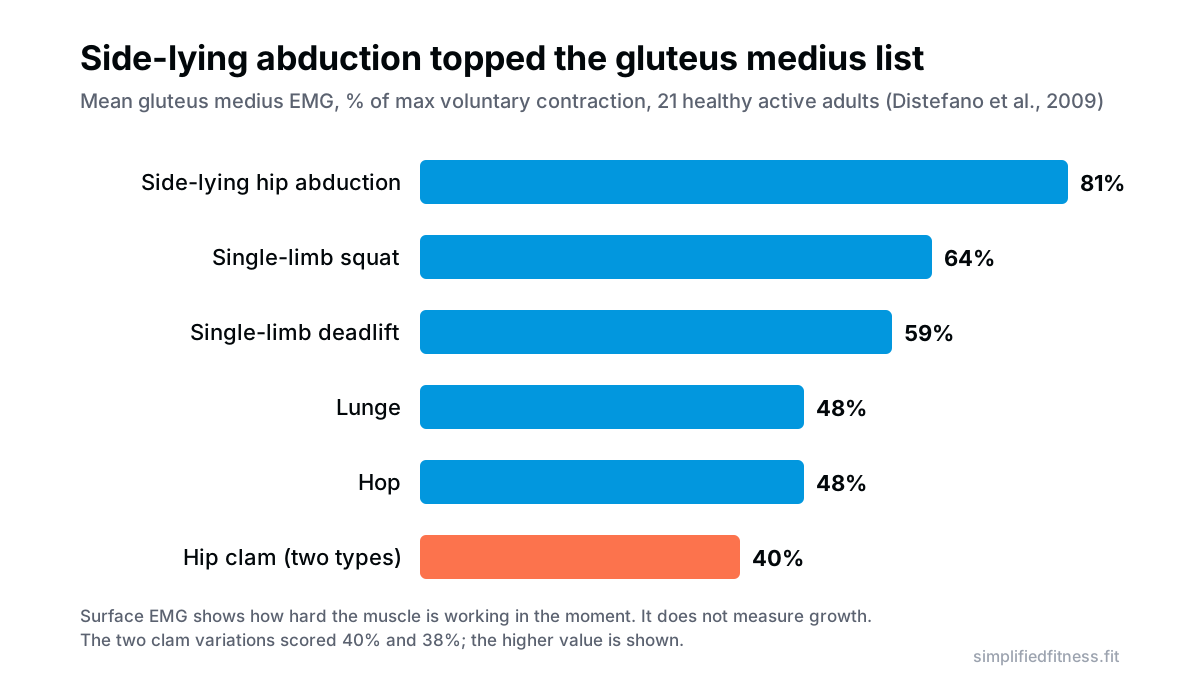
In a lab study of 21 healthy, physically active adults, gluteus medius activity was highest in side-lying hip abduction at about 81% of maximum, ahead of the single-limb squat (64%), single-limb deadlift (59%), lunges (48%), hops (48%) and the two clam variations (about 40% and 38%) (Distefano et al., 2009).
A larger systematic review and meta-analysis (56 studies) looked at individual segments of the medius and minimus. For the middle part of the medius, the best options included the single-leg bridge, side-lying abduction with the hip turned in, lateral step-ups, standing abduction with added resistance and resisted side-steps. Hip hitches (pelvic drop) and isometric standing abduction hit high activity across all minimus segments (Moore et al., 2020).
Another review, which stratified exercises by load, found that specific hip abduction and rotation exercises were moderate to very high load, while unilateral stance work with the other leg moving was often high or very high. Prone, quadruped and two-leg bridge variations were generally low or moderate (Ebert et al., 2017).
One more angle comes from force modelling rather than EMG. In 14 trained female footballers, the highest estimated gluteus medius forces came from the bodyweight side plank, the loaded single-leg squat and the loaded single-leg Romanian deadlift. Adding a 12-rep-max load raised peak gluteal forces by 28-150 N depending on the exercise (Collings et al., 2023).
Notice the pattern. The winners are either direct abduction or single-leg movements that force your hips to stay level. Plain clams, a popular warm-up, sit near the bottom for activation.
A caveat on all of this: most of these studies are small, done in healthy young people, and measure short-term muscle activity in a lab. It is a good guide to exercise choice. It is not a promise about size.
Hip abduction machine hypertrophy: seated, leaning forward or upright?
The abduction machine is the easiest way to load the muscle with a stable body position and a numbered weight stack.
One controlled laboratory study had 11 men do ten maximal reps of side-lying abduction, clam and machine abduction. Gluteus medius activation was greater than TFL in all three. Gluteus medius activation did not differ between exercises, but the TFL was more active in side-lying abduction than on the machine, so the machine had the best gluteus medius to TFL ratio (de Almeida Paz et al., 2022).
A different study in 16 untrained women found something that looks like a contradiction. With elastic resistance, gluteus medius activity was significantly higher than on the machine during abduction (Brandt et al., 2013). Why might the two differ? Different people (trained men vs untrained women), different resistance devices, and different test setups. A band’s resistance rises as it stretches, which is a different loading profile to a weight stack.
My cautious takeaway: the machine is a fine, low-fatigue choice, and bands or cables are fine too. Neither has been shown to build more muscle.
Leaning forward vs sitting upright? I could not find a trial comparing them. The hip angle changes with trunk position, which changes which fibres are lengthened and where the resistance feels hardest, but “leaning forward hits the upper glutes” is a coaching belief, not a measured result. Try both for 3-4 weeks. Keep the one where you feel the outer hip rather than the lower back, and stick with it so your progress is trackable.
Cable glute kickbacks at 45 degrees: how to set them up
A kickback is mainly hip extension, which is gluteus maximus territory. Angle the leg back and out roughly 45 degrees and you add abduction, which brings in the gluteus medius and the upper maximus fibres. That is the mechanical logic, and it is why the movement is popular for the “upper glute” look.
Here is the honest part. I could not find an EMG or hypertrophy study that tested a cable kickback at 45 degrees, so I am not going to tell you it beats anything else on the list. Treat it as a reasonable exercise that fits the anatomy.
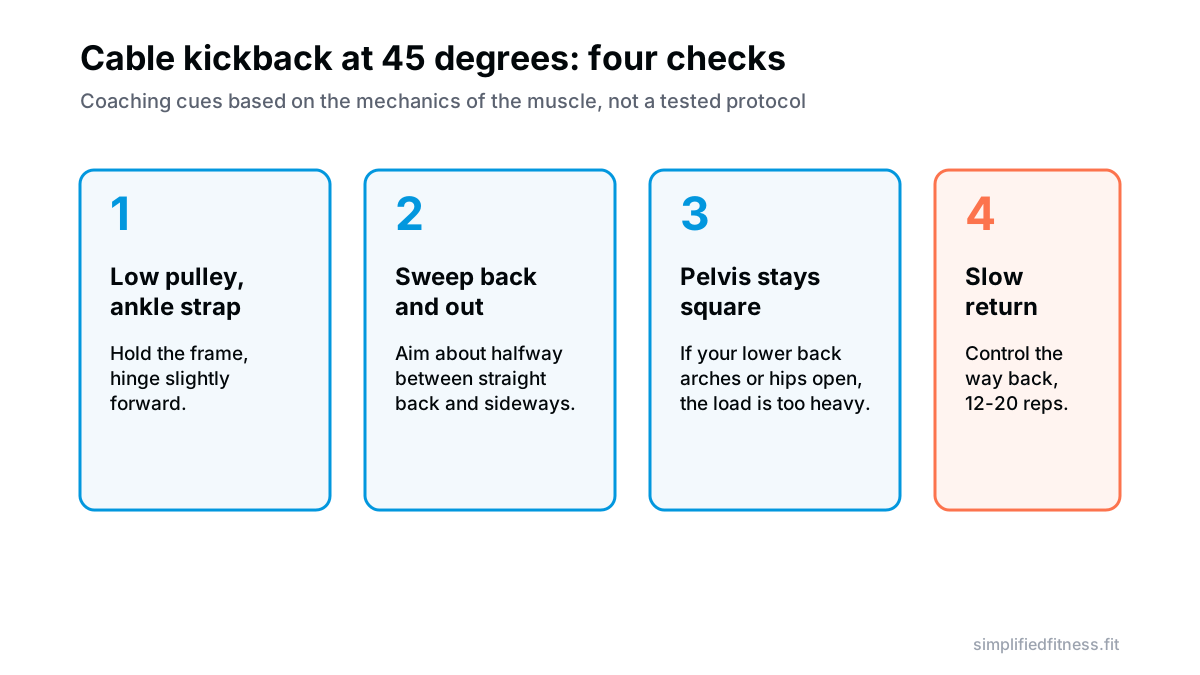
The most common mistake is turning it into a lower back exercise. The leg swings higher, the spine arches, and the glute is barely involved. If you cannot keep your ribs down and your pelvis square, the weight is too heavy.
Do squats and hip thrusts already train the gluteus medius?
Partly. Muscles often grow from heavy compound work, but gluteus medius and minimus may be a harder case.
In a nine-week study, 34 untrained college-aged people were randomised to back squats or hip thrusts with equal set volume, and muscle size was measured by MRI. Gluteus maximus size grew similarly in both groups, but gluteus medius plus minimus showed little to no growth, with small differences between groups (Plotkin et al., 2023).
Two things to keep in mind. These were untrained people over only nine weeks. And the study says nothing about what direct abduction work does over a longer period.
A separate EMG study in 10 competitive bodybuilders found gluteus medius activity was higher in the front squat than in back squat variations during the descent (Coratella et al., 2021). That is an activity measure in ten people, not a growth result, but it hints that squat variation matters.
The practical read: if the upper glutes are a priority, add one direct abduction movement and one single-leg movement, rather than hoping squats cover it. For more on single-leg options, see our guide to Bulgarian split squats and lunges and the unilateral vs bilateral training comparison.
Can you fix hip dips with exercise?
This is the question behind most searches for gluteus medius exercises, so let’s be straight about it.
A hip dip (also called a trochanteric depression) is a small indentation on the outer hip, just below the top of the pelvis. It is generally explained by skeleton rather than fat or muscle: the distance between the top of the pelvic bone (the iliac crest) and the top of the thigh bone (the greater trochanter), and how the skin attaches in that gap. Bone shape varies from person to person, and you cannot train it.
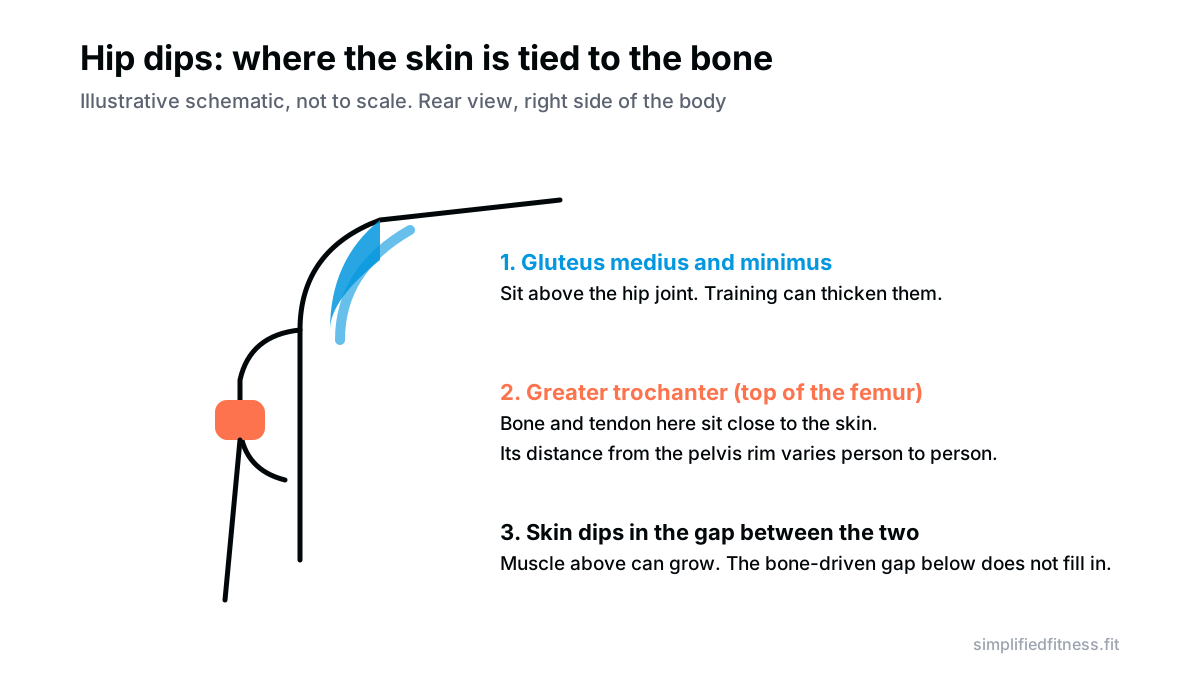
I have to be careful with sourcing here. The studies I trust on muscle did not test hip dips, and I did not find a trial that tracked hip dips after training. The skeletal explanation is the standard anatomical one, but the strongest claim I can support is the hedged one: hip dips are common, they are not caused by weakness, and I found no evidence that any exercise removes them.
The only paper I found on the topic is a small dermatology case series of 11 female patients, which describes hip dips as potentially caused by athletic muscular definition or ageing, and reports good cosmetic results from hyaluronic acid filler injected into the area (Lourenco et al., 2024). It had no control group and I am not recommending it. I mention it to show that, even in clinical settings, the discussion is about contour work, not training.
What training can honestly do:
- Thicken the muscle above the dip, which changes how the outline reads.
- Build the glute max and medius together, so the whole hip area looks fuller.
- Reduce body fat if that is your goal, which changes overall shape but may not remove the dip.
What it cannot do: change your pelvis or femur.
Why single-leg stability matters beyond looks
A strong gluteus medius is more than an aesthetic goal. It helps control the pelvis and knee on one leg, which is basically every step you take.
A systematic review of gluteal muscle activity found moderate-to-strong evidence that gluteus medius activity is delayed and shorter in duration during stair negotiation in people with patellofemoral pain (pain at the front of the knee) (Barton et al., 2013). All ten studies were case-control, and there were no prospective studies, so this shows an association. It does not show that weak glutes cause knee pain, or that strengthening always fixes it. If you have persistent knee or hip pain, see a doctor or physiotherapist rather than self-treating with abduction work.
For general lifters, the useful message is simple. If your pelvis drops or your knee caves in on a split squat, slow down, lower the load, and treat that as a cue to train single-leg control. Our guide on foot pronation and knee valgus in squats covers the other side of that problem.
How to program the upper glutes
Keep it small. This is an add-on to your leg days, not a second leg day.
| Exercise | Why it earns a spot | Sets x reps |
|---|---|---|
| Hip abduction machine | Stable, low fatigue, good medius to TFL ratio | 3 x 12-20 |
| Side-lying or standing cable abduction | Side-lying topped one EMG ranking | 2-3 x 12-20 |
| Cable kickback (45 degrees) | Hits extension plus abduction, logical fit | 2-3 x 12-15 |
| Single-leg RDL or single-leg squat | High medius force, builds balance | 2-3 x 8-12 |
| Side plank | High medius force with bodyweight only | 2-3 x 20-40 s |
Pick two or three, not all five. Train them twice a week after your main lifts, add load or a rep each week, and keep most sets 1-3 reps from failure.
On rep ranges: a 2021 review argues that muscle growth can occur across a wide spectrum of loading zones, not just the classic 8-12 (Schoenfeld et al., 2021). That fits abduction work, where light-to-moderate loads and higher reps are more comfortable and joint-friendly. If you want help tracking your weekly sets, our training volume calculator is free, and our free leg day plan shows where these fit in a full session.
For Indian gym-goers on a budget: you do not need a fancy machine. A loop band at home, a cable station, and a bench for single-leg squats cover everything above. Protein from dal, paneer, curd, soya chunks or eggs matters more for glute growth than the exact exercise order.
Give it at least 8-12 weeks before judging. Given that the squat versus hip thrust trial found so little medius growth in nine weeks, patience is part of the plan. For the wider picture on stance and depth, see stance width and foot placement in squats and leg presses, and for the inner thigh counterpart, our adductor magnus training guide.
When to see a doctor
Muscle soreness on the outer hip after new abduction work is normal. Sharp pain on the outside of the hip, pain that wakes you at night, a limp, or a hip that gives way is not. These can have causes (tendon problems, joint problems, nerve issues) that need an assessment. See a doctor or physiotherapist before pushing through.
Frequently Asked Questions
What are the best gluteus medius exercises for the upper glutes?
Side-lying hip abduction, the hip abduction machine, single-leg squats and deadlifts, and the side plank have the best EMG and force-modelling support. They load the muscle through its job, which is abducting the thigh and holding the pelvis level on one leg. Pick two of them and train them 2 times a week with 10-20 controlled reps.
Do cable glute kickbacks work the gluteus medius?
They can, because a kickback at roughly 45 degrees mixes hip extension (gluteus maximus) with abduction (gluteus medius and upper maximus fibres). I could not find a study that measured that exact angle, so this is mechanical reasoning rather than proven fact. Use a strap on the ankle, keep your pelvis square, and treat it as one option among several.
Is the hip abduction machine good for glute growth?
It is a good, low-fatigue way to load the gluteus medius. A 2022 lab study of 11 men found the machine gave a higher gluteus medius to TFL ratio than side-lying abduction and clams, though gluteus medius activation itself was similar. That study measured muscle activity, not growth, so progress the load over time and track your reps.
Should I lean forward or sit upright on the hip abduction machine?
There is no good trial comparing the two positions, so the choice comes down to feel. Leaning forward and sitting upright change the hip angle and which fibres are most stretched, but I have not seen data showing one builds more muscle. Try both for a few weeks, keep the one where you feel the outer hip and not the lower back, and stay consistent.
Can you fix hip dips with exercise?
Mostly no. Hip dips usually come from the gap between the top of your pelvis and the top of your thigh bone, which is skeletal structure that training cannot change. Building the gluteus medius and surrounding glutes can change overall shape and make the dip look less pronounced, but it will not fill the dent in the bone-to-skin line.
Are hip dips normal?
Yes, they are a normal anatomical variation, and they can show up at any body fat level. They are not a sign of weakness or poor health. If you notice a sudden change in one hip, pain, or a limp, see a doctor rather than assuming it is a hip dip.
How often should I train the gluteus medius?
Two sessions a week is a sensible starting point for most lifters. Evidence shows muscles can grow across a wide range of loads, so there is no single magic frequency. Add 2-4 hard sets per session on top of your squats and lunges, and raise sets only if your recovery stays good.
How many reps should I do for the hip abductors?
Anything from about 8 to 25 reps close to failure can work, since a 2021 review argues muscle growth is possible across a wide spectrum of loading zones. Higher reps are often more comfortable on the abduction machine and cables because the lever is short and the joint stays supported. Start at 12-20 reps and add weight when you hit the top of the range cleanly.
Do squats and hip thrusts train the gluteus medius?
They train it to a degree, but not as directly as abduction work. In a nine-week MRI study of untrained adults, both back squats and hip thrusts built similar gluteus maximus size, while gluteus medius plus minimus showed little to no growth. If the upper glutes are a priority, add one direct abduction exercise.
What does a weak gluteus medius feel like?
Common signs are the pelvis dropping or the knee drifting inward on single-leg work, and fatigue on the outer hip during walking or stairs. Research links delayed gluteus medius activity with patellofemoral (front of knee) pain, but that is an association, not proof of cause. If you have ongoing hip or knee pain, see a physiotherapist or doctor for a proper assessment.
What is the difference between gluteus medius and gluteus minimus?
Both sit on the side of the pelvis and abduct the hip, and the minimus lies underneath the medius. Anatomical reviews note that both may have separate segments with slightly different roles, though that is still being worked out. In practice you train them together with the same exercises.
Can I train the glute medius at home without machines?
Yes. Side-lying hip abduction, side planks, single-leg squats to a bench and single-leg Romanian deadlifts all rank well in the research and need little or no equipment. A loop band or a backpack adds resistance. Aim for slow reps and a clear burn on the outer hip.
Do wider hips mean I have a weak gluteus medius?
No. Hip width is mostly bone structure and body composition, and it says very little about how strong your muscles are. Judge strength by how you perform on single-leg movements and by progress in load or reps, not by looks.
Sources & References
Every claim above is checked against peer-reviewed research (PubMed, U.S. National Library of Medicine) or guidance from established health bodies. How we fact-check.
- Distefano LJ, et al. Gluteal muscle activation during common therapeutic exercises. J Orthop Sports Phys Ther. 2009. PMID: 19574661
- Moore D, et al. A systematic review and meta-analysis of common therapeutic exercises that generate highest muscle activity in the gluteus medius and gluteus minimus segments. Int J Sports Phys Ther. 2020. PMID: 33344003
- de Almeida Paz I, et al. Hip abduction machine is better than free weights to target the gluteus medius while minimizing tensor fascia latae activation. J Bodyw Mov Ther. 2022. PMID: 35500965
- Ebert JR, et al. A systematic review of rehabilitation exercises to progressively load the gluteus medius. J Sport Rehabil. 2017. PMID: 27632888
- Collings TJ, et al. Gluteal muscle forces during hip-focused injury prevention and rehabilitation exercises. Med Sci Sports Exerc. 2023. PMID: 36918403
- Flack NA, et al. A review of the anatomy of the hip abductor muscles, gluteus medius, gluteus minimus, and tensor fascia lata. Clin Anat. 2012. PMID: 22109658
- Plotkin DL, et al. Hip thrust and back squat training elicit similar gluteus muscle hypertrophy and transfer similarly to the deadlift. Front Physiol. 2023. PMID: 37877099
- Barton CJ, et al. Gluteal muscle activity and patellofemoral pain syndrome: a systematic review. Br J Sports Med. 2013. PMID: 22945929
- Lourenco L, et al. Hip dips technique: filling lateral depressions with hyaluronic acid of large particles. Skin Health Dis. 2024. PMID: 39624740
- Coratella G, et al. The activation of gluteal, thigh, and lower back muscles in different squat variations performed by competitive bodybuilders: implications for resistance training. Int J Environ Res Public Health. 2021. PMID: 33477561
- Schoenfeld BJ, et al. Loading recommendations for muscle strength, hypertrophy, and local endurance: a re-examination of the repetition continuum. Sports (Basel). 2021. PMID: 33671664
- Brandt M, et al. Perceived loading and muscle activity during hip strengthening exercises: comparison of elastic resistance and machine exercises. Int J Sports Phys Ther. 2013. PMID: 24377067

Umair Hazrami · Founder & Head Coach, Simplified Fitness
Umair Hazrami founded Simplified Fitness and the Simplified Lifter channel to cut through fitness noise. With 4+ years of consistent training and 10+ coaching clients, he writes every guide from the peer-reviewed research and links the sources so you can check them. Our editorial standards.
Educational content only, not medical advice. If you have a medical condition, are pregnant, or take medication, talk to a qualified doctor before changing your diet, supplements or training. Full disclaimer.
Keep reading
Exercise Technique
Adductor Magnus Training: Seated Adductor Machine and Copenhagen Planks for Thigh Mass
Adductor magnus training explained: what research says on deep squats, the adductor machine and Copenhagen planks for thicker inner thighs and groin strength.
7 min read
Exercise Technique
High Bar vs Low Bar Squat: Which Builds More Quad Muscle?
High bar vs low bar squat for hypertrophy: what torso lean, knee travel and EMG studies show, why high-bar leans quad, and when low-bar still makes sense.
8 min read
Exercise Technique
Calf Hypertrophy Science: Standing vs Seated Calf Raises (Gastrocnemius vs Soleus)
Calf hypertrophy explained: why calves seem stubborn, what the trials say on exercise choice, stretch and foot position, plus weekly sets, reps and frequency.
9 min read
Exercise Technique
Complete Leg Workout Programming: Quad Day vs Hamstring and Glute Day
Best leg workout routine science: split leg day into a quad session and a hamstring-glute session, with sets, order and a 5-week plan that avoids burnout.
9 min read