Are Squats Bad for Your Knees? What the Research Actually Says
Are squats bad for your knees? Research on deep squats, kneecap stress and the knees-over-toes rule shows where the myth came from and how to squat safely.

TL;DR. The short answer
- For healthy people, squats are not shown to damage knees. A review of over 164 articles concluded that concerns about deep squats harming passive knee tissues are unfounded when technique is learned and loads progress gradually.
- Kneecap compression peaks around 90 degrees of knee flexion in biomechanical models, then eases as the contact area grows in deeper positions.
- Stopping your knees at your toes is not protective. In one small study it cut knee torque but raised hip torque from about 28 to about 303 N.m, shifting load toward the hips and low back.
- Heavy loads at the bottom still raise kneecap forces, so build depth and load gradually, and stop or modify if pain builds or lingers.
- Existing knee pain, swelling, locking or giving way needs a clinician, not a forum answer.
Part of our complete guide: Joint-Friendly Lifting & Fitness Myths: A Guide for Over-40s, Teens and Sore Backs
Table of contents
Are squats bad for your knees? For healthy people, the best available research says no. A narrative review of over 164 articles concluded that deep squats do not add injury risk to passive tissues like ligaments and cartilage, as long as technique is learned and loads rise gradually (Hartmann et al., 2013).
That does not mean every squat feels good for every knee. It means the blanket rule “squats ruin knees” is not what the evidence shows. This article is part of our joint-friendly lifting myth-busting guide, and it covers where the myth came from, what the biomechanics say about the kneecap, and why the knees-over-toes rule backfires.
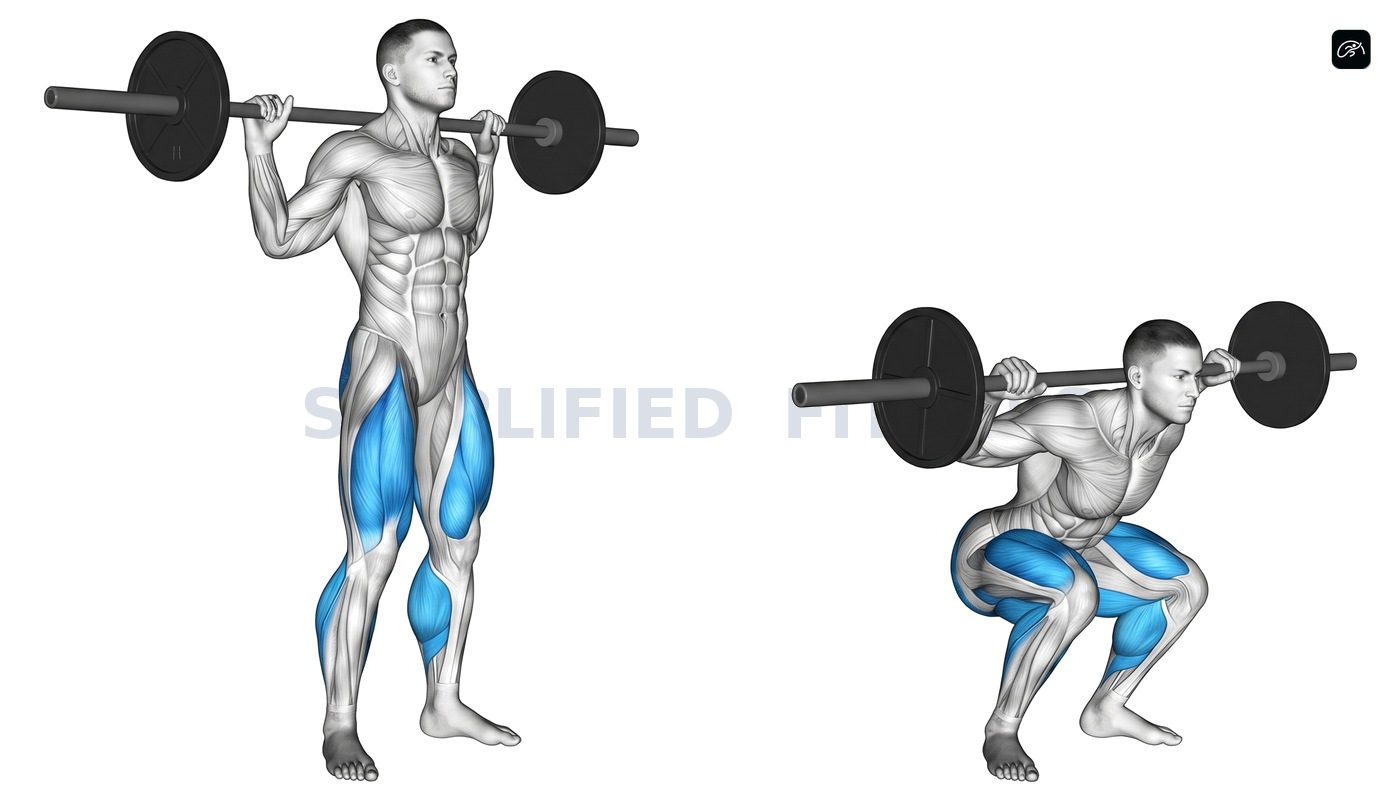
Where did the “squats destroy your knees” myth come from?
The belief is commonly traced to early-1960s work that linked deep squatting with looser knee ligaments, often credited to Karl Klein. I have not linked that paper because I could not check its methods against a PubMed abstract, so treat the details with caution.
What I can verify is how the later literature treated the idea. The Hartmann review looked at the claim that deep flexion should be avoided to limit knee forces. It argued that this advice ignored the wrapping effect, functional adaptation and the way soft tissue at the back of the thigh and calf shares load. Its conclusion on deep squats was blunt: concerns about chondromalacia, osteoarthritis and osteochondritis from deep squats were unfounded (Hartmann et al., 2013).
An old rule, repeated by coaches and physios for decades, can feel like fact. It is still worth checking against newer data.
What happens to your kneecap in a deep squat?
The kneecap (patella) glides in a groove at the end of the thigh bone. When you bend your knee under load, the quadriceps and patellar tendon press it into that groove. That pressure is called patellofemoral stress.
According to the Hartmann review, which relied on biomechanical calculations and cadaver knee studies, the highest retropatellar compressive forces and stresses occur at about 90 degrees of knee flexion. Beyond that, the wrapping effect helps spread load, and the contact area between kneecap and thigh bone keeps growing, which lowers compressive stress (Hartmann et al., 2013). The same review notes there are no realistic force estimates beyond roughly 50 degrees in the deep squat, so this is a model-based picture, not a direct measurement inside living knees.
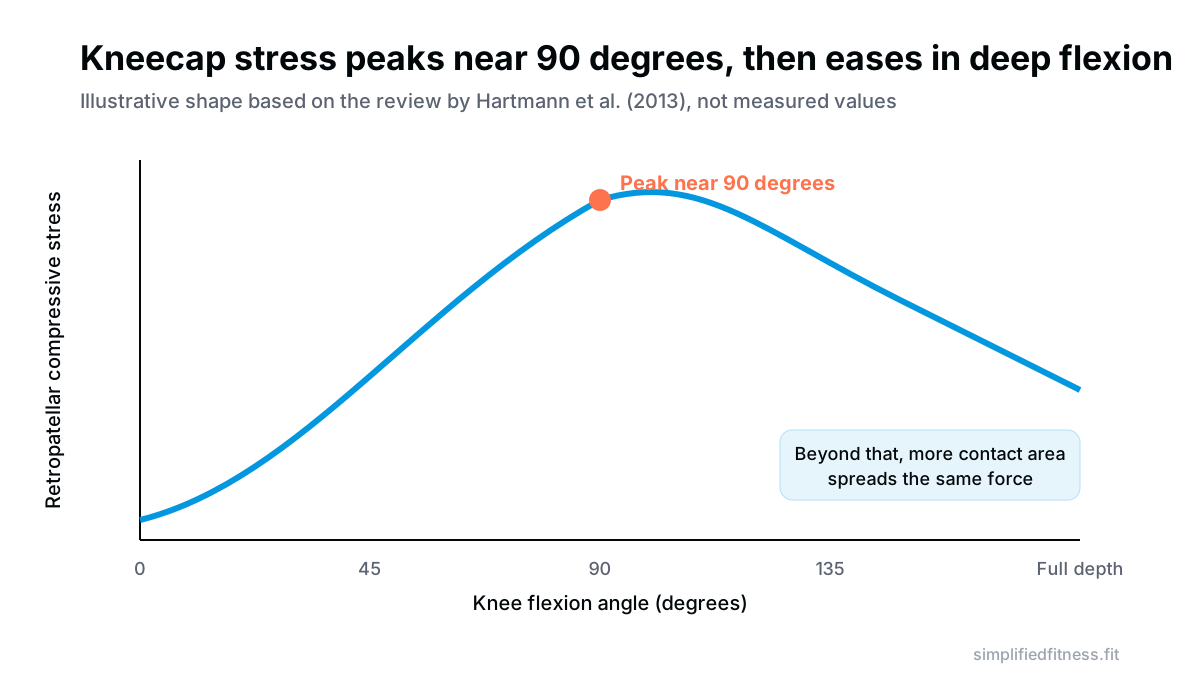
Does this mean deeper is always better for the knee?
No, and the research is not uniform here. A biomechanical model in experienced female lifters found peak patellofemoral joint reaction force was higher at below-parallel depth than at parallel or above, and stress rose with load at each depth (Zavala et al., 2021).
Why might these studies differ? Hartmann summarised cadaver data and calculations from many articles and considered contact area, while Zavala modelled forces and stress in a specific sample of women using knee moments and joint angles. Forces going up with depth is not the same as injury going up, because tissue adapts to load. A cautious takeaway: heavy loads at the very bottom are the demanding part, so build up to them.
Another model-based comparison found squats produced more patellofemoral stress than knee extensions at 60 to 90 degrees of flexion, but less at 0 to 30 degrees (Powers et al., 2014). That is useful if you are managing front-of-knee pain, which is covered in our guide to training around knee pain. It was a study of ten healthy people, so it informs exercise choice rather than proving harm.
Should your knees go past your toes?
You have heard “never let your knees go past your toes.” The idea is to keep the shin vertical so the knee is spared.
Fry and colleagues tested exactly that. Seven weight-trained men did parallel squats with a bodyweight load, once with knees free to travel and once with a wooden barrier stopping them at the toes. With knees free, knee torque averaged 150.1 N.m and hip torque 28.2 N.m. With the barrier, knee torque fell to 117.3 N.m but hip torque jumped to 302.7 N.m, and the trunk leaned further forward (Fry et al., 2003).
So restricting the knees did reduce knee demand, but it moved a large amount of torque to the hips, and the authors suggested to the low back as well. That is roughly a tenfold increase at the hip in this sample, although the individual results varied a lot. The authors suggested that appropriate loading may require the knees to move slightly past the toes.
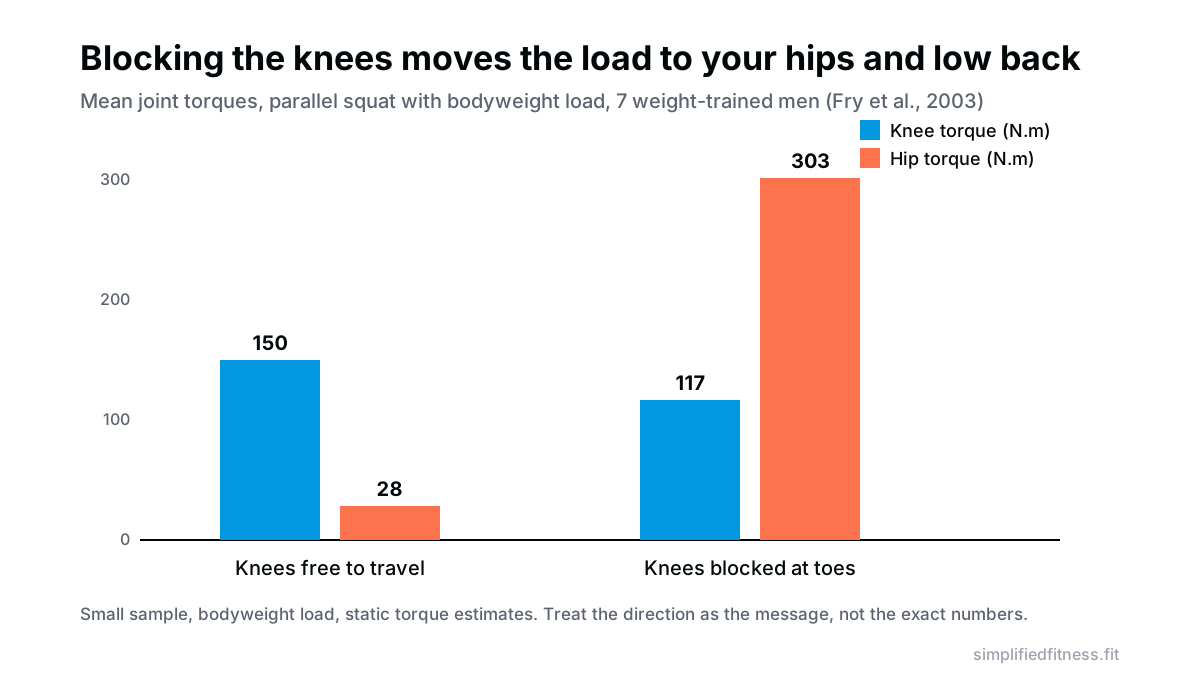
A more recent review agrees. It describes the toe rule as a persistent myth from 1970s and 1980s research, notes the hip and lumbar spine take high peak torques when knee travel is deliberately limited, and concludes that for healthy trained people restricting it is likely not effective. The exception is knee rehabilitation, where a clinician may want it (Illmeier & Rechberger, 2023).
You may have seen a claim that the toe rule raises low-back stress by 1000 percent. The Fry hip torque figures are in that ballpark, but they are static torques from seven men squatting bodyweight, so I would not repeat “1000 percent” as a universal figure for spinal load.
Are deep squats better or worse than half squats for the knees?
A common alternative is to “protect” the knees with quarter or half squats. The evidence does not support that idea for long-term joint health.
Hartmann and colleagues argued that half and quarter squat training with comparatively supramaximal loads may favour degenerative changes in knee and spinal joints over time, while deep squats with learned technique and progressive loads strengthen the lower body (Hartmann et al., 2013). That is a review argument, not a long-term trial, so keep that in mind.
A direct comparison exists for muscle and tendon outcomes. In a 12-week randomised trial, 17 male students trained either deep squats (0 to 120 degrees of knee flexion) or shallow squats (0 to 60 degrees). Deep squats produced larger gains in front-thigh muscle size (4 to 7 percent more), isometric knee extension strength and squat-jump performance. Patellar tendon cross-sectional area did not differ between groups (Bloomquist et al., 2013). The sample was small and made of young men who were not necessarily trained, so apply it cautiously.
For more on depth and growth, see our article on squat depth science for hypertrophy.
| Question | What the evidence says | Caution |
|---|---|---|
| Do deep squats damage ligaments or cartilage? | Narrative review of 164+ articles: concern unfounded | Model and cadaver based |
| Is the kneecap most stressed at the bottom? | Peak near 90 degrees, easing beyond | Other models show higher force at below parallel |
| Do knees past toes harm knees? | Blocking them raised hip torque sharply | 7 men, bodyweight only |
| Are half squats safer? | Not clearly, and deep built more thigh muscle | One small 12-week trial |
Do squats make your tendons and ligaments stronger?
Tendons respond to load, but slowly. A systematic review and meta-analysis of 61 studies (763 participants) found that mechanical loading produced moderate increases in tendon stiffness (SMD 0.74), large increases in modulus (SMD 0.82) and small increases in cross-sectional area. Resistance training with higher tendon strain produced greater gains than low-strain protocols (Lazarczuk et al., 2022).
The practical message is that tendons are not fragile things to be wrapped in cotton wool, but they do not adapt overnight. Muscles often get stronger faster than tendons can keep up, which is why jumping from nothing to heavy squats is a classic way to irritate a knee. Our article on connective tissue adaptation timelines goes deeper on this.
How to squat safely: a progression for your knees
The point is not to avoid depth. It is to earn it.
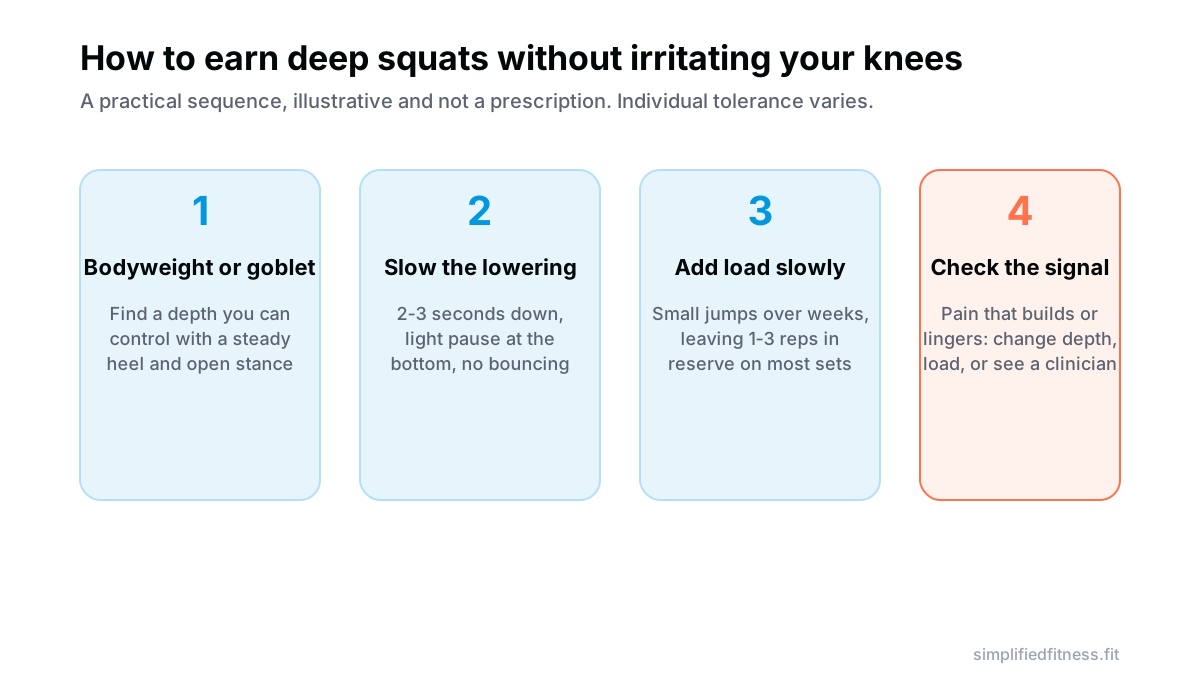
- Start with a depth you control. A goblet squat or bodyweight squat to a depth where your heels stay down and your back stays steady is a fine start.
- Fit the stance to your hips. Femur length and hip shape change what a comfortable stance looks like. Our articles on stance width and foot placement and adapting range of motion to your anthropometry cover how to test this.
- Slow the lowering phase. A 2 to 3 second descent builds control and gives you feedback about where the knee feels loaded.
- Add weight in small steps. Increase load over weeks rather than session to session, and keep most sets with 1 to 3 reps left in the tank.
- Treat lingering pain as information. A mild ache that settles within a day is different from sharp pain, swelling or pain that builds. Our leg day plan is a reasonable starting layout if you want a structure to follow.
If you want to see the difference between technique variations, our comparison of high bar and low bar squat biomechanics is a good next read, and knee sleeves versus wraps covers whether gear changes the picture.
What if you already have knee pain or osteoarthritis?
Everything above applies to healthy knees. It is not a diagnosis, and it does not tell you what to do about a painful or diagnosed knee.
Resistance training is commonly used as part of knee osteoarthritis care. A systematic review and network meta-analysis of 39 randomised trials (2,646 participants) found that all five exercise types it tested, including resistance training, improved knee osteoarthritis outcomes versus control, though most trials failed to blind participants and risk of performance bias was high (Mo et al., 2023). It does not tell us which squat depth is right for your knee.
See a doctor or physiotherapist if you have:
- Swelling that appears after training
- Locking, catching or the knee giving way
- Pain that wakes you at night or builds over several weeks
- Pain following a twisting injury or a pop
Until then, drop the load, shorten the range to where the knee is comfortable, and avoid pushing through sharp pain.
The bottom line on squats and your knees
Squats are not shown to be bad for healthy knees. The idea that depth wrecks the joint comes from old assumptions that later reviews did not support. Kneecap stress does rise with heavy loads, and there is no single perfect depth, so progress gradually. Skip the knees-over-toes rule unless a clinician has told you otherwise, and listen to persistent pain. A patient training plan and good recovery will do more for your knees than any rule about toes.
Frequently Asked Questions
Are squats bad for your knees?
For healthy people, current evidence does not show that squats damage the knees. A review of over 164 articles found that deep squats do not raise injury risk to passive tissues like ligaments and cartilage. If you have pain or a diagnosed knee condition, adjust depth and load and speak to a clinician.
Are deep squats safe for your knees?
Deep squats appear safe for most healthy lifters when technique is learned properly and loads rise gradually. Models suggest kneecap stress peaks near 90 degrees and then eases as contact area grows. Start with a depth you can control and add weight slowly.
Should your knees go past your toes when squatting?
For most people, a little forward knee travel is normal and often necessary. A study of seven trained men found that blocking the knees cut knee torque but sharply increased hip torque. Let your knees travel as far as your ankles allow while your heels stay down.
Does squatting ruin your knees long term?
There is no good evidence that well-programmed squatting ruins healthy knees. The reviewed biomechanical and tissue research points to adaptation, with cartilage, ligaments and tendons responding to progressive loading. Keep volume and load increases gradual, and take knee pain that persists seriously.
Are half squats safer than deep squats?
Not necessarily. The Hartmann review argued that partial squats loaded with supramaximal weights could favour degenerative changes over the long term. Deep squats also built more thigh muscle than shallow squats in a 12-week trial of 17 men, so use the depth you can control.
Where did the myth that squats are bad for knees come from?
It is commonly traced to early-1960s work that linked deep squatting to looser knee ligaments, which was then repeated for decades. Later reviews examined that concern and found it unfounded for healthy lifters. The sensible habit is to question old rules and look at the modern biomechanical data.
Why do my knees hurt when I squat?
Common reasons are too much load or volume too soon, poor stance fit for your hips, or an existing irritated tendon or kneecap joint. Pain during a squat is a signal to change depth, load or stance, not a proof that squats are harmful. If it lingers, swells or comes with locking, see a physio or doctor.
Do squats cause patellofemoral pain syndrome?
Squats load the kneecap joint, and loading the joint harder than it is ready for can irritate it, but there is no proof that squatting itself causes the condition. Modelling work shows kneecap stress rises with load and at deeper positions in female lifters. If you have front-of-knee pain, our guide to training around knee pain covers modifications.
Do squats strengthen knee tendons and ligaments?
Yes, tendons adapt to loading. A meta-analysis of 61 studies found that mechanical loading increased tendon stiffness by a moderate amount, with higher strain resistance training producing the largest gains. Tendons adapt more slowly than muscle, so progress load gradually.
Can I squat with knee osteoarthritis?
Many people with knee osteoarthritis benefit from resistance training, but you should get individual advice first. A network meta-analysis of 39 trials found that exercise, including resistance training, improved symptoms, though most trials had a high risk of bias. Ask your doctor or physiotherapist to set a comfortable depth and load.
Do knee sleeves protect my knees from squat damage?
Sleeves are not a requirement for knee health in healthy lifters. They add warmth and some people like the feel, but the main drivers of knee tolerance are depth you control, gradual loading and recovery. See our knee sleeves versus wraps article for the details.
How deep should I squat?
Squat to a depth you can control with your heels down and your back position steady, which is often parallel or a little below. Depth also depends on hip structure and ankle mobility, so there is no single right number. Test a few stances and pick the one that feels strong and pain free.
When should I see a doctor about knee pain from squats?
See a doctor if you have swelling, locking, the knee giving way, pain at night or pain that keeps building over weeks. These signs can point to a structural problem that training changes will not fix. Until you are assessed, drop the load and avoid pushing through pain.
Sources & References
Every claim above is checked against peer-reviewed research (PubMed, U.S. National Library of Medicine) or guidance from established health bodies. How we fact-check.
- Hartmann H, et al. Analysis of the load on the knee joint and vertebral column with changes in squatting depth and weight load. Sports Med. 2013. PMID: 23821469
- Fry AC, et al. Effect of knee position on hip and knee torques during the barbell squat. J Strength Cond Res. 2003. PMID: 14636100
- Illmeier G, et al. The Limitations of Anterior Knee Displacement during Different Barbell Squat Techniques: A Comprehensive Review. J Clin Med. 2023. PMID: 37109294
- Zavala L, et al. Patellofemoral joint kinetics in females when using different depths and loads during the barbell back squat. Eur J Sport Sci. 2021. PMID: 32781938
- Powers CM, et al. Patellofemoral joint stress during weight-bearing and non-weight-bearing quadriceps exercises. J Orthop Sports Phys Ther. 2014. PMID: 24673446
- Bloomquist K, et al. Effect of range of motion in heavy load squatting on muscle and tendon adaptations. Eur J Appl Physiol. 2013. PMID: 23604798
- Lazarczuk SL, et al. Mechanical, Material and Morphological Adaptations of Healthy Lower Limb Tendons to Mechanical Loading: A Systematic Review and Meta-Analysis. Sports Med. 2022. PMID: 35657492
- Mo L, et al. Exercise Therapy for Knee Osteoarthritis: A Systematic Review and Network Meta-analysis. Orthop J Sports Med. 2023. PMID: 37346776

Umair Hazrami · Founder & Head Coach, Simplified Fitness
Umair Hazrami founded Simplified Fitness and the Simplified Lifter channel to cut through fitness noise. With 4+ years of consistent training and 10+ coaching clients, he writes every guide from the peer-reviewed research and links the sources so you can check them. Our editorial standards.
Educational content only, not medical advice. If you have a medical condition, are pregnant, or take medication, talk to a qualified doctor before changing your diet, supplements or training. Full disclaimer.
Keep reading
Health & Longevity
Are Deadlifts Bad for Your Lower Back? What Spinal Loading Research Shows
Are deadlifts bad for lower back health? The research shows spinal loads are high but tolerable, and trials use loaded lifting for back pain. How to hinge.
9 min read

Health & Longevity
Why Tendons Adapt Slower Than Muscles: Connective Tissue Timelines for Lifters
Tendon adaptation vs muscle growth: why your tendons lag behind your strength gains, what studies show about timelines, and how to add load without tendonitis.
8 min read

Health & Longevity
Desk Worker Workout Routine: Fix Pelvic Tilt, Weak Glutes and a Rounded Upper Back
A desk worker workout routine built on evidence: what sitting really does to your hips, why pelvic tilt is mostly normal, and 3 gym correctives that help.
8 min read
Health & Longevity
Does Cardio Kill Gains? The Real Science of the Interference Effect
Does cardio kill gains? A 43-study review found moderate cardio barely dents muscle size. Learn what the interference effect is and how to program around it.
8 min read