Intra-Abdominal Pressure and the Valsalva Maneuver: How to Brace Under Heavy Load
Valsalva maneuver lifting explained: how to breathe and brace on heavy squats and deadlifts, what the blood pressure research says, and how to avoid blackouts.
TL;DR. The short answer
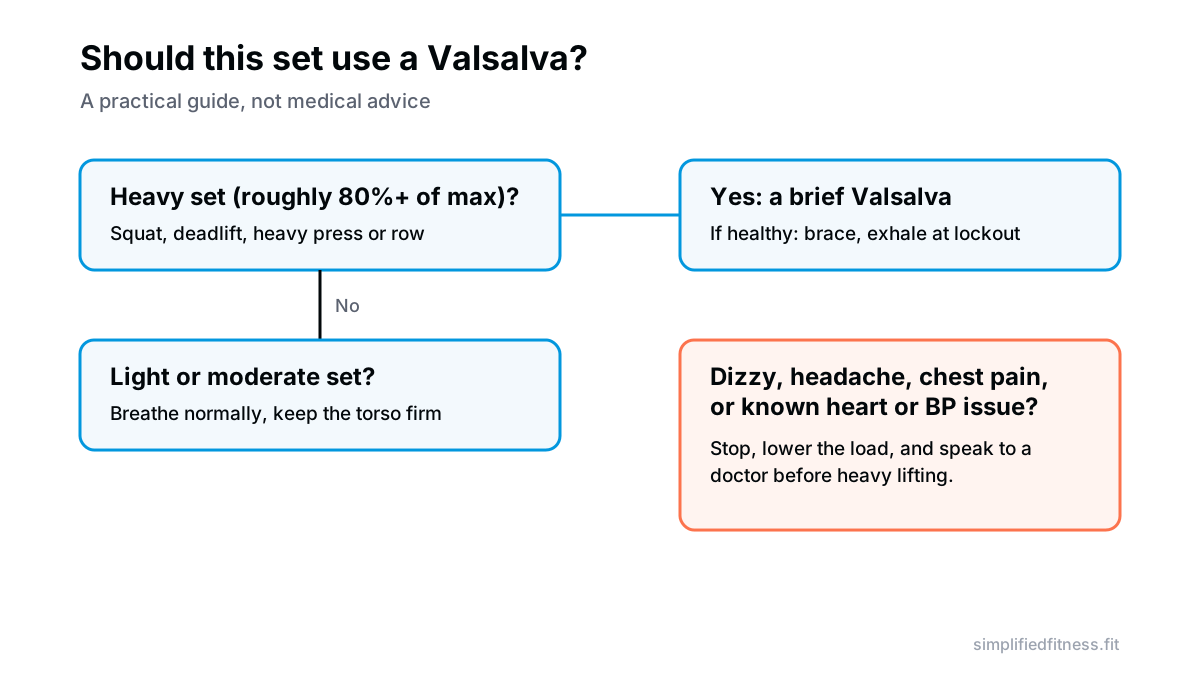
- A brief Valsalva maneuver (deep breath, then bearing down with the airway closed) raises intra-abdominal pressure, which may help trunk rigidity and spine stability. A brief Valsalva is hard to avoid on loads above roughly 80% of your max.
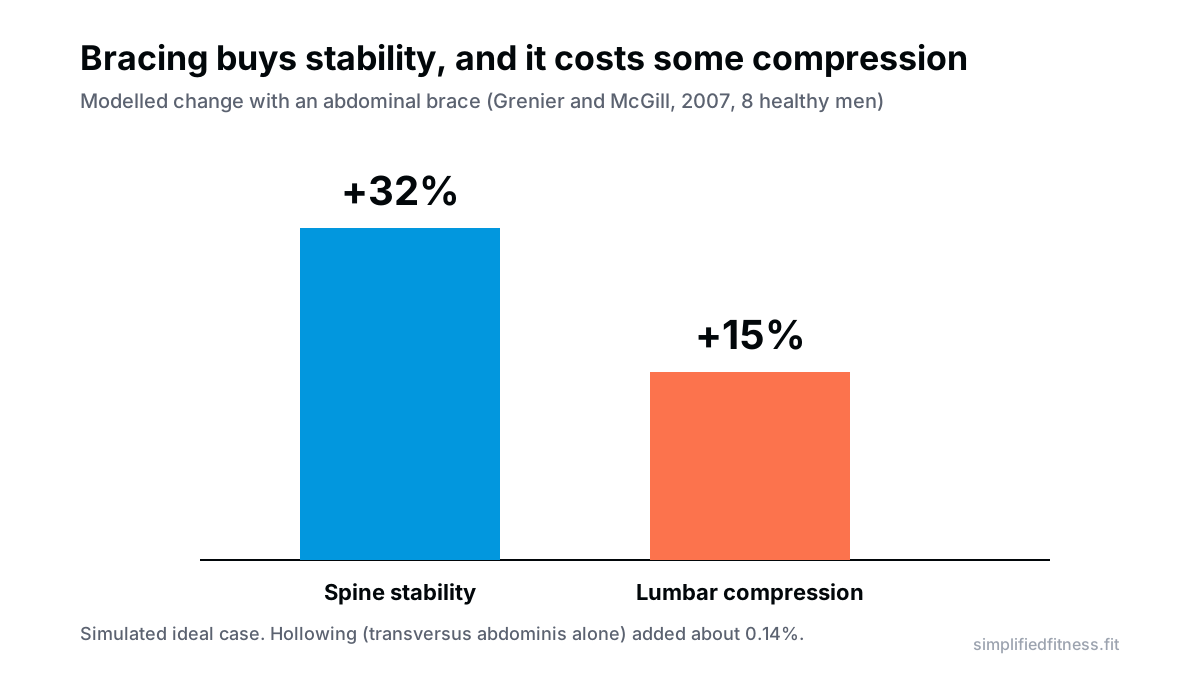
- Bracing means tensing the abdominals, obliques and back muscles all the way around the trunk. In a lab model, a full abdominal brace improved spine stability by 32% while raising lumbar compression by 15%, and the 'hollow' belly pull-in added essentially nothing.
- Blood pressure spikes sharply during hard sets, with or without a Valsalva. Whether a brief Valsalva is dangerous for healthy lifters is unconfirmed, but people with heart disease, uncontrolled high blood pressure or aneurysm risk should ask a doctor first.
- To avoid blacking out: breathe in before the rep, hold only through the hardest part, exhale at lockout, stay off grinders to failure when you are dehydrated or unwell, and never hold your breath for a long time.
Part of our complete guide: Maximal Strength, Neuromuscular Adaptations & Powerlifting Science for General Lifters
Table of contents
Valsalva maneuver lifting is the habit of taking a deep breath and bearing down against a closed airway so your torso turns into a stiff, pressurized cylinder under a heavy bar. Research suggests this raises intra-abdominal pressure and can help spine stability, and no health risk from a brief Valsalva has been confirmed in healthy lifters. It is also tied to big blood pressure swings, so the skill is using it briefly and correctly, not holding your breath for dear life.
This is one of the core skills behind the heavy lifts in our maximal strength and powerlifting science guide. Here we cover the mechanics, what the blood pressure studies actually found, a bracing routine you can use tomorrow, and how to avoid blacking out.
What is intra-abdominal pressure and why does it matter?
Think of your midsection as a sealed can. The diaphragm is the lid, the abdominal and back muscles are the walls, and the pelvic floor is the base. When you pull in air and tighten the walls, pressure builds inside the can. That pressure pushes outward in every direction, including against the front of the spine, and it makes the trunk much harder to fold or bend.
In a classic study, Harman and colleagues (1988) measured pressures in 11 men during deadlifts, rows, leg presses, bench press and box lifts at 50, 75 and 100% of their four-rep maximum. Pressure rose with the weight lifted, climbed before the bar moved, and peaked after it did. The highest intra-abdominal pressure of all came from a pure Valsalva maneuver (about 26.6 kPa on average, with one lifter reaching 36.9 kPa).
Two things are worth noticing. Pressure builds before the movement starts, which is why you set your brace before the bar leaves the floor. And the Valsalva on its own beat every lift tested, which tells you how powerful a deliberate breath-and-bear-down can be.
Does the Valsalva maneuver protect your spine?
The popular version says that extra pressure “unloads” the spine. The evidence is more careful than that. A 2013 review by Hackett and Chow found that the Valsalva increases intra-abdominal pressure, and that pressure rises as lifting intensity and effort rise. Their conclusion was that the Valsalva effectively raises pressure, which “may assist with spine stability and trunk rigidity.” Note the word “may.”
They also noted that a brief Valsalva is essentially unavoidable when you lift loads above about 80% of your max, or when you take lighter loads to failure. In other words, you are already doing some version of it on heavy sets. The practical question is whether you do it well.
Stability is not the same as less compression. Modelling work on bracing found the opposite trade-off, which we will get to below. What pressure and co-contraction mainly buy you is a rigid trunk that resists being bent by the bar, so the spine stays in a neutral, strong position instead of buckling at the worst moment. I would treat any claim that the Valsalva “removes” spinal load as stronger than the data supports.
How to brace your core for heavy squats and deadlifts
Here is a simple sequence for lifters who have never been taught to brace.
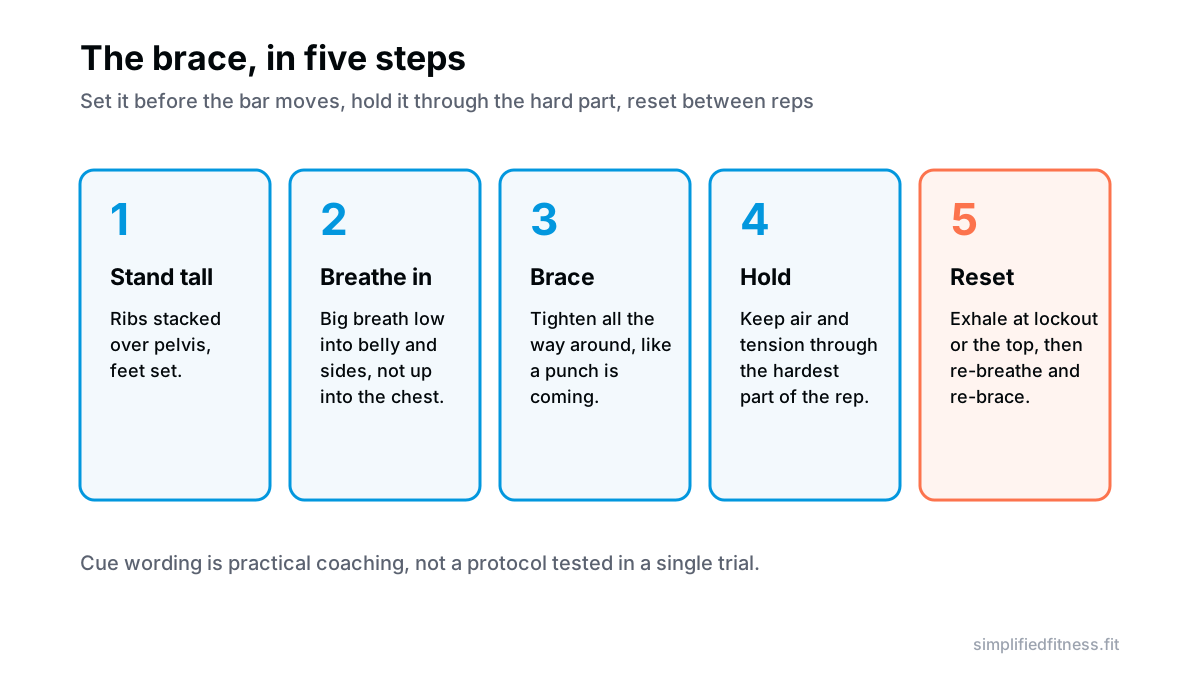
- Stand tall. Ribs stacked over your pelvis, feet set. A rib cage flared up and back makes a poor brace.
- Breathe in low. Aim the breath into your belly and sides, as if filling a belt around your waist. If your shoulders shoot up, the breath is going to your chest.
- Brace. Tighten your abs, obliques and lower back at the same time, all the way around. The cue most coaches use is “brace like someone is about to punch you in the stomach.”
- Hold. Keep the air and tension through the hardest part of the rep, usually the bottom of a squat or the break from the floor on a deadlift.
- Reset. Exhale at lockout or the top, take a fresh breath, brace again. Do not carry leftover air from the last rep.
A quick drill: lie on your back, put your hands on your sides just above your hips, breathe in, and try to push your hands outward with your abs without arching your back. That outward push is the feeling you want standing under a bar. Then practise with an empty bar, then lighter work, before using it on heavy sets. The same pattern carries over to low-bar squat technique and to both conventional and sumo deadlifts.
Bracing versus hollowing: pulling your belly in is the wrong cue
You will still hear “suck your belly button in.” Two studies from the same Waterloo spine lab tested that idea. Grenier and McGill (2007) used eight healthy young men and a simulation. In the modelled ideal case, a full abdominal brace improved spine stability by 32% with a 15% increase in lumbar compression, while the transversus abdominis (the muscle behind the hollowing cue) contributed about 0.14% of stability. They concluded there seems to be no mechanical rationale for hollowing to enhance stability.
Vera-Garcia and colleagues (2007) found similar results in 11 healthy men hit with sudden loading: hollowing did not reduce how far the spine moved, while bracing increased co-contraction, reduced lumbar displacement and increased stability, again at the cost of higher spinal compression. When the participants knew when the push was coming, they could stabilize with a smaller compressive cost.
The caveats matter. These were small samples of healthy young men, and modelling is not the same as people grinding out a one-rep max. For back pain rehab, other approaches may be used by clinicians, and that is a different question. For heavy lifting in healthy people, the cue that holds up is: brace outward, do not pull in.
Is the Valsalva maneuver dangerous for blood pressure?
This is where honest answers get uncomfortable. Blood pressure during hard lifting is high, with or without a Valsalva.
In 1985, MacDougall and colleagues recorded blood pressure directly from an artery in five experienced bodybuilders. Pressures rose rapidly during the lifting phase. The highest average was 320/250 mmHg during double-leg presses, and one lifter exceeded 480/350 mmHg. Even single-arm curls to failure reached about 255/190 mmHg on average. Part of the spike came from the Valsalva, and the rest came from muscles squeezing blood vessels and a strong pressor response.
Two caveats. This was five young, experienced lifters, an invasive measurement and brutal sets, so it describes what is possible rather than a typical session. And the rise was not caused only by breath-holding.
Does the Valsalva make things worse? The Hackett and Chow review found that blood pressure rose with the Valsalva during resistance exercise, and that the Valsalva alone caused larger hemodynamic changes, but concluded that its health risks during resistance training remain unconfirmed. That is a fair summary: plausible concern, no confirmed harm in healthy people.
Two studies on the brain give extra context:
- Haykowsky and colleagues (2003) measured pressure around the brain in seven clinically stable neurosurgical patients. The Valsalva alone raised intracranial pressure more than a light one-arm biceps curl done without breath-holding, which lowered the wall stress on brain arteries compared with the curl. This is a tiny sample of patients, not lifters.
- Perry and colleagues (2020) studied 11 healthy people doing isometric leg extensions with and without a Valsalva. Resistance exercise with and without the Valsalva produced similar cerebrovascular responses, but the Valsalva by itself produced the greatest cerebrovascular challenge afterwards.
The practical read: brief, braced holds are probably tolerable in healthy lifters, long empty breath-holds are the pattern to avoid, and the moments after release deserve respect.
When to avoid the Valsalva and when to see a doctor
Not everyone should treat a heavy Valsalva as routine. Talk to a doctor before lifting heavy if you have:
- known heart disease or heart rhythm problems
- high blood pressure that is not well controlled
- a history of aneurysm, stroke or hernia
- previous fainting during exercise
- retinal or eye conditions where a doctor has told you to avoid straining
I cannot diagnose anything from an article. If a heavy set ever brings on chest pain, a sudden severe headache, vision changes or fainting, stop training and get medical advice. Evidence on the Valsalva in pregnancy, older adults and people with disease is limited, so those groups especially should ask a clinician.
How to avoid blacking out when you lift
Weightlifter’s blackout is a long-recognised problem, and the likely mechanism is a shift in pressure and blood flow to the brain. Long breath-holds, hard breathing beforehand and standing up fast are the usual suspects. A few habits cut the risk:
- Keep holds short. Hold through the sticking point, then exhale at lockout. Do not carry a breath-hold for five or six reps.
- Do not hyperventilate before a heavy set. A few big breaths are fine. Panting hard beforehand can leave you lightheaded. Take one controlled breath and brace.
- Eat, drink and rest. Training dehydrated, underslept or after skipping meals makes dizziness more likely, especially in the Indian summer or a hot, crowded gym. Salt, water and a proper pre-workout meal help.
- Move calmly after a max set. Do not rush up from a hard set. Walk, breathe, sit down if you need to.
- Use safeties. Pins or spotters for heavy squats and benches matter more if you ever feel light-headed.
If dizziness keeps happening even with these changes, see a doctor.
Breathing for light sets, high reps and cardio-style training
Not every set needs a full Valsalva. A simple rule of thumb that matches the research:
| Situation | Breathing approach |
|---|---|
| Heavy singles, doubles, triples (about 80%+ of max) | Breathe in, brace, brief hold through the hard part, exhale at lockout |
| Moderate sets of 5-8 | Brace on each rep, short hold at the hardest section, quick re-breathe at the top |
| Higher-rep sets (10+) | Keep the torso firm, take small breaths between reps, avoid long holds |
| Accessory and isolation work | Breathe steadily, exhale during effort |
If you use effort ratings to pick loads, our RIR and RPE calculator can help you separate truly heavy sets from moderate ones, and our guide to RPE-based top singles and back-off sets covers that style of training. Heavy testing days, like those in 1RM testing protocols, are where the full brace matters most.
Do belts replace bracing?
No. A belt gives your abs something to push against, so many lifters can brace harder with one on. It does not replace the breath or the tension. Learn the skill without a belt first. The detail on belts belongs in our separate guide to weightlifting belts and intra-abdominal pressure.
A simple practice plan
- Spend a week drilling the supine brace and breathing for two minutes a day.
- On warm-up sets, rehearse the five-step sequence with 40-60% of your working weight.
- Treat the brace as part of the setup, as important as foot position.
- Film a set from the side. If your ribs flare or your belly pushes forward instead of out around the sides, correct it on the next warm-up.
- Reassess after a few weeks. If heavy sets feel more solid, the habit is working.
That is the whole skill: a deliberate breath, a tight trunk, a short hold, a calm exhale. Practice it on light weights and it becomes automatic when the bar gets heavy.
Frequently Asked Questions
What is the Valsalva maneuver in weightlifting?
It is a forced exhale against a closed airway, usually after a deep breath, that traps air in your torso. A 2013 review found it raises intra-abdominal pressure and may help trunk rigidity and spine stability. In practice, take a big breath before the rep, brace, and hold it through the hardest part.
Is the Valsalva maneuver safe when lifting?
For healthy lifters, the review by Hackett and Chow concluded that the health risks of the Valsalva during resistance exercise remain unconfirmed. Blood pressure rises sharply during hard sets whether or not you hold your breath. If you have heart disease, high blood pressure that is not controlled, or a history of aneurysm or stroke, speak to your doctor before lifting heavy.
How do I brace my core for heavy squats?
Take a deep breath low into your belly and sides, then tighten your abs, obliques and lower back together, as if someone is about to punch you in the stomach. A bracing model found this co-contraction improved spine stability, while pulling the belly in did not. Set the brace before you unrack and keep it until the rep is finished.
What is intra-abdominal pressure?
It is the pressure inside your abdominal cavity, created by the diaphragm above, the abdominal wall around it and the pelvic floor below. In an 11-man study, intra-abdominal pressure rose with the weight lifted and was highest during a pure Valsalva maneuver. Training the brace teaches you to raise it on purpose when you need a stiff trunk.
Should I breathe in or out when I squat?
For heavy squats, breathe in and brace before you descend, hold through the sticking point, then exhale near the top and re-brace for the next rep. This keeps pressure up when the spine is under most load. For light sets, breathing steadily while keeping your torso firm is fine.
Why do I see stars or feel dizzy after a heavy set?
Holding your breath raises pressure in the chest, and when you release it blood pressure and blood flow shift quickly. In one study of eleven healthy adults, the Valsalva alone produced the biggest cerebrovascular challenge after release. Sit down, breathe normally, and see a doctor if it keeps happening or comes with chest pain or a bad headache.
Can the Valsalva maneuver make you pass out?
Yes, in some people a long breath-hold can reduce blood flow to the brain enough to cause lightheadedness or fainting, a pattern long described as weightlifter's blackout. The cause is a pressure and blood flow shift rather than anything unique to lifting. Keep holds short, exhale at lockout, and avoid grinding reps when you are dehydrated, sick or very hot.
Is abdominal hollowing or bracing better for lifting?
Bracing is better for heavy lifting. In a modelling and EMG study of eight men, a brace improved spine stability by 32% while hollowing the belly contributed almost nothing mechanically. Stiffen the whole midsection instead of sucking the belly in.
Does bracing increase compression on the spine?
Yes, slightly, and that is the trade-off. The same model found a 15% rise in lumbar compression with a brace, because muscles pressing on the spine add load even while they stabilize it. Stability matters more than a small compression increase when the bar is heavy, but it is one reason to avoid braced grinding with sloppy form.
Do I need a Valsalva for light weights or high-rep sets?
Not usually. Lighter loads produce lower pressures, and Hackett and Chow note that a brief Valsalva becomes unavoidable mainly above about 80% of maximal effort or when you push light sets to failure. Breathe steadily on easy sets, and save the full brace for heavy work.
Do weightlifting belts replace bracing?
No. A belt gives your abs something to push against, but you still have to take the breath and tighten around it. Learn the brace without a belt first, then see our guide on weightlifting belts and intra-abdominal pressure.
Can I brace and breathe at the same time on high-rep sets?
Yes. On sets of 8-12 or more, keep the torso braced and take quick, small breaths at the top of each rep rather than holding for the whole set. This keeps the trunk firm without long breath-holds. If you get lightheaded, lower the load or the rep target.
How should I breathe during deadlifts?
Breathe in and brace at the bar before you pull the slack out, hold through the lift, exhale at lockout, then reset. The same pattern works for conventional and sumo. If the bar is touch-and-go, take a fresh brace each rep rather than relying on leftover air.
Sources & References
Every claim above is checked against peer-reviewed research (PubMed, U.S. National Library of Medicine) or guidance from established health bodies. How we fact-check.
- Hackett DA, et al. The Valsalva maneuver: its effect on intra-abdominal pressure and safety issues during resistance exercise. J Strength Cond Res. 2013. PMID: 23222073
- Harman EA, et al. Intra-abdominal and intra-thoracic pressures during lifting and jumping. Med Sci Sports Exerc. 1988. PMID: 3367756
- MacDougall JD, et al. Arterial blood pressure response to heavy resistance exercise. J Appl Physiol. 1985. PMID: 3980383
- Haykowsky MJ, et al. Resistance exercise, the Valsalva maneuver, and cerebrovascular transmural pressure. Med Sci Sports Exerc. 2003. PMID: 12544637
- Perry BG, et al. Cerebrovascular haemodynamics during isometric resistance exercise with and without the Valsalva manoeuvre. Eur J Appl Physiol. 2020. PMID: 31912226
- Grenier SG, et al. Quantification of lumbar stability by using 2 different abdominal activation strategies. Arch Phys Med Rehabil. 2007. PMID: 17207676
- Vera-Garcia FJ, et al. Effects of abdominal stabilization maneuvers on the control of spine motion and stability against sudden trunk perturbations. J Electromyogr Kinesiol. 2007. PMID: 16996278

Umair Hazrami · Founder & Head Coach, Simplified Fitness
Umair Hazrami founded Simplified Fitness and the Simplified Lifter channel to cut through fitness noise. With 4+ years of consistent training and 10+ coaching clients, he writes every guide from the peer-reviewed research and links the sources so you can check them. Our editorial standards.
Educational content only, not medical advice. If you have a medical condition, are pregnant, or take medication, talk to a qualified doctor before changing your diet, supplements or training. Full disclaimer.
Keep reading
Strength & Cardio
1-Rep Max Testing vs 1RM Formulas: Which Is More Accurate and What Does Each Cost You?
1RM testing vs calculation: how accurate are Epley and Brzycki, when a true max is worth the risk, and a safe protocol if you do test. Studies linked.
9 min read
Strength & Cardio
Accommodating Resistance: Do Bands and Chains Really Match the Squat and Bench Strength Curve?
Accommodating resistance with bands and chains makes the top of a lift heavier. See what trials show on power and strength, and how to set it up safely.
9 min read
Strength & Cardio
Competition Bench Press Technique: Arch, Leg Drive, Lats and Bar Path Explained
Competition bench press technique explained: scapular setup, leg drive, lat tension, bar path and pause commands, plus what the research does and does not show.
10 min read
Strength & Cardio
Conventional vs Sumo Deadlift: Which Suits Your Hips, Limbs and Back?
Conventional vs sumo deadlift biomechanics: what the studies show on muscle demand, bar path and back load, plus a simple test to pick the style for your body.
10 min read