Tibialis Anterior Exercises: Do Tib Raises Really Fix Shin Splints and Knees?
Tibialis anterior exercises are trending for bulletproof knees and shin splints. See what research supports, tib bar vs wall raises, and a simple routine.
TL;DR. The short answer
- Tibialis anterior exercises train the muscle on the front of your shin, which lifts the foot toward the shin (dorsiflexion). They are cheap and low risk, but no trial has yet shown that tib raises alone prevent knee pain or shin splints.
- Stiff ankles (limited dorsiflexion range) are linked with patellar tendon pain in some athletes, yet the evidence is limited or conflicting, and range of motion is a different thing from tibialis strength.
- Shin splints (medial tibial stress syndrome) is mostly a bone loading problem at the inner shin edge. Risk factors include female sex, higher body weight, foot pronation and previous running injury, and no treatment is proven best.
- Wall tibialis raises are enough for most lifters. A tib bar just lets you add load once 20 clean reps feel easy.
- Shin pain at rest, at night, or at one spot on the bone needs a doctor or physio, not more raises.
Part of our complete guide: Complete Lower-Body & Core Training Guide: Quads, Glutes, Hamstrings, Calves & Abs Science
Table of contents
Tibialis anterior exercises train the muscle on the front of your shin, the one that pulls your toes up toward your knee. They are low risk, cheap and worth a few minutes a week. But no study I could find has shown that tib raises on their own prevent shin splints or make your knees “bulletproof.”
That gap between social media and the research is what this guide is about. It sits inside our complete lower body and core training guide, so think of it as the small-muscle chapter: what the tibialis does, what the evidence really says, and a simple way to train it without turning it into a hobby.
What does the tibialis anterior actually do?
The tibialis anterior runs down the outside front of your shin bone and attaches near the inside of your foot. Its main job is dorsiflexion, lifting the front of the foot toward the shin. It also helps turn the sole slightly inward.
Where it earns its keep is gait. At heel strike, your foot is lowered to the ground under control, and the tibialis works eccentrically to stop it slapping down. In running and jumping, ankle control during landing matters. That is standard anatomy rather than a result from one study, and it is the reason coaches like the muscle.
What it does not do is run your knee. Your quads, hamstrings and glutes carry the big loads. The tibialis is a supporting actor.
Do tibialis anterior exercises protect your knees?
Here is where the claim comes from, and where it gets shaky.
Some athletes with patellar tendon pain have less ankle dorsiflexion range. In a one-year study of 75 junior elite basketball players, 12 developed patellar tendinopathy. Those players had started with about 5 degrees less dorsiflexion range. Players under about 36.5 degrees had an 18.5% to 29.4% risk of developing it within a year, versus 1.8% to 2.1% for the rest (Backman and Danielson, 2011).
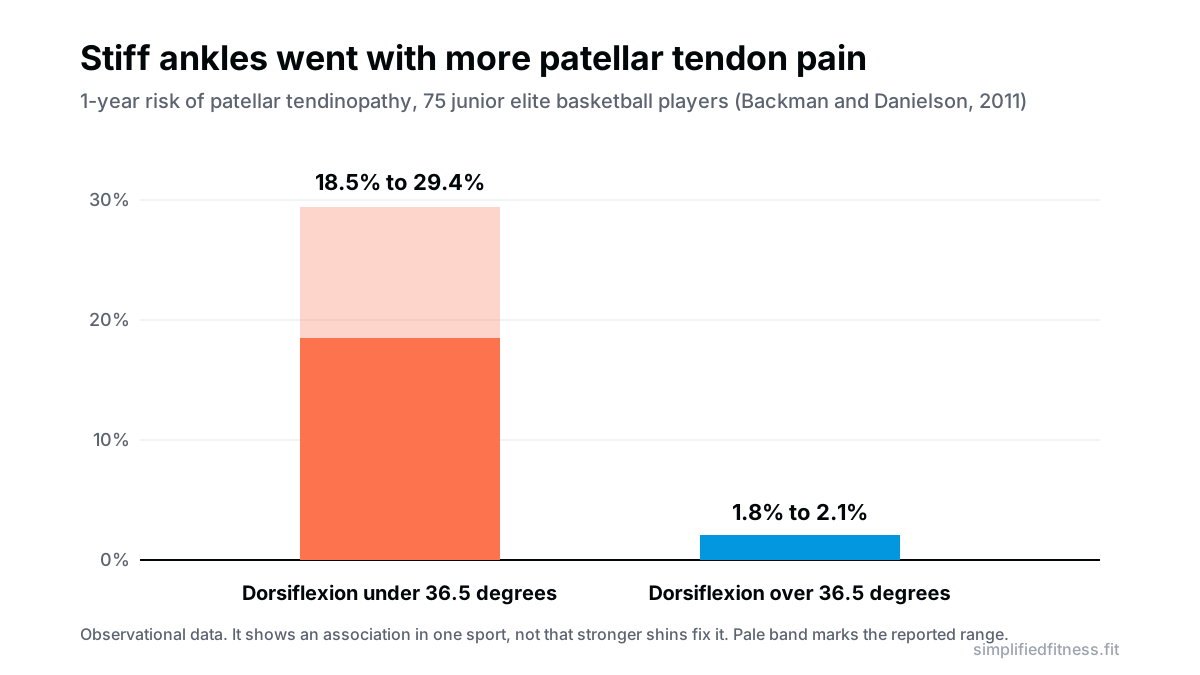
That sounds convincing, until you zoom out. A 2018 systematic review and meta-analysis of 31 studies concluded there was a lack of strong evidence for any modifiable risk factor, and called the evidence for reduced dorsiflexion range limited or conflicting (Sprague et al., 2018).
So we have two honest readings. Study A found a clear link in one sport. The review found the overall picture weak. Part of the reason: most of the included studies were cross-sectional, so they cannot show what came first.
And here is the bigger problem. Ankle dorsiflexion range is mostly about calf and joint tightness. Tibialis strength is a different quantity. Even if stiff ankles are bad for knees, that does not prove that a stronger tibialis fixes it.
If your actual problem is a squat that cannot get deep because your heels lift or your knees cave, look at foot position and ankle range first. Our guide on foot pronation, knee valgus and squat mechanics covers that, and so does are squats bad for your knees.
Can tibialis anterior exercises prevent shin splints?
Short answer: nobody knows yet. Let’s be clear about what shin splints even is.
The clinical name is medial tibial stress syndrome (MTSS): pain along the inner edge of the shin during exercise. A critical review noted that it appears to be bone resorption outpacing bone formation in the tibial cortex, rather than simple inflammation of the covering of the bone (Moen et al., 2009). It is a loading and adaptation problem.
What predicts it? A meta-analysis of risk factors found female sex (odds ratio 2.35), higher body weight, greater navicular drop (how far the arch collapses), previous running injury and more hip external rotation with the hip flexed as significant factors (Reinking et al., 2017). A newer meta-analysis of 21 papers also flagged foot posture, inversion range of motion and eversion strength, though the authors found signs of publication bias (their adjustment for it changed the results little) (Lee et al., 2025).
Notice what is missing from those lists: weak dorsiflexor muscles are not a headline risk factor in these reviews.
What about treatment? A systematic review of 11 trials found that none were free enough from bias to recommend any treatment. Stretching and strengthening exercises were among the options that had not been proven effective (Winters et al., 2013). The earlier critical review noted that in three randomized trials, rest did as well as any intervention (Moen et al., 2009). That is a statement about weak evidence, not proof that exercise is useless.
Wall raises vs tib bar: which is better?
No trial compares them, so this is practical coaching, not research.
| Option | Load | Best for | Downside |
|---|---|---|---|
| Seated toe lifts | None | Learning the movement | Runs out of difficulty fast |
| Wall tib raises (bodyweight) | Body angle | Most lifters, free | Hard to load heavily |
| Dumbbell or plate on foot | Adjustable | Home progression | Fiddly setup |
| Tib bar | Adjustable | Gym users who want measurable load | Cost, availability |
Both train the same muscle through the same movement. The main difference is how easily you can add resistance and track it. For most people in India with a bodyweight or home setup, wall raises are plenty.
How to train the tibialis anterior
Here is a simple ladder. It is an illustrative practical progression, not a protocol from a trial.
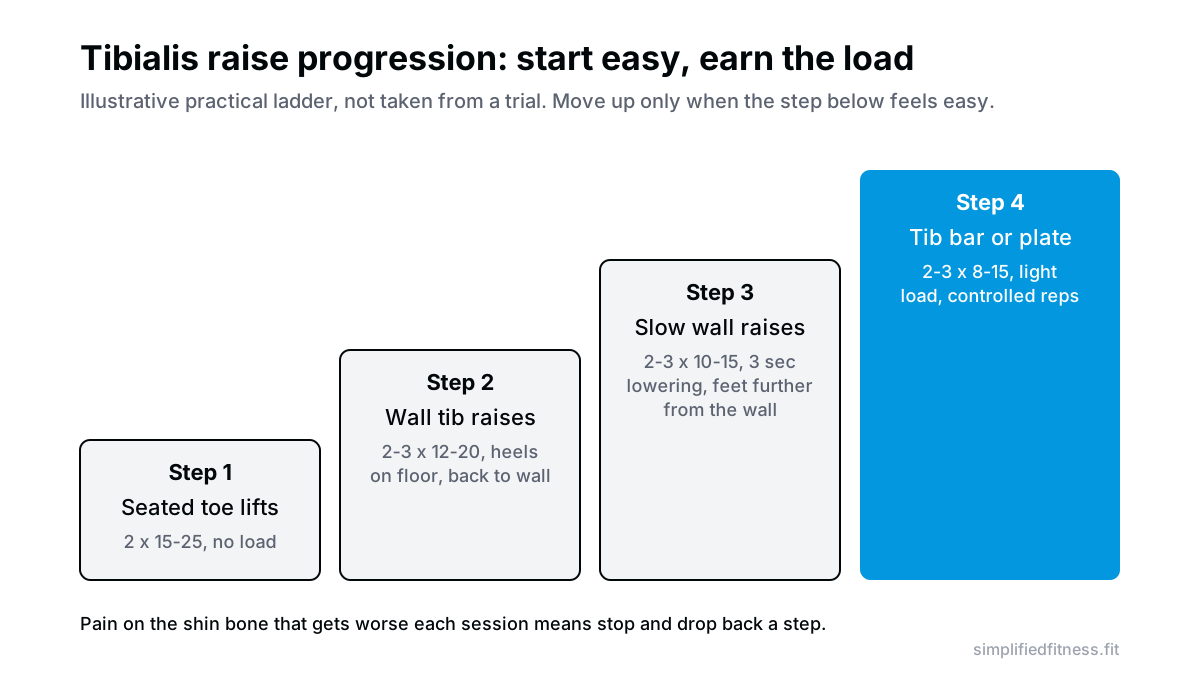
The wall raise. Stand with your back against a wall and your feet roughly 30-40 cm out. Keep your knees straight and glutes touching the wall. Lift your toes as high as you can, pause a beat, then lower for 2-3 seconds.
Dosing. Start with 2 sets of 12-20, two or three times per week. Stay a couple of reps short of failure at first. There are no good trials on the best dose for this muscle, so treat this as a starting point, not a prescription.
Progress. When 20 clean reps feel easy, move your feet further from the wall. Then hold a plate or use a tib bar.
Where it fits. Tack it on at the end of a leg day, or between sets of something that rests the legs, such as upper body work. Our leg day plan already has a place for accessory work.
Will it fix shin splints in lifters and runners?
For lifters, shin pain is often not the issue. It usually appears when someone adds running, jump rope or plyometrics to a lifting program. The sensible approach covers the boring but proven bits.
- Add impact gradually, a small step at a time across weeks.
- Watch body weight and footwear. Higher weight and greater navicular drop both appear in the risk reviews above.
- Take a deload week from running if shin soreness builds.
- Keep calves and ankles mobile. Our piece on calf training shows how to train them with full range.
If you split your training between lifting and running, our guide to hybrid training scheduling helps you avoid stacking too much impact on the same week. You can also check your lower body workload with the training volume calculator.
When should you see a doctor about shin pain?
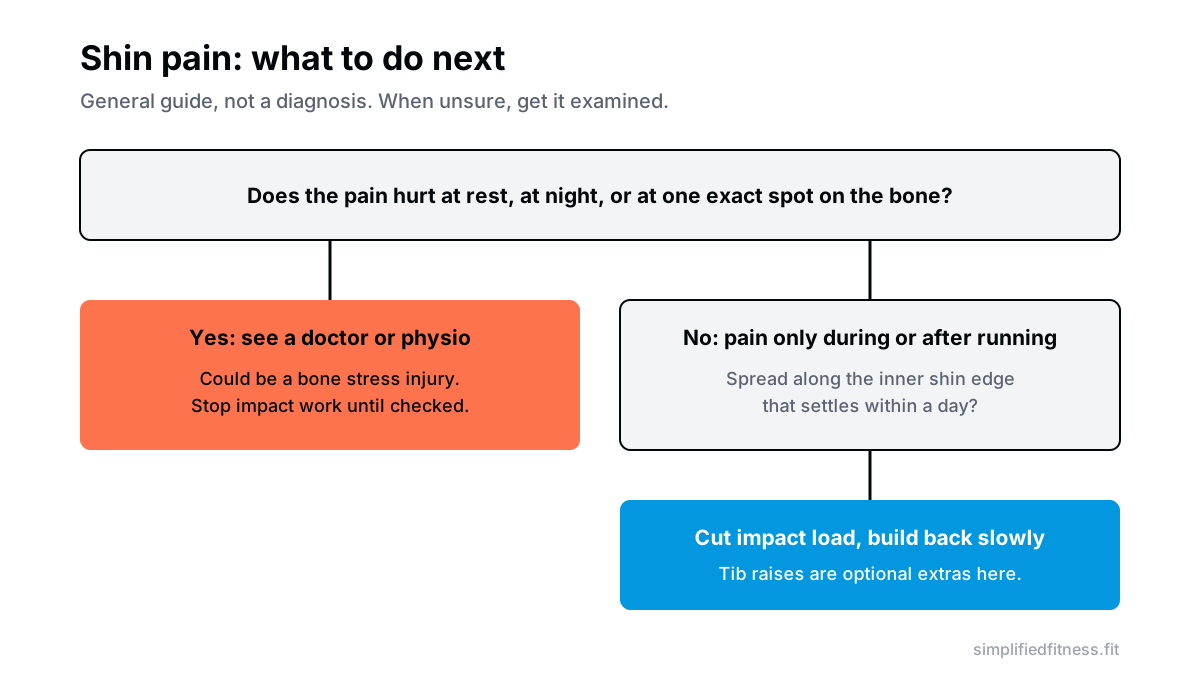
Pain along the inner shin that appears during exercise and eases afterward is the classic shin splints pattern. A different pattern is a warning sign.
See a doctor or physio if:
- the pain hurts at rest or wakes you at night,
- you can press on one small, exact spot on the bone and it is sharply tender,
- the pain gets worse each session despite backing off,
- there is swelling, or your foot feels numb or weak when lifting the toes.
Those can point to a bone stress injury or another problem that needs proper assessment. This article cannot diagnose you. Knee pain is a separate matter, and our guide to modifying leg workouts around knee pain covers practical exercise swaps.
Is it worth adding tibialis raises to your routine?
Probably, if you want an extra low-cost accessory and your shins are not already painful. A few minutes, a wall and some patience is all it takes. The risk is low and some lifters like the feeling of a stronger ankle during squats and lunges.
Just keep your expectations calibrated. No study shows tib raises make knees bulletproof, and evidence for them as a shin splints cure is thin. Your calves, quads, glutes, sensible run progressions and decent footwear matter far more.
If you want a plan with a place for it, start with our free leg day plan, add the raises at the end, and give it six to eight weeks. If your shins feel better, great. If not, you spent ten minutes a week learning that.
Frequently Asked Questions
What are the best tibialis anterior exercises?
The simplest are seated toe lifts, wall tibialis raises and, once those are easy, loaded raises on a tib bar or with a light plate. No trial has ranked these against each other, so pick the one you can do with a full range and no pain. Start with 2 sets of 15-20 and progress slowly.
How do you train the tibialis anterior at home?
Stand with your back against a wall, feet about 30-40 cm out in front, and lift your toes toward your shins without bending your knees. This works the tibialis anterior through dorsiflexion, its main job. Do 2-3 sets of 12-20 slow reps, 2-3 times a week, and move your feet further from the wall to make it harder.
Do tibialis raises help shin splints?
They might help some people, but there is no direct evidence that tib raises prevent or treat shin splints. A systematic review of treatments found that none of the studied options, including stretching and strengthening exercises, was proven effective, mainly because trials were low quality. If you try them, treat them as one piece of a load management plan.
What actually causes shin splints?
Medial tibial stress syndrome appears to be bone resorption outpacing bone formation along the inner tibia, not a simple muscle tear. Meta-analyses link it to female sex, higher body weight, greater navicular drop and previous running injury. Coaches and clinicians also commonly point to sudden jumps in running or jumping volume, though those reviews did not test that directly.
Is a tib bar worth buying?
For most people, no. A wall raise with bodyweight, a dumbbell held between the feet or a plate on a loop of rope does the same job. A tib bar is convenient if you train in a gym that has one, but nothing in the research suggests it works better than other loading methods.
Do tibialis raises protect the knees?
There is no trial showing that tibialis raises protect the knees. Limited ankle dorsiflexion range has been linked to patellar tendinopathy in athletes, but a 2018 meta-analysis rated that evidence as limited or conflicting. Treat tib raises as a low-cost accessory, not a knee injury cure.
How often should I train my tibialis anterior?
Two to three short sessions a week is a reasonable starting point. Small stabilising muscles recover quickly and the exercise is light, but there are no good trials on the ideal dose for this muscle. Add a set or reps before adding load, and back off if the shin gets sore on the bone.
Why does my tibialis anterior burn so quickly?
The muscle is small and rarely trained, so it fatigues fast at first. Your body also has little practice at isolating it, and most people lift the foot with too little range. Keep reps slow, pause at the top and expect numbers to climb over a few weeks.
Can tibialis training improve ankle mobility?
Not directly. Dorsiflexion range of motion is mostly limited by calf tightness, joint structure and soft tissue, while the tibialis anterior provides the active force to pull the foot up. Strengthening it may help you control the end range, but the evidence is thin, so also work on calf flexibility if your squat depth is limited.
Does tibialis anterior size matter for looks?
It can add a little fullness to the front of the lower leg, but for most people the effect is small and varies with genetics. Your calves and overall leg development matter much more visually. Do the raises for function and add them only if you enjoy them.
Are tibialis raises safe for beginners?
Yes, for most healthy people, because bodyweight raises are low impact and easy to scale. Start with no load and stop if you feel sharp or bony shin pain. If you have a past shin stress injury or ongoing pain, check with a physio first.
When should I see a doctor about shin pain?
See a doctor or physio if shin pain hurts at rest, wakes you at night, or you can press on one exact spot on the bone. Those signs can point to a bone stress injury, which needs a proper diagnosis. Do not try to strengthen your way through it.
Sources & References
Every claim above is checked against peer-reviewed research (PubMed, U.S. National Library of Medicine) or guidance from established health bodies. How we fact-check.
- Backman LJ, et al. Low range of ankle dorsiflexion predisposes for patellar tendinopathy in junior elite basketball players: a 1-year prospective study. Am J Sports Med. 2011. PMID: 21917610
- Sprague AL, et al. Modifiable risk factors for patellar tendinopathy in athletes: a systematic review and meta-analysis. Br J Sports Med. 2018. PMID: 30054341
- Fong CM, et al. Ankle-dorsiflexion range of motion and landing biomechanics. J Athl Train. 2011. PMID: 21214345
- Dill KE, et al. Altered knee and ankle kinematics during squatting in those with limited weight-bearing-lunge ankle-dorsiflexion range of motion. J Athl Train. 2014. PMID: 25144599
- Moen MH, et al. Medial tibial stress syndrome: a critical review. Sports Med. 2009. PMID: 19530750
- Winters M, et al. Treatment of medial tibial stress syndrome: a systematic review. Sports Med. 2013. PMID: 23979968
- Reinking MF, et al. Medial tibial stress syndrome in active individuals: a systematic review and meta-analysis of risk factors. Sports Health. 2017. PMID: 27729482
- Lee I, et al. How medial tibial stress syndrome is affected by alignment, range of motion, strength, and gait biomechanics: a systematic review and meta-analysis. J Sport Rehabil. 2025. PMID: 39577407

Umair Hazrami · Founder & Head Coach, Simplified Fitness
Umair Hazrami founded Simplified Fitness and the Simplified Lifter channel to cut through fitness noise. With 4+ years of consistent training and 10+ coaching clients, he writes every guide from the peer-reviewed research and links the sources so you can check them. Our editorial standards.
Educational content only, not medical advice. If you have a medical condition, are pregnant, or take medication, talk to a qualified doctor before changing your diet, supplements or training. Full disclaimer.
Keep reading

Exercise Technique
Adductor Magnus Training: Seated Adductor Machine and Copenhagen Planks for Thigh Mass
Adductor magnus training explained: what research says on deep squats, the adductor machine and Copenhagen planks for thicker inner thighs and groin strength.
7 min read
Exercise Technique
High Bar vs Low Bar Squat: Which Builds More Quad Muscle?
High bar vs low bar squat for hypertrophy: what torso lean, knee travel and EMG studies show, why high-bar leans quad, and when low-bar still makes sense.
8 min read
Exercise Technique
Calf Hypertrophy Science: Standing vs Seated Calf Raises (Gastrocnemius vs Soleus)
Calf hypertrophy explained: why calves seem stubborn, what the trials say on exercise choice, stretch and foot position, plus weekly sets, reps and frequency.
9 min read
Exercise Technique
Complete Leg Workout Programming: Quad Day vs Hamstring and Glute Day
Best leg workout routine science: split leg day into a quad session and a hamstring-glute session, with sets, order and a 5-week plan that avoids burnout.
9 min read