Functional Anatomy of the Hamstrings: Biceps Femoris, Semitendinosus, Semimembranosus
Hamstrings anatomy functional guide: how biceps femoris, semitendinosus and semimembranosus differ, and why you need both leg curls and RDLs to train them.
TL;DR. The short answer
- The hamstrings are four muscles: semitendinosus, semimembranosus, biceps femoris long head (all cross hip and knee) and biceps femoris short head (crosses only the knee).
- Because three heads cross the hip, hip-hinge work like RDLs trains them at the hip, while leg curls train all four at the knee. Neither movement covers the whole group alone.
- In a 12-week MRI trial, seated leg curls grew the whole hamstrings more than prone curls (+14% vs +9%), mainly in the two-joint muscles.
- EMG studies disagree somewhat on which exercise favours which head, so treat 'inner vs outer hamstring' targeting as a tendency, not a switch.
- A practical default is one hip-hinge movement plus one knee-flexion movement per hamstring week, both taken through a full range of motion.
Part of our complete guide: Complete Lower-Body & Core Training Guide: Quads, Glutes, Hamstrings, Calves & Abs Science
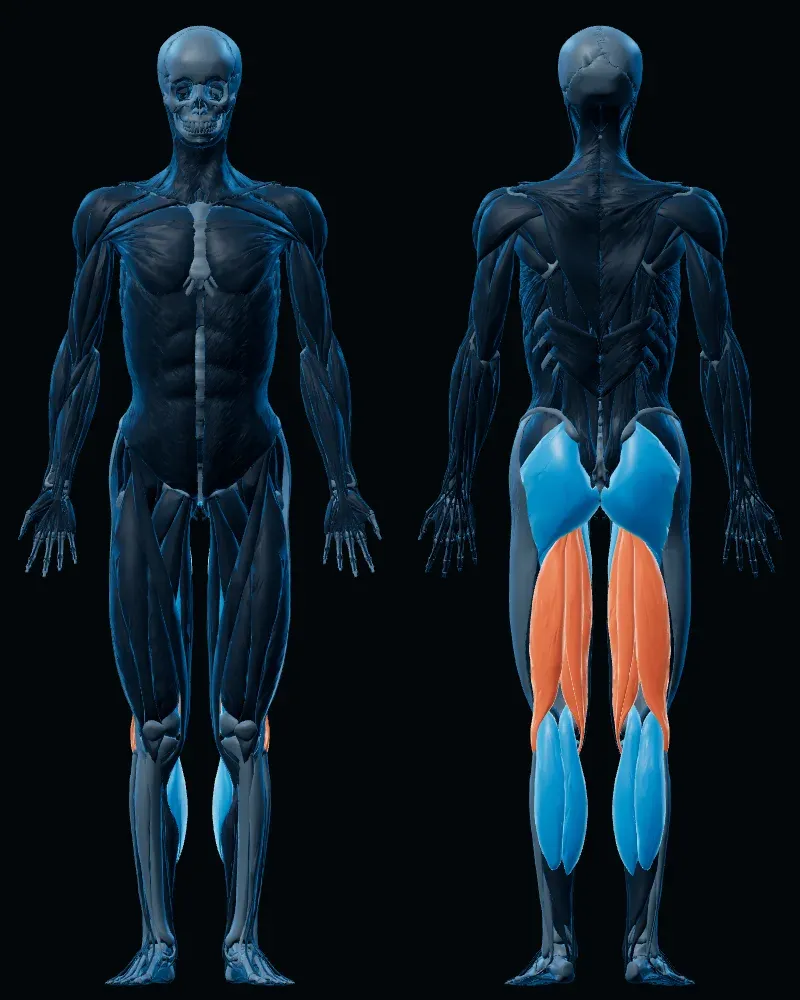
Muscles worked: hamstrings
Main movers: biceps femoris, semitendinosus and semimembranosus
Assisting: glutes, calves and adductor magnus
Table of contents
The hamstrings are not one muscle. They are four: the semitendinosus, the semimembranosus, and the long and short heads of the biceps femoris. Three of them cross both the hip and the knee, one crosses only the knee, and that single fact is why leg curls and hip hinges are both needed. This hamstrings anatomy functional guide sits inside our complete lower body and core training guide and gives you the map before you pick exercises.
Most lifters train hamstrings as a single “back of the thigh” block. That is a fine start. Knowing what is actually back there lets you build a better week.
What are the four hamstring muscles?
Start with the layout. Two sit on the inner (medial) side and two on the outer (lateral) side of the back of the thigh.
- Semitendinosus: medial, superficial, a long thin belly that turns into a long tendon near the knee.
- Semimembranosus: medial, deeper, under the semitendinosus.
- Biceps femoris long head: lateral, starts on the pelvis like the two above.
- Biceps femoris short head: lateral, starts on the thigh bone (femur), not the pelvis.
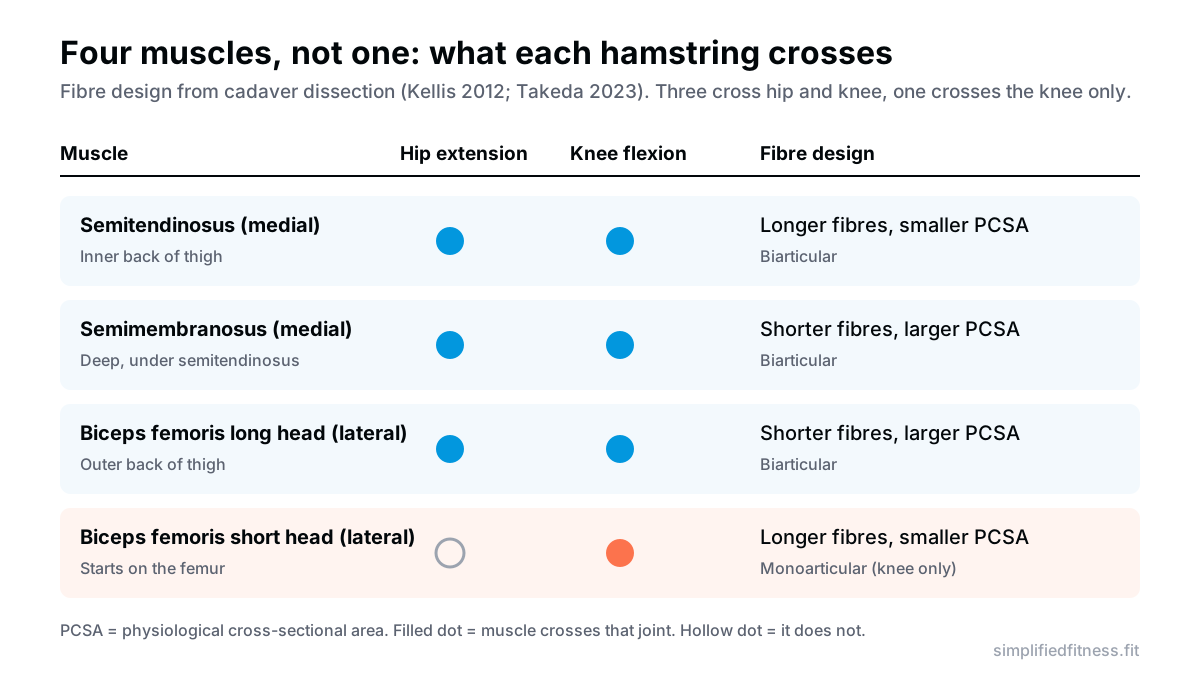
The first three are biarticular, meaning they cross two joints. They can extend the hip and bend the knee. The short head is monoarticular. It crosses only the knee, so it can bend the knee but cannot extend the hip.
How are the hamstrings built differently?
Cadaver work shows these muscles are not copies of each other. In an eight-specimen dissection study (average age about 68), (Kellis et al., 2012) found that the ratio of fascicle length to muscle length was higher for the semitendinosus (0.58) and biceps femoris short head (0.50) than for the biceps femoris long head (0.27) and semimembranosus (0.22). The authors concluded that treating the hamstrings as one uniform muscle gives a less accurate picture.
A second dissection study of 16 lower limbs (Takeda et al., 2023) reached a similar split. The semimembranosus and biceps femoris long head had shorter fibres and larger physiological cross-sectional area. The semitendinosus and short head had longer fibres and smaller cross-sectional area.
In plain terms: some of the hamstrings look built for force, others for range and speed of shortening. Both studies used cadavers, so they describe structure, not what happens during a set.
Knee flexion vs hip extension: what do the hamstrings actually do?
Two jobs, one muscle group.
Knee flexion is the leg curl movement: heel moves towards the glute. All four heads help here, including the short head.
Hip extension is the movement in an RDL, a good morning or standing up from a deadlift: the thigh moves backwards relative to the pelvis, or the pelvis rotates back over a fixed thigh. Only the three biarticular heads can contribute. The short head cannot, because it does not cross the hip.
A 2018 review in Sports Medicine summarised the pattern: higher biceps femoris long head and semimembranosus activity during hip extension-oriented movements, and preferential semitendinosus and short head activity during knee flexion-oriented movements. The same review notes that activation patterns “diverge significantly” between exercises.
That is the logic behind “you need both”. A hip hinge cannot properly train the short head, and a curl does not load the hamstrings as hip extensors. If you only do one, you leave something untrained.
Medial vs lateral hamstrings: can you target them?
This is where the research gets messier, and we would rather show you the conflict than pretend there is a tidy answer.
What studies found about hinges:
- In 16 elite female handball and soccer players, (Zebis et al., 2013) reported that the kettlebell swing and Romanian deadlift favoured the semitendinosus over the biceps femoris (by about 17-22%), while the supine leg curl and hip extension favoured the biceps femoris (by about 20-23%).
- In 12 weight-trained men at 85% of 1RM, (McAllister et al., 2014) found the semitendinosus was substantially more active than the biceps femoris across all exercises tested, with hamstring activity highest in the RDL and glute-ham raise.
What studies found that complicates this:
- In 24 recreationally active men, (Bourne et al., 2017) found the largest lateral-to-medial EMG ratio in the 45 degree hip extension, and the lowest in the Nordic hamstring and bent-knee bridge. Functional MRI showed hip extension loaded the biceps femoris long head, semitendinosus and semimembranosus more than the short head, while the Nordic preferentially recruited the semitendinosus.
- In 15 trained women, (Stevens et al., 2022) measured three regions of the biceps femoris. Kickbacks, Nordics and leg curls gave higher activation than RDLs, step-ups and hip extensions in the proximal and distal regions. The Nordic consistently produced the highest voltage.
Why might these disagree? Different exercise definitions (supine curl vs seated curl vs Nordic), different loads, different populations (elite women, trained women, recreational men), and surface EMG can only sample what lies under the electrode. Cross-talk and joint-angle changes also make comparisons across exercises imprecise.
The cautious takeaway: the biceps femoris long head tends to be loaded well by hip extension, and the semitendinosus tends to be loaded well by some hinges and by Nordics. Do not expect a clean inner vs outer split from one exercise.
What does growth research say about curls vs hinges?
EMG tells you which muscle works. It does not tell you what grows. For that you need imaging after weeks of training.
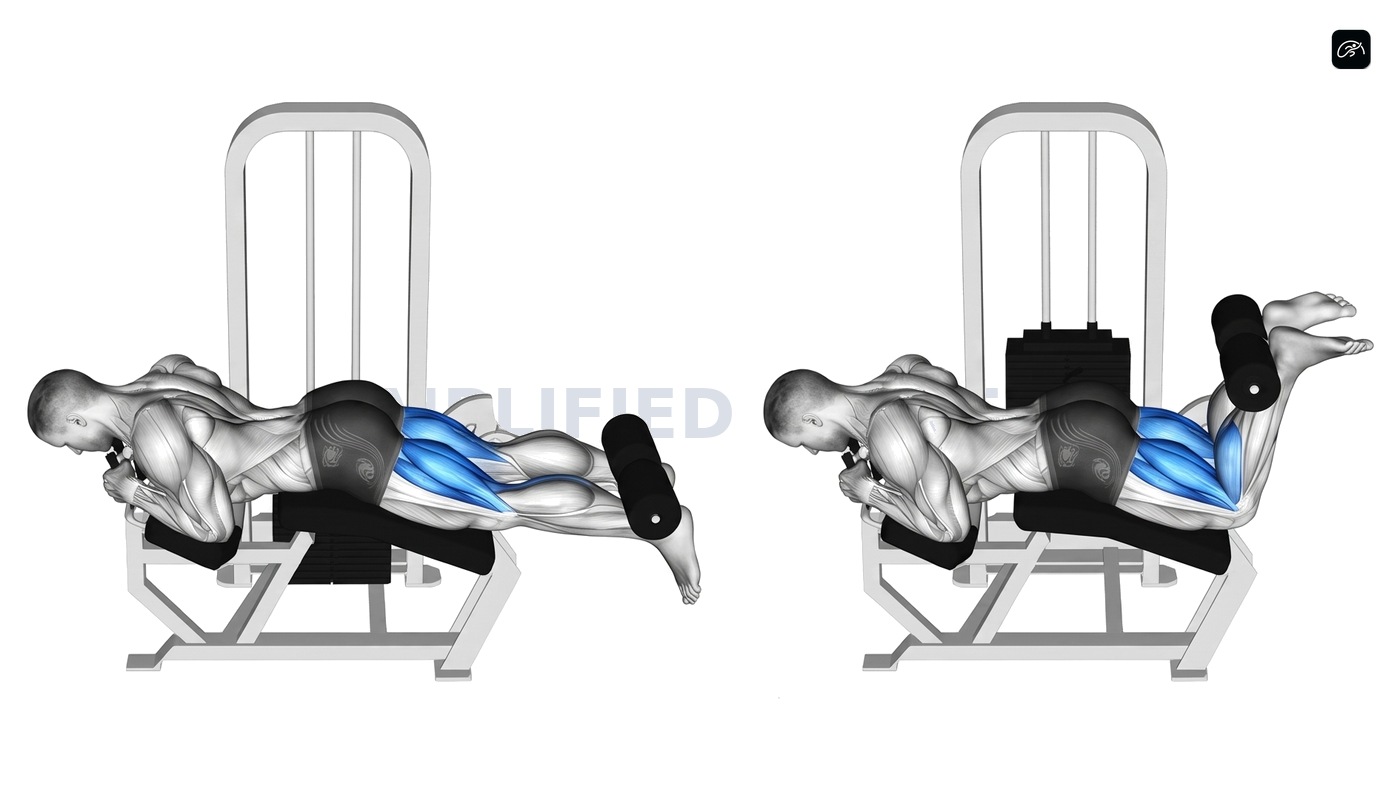
Maeo and colleagues (2021) trained 20 healthy adults, one leg on the seated curl and the other on the prone curl, at 70% 1RM for 5 sets of 10, twice a week for 12 weeks. MRI showed whole-hamstring volume rose by 14% with seated curls and 9% with prone. The biarticular muscles gained more with the seated version, while the monoarticular short head grew similarly (+10% vs +9%).
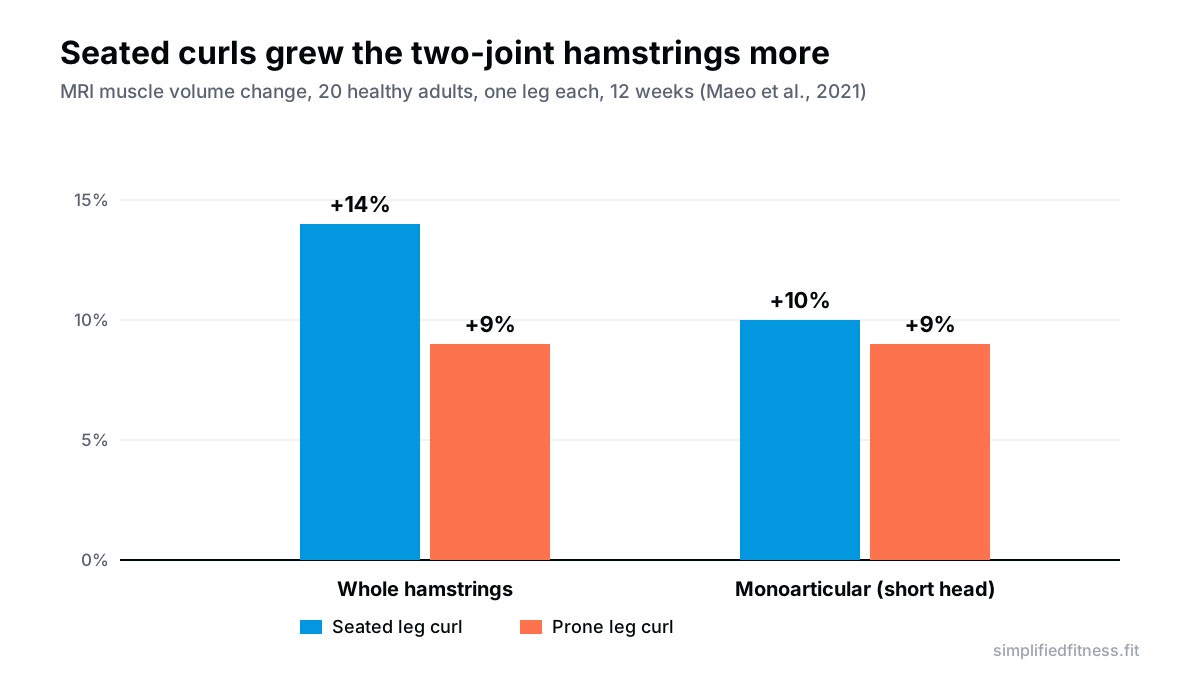
The authors suggested that training at long muscle lengths promotes hypertrophy. That fits a broader pattern: a systematic review of range of motion (Schoenfeld and Grgic, 2020) found that full range of motion conferred beneficial effects on lower body hypertrophy versus partial range. For more on this idea, see our guides to stretch-mediated hypertrophy and range of motion.
Two caveats. Maeo’s sample was small and the training was supervised. And the result tells you that seated curls were better than prone curls, not that curls beat hinges.
For the hinge side, a 10-week trial in 30 recreationally active men (Bourne et al., 2017) compared the Nordic and a hip extension exercise with no training. Both lengthened biceps femoris long head fascicles. Long head volume increased more with hip extension than with the Nordic, and both exercises increased semitendinosus volume. A 2024 follow-up from the same research group, also 10 weeks and 30 men (Lazarczuk et al., 2024), found regional growth was greatest in the mid-portion of the semitendinosus for both exercises and in the mid-portion of the long head for the hip extension group.
Put together, the pattern is fairly consistent: the hip extension exercise grew the biceps femoris long head more than the Nordic did, both exercises grew the semitendinosus, and the curl variant with a stretched hamstring grew the group more. All of this is in young, active men or healthy adults, so be careful applying it to older lifters or beginners.
How should I train hamstrings based on the anatomy?
The anatomy points to a simple structure.
| Job | Heads that contribute | Example exercise |
|---|---|---|
| Hip extension | Semitendinosus, semimembranosus, biceps femoris long head | Romanian deadlift, stiff-leg deadlift |
| Knee flexion | All four, including the short head | Seated leg curl, lying curl, Nordic |
Our default for most lifters:
- One hip-hinge movement. Use a Romanian or stiff-leg deadlift with a controlled lowering phase.
- One knee-flexion movement. Use a seated leg curl if your gym has the machine. Lying curls are a fine substitute.
- Train both through a full range and aim for a hard last few reps. Skip the heavy half-reps.
- Check weekly volume with our training volume calculator.
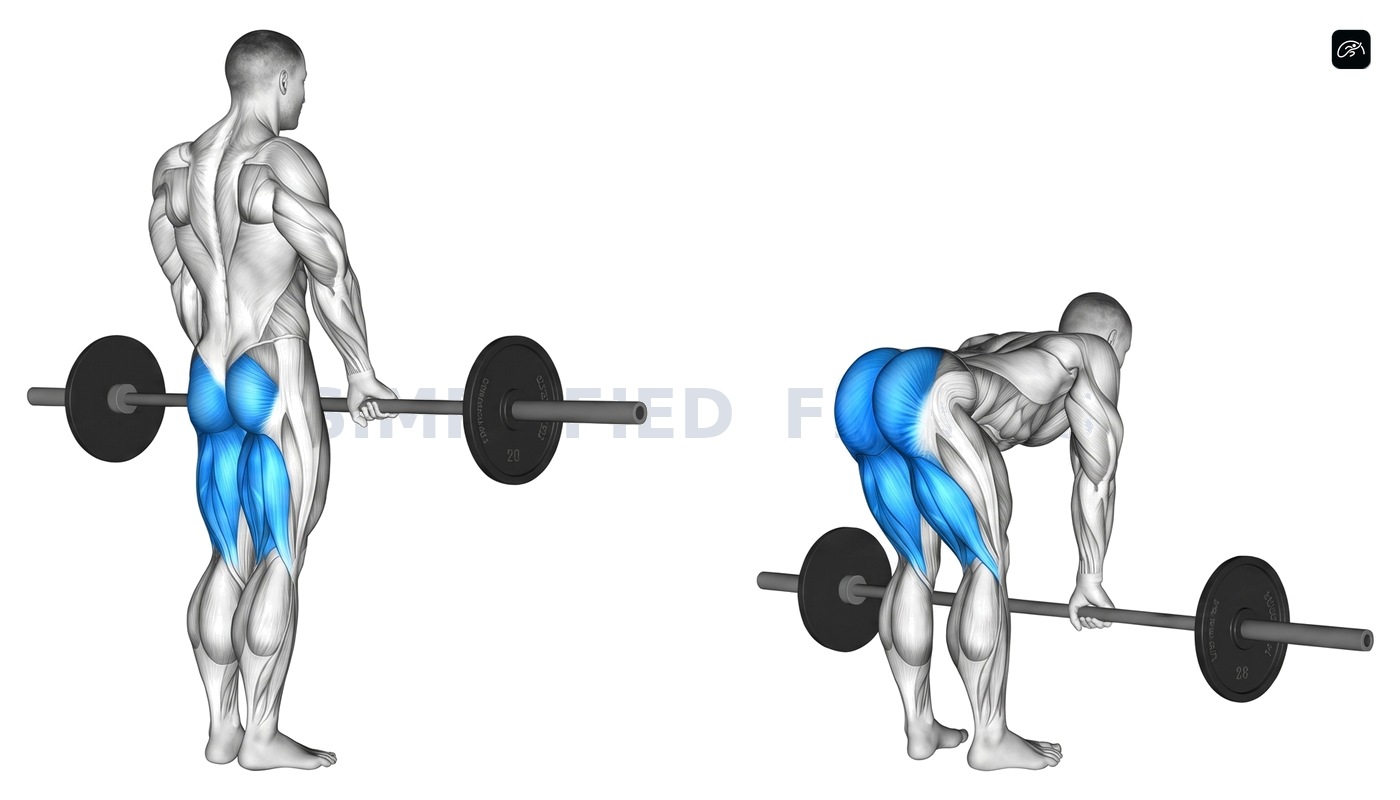
For hinge technique and progressions, read our guide to Romanian deadlifts. For machine choice, see seated vs lying leg curls. If you are curious about the Nordic, we cover it in Nordic hamstring curls, and for the balance with the front of the thigh see the hamstring to quadriceps ratio and the quadriceps anatomy guide.
What about injury and when to see a doctor?
The 2018 Sports Medicine review notes that eccentric knee flexor training reduces hamstring strain risk when compliance is adequate, and that benefits are likely partly mediated by longer biceps femoris long head fascicles and better eccentric strength. That is evidence from athlete populations, so it will not guarantee that your own hamstrings stay safe.
A sudden sharp pain, a pop, visible bruising at the back of the thigh, or pain that does not settle in a few days is a reason to get assessed by a doctor or physiotherapist. This article is education, not diagnosis.
Are the hamstrings fed differently if I am vegetarian?
No. Hamstring growth follows the same rules as any muscle: enough training stimulus, enough total protein, enough calories and sleep. Dal, paneer, curd, soya and eggs can all get you there. Our protein intake calculator gives a daily target based on your weight and goals.
Quick recap
- Four hamstring muscles, three biarticular, one monoarticular.
- Hip hinges and curls load them at different joints, so use both.
- Seated curls beat prone curls for growth in one 12-week MRI trial.
- EMG studies disagree on medial vs lateral targeting, so hold that idea loosely.
- If pain is sharp or persistent, see a clinician.
Frequently Asked Questions
What are the four hamstring muscles?
The hamstrings are the semitendinosus, semimembranosus, biceps femoris long head and biceps femoris short head. The first three cross both the hip and the knee, while the short head crosses only the knee. Knowing this helps you pick exercises that load the group at both joints.
Which hamstring muscle is the biggest?
In cadaver dissections the semimembranosus and biceps femoris long head have shorter fibres and larger physiological cross-sectional area, which points to a high capacity for force. Size by volume varies between people, so do not assume one ranking fits everyone. Training both hip and knee movements covers all of them regardless.
What is the difference between medial and lateral hamstrings?
The medial hamstrings are the semitendinosus and semimembranosus on the inner back of the thigh, and the lateral hamstring is the biceps femoris on the outer side. Cadaver work shows the medial and lateral muscles have different fibre designs. In the gym, this means variety in exercises is more useful than chasing one muscle.
Do leg curls or RDLs work the hamstrings better?
Neither is strictly better because they load different jobs. Leg curls train knee flexion and RDLs train hip extension, and hamstring muscles contribute to both. Use one of each, for example a seated leg curl and a Romanian deadlift, in the same week.
Is the biceps femoris short head trained by RDLs?
Not in the same way. The short head only crosses the knee, so it cannot help extend the hip, which makes knee-flexion work the cleaner way to train it. Add a leg curl variation to your hamstring days.
Do seated leg curls build more hamstring muscle than lying leg curls?
In one 12-week trial of 20 healthy adults, seated curls increased whole hamstring volume by 14% versus 9% for prone curls. The seated position holds the hips flexed, so the two-joint hamstrings are stretched more at the start of each rep. That is a single trial, so treat it as a strong hint rather than the final word, and favour the seated machine when you have one.
Which exercise hits the semitendinosus most?
EMG studies point to hip-hinge movements such as the Romanian deadlift and kettlebell swing, and also the Nordic curl, depending on the study. Results conflict because the exercises, loads and muscles measured differ. A mix of hinges and curls is the safest approach.
Can I target inner or outer hamstrings by turning my feet?
The studies reviewed here compared exercises, not foot rotation, so we cannot point you to evidence that foot position isolates a head. Any effect is likely small compared with simply choosing hinge and curl variations and training them hard. Spend your attention on range of motion and progressive load instead.
How many hamstring exercises do I need per week?
Two is a sensible starting point: one hip-hinge and one knee-flexion movement. The anatomy shows the group works at two joints, and there is no single exercise that fully covers both. Check your weekly set count with the training volume calculator linked in this article.
Do the hamstrings help protect the knee?
The medial hamstrings are thought to help resist excessive knee valgus and rotation, according to the rationale in EMG work on female handball and soccer players. That is a mechanism, not proof that training prevents injury in any individual. If you have knee pain or an old injury, see a physiotherapist or doctor.
Why do my hamstrings feel tight but weak?
Tightness is a sensation and does not reliably tell you about strength or length, and it can come from many causes. Strong hamstrings trained through a long range often feel better than ones that only get stretched. If pain is sharp, persistent or follows a pop, get it assessed by a clinician.
Are Nordic curls good for the hamstrings?
Nordics produced the highest EMG across three regions of the biceps femoris in trained women and lengthened biceps femoris long head fascicles in a 10-week trial. They are demanding, so start with low volume. Our dedicated Nordic article covers progressions.
Does hamstring training matter for vegetarians in India?
Muscle growth depends on training stimulus and adequate protein overall, not on the specific diet pattern. Dal, paneer, curd and soya can all help you reach your protein target. Aim for a daily total that suits your body weight and training and use the protein calculator to check it.
Sources & References
Every claim above is checked against peer-reviewed research (PubMed, U.S. National Library of Medicine) or guidance from established health bodies. How we fact-check.
- Maeo S, et al. Greater Hamstrings Muscle Hypertrophy but Similar Damage Protection after Training at Long versus Short Muscle Lengths. Med Sci Sports Exerc. 2021. PMID: 33009197
- McAllister MJ, et al. Muscle activation during various hamstring exercises. J Strength Cond Res. 2014. PMID: 24149748
- Zebis MK, et al. Kettlebell swing targets semitendinosus and supine leg curl targets biceps femoris: an EMG study with rehabilitation implications. Br J Sports Med. 2013. PMID: 22736206
- Stevens BM, et al. Muscle Activation Patterns of the Proximal Medial and Distal Biceps Femoris and Gluteus Maximus Among 6 Hip Extension and Knee Flexion Exercises in Trained Women. Int J Exerc Sci. 2022. PMID: 35989703
- Bourne MN, et al. Impact of exercise selection on hamstring muscle activation. Br J Sports Med. 2017. PMID: 27467123
- Bourne MN, et al. Impact of the Nordic hamstring and hip extension exercises on hamstring architecture and morphology: implications for injury prevention. Br J Sports Med. 2017. PMID: 27660368
- Bourne MN, et al. An Evidence-Based Framework for Strengthening Exercises to Prevent Hamstring Injury. Sports Med. 2018. PMID: 29116573
- Kellis E, et al. Architectural differences between the hamstring muscles. J Electromyogr Kinesiol. 2012. PMID: 22564790
- Takeda K, et al. Unique morphological architecture of the hamstring muscles and its functional relevance revealed by analysis of isolated muscle specimens and quantification of structural parameters. J Anat. 2023. PMID: 36914559
- Lazarczuk SL, et al. Hamstring Muscle-Tendon Geometric Adaptations to Resistance Training Using the Hip Extension and Nordic Hamstring Exercises. Scand J Med Sci Sports. 2024. PMID: 39297348
- Schoenfeld BJ, Grgic J. Effects of range of motion on muscle development during resistance training interventions: A systematic review. SAGE Open Med. 2020. PMID: 32030125

Umair Hazrami · Founder & Head Coach, Simplified Fitness
Umair Hazrami founded Simplified Fitness and the Simplified Lifter channel to cut through fitness noise. With 4+ years of consistent training and 10+ coaching clients, he writes every guide from the peer-reviewed research and links the sources so you can check them. Our editorial standards.
Educational content only, not medical advice. If you have a medical condition, are pregnant, or take medication, talk to a qualified doctor before changing your diet, supplements or training. Full disclaimer.
Keep reading

Exercise Technique
Adductor Magnus Training: Seated Adductor Machine and Copenhagen Planks for Thigh Mass
Adductor magnus training explained: what research says on deep squats, the adductor machine and Copenhagen planks for thicker inner thighs and groin strength.
7 min read
Exercise Technique
High Bar vs Low Bar Squat: Which Builds More Quad Muscle?
High bar vs low bar squat for hypertrophy: what torso lean, knee travel and EMG studies show, why high-bar leans quad, and when low-bar still makes sense.
8 min read
Exercise Technique
Calf Hypertrophy Science: Standing vs Seated Calf Raises (Gastrocnemius vs Soleus)
Calf hypertrophy explained: why calves seem stubborn, what the trials say on exercise choice, stretch and foot position, plus weekly sets, reps and frequency.
9 min read
Exercise Technique
Complete Leg Workout Programming: Quad Day vs Hamstring and Glute Day
Best leg workout routine science: split leg day into a quad session and a hamstring-glute session, with sets, order and a 5-week plan that avoids burnout.
9 min read