Foot Pronation, Knee Valgus, and Squat Mechanics: Flat Feet, Arches, and Lifting Shoes
Knees caving in on squats with flat feet? See what research says about pronation, short foot, hip strength and lifting shoes, and what to try first.
TL;DR. The short answer
- Flat feet do not automatically make your knees cave in. One study of 30 healthy adults linked greater midfoot width mobility and less ankle dorsiflexion to a larger knee valgus angle, but a second study found different feet without different valgus.
- Short foot exercise (gently lifting the arch while the toes stay flat) modestly improved arch measures in flatfoot meta-analyses, though one found the effect depended on training for more than 6 weeks.
- Raising the heel (lifting shoes or a wedge) adds roughly 4-5 degrees of ankle and knee range in the squat (healthy adults, pooled studies). Whether they fix valgus has not been shown.
- Hip abductor weakness is a popular explanation for valgus, yet a 2026 review of healthy people found mostly no significant link. Strengthen the hips for general reasons, but do not expect it to be a guaranteed cure.
- Sharp pain, swelling, locking or giving way means stop squatting and get the knee assessed by a doctor or physiotherapist.
Part of our complete guide: Complete Lower-Body & Core Training Guide: Quads, Glutes, Hamstrings, Calves & Abs Science
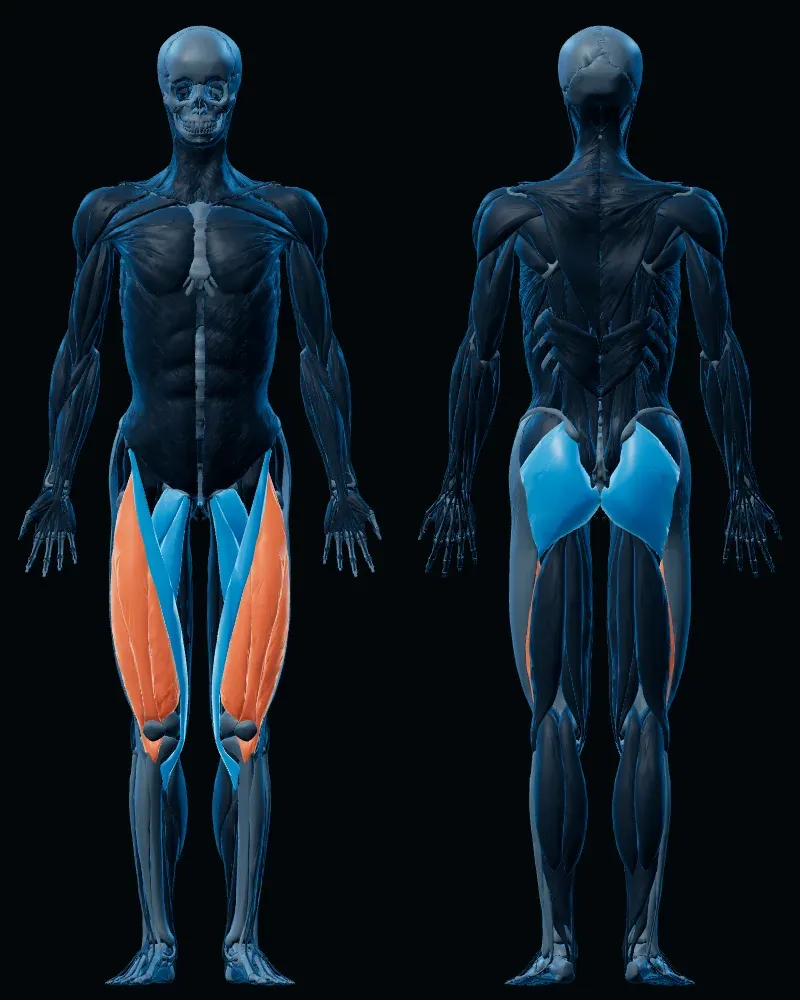
Muscles worked: quads
Main movers: rectus femoris and the three vasti
Assisting: adductors, sartorius and glutes
Table of contents
If your knees cave in on heavy squats and you have flat feet, the foot is a reasonable suspect, but it is rarely the only one. Research links some measures of midfoot mobility and less ankle range to a larger knee valgus angle, yet it does not show a clean “flat foot causes valgus” rule. A practical knee valgus squat fix for flat feet starts with the foot and ankle, then works up to the hip.
This article sits inside our complete lower-body and core training guide. It is about the foot-ankle-knee chain: what pronation does, what short foot can and cannot do, whether lifting shoes help, and where the hips fit.
What is knee valgus, and why do flat feet get blamed?
Knee valgus (specifically dynamic valgus) is when the knee drifts toward the midline during a squat or lunge instead of tracking over the foot. Researchers usually measure it as the frontal plane projection angle (FPPA) from video.
Pronation is the foot rolling inward as the arch lowers under load. A flat or collapsing arch gets blamed because the foot is the first thing that meets the floor. Authors of one study put it plainly: the foot is the primary interface with the support surface, so foot and ankle mobility may affect the FPPA (Wyndow et al., 2016).
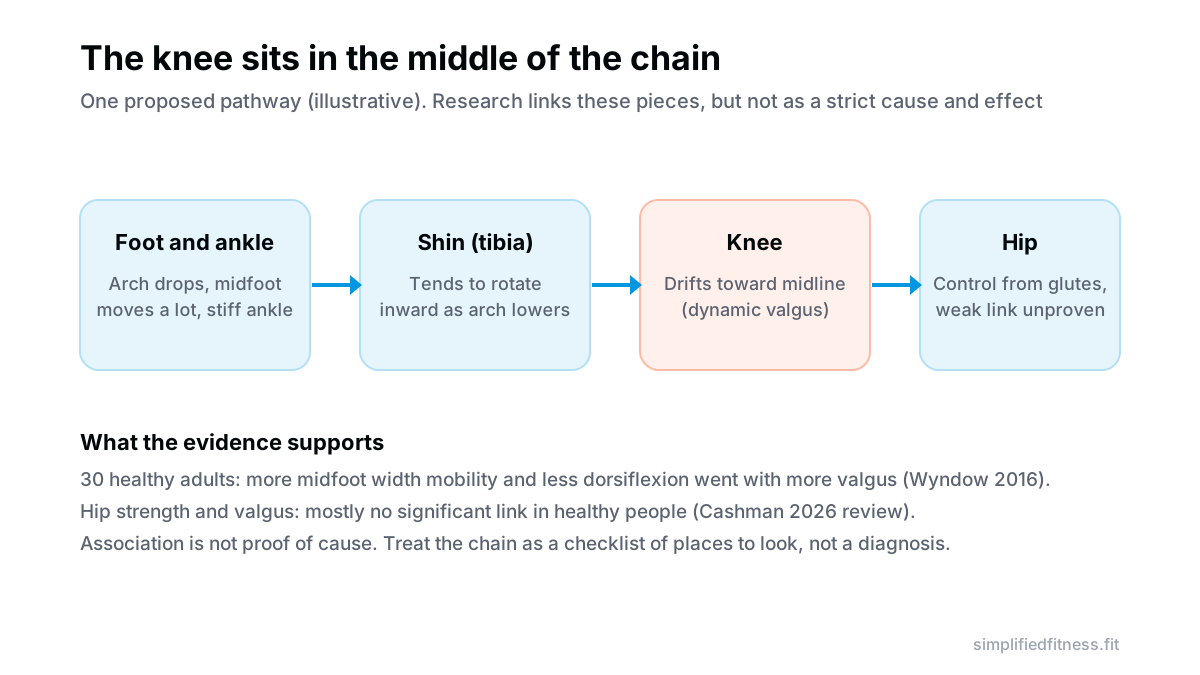
Valgus also gets attention because it shows up more in people with patellofemoral pain and ACL injury, as the same authors note. Seeing it in your own squat does not mean you are headed for an injury. It means look closer.
What does the research say about foot mobility and valgus?
In 30 healthy adults doing single-leg squats, higher midfoot width mobility was associated with a greater peak FPPA, and lower midfoot height mobility and lower ankle dorsiflexion were also associated with a greater FPPA (Wyndow et al., 2016). So a mobile foot and a stiff ankle both lined up with more knee drift.
That sounds like the case closed. It is not.
A later study of 51 people with patellofemoral osteoarthritis and 23 controls found the arthritis group had less dorsiflexion and more foot mobility, but no difference in knee valgus angle during the single-leg squat (Wyndow et al., 2018). Different populations (healthy 18 to 50 year olds in the first study, adults in their mid-50s in the second), a modest sample and a single-leg test could all explain the mismatch. Both are observational, so neither proves the foot causes valgus.
In the gym, this looks like a lifter who feels the arch roll in and the knee follow on the second or third grind rep. Sometimes the ankle is also running out of range, which fits the dorsiflexion link above, though that has not been tested in heavy barbell squats.
Does the short foot exercise fix arch collapse?
Short foot is a small drill: keep the toes relaxed and flat, then draw the ball of the foot toward the heel so the arch rises. No toe curling.
The evidence is modest and mixed. A 2022 meta-analysis of six randomized trials (201 patients with flatfoot) found short foot reduced navicular drop (mean difference -0.23, 95% CI -0.45 to -0.02) and Foot Posture Index scores (MD -0.67) compared with controls, with no significant difference in muscle hypertrophy (Huang et al., 2022). The control groups varied, including insoles and other strengthening.
A 2024 meta-analysis reached a more cautious place. Pooled results showed no significant difference in navicular drop or Foot Posture Index versus controls, and only programmes longer than 6 weeks showed a significant navicular drop improvement (Cheng et al., 2024). Its authors note that many trials were unclear on whether participants had symptomatic flat feet.
Why the difference? Different trial pools, different comparators, and duration. The cautious takeaway: short foot may nudge arch measures over several weeks, and the effect is small. Note too that these studies measured the arch, not your squat.
How to root your foot in a squat (the tripod cue)
This is the in-the-moment version, and it is coaching practice rather than a tested protocol.
- Feel three contact points: the base of the big toe, the base of the little toe and the heel.
- Press them into the floor as if you were gently trying to spread the floor apart.
- Keep the toes long and flat. Do not claw.
- Lift the arch a little, without letting the big toe come off the floor.
- Keep that pressure through the descent and the drive.
Done well, the knee tracks more easily over the middle of the foot. Done badly (toes gripping, heel lifting), it just adds tension.
A small turnout of the toes, within what feels natural, often helps people find a stable base. If your stance is the problem, our guide to stance width and foot placement in squats and leg press covers it.
Do weightlifting shoes help with knee valgus?
Lifting shoes have a firm sole and a raised heel. The heel is the part that matters for squat mechanics.
A 2026 meta-analysis of 14 studies (177 healthy adults) found heel elevation significantly increased ankle range of motion (mean difference 4.33 degrees) and knee range (4.94 degrees), but not hip or trunk range. The ankle effect was significant only above about 2.5 cm of lift (Ghasemi et al., 2026).
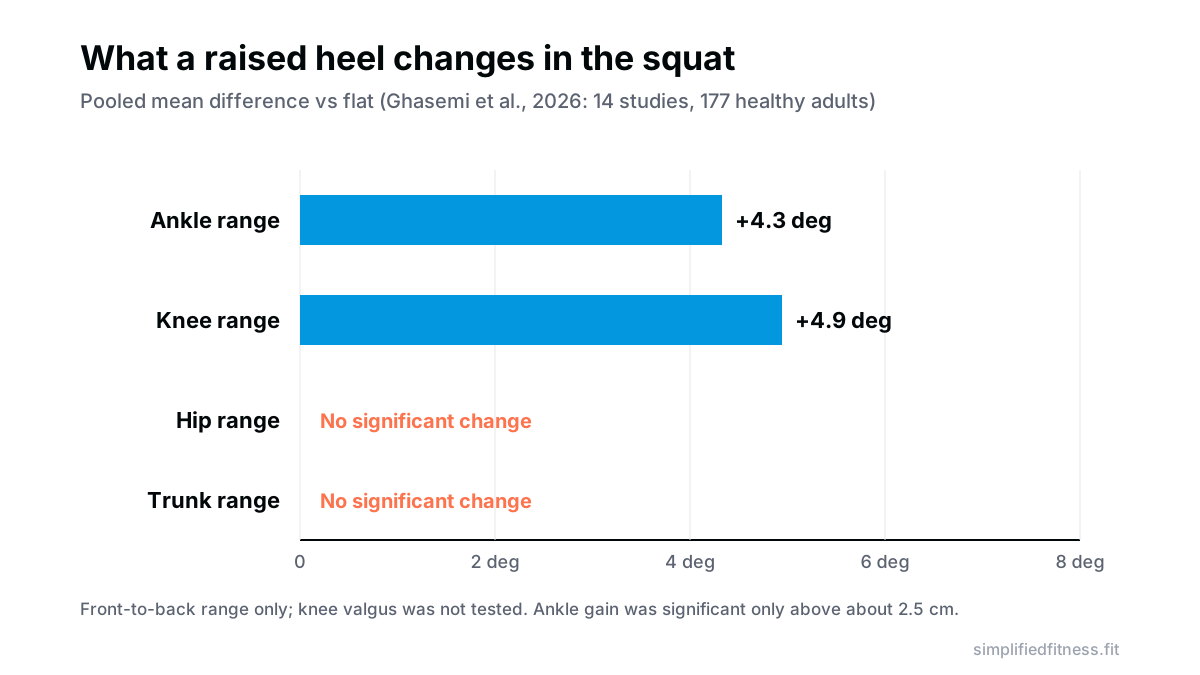
That is a sagittal-plane result (front-to-back bending). It says nothing directly about knees caving inward, so be careful about claiming shoes fix valgus.
Two other findings are worth knowing:
- In 14 recreational lifters squatting at 80% of 1RM, barefoot flat, barefoot on a raised platform and lifting shoes produced no significant differences in knee extensor and spinal muscle activation or in trunk angles. The authors concluded heel-raised shoes are unlikely to protect the back in this group (Lee et al., 2019).
- In 20 lifters (10 novice, 10 regular), raising the heels left most symmetry measures largely unchanged, with one exception: lower knee extension moment asymmetry, in novices only (Sayers et al., 2020).
| Option | What it likely does | What it does not show |
|---|---|---|
| Flat, firm shoes or barefoot | Stable base, good floor feel | No proven valgus fix |
| Lifting shoes (raised heel) | More ankle and knee range, firm sole | Little evidence of back or knee protection |
| Heel wedge or plates | Cheap way to test heel height | Can mask an ankle that needs work |
| Arch insoles or orthotics | May feel supportive | Weak evidence in adult flatfoot |
If you squat shallow because your ankles run out of range, lifting shoes may be worth trying. If your depth is fine, they are optional. On a budget, a small plate or wedge under each heel is not a substitute for a good shoe, but it can show you quickly whether ankle range is your limiter. In the review above, the ankle gain was clear only with lifts above about 2.5 cm. For how bar position changes the demand, see high bar vs low bar squat biomechanics.
Do orthotics and arch supports fix it?
Probably not on their own. A systematic review of 12 studies on foot orthoses for adult flatfoot found most were low quality with small samples (8 to 80), and concluded that evidence for orthoses is lacking (Herchenröder et al., 2021). That is a gap in the evidence, not proof they never help.
If an insole makes your foot comfortable, using it is a low-risk experiment. If you have persistent arch or heel pain, a podiatrist can assess your foot properly.
Is it your hips? The abductor strength question
The standard gym advice is “strengthen your glute medius.” Fair enough, but the evidence for it as a valgus fix is weaker than the advice suggests.
A 2026 systematic review of healthy people found that of the correlation studies for hip abductors, 12 papers found no significant correlation, 2 supported a link and 2 found evidence contrary. None of the partial meta-analyses reached significance, and the authors concluded that weakness may not result in increased dynamic knee valgus in healthy people (Cashman et al., 2026).
On the training side, a 5-week trial in 29 asymptomatic volunteers with increased valgus compared isolated hip abductor strengthening with a functional motor control programme. Hip abductor strength rose 27% and 35% respectively, but valgus and internal rotation changes were not statistically significant, even though the authors saw a trend toward clinically meaningful improvements (Palmer et al., 2015).
So what to do? Train the hips because strong glutes are useful anyway, and treat any valgus improvement as a bonus. Our guide to glute medius and minimus abduction work has the exercises.
A practical order to try things
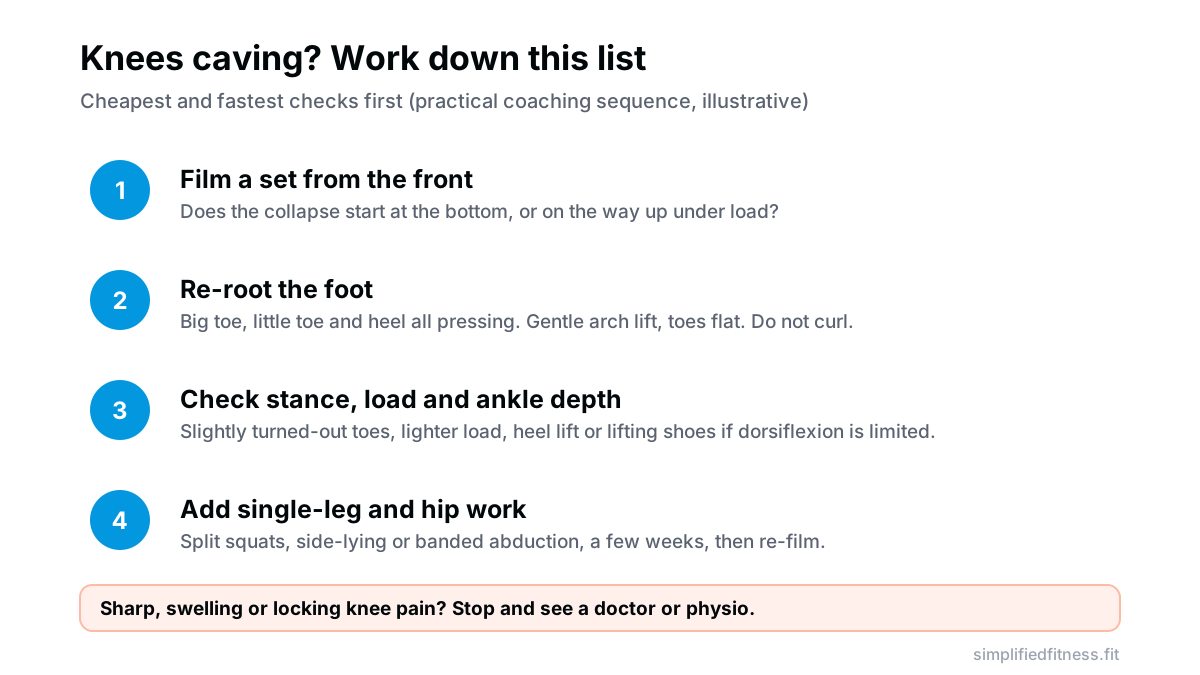
- Film from the front. A phone at hip height is enough. Compare rep 1 with the last rep.
- Re-root the foot. Tripod cue, toes flat, a gentle arch lift.
- Lower the load a notch. If valgus appears only above a certain weight, that is useful information.
- Test the ankle. If heel lift makes the squat feel immediately better, ankle range is part of it. Our guide to tibialis anterior training and knee health covers a related lower-leg lever.
- Add single-leg work. Split squats and step-ups load each leg separately. Programme them on your leg day plan.
- Re-film after 4-6 weeks.
The most common mistake here is changing four things at once, so you never learn which one helped. Change one, test it for a couple of weeks, then add the next.
When to see a doctor or physio
Squats are not automatically bad for knees, and our deep dive on whether squats are bad for your knees covers that. But some signs need assessment:
- Sharp pain, especially at the front or inside of the knee
- Swelling, locking, catching or the knee giving way
- Arch or heel pain that persists for weeks
- Pain that gets worse with each session
If any of those apply, get it looked at. Meanwhile, our guide to exercise modifications for knee pain covers lower-stress options. This article is education, not a diagnosis.
Frequently Asked Questions
Do flat feet cause knees to cave in when squatting?
Not always. In 30 healthy adults, greater midfoot width mobility and lower ankle dorsiflexion were associated with a larger knee valgus angle in a single-leg squat, but that is an association, not proof of cause. A second study found the foot and knee relationship inconsistent, so check ankle range, hip control and load too.
What is knee valgus in a squat?
Knee valgus means your knee drifts toward the midline of the body instead of tracking over your toes. Researchers measure it with the frontal plane projection angle from video during squats. A little drift is common, and what matters more is whether it is getting worse under load or comes with pain.
Is knee valgus always bad?
No. Dynamic valgus is observed more often in people with knee problems like patellofemoral pain, but seeing it in your squat does not mean you will be injured. Treat it as a flag to investigate, and only worry if it comes with pain or keeps worsening as you fatigue.
How do I fix my knees caving in on squats with flat feet?
Work through the cheap fixes first: film yourself, press evenly through big toe, little toe and heel, lower the load, and check your ankle range. Then add single-leg work and hip strengthening for a few weeks and re-film. If the collapse is painful or persistent, see a physio.
What is the short foot exercise?
It is a small movement where you shorten the foot by drawing the ball of the foot toward the heel, lifting the arch without curling your toes. Meta-analyses in flatfoot groups report modest improvements in arch measures. Practise it seated or standing for a few minutes, then carry the same feeling into your squat setup.
Does short foot exercise cure flat feet?
It does not cure flat feet, and results vary between studies. One meta-analysis found no overall significant benefit and a significant navicular drop improvement only when training ran longer than 6 weeks, while another found small but significant improvements versus comparison groups. Think of it as practice for foot control, not a structural fix.
Are weightlifting shoes good for flat feet?
They may help some lifters squat deeper by giving extra ankle range, but there is no strong evidence they correct valgus. A rigid raised heel changes ankle and knee angles, and a firm sole gives a stable base. Try them if limited ankle mobility is your issue, and keep the arch work separate.
Do weightlifting shoes protect your back or knees?
The evidence is thin. A small study of 14 recreational lifters found that raised heels did not significantly change trunk angles or muscle activation at 80% of 1RM, and the authors concluded the shoes are unlikely to give meaningful back protection. Buy them for comfort and depth, not injury insurance.
Should I squat barefoot or in flat shoes?
Either can work. A flat, firm sole gives a stable base and lets you feel the floor, and the same small lab study found no significant knee or trunk kinematic differences between barefoot flat, raised platform and lifting shoes. Choose what lets you keep the foot rooted and the knee tracking well.
Do arch supports or orthotics fix knee valgus?
Evidence is weak. A 2021 systematic review of orthoses for adult flatfoot found low methodological quality and a lack of evidence for their effect. If an insole feels comfortable, it is a low-risk experiment, but it is not a proven fix for caving knees.
Will strengthening my glute medius stop my knees caving?
Sometimes it helps, but the research is mixed. A 2015 trial in 29 asymptomatic people saw hip abductor strength rise 27-35% but no significant change in valgus, though there was a trend toward improvement. A 2026 review also found mostly no significant link between hip strength and valgus in healthy people.
Can I keep squatting if I have arch or knee pain?
Mild, short-lived discomfort that settles quickly is common, and you can often adjust load, depth or stance. Pain that is sharp, swelling, locking or giving way needs assessment first. Reduce the load, try a box squat or leg press, and see a doctor or physio if it persists.
How do I know if my knees cave in on squats?
Film a set from the front at hip height, at both light and working weights. Look for the knee moving inward past the big toe on the way up. Compare your last rep with your first, because fatigue often makes it worse.
Sources & References
Every claim above is checked against peer-reviewed research (PubMed, U.S. National Library of Medicine) or guidance from established health bodies. How we fact-check.
- Wyndow N, et al. The relationship of foot and ankle mobility to the frontal plane projection angle in asymptomatic adults. J Foot Ankle Res. 2016. PMID: 26816531
- Wyndow N, et al. Foot and ankle characteristics and dynamic knee valgus in individuals with patellofemoral osteoarthritis. J Foot Ankle Res. 2018. PMID: 30559838
- Cashman G, et al. The effect of hip abductor or external rotator strength on dynamic knee valgus in healthy subjects: a systematic review with partial meta-analysis. Knee. 2026. PMID: 42476040
- Palmer K, et al. A randomised trial into the effect of an isolated hip abductor strengthening programme and a functional motor control programme on knee kinematics and hip muscle strength. BMC Musculoskelet Disord. 2015. PMID: 25935843
- Huang C, et al. Effects of the short-foot exercise on foot alignment and muscle hypertrophy in flatfoot individuals: a meta-analysis. Int J Environ Res Public Health. 2022. PMID: 36231295
- Cheng J, et al. Effects of short foot training on foot posture in patients with flatfeet: a systematic review and meta-analysis. J Back Musculoskelet Rehabil. 2024. PMID: 38517769
- Ghasemi M, et al. Heel elevation increases ankle and knee range of motion during squatting in healthy adults: a systematic review with meta-analysis. Sports Biomech. 2026. PMID: 41612762
- Lee SP, et al. Heel-raised foot posture does not affect trunk and lower extremity biomechanics during a barbell back squat in recreational weight lifters. J Strength Cond Res. 2019. PMID: 30789547
- Sayers MGL, et al. The effect of increasing heel height on lower limb symmetry during the back squat in trained and novice lifters. BMC Sports Sci Med Rehabil. 2020. PMID: 32728445
- Herchenroder M, et al. Evidence for foot orthoses for adults with flatfoot: a systematic review. J Foot Ankle Res. 2021. PMID: 34844639

Umair Hazrami · Founder & Head Coach, Simplified Fitness
Umair Hazrami founded Simplified Fitness and the Simplified Lifter channel to cut through fitness noise. With 4+ years of consistent training and 10+ coaching clients, he writes every guide from the peer-reviewed research and links the sources so you can check them. Our editorial standards.
Educational content only, not medical advice. If you have a medical condition, are pregnant, or take medication, talk to a qualified doctor before changing your diet, supplements or training. Full disclaimer.
Keep reading
Exercise Technique
Adductor Magnus Training: Seated Adductor Machine and Copenhagen Planks for Thigh Mass
Adductor magnus training explained: what research says on deep squats, the adductor machine and Copenhagen planks for thicker inner thighs and groin strength.
7 min read
Exercise Technique
High Bar vs Low Bar Squat: Which Builds More Quad Muscle?
High bar vs low bar squat for hypertrophy: what torso lean, knee travel and EMG studies show, why high-bar leans quad, and when low-bar still makes sense.
8 min read
Exercise Technique
Calf Hypertrophy Science: Standing vs Seated Calf Raises (Gastrocnemius vs Soleus)
Calf hypertrophy explained: why calves seem stubborn, what the trials say on exercise choice, stretch and foot position, plus weekly sets, reps and frequency.
9 min read
Exercise Technique
Complete Leg Workout Programming: Quad Day vs Hamstring and Glute Day
Best leg workout routine science: split leg day into a quad session and a hamstring-glute session, with sets, order and a 5-week plan that avoids burnout.
9 min read