Hack Squats for Quad Growth: Foot Position, Ankle Mobility and Fatigue Cost
Hack squat quad hypertrophy explained: why the pad lowers fatigue cost, how foot position and ankle mobility change the lift, and what research does not show.
TL;DR. The short answer
- The hack squat is a strong quad builder mainly because the back pad and fixed track remove balance and trunk demands, so your quads are the limiting factor. No trial has directly compared hack squat and barbell squat for muscle growth, so this is a mechanical argument, not a proven superiority.
- In a 10-man study, hack squat 1RM was higher than back squat 1RM, while trunk muscle activation was lower. Less trunk work suggests the legs may take a bigger share of the effort, though the study did not measure quad activity.
- Full range of motion looks better than partial range for lower-body growth in a systematic review of six studies, so depth you can control is worth chasing.
- Limited ankle dorsiflexion is the usual reason people cannot get deep. A small heel lift increased ankle and knee range in a 14-study meta-analysis, but it was tested in free-weight squats, not on hack machines.
- A 2023 meta-analysis found no evidence that training to momentary failure builds more muscle than stopping short, so leaving a rep or two in reserve is reasonable, and it is easier to repeat on a machine with a heavy track.
Part of our complete guide: Complete Lower-Body & Core Training Guide: Quads, Glutes, Hamstrings, Calves & Abs Science
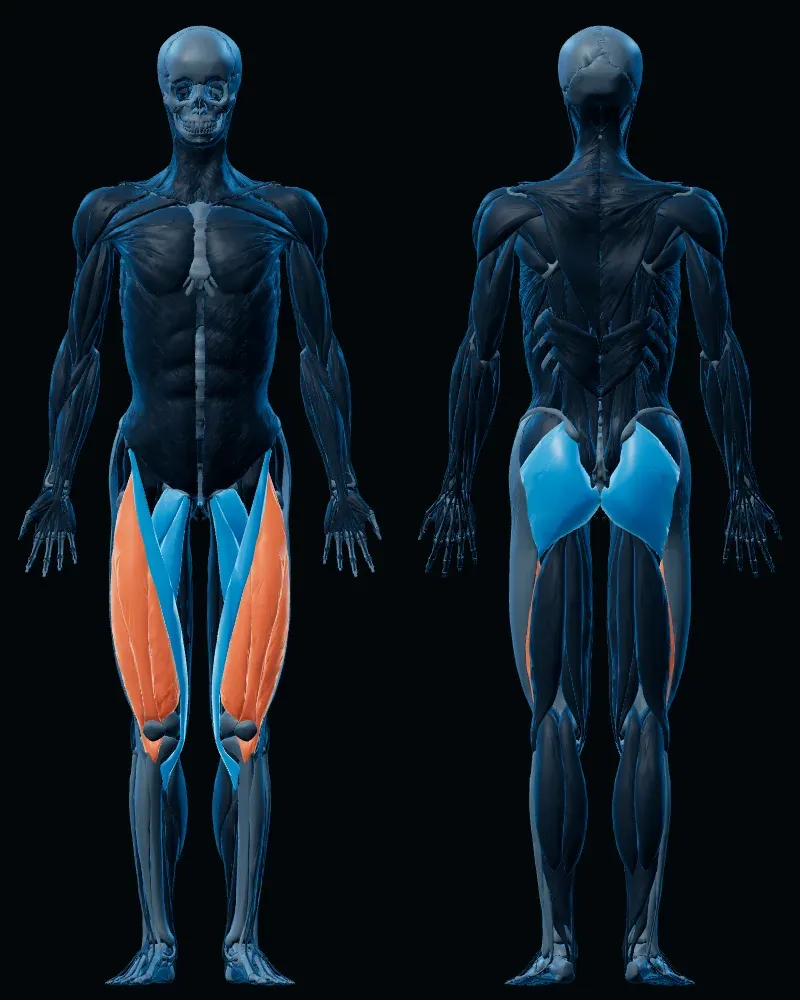
Muscles worked: quads
Main movers: rectus femoris and the three vasti
Assisting: adductors, sartorius and glutes
Table of contents
Hack squat quad hypertrophy comes down to one thing: the machine lets your quads be the weak link. The back pad and fixed track take most of the balance and bracing job off you, so a set is more likely to end because your legs are tired, not because your lower back or balance gave out first. That is a useful trait in a quad exercise, and it is why so many bodybuilders keep one in their leg day.
Let’s be straight about the evidence up front. Nobody has run a long training trial of hack squat against barbell squat for muscle size. What we have is mechanics, some related research on range of motion and failure, and common coaching practice. This article uses all three, labels which is which, and shows you how to set the machine up. It sits inside our complete lower body and core training guide.
What is the hack squat actually doing differently?
Picture a barbell back squat. The bar sits on your upper back, you balance it, brace your trunk, and keep your whole body stacked over your feet. If you get tired or wobbly anywhere in that chain, the set ends. Often the quads are not the first thing to quit.
Now the hack squat. Your back and shoulders are pinned to an angled pad, your feet are on a platform, and the sled moves on a fixed track at roughly 45 degrees on many machines (angles vary between brands). You cannot fall forward. You cannot lose the bar path.
This idea is often described as a good stimulus-to-fatigue ratio: a lot of quad work for a modest amount of whole-body cost. We unpack that concept in our guide to stimulus-to-fatigue ratio and exercise selection. Here it is enough to say the hack squat is often used as the textbook example, on mechanical grounds rather than trial data.
Does the hack squat reduce trunk and back demand?
There is one study that speaks to this directly. Researchers compared back squat and hack squat in 10 males at four relative loads (65, 75, 85 and 95% of maximal system mass). Hack squat 1RM and submaximal loads were higher than the equivalent back squat loads, but trunk muscle activation was higher in the back squat for all muscles and phases except the rectus abdominis in the concentric phase (Clark et al., 2019). The authors concluded the back squat is better for trunk strength and stability.
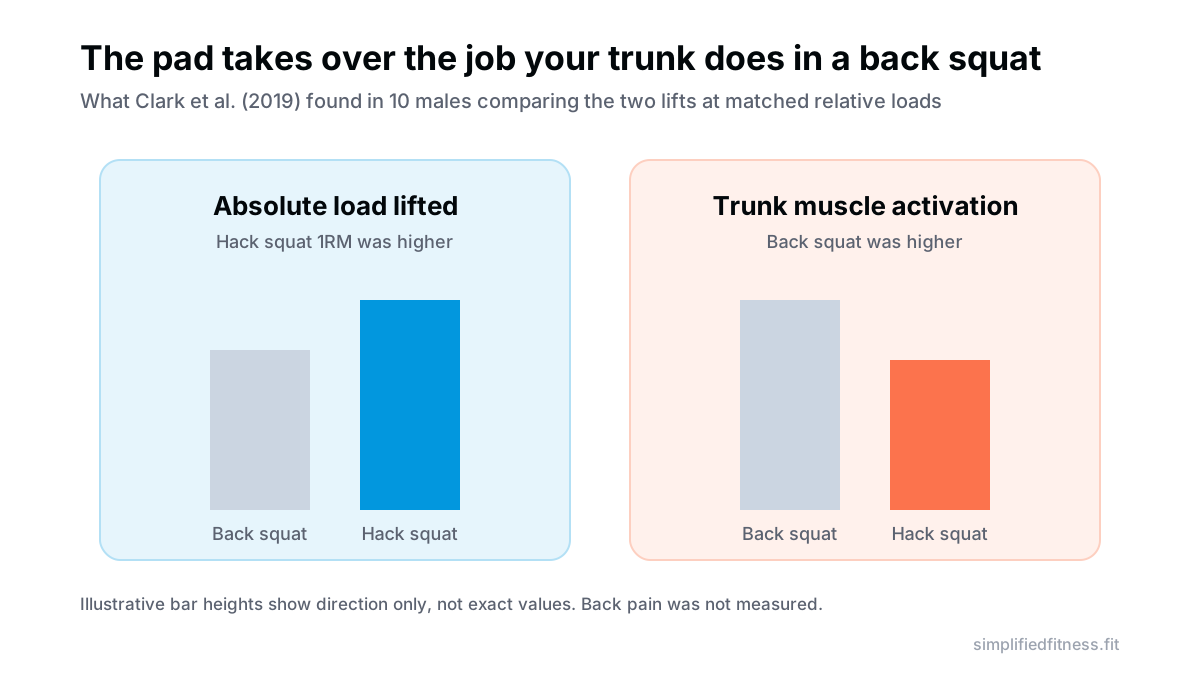
Read that carefully. It is 10 men, one lab, and it measured muscle activity, not injuries or back pain. It fits the idea that the pad shifts effort to the legs. It does not prove the hack squat is easier on a sore back.
If your back hurts under load, the right move is to get it checked, not to switch machines and hope.
Does the hack squat build more quad than a barbell squat?
Honestly, we do not know. The 2020 systematic review of range of motion found that full range of motion looked beneficial for lower-body hypertrophy compared with partial range, across six studies and 135 participants (mostly men) (Schoenfeld & Grgic, 2020). That supports going deep, not any particular machine.
There is a wrinkle. In a 10-week study of 17 males, full squats and half squats increased knee extensor volume by similar amounts (4.9% and 4.6%), while the glutes and adductors grew more with full squats (Kubo et al., 2019). So depth may matter more for your hips than for your quads, at least over that short window with that small sample.
Why might the two findings differ? The studies used different designs, different muscles and small groups. A practical read: depth you can control is worth chasing, but do not assume you must grind to the bottom to grow quads.
A knee-extension trial in 50 untrained women is also relevant. Training the stretched part of the range (100-65 degrees of knee flexion), full range, or a varied range produced the greatest quad growth, with the shortened-only range doing worse (Pedrosa et al., 2025). That is a different exercise and an untrained group, so apply it loosely. It fits the idea that the bottom of the rep matters. Our article on range of motion and stretch-mediated hypertrophy goes further.
Where should your feet go?
There is no trial that compared hack squat foot positions for growth, so this is coaching logic. The mechanics are simple.
- Feet lower on the platform: the knees travel further forward, which usually means more knee bend and more quad demand, and more stress at the front of the knee.
- Feet higher on the platform: the hips do more of the work, which tends to move the effort toward glutes and hamstrings.
- Narrower stance: more knee-dominant for most people.
- Wider stance with toes out: often feels better for people with tight hips or ankles, and brings in the inner thighs.
A reasonable starting point is shoulder width, feet mid platform, toes pointed out 10-20 degrees. Then adjust. Keep whichever position lets your heels stay flat and your knees track in line with your toes.
Our article on foot placement for squats and the leg press covers stance in more depth.
Ankle dorsiflexion: the quiet limiter
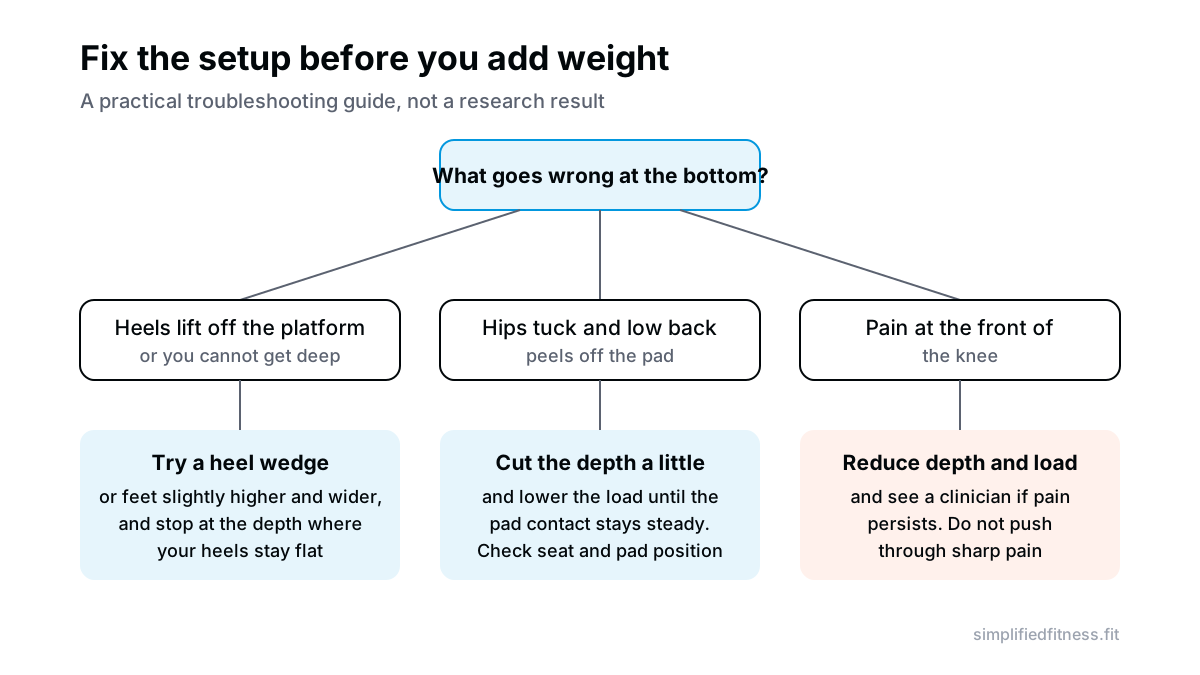
To get deep on a hack squat, your knees have to travel forward and your shins have to tilt. That needs ankle dorsiflexion, the ability of the shin to move forward over the foot. If your ankle runs out first, you get one of three things: heels lifting, a shallow rep, or hips tucking under at the bottom.
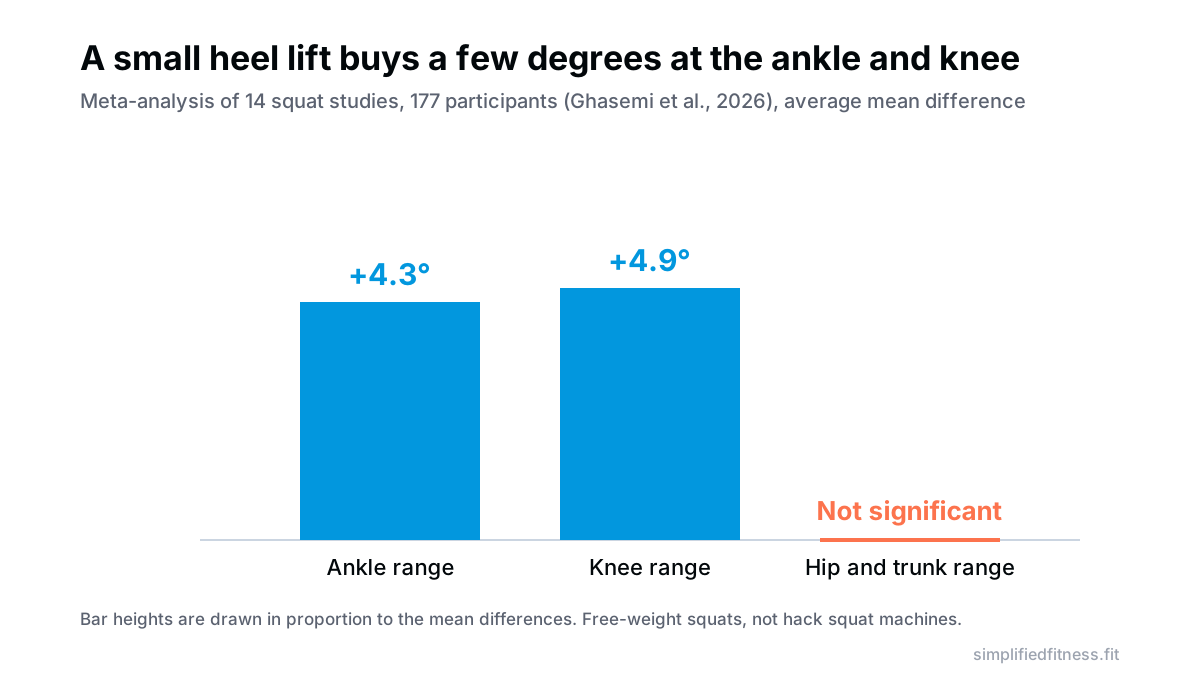
Heel elevation is the usual fix. A 2026 meta-analysis pooled 14 studies (177 participants) and found that heel elevation increased ankle range by about 4.3 degrees and knee range by about 4.9 degrees, with no significant effect on hip or trunk range (Ghasemi et al., 2026). Ankle range only rose significantly at higher lifts (over about 2.5 cm).
A second 2026 study put 30 men with restricted dorsiflexion through loaded squats at 0 to 5 cm of heel lift, using motion capture and finite element modelling. More heel lift reduced trunk forward lean and modelled stress in the lower lumbar segments, but it also increased the knee extension moment, so excessive elevation may raise knee demand (Cai et al., 2026).
Both studies used free-weight squats, not hack squat machines. The mechanical logic should carry over, but the numbers will not. In the meta-analysis, the ankle gains showed up mainly with lifts above about 2.5 cm, while the knee gained range with both low and high lifts. So start with a small wedge, around 1-2 cm, if your heels lift, and only go higher if you need to. More is not automatically better.
What about knees going past toes?
The old rule that knees must never cross the toes is not supported as a universal rule, but it is not nonsense either. In a lab model of 25 healthy women, squatting with knees allowed past the toes produced higher patellofemoral joint stress and quadriceps force than keeping them behind (Kernozek et al., 2018). The authors suggested minimizing forward knee travel for people with patellofemoral pain.
Healthy knees adapt to loads. Painful knees do not always. If the front of your knee hurts, reduce depth and load and see a clinician if it persists. If you want to train the quads deeply with a controlled pain-free range, a leg extension can be a useful companion.
How to do the hack squat, step by step
- Set the machine. Adjust the shoulder pads so you are snug when your knees are straight. Put your feet shoulder width, mid platform.
- Unrack and brace. Take the weight, keep your back and head on the pad, and set your hips against the back pad.
- Lower slowly. Take about 2-3 seconds down. Let your knees move forward over your toes in line with them.
- Pause briefly at the bottom. No bouncing. Keep your heels down.
- Drive up. Push through the whole foot, and keep your lower back in contact with the pad.
- Stop just short of lockout if you want constant tension on the quads, or lock out for a breath if you need it.
A good depth is the lowest point where your heels stay planted and your hips do not tuck. For some that is 90 degrees at the knee. For others it is deeper. Your range will improve with practice.
Can you safely take hack squats to failure?
Failure is the part people argue about. A 2023 meta-analysis of 15 studies found no evidence that training to momentary muscular failure is superior to stopping short of it for hypertrophy, although studies using any definition of set failure showed a trivial advantage (effect size 0.19) (Refalo et al., 2023). In plain terms, stopping 1-2 reps before failure is likely enough for most sets.
The machine does make failure safer than a free barbell squat. The pad and track let you reach a hard set without worrying about being pinned. Still, the fatigue cost is real, and your form is the first thing to degrade. We cover this in more detail in training to failure vs RIR, and you can estimate loads with our RIR and RPE calculator.
A simple approach:
- Most sets: stop with 1-2 reps in reserve.
- Last set only: push close to failure, with the same depth and pad contact as your first rep.
- If depth or pad contact breaks down, the set is over. Do not chase a rep.
Always set the safety stops on the machine to a height you can reach.
Hack squat vs barbell squat vs leg press
| Feature | Hack squat | Barbell back squat | Leg press |
|---|---|---|---|
| Back support | Pad on back | None | Pad on back and hips |
| Balance demand | Low | High | Low |
| Trunk activation | Lower (Clark et al., 2019) | Higher | Likely low (not measured here) |
| Foot position | Adjustable | Adjustable | Very adjustable |
| Best for | Heavy quad volume | Whole-body strength | Heavy, high-volume leg work |
None of these has been shown to be the best quad builder. A sensible leg day uses a mix. See our breakdown of high bar vs low bar squats for the barbell side, and leg press foot placement for the other machine.
Where hack squats fit in your week
Many lifters put the hack squat first or second on leg day, after a heavy compound lift or in its place. A simple split looks like this, as a coaching example rather than a studied program:
- Hack squat: 3 sets of 6-10 reps, 1-2 reps in reserve.
- Leg extension: 2-3 sets of 10-15 reps.
- Romanian deadlift or leg curl: 2-3 sets.
- Calves: 3 sets.
If you only have access to a basic gym, swap in a leg press. Our leg day plan shows how we sequence it, and the complete leg workout programming guide explains how many weekly sets make sense.
Who should be careful with hack squats
If you have a history of knee surgery, ongoing knee pain, hip pain or back symptoms, speak with a doctor or physiotherapist before loading the hack squat hard. Sharp pain, numbness or tingling down a leg, or pain that gets worse with each set are signs to stop and get assessed. This is general information, not a diagnosis.
Frequently Asked Questions
Is the hack squat good for quad hypertrophy?
It is a very good option, although no trial has proven it beats other quad exercises. The pad and fixed track let you train the quads hard without needing to balance or brace as much as in a free squat. Use it as a main quad movement alongside a leg press or leg extension, and judge it by how well you can control depth and push close to failure.
Why does the hack squat feel easier on the lower back than a barbell squat?
Your back rests on a pad and the load travels on a fixed track, so your trunk is not holding a bar over your spine. In a 2019 study of 10 males, trunk muscle activation was lower in the hack squat than in the back squat at matched relative loads. Back pain itself was not measured, so if you have ongoing back symptoms, see a clinician rather than assuming any machine is safe.
Is the hack squat better than the barbell squat?
Neither is proven better for quad growth, because they have not been compared head to head in a training trial. The hack squat lets you load the legs with less trunk involvement, while the back squat trains the trunk and lets you load more of the whole body. Many lifters do one as the main lift and the other as a secondary lift, depending on what limits them.
Where should I place my feet on a hack squat?
A moderate stance, roughly shoulder width, mid platform, with toes slightly out is a sensible starting point. Lower and narrower foot positions tend to push the knees further forward, while higher and wider positions shift effort toward the hips. Try two or three positions across a few sessions and keep the one where your heels stay flat and your quads feel the work.
Do I need a heel wedge for hack squats?
You do not need one if your heels stay flat at your chosen depth. A 2026 meta-analysis found heel elevation increased ankle and knee range of motion in squats, so a wedge can help if tight ankles stop you short, though that data came from free-weight squats. Start with a thin lift and see whether depth and comfort improve.
Is it bad for knees to go over toes in a hack squat?
Not inherently, but it does load the knee joint more. In a 2018 lab model of 25 healthy women, allowing the knees past the toes in a squat increased patellofemoral joint stress compared with keeping them behind. If your knees complain, reduce depth or load, and see a clinician if pain persists.
How deep should I go on the hack squat?
Go as deep as you can while keeping your heels down and your lower back in contact with the pad. A systematic review found full range of motion beat partial range for lower-body muscle growth. Increase depth gradually over weeks rather than forcing it in one session.
How many reps and sets should I do on the hack squat?
A common approach is 2-4 hard sets in the 6-15 rep range, stopping 1-2 reps before failure on most sets. That range is a coaching convention rather than a result from a hack squat trial. Add reps first, then weight, and use your weekly leg volume as the guide for how many sets fit in.
Should I take hack squats to failure?
It is optional, and most of the evidence suggests it is not required. A 2023 meta-analysis found no evidence that training to momentary failure beats stopping short of it for hypertrophy. On a machine with a safe stopping point, an occasional last set to failure is reasonable, as long as the pad contact and depth stay controlled.
Can I do hack squats if I have no hack squat machine?
Yes, you can use a leg press, a Smith machine squat with feet forward, or a goblet or front squat. These change the angle and the stability demand, so the feel will not be identical. Pick the one where you can reach good depth and push close to failure safely.
Hack squat vs leg press for quads?
Both are supported, machine-based quad builders, and neither has been shown to win. The hack squat track is steeper, so your torso stays more upright against the pad, while the leg press lets you change foot height and hip position more freely. Rotate them across training blocks or use one as your main lift and the other as a back-off lift.
Why do my heels lift in the hack squat?
Usually your ankle cannot bend far enough at that depth, or your feet are too low on the platform. Heel lift shifts load to the front of the foot and tends to stress the knees. Raise your feet slightly, use a small wedge, or stop where your heels stay planted.
Is the hack squat safe for beginners?
It is generally easier to learn than a barbell squat because the track controls the path. Start with a light load, a depth you can control, and a clear stopping point. If you have knee, hip or back pain, check with a doctor or physio before loading it.
Sources & References
Every claim above is checked against peer-reviewed research (PubMed, U.S. National Library of Medicine) or guidance from established health bodies. How we fact-check.
- Clark DR, et al. Trunk Muscle Activation in the Back and Hack Squat at the Same Relative Loads. J Strength Cond Res. 2019. PMID: 28704312
- Schoenfeld BJ, et al. Effects of range of motion on muscle development during resistance training interventions: A systematic review. SAGE Open Med. 2020. PMID: 32030125
- Kubo K, et al. Effects of squat training with different depths on lower limb muscle volumes. Eur J Appl Physiol. 2019. PMID: 31230110
- Pedrosa GF, et al. From full to partials: Investigating the impact of range of motion training on maximum isometric action, and muscle hypertrophy in young women. J Sports Sci. 2025. PMID: 40366729
- Ghasemi M, et al. Heel elevation increases ankle and knee range of motion during squatting in healthy adults: a systematic review with meta-analysis. Sports Biomech. 2026. PMID: 41612762
- Cai J, et al. Dose-Dependent Effects of Heel Elevation on Kinetic Chain Reconstruction and Lumbar Stress During Loaded Squatting in Men With Restricted Ankle Dorsiflexion. J Strength Cond Res. 2026. PMID: 42551866
- Kernozek TW, et al. Effects of Anterior Knee Displacement During Squatting on Patellofemoral Joint Stress. J Sport Rehabil. 2018. PMID: 28422563
- Refalo MC, et al. Influence of Resistance Training Proximity-to-Failure on Skeletal Muscle Hypertrophy: A Systematic Review with Meta-analysis. Sports Med. 2023. PMID: 36334240

Umair Hazrami · Founder & Head Coach, Simplified Fitness
Umair Hazrami founded Simplified Fitness and the Simplified Lifter channel to cut through fitness noise. With 4+ years of consistent training and 10+ coaching clients, he writes every guide from the peer-reviewed research and links the sources so you can check them. Our editorial standards.
Educational content only, not medical advice. If you have a medical condition, are pregnant, or take medication, talk to a qualified doctor before changing your diet, supplements or training. Full disclaimer.
Keep reading

Exercise Technique
Adductor Magnus Training: Seated Adductor Machine and Copenhagen Planks for Thigh Mass
Adductor magnus training explained: what research says on deep squats, the adductor machine and Copenhagen planks for thicker inner thighs and groin strength.
7 min read
Exercise Technique
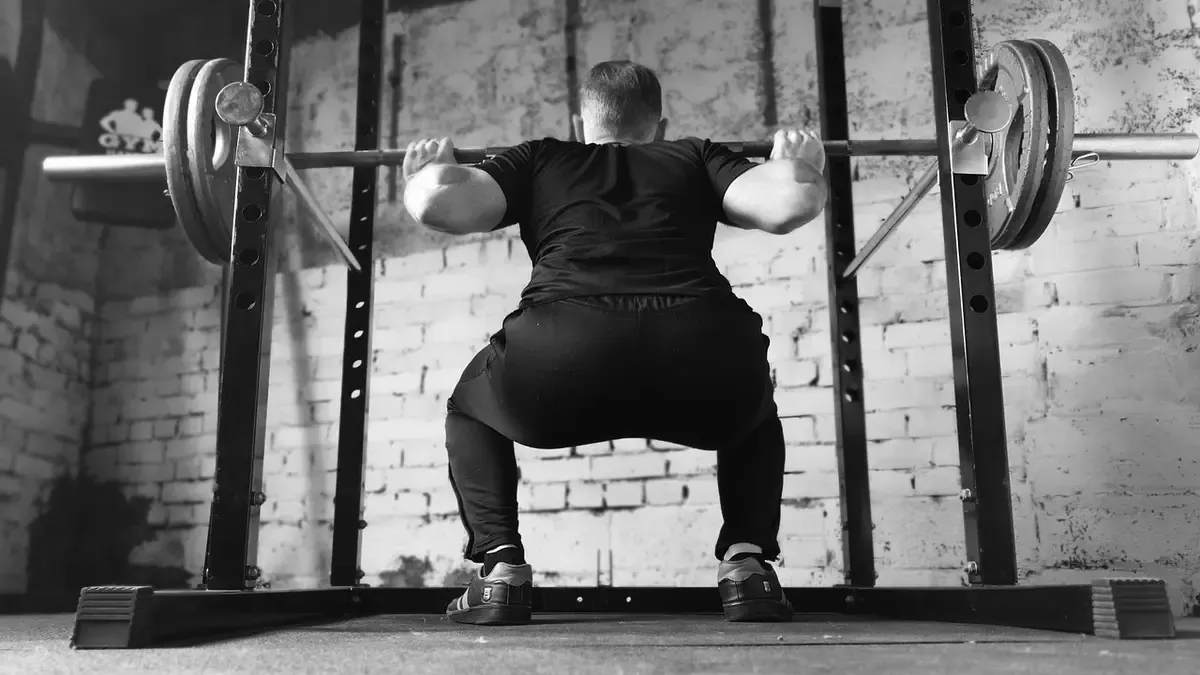
High Bar vs Low Bar Squat: Which Builds More Quad Muscle?
High bar vs low bar squat for hypertrophy: what torso lean, knee travel and EMG studies show, why high-bar leans quad, and when low-bar still makes sense.
8 min read
Exercise Technique
Calf Hypertrophy Science: Standing vs Seated Calf Raises (Gastrocnemius vs Soleus)
Calf hypertrophy explained: why calves seem stubborn, what the trials say on exercise choice, stretch and foot position, plus weekly sets, reps and frequency.
9 min read
Exercise Technique
Complete Leg Workout Programming: Quad Day vs Hamstring and Glute Day
Best leg workout routine science: split leg day into a quad session and a hamstring-glute session, with sets, order and a 5-week plan that avoids burnout.
9 min read