Sissy Squats and Reverse Nordic Curls: High-Tension Lengthened Quad Training
Sissy squat vs reverse nordic: how each one loads the quads at long length, what the research says, how to progress safely, and where they fit in a leg day.
TL;DR. The short answer
- Sissy squats and reverse Nordic curls both load the quads with the knee deeply bent, but neither has direct hypertrophy trials. The case for them rests on long-muscle-length research with other quad exercises.
- A 2024 EMG study found the reverse Nordic curl did not produce more eccentric quad activation than bodyweight single-leg squats, lunges or Bulgarian squats. It is a different option, not a superior one.
- Start with a short range, hold a rail or band, and lower slowly. Add depth and reps before you add any load.
- Mild stretch and muscle burn in the front of the thigh is expected. Sharp pain at the kneecap or just below it is a signal to regress or stop.
- Use either move as a finisher after your main quad work, 2-3 sets, once or twice a week.
Part of our complete guide: Complete Lower-Body & Core Training Guide: Quads, Glutes, Hamstrings, Calves & Abs Science
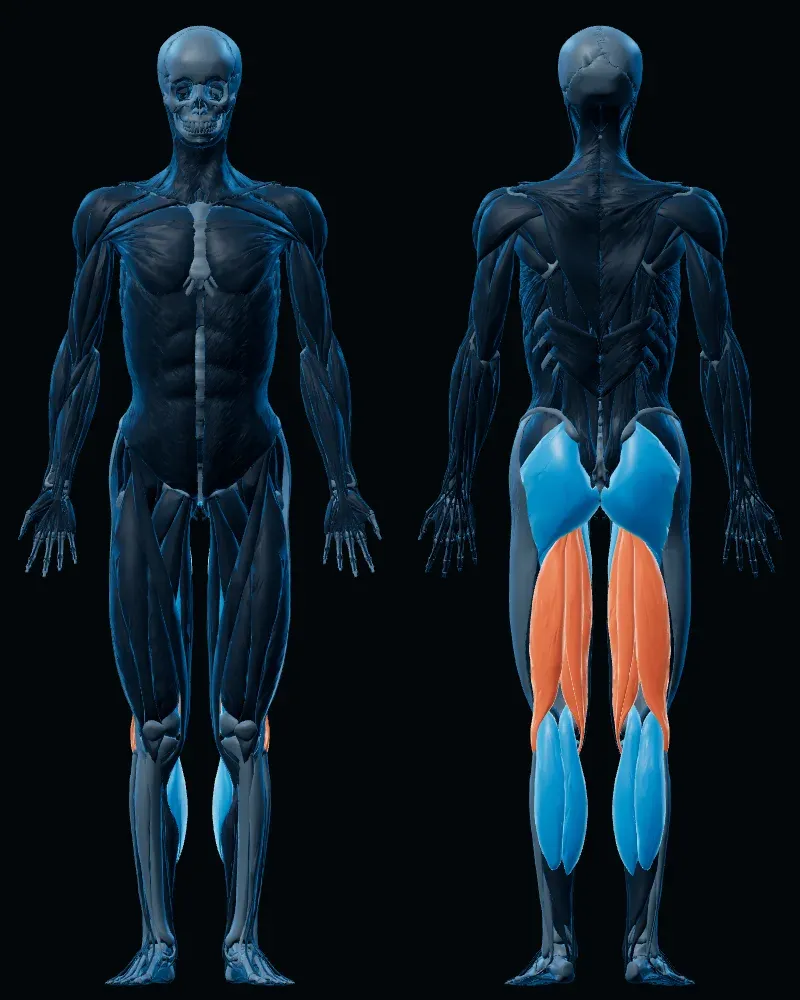
Muscles worked: hamstrings
Main movers: biceps femoris, semitendinosus and semimembranosus
Assisting: glutes, calves and adductor magnus
Table of contents
Sissy squat vs reverse Nordic: both are bodyweight moves that bend the knee deeply while the hip stays open, which puts the rectus femoris (the quad muscle that crosses the hip) at a long length. Neither has been tested head to head for muscle growth, so the honest answer is that they are two different ways to get a similar stimulus. One study even found the reverse Nordic is not more demanding than ordinary single-leg squats.
This guide sits inside our complete lower-body and core training guide. Here we look at what each exercise does, what the evidence supports, how to build up to them, and how to protect your knees.
What do sissy squats and reverse Nordic curls actually do?
The quadriceps has four heads. Three (the vasti) only cross the knee. The rectus femoris crosses the hip as well, so it is stretched most when the hip is extended and the knee is bent. For the anatomy, see our breakdown of the quadriceps heads.
Both exercises create exactly that position.
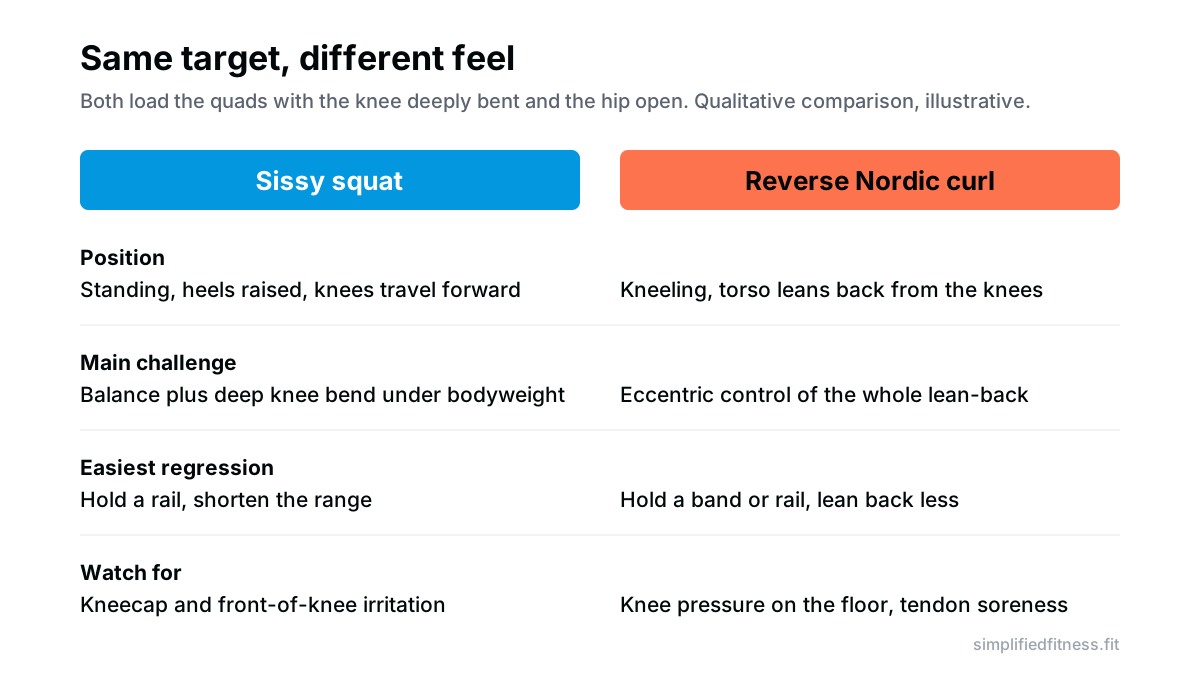
- Sissy squat: you stand, lift your heels and let your knees drift forward as your torso leans back. Your body forms a line from knees to shoulders.
- Reverse Nordic curl: you kneel and lean back from the knees with a straight body line, lowering as slowly as you can.
The load is your body weight acting at a long lever arm in front of the knee. That is why even a small lean is hard, and why a rail or band makes such a difference.
Is there evidence that they build bigger quads?
Not directly. I could not find a trial that trained either exercise and measured muscle growth, so anything below is indirect.
What we do have is research on training at long muscle lengths with other quad exercises. A systematic review of range of motion studies found that full range and partial range at the lengthened part of the movement produced more growth in the rectus femoris and vastus lateralis than partial range in the shortened part (Kassiano et al., 2023). The authors suggested that quads tend to grow best when trained at longer muscle lengths.
A separate randomized trial in 45 untrained women used the knee extension. Training only the lengthened part (100 to 65 degrees of knee flexion) produced greater growth in certain regions of the rectus femoris and vastus lateralis than other ranges (Pedrosa et al., 2022). Untrained women, one machine exercise, a few regions measured: useful, but it does not transfer neatly to a bodyweight kneeling lean.
An earlier systematic review concluded that full range training seems to favour lower-body hypertrophy compared with partial range, based on six studies (Schoenfeld and Grgic, 2020). If you want the wider concept, we cover it in long muscle length training.
Sissy squat vs reverse Nordic: does either win?
A 2024 cross-sectional study compared the reverse Nordic curl with single-leg squats, Bulgarian squats and forward lunges in 23 healthy volunteers. Eccentric rectus femoris and vastus medialis activation in the reverse Nordic was similar to the squat-based exercises, vastus lateralis activation was lower than the single-leg squat, and knee range of motion was smaller (Pereira et al., 2024).
That cuts against the idea that the reverse Nordic is a special “quad overload” exercise. The study was framed around preventing quad strain injuries, not hypertrophy, and it was a one-session EMG study, not a training trial. But it is a useful reality check.
So how do you choose?
| Sissy squat | Reverse Nordic curl | |
|---|---|---|
| Balance demand | High | Lower (you are kneeling) |
| Equipment | Rail or door frame | Pad, band or fixed object |
| Knee pressure | On the front of the knee | Kneecap pressure on the floor |
| Easiest regression | Hold rail, shorten range | Lean back less, hold support |
| Good for | Controlled bodyweight overload | Slow eccentric practice |
If balance or heel position makes the sissy squat feel awkward, the reverse Nordic is the easier one to learn. If kneeling bothers your kneecaps, go the other way.
Are sissy squats safe for your knees?
They are demanding, not automatically dangerous. The front of the knee takes a lot of load when the knees travel forward over the toes. In a lab model of 25 healthy young women, squatting with the knees going past the toes produced higher patellofemoral joint stress, reaction force and quadriceps force than squatting with the knees behind the toes (Kernozek et al., 2018). The authors suggest limiting forward knee travel for people with patellofemoral pain.
Two caveats. Those were ordinary squats, not sissy squats, and higher stress in a model does not mean injury in a healthy knee. Tendons and joints adapt to load if you build it gradually. The risk is jumping straight to a deep, fast, unsupported rep.
The patellar tendon is the other thing to respect. Patellar tendinopathy is a painful overload problem at the front of the knee, and the main treatment is progressive strengthening. A 2021 randomized trial of 76 patients found progressive tendon-loading exercise improved the VISA-P score more than eccentric-only therapy at 24 weeks (Breda et al., 2021). A 2025 Cochrane review of seven trials (211 athletes) was cautious, rating most of the evidence low or very low certainty (Lopes et al., 2025). Takeaway: gradual loading is the sound principle, but the tendon research is not strong, and none of it tested sissy squats.
How to progress sissy squats and reverse Nordic curls
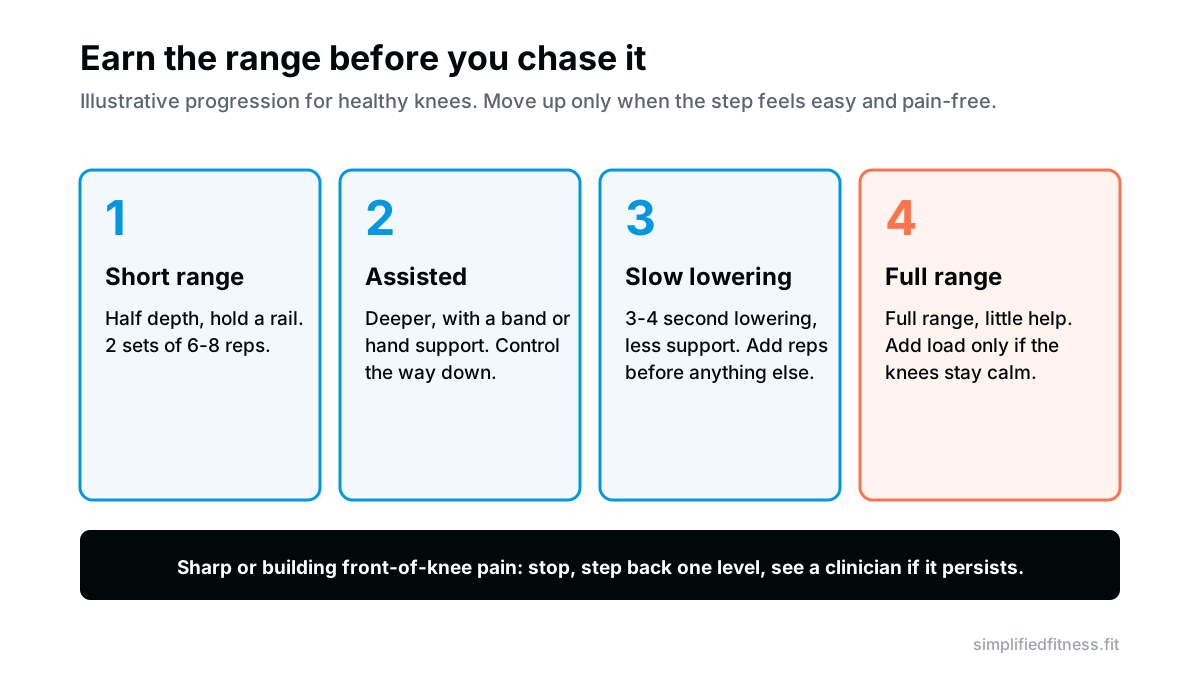
This is a coaching framework, not a research protocol.
- Short range with support. Half depth, hold a rail or door frame. Two sets of 6-8 slow reps.
- Assisted depth. Go deeper, keeping hand or band support. Control every lowering.
- Slow lowering, less help. Take 3-4 seconds down and reduce the assistance. Add reps before anything else.
- Full range. Only when step 3 is easy and pain-free. Add load, such as holding a plate, only if your knees stay calm.
Practical details that matter:
- Keep ribs down and glutes lightly squeezed so you lean as one line instead of folding at the waist.
- On a tiled floor, use a mat for grip and a pad for your knees.
- Warm up with a few light leg extensions or bodyweight squats first.
- Skip the move if you are in a flare of knee pain.
How to program them as a quad finisher
Use them after your main lifts, not before. Heavy squats and leg presses need your legs fresh, and these moves are better as a finisher.
- Frequency: 1-2 times per week.
- Volume: 2-3 sets of 6-12 slow reps.
- Effort: finish a rep or two before your form breaks.
- Placement: after squats or leg press, instead of one set of leg extensions.
Check your weekly leg volume with the training volume calculator, and find a base routine in our leg day plan. If you want a fuller template, see how to organise a complete leg workout.
For the hamstring counterpart of this idea, read our Nordic hamstring curl guide.
Setting these up at home
You do not need a gym for either move. A sturdy door frame, a balcony rail or a heavy wardrobe handle gives you the support for the sissy squat, and a folded yoga mat or a thick cushion works as a kneeling pad. On smooth tiles, check the floor grip first, because a sliding foot or knee at the deepest point is the real hazard.
If you train in a hot room, keep sets shorter and rest a little longer. Slow eccentric reps are tiring, and form is the first thing that slips when you are sweaty and fatigued. A band looped around a fixed anchor gives you adjustable help, so you can reduce the assistance week by week instead of guessing.
Who should skip these, and when to see a doctor
Skip or modify these if you have current kneecap pain, a recent knee injury or surgery, or swelling at the knee. Do not diagnose yourself from a blog post.
See a doctor or physiotherapist if:
- front-of-knee pain lasts more than a couple of weeks
- the knee swells, locks or gives way
- pain wakes you at night
- pain is sharp and is not settling with a lighter version
The bottom line
Sissy squats and reverse Nordic curls are legitimate, low-equipment ways to put the quads under tension at long length. The evidence for long-length training is encouraging, but the evidence for these two exercises specifically is thin, and the one EMG study we have does not make the reverse Nordic look special. Use them as finishers, build range slowly, and keep your knees happy. For the full picture of leg training, return to the complete lower-body guide.
Frequently Asked Questions
What is the difference between a sissy squat and a reverse Nordic curl?
A sissy squat is done standing with the knees travelling forward and the heels raised, while a reverse Nordic curl is done kneeling with the torso leaning back. Both bend the knee deeply with the hip open, which stretches the rectus femoris. Pick whichever feels more controllable for your balance and knees.
Which is better for quads, sissy squats or reverse Nordics?
There is no trial that compares them for muscle growth, so neither can be called better. A 2024 EMG study found reverse Nordic curls gave similar rectus femoris activation to bodyweight squat variations. Choose the one you can control through a full, pain-free range.
Do reverse Nordic curls work the rectus femoris?
Yes, the rectus femoris is active in them, with activation similar to single-leg squats, Bulgarian squats and lunges in one study of 23 healthy people. Because the rectus femoris crosses the hip and knee, an open hip with a bent knee puts it at a long length. That is a reasoned anatomical argument, not a proven growth advantage.
Are sissy squats bad for your knees?
They are not proven harmful, but they place a lot of demand on the front of the knee. Lab modelling shows forward knee travel in squats raises patellofemoral stress compared with keeping knees behind the toes, though that was in healthy young women and not sissy squats specifically. Build range gradually and stop if you get sharp kneecap pain.
Can sissy squats cause patellar tendonitis?
There is no good evidence that sissy squats on their own cause it. Patellar tendinopathy is generally seen as an overload problem, with lots of jumping and sudden spikes in training load the usual suspects. Increase depth and volume slowly rather than jumping straight to full range.
How do I make sissy squats easier?
Hold a rail or a door frame, shorten the range, and keep your hips tucked forward. The support lets you control the lowering, which is where most of the work happens. Reduce the assistance gradually over several weeks.
How do I do a reverse Nordic curl without a partner or machine?
Kneel on a pad, keep your body in one line from knees to head, and lean back as slowly as you can, using a band or a hand on a fixed object to catch yourself. Start with a small lean and increase it session by session. Come back up using your quads, pushing off your hands only if you must.
How many sets and reps of sissy squats should I do?
Two to three sets of 6-12 slow reps, once or twice a week, is a sensible start as a finisher. There is no tested prescription for these two moves, so the numbers are a coaching starting point, and slow, controlled reps close to failure matter more than an exact count. Stop each set when your range or control starts to break down.
Are these exercises good for beginners?
Only in a strongly assisted form. Beginners usually make faster progress with squats, leg presses and leg extensions, which are easier to load and track. Treat these as an add-on once you have a few months of consistent leg training.
Do I need weights to progress sissy squats or reverse Nordics?
Not at first. Longer lowering times, deeper range and less assistance make bodyweight versions much harder. If you add load later, such as holding a plate, increase it in small steps and only if your knees stay calm.
When should I see a doctor about knee pain from these exercises?
See a doctor or physiotherapist if front-of-knee pain lasts more than a couple of weeks, wakes you at night, or comes with swelling or a knee that gives way. Pain that is worse at the start of training and eases when warm can be a tendon issue, but only an examination can tell. Rest from the aggravating move meanwhile.
Can I do these at home in India without a gym?
Yes, you only need a sturdy rail, a door frame or a resistance band, plus a folded mat or cushion for kneeling. That makes them practical for a flat or a home setup. Keep a stable anchor and good floor grip, especially on tiled floors.
Sources & References
Every claim above is checked against peer-reviewed research (PubMed, U.S. National Library of Medicine) or guidance from established health bodies. How we fact-check.
- Schoenfeld BJ, et al. Effects of range of motion on muscle development during resistance training interventions: A systematic review. SAGE Open Med. 2020. PMID: 32030125
- Kassiano W, et al. Which ROMs Lead to Rome? A Systematic Review of the Effects of Range of Motion on Muscle Hypertrophy. J Strength Cond Res. 2023. PMID: 36662126
- Pedrosa GF, et al. Partial range of motion training elicits favorable improvements in muscular adaptations when carried out at long muscle lengths. Eur J Sport Sci. 2022. PMID: 33977835
- Pereira NDS, et al. Reverse Nordic Curl Does Not Generate Superior Eccentric Activation of the Quadriceps Muscle Than Bodyweight Squat-Based Exercises. J Sport Rehabil. 2024. PMID: 39214520
- Breda SJ, et al. Effectiveness of progressive tendon-loading exercise therapy in patients with patellar tendinopathy: a randomised clinical trial. Br J Sports Med. 2021. PMID: 33219115
- Lopes AD, et al. Exercise for patellar tendinopathy. Cochrane Database Syst Rev. 2025. PMID: 40421598
- Kernozek TW, et al. Effects of Anterior Knee Displacement During Squatting on Patellofemoral Joint Stress. J Sport Rehabil. 2018. PMID: 28422563
- Siegel SD, et al. Stretch-mediated hypertrophy and strength increases and their impact on dynamic balance performance: a randomized controlled intervention study. Sci Rep. 2026. PMID: 41796242

Umair Hazrami · Founder & Head Coach, Simplified Fitness
Umair Hazrami founded Simplified Fitness and the Simplified Lifter channel to cut through fitness noise. With 4+ years of consistent training and 10+ coaching clients, he writes every guide from the peer-reviewed research and links the sources so you can check them. Our editorial standards.
Educational content only, not medical advice. If you have a medical condition, are pregnant, or take medication, talk to a qualified doctor before changing your diet, supplements or training. Full disclaimer.
Keep reading
Exercise Technique
Adductor Magnus Training: Seated Adductor Machine and Copenhagen Planks for Thigh Mass
Adductor magnus training explained: what research says on deep squats, the adductor machine and Copenhagen planks for thicker inner thighs and groin strength.
7 min read
Exercise Technique
High Bar vs Low Bar Squat: Which Builds More Quad Muscle?
High bar vs low bar squat for hypertrophy: what torso lean, knee travel and EMG studies show, why high-bar leans quad, and when low-bar still makes sense.
8 min read
Exercise Technique
Calf Hypertrophy Science: Standing vs Seated Calf Raises (Gastrocnemius vs Soleus)
Calf hypertrophy explained: why calves seem stubborn, what the trials say on exercise choice, stretch and foot position, plus weekly sets, reps and frequency.
9 min read
Exercise Technique
Complete Leg Workout Programming: Quad Day vs Hamstring and Glute Day
Best leg workout routine science: split leg day into a quad session and a hamstring-glute session, with sets, order and a 5-week plan that avoids burnout.
9 min read