Nordic Hamstring Curls: Do They Build Muscle or Just Prevent Pulls?
Nordic hamstring curl hypertrophy explained: what the research says about muscle growth, fascicle length and injury risk, plus a progression you can use.

TL;DR. The short answer
- Nordic curls do grow hamstrings. In a 12-week MRI study of 42 young men, Nordics raised whole-hamstring volume by about 11%, but a lengthened-state eccentric leg curl raised it by about 18%.
- Nordics lengthen biceps femoris fascicles, the muscle fibre bundles linked to hamstring injury risk. A 10-week trial found hip extensions lengthened them about as much.
- Earlier meta-analyses reported roughly half as many hamstring injuries with Nordic programmes, but a 2021 reanalysis of only randomised trials called the evidence inconclusive.
- Low volume works. A meta-analysis found lower Nordic volumes produced similar strength and fascicle changes to high volumes, so you do not need long sessions.
- Pain in the back of the thigh, or a recent strain, means see a physio or doctor before loading Nordics.
Part of our complete guide: Complete Lower-Body & Core Training Guide: Quads, Glutes, Hamstrings, Calves & Abs Science
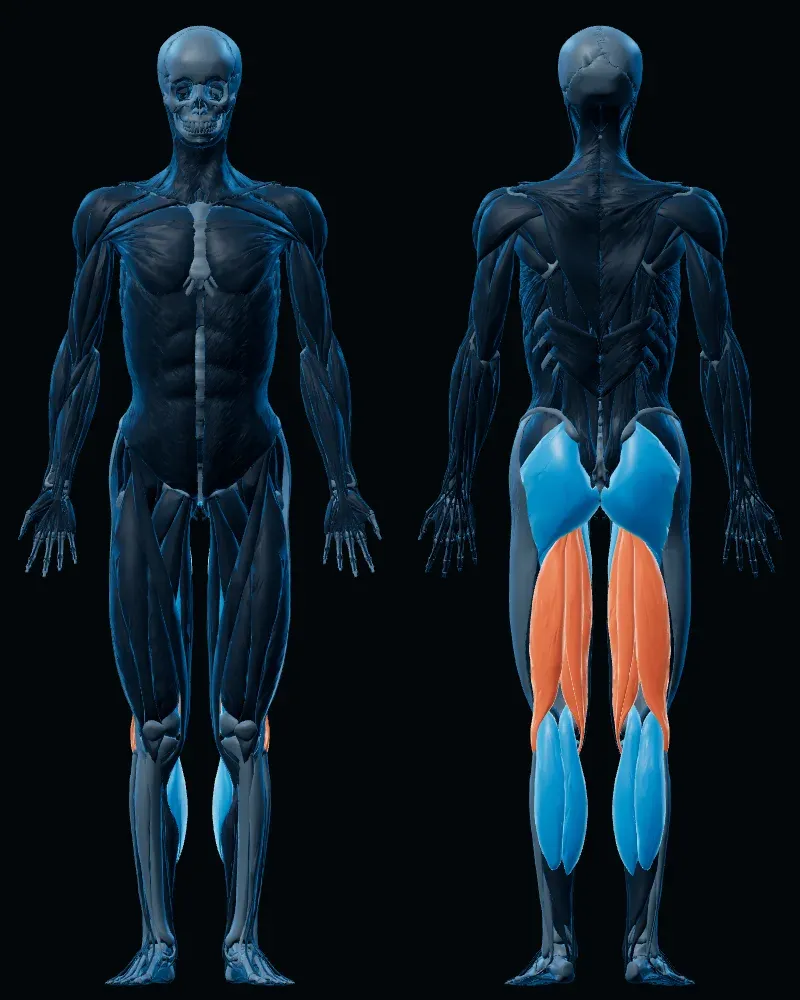
Muscles worked: hamstrings
Main movers: biceps femoris, semitendinosus and semimembranosus
Assisting: glutes, calves and adductor magnus
Table of contents
Nordic hamstring curl hypertrophy is real but modest: Nordics do grow your hamstrings, just not as well as some other eccentric curls. They also lengthen muscle fascicles and may lower your odds of a pull, although how strongly is still debated.
So the honest answer to “muscle builder or injury preventer?” is both, with caveats on each. This guide is part of our complete lower body and core training guide, and it focuses on the eccentric mechanics: what the exercise does inside the muscle, what the trials show, and how to fit it into a gym week.
What is a Nordic hamstring curl, really?
You kneel on a pad, heels anchored, torso straight from knee to head. Then you lean forward and let your hamstrings fight gravity for as long as they can. When you can’t hold it any more, you catch yourself with your hands and push back up.
The hamstrings are working eccentrically: they are lengthening while producing force. And the hardest point comes late in the fall, when the lever arm is long and your knee is nearly straight. That is why most people can lower slowly for the first few centimetres, then drop.
Because you are lowering more than you can lift back up, it is often called a supramaximal eccentric. We are not claiming that has been proven to be special on its own. What the studies measure is what happens to strength, fascicle length and muscle size afterwards.
What are fascicles, and why does the length matter?
A fascicle is a bundle of muscle fibres. Longer fascicles mean more sarcomeres in series, and that lets a muscle produce force over a bigger range before it is strained.
This matters for your biceps femoris long head, the outer hamstring that fails most often in sprinting. In a prospective study of 152 elite soccer players, those with biceps femoris fascicles shorter than 10.56 cm had about 4 times the relative risk of a later hamstring strain (RR 4.1), and eccentric knee flexor strength below 337 N carried an RR of 4.4 (Timmins et al., 2016).
Observational, remember. Short fascicles go with injury; the study can’t prove that lengthening them prevents it.
Still, it gives the Nordic its rationale. In a 10-week trial of 30 recreationally active men, Nordic training lengthened biceps femoris long head fascicles with large effects after 10 weeks (d=1.77-2.17 across the Nordic and hip extension groups), and the two exercises did not differ significantly (Bourne et al., 2017). In other words, hip extensions did the same thing for fascicles.
Nordic hamstring curl hypertrophy: do they build muscle?
Yes, but not equally everywhere. The best head-to-head data comes from a 12-week MRI trial in 42 healthy young men, who did Nordics, a lengthened-state eccentric leg curl on a weight stack, or nothing. Nordics raised whole-hamstring volume by about 11%. The hip-flexed leg curl raised it by about 18% (Maeo et al., 2024).
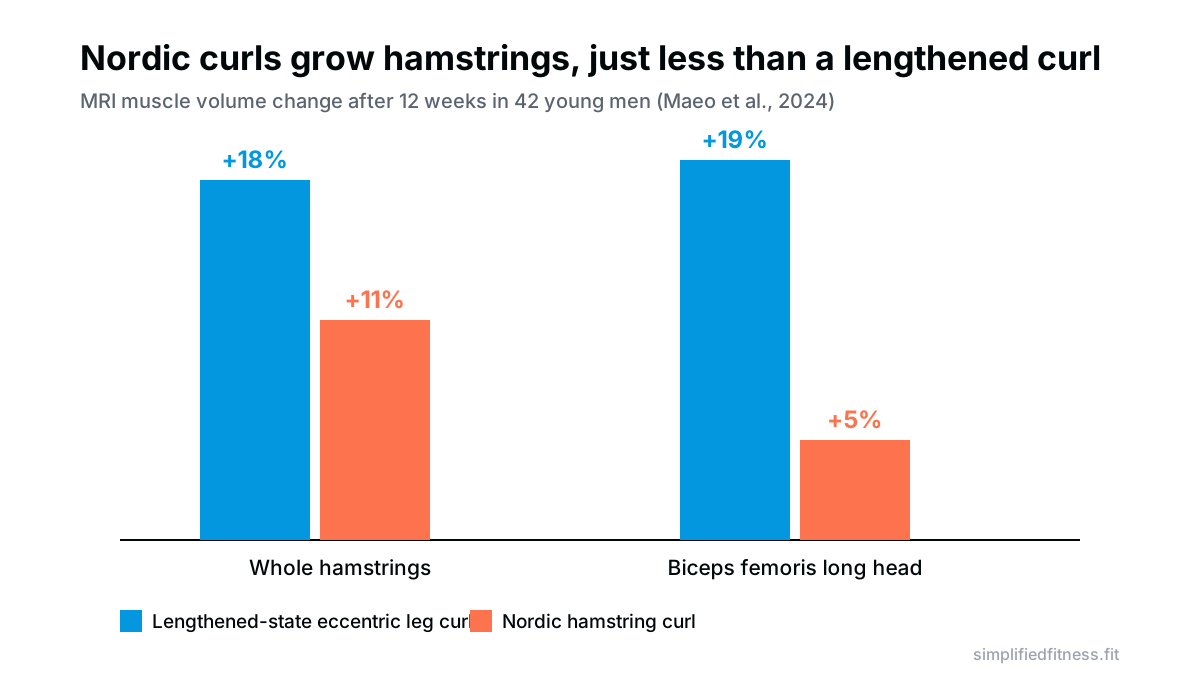
The pattern differed by muscle. The lengthened curl grew the muscles that also extend the hip (about 2.2-fold more than Nordics), while Nordics grew the knee-only flexors more (about 1.9-fold more than the curl). For the biceps femoris long head, the gains were about +19% against +5%.
Two honest limits. These were young, healthy men over 12 weeks, so we can’t say the same applies to older lifters or to trained athletes over years. And in the earlier 10-week trial, hip extensions grew biceps femoris long head volume more than Nordics did, while both raised semitendinosus volume similarly (Bourne et al., 2017).
If you want the anatomy behind this, see our guide to hamstring anatomy and the biceps femoris. For the machine option, read seated vs lying leg curls.
Do Nordic curls actually prevent hamstring strains?
This is where the evidence gets argued about.
A 2019 meta-analysis of 15 studies pooled 8,459 athletes and found a risk ratio of 0.49 (95% CI 0.32-0.74) for programmes that included Nordics. The authors concluded they reduce hamstring injuries by up to 51% (van Dyk et al., 2019). That is where the famous “Nordics halve injuries” line comes from. Using only the 8 randomised studies it was 0.52, and with high-risk-of-bias studies removed it was 0.55.
Then a 2021 reappraisal argued that only 5 of those 15 studies were actually randomised to Nordics. For those five RCTs the risk ratio was 0.56 (95% CI 0.20-1.52). After adding one newer RCT it was 0.59 (95% CI 0.27-1.29). The authors concluded the protective effect remains inconclusive and mostly derived from trials at high risk of bias, with a conditional recommendation at best, for soccer (Impellizzeri et al., 2021).
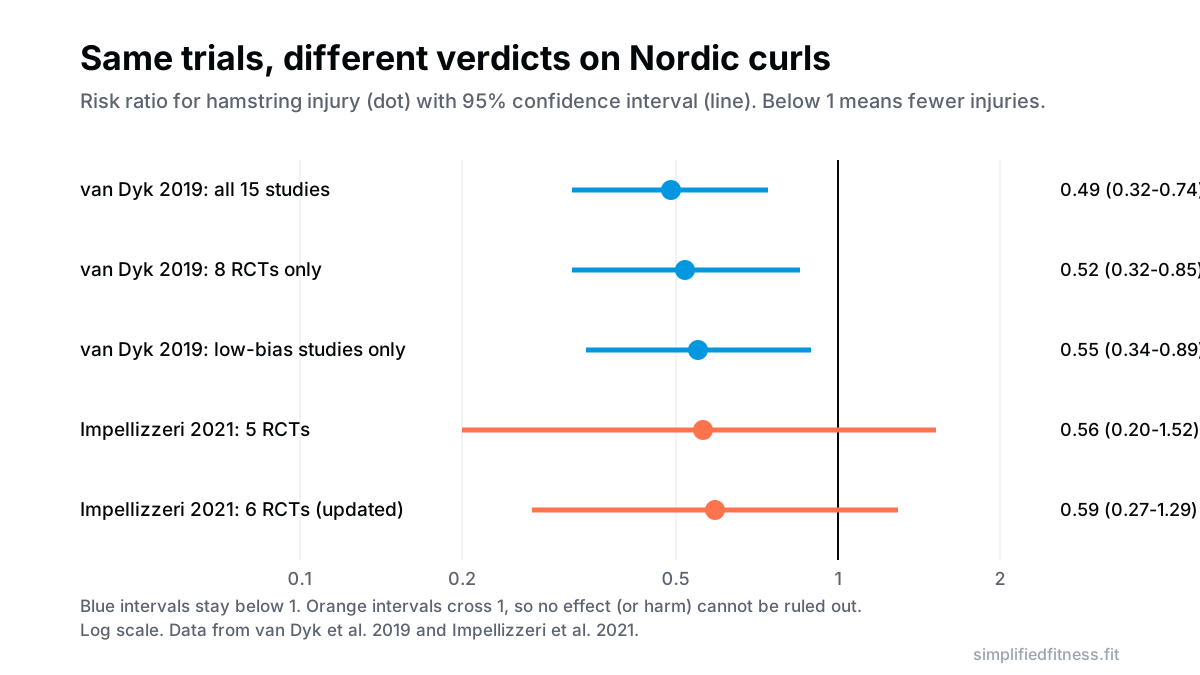
Why do the two disagree? Mostly on study selection. The first included non-randomised and multi-component programmes. The second kept only randomised trials, and the pool shrank, so the interval widened. The point estimates are similar (about 0.5-0.6); the certainty is not.
A cautious takeaway: the direction of the evidence favours Nordics, the size of the benefit is uncertain, and the data are mostly from team sport athletes. It tells us little about lifters who never sprint.
Do lifters who never sprint need Nordics?
Hamstring strains are mostly a sprinting and kicking injury, not a leg curl injury. The injury data behind Nordics comes almost entirely from team sports. If you play football, run sprints or do hill sprints, a Nordic is a reasonable part of your prep. If you mostly lift, your risk is likely lower and your hamstrings are already getting work from hinges, so don’t feel obliged.
In the gym, the more common mistake is a hamstring that gets nothing but one set of lying curls. Add a hinge and a lengthened curl and you have most of what the research supports. Our Romanian deadlift guide covers the technique.
Nordics versus Romanian deadlifts for fascicle length
In a 6-week randomised trial, 32 healthy adults (15 women, 17 men) trained twice a week with either an eccentrically biased Romanian deadlift or the Nordic. Biceps femoris long head fascicle length rose by 0.80 cm (about 9%) overall, and there were no significant differences between groups in fascicle length, pennation angle or muscle thickness. Hamstring cross-sectional area rose about 10% across the whole sample, again with no group difference (Crawford et al., 2025).
That is useful. If you hate Nordics, or can’t anchor your heels, a slow RDL gives a similar short-term architectural signal. But there is a catch: after 2 weeks of detraining, fascicle length and pennation angle returned to baseline while the size gain stayed. Fascicle changes seem to fade fast, so this is not a one-and-done fix.
How much Nordic volume do you really need?
Less than you think. A meta-analysis of 13 studies found that after 6 or more weeks, eccentric strength improved a lot with both high-volume (g = 2.12) and low-volume (g = 2.28) programmes, and fascicle length changes were similar (g of 2.58 or more). The authors concluded lower volumes may be more appropriate for athletes and could help compliance (Cuthbert et al., 2020).
Compliance is the real problem in the field. A survey of 50 professional football teams found the Nordic programme was completed in full in only 16 of 150 club-seasons (10.7%) (Bahr et al., 2015). Nobody wants a punishing exercise.
A sensible gym dose, as a coaching suggestion and not a trial protocol:
- Weeks 1-2: 1-2 sets of 3-5 assisted reps, once a week
- Weeks 3-6: 2-3 sets of 4-6 reps, once or twice a week
- After that: 1-2 sets of 3-5 reps weekly to maintain
A Nordic curl progression that works in a normal gym
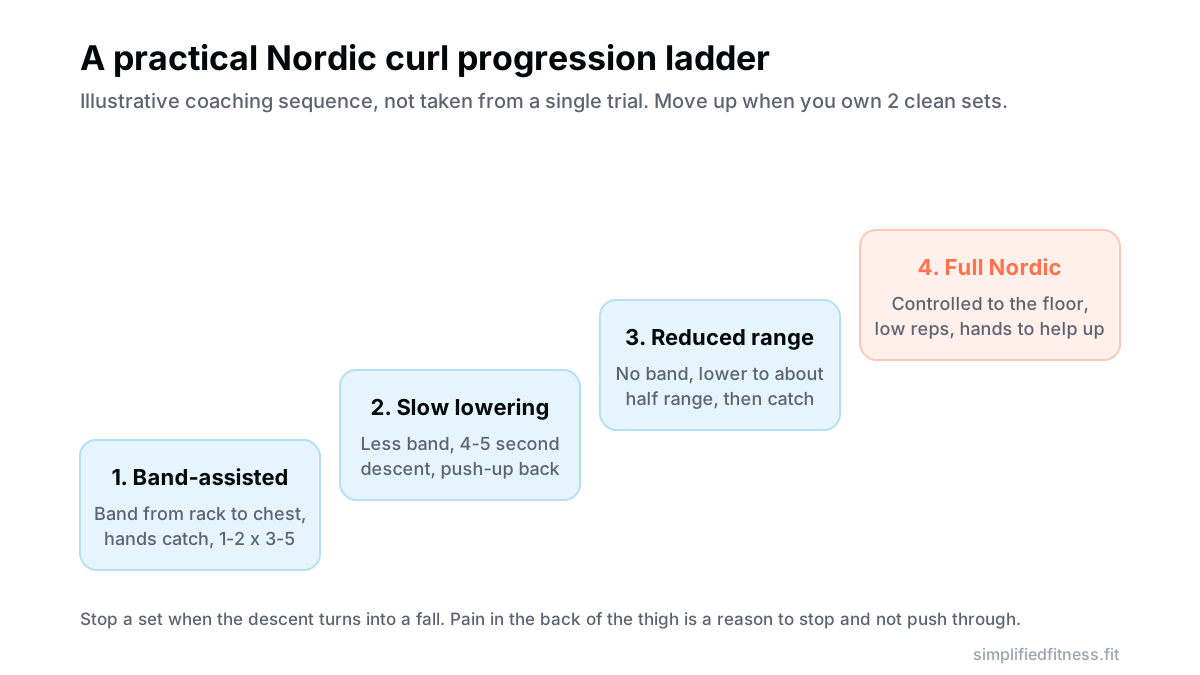
This ladder is illustrative coaching practice, not a tested protocol:
- Band-assisted. Loop a resistance band over a rack bar and hold it at your chest. It takes the edge off the hardest point.
- Slow lowering. Use a lighter band and aim for a 4-5 second descent. Use your hands to push back.
- Reduced range. No band, lower until your control breaks, then catch.
- Full Nordic. Control it toward the floor, with low reps.
Gym setups. A partner kneeling on your ankles, a barbell loaded under a squat rack, or a padded ankle anchor all work. Use a folded mat or pad under your knees. Squeeze your glutes, keep the hips extended and avoid piking at the waist.
If the hamstring is already sore or tight, skip it for now. See our return-to-gym traffic light model for graded loading.
What if you can’t do a Nordic at all?
You have options. The research above suggests hip extension work, an eccentrically biased RDL, or a lengthened-state leg curl can give similar or better hamstring growth. No Nordic bench in your gym? A partner and a loaded bar under a rack are plenty.
For vegetarian lifters, nothing changes in the training. Your hamstrings need enough protein and total food to recover, and our protein calculator can give you a daily target. Dal, paneer, curd and soya can all fit.
To slot this into a week, our leg day plan has hinge and curl work you can build around. For how hamstring strength relates to the quads, see the hamstring to quad ratio guide.
When to see a doctor or physio
Nordics are not a rehab drill to start on your own. Stop and get assessed if you have:
- A sudden sharp pain in the back of the thigh during sprinting or lifting
- Bruising, swelling or a palpable gap in the muscle
- Pain that lingers for more than a few days after a session
- A previous hamstring strain that has never fully settled
A physio can tell you when and how to load the muscle after an injury. This article is educational and does not replace medical advice.
Frequently Asked Questions
Do Nordic hamstring curls build muscle?
Yes, they do build hamstring muscle, though they are not the most efficient option. In a 12-week trial in 42 young men, Nordics raised total hamstring volume by about 11%, compared with about 18% for a lengthened-state eccentric leg curl. If size is your goal, pair Nordics with a hip-flexed curl or a Romanian deadlift.
Do Nordic curls prevent hamstring injuries?
They may reduce them, but the certainty is lower than gym lore suggests. A 2019 meta-analysis found a risk ratio of 0.49 for programmes including the Nordic, while a 2021 reanalysis of only randomised trials found a wide interval (0.27-1.29) that includes no effect. Treat Nordics as one sensible tool, not a guarantee.
What are fascicles and why does their length matter?
Fascicles are bundles of muscle fibres, and longer ones let a muscle work across a bigger range before it gets overstretched. In a study of 152 elite soccer players, biceps femoris fascicles shorter than 10.56 cm carried about 4 times the risk of a later hamstring injury. That is an observational link, so it does not prove lengthening fascicles on its own protects you.
How many Nordic curls should I do per week?
Fewer than most programmes suggest. A meta-analysis found low-volume Nordic training produced similar eccentric strength and fascicle gains to high-volume training after 6 weeks or more. A practical start is 2-3 sets of 4-6 reps, once or twice a week, with easy sessions first.
Are Nordic curls better than Romanian deadlifts?
Neither is clearly better for architecture. A 6-week randomised trial found Romanian deadlifts and Nordics produced comparable changes in fascicle length, pennation angle and hamstring cross-sectional area. Pick the one you can load progressively and recover from, or use both.
Are Nordic curls better than leg curls for hypertrophy?
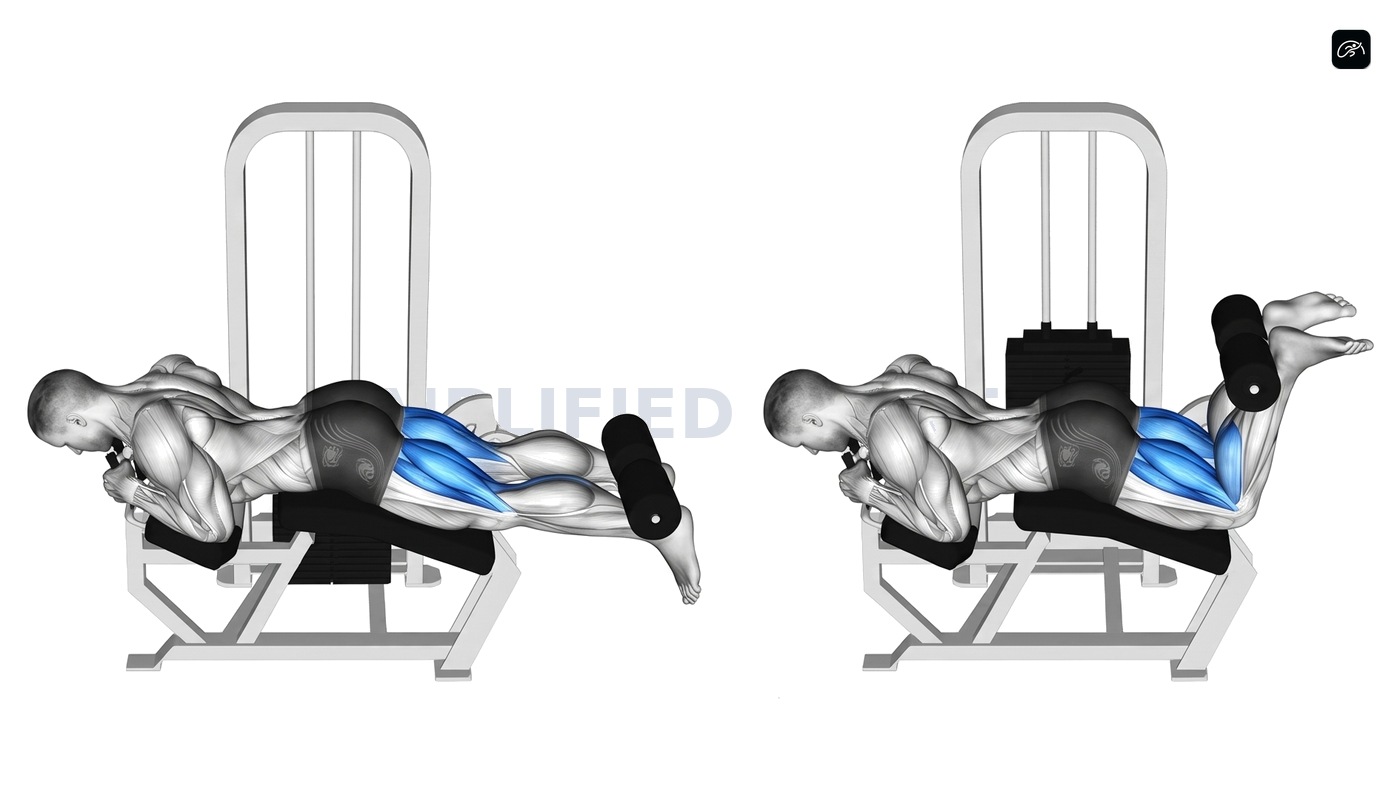
In the one head-to-head MRI trial we found, a lengthened-state eccentric leg curl grew the hamstrings more than Nordics. The mechanism is that the hip-flexed position puts the biceps femoris long head under more stretch while it works. A seated leg curl is a simple gym version of that idea.
Can beginners do Nordic curls?
Usually only in an assisted form, because the full version is very demanding. Use a band, a slow lowering phase or a reduced range, and catch yourself with your hands. Build up over several weeks and skip the exercise if you have a recent hamstring strain.
Why do Nordic curls make my hamstrings so sore?
Eccentric work done in a stretched, unfamiliar position commonly causes more soreness than normal lifting. The mechanism is likely muscle damage from lengthening under load, which settles as you adapt. Start with 1-2 sets and add volume slowly so you can still train legs afterwards.
Do I need a Nordic bench or partner?
You need something to anchor your heels. A partner holding your ankles, a loaded barbell under a rack, a sturdy cable station or a padded gym machine all work. Pad your knees and check that the anchor cannot slide.
What is a good alternative to Nordic curls?
Hip extension work and eccentrically biased Romanian deadlifts both lengthened fascicles in trials. A 10-week trial found hip extensions matched Nordics for fascicle lengthening and grew the biceps femoris long head more. Lengthened-state leg curls are another option.
Do Nordic curls help sprinting?
The evidence is indirect. Nordics raise eccentric hamstring strength and lengthen fascicles, and those traits are linked to injury risk in athletes, but we found no study here showing faster sprint times from Nordics alone. Keep sprinting itself in the plan.
How long do fascicle gains last if I stop?
Not long. In a 6-week trial followed by 2 weeks of detraining, fascicle length and pennation angle returned to baseline while cross-sectional area stayed elevated. Keep a small maintenance dose, such as one easy set a week.
Should I do Nordic curls before or after leg day?
Do them early in the session if the goal is Nordic quality, or as a finisher at a low volume. The exercise is fatiguing and technique falls apart when you are tired, so stop each set when the lowering turns into a drop. Avoid doing a heavy session of them right before sprint work.
Sources & References
Every claim above is checked against peer-reviewed research (PubMed, U.S. National Library of Medicine) or guidance from established health bodies. How we fact-check.
- van Dyk N, et al. Including the Nordic hamstring exercise in injury prevention programmes halves the rate of hamstring injuries: a systematic review and meta-analysis of 8459 athletes. Br J Sports Med. 2019. PMID: 30808663
- Impellizzeri FM, et al. Why methods matter in a meta-analysis: a reappraisal showed inconclusive injury preventive effect of Nordic hamstring exercise. J Clin Epidemiol. 2021. PMID: 34520846
- Bourne MN, et al. Impact of the Nordic hamstring and hip extension exercises on hamstring architecture and morphology: implications for injury prevention. Br J Sports Med. 2017. PMID: 27660368
- Maeo S, et al. Hamstrings Hypertrophy Is Specific to the Training Exercise: Nordic Hamstring versus Lengthened State Eccentric Training. Med Sci Sports Exerc. 2024. PMID: 38857522
- Cuthbert M, et al. The Effect of Nordic Hamstring Exercise Intervention Volume on Eccentric Strength and Muscle Architecture Adaptations: A Systematic Review and Meta-analyses. Sports Med. 2020. PMID: 31502142
- Crawford SK, et al. Hamstrings Muscle Architecture and Morphology Following 6 wk of an Eccentrically Biased Romanian Deadlift or Nordic Hamstring Exercise Intervention. Med Sci Sports Exerc. 2025. PMID: 40085810
- Timmins RG, et al. Short biceps femoris fascicles and eccentric knee flexor weakness increase the risk of hamstring injury in elite football (soccer): a prospective cohort study. Br J Sports Med. 2016. PMID: 26675089
- Bahr R, et al. Evidence-based hamstring injury prevention is not adopted by the majority of Champions League or Norwegian Premier League football teams: the Nordic Hamstring survey. Br J Sports Med. 2015. PMID: 25995308

Umair Hazrami · Founder & Head Coach, Simplified Fitness
Umair Hazrami founded Simplified Fitness and the Simplified Lifter channel to cut through fitness noise. With 4+ years of consistent training and 10+ coaching clients, he writes every guide from the peer-reviewed research and links the sources so you can check them. Our editorial standards.
Educational content only, not medical advice. If you have a medical condition, are pregnant, or take medication, talk to a qualified doctor before changing your diet, supplements or training. Full disclaimer.
Keep reading

Exercise Technique
Adductor Magnus Training: Seated Adductor Machine and Copenhagen Planks for Thigh Mass
Adductor magnus training explained: what research says on deep squats, the adductor machine and Copenhagen planks for thicker inner thighs and groin strength.
7 min read
Exercise Technique
High Bar vs Low Bar Squat: Which Builds More Quad Muscle?
High bar vs low bar squat for hypertrophy: what torso lean, knee travel and EMG studies show, why high-bar leans quad, and when low-bar still makes sense.
8 min read
Exercise Technique
Calf Hypertrophy Science: Standing vs Seated Calf Raises (Gastrocnemius vs Soleus)
Calf hypertrophy explained: why calves seem stubborn, what the trials say on exercise choice, stretch and foot position, plus weekly sets, reps and frequency.
9 min read
Exercise Technique
Complete Leg Workout Programming: Quad Day vs Hamstring and Glute Day
Best leg workout routine science: split leg day into a quad session and a hamstring-glute session, with sets, order and a 5-week plan that avoids burnout.
9 min read