High Bar vs Low Bar Squat: Which Builds More Quad Muscle?
High bar vs low bar squat for hypertrophy: what torso lean, knee travel and EMG studies show, why high-bar leans quad, and when low-bar still makes sense.
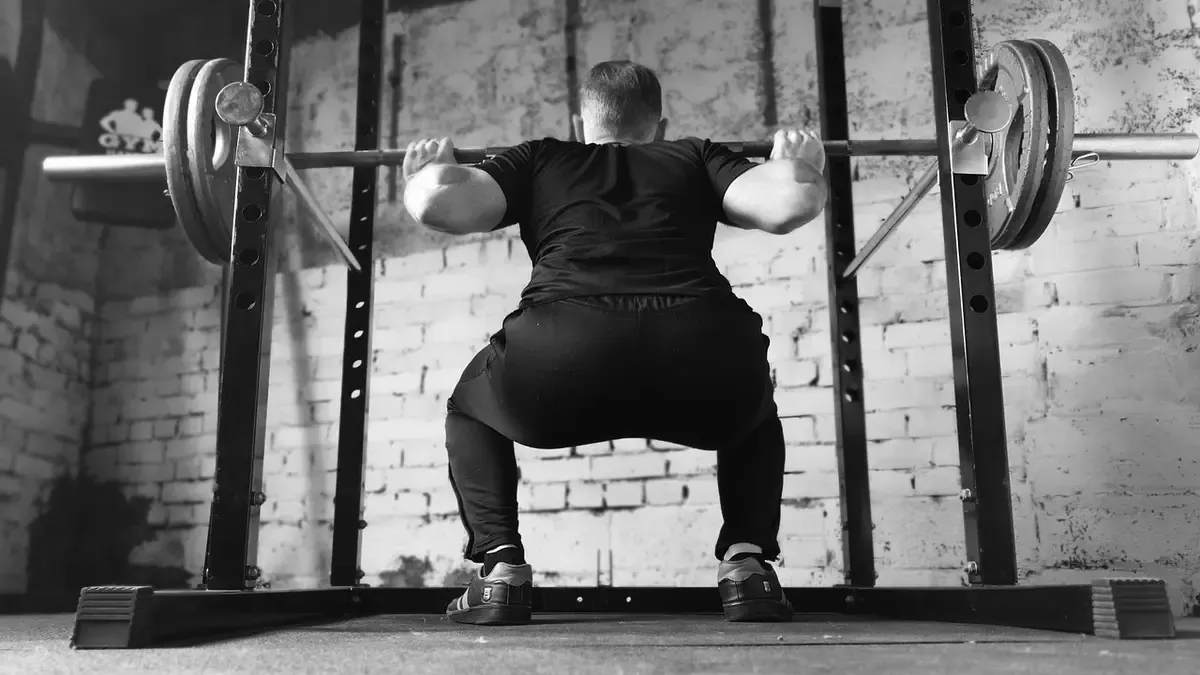
TL;DR. The short answer
- High-bar squats use a more upright torso and more knee bend, and reviews report higher quadriceps activity than low-bar. Low-bar leans forward and loads the hips, adductors and lower back more.
- Evidence that high-bar builds more quad muscle over months is indirect. It comes from EMG and joint-moment studies, not long-term growth trials, and the newest studies show smaller differences than older ones.
- Low-bar often lets you move a bit more weight, but that does not automatically mean more quad growth, because more of the extra load is likely carried by the hips and lower back.
- For most lifters chasing quad size, high-bar to full depth is a sensible default. Pick whichever variation you can perform deep, pain-free and consistently.
Part of our complete guide: Complete Lower-Body & Core Training Guide: Quads, Glutes, Hamstrings, Calves & Abs Science
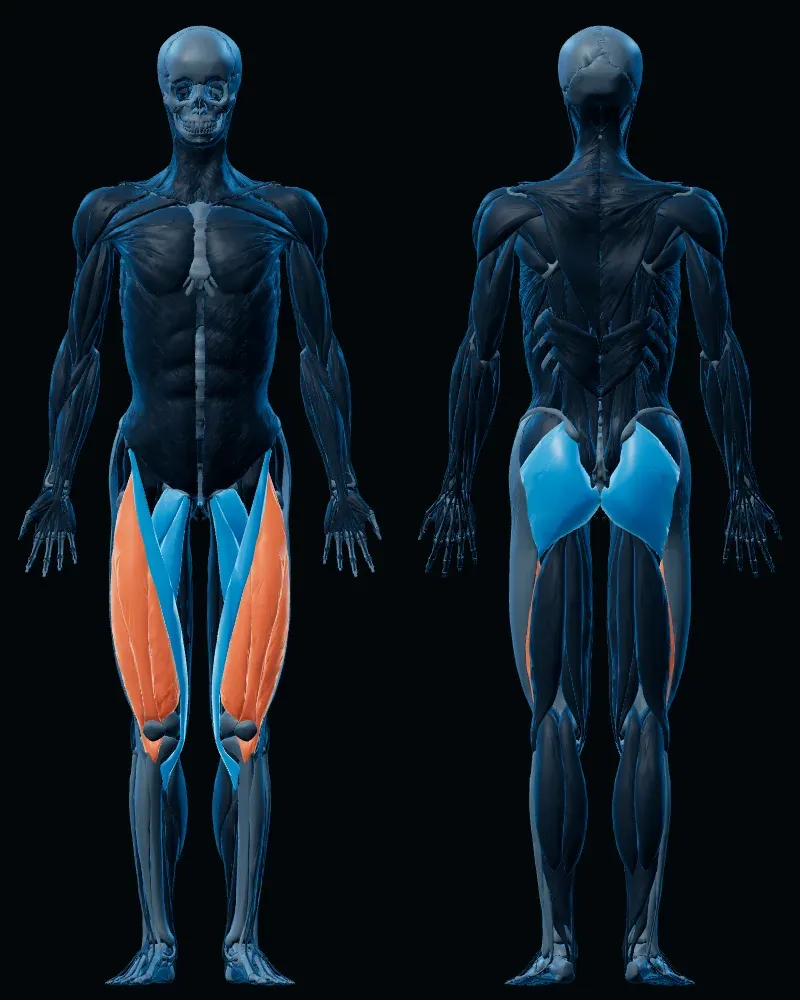
Muscles worked: quads
Main movers: rectus femoris and the three vasti
Assisting: adductors, sartorius and glutes
Table of contents
High bar vs low bar squat hypertrophy comes down to this: the high-bar squat probably gives quads a modest edge, while the low-bar squat shifts more work to the hips, adductors and lower back. But the evidence is indirect, and the newest studies suggest the gap is smaller than gym folklore claims.
This article sits inside our complete lower-body and core training guide. Here we focus on one question: if you want bigger quads, where should the bar sit?
What actually changes between high-bar and low-bar?
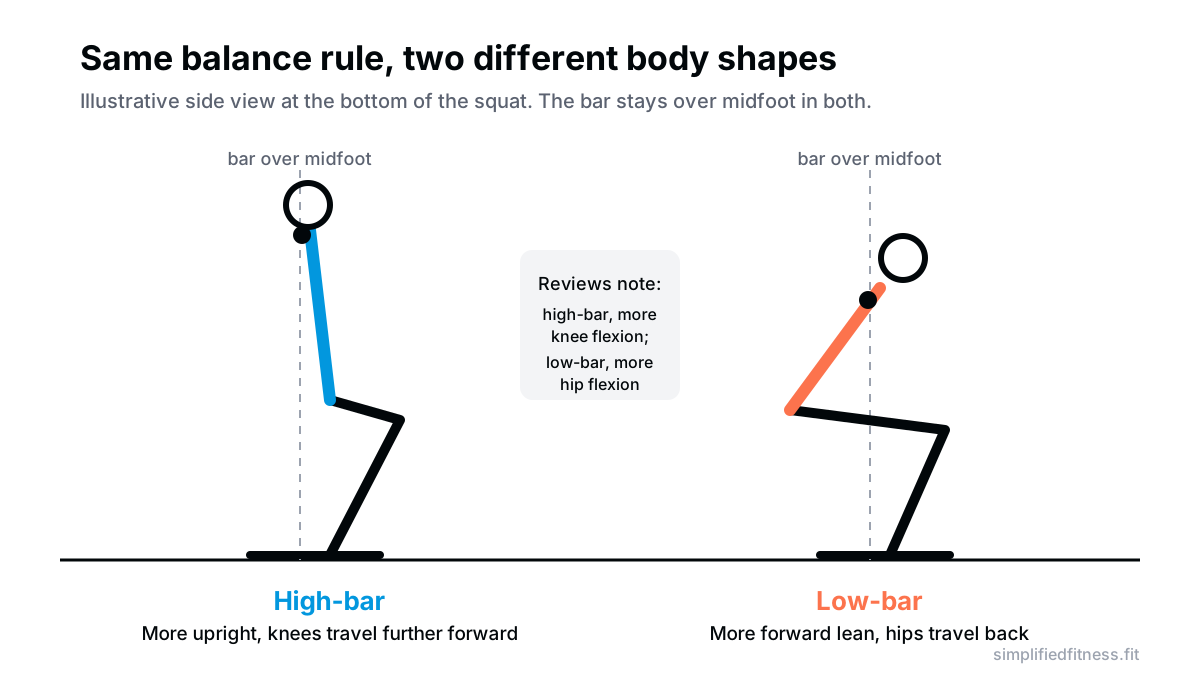
Only the bar position. High-bar rests on the upper trapezius. Low-bar sits a few centimetres lower, across the rear delts and mid-traps. That small shift changes how you balance.
In both versions, your body has to keep the bar roughly over midfoot, or you fall over. A review of the biomechanics literature explains that lifters use different movement strategies to keep the centre of mass over the base of support. Those strategies show up as differences in joint angles and muscle activity (Glassbrook et al., 2017).
The same review reports that the high-bar squat has greater knee flexion, less hip flexion, a more upright torso and a deeper squat. The low-bar squat has greater hip flexion, and therefore more forward lean.
Why does high-bar lean towards quads?
Think of it as a question of moment arms. Whichever joint sits furthest from the bar’s line of force has to work harder to resist it.
With an upright torso, the knees travel forward and sit further from the bar line. That puts more demand on the knee extensors, which are the quadriceps. With low-bar, the torso leans, the hips sit further back, and the hips carry more of the demand. This is simplified physics, and real lifting varies with limb lengths, stance and depth.
The anatomy behind it is covered in our guide to the quadriceps heads. The short version: the vasti only cross the knee, so they get their work from knee extension, and the rectus femoris also crosses the hip.
What does the EMG research show?
EMG measures electrical activity in a muscle. It is a useful clue, not proof of growth.
Here is the pattern across studies:
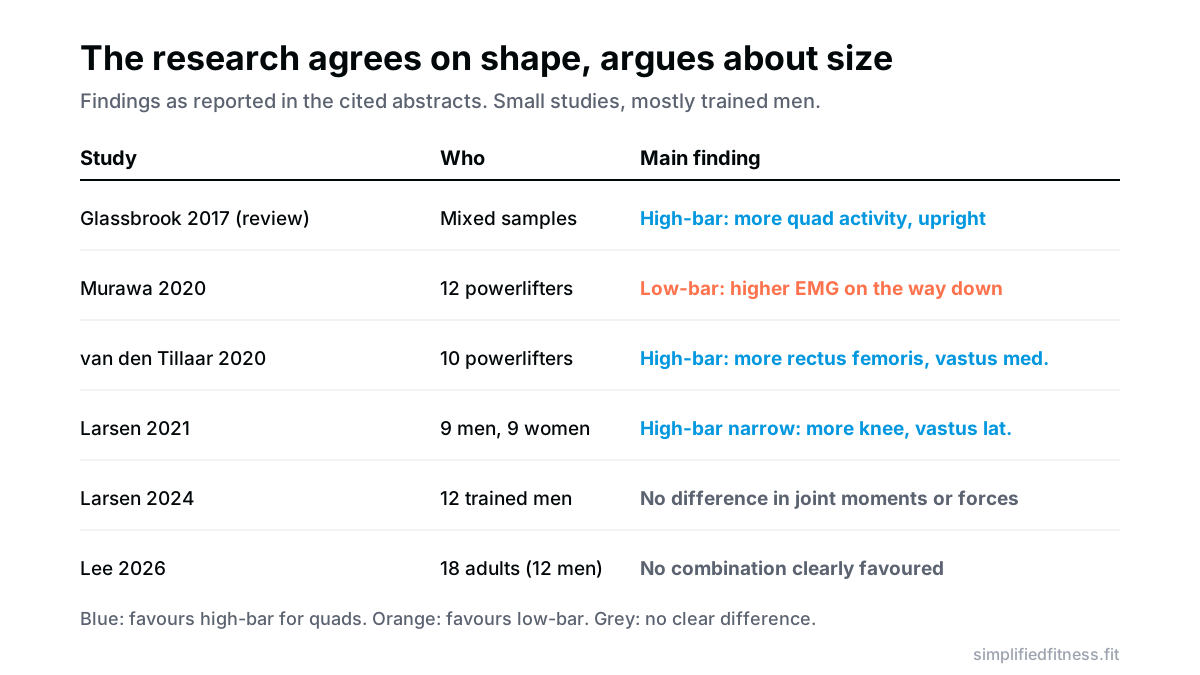
- In 10 trained male powerlifters doing 5-rep max squats with matched load, depth and stance, the high bar showed more rectus femoris, vastus medialis and lower erector spinae activity than the low bar. The authors concluded that when the goal is to maximally activate knee extensors with matched external load, high-bar looks preferable (van den Tillaar et al., 2020).
- In 12 experienced male powerlifters at 60-70% of 1RM, EMG during the eccentric (lowering) phase was higher for the low bar than the high bar for all muscles measured at 60% and 65% of 1RM. The authors emphasised the posterior chain (Murawa et al., 2020).
- The 2017 review concluded that low-bar has greater activity in the erector spinae, adductors and gluteal muscles, while high-bar has greater quadriceps activity (Glassbrook et al., 2017).
Do the studies disagree?
Yes, and fairly. A 2024 study in 12 recreationally trained men used motion capture and force plates to estimate muscle forces at three-rep max. Loads were not significantly different between high and low bar (about 129 kg versus 130 kg). The researchers found no significant differences in net joint moments, muscle forces or muscle-specific moments at the hip, knee or ankle. They concluded that bar placement plays a minor role when stance width is standardised, and that choice should come down to preference and comfort (Larsen et al., 2024).
A 2026 study in 18 healthy adults (12 men, 6 women) tested bar position, stance width, repetition and load together. Its conclusion was that consistent muscle activation did not favour any combination, and lifters could choose by comfort (Lee et al., 2026).
Why might the results differ? Possible reasons include:
- different muscles measured and different phases of the lift
- matched versus self-selected depth and stance
- small samples, mostly men, mostly trained powerlifters
- EMG versus modelled muscle force, which answer different questions
Does low-bar let you lift heavier, and does that matter?
Often, yes, for experienced squatters. A 2019 analysis of powerlifters, Olympic lifters and recreational lifters concluded that when the goal is to lift the greatest load possible, low-bar may be preferable, and that it emphasises the stronger hip musculature (Glassbrook et al., 2019).
But for hypertrophy, a heavier bar is not automatically better. If the extra load is carried by your hips and lower back, your quads may not get more work. The 2024 study above also found no difference in 3RM load between the two, so the strength gap may depend on the person.
Depth probably matters more than bar position
If you are choosing between a small bar position effect and a depth effect, depth looks like the bigger factor. A systematic review of six training studies, four of them for the lower body, concluded that full range of motion confers beneficial effects on lower-body hypertrophy versus partial range of motion (Schoenfeld & Grgic, 2020). The sample was 135 people, mostly men, and the authors note the response may be muscle-specific.
High-bar tends to make depth easier, since the review above reports a deeper squat for it. For a deeper dive into depth, see squat depth: parallel vs deep.
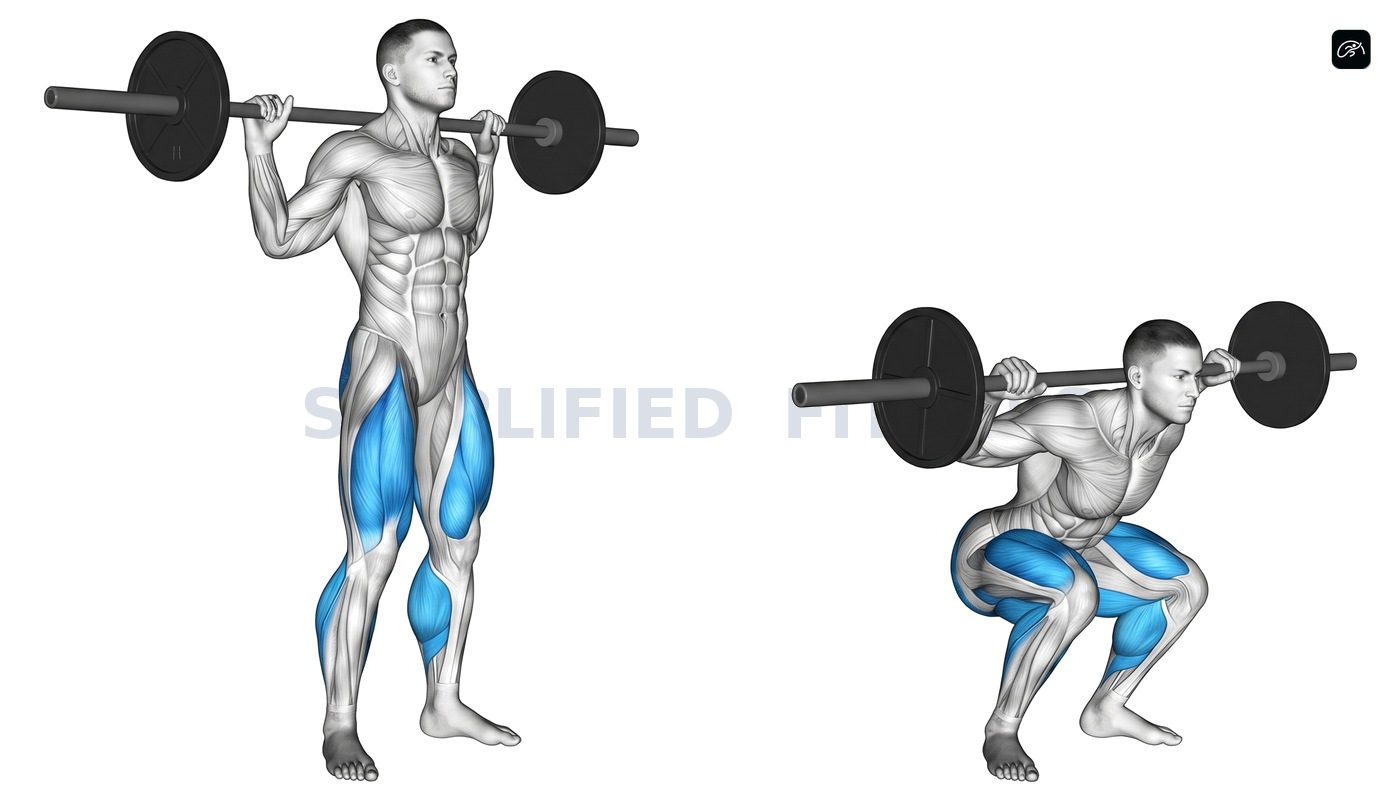
How to set up a high-bar squat for quads
- Bar on the upper traps. It sits on the muscle shelf, not on the neck bone.
- Grip as narrow as your shoulders allow. Pull the bar into your back and keep your elbows roughly under the bar.
- Feet roughly shoulder width, toes slightly out. Adjust to your hips.
- Brace, then sit down between the knees. Let the knees travel forward over your toes while heels stay flat.
- Hit full depth you can control. Then drive up, keeping the bar over midfoot.
Some forward knee travel is normal. If your heels lift, a small raise under the heels from weightlifting shoes or a thin plate may help. For more on this, see our stance width and foot placement guide.
High-bar or low-bar: how to choose
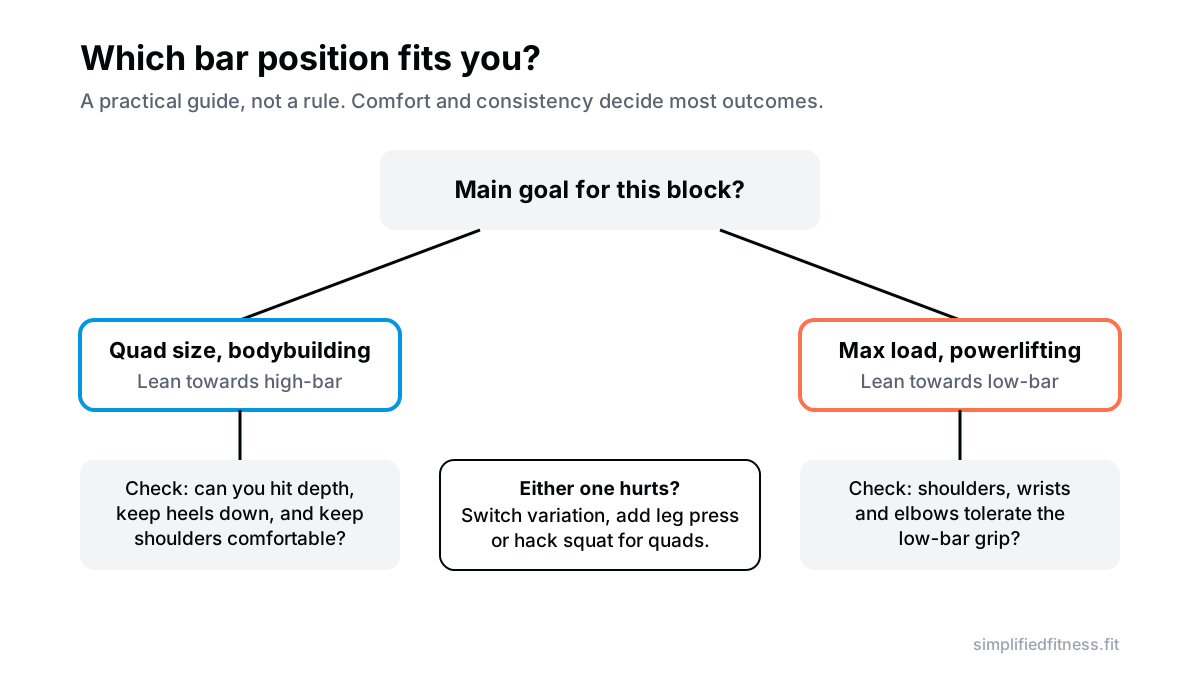
| Factor | High-bar | Low-bar |
|---|---|---|
| Torso | More upright | More forward lean |
| Knee travel | Greater | Less |
| Likely emphasis | Quadriceps | Hips, adductors, erectors |
| Depth | Often deeper | Often a bit shallower |
| Heavier loads | Sometimes lower | Sometimes higher |
| Shoulder demand | Lower for many | Higher flexibility needed |
For the technique side of low-bar, see our low-bar squat guide. For a different quad-focused option, compare with the front squat for quad hypertrophy.
Knee pain and forward knee travel
Many people worry that high-bar is hard on the knees because the knees move forward. Our article on whether squats are bad for your knees goes through the evidence in detail. In short, forward knee travel in healthy people is not a reason to avoid it on its own.
If you get sharp, persistent or worsening knee pain, or knee swelling, see a doctor or physiotherapist. Do not train through it.
What the studies cannot tell you
It is worth being honest about the limits here. Most studies above used trained men, usually powerlifters or recreational lifters, lifting for a handful of reps in a single lab session. None followed people for 12 weeks and measured quad size. EMG amplitude can also shift with fatigue, electrode placement and lifting speed, so a higher reading does not translate directly into more growth.
That matters for women, older lifters and complete beginners, who are barely represented. A beginner’s biggest gains will come from simply squatting regularly with good effort, whichever bar position they pick.
Practical programming notes
If you want to test this yourself, run one variation for 8-12 weeks and track two things: the load for a given number of reps, and a thigh measurement taken at the same spot each month. Do not switch every week, because you will never learn which one works for you.
Keep the last one or two reps of each set close to failure, since effort is what drives growth in either position. Rest 2-3 minutes between heavy sets so the quads and lower back can recover. Warm up with the empty bar and two or three ramp-up sets before working weight.
Indian gym context
Many gyms in India have a basic power rack and a shared bar with limited plates. In that setup, a simple plan works well:
- Start with high-bar squats for 3-4 sets of 6-12 reps, to full depth.
- Add leg press or hack squat for extra quad sets.
- Eat enough protein: dal, paneer, curd, soya chunks and eggs all help. Our protein calculator gives a daily target.
- Heat and humidity: sweat more, drink water and rest a bit longer between heavy sets.
Our free leg day plan shows how to fit squats among other quad and hamstring work.
The bottom line
High-bar likely gives quads a modest bias through an upright torso and more knee bend. Low-bar shifts work to the hips and lets some lifters move more weight. The newest studies show these differences shrink when stance and depth are matched, so there is no single winner.
For quad size, a reasonable plan is high-bar squats to full depth, plus another quad movement. Use the bar position that lets you go deep, stay pain-free and keep showing up. Progress over 8-12 weeks is your real test.
Frequently Asked Questions
Does high bar or low bar squat build more quads?
High-bar probably gives a small edge for quads, but the evidence is indirect. A review of the biomechanics literature reports greater quadriceps activity in the high-bar squat, while a 2024 study with matched stance width found no differences in muscle forces. Use high-bar if quad size is your priority, and judge it by your own progress over 8-12 weeks.
Is low bar squat bad for hypertrophy?
No. Low-bar still trains the quads hard, and it shifts extra work to the hips, adductors and spinal erectors. Hypertrophy depends on stimulating the muscle with enough hard sets, and you can do that in either variation. If low-bar is what you squat best, you can still build quads, then add leg press or hack squat for extra quad work.
Why is high bar squat better for quads?
The upright torso lets the knees travel further forward, so the knee extensors carry more of the job. One EMG study in 10 trained powerlifters found higher vastus medialis and rectus femoris activity with a high bar when load, depth and stance were matched. This is a bias, not an on-off switch, so keep depth and effort high.
Should the knees go past the toes in a high bar squat?
For most healthy lifters, some forward knee travel is normal and part of why high-bar loads the quads. The goal is to keep your heels down and the bar over midfoot, not to stop the knees at the toes. If you feel sharp knee pain, reduce depth or load and see a physiotherapist.
Which squat lets you lift more weight?
Low-bar commonly allows heavier loads in experienced squatters because the hips, which are strong, do more of the work. In one study of 3-rep max squats in recreationally trained men, the loads were not significantly different, so the gap may be small. Test both with an estimate from our one rep max calculator before assuming either way.
Is high bar squat easier on the lower back?
Usually the torso is more upright, so the lower back is often under less lean-forward demand than in low-bar. Reviews report greater erector spinae activity in the low-bar squat. Brace well in both, and talk to a doctor if you have ongoing back pain.
Which is better for glutes, high bar or low bar?
Low-bar tends to involve the glutes and adductors somewhat more, and a 2021 study found lower gluteus maximus activity in a high-bar narrow stance. Depth also matters for glute work. If glutes are your main target, add hip thrusts rather than relying on bar position alone.
Can I switch between high bar and low bar?
Yes. Both are the same lift with a different bar position and torso angle. Expect a few weeks of feeling slightly clumsy after a switch, and drop the load by 10-15% while you relearn the groove.
Does squat depth matter more than bar position?
For lower-body hypertrophy, range of motion looks like a bigger factor. A systematic review found full range of motion confers beneficial effects on lower body hypertrophy versus partial range. Squat as deep as you can control, in whichever bar position allows that.
Where do I place the high bar on my back?
The high bar sits on top of the upper trapezius, just under the bump at the base of your neck. Grip the bar as close as your shoulders allow, pull it into your upper back, and keep elbows under it. If it digs into bone, a bit of padding or a slightly lower position can help.
Do beginners need to choose a bar position?
Not at first. Start with whichever feels more natural and lets you squat to a comfortable depth with control. Many beginners find high-bar easier to learn because the torso stays more upright and the shoulders need less flexibility.
Do I still need leg press or leg extensions if I squat high bar?
Often yes, if quad size is the goal. Squats are heavy, tiring and limited by balance and the lower back, so machines let you add quad volume with less systemic fatigue. Add 2-3 hard sets of leg press or leg extension after squats.
How many sets of squats should I do per week for quads?
There is no single magic number, but many lifters grow well on roughly 6-10 hard weekly sets for quads across all exercises, split over two sessions. Squats can be the base, with other quad work filling the rest. Add sets only if progress stalls and recovery holds.
Sources & References
Every claim above is checked against peer-reviewed research (PubMed, U.S. National Library of Medicine) or guidance from established health bodies. How we fact-check.
- Glassbrook DJ, et al. A Review of the Biomechanical Differences Between the High-Bar and Low-Bar Back-Squat. J Strength Cond Res. 2017. PMID: 28570490
- Glassbrook DJ, et al. The High-Bar and Low-Bar Back-Squats: A Biomechanical Analysis. J Strength Cond Res. 2019. PMID: 28195975
- Larsen S, et al. A Biomechanical Comparison Between a High and Low Barbell Placement on Net Joint Moments, Kinematics, Muscle Forces, and Muscle-Specific Moments in 3 Repetition Maximum Back Squats. J Strength Cond Res. 2024. PMID: 38900172
- Murawa M, et al. Muscle activation varies between high-bar and low-bar back squat. PeerJ. 2020. PMID: 32551198
- Larsen S, et al. Effects of Stance Width and Barbell Placement on Kinematics, Kinetics, and Myoelectric Activity in Back Squats. Front Sports Act Living. 2021. PMID: 34541522
- van den Tillaar R, et al. The Effects of Barbell Placement on Kinematics and Muscle Activation Around the Sticking Region in Squats. Front Sports Act Living. 2020. PMID: 33345183
- Lee CXY, et al. The effects of bar positioning, stance width, repetition, and load on muscle activity during the barbell back squat. PLoS One. 2026. PMID: 42579678
- Schoenfeld BJ, et al. Effects of range of motion on muscle development during resistance training interventions: A systematic review. SAGE Open Med. 2020. PMID: 32030125

Umair Hazrami · Founder & Head Coach, Simplified Fitness
Umair Hazrami founded Simplified Fitness and the Simplified Lifter channel to cut through fitness noise. With 4+ years of consistent training and 10+ coaching clients, he writes every guide from the peer-reviewed research and links the sources so you can check them. Our editorial standards.
Educational content only, not medical advice. If you have a medical condition, are pregnant, or take medication, talk to a qualified doctor before changing your diet, supplements or training. Full disclaimer.
Keep reading
Exercise Technique
Adductor Magnus Training: Seated Adductor Machine and Copenhagen Planks for Thigh Mass
Adductor magnus training explained: what research says on deep squats, the adductor machine and Copenhagen planks for thicker inner thighs and groin strength.
7 min read
Exercise Technique
Calf Hypertrophy Science: Standing vs Seated Calf Raises (Gastrocnemius vs Soleus)
Calf hypertrophy explained: why calves seem stubborn, what the trials say on exercise choice, stretch and foot position, plus weekly sets, reps and frequency.
9 min read
Exercise Technique
Complete Leg Workout Programming: Quad Day vs Hamstring and Glute Day
Best leg workout routine science: split leg day into a quad session and a hamstring-glute session, with sets, order and a 5-week plan that avoids burnout.
9 min read
Exercise Technique
Foot Pronation, Knee Valgus, and Squat Mechanics: Flat Feet, Arches, and Lifting Shoes
Knees caving in on squats with flat feet? See what research says about pronation, short foot, hip strength and lifting shoes, and what to try first.
8 min read