Quadriceps Anatomy: Rectus Femoris and the Three Vasti, and How to Train Them
Quadriceps anatomy functional guide: why the rectus femoris crosses two joints, why squats alone often miss it, and how to train all four quad heads.
TL;DR. The short answer
- The quadriceps has four muscles: three vasti (lateralis, medialis, intermedius) that cross only the knee, and the rectus femoris, which crosses both the hip and the knee.
- In short trials, squat-type training grew the vasti but showed little or no rectus femoris growth, while leg extensions grew all regions of the rectus femoris.
- Leg extensions done with the hip more extended (a reclined seat, around 40 degrees of hip flexion) grew the rectus femoris more than an upright seat in one 10-week trial in untrained men.
- Most quad strains in one elite Australian football dataset involved the rectus femoris, and almost half happened while kicking. Sprint and kick exposure, not gym squats, is the main risk context.
- A simple plan is one squat pattern plus one leg extension variation, scaled to your own weekly volume and recovery.
Part of our complete guide: Complete Lower-Body & Core Training Guide: Quads, Glutes, Hamstrings, Calves & Abs Science
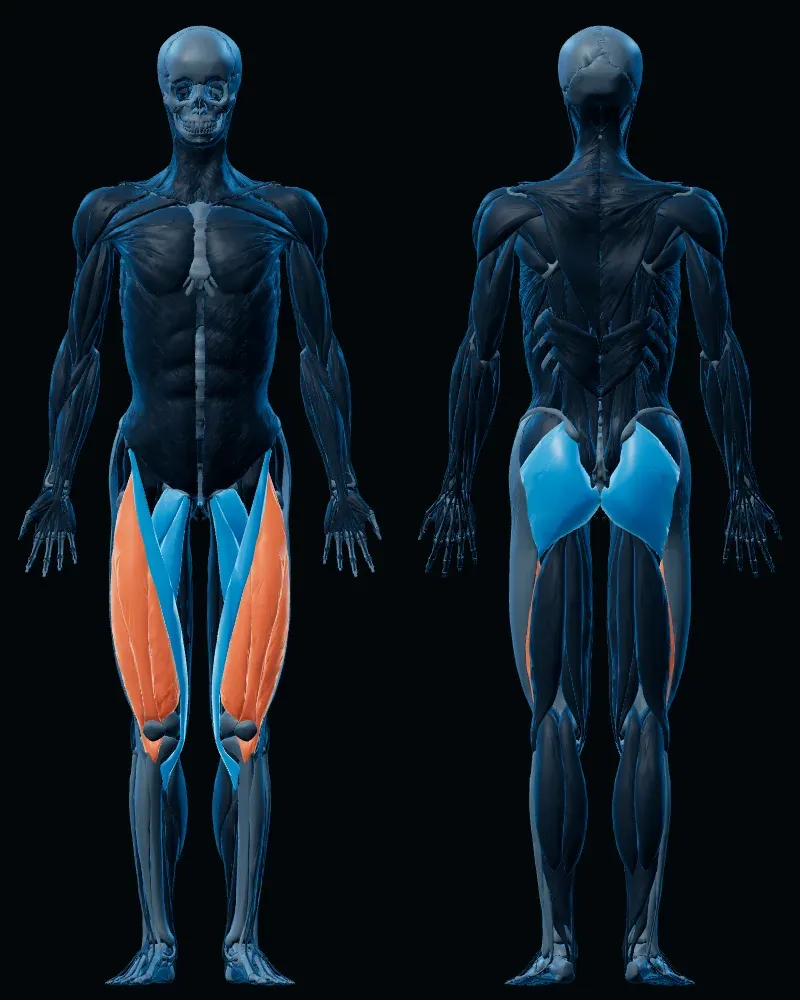
Muscles worked: quads
Main movers: rectus femoris and the three vasti
Assisting: adductors, sartorius and glutes
Table of contents
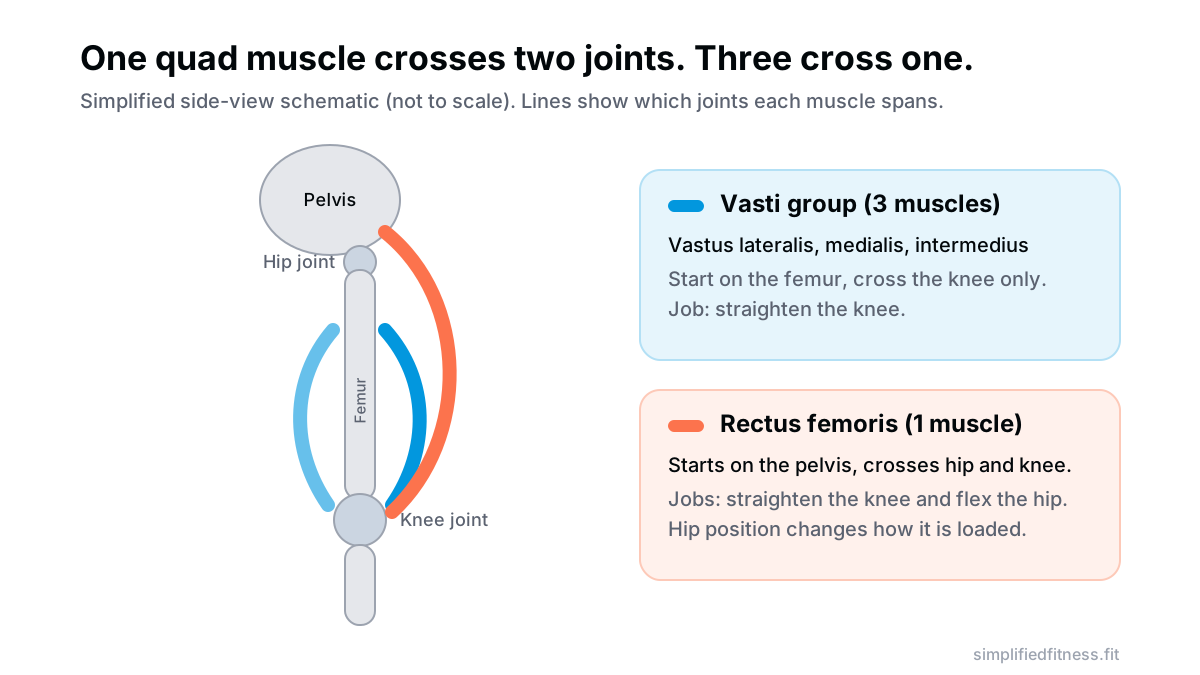
Your quads are not one muscle. They are four, and one of them behaves differently from the other three. That difference is the whole story of quadriceps anatomy functional training: three vasti cross only the knee, while the rectus femoris crosses the hip and the knee, so squats and leg extensions do not load them the same way.
This is a detailed anatomy map that sits under our complete lower body and core training guide. We will cover what each muscle does, what the research shows about squats versus leg extensions for the rectus femoris, and what that means for your programme and for injury risk. The evidence here is mostly short trials in untrained or recreationally trained men, so we will flag where it is thin.
The four quad muscles and what each one does
All four muscles join into the patellar tendon, wrap over the kneecap and attach to the shin bone. All four straighten the knee. The differences are where each one starts and which joints it crosses.
| Muscle | Where it starts | Joints crossed | Main jobs |
|---|---|---|---|
| Vastus lateralis | Outer femur | Knee only | Knee extension, outer thigh size |
| Vastus medialis | Inner femur | Knee only | Knee extension, lower inner thigh |
| Vastus intermedius | Front of femur, deep | Knee only | Knee extension, hidden under rectus femoris |
| Rectus femoris | Pelvis (front) | Hip and knee | Knee extension and hip flexion |
The three vasti are called monoarticular, because they cross one joint. The rectus femoris is biarticular. Hip flexion means lifting your knee toward your chest, which is why the rectus femoris is busy when you kick or sprint.
Why squats alone often under-train the rectus femoris
In a squat, your hips and knees bend together on the way down and extend together on the way up. On the way down, the rectus femoris shortens across the hip as it lengthens across the knee, and the opposite happens on the way up, so its overall length changes relatively little. One explanation is that this limits how much stretch and tension it gets compared with an exercise that loads it across the knee alone. That is a mechanical argument. The research below supports the practical result, although it does not prove the mechanism.
Here is what the studies found.
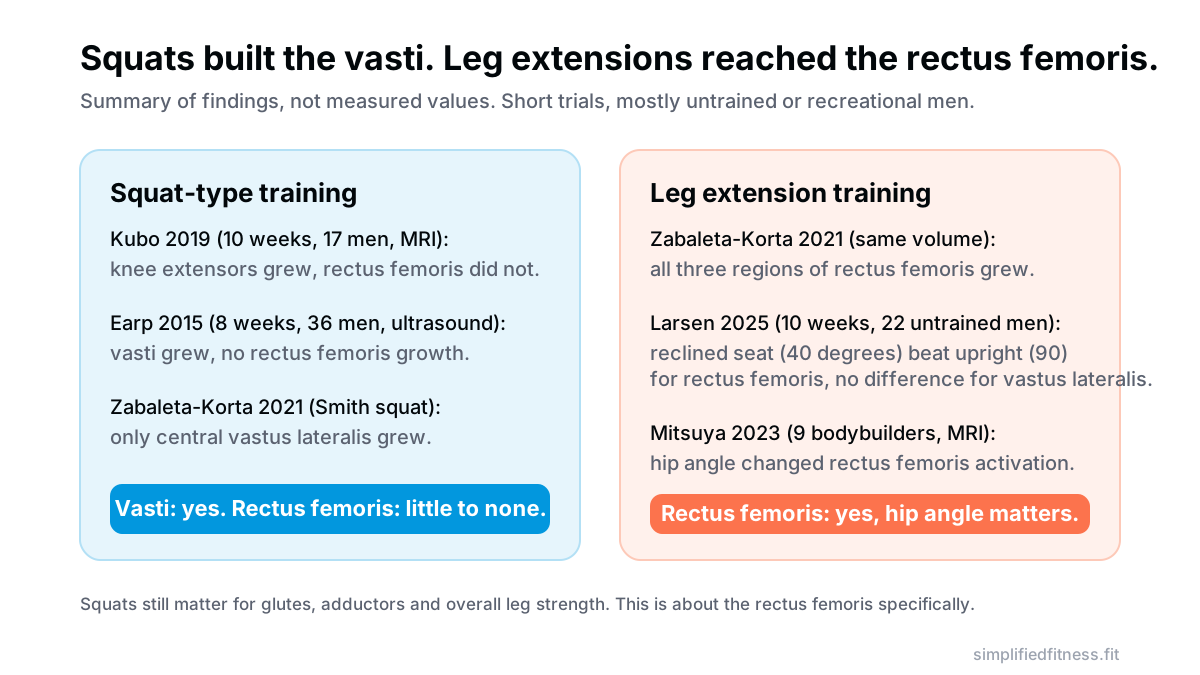
- Kubo and colleagues (2019) put 17 men through 10 weeks of full or half squats, twice a week, and measured muscle volume with MRI. Knee extensor volume rose by about 4.6-4.9% in both groups, but the volume of the rectus femoris did not change in either one (Kubo et al., 2019).
- Earp and colleagues (2015) trained 36 untrained men for 8 weeks with heavy parallel squats or jump squats and measured each quad muscle with ultrasound. The vastus lateralis, intermedius and medialis grew in various regions, but no hypertrophy was observed in the rectus femoris at any location (Earp et al., 2015).
- Zabaleta-Korta and colleagues (2021) compared Smith machine squats with leg extensions at equal volume and intensity. All three measured regions of the rectus femoris grew in the leg extension group, while in the squat group only the central region of the vastus lateralis grew significantly (Zabaleta-Korta et al., 2021).
There is also a fair counterpoint. Squats are not useless for quads, and Kubo and colleagues found full squats built the glutes and adductors more than half squats did (Kubo et al., 2019). The point is not to drop squats. It is that if you want the rectus femoris covered, squats are probably not enough on their own.
If you want the deeper breakdown on squat variations, see our guides on high bar versus low bar squat biomechanics and front squat versus back squat for quad growth.
How to train the rectus femoris: hip angle matters
If the rectus femoris crosses the hip, then moving the hip should change what the leg extension does to it. Two studies tested exactly this.
Larsen and colleagues (2025) trained 22 untrained men for 10 weeks, twice per week, with one leg using a 90 degree hip angle (seated upright) and the other a 40 degree hip angle (reclined). Rectus femoris growth was greater at 40 degrees, with extreme evidence in the authors’ statistical model. The vastus lateralis grew the same under both (Larsen et al., 2025). That fits the anatomy: the vasti do not care about the hip.
Mitsuya and colleagues (2023) looked at muscle activity with MRI in nine male bodybuilders doing leg extensions at 0, 40 and 80 degrees of hip flexion. The more reclined settings (0 and 40 degrees) produced higher activity in the proximal and middle rectus femoris than 80 degrees, and the study concluded that different parts of the rectus femoris can be targeted through hip angle. It was an acute study, with no growth measured, and the lifters’ own sense of where they felt the muscle working did not match the MRI (Mitsuya et al., 2023).
So a reasonable, hedged takeaway: if your leg extension seat reclines, use a reclined setting for at least some of your sets. If it does not, you can still use the exercise, and the evidence suggests both positions are viable for quad growth overall.
For setup, range and knee comfort details, see our dedicated guide to leg extensions for rectus femoris hypertrophy and knee safety.
What about the vastus lateralis, medialis and intermedius?
The vasti are the big growth engines of your thigh, and they respond well to the usual hard sets of squats, hack squats and leg presses. Two things are worth knowing.
You cannot isolate one vastus muscle. All three straighten the knee together. None of the trials above tested special foot angles for the “teardrop”, and we found no good evidence that they isolate it. Pick exercises you can load hard, train them close to failure and progress over time.
Range of motion looks forgiving. A 2023 systematic review of 11 studies concluded that training at longer muscle lengths, through partial or full range, tends to give good quad growth, and suggested combining partials in the early part of the range with full range work (Kassiano et al., 2023). The review pooled mixed studies, so the practical read is: use full range most of the time and do not fear a stretched position.
We cover the squat-depth debate and the knee question in more detail in squat depth and hypertrophy and are squats bad for your knees.
A simple session that covers all four heads
You do not need a complicated quad workout. Pair one squat pattern with one leg extension variation.
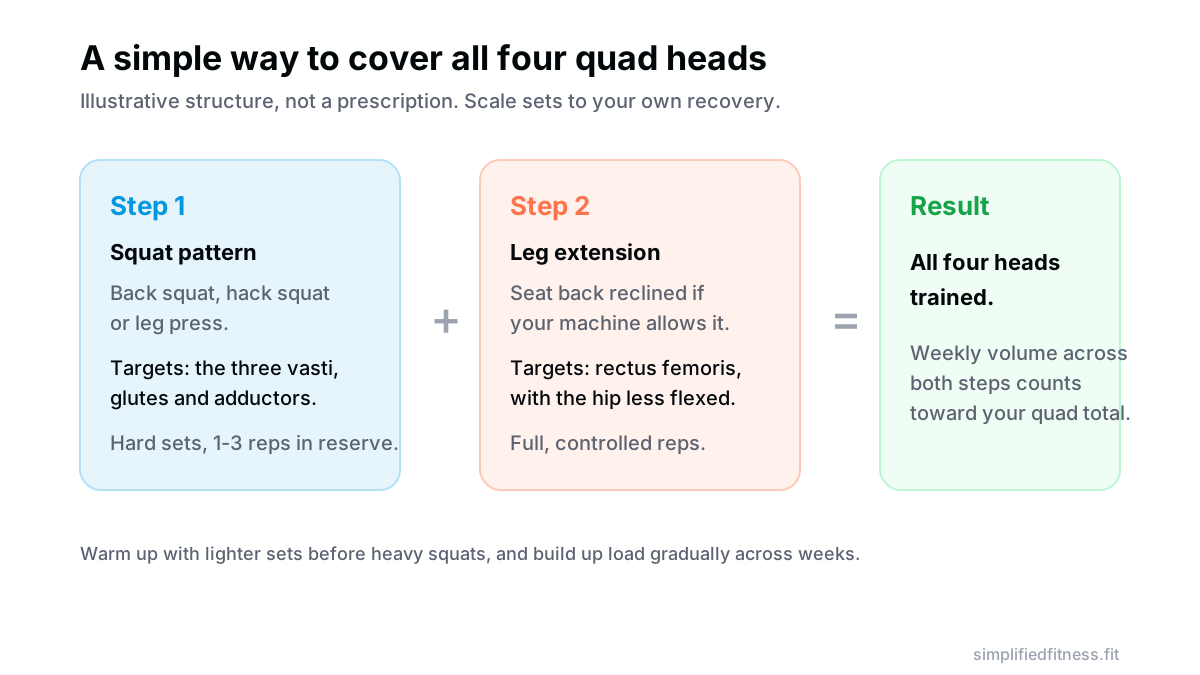
- Squat pattern: back squat, hack squat or leg press, for the vasti, glutes and adductors.
- Leg extension: seat reclined if possible, full controlled range.
- Volume: a common starting range is roughly 6-10 hard sets per muscle per week, spread over two sessions, finishing sets with 1-3 reps in reserve. Count both exercises toward your quad total. Check your numbers with our training volume calculator.
- Progression: add a rep or a little load each week, and add sets only if progress stalls and you are recovering well.
Not sure how to slot this into a week? Our leg day plan shows one way to lay out the exercises. If you have no leg extension machine, sissy squats and reverse Nordics work the quads in a hip-extended position, though they are harder on the knees and you should build up to them. Hack squats are another useful squat-pattern option.
For budget and Indian gym context: most commercial gyms in India have a leg extension and a leg press even when the free weight area is small. If your gym has only one, use it plus a bodyweight or goblet squat variation, and be consistent. Protein from dal, paneer, curd and eggs supports recovery, but it does not change which muscle you load.
Quad tear prevention: what the evidence says
A quad strain is a tear in the muscle fibres, from mild to severe. Most of what we know comes from athletes, not gym lifters.
In seven AFL seasons (2014 to 2020) at elite level, 164 quadriceps strains were recorded, and 91.3% involved the rectus femoris. Nearly half (48.4%) happened during kicking, most in the dominant kicking leg, and rectus femoris injuries took about 14 days longer to return from than vasti injuries. All re-injuries involved the rectus femoris (Pietsch et al., 2024). A 2026 clinical review describes the typical presentation as anterior thigh pain after kicking or sprinting, often with a sudden “pop”, and notes that no treatment algorithm has been established (Mullen et al., 2026).
What that implies for you, hedged appropriately:
- The risk context is kicking and sprinting, so build up football, sprint or kicking exposure gradually.
- The data are from elite male footballers. They may not apply to casual lifters.
- We did not find a trial showing a specific gym exercise prevents quad strains, so sensible steps (a warm-up, building load gradually, not training through sharp pain) are common-sense measures, not proven shields.
If your knee hurts rather than your thigh, see knee pain leg workout modifications and speak to a clinician if pain persists.
The bottom line
Your quads are four muscles with two jobs. The three vasti straighten the knee. The rectus femoris does that and also flexes the hip, which is why it behaves differently in exercise. Squats are a great base for the vasti, but trials suggest they may not reliably grow the rectus femoris, while leg extensions do, especially with the hip more extended.
You do not need to overthink it. Pick one squat pattern, add one leg extension, train both hard, and keep an eye on your total weekly sets. Research here is short term and mostly in men, so treat the specifics as a sensible starting point, not a law.
Frequently Asked Questions
What are the four muscles of the quadriceps?
The quadriceps is made of the rectus femoris, vastus lateralis, vastus medialis and vastus intermedius. Together they straighten the knee, and the rectus femoris also helps flex the hip. Train all four by combining a squat pattern with a leg extension.
Which quad muscle crosses the hip joint?
Only the rectus femoris crosses both the hip and the knee. The three vasti start on the thigh bone and cross only the knee. That is why hip position changes how hard the rectus femoris works, so use a reclined leg extension seat if your machine allows it.
Do squats work the rectus femoris?
Squats load it, but the evidence suggests they are a weak growth stimulus for it. In an MRI trial, 10 weeks of squatting grew the knee extensors overall while the rectus femoris volume did not change, and a second trial found no rectus femoris growth after 8 weeks of squat-type training. Add leg extensions if you want it covered.
Why do leg extensions grow the rectus femoris better than squats?
In a leg extension the hip angle stays fixed, so the rectus femoris does all of its work at the knee. In a squat the hip and knee bend together, so the muscle shortens at the hip while it lengthens at the knee, which may limit how much its overall length changes under load. One trial with matched volume found all three regions of the rectus femoris grew with leg extensions, and only one region of the vastus lateralis grew with Smith machine squats.
Is the leg extension bad for your knees?
Not for most healthy people, though some with knee pain find it uncomfortable. The load sits at the end of the lever, so a pain-free range and moderate loading matter more than the exercise name. If the front of your knee hurts, reduce the range or load and see a physiotherapist if it persists.
What does the vastus medialis do, and can you train it separately?
The vastus medialis helps straighten the knee, mostly through the lower inner thigh. Research does not show that you can isolate it with a special exercise, so full-range squats, leg presses and leg extensions are the practical way to train it. Ignore claims about 'teardrop only' exercises.
What does the vastus intermedius do?
It sits deep under the rectus femoris on the front of the femur and extends the knee. You cannot see it directly, but it adds to overall thigh size and strength. It is trained by the same knee extension work as the other vasti.
How do you grow the outer quad sweep?
The outer sweep is mostly the vastus lateralis, one of the largest vasti. Hard sets of squats, hack squats or leg presses train it well, and in one trial Smith machine squats grew its central region. Get your sets close to failure and add load over weeks rather than hunting for a special angle.
How many sets per week do quads need?
Many lifters grow with roughly 6-10 hard sets per muscle per week, trained across two sessions, then add more only if progress stalls. Count squat pattern sets and leg extension sets together. Use our training volume calculator to check your weekly total.
How common are rectus femoris strains?
A 2026 clinical review describes them as infrequently reported, and most of the data we have come from athletes rather than gym lifters. In elite Australian football, 91.3% of quadriceps strains involved the rectus femoris, and almost half happened while kicking. If you play football or sprint, build up kicking and sprinting volume gradually.
Can I prevent a quad tear?
You cannot eliminate the risk, but strong quads, gradual build-up of sprinting and kicking, and a proper warm-up are sensible steps. We could not find a trial showing that a specific gym exercise prevents quad strains, so treat these as common-sense steps, not guarantees. If you feel a sudden pop or sharp pain in the front of the thigh, stop and get it assessed.
Should I train the quads with partial reps?
Partial reps that stay at long muscle lengths can be effective, but they are not a replacement for full range work. A systematic review found training at longer muscle lengths, via partials or full range, tended to give good quad growth. Use full range most of the time and keep your joints comfortable.
Do I need leg extensions if I can already squat heavy?
Heavy squats build strong legs, but the evidence suggests the rectus femoris may be under-trained by squats alone. If your front thigh looks full on the sides but flat down the middle, a few hard sets of leg extensions are a cheap fix. If you only have access to a barbell, sissy squats or similar hip-extended knee work are the alternative.
Sources & References
Every claim above is checked against peer-reviewed research (PubMed, U.S. National Library of Medicine) or guidance from established health bodies. How we fact-check.
- Kubo K, et al. Effects of squat training with different depths on lower limb muscle volumes. Eur J Appl Physiol. 2019. PMID: 31230110
- Earp JE, et al. Inhomogeneous quadriceps femoris hypertrophy in response to strength and power training. Med Sci Sports Exerc. 2015. PMID: 25811947
- Zabaleta-Korta A, et al. The role of exercise selection in regional muscle hypertrophy: a randomized controlled trial. J Sports Sci. 2021. PMID: 34743671
- Larsen S, et al. The effects of hip flexion angle on quadriceps femoris muscle hypertrophy in the leg extension exercise. J Sports Sci. 2025. PMID: 39699974
- Mitsuya H, et al. Hip flexion angle affects longitudinal muscle activity of the rectus femoris in leg extension exercise. Eur J Appl Physiol. 2023. PMID: 36795130
- Kassiano W, et al. Which ROMs lead to Rome? A systematic review of the effects of range of motion on muscle hypertrophy. J Strength Cond Res. 2023. PMID: 36662126
- Pietsch S, et al. Epidemiology of quadriceps muscle strain injuries in elite male Australian football players. Scand J Med Sci Sports. 2024. PMID: 37994173
- Mullen S, et al. Injuries to the rectus femoris: a review of evaluation, management, and return to sport. J Am Acad Orthop Surg. 2026. PMID: 41248256

Umair Hazrami · Founder & Head Coach, Simplified Fitness
Umair Hazrami founded Simplified Fitness and the Simplified Lifter channel to cut through fitness noise. With 4+ years of consistent training and 10+ coaching clients, he writes every guide from the peer-reviewed research and links the sources so you can check them. Our editorial standards.
Educational content only, not medical advice. If you have a medical condition, are pregnant, or take medication, talk to a qualified doctor before changing your diet, supplements or training. Full disclaimer.
Keep reading
Exercise Technique
Adductor Magnus Training: Seated Adductor Machine and Copenhagen Planks for Thigh Mass
Adductor magnus training explained: what research says on deep squats, the adductor machine and Copenhagen planks for thicker inner thighs and groin strength.
7 min read
Exercise Technique
High Bar vs Low Bar Squat: Which Builds More Quad Muscle?
High bar vs low bar squat for hypertrophy: what torso lean, knee travel and EMG studies show, why high-bar leans quad, and when low-bar still makes sense.
8 min read
Exercise Technique
Calf Hypertrophy Science: Standing vs Seated Calf Raises (Gastrocnemius vs Soleus)
Calf hypertrophy explained: why calves seem stubborn, what the trials say on exercise choice, stretch and foot position, plus weekly sets, reps and frequency.
9 min read
Exercise Technique
Complete Leg Workout Programming: Quad Day vs Hamstring and Glute Day
Best leg workout routine science: split leg day into a quad session and a hamstring-glute session, with sets, order and a 5-week plan that avoids burnout.
9 min read