Romanian Deadlifts (RDL): Hip Hinge Cues, Pelvic Positioning, and Hamstring Tension
Romanian deadlift (RDL) form made simple: hip hinge cues, where to stop, dumbbell vs barbell, and how to feel hamstrings instead of your lower back.

TL;DR. The short answer
- Good romanian deadlift form is a hip hinge: push your hips straight back, keep soft knees (roughly 15-20 degrees of bend), and slide the bar along your thighs until your hamstrings are stretched.
- Stop each rep where your hips stop moving back and before your lower back starts to round. For most people that is somewhere between knee and mid-shin, and it is fine if yours is higher.
- In trained lifters the RDL produced high hamstring and glute activity, and in one study of untrained people 9 weeks of stiff-leg deadlifts grew the semimembranosus (one of the hamstrings), so it is a sound main hamstring and glute lift.
- Barbell and dumbbell RDLs train the same hinge. Use the barbell if you want easy heavy loading, dumbbells if you are learning or training at home.
- Persistent back pain, pain that travels down a leg, or numbness during or after deadlifting is a reason to see a doctor or physio, not to push through.
Part of our complete guide: Complete Lower-Body & Core Training Guide: Quads, Glutes, Hamstrings, Calves & Abs Science
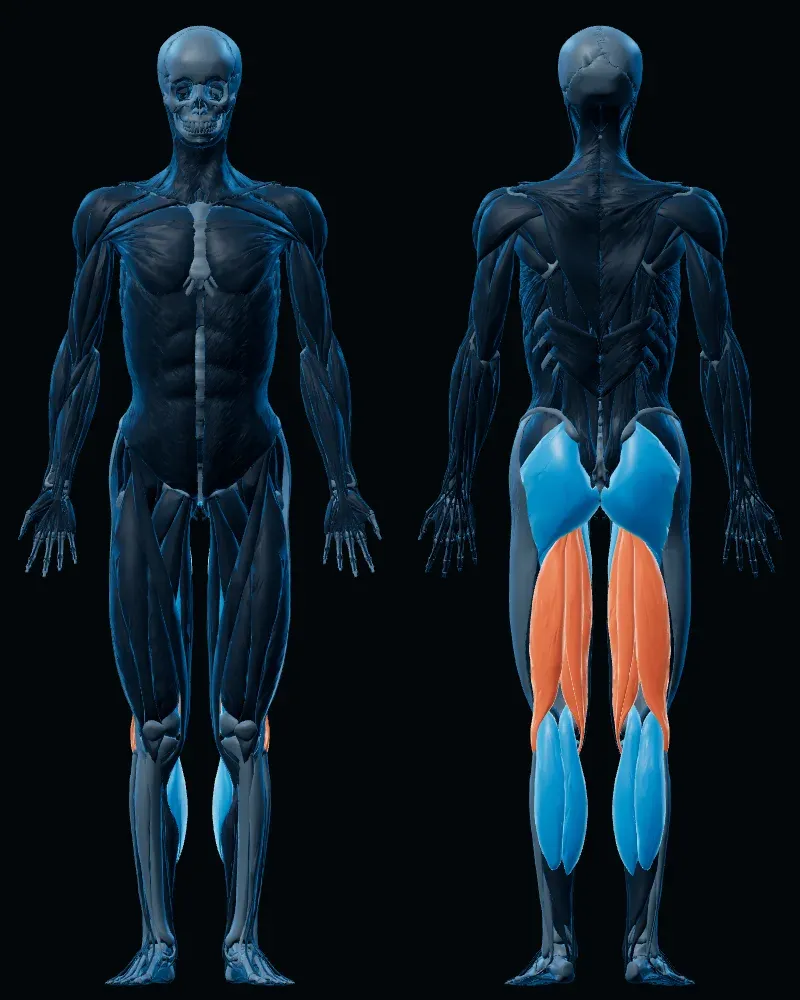
Muscles worked: hamstrings
Main movers: biceps femoris, semitendinosus and semimembranosus
Assisting: glutes, calves and adductor magnus
Table of contents
Good romanian deadlift form comes down to one idea: your hips travel backward, not just down. Keep a soft knee bend, keep the bar against your thighs, and stop when your hamstrings are fully stretched and before your lower back rounds.
When people say RDLs “only hit my back,” the usual culprit is a bent-over reach instead of a hinge. This guide fixes that, as part of our complete lower body and core training guide. We will cover the setup, the cues, where to stop, dumbbell vs barbell, straps, and what the research does and does not say.
What is the Romanian deadlift actually training?
The RDL is a hip extension exercise. The hamstrings and glutes lengthen as your hips move back, then shorten to bring you upright. Your spinal erectors work isometrically the whole time to hold your torso still, which is why your back feels it too.
Here is what the studies show. In a 2014 study, twelve weight-trained men did leg curls, good mornings, glute-ham raises and RDLs at 85% of their one-rep max while researchers recorded surface EMG. Hamstring activity was highest in the RDL and the glute-ham raise, and the semitendinosus was consistently more active than the biceps femoris across exercises (McAllister et al., 2014).
A 2019 study of eight men with at least a year of lower-body training compared the back squat, RDL and barbell hip thrust. At one-rep max, hip thrust glute activity beat the squat, but was not significantly different from the RDL. The authors concluded the RDL was about as effective as the hip thrust for isolating the hip extensors (Delgado et al., 2019).
Does it grow muscle? One 2025 trial gave 36 untrained adults 9 weeks of either Nordic curls, stiff-leg deadlifts or no training. The stiff-leg deadlift group improved their 1RM by about 34% and showed growth in the semimembranosus of about 11% (Morin et al., 2025). That is a small study in beginners, so results in trained lifters may be smaller, but it supports the RDL family as a real hamstring builder. For a muscle-by-muscle map of the hamstrings, see hamstring anatomy: biceps femoris and semitendinosus.
How do you do a Romanian deadlift step by step?
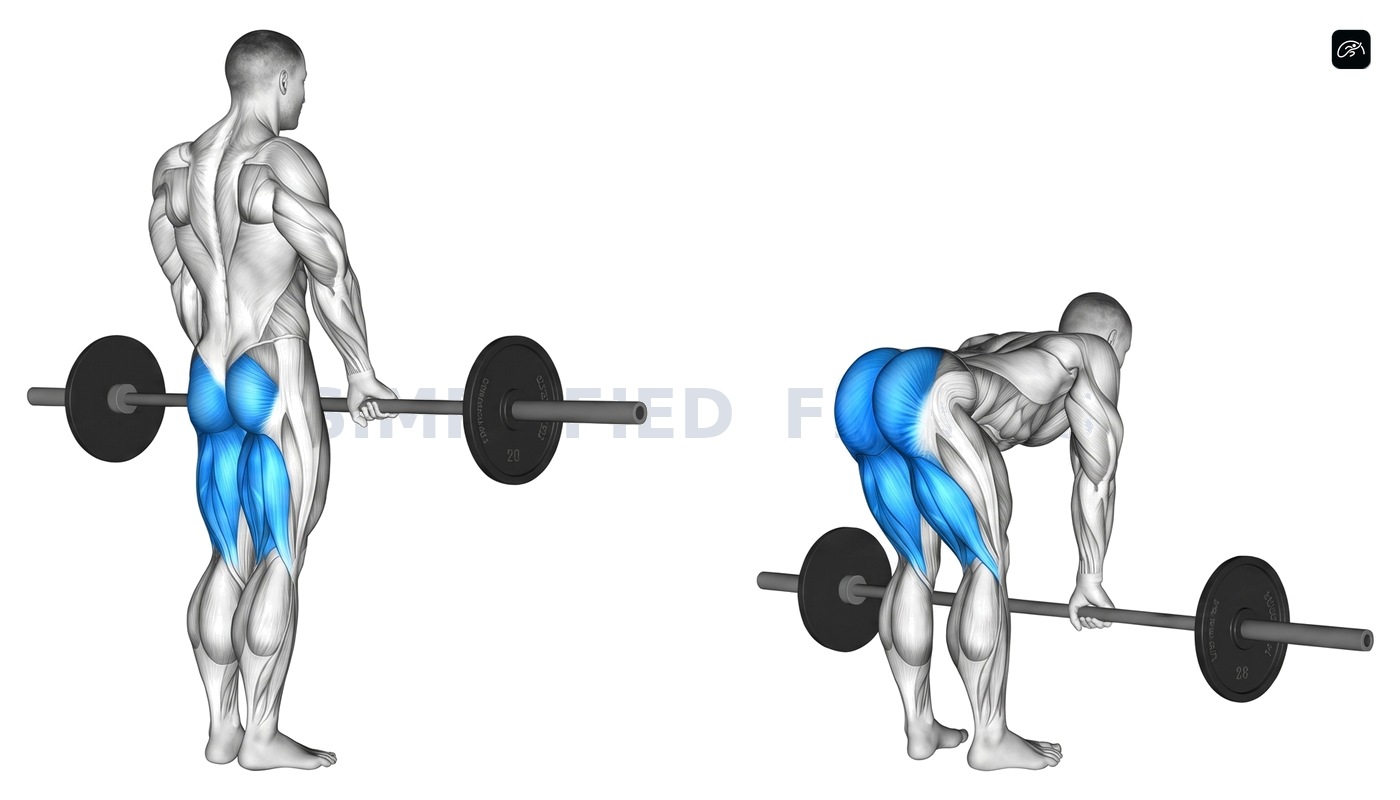
Think in four moves.
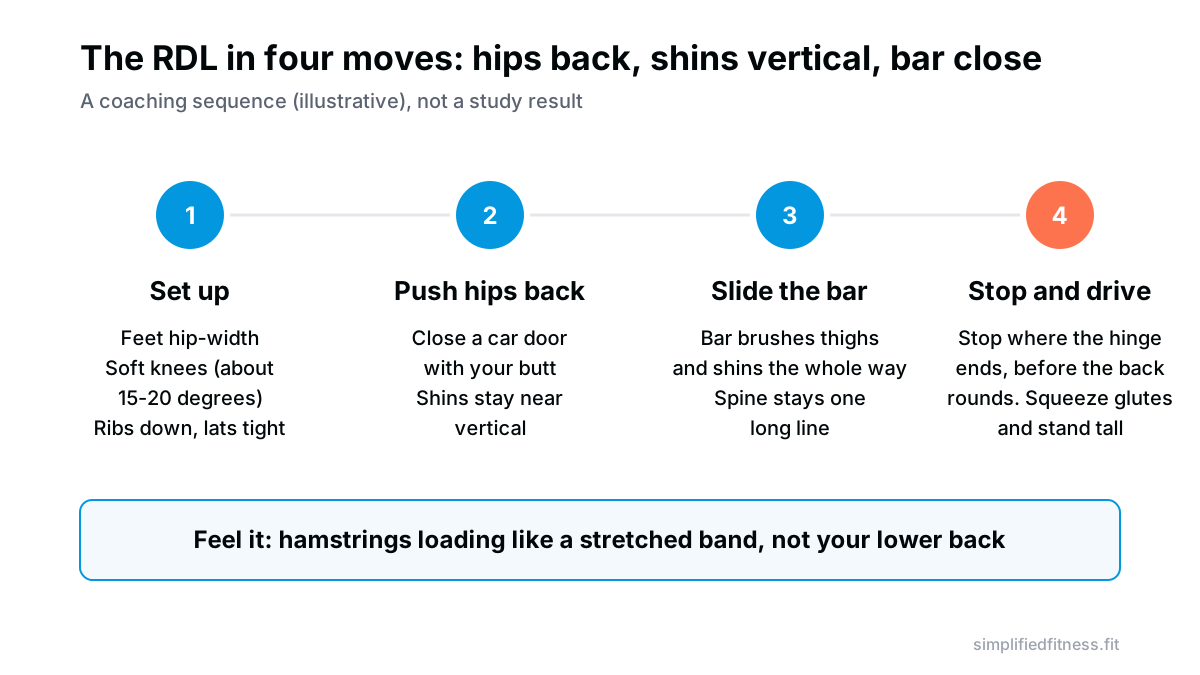
1. Set up. Stand with feet about hip-width apart, bar or dumbbells in hand, and a soft knee bend of roughly 15-20 degrees. That number is a coaching cue, not a lab finding. Pull your shoulders down and back to switch on your lats, and keep your ribs stacked over your pelvis.
2. Push the hips back. The classic cue is “close a car door with your butt.” Your hips travel straight back behind your heels while your knees stay at the same small angle. Your shins stay close to vertical.
3. Slide the bar. Let the bar brush your thighs and shins the whole way. A bar that drifts forward increases the lever arm on your back and moves the stretch out of the hamstrings.
4. Stop, then drive. Reverse by pushing your feet into the floor and driving your hips forward, finishing with a glute squeeze rather than leaning back.
How low should you go on an RDL?
This is the question that decides whether the lift is a hamstring exercise or a back exercise.
The honest answer: lower is useful only while your hips are still travelling back and your spine position holds. A 2020 systematic review of range-of-motion trials found that training lower-body muscles through a full range of motion appeared better for growth than partial range, though only six studies were included and the review notes that responses may differ by muscle (Schoenfeld & Grgic, 2020). Full range matters, but “full” means your full controlled hinge, not the position your back can reach by rounding.
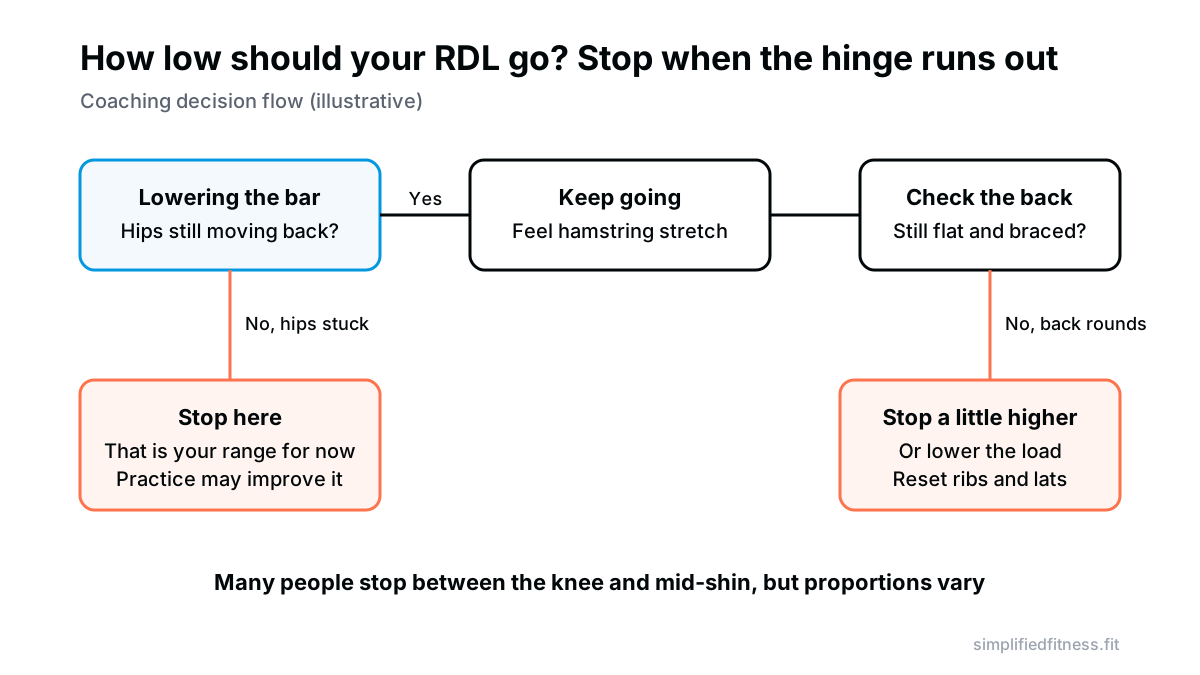
Most lifters end up somewhere between just below the knee and mid-shin. Some tall or very flexible people can go lower, some people with tight hamstrings stop near the knee, and both are fine. Your range may creep down as your flexibility and control improve.
How do I do RDLs without lower back pain?
Back effort in a hinge is normal. Back pain is a different thing. A few adjustments keep the load where you want it:
- Brace before you move. Take a breath into your belly, tighten your trunk, and keep that tension through the rep.
- Keep the bar glued to your legs. Distance from the body is what turns a hinge into a back lift.
- Shorten the range, not the quality. Stop 5-10 cm higher than you think you should.
- Lower the load. If your spine position changes by rep six, the weight or the rep target is too high.
- Slow the lowering. About two to three seconds down makes the stretch easier to feel and your positions easier to hold.
If you want the broader picture on lifting and spine health, read are deadlifts bad for your lower back, and for back muscle training with RDLs see spinal erector training with back extensions and RDLs.
Dumbbell vs barbell RDL: which is better?
I do not know of a trial showing that one grows hamstrings more than the other, so this is a practical decision rather than a scientific one.
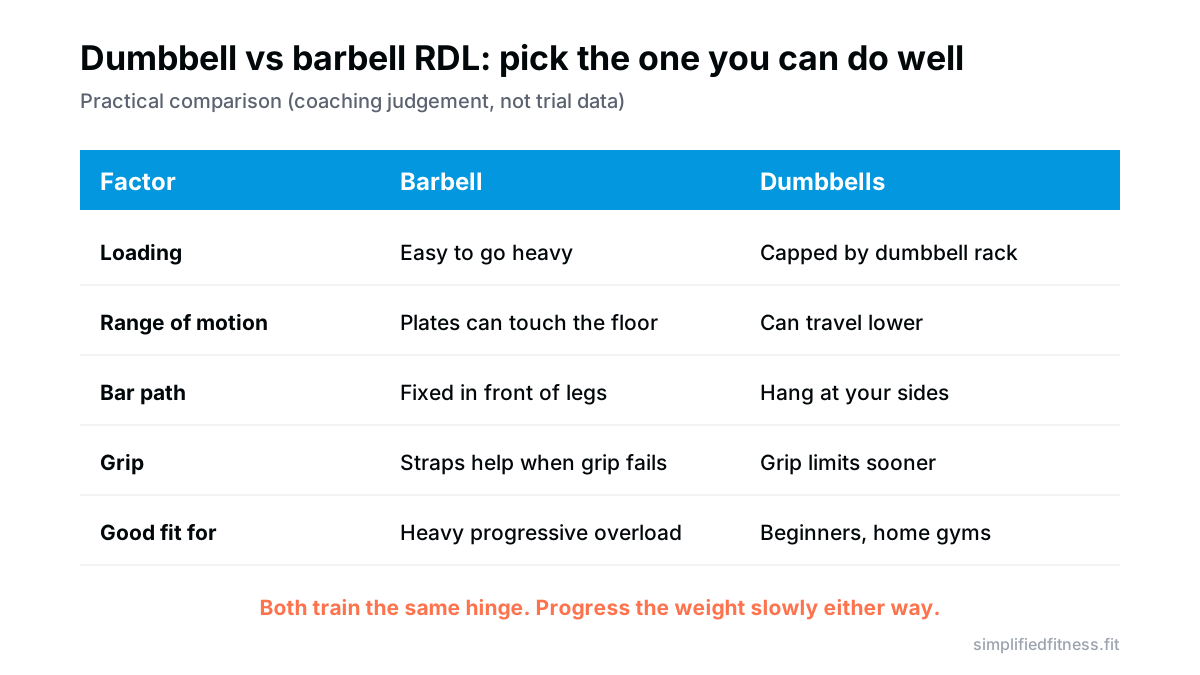
Barbell: easiest to load heavily and progress in small plate jumps. The plates limit how low you can go if you stand on the floor, and some people find the fixed bar path restrictive.
Dumbbells: hang at your sides, can travel lower, and are friendlier for beginners and home gyms. If your gym’s dumbbells top out around 30-40 kg, you may outgrow them for two-legged RDLs. Then you can slow the tempo, pause at the bottom, or switch to a single-leg version.
Straps: your grip often fails before your hamstrings on heavy sets. Straps let the hamstrings decide when you are done. Use them on your hardest sets, and train grip separately.
What do RDLs not do?
An RDL trains the hamstrings at the hip. It does not train them at the knee. Activity in the biceps femoris differs by region and exercise: in a 2022 study of 15 trained women, the RDL produced lower biceps femoris activation than Nordic curls, leg curls and kickbacks, in several regions of the muscle (Stevens et al., 2022). That is one small EMG study, and EMG is not growth, but it fits the logic of pairing the hinge with a knee-flexion exercise. Our guide to seated vs lying leg curls covers the second half.
Do RDLs help with hamstring injury prevention?
Maybe, and that deserves a hedge. In a 2025 randomized trial of 32 healthy young adults, an eccentrically biased RDL and the Nordic hamstring exercise were compared over 6 weeks, training twice a week. Biceps femoris long head fascicle length rose by about 9% with no difference between groups, while pennation angle fell. The fascicle changes returned to baseline after a 2-week detraining period, though hamstring cross-sectional area stayed elevated (Crawford et al., 2025). This was short, in young healthy people, and did not measure injuries, so it supports RDLs as an option but does not show they prevent injury. If Nordics are your preference, see Nordic hamstring curls and fascicle lengthening.
How to program RDLs for hamstring and glute growth
A simple starting point, not a rule:
- Sets and reps: 2-4 hard sets of 6-12 reps.
- Frequency: once or twice a week, spread across different days.
- Effort: finish with 1-3 reps in reserve. Our RIR and RPE calculator helps you practise judging that.
- Tempo: 2-3 seconds down, short pause in the stretch, then drive up.
- Progression: add reps first, then weight in small jumps, and only if your hinge looks the same.
Put them after your main quad lift on leg day or first on a hamstring-focused day. Our leg day plan shows one way to fit a hinge into a full session, and for the glute side of things, read glute max hypertrophy: hip thrusts vs squats.
If you want to stretch the hamstrings harder, the principle is covered in stretch-mediated hypertrophy, but remember that stretch is only useful while your spine stays put.
Quick checklist before every set
- Soft knees, same angle all the way.
- Hips go back first.
- Bar touches your thighs.
- Ribs down, lats tight.
- Stop when the hinge ends.
- Stand tall with your glutes, not your lower back.
Most people improve their RDL more by lowering the weight and tidying the hinge for a few weeks than by adding another plate.
Frequently Asked Questions
How do you do a Romanian deadlift correctly?
Stand hip-width with soft knees, brace your trunk, then push your hips back while the bar slides down your thighs. Lower until you feel a strong hamstring stretch and your hips stop travelling backward, then squeeze your glutes to stand up. Start light enough that you can pause at the bottom without your lower back rounding.
How do I do RDLs without lower back pain?
Keep your ribs stacked over your pelvis and stop the rep before your lower back rounds. A common cause of RDL back discomfort is reaching too low with the bar drifting away from the legs, which turns a hinge into a lower-back lift. Cut the range by a few centimetres, keep the bar touching your thighs, and see a doctor if pain persists or spreads into a leg.
How low should a Romanian deadlift go?
As low as you can go while keeping your spine position and still feeling the stretch in your hamstrings. That point is set by your hamstring flexibility and body proportions, so it varies from person to person. A systematic review found that lower-body training through a full range of motion tended to beat partial range for muscle growth, but only if you control the position.
What is the difference between an RDL and a stiff-leg deadlift?
They are close cousins, and the names are used loosely in gyms. The RDL usually keeps a soft knee bend and starts from standing each rep, while a stiff-leg deadlift often uses straighter legs and may start from the floor. The practical goal is the same: a hamstring-heavy hip hinge, so choose the version where you feel your hamstrings the most.
How much should my knees bend in an RDL?
A small, fixed bend of roughly 15-20 degrees is a good starting cue. Bending more turns the lift into a squat-like movement that shifts work toward the quads, while some people find locking the knees straight uncomfortable behind the knee. Set the angle at the top and keep it the same throughout the set.
Dumbbell RDL or barbell RDL for hamstrings?
Both train the same hip hinge, so the better one is the one you can perform with good form and progress over time. The barbell makes heavy loading easy, while dumbbells hang at your sides and can travel a bit lower, which suits beginners and home gyms. There is no trial that I know of showing one grows hamstrings more than the other, so treat this as a practical choice.
Should I use straps on RDLs?
Straps are a reasonable tool when your grip gives out before your hamstrings do. They let the target muscle, not your forearms, decide when the set ends. Keep grip training in your plan separately, and use straps on your heaviest sets rather than every warm-up.
Do RDLs build hamstrings and glutes?
Yes, they are a strong hip extension exercise for both. In one study of trained men, the RDL and the barbell hip thrust did not differ significantly in glute activity at maximal loads, and in a 9-week trial untrained participants gained semimembranosus volume from stiff-leg deadlifts. Pair RDLs with a leg curl, since they do not train the knee-bending role of the hamstrings.
Are RDLs better than leg curls for hamstrings?
Neither replaces the other. RDLs train the hamstrings at the hip, while leg curls train them at the knee, and activity patterns differ by exercise and by hamstring region. Including one hinge and one curl in your week is a sensible way to cover both jobs.
How many sets and reps of RDLs should I do?
For most lifters, 2-4 hard sets of 6-12 reps, once or twice a week, is a reasonable starting range. Slow, controlled lowering and leaving 1-3 reps in reserve keeps the work in the hamstrings and out of your lower back. Use our RIR and RPE calculator if you want to practise judging how close to failure you are.
Why do I feel RDLs in my lower back instead of my hamstrings?
Usually the bar has drifted forward, the hips are not travelling back far enough, or the rep goes lower than your hinge allows. The spinal erectors work hard to hold your torso position in any hinge, so some lower-back effort is normal, but sharp or lingering pain is not. Lighten the load, shorten the range and keep the bar against your legs.
Do RDLs help prevent hamstring injuries?
Possibly, though the evidence is limited to short training studies. In a 6-week trial of young healthy adults, an eccentrically biased RDL increased biceps femoris long head fascicle length by about 9%, similar to the Nordic hamstring exercise, but these changes returned to baseline after 2 weeks of detraining. If injury prevention is your goal, keep training the hamstrings consistently rather than expecting a one-off block to protect you.
Can I do RDLs if I am a beginner or have a stiff back?
Yes, most beginners can learn the hinge with a light dumbbell or even a broomstick against the spine. Start with a short range, rehearse the hip movement, and add load slowly. If you have a known back condition, diagnosed injury or ongoing pain, check with your doctor or physio before loading the hinge.
Sources & References
Every claim above is checked against peer-reviewed research (PubMed, U.S. National Library of Medicine) or guidance from established health bodies. How we fact-check.
- Crawford SK, et al. Hamstrings Muscle Architecture and Morphology Following 6 wk of an Eccentrically Biased Romanian Deadlift or Nordic Hamstring Exercise Intervention. Med Sci Sports Exerc. 2025. PMID: 40085810
- McAllister MJ, et al. Muscle activation during various hamstring exercises. J Strength Cond Res. 2014. PMID: 24149748
- Delgado J, et al. Comparison Between Back Squat, Romanian Deadlift, and Barbell Hip Thrust for Leg and Hip Muscle Activities During Hip Extension. J Strength Cond Res. 2019. PMID: 31356511
- Stevens BM, et al. Muscle Activation Patterns of the Proximal Medial and Distal Biceps Femoris and Gluteus Maximus Among 6 Hip Extension and Knee Flexion Exercises in Trained Women. Int J Exerc Sci. 2022. PMID: 35989703
- Schoenfeld BJ, Grgic J. Effects of range of motion on muscle development during resistance training interventions: A systematic review. SAGE Open Med. 2020. PMID: 32030125
- Morin T, et al. Robustness of hamstring muscle activation strategies following selective hypertrophy induced by Nordic hamstring curl and stiff-leg deadlift exercises. J Appl Physiol. 2025. PMID: 40586278

Umair Hazrami · Founder & Head Coach, Simplified Fitness
Umair Hazrami founded Simplified Fitness and the Simplified Lifter channel to cut through fitness noise. With 4+ years of consistent training and 10+ coaching clients, he writes every guide from the peer-reviewed research and links the sources so you can check them. Our editorial standards.
Educational content only, not medical advice. If you have a medical condition, are pregnant, or take medication, talk to a qualified doctor before changing your diet, supplements or training. Full disclaimer.
Keep reading

Exercise Technique
Adductor Magnus Training: Seated Adductor Machine and Copenhagen Planks for Thigh Mass
Adductor magnus training explained: what research says on deep squats, the adductor machine and Copenhagen planks for thicker inner thighs and groin strength.
7 min read
Exercise Technique
High Bar vs Low Bar Squat: Which Builds More Quad Muscle?
High bar vs low bar squat for hypertrophy: what torso lean, knee travel and EMG studies show, why high-bar leans quad, and when low-bar still makes sense.
8 min read
Exercise Technique
Calf Hypertrophy Science: Standing vs Seated Calf Raises (Gastrocnemius vs Soleus)
Calf hypertrophy explained: why calves seem stubborn, what the trials say on exercise choice, stretch and foot position, plus weekly sets, reps and frequency.
9 min read
Exercise Technique
Complete Leg Workout Programming: Quad Day vs Hamstring and Glute Day
Best leg workout routine science: split leg day into a quad session and a hamstring-glute session, with sets, order and a 5-week plan that avoids burnout.
9 min read