Optimal Training Volume and Frequency: How Many Sets per Muscle Actually Build Muscle
What is the optimal training volume for muscle growth? See where weekly sets stop paying off, if 2x or 3x a week matters, and how to count compound sets.

TL;DR. The short answer
- For most lifters, roughly 10-20 hard sets per muscle per week is where muscle growth tends to level off. 6-10 sets still produces solid gains and is a sensible starting point.
- Muscle growth rises with weekly volume, but with diminishing returns. A 2026 meta-regression of 67 studies found every extra set helped less than the one before.
- When weekly sets are matched, training a muscle 1, 2 or 3 times a week produces similar growth. Frequency is mainly a tool for spreading sets out so each one is good quality.
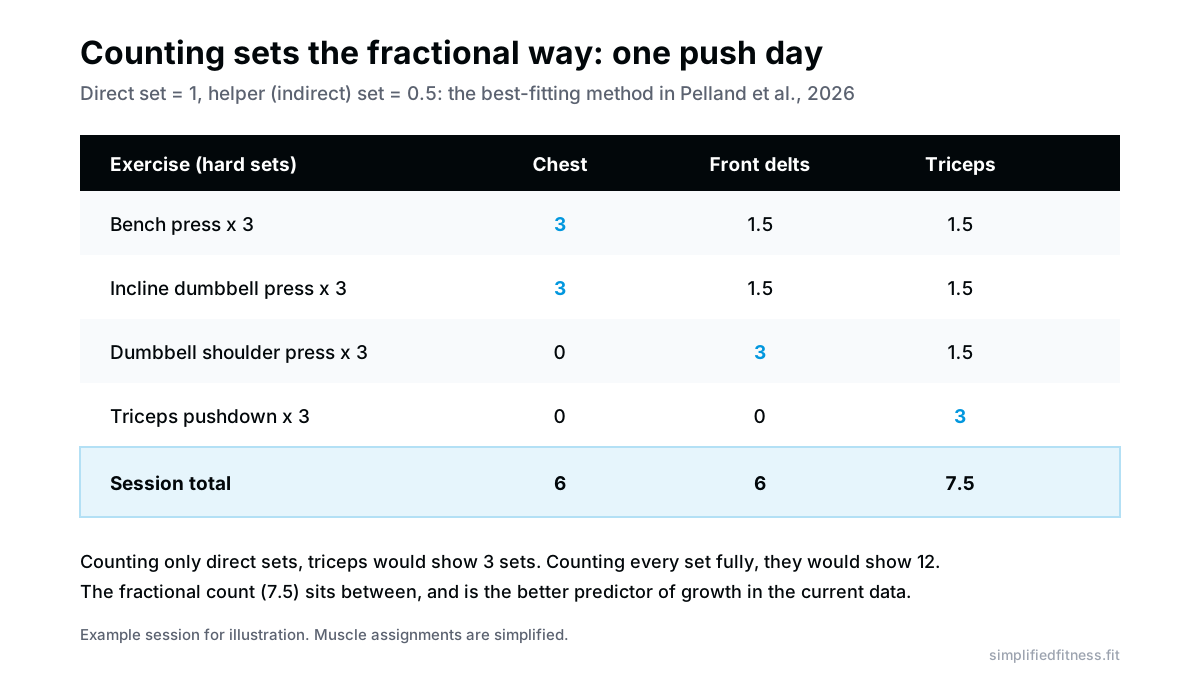
- Count compound sets as half a set for helper muscles (for example, bench press counts 0.5 toward triceps). This fractional method predicted growth best in the largest analysis so far.
- Junk volume is sets that add fatigue without adding stimulus: sets far from failure, sloppy sets, or sets done after your performance has already crashed.
Table of contents
For most lifters, the optimal training volume for muscle growth is roughly 10-20 hard sets per muscle per week, and 6-10 sets already gets you a big share of the gains. More sets do build more muscle, but every extra set pays back less than the one before. How often you train a muscle matters far less than how many good sets you get through in the week.
That is the short answer. The longer one is more useful, because “10-20 sets” means nothing if you count sets wrong, cram them into one exhausted session, or pad them with half-effort reps.
This guide walks through what the dose-response studies actually measured, where productive volume ends and junk volume begins, how to count sets from compound lifts, and how to build a week you can recover from. It sits alongside our guide to muscle hypertrophy for natural lifters, which covers the bigger picture of how muscle grows.
What is the optimal training volume for muscle growth?
Training volume, in this guide, means hard sets per muscle per week. Not tonnage. Not total reps. Hard sets, meaning sets taken reasonably close to failure (we explain why that unit wins in hard sets vs tonnage).
Here is the working answer, then the evidence behind it:
- Under 5 sets per week: enough to maintain, and enough for real beginners to grow, but usually not enough to push trained muscle much.
- 6-10 sets: a strong starting point. Plenty of trained people grow well here.
- 10-20 sets: the range where most research shows growth beginning to level off.
- 20+ sets: sometimes a little more growth, sometimes nothing extra, always more fatigue.
The honest version: there is no single optimal training volume for everyone. There is a curve, and your job is to find where you sit on it.
What the dose-response research actually shows
The case for “more sets, more muscle” rests on several meta-analyses, and they agree on direction more than on exact numbers.
Krieger (2010) was the first big look at hypertrophy. Pooling 8 studies, multiple sets per exercise produced about 40% larger hypertrophy effect sizes than single sets, in both trained and untrained people (Krieger, 2010). Effect sizes crept up from 2-3 to 4-6 sets per exercise, but the difference between those two was not significant.
Schoenfeld and colleagues (2017) then looked at weekly sets per muscle across 15 studies. Each extra weekly set was associated with roughly 0.37% more muscle growth (Schoenfeld et al., 2017). When they split volume into under 5, 5-9 and 10+ sets per muscle per week, there was only a trend (p = 0.074) favouring the higher categories. That is the paper behind the popular “10+ sets” advice, and it is worth knowing the categorical result was not statistically significant.
Pelland and colleagues (2026) ran the largest analysis yet: 67 studies and 2,058 participants. Gains in both size and strength kept increasing as volume went up, but with diminishing returns, and those diminishing returns kicked in more sharply for strength than for size (Pelland et al., 2026).
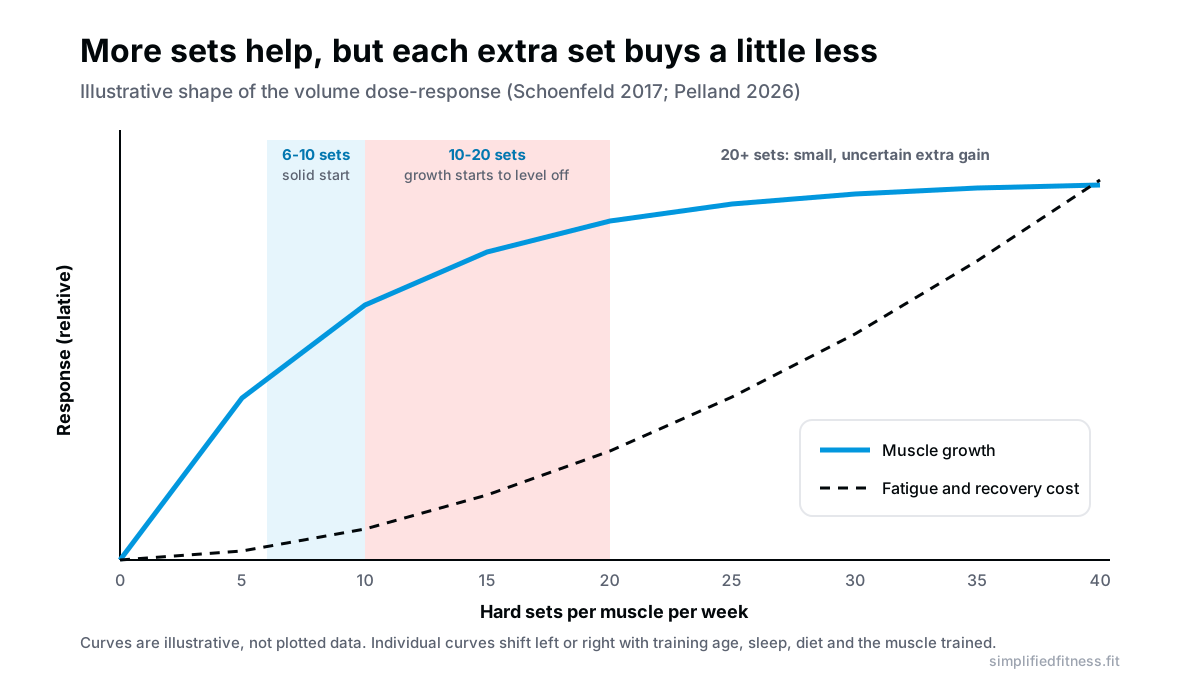
Put plainly: the first few sets are worth a lot. Sets 15-20 are worth something. Set 30 is worth very little, and it costs you.
For a deeper walk-through of the curve itself, see the weekly set volume dose-response curve.
Where does 10-20 sets come from, and is more ever better?
This is where the trials disagree, and it is worth seeing why.
| Study | Who | Weekly volume compared | What happened to muscle size |
|---|---|---|---|
| Schoenfeld et al., 2019 | 34 trained men, 8 weeks | 1, 3 or 5 sets per exercise, 3 sessions a week | Higher volume grew elbow flexors and thighs more |
| Heaselgrave et al., 2019 | 49 trained men, 6 weeks | 9, 18 or 27 biceps sets | All grew; no significant difference; 18 sets looked best on effect size |
| Brigatto et al., 2022 | 27 trained men, 8 weeks | 16, 24 or 32 sets | 32 sets beat 16 for thighs and triceps |
| Enes et al., 2024 | 31 trained men, 12 weeks | Constant sets vs adding 4 or 6 sets every 2 weeks | No significant difference; possible small benefit that seemed to plateau |
| Baz-Valle et al., 2022 (review) | Trained men, 7 trials | Under 12, 12-20, over 20 sets | 12-20 matched 20+ for quads and biceps; triceps favoured 20+ |
The case for very high volume. In Schoenfeld’s 2019 trial, muscle growth showed a dose-response, with more growth in the five-set group at several sites, while strength gains were similar across groups (Schoenfeld et al., 2019). Brigatto’s group found 32 weekly sets produced more lower-body and triceps thickness than 16 (Brigatto et al., 2022).
The case for a plateau. Heaselgrave’s biceps trial found no significant difference between 9, 18 and 27 sets, with the 18-set group posting the largest average increase (9.5% versus 4.3% and 5.4%) (Heaselgrave et al., 2019). Enes and colleagues progressively added sets for the legs of experienced lifters (5 years of training on average) and saw clearly better strength, but only a possible small benefit for size that appeared to level off at the higher volumes (Enes et al., 2024). The 2022 review by Baz-Valle concluded that 12-20 weekly sets may be the best standard recommendation for young trained men (Baz-Valle et al., 2022).
Why might they differ? Small samples (often 9-17 people per group), short durations (6-12 weeks), different muscles, and different definitions of a “set.” Ultrasound measurements taken soon after hard training also raised a concern: was the extra “growth” just swelling? A 2026 study in 13 trained men tested this acutely. After sessions of 7, 14 or 21 lower-body sets, muscle thickness returned to baseline within 24 hours, with no sustained swelling, although 21 sets did produce higher effort ratings and worse perceived recovery (Alvarez et al., 2026). That is reassuring for the high-volume studies, but it was a short study of single sessions.
Is there a reason natural lifters might tolerate less? Possibly, though direct comparisons are thin. We cover that debate in natural vs enhanced volume tolerance.
Junk volume: where productive sets stop
“Junk volume” gets thrown around a lot. A useful definition: sets that add fatigue without adding meaningful stimulus. It is not a fixed number. Set 14 might be productive for one lifter and junk for another.
In practice, junk volume usually looks like one of these:
- Sets stopped far from failure. Ten easy reps with a weight you could lift 20 times are not a hard set, no matter what your log says.
- Sets after your performance has crashed. If your fifth set of curls is half the reps of your first, the stimulus per set has dropped, but the fatigue keeps coming.
- Ugly, momentum-fueled reps. Swinging the weight shifts work away from the target muscle.
- Redundant exercises. Three different flat pressing variations back to back, each started already fried.
- Volume you cannot recover from by the next session for that muscle. If you come back weaker, the extra sets probably cost more than they gave.
Here is the part that gets missed. Junk volume is not mainly about the number. A lifter doing 12 genuinely hard sets can be training more productively than one doing 25 sets where half are sloppy. Effort and execution decide whether a set counts. How close to failure each set should go is covered in our load, rep range and RIR guide.
More on spotting it in junk volume explained, and on the old low-volume, high-intensity school in HIT vs high-volume training.
How to count sets: direct sets and fractional volume
You cannot follow a set target if you do not know what counts as a set for which muscle. A bench press works your chest, but your triceps and front delts are clearly working too. Do those count?
The 2026 Pelland meta-regression tested three ways of counting: indirect sets counted as zero, as a full set, or as half a set. The fractional method (half a set) fit the data best (Pelland et al., 2026).
Practical rules for counting:
- Direct sets count as 1. Bench for chest, squats for quads, rows for upper back.
- Clear helper muscles count as 0.5. Triceps on presses, biceps on rows and pulldowns, front delts on chest presses, glutes on squats.
- Only count hard sets. Warm-ups and easy feeder sets do not go in the total.
- Do not count stabilisers. Your abs work during a squat. That does not make squats an ab session.
This matters most for arms and front delts. Many lifters doing a typical push-pull routine already accumulate several fractional sets for these muscles before a single curl or pushdown. Our deep dive on direct vs indirect fractional set volume works through full weekly examples, and the training volume calculator does the counting for you.
Volume landmarks: MV, MEV, MAV and MRV explained
The volume landmarks idea comes from a coaching framework, popularised by Mike Israetel and colleagues, rather than from a single study. It gives names to points on the dose-response curve:
| Landmark | What it means | Rough idea in practice |
|---|---|---|
| MV (maintenance volume) | Sets needed to keep the muscle you have | Often low, a handful of hard sets per week |
| MEV (minimum effective volume) | The least volume that produces noticeable growth | Where a training block might start |
| MAV (maximum adaptive volume) | The range that gives the best return | Where most productive training sits |
| MRV (maximum recoverable volume) | The most you can do and still recover | Pushing past this means going backwards |
The concept matches the research shape well: low volume maintains, more volume grows, and past some point you cannot recover. The specific numbers you see attached to each muscle online, though, are coaching estimates. They have not been tested in controlled trials muscle by muscle, and they shift with training age, sleep, diet, stress and how hard each set is.
So treat landmarks as a vocabulary, not a prescription. Two of our guides go further: volume landmarks MV, MEV, MAV and MRV and how they change across novice, intermediate and advanced lifters. For maintenance specifically (busy months, exam season, travel), see the science of maintenance volume.
Training frequency: is 2x or 3x a week better?
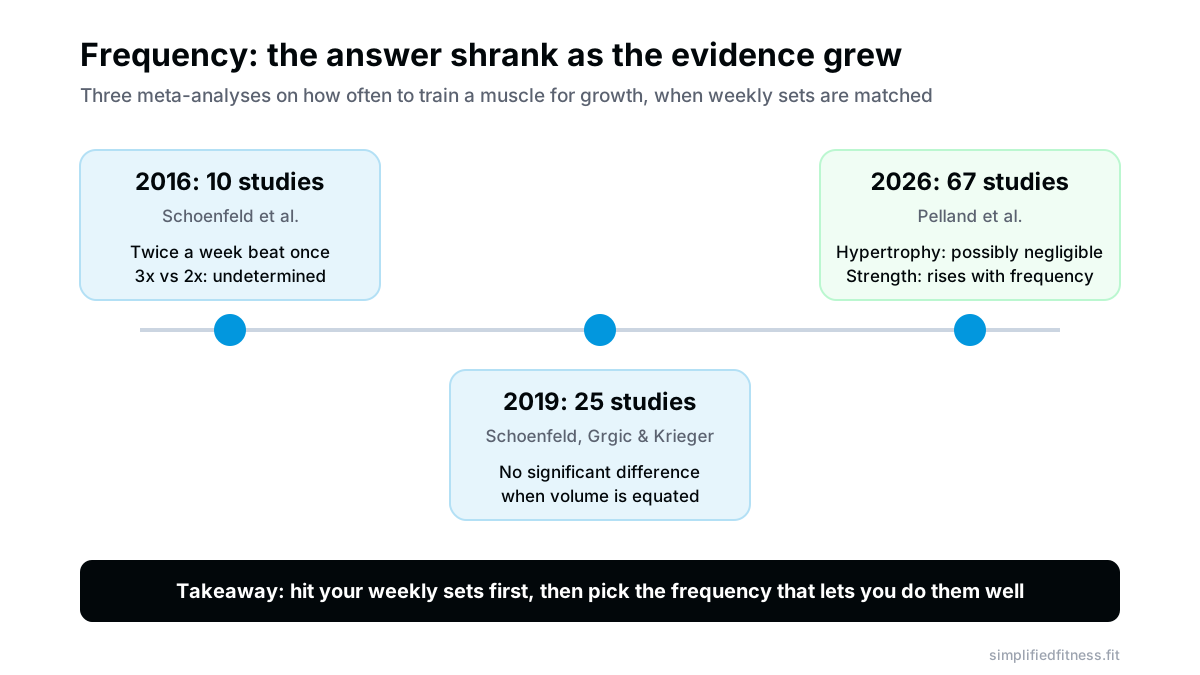
Short answer: when weekly sets are matched, frequency barely matters for muscle size. It matters a bit more for strength.
The evidence has shifted over a decade, which makes this a good example of how sports science corrects itself.
- 2016: A meta-analysis of 10 studies found higher training frequencies beat lower ones (effect sizes of 0.49 versus 0.30) and concluded that twice a week beat once a week on a volume-equated basis. Whether three times beat twice could not be determined (Schoenfeld et al., 2016).
- 2019: With 25 studies, the same research group found no significant difference between frequencies when volume was equated, including in trained lifters and with direct measures of muscle size. When volume was not equated, higher frequencies had a modest edge, probably because more sessions usually meant more sets (Schoenfeld et al., 2019).
- 2026: Across 67 studies, the effect of frequency on hypertrophy was compatible with being negligible, while strength gains did rise with frequency, again with diminishing returns (Pelland et al., 2026).
Two trials in trained men line up with this. Training muscles 2 versus 3 times a week for 10 weeks produced similar gains in strength and muscle thickness, though effect sizes slightly favoured the twice-a-week split (Lasevicius et al., 2019). Going from 3 to 6 sessions a week with volume and intensity equated did not add strength or fat-free mass over 6 weeks (Colquhoun et al., 2018).
So why does everyone still recommend hitting muscles twice a week? Because frequency is a tool for distributing volume. Sixteen sets of chest in one session is miserable, and the last several are likely done tired and sloppy. Split across two sessions, every set is done fresher. That is the real reason 2x usually wins in the gym, not some magic of protein synthesis timing.
For the full comparison, see training frequency 1x vs 2x vs 3x with equated volume. For how this shapes your weekly layout, our workout splits and session architecture guide and full body vs upper/lower vs PPL volume distribution go deeper.
How many sets per session is too many?
There is no well-established per-session cap. You will often hear “no more than 6-10 hard sets per muscle per session.” Treat that as a coaching rule of thumb, not a research finding.
What we do know points the same way:
- In Heaselgrave’s trial, 9 biceps sets done in one weekly session were enough to grow the muscle (Heaselgrave et al., 2019).
- In Alvarez’s study, 21 lower-body sets in one session produced higher ratings of effort and worse perceived recovery than 7 or 14 sets (Alvarez et al., 2026).
- Rep performance tends to fall across sets as fatigue accumulates, which is the practical sign that the next set is giving less.
A rough rule of thumb, not a tested cutoff: if your reps on a given exercise have dropped by around a third or more from your first working set at the same weight, you are probably in diminishing-returns territory for that muscle today. Move the remaining sets to another day. More detail in per-session set volume caps.
Recovery capacity: why your number is not someone else’s
Two lifters on the same program can respond very differently. Your volume tolerance depends on things outside the gym as much as inside it:
- Sleep. Short or broken sleep is one of the quickest ways to lower the volume you can recover from. Our sleep and recovery guide covers the details.
- Calories. In a deficit, recovery usually gets harder. Most people do better holding or trimming volume while cutting, as covered in volume adjustments during cutting.
- Protein. Hitting a solid daily protein intake supports recovery. For vegetarian lifters in India, that often means planning around dal, paneer, curd, soya chunks and milk rather than hoping roti and rice get you there.
- Life stress and work hours. A 10-hour shift plus a long commute eats into recovery the same way extra sets do.
- Heat. Training in a hot, humid gym in May is harder than the same session in December. Expect sessions to feel tougher and adjust effort rather than forcing extra sets.
- The muscle itself. Some muscles seem to tolerate more sets than others, discussed in muscle-specific volume tolerance.
- Training age. Beginners grow on less. Advanced lifters may need more, but have less room to waste.
There is also a cost to high volume beyond sore muscles, covered in the biological cost of high volume. For building a personal picture of what you tolerate, see individual recovery profiling.
Building your week: practical volume by experience level
These ranges are practical starting points based on the research above, not prescriptions tested as-is.
| Lifter | Weekly hard sets per muscle (direct + half of indirect) | Frequency per muscle | Notes |
|---|---|---|---|
| Beginner (under 1 year) | 6-10 | 2-3x | Focus on technique and adding load. More sets rarely needed yet. |
| Intermediate (1-3 years) | 10-16 | 2x | Most people make good progress here for a long time. |
| Advanced (3+ years) | 12-20, occasionally more for lagging muscles | 2-3x | Add volume slowly and only where progress has stalled. |
| Cutting or high-stress phase | Roughly 6-12 | 2x | Keep intensity high, trim sets before you trim heavy lifts. |
| Maintenance (busy period) | A few hard sets | 1-2x | Enough to hold muscle until life calms down. |
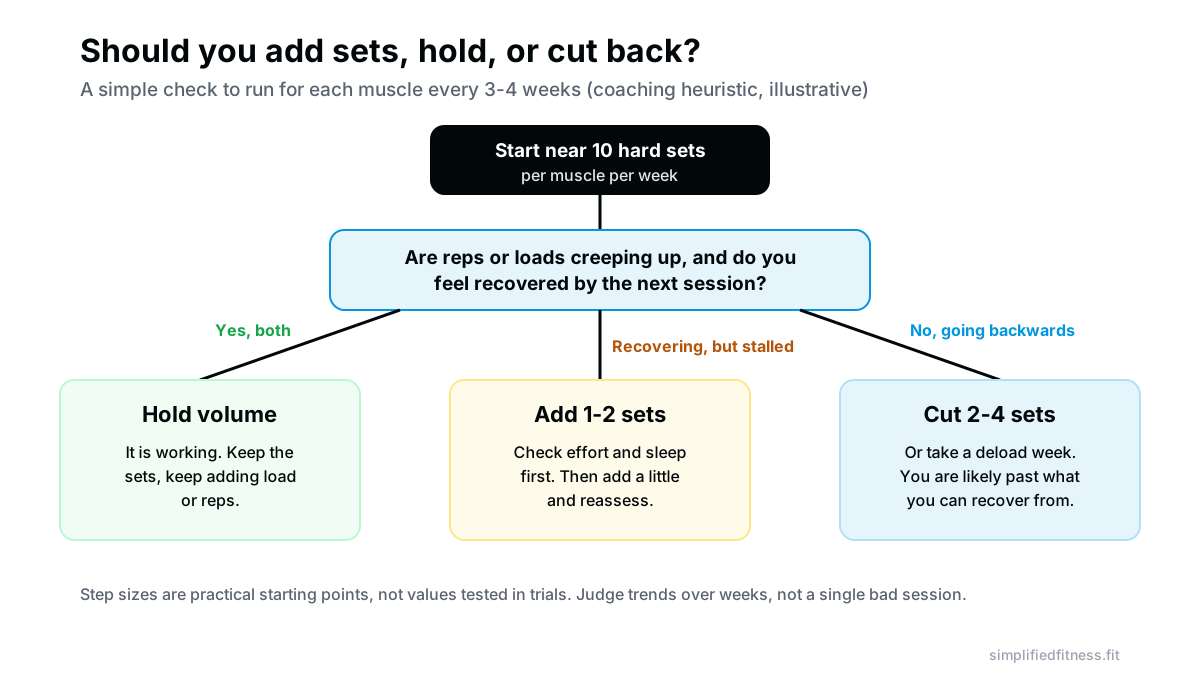
How to adjust from there:
A sample week for an intermediate lifter on an upper/lower split might put chest at about 12 sets (6 per upper day), quads at about 12 sets (6 per lower day), and arms at 4-6 direct sets each on top of the fractional work from presses and rows. If you want a ready-made structure, our free push, pull and legs plans and the leg day plan already balance volume across the week.
Want something more responsive than a fixed plan? Autoregulating set volume shows how to adjust sets on the fly using readiness and rep performance.
Common volume mistakes
- Copying an advanced lifter’s program. Their 25 sets of chest may be what they need after a decade of training. You probably do not.
- Counting every set fully. Logging bench press as a full triceps set makes your arm volume look higher than it effectively is, and makes extra pushdowns seem unnecessary when they might not be.
- Ignoring indirect work entirely. The opposite problem. Adding 10 direct triceps sets on top of heavy pressing can push arms past what they recover from.
- Adding volume to fix poor effort. Covered above. Harder sets first, more sets second.
- Never deloading. Fatigue builds quietly. A planned lighter week every 4-8 weeks, or whenever performance slides, is cheap insurance. See deloads and volume resensitisation and our progressive overload, deloads and plateaus guide.
- Changing everything at once. If you change sets, exercises and frequency in the same week, you will never know what worked.
When to see a doctor
Normal training fatigue clears with a few easier days. Some signs are worth a medical check rather than another deload:
- persistent fatigue, low mood or poor sleep that does not improve after one to two weeks of reduced training
- a resting heart rate that stays unusually high for days
- frequent illness, unexplained weight loss, or, in women, missed periods
- dark, cola-coloured urine or severe muscle pain and swelling after a session, which needs prompt medical attention
- joint pain that is sharp, localised or getting worse rather than better
Overtraining syndrome is uncommon and is diagnosed by ruling other things out, which is a job for a doctor, not a training log. Our article on overtraining syndrome vs non-functional overreaching explains the difference.
The bottom line
The research gives a clear shape and a fuzzy endpoint. More weekly sets build more muscle, with diminishing returns that usually become obvious somewhere between 10 and 20 hard sets per muscle. Above 20, some trials show a little more growth and others show nothing, and fatigue keeps rising either way. Frequency is mostly about spreading those sets so each one is done well.
So: count your sets honestly (direct sets plus half of indirect), make each one hard, start near 10 per muscle, and let your progress over 3-4 weeks tell you whether to add, hold or cut. That is the whole system. If you want the numbers done for you, plug your current program into the training volume calculator and see where each muscle actually lands.
Go deeper: every guide in this topic
- Autoregulation of Set Volume: Add or Cut Sets Based on Readiness and Velocity Loss
- The Biological Cost of High Volume: Sleep, Cortisol and Immune Strain
- How to Count Compound Sets Toward Weekly Volume: Direct vs Fractional Sets
- Distributing Weekly Volume: Full Body 3x vs Upper/Lower 4x vs PPL 6x
- HIT (Mentzer Heavy Duty) vs High-Volume Training: What the Evidence Says
- Why You Burn Out on 12 Sets While Your Partner Thrives on 20
- Junk Volume Explained: Why Extra Sets Stop Building Muscle
- Maintenance Volume (MV) Science: How Few Sets Keep Your Muscle in Busy Phases
- Mesocycle Volume Progression: Starting at Minimum Effective Dose and Adding Sets Responsibly
- Muscle-Specific Volume Tolerance: Why Side Delts Recover Faster Than Quads
- Natural vs Enhanced Volume Tolerance: Why Pro Bodybuilder Splits Fail Natural Lifters
- Overtraining Syndrome vs Overreaching: Signs, Biomarkers and Recovery Time
- How Many Sets per Muscle per Workout? Why 6-8 Hard Sets Is a Smart Cap
- Quantifying Training Volume: Hard Set Counting vs Tonnage (Sets x Reps x Weight)
- Training Frequency: 1x vs 2x vs 3x Weekly with Equated Total Set Volume
- Training Volume While Cutting: Should You Reduce Sets in a Calorie Deficit?
- Volume Landmarks by Experience Level: How Many Sets Novice, Intermediate and Advanced Lifters Need
- Volume Landmarks Explained: MV, MEV, MAV and MRV for Muscle Growth
- Volume Resensitization for Hypertrophy: Do Deloads Reset Muscle Growth?
- Weekly Set Volume for Muscle Growth: 6-10 vs 10-20 Sets per Muscle
Frequently Asked Questions
What is the optimal training volume for muscle growth?
For most people, the optimal training volume sits somewhere around 10-20 hard sets per muscle per week. Meta-analyses show growth increases with weekly sets, but each additional set adds less, and studies in trained men often find little extra benefit beyond about 20 sets. Start near 10 sets, track progress for a few weeks, and only add sets if you are recovering well but stalling.
How many sets per muscle group per week should a beginner do?
Beginners usually grow well on about 6-10 hard sets per muscle per week. A 2010 meta-analysis found multiple sets per exercise beat single sets for growth, but you do not need marathon sessions early on. Pick two or three exercises per muscle, do 2-3 sets each, and push the weights up week to week.
Is 10 sets per week enough to build muscle?
Yes, 10 hard sets per muscle per week is enough to build muscle for most lifters, especially those in their first few years. In a 6-week trial, trained men grew their biceps with 9 weekly sets done in a single session, although 18 sets showed a larger effect size. Treat 10 as a strong baseline and add sets only if progress stalls while recovery is good.
Is 20 sets per muscle per week too much?
Twenty sets is not automatically too much, but it is near the point where most research shows the gains flattening. A 2022 review of trained men found no difference between 12-20 and more than 20 weekly sets for quads and biceps, while triceps did grow more with the higher volume. If 20 sets leaves you sore, weaker or dreading sessions, drop back to 12-16 and see if progress resumes.
What is junk volume?
Junk volume is training that adds fatigue without adding meaningful muscle-building stimulus. It usually means sets stopped far from failure, sets with poor technique, or extra sets done after your reps have already crashed. Keep every working set within about 0-3 reps of failure and stop adding sets once performance drops sharply in a session.
Is training a muscle twice a week better than once?
When weekly sets are equal, training a muscle twice a week does not appear to beat once a week by much, if at all, for hypertrophy. A 2016 meta-analysis of 10 studies favoured twice a week, but a larger 2019 analysis of 25 studies found no significant difference when volume was equated. Training twice a week is still useful because it lets you split 12-20 sets into two sessions where every set is fresher.
Is 2x or 3x a week better for hypertrophy?
For muscle size, 2x and 3x a week appear to work about equally well when weekly sets are matched. A 10-week trial in trained men found similar strength and muscle thickness gains with 2 versus 3 sessions per muscle per week, with small effect-size trends favouring the 2x split. Choose the option that fits your schedule and lets you train each set hard.
Does training frequency matter for strength?
Frequency seems to matter more for strength than for muscle size. The 2026 Pelland meta-regression found strength gains rose with weekly frequency (with diminishing returns), while the effect on hypertrophy was compatible with being negligible. If you want a bigger squat or bench, practising the lift two or three times a week is a sensible move.
What are MEV, MAV and MRV?
MV, MEV, MAV and MRV are volume landmarks from a coaching framework: maintenance volume, minimum effective volume, maximum adaptive volume and maximum recoverable volume. They describe the idea that there is a weekly set range that keeps muscle, a range that starts growth, a range that gives the best return and a ceiling you cannot recover from. The framework fits the dose-response data in spirit, but the exact numbers are individual estimates rather than values proven in studies.
How many sets per session per muscle is too many?
There is no proven per-session ceiling, but many coaches cap a muscle at roughly 6-10 hard sets per session as a practical rule. In one study, trained men who did 21 lower-body sets in a session reported higher effort and worse perceived recovery than after 7 or 14 sets. If your last few sets in a session show big rep drops, move them to another day instead of grinding through.
Do compound exercises count toward arm volume?
Yes, compound exercises add some volume to helper muscles, but probably not a full set's worth. The largest meta-regression to date found that counting indirect sets as half a set predicted growth better than counting them fully or not at all. So three sets of bench press can be logged as roughly 1.5 sets for triceps.
Do I need more volume as I get more advanced?
Advanced lifters often need somewhat more volume to keep progressing, but the evidence is less clear than many assume. Trials in trained men show higher volumes sometimes produce more growth, yet several also show plateaus above about 20 weekly sets. Increase volume gradually and only when progress stalls despite good effort, sleep and nutrition.
Does high volume just cause muscle swelling instead of growth?
Swelling is a fair concern, but current evidence suggests it does not explain away high-volume results. A 2026 study in trained men found muscle thickness returned to baseline within 24 hours after sessions of 7, 14 or 21 sets, with no sustained swelling. It was a short study of single sessions, so treat it as reassuring rather than final.
Should I do more volume when cutting?
No, most people should hold or slightly reduce volume during a calorie deficit rather than add more. Recovery tends to be harder when food is restricted, and keeping the muscle you have usually takes less volume than building new muscle. Keep intensity high, keep your key lifts, and trim sets if performance keeps falling.
How do I know if I am doing too much volume?
Signs of too much volume include falling reps or loads across weeks, soreness that lasts into the next session for the same muscle, poor sleep and dreading training. Studies show higher volume raises perceived exertion and lowers perceived recovery, so these feelings are worth tracking. Cut 2-4 weekly sets for the affected muscle or take a lighter week and see if performance bounces back.
Do hard sets mean training to failure?
A hard set is one taken close to failure, usually within about 0-3 reps in reserve, not necessarily to complete failure. Sets stopped far from failure provide less growth stimulus, which is why they are often excluded when counting productive volume. Our load, rep range and RIR guide covers how close to failure each set should go.
Is high-intensity low-volume training (HIT) effective?
Low-volume training to failure can build muscle, especially for beginners, but most evidence suggests more sets produce more growth up to a point. A 2010 meta-analysis found multiple sets produced about 40% larger hypertrophy effect sizes than single sets. Single-set training is a reasonable choice when time is short, but it is not the growth-maximising option for most people.
How much volume do I need to maintain muscle?
Maintaining muscle usually takes far less volume than building it. In an 8-week trial in trained men, one set per exercise three times a week (about 13 minutes per session) still improved strength, although the higher-volume groups grew more. If life gets busy, a few hard sets per muscle per week is a reasonable floor to hold onto your gains.
Do small muscles need less volume than large muscles?
Small muscles do not necessarily need less volume, and they often get extra indirect work from compound lifts. Biceps, triceps and front delts are trained during rows, presses and pulldowns, so direct sets can be lower if you count fractional volume. Track direct plus half of indirect sets for each muscle and adjust from there.
How long should I stay at one volume before changing it?
Stay at a given volume for about 3-4 weeks before deciding whether to change it. Single sessions are noisy, while trends in reps, loads and recovery over several weeks tell you much more. Change one variable at a time so you know what actually made the difference.
Can women handle the same training volume as men?
There is no strong evidence that women need a different weekly set range, but most volume trials were done in young men. The 2026 Pelland analysis included about 21% female participants, so conclusions lean heavily on male data. Women can start at the same 10-20 set guidelines and adjust based on their own recovery and progress.
Does more volume help strength as much as size?
No, extra volume appears to help strength less than it helps size. An 8-week trial in trained men found strength gains were similar across 1, 3 and 5 sets per exercise while muscle growth favoured the higher volumes, and a 2026 meta-regression found diminishing returns were steeper for strength. For strength, frequency and heavier practice with the specific lift matter more than piling on sets.
Sources & References
Every claim above is checked against peer-reviewed research (PubMed, U.S. National Library of Medicine) or guidance from established health bodies. How we fact-check.
- Schoenfeld BJ, et al. Dose-response relationship between weekly resistance training volume and increases in muscle mass: A systematic review and meta-analysis. J Sports Sci. 2017. PMID: 27433992
- Pelland JC, et al. The Resistance Training Dose Response: Meta-Regressions Exploring the Effects of Weekly Volume and Frequency on Muscle Hypertrophy and Strength Gains. Sports Med. 2026. PMID: 41343037
- Krieger JW. Single vs. multiple sets of resistance exercise for muscle hypertrophy: a meta-analysis. J Strength Cond Res. 2010. PMID: 20300012
- Baz-Valle E, et al. A Systematic Review of The Effects of Different Resistance Training Volumes on Muscle Hypertrophy. J Hum Kinet. 2022. PMID: 35291645
- Schoenfeld BJ, et al. Resistance Training Volume Enhances Muscle Hypertrophy but Not Strength in Trained Men. Med Sci Sports Exerc. 2019. PMID: 30153194
- Heaselgrave SR, et al. Dose-Response Relationship of Weekly Resistance-Training Volume and Frequency on Muscular Adaptations in Trained Men. Int J Sports Physiol Perform. 2019. PMID: 30160627
- Brigatto FA, et al. High Resistance-Training Volume Enhances Muscle Thickness in Resistance-Trained Men. J Strength Cond Res. 2022. PMID: 31868813
- Enes A, et al. Effects of Different Weekly Set Progressions on Muscular Adaptations in Trained Males: Is There a Dose-Response Effect? Med Sci Sports Exerc. 2024. PMID: 37796222
- Alvarez M, et al. Don't Sweat the Swelling: Exercise Volume's Transient Effects in Trained Men. Int J Sports Med. 2026. PMID: 41565215
- Schoenfeld BJ, et al. Effects of Resistance Training Frequency on Measures of Muscle Hypertrophy: A Systematic Review and Meta-Analysis. Sports Med. 2016. PMID: 27102172
- Schoenfeld BJ, et al. How many times per week should a muscle be trained to maximize muscle hypertrophy? A systematic review and meta-analysis of studies examining the effects of resistance training frequency. J Sports Sci. 2019. PMID: 30558493
- Lasevicius T, et al. Similar Muscular Adaptations in Resistance Training Performed Two Versus Three Days Per Week. J Hum Kinet. 2019. PMID: 31531139
- Colquhoun RJ, et al. Training Volume, Not Frequency, Indicative of Maximal Strength Adaptations to Resistance Training. J Strength Cond Res. 2018. PMID: 29324578

Umair Hazrami · Founder & Head Coach, Simplified Fitness
Umair Hazrami founded Simplified Fitness and the Simplified Lifter channel to cut through fitness noise. With 4+ years of consistent training and 10+ coaching clients, he writes every guide from the peer-reviewed research and links the sources so you can check them. Our editorial standards.
Educational content only, not medical advice. If you have a medical condition, are pregnant, or take medication, talk to a qualified doctor before changing your diet, supplements or training. Full disclaimer.
Keep reading

Programming
2-Day per Week Lifting Programs: Minimum Effective Dose for Busy Professionals
Can a 2 day a week workout routine hypertrophy goals support? Yes. Get a ready two-day full-body plan, the research behind it and how to run it in 60 minutes.
9 min read
Programming
30-Minute High-Density Hypertrophy Sessions: Micro-Workouts for Time-Constrained Lifters
Can a 30 minute workout for muscle growth work? See how paired sets, Myo-reps and machine setups fit 16 hard sets into half an hour, plus a 4-day plan.
10 min read
Programming
The 5 Modalities of Progressive Overload: A Checklist for When Weight Won't Go Up
5 ways to progressive overload: load, reps, range of motion, tempo and rest density. A practical checklist for compounds and isolations, with the research.
7 min read

Programming
The 7-Minute Dynamic Warm-Up: A Fast Routine to Prep Joints Before Lifting
A dynamic warm up for lifting takes about 7 minutes, not 25. See the 2-3-2 routine, what the research says about stretching and foam rolling, and what to skip.
9 min read